
Judge, 1911-02-04 · page 17 of 24
Judge — February 4, 1911 — page 17: what you’re looking at
What you’re looking at
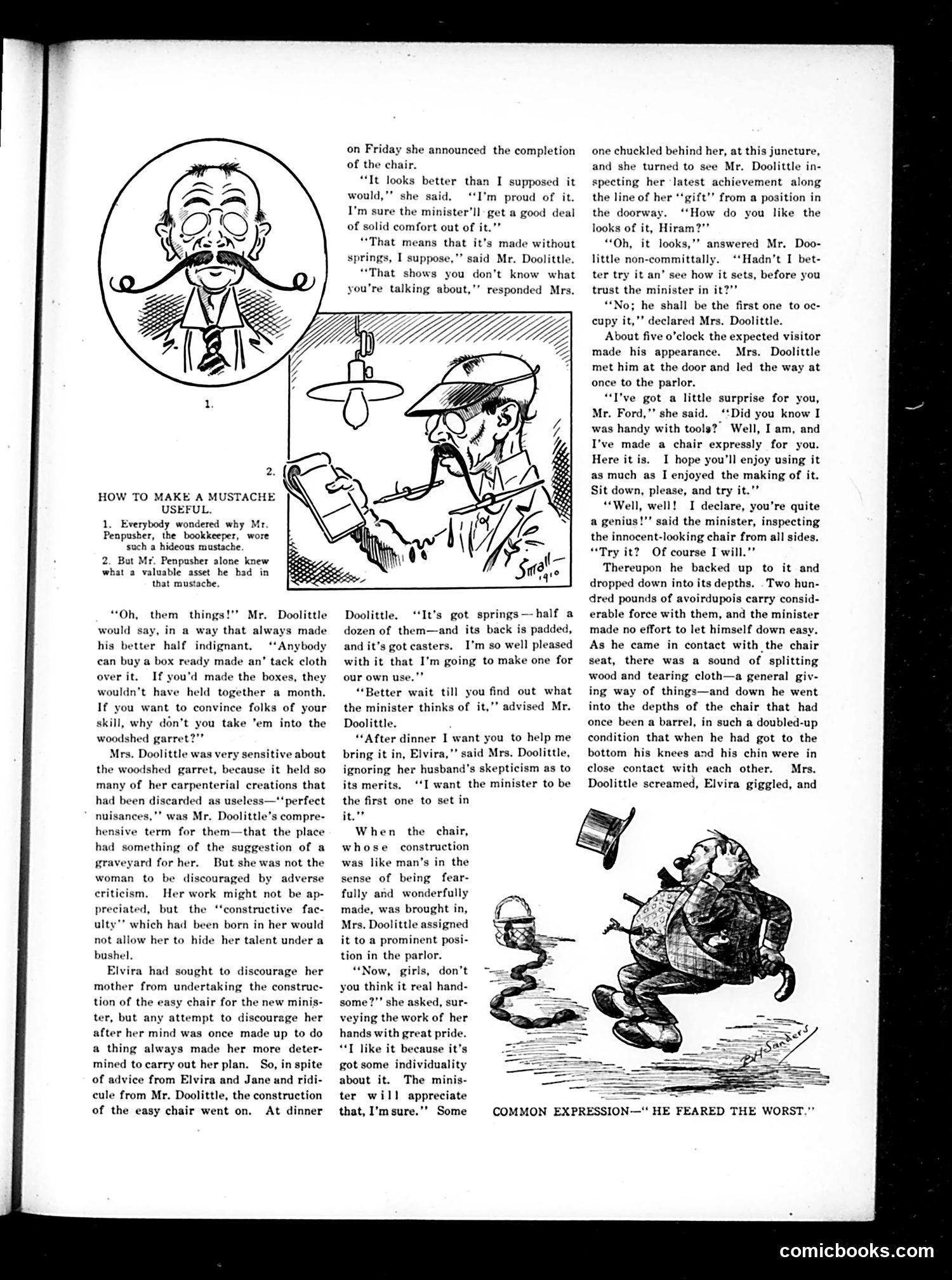
This page presents a humorous domestic story about Mrs. Doolittle's homemade furniture project. The top illustration labeled "How to Make a Mustache Useful" shows a bookkeeper (Mr. Penpusher) whose prominent mustache becomes a practical tool—he uses it to hold things. The main story satirizes well-intentioned but poorly-executed craftsmanship. Mrs. Doolittle, despite her husband's skepticism, builds an "easy chair" for the new minister using springs, padding, and casters. The humor centers on the gap between her pride in the work and Mr. Doolittle's doubts about its safety and construction quality. He warns her to test it first, but she insists the minister use it untested—setting up an expectation of comedic disaster. The satire targets both amateur carpentry and domestic friction: the husband's resigned tolerance of his wife's "constructive faculty" (which fills their woodshed with failed projects), and her stubborn determination despite criticism. The bottom illustration shows the chair apparently collapsing or malfunctioning catastrophically—the joke's punchline delivered visually.
📄 Transcribed text from this page (OCR, searchable)
Machine-transcribed from the original scan — historical spelling and the odd misread are preserved.
HOW TO MAKE A MUSTACHE USEFUL, 1. Everybody wondered why Mr Penpusher, the bookkeeper, wore such a hideous mustache. 2. But Mr. Penpusher alone knew what a valuable asset he had in that mustache, “Oh, them = things!’’ Mr. Doolittle would say, in a way that always made his better half indignant. ‘Anybody can buy a box ready made an’ tack cloth over it. If 1 made the boxes, they wouldn't held together a month. If you want to convince folks of your skill, why don’t you take ’em into the woodshed garret? Mrs. Doolittle was ve the woodshed garret, because it held so many of her carpenterial creations that ss—‘‘perfect sensitive about had been discarded as usele: was Mr. Doolittle’s compre- nuisance: hensive term for them—that the place had something of the suggestion of a graveyard for her. But she was not the woman to be discouraged by adverse criticism. Her work might not be ap- preciated, but the ‘‘constructive fac- ulty’’ which had been born in her would not allow her to hide her talent under a bushel. Elvira had sought to discourage her mother from undertaking the construc- tion of the easy chair for the new minis- ter, but any attempt to discourage her after her mind was once made up to do a thing always made her more deter- mined to carry out her plan. So, in spite of advice from Elvira and Jane und ridi- cule from Mr. Doolittle, the construction of the easy chair went on. At dinner on Friday she announced the completion of the chair. “It looks better than I supposed it would,’’ she said, ‘‘I’m proud of it. I'm sure the minister’ll get a good deal of solid comfort out of it.’” jat_ means that it’s made without springs, I suppose,"’ said Mr. Doolittle. “That shows you don't know what you're talking about,’’ responded Mrs. Doolittle. ‘‘It's got springs—half a dozen of them—and its back is padded, and it’s got casters. I’m so well pleased with it that I'm going to make one for our own use."* “Better wait till you find out what the minister thinks of it,’ advised Mr. Doolittle. “After dinner I want you to help me bring it in, Elvira,”’ said Mrs. Doolittle, ignoring her husband's skepticism as to “T want the minister to be its merits. the first one to set in When the chair, whose construction was like man’s in the sense of being fear- fully and wonderfully made, was brought in, Mrs. Doolittle assigned it to a prominent posi- tion in the parlor. “Now, girls, don’t you think it real hand- some ?’’ she asked, sur- veying the work of her hands with great pride. “T like it because it’s got some individuality about it. The minis- ter will appreciate that, I’msure.’’ Some one chuckled behind her, at this juncture, and she turned to see Mr. Doolittle in- specting her latest achievement along the line of her ‘‘gift’’ from a position in the doorway. ‘‘How do you like the looks of it, Hiram?’’ “Oh, it looks,’’ answered Mr. Doo- little non-committally. ‘‘Hadn’t I bet- ter try it an’ see how it sets, before you trust the minister in it?" “‘No; he shall be the first one to oc- cupy it,’’ declared Mrs. Doolittle. About five o’clock the expected visitor made his appearance. Mrs. Doolittle met him at the door and led the way at once to the parlor. “I've got a little surprise for you, Mr. Ford,’’ she said. ‘*Did you know I was handy with tools?) Well, Iam, and I’ve made a chair expressly for you. Here it is. I hope you'll enjoy using it as much as I enjoyed the making of it. Sit down, please, and try it.’’ “Well, well! I declare, you're quite a genius!" said the minister, inspecting the innocent-looking chair from all sides. “Try it? Of course I will.”’ Thereupon he backed up to it and dropped down into its depths. . Two hun- dred pounds of avoirdupois carry consid- erable force with them, and the minister made no effort to let himself down easy. As he came in contact with the chair seat, there was a sound of splitting wood and tearing cloth—a general giv- ing way of things—and down he went into the depths of the chair that had once been a barrel, in such a doubled-up condition that when he had got to the bottom his knees and his chin were in close contact with each other. Mrs. Doolittle screamed, Elvira giggled, and COMMON EXPRESSION—‘‘ HE FEARED THE WORST.” comicbooks.com