
A complete issue · 26 pages · 1911
Judge — January 7, 1911
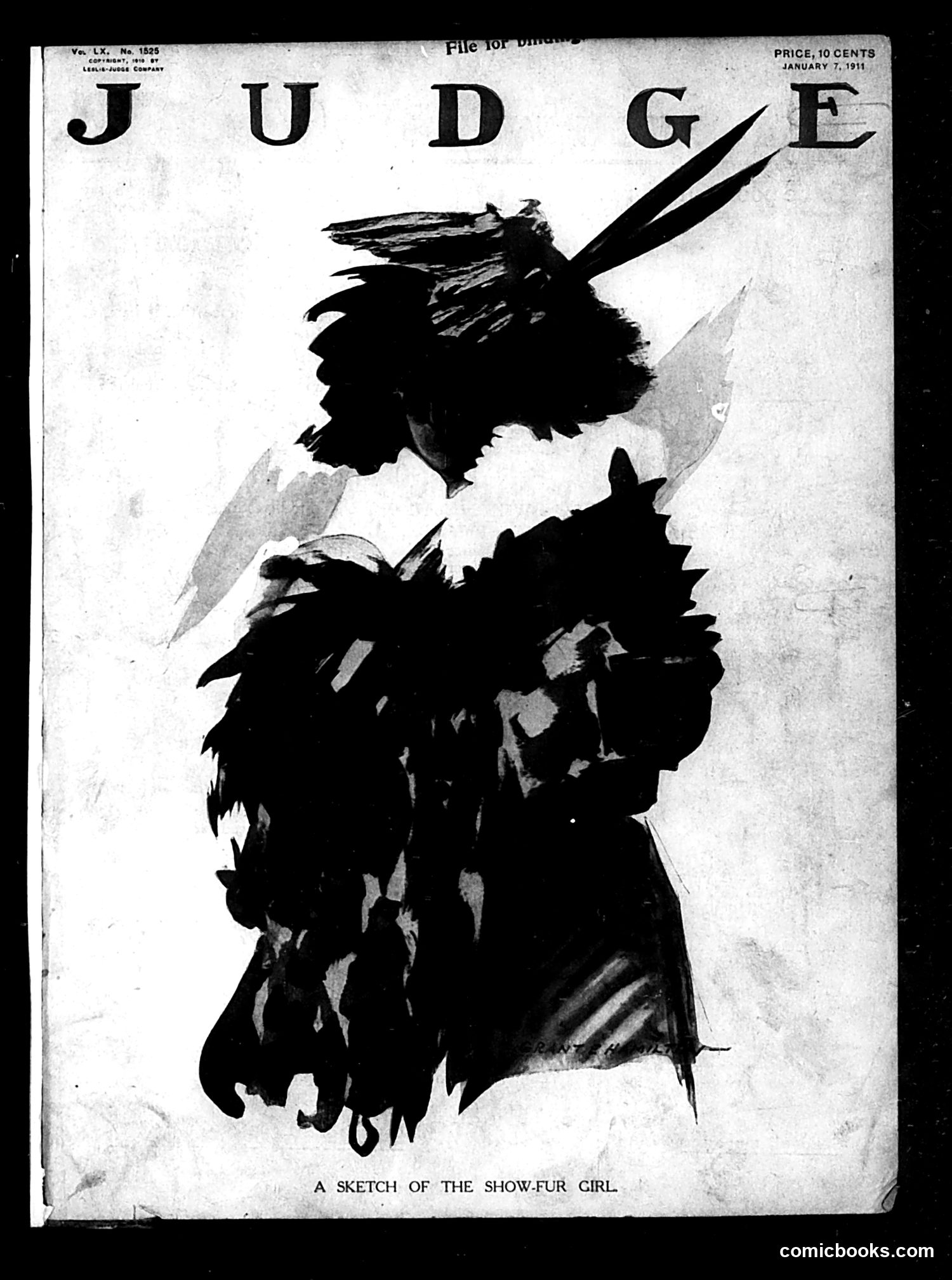
This is the cover of *Judge* magazine from January 7, 1911. The caption "A Sketch of the Show-Fur Girl" refers to a contemporary fashion trend: young women wearing elaborate, showy fur garments and accessories. The silhouetted illustration depicts a fashionable woman in a large feathered hat and heavy fur coat or stole—typical of Edwardian/early 1910s high fashion. The exaggerated, somewhat grotesque rendering satirizes the excess and ostentation of this trend among affluent women. The joke likely critiques both the vanity of fashion-obsessed women and perhaps the waste involved in such conspicuous display during an era of economic inequality. *Judge*, a satirical magazine, frequently mocked contemporary social pretensions through such caricatural fashion commentary.
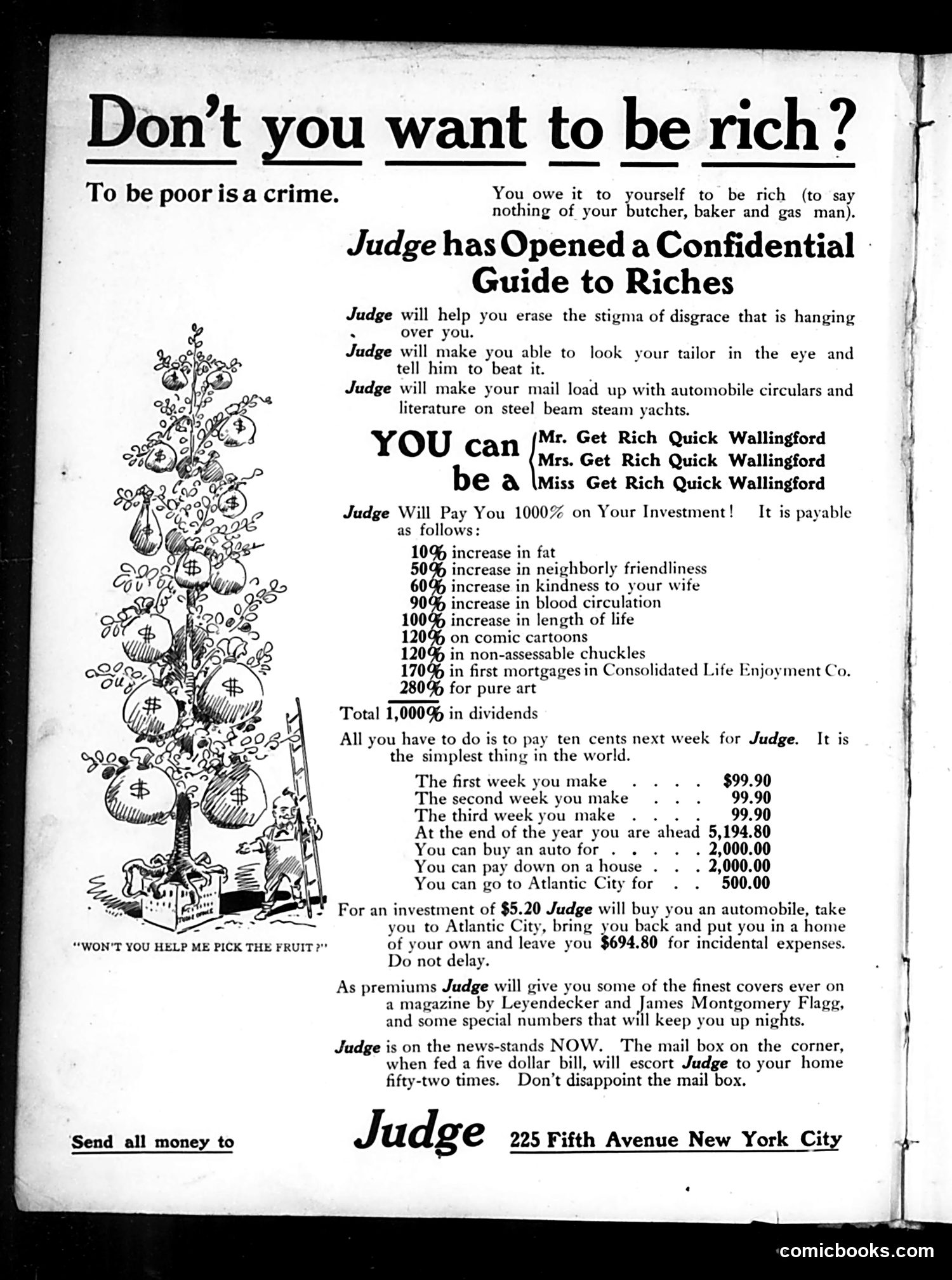
This Judge magazine page satirizes fraudulent investment schemes promising instant wealth. The opening line "To be poor is a crime" mocks the era's harsh judgment of the poor, while the ad parodies legitimate financial promises. The central image—a money tree—visualizes the fantasy these schemes peddle. The absurd "returns" (1000% total dividends including "170% in first mortgages") and ridiculous benefits ("120% in non-assayable chuckles") mock schemes' outlandish claims. The pricing structure starting at ten cents weekly, escalating to $5,194.80 annually, mirrors real predatory schemes targeting working people. The promised automobile and house purchase for minimal investment exposes the scam's fundamental dishonesty. The satirist highlights how these schemes exploit aspirational Americans desperate to escape poverty, using impossible promises and theatrical language ("Judge") to appear legitimate.
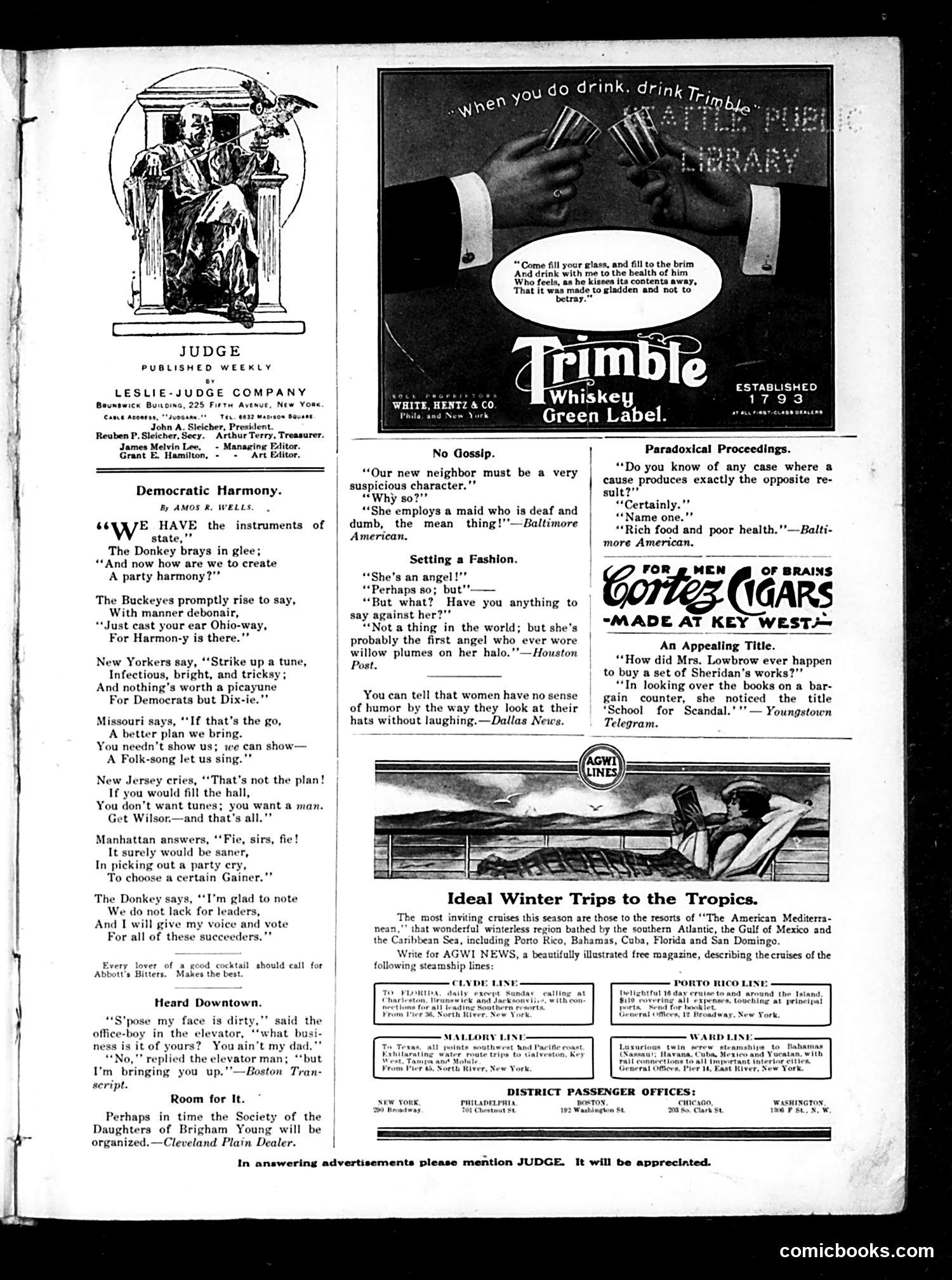
This page is primarily **advertising and light humor content** rather than political satire. The main political poem, "Democratic Harmony" by Amos P. Wells, uses animal metaphors (Buckeyes, New Yorkers, Donkey) to humorously represent different Democratic constituencies squabbling over party direction—likely reflecting internal Democratic divisions of the era. The poem mocks their inability to unite. The remaining content consists of: - **Advertisements** for Trimble Whiskey and Cortez Cigars - **Humor shorts** with puns and wordplay from various newspapers - **Travel advertisements** for Caribbean cruises - **Social notices** about upcoming events The illustrations are generic Victorian-era decorative images rather than pointed political cartoons. This appears to be a typical Judge issue mixing light satire with substantial commercial content.
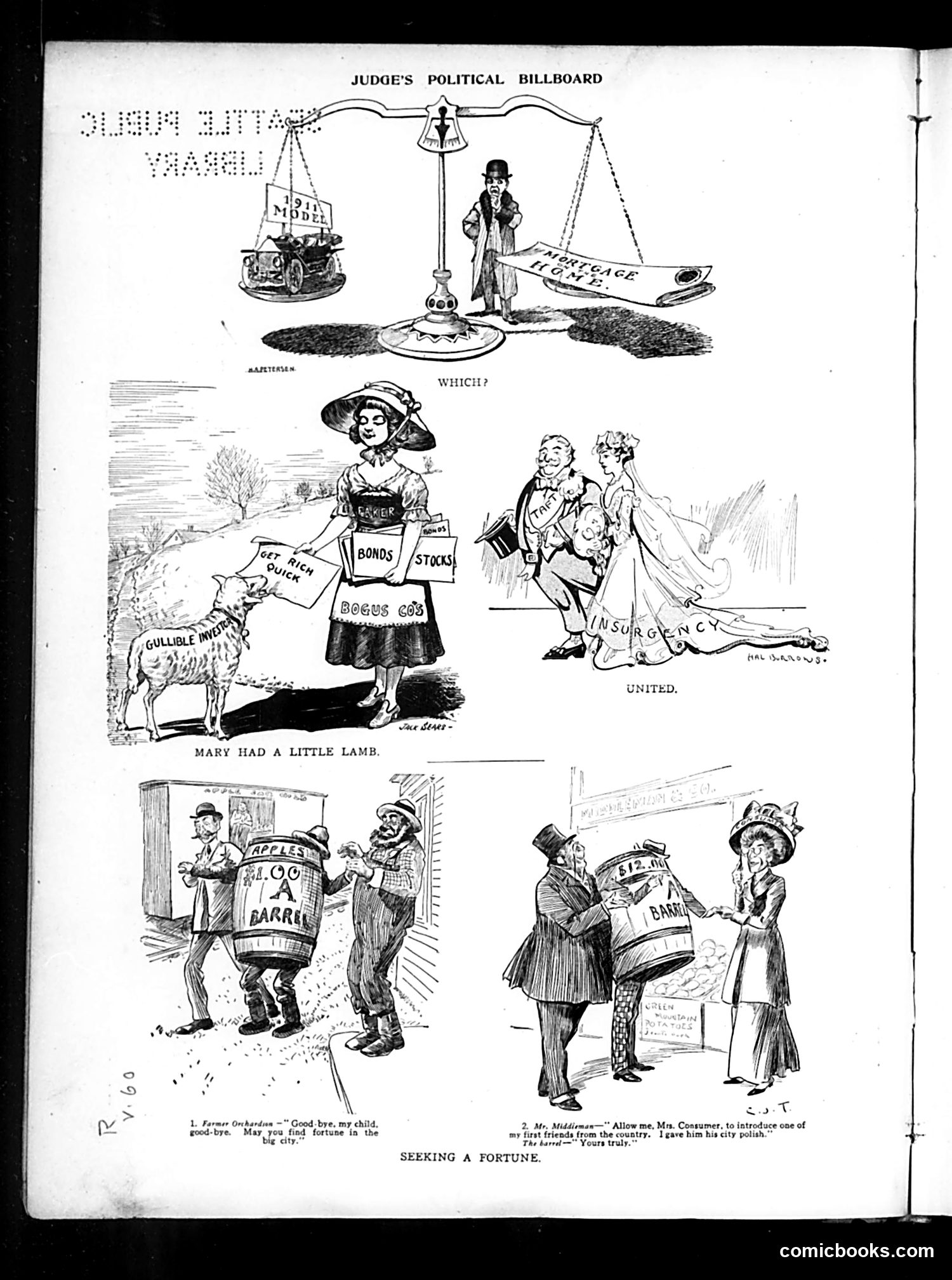
This satirical page uses the metaphor of a judge's scales to critique financial instruments and market speculation during what appears to be the early 20th century. **Top cartoon**: A judge balances a "1911 Model" automobile against a "Mortgage" document, questioning which is more valuable—mocking Americans' tendency to pursue luxury goods while ignoring debt obligations. **Middle section**: "Mary Had a Little Lamb" parody shows a woman labeled with "Bonds," "Stocks," and "Gullible Investor" following her, satirizing how easily investors follow financial trends. **Bottom cartoons** ("Seeking a Fortune"): Depict financial schemes—one shows men trading an apple barrel, another shows con artists presenting a fake "City Bank" to a gullible consumer, mocking get-rich-quick schemes and financial fraud targeting ordinary people. The overall message: warns against financial recklessness and market manipulation.
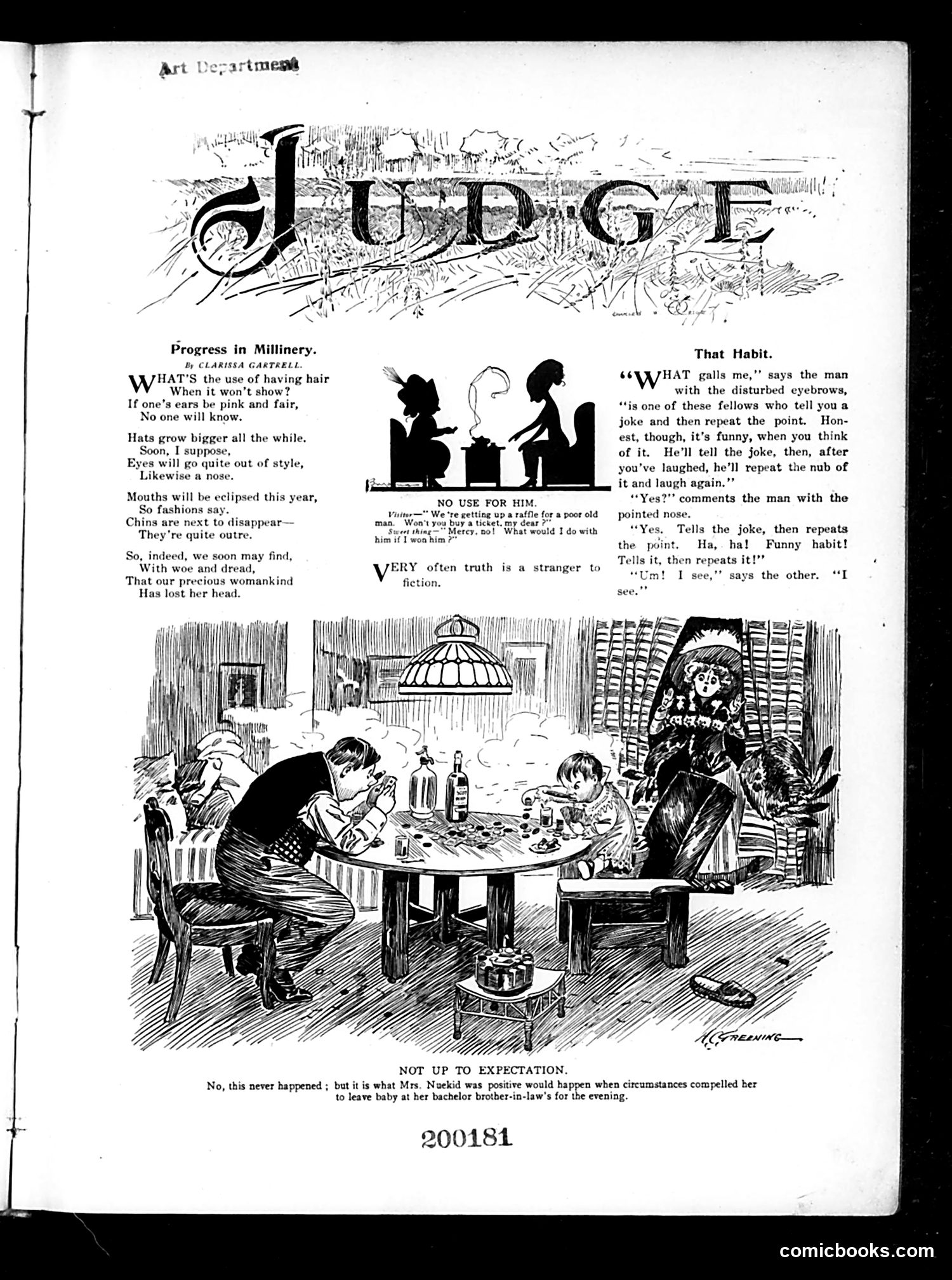
This page contains three distinct pieces: 1. **"Progress in Millinery"** (top left): A poem by Clarissa Gartwell satirizing women's changing hairstyles. It jokes that hair fashions will eventually disappear entirely—women will be bald—mocking the rapid evolution of millinery trends. 2. **"That Habit"** (top right): A brief humorous dialogue about a man who compulsively repeats jokes and their punchlines, then laughs again. It's social satire targeting annoying personality habits. 3. **"Not Up to Expectation"** (large illustration): Shows a domestic scene where a man supervises children while a woman (Mrs. Nickell) is away. The caption indicates this arrangement was unexpected—she had to leave her children with their uncle, contradicting what should have happened. The satire targets domestic arrangements or women's duties.
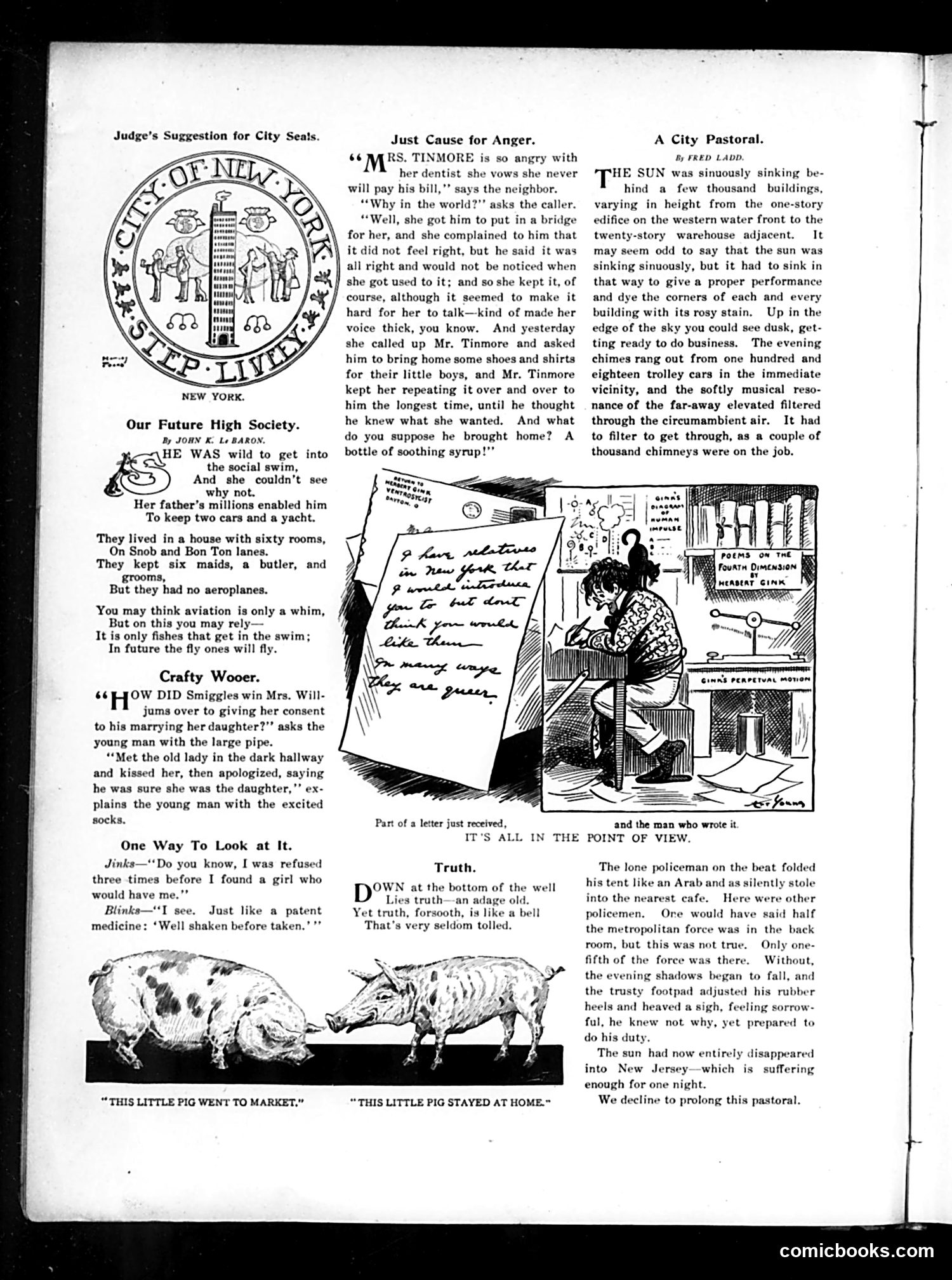
This page contains satirical humor pieces typical of early 20th-century American magazines: **"Our Future High Society"** mocks newly wealthy families attempting to join elite social circles. The joke: despite having mansions, servants, and yachts, they lack aeroplanes—suggesting that conspicuous consumption and status symbols constantly shift, making it impossible for the newly rich to ever truly "arrive" in society. **"Crafty Wooer"** is a brief joke about deception in courtship—a man wins a mother's consent by kissing her in the dark while claiming to mistake her for her daughter. **"Just Cause for Anger"** humorously depicts a woman's frustration when a dentist's dental bridge makes her speech unclear, leading to a miscommunication where he brings soothing syrup instead of shoes and shirts. **"A City Pastoral"** parodies flowery romantic literature by applying it absurdly to urban industrial landscapes—chimneys instead of nature, trolley cars instead of songbirds—and concludes with a policeman abandoning his post, satirizing urban decay and corruption. The content reflects Judge's satirical stance on American social pretension, urban life, and domestic absurdities.
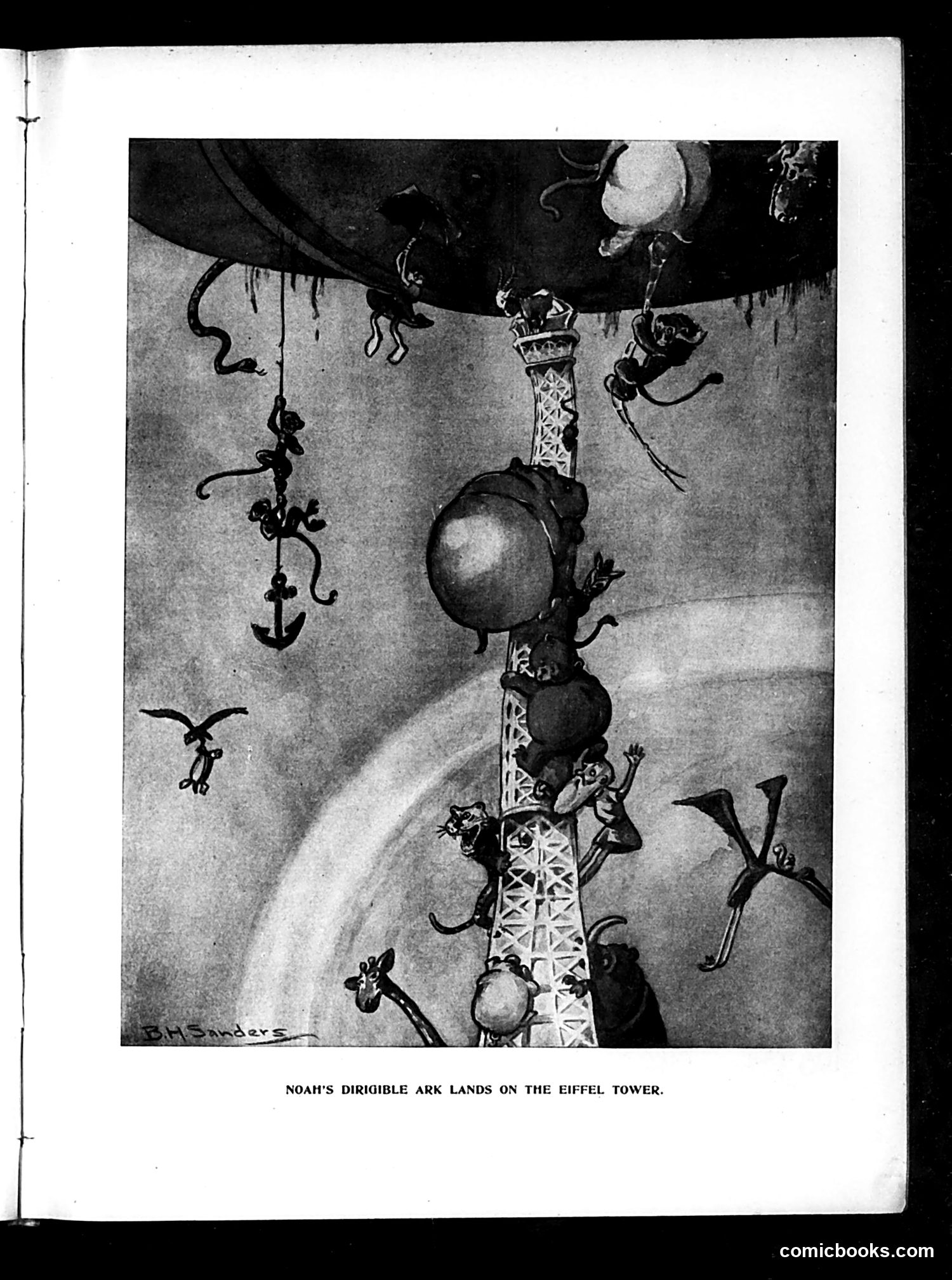
This satirical cartoon reimagines the biblical Noah's Ark as a modern dirigible (airship) landing atop the Eiffel Tower in Paris. The image shows animals dangling from ropes around the tower's lattice structure, creating a surreal, comedic scene. The satire appears to mock technological advancement and modernity by literalizing the ancient Noah's Ark story through contemporary invention—the airship being a cutting-edge technology of the early 20th century. By placing this fantastical scene at the iconic Eiffel Tower, the cartoon juxtaposes biblical antiquity with modern European culture and engineering. The humor lies in the absurdist collision of these elements: what would salvation via ancient maritime vessel become in an age of aerial technology? The specific meaning beyond this general satire remains unclear without additional context from the magazine's date and editorial stance.
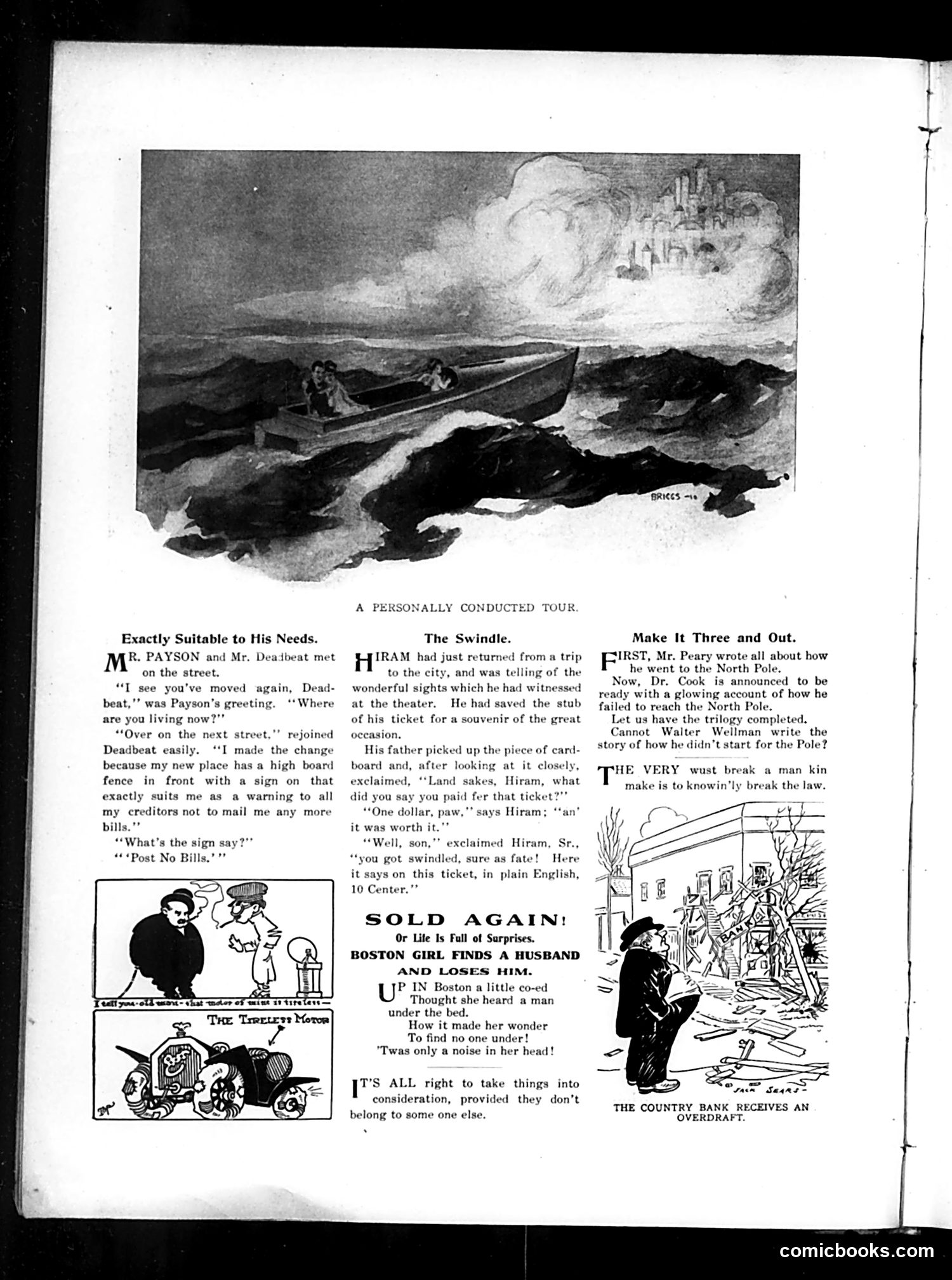
This page contains four separate humorous pieces typical of early-20th-century American satire: 1. **"Exactly Suitable to His Needs"**: A deadbeat tenant jokes that his new rental's "Post No Bills" sign perfectly warns creditors away—clever wordplay on evading debt collectors. 2. **"The Swindle"**: A father discovers his son overpaid for a theater ticket. The boy paid $1 but the ticket clearly states "10 cents"—satirizing naive rural folk vulnerable to urban con artists. 3. **"Sold Again!"**: A Boston woman hears a mysterious sound under her bed, imagines discovering a man, then learns it was just "a noise in her head"—poking fun at female hysteria tropes and romantic daydreaming. 4. **"Make It Three and Out"**: References explorer Robert Peary's North Pole claims and Dr. Cook's competing account, sarcastically suggesting a third explorer (Walter Wellman) should write about *failing* to reach it. The artwork includes small cartoon illustrations accompanying each piece. The overall tone reflects Judge's satirical treatment of contemporary fraud, gullibility, and notable news events.
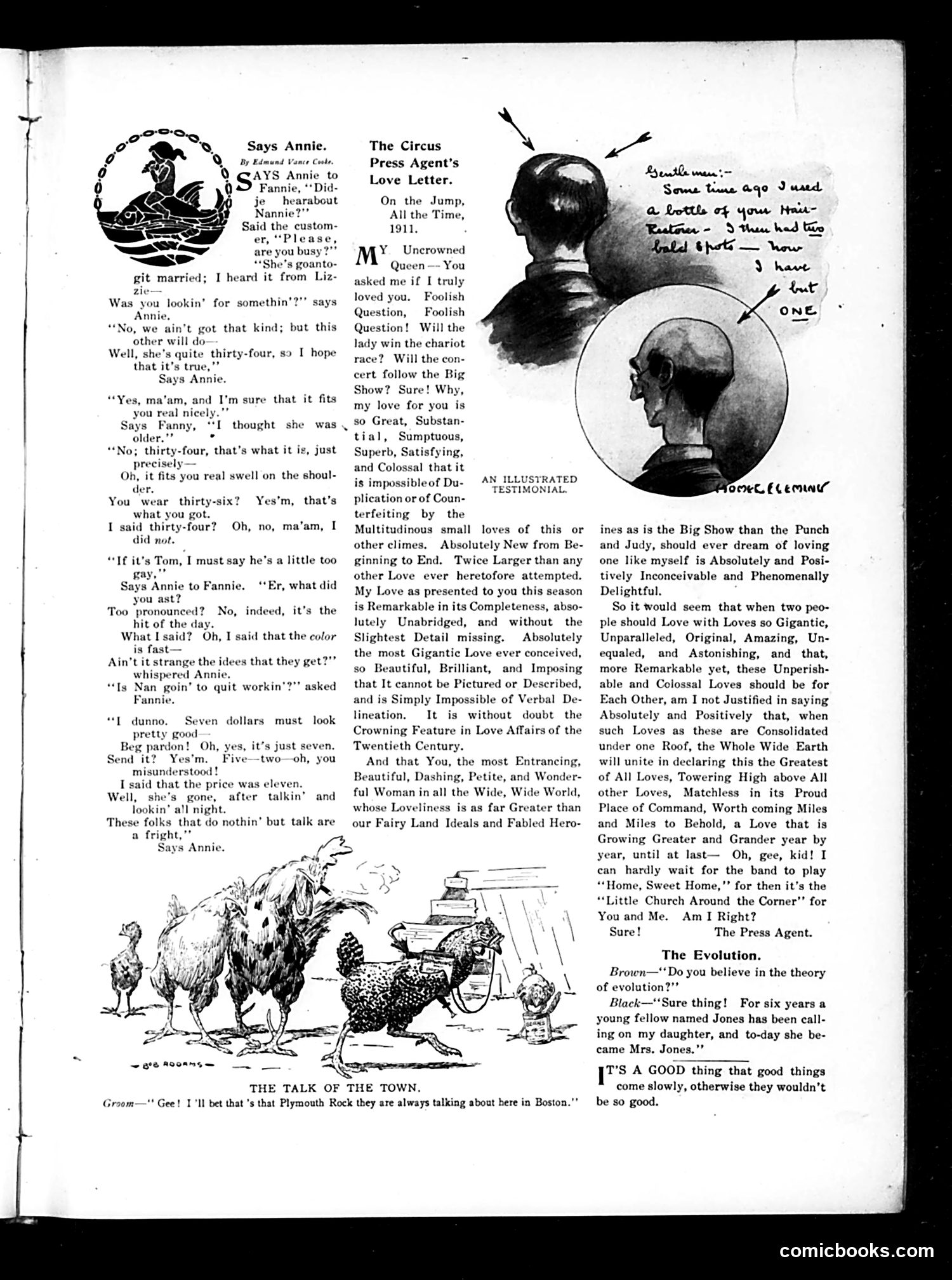
This page contains three satirical pieces typical of early 1900s American humor: 1. **"Says Annie"** — A dialogue between shop girls mocking working-class speech patterns and the minor deceptions of retail transactions (lying about dress sizes, bargaining). 2. **"The Circus Press Agent's Love Letter"** — Parodies circus advertising hyperbole by applying it to a romantic declaration. The press agent's letter uses exaggerated circus-speak ("Gigantic," "Unparalleled," "Colossal") to describe his love, mocking both circus promotional excess and melodramatic romantic language. This satirizes how advertisers oversell everything. 3. **"The Talk of the Town"** — A brief joke where a groom mistakes an ordinary bird (likely chickens) for the famous Plymouth Rock, reflecting on Boston tourism. The page satirizes American commercial culture, working-class vernacular, and advertising excess—concerns typical of Judge's satirical commentary on early 20th-century society.
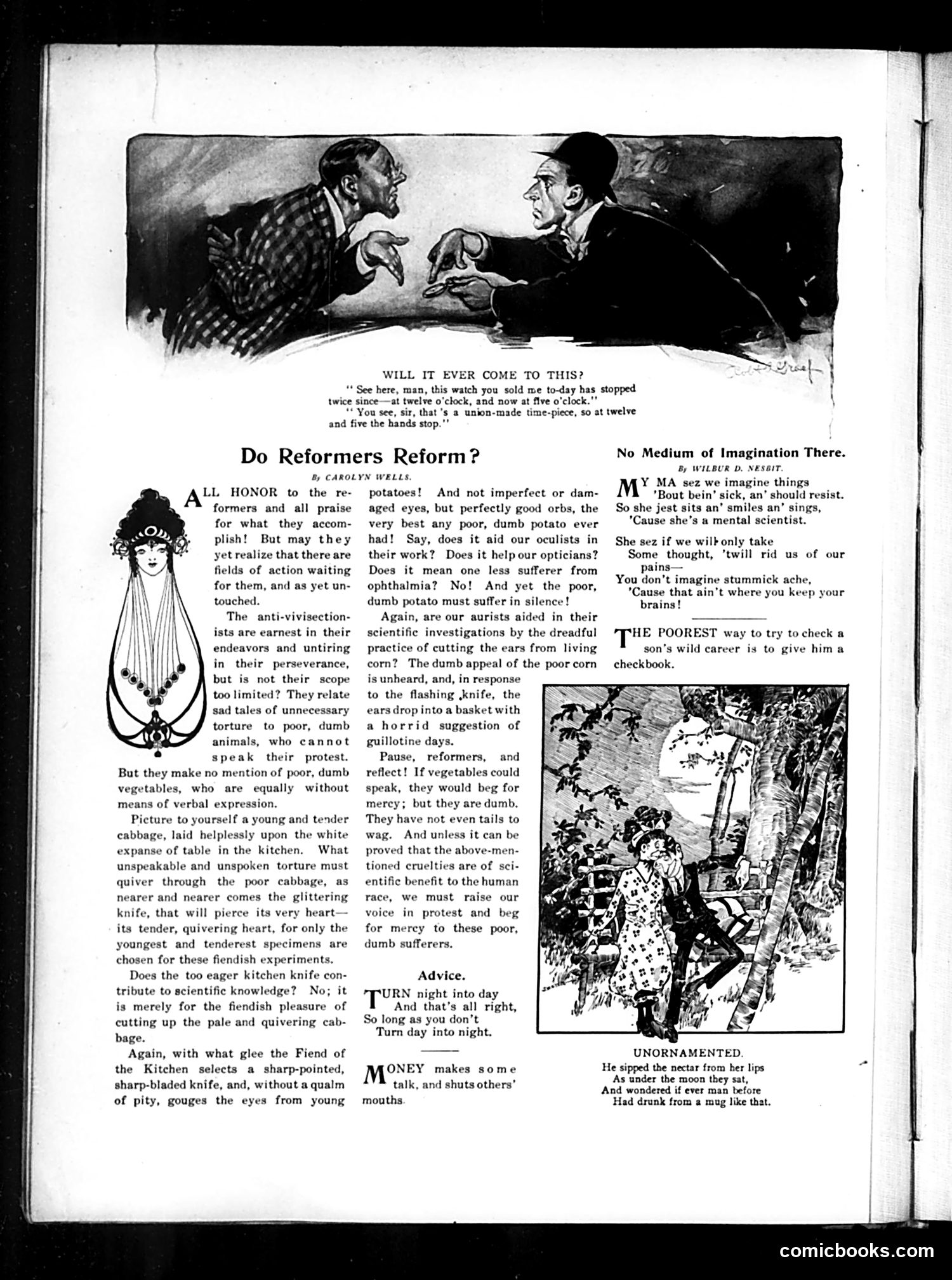
This page satirizes **reform movements of the early 20th century** through absurdist humor. **Top cartoon**: Mocks labor unions by showing a watch seller defending a defective "union-made" timepiece—the hands deliberately stop at union break times (12 and 5 o'clock). The satire: reformers' well-intentioned rules create ridiculous, counterproductive outcomes. **"Do Reformers Reform?"** (Carolyn Wells): Extends this critique. Anti-vivisectionists protest animal cruelty in laboratories, but Wells mockingly argues they ignore vegetable "suffering"—potatoes having eyes gouged out, corn ears cut off, cabbages sliced. The satire is **reductio ad absurdum**: if reformers truly cared about all sentient beings, their logic leads to absurd conclusions. It suggests reformers are selective and performative rather than principled. **Minor pieces**: Short humorous verses about imagination, money, and a man drinking from a "mug" (implying his date's lips). Standard period humor filler. **Context**: Reflects Progressive Era skepticism toward reform movements—viewing activists as earnest but naive or hypocritical.
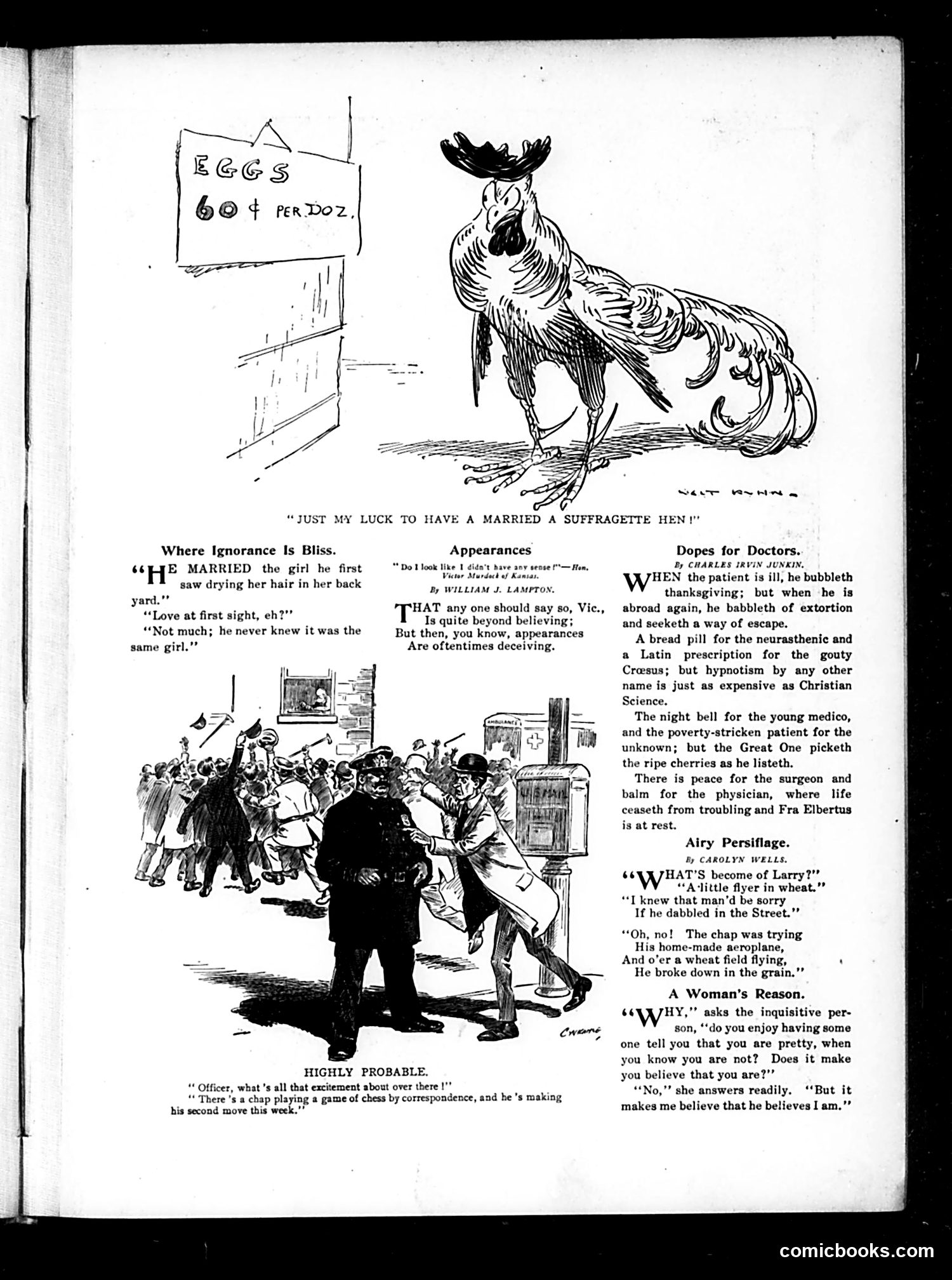
This page from the satirical magazine Judge contains multiple brief humorous pieces typical of early 20th-century American humor magazines. **"Just My Luck to Have Married a Suffragette Hen"** (top): A rooster complains about marrying a suffragette hen—referencing the women's suffrage movement. The joke equates women's rights activism with nagging domesticity, a common anti-suffrage trope of the era. **"Where Ignorance Is Bliss"**: A man marries a woman without recognizing her later—mocking male obliviousness. **"Highly Probable"**: A joke about someone playing chess-by-mail making only one move per week—absurdist humor about slow-moving correspondence. The remaining pieces ("Appearances," "Dopes for Doctors," "Airy Persiflage," "A Woman's Reason") are brief satirical quips about deception, medical practitioners, aviation, and gender relations—typical Judge content mixing topical references (aviation, Christian Science, suffrage) with everyday social observation. The overall tone is lighthearted mockery of contemporary life and emerging social movements.
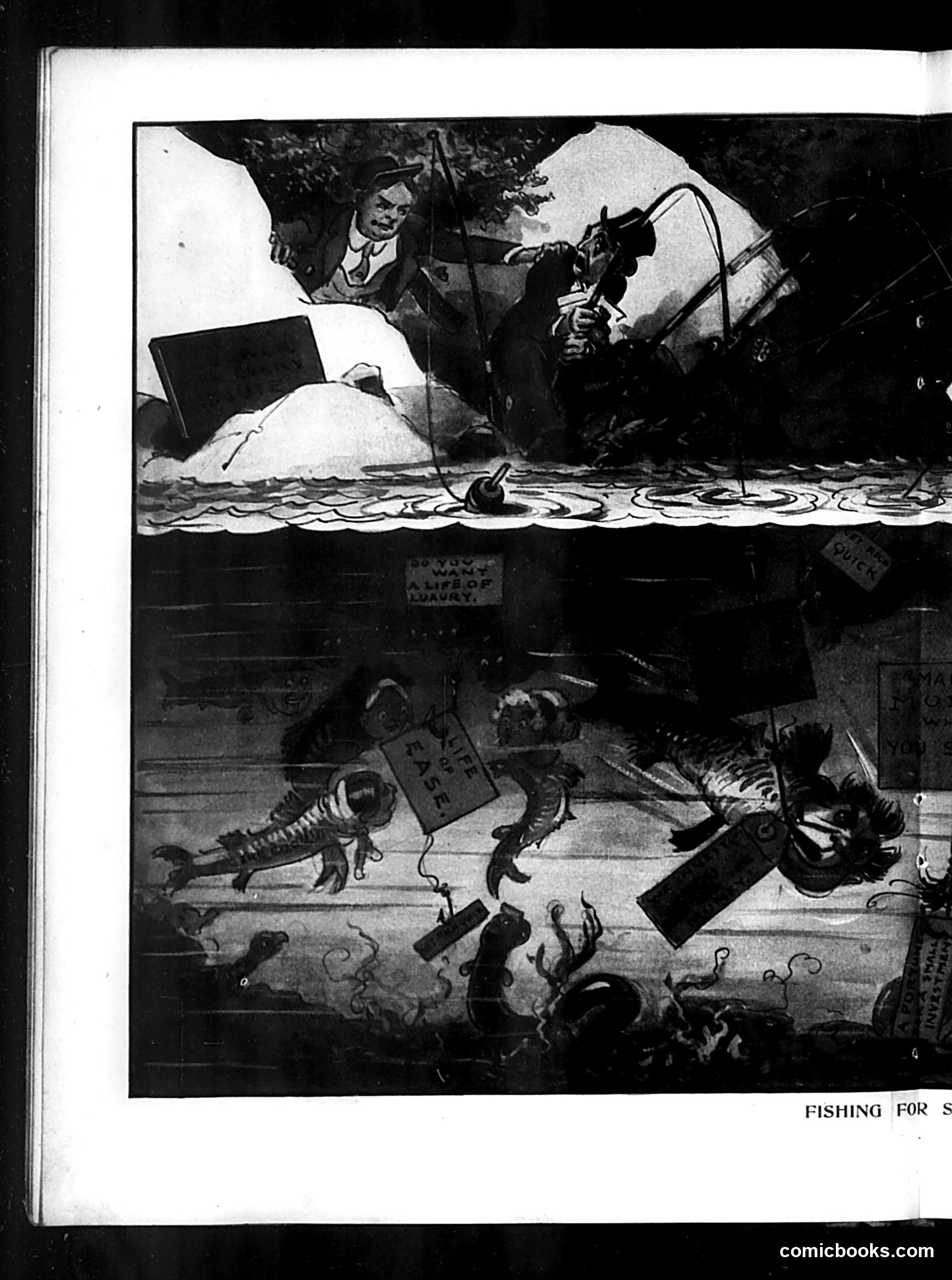
This page appears to show two cartoon panels depicting "Fishing for" something (the text is cut off). The top panel shows a figure fishing with elaborate equipment above water. The bottom panel depicts several creatures—appearing to be fish or sea creatures with human-like characteristics—below the surface, seemingly caught or attracted by the bait. The visible OCR text ("FISHING FOR") is incomplete, making it difficult to identify the specific satirical target. Without the full caption or title, I cannot determine what political, social, or cultural issue this cartoon references. The style and black-and-white reproduction are consistent with early-to-mid 20th century Judge magazine content, but the specific meaning of the satire remains unclear from this partial page alone.
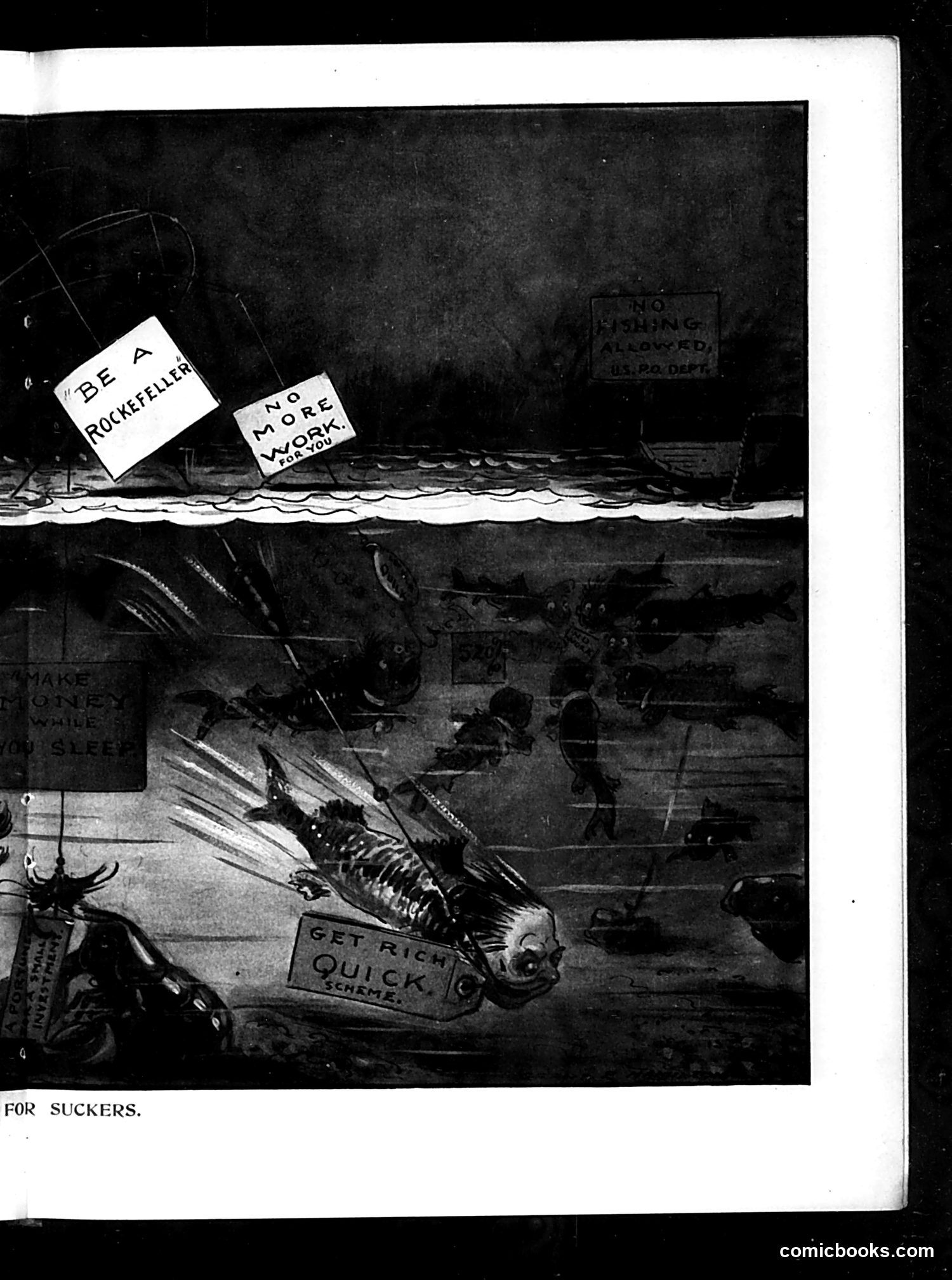
This appears to be a satirical cartoon about financial schemes targeting gullible people. The visible labels include "BE A ROCKEFELLER," "NO MORE WORK," "NO SMOKING ALLOWED," and "GET RICH QUICK SCHEME." The cartoon depicts various insects or creatures (drawn in an exaggerated, grotesque style) clustered around what seems to be fraudulent get-rich-quick propositions. The labels suggest these are misleading promises—becoming wealthy like Rockefeller, achieving leisure without work—classic con-artist pitches. The bottom caption "FOR SUCKERS" makes the satire explicit: this is mocking people who fall for such schemes. The Judge magazine was ridiculing the prevalence of financial fraud and the desperation or naïveté of those who believed in quick wealth shortcuts, particularly relevant during periods of economic anxiety.
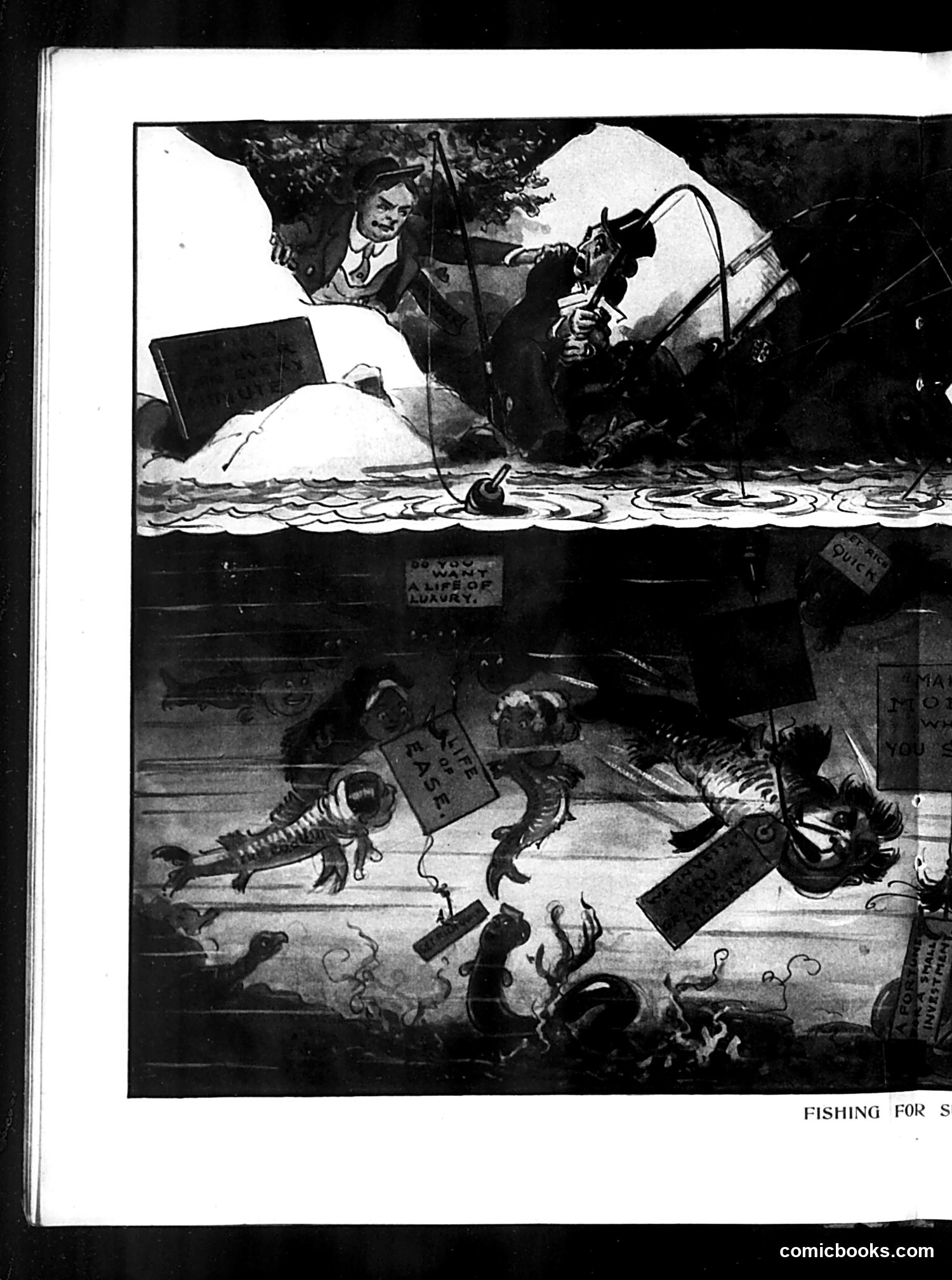
This two-panel cartoon satirizes women's suffrage activism. The top panel shows a woman fishing from a boat, with a man watching from shore—likely representing a suffragist attempting to "catch" voting rights. The bottom panel depicts the actual "catch": various creatures and objects labeled with suffrage-related text (though specifics are hard to read in this reproduction). The satire appears to mock suffragists' efforts as futile or absurd—"fishing" suggests they're chasing something elusive or ridiculous. The creatures caught seem designed to ridicule women's suffrage arguments or supporters. This reflects *Judge* magazine's anti-suffrage editorial stance during the early 20th century, when women's voting rights remained controversial among mainstream publications and conservative audiences.
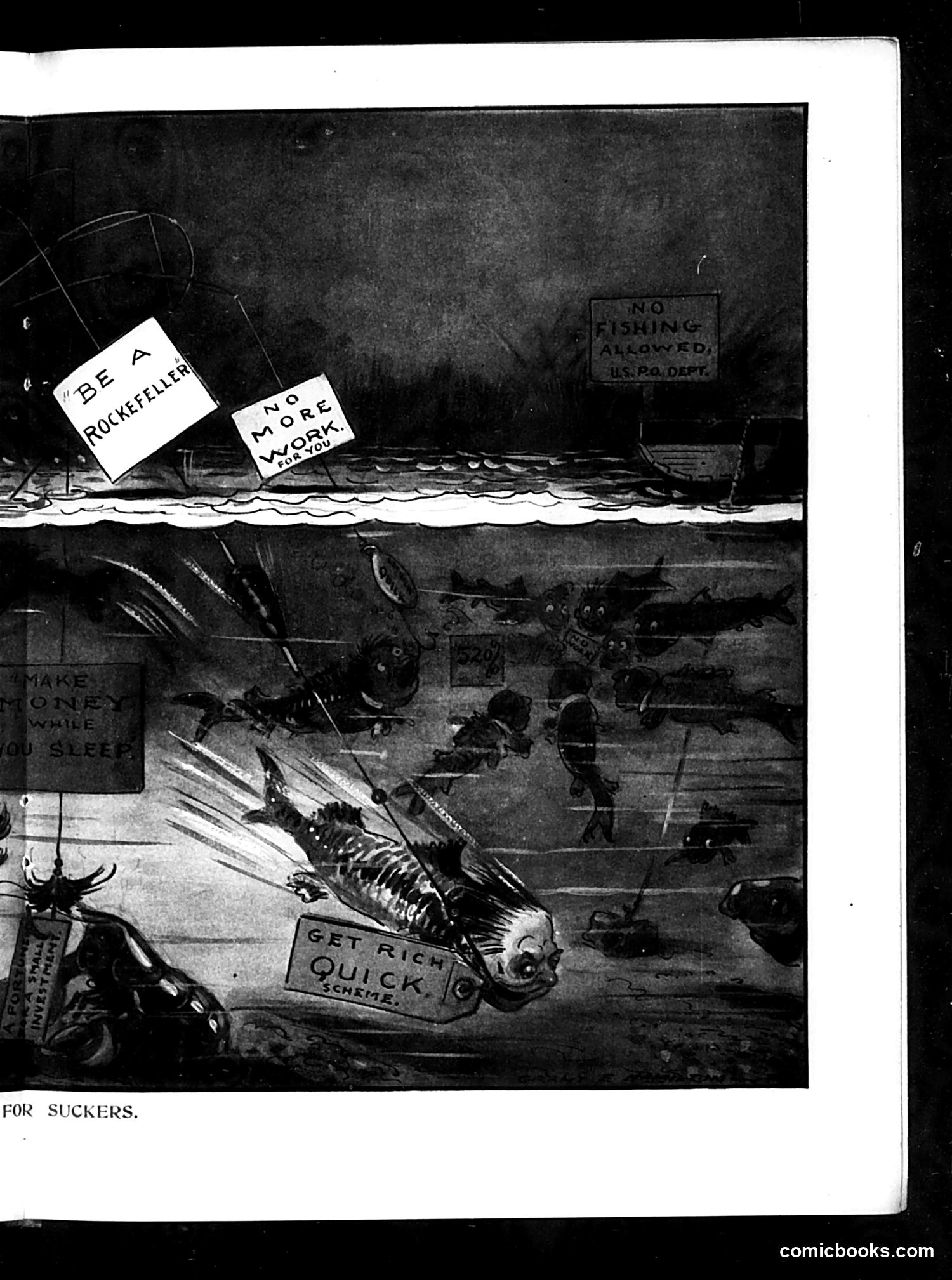
This appears to be a satirical cartoon criticizing get-rich-quick schemes and financial frauds targeting working people. The upper panel shows signs reading "BE A ROCKEFELLER" and "NO MORE WORK FOR YOU"—mocking unrealistic promises of wealth. The lower panel depicts various schemes and scams ("GET RICH QUICK SCHEME"), with fish and fishing imagery suggesting people are being "caught" or duped like fish taking bait. The title "FOR SUCKERS" makes the point explicit: these schemes prey on gullible people. The Rockefeller reference likely invokes the era's most famous industrialist, representing the wealth these schemes falsely promise. The U.S. Post Office stamp warns against mail fraud, suggesting postal scams were a significant problem Judge's readers faced.
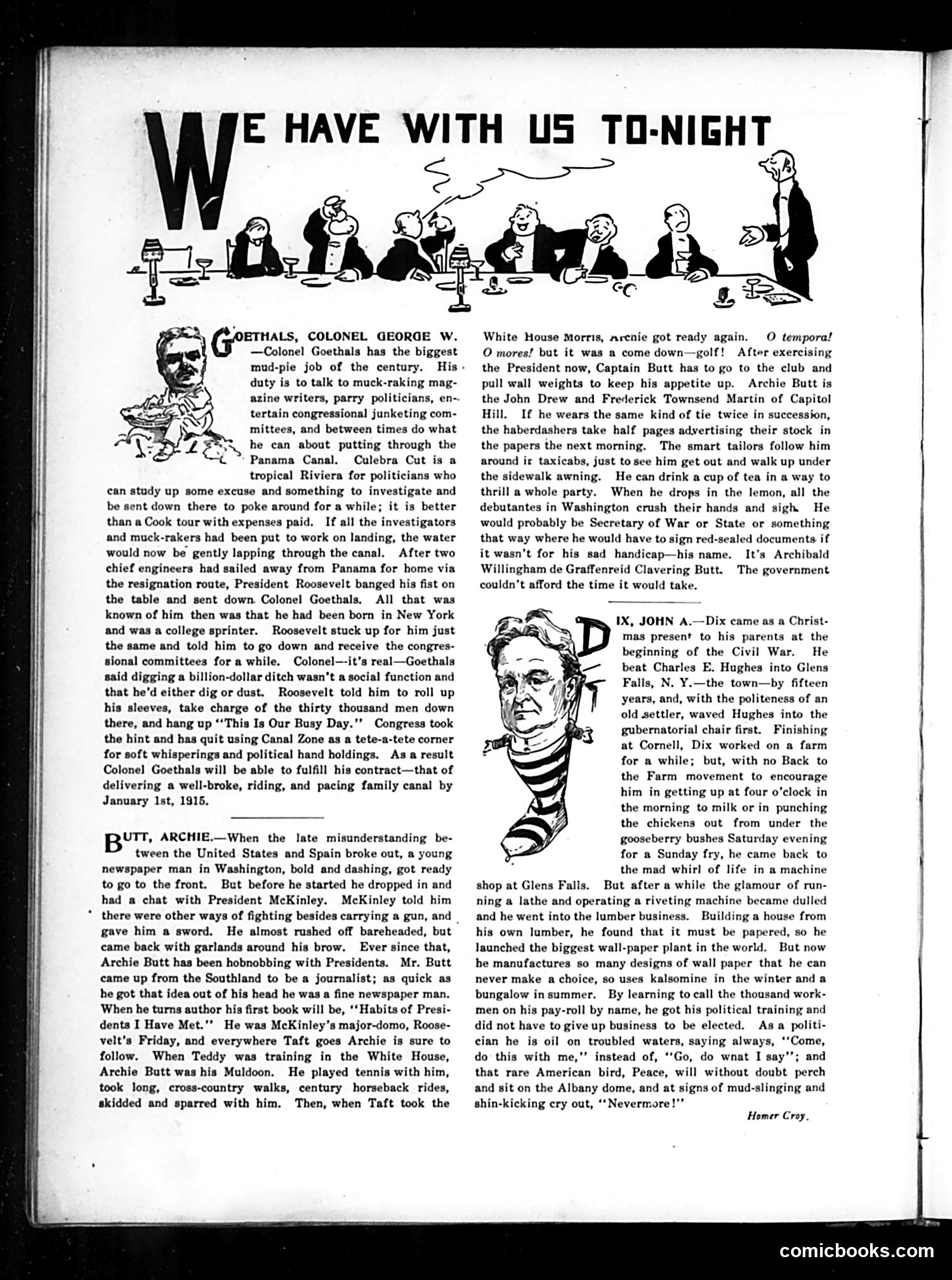
This page satirizes two prominent figures in the Taft administration (circa 1909-1913): **Colonel George W. Goethals** — The chief engineer overseeing the Panama Canal construction. The satire mocks how Congressional committees and muck-raking journalists constantly visit the Canal Zone under pretense of investigation, distracting from actual work. Judge praises Goethals for refusing to treat the project as a "social function" and forcing Congress to stop using it as a junket destination. **Archie Butt** — A military aide and presidential companion who served under McKinley, Roosevelt, and Taft. The satire affectionately ridicules him as a professional presidential hanger-on—someone whose sole talent is socializing with presidents and whose fashion choices supposedly influence Washington haberdashers. The humor turns on his usefulness being diminished under Taft compared to the athletically vigorous Roosevelt, forcing him to merely "pull wall weights" at clubs instead of exercising the President directly. Both pieces exemplify Judge's commentary on Washington's administrative inefficiency and social pretension.
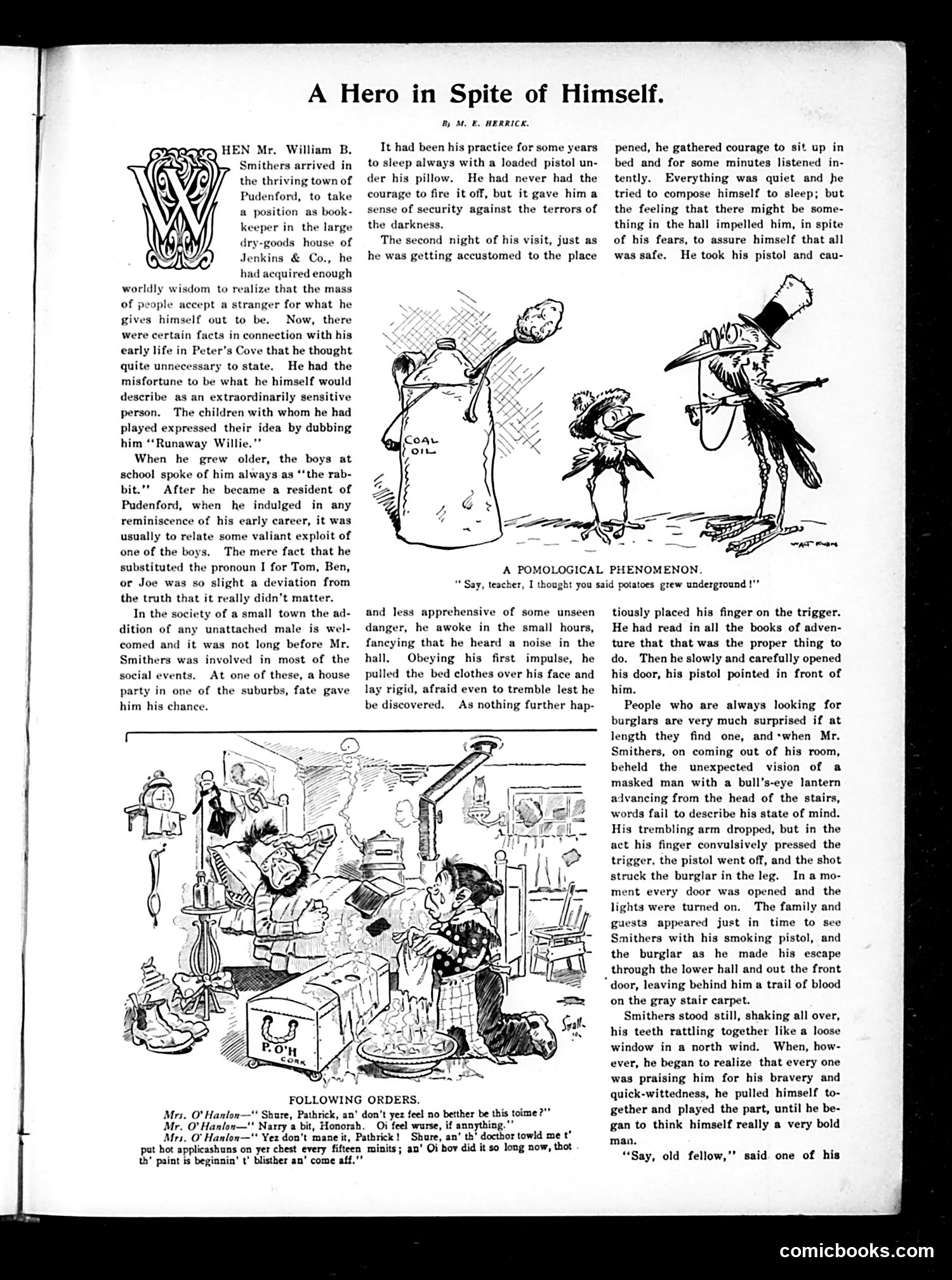
This is a humorous short story illustrated with comics. The narrative satirizes small-town social climbing: William B. Smithers, a timid man nicknamed "Runaway Willie" in his youth, reinvents himself in a new town by fabricating brave exploits (substituting "I" for other boys' names in old stories). The irony centers on accidental heroism: at a house party, Smithers wakes terrified by noise, grabs his loaded pistol for false security, and accidentally shoots a real burglar in the leg while trembling with fear. Society celebrates him as a hero despite his cowardice being the actual cause of his "bravery." The side cartoon ("A Pomological Phenomenon") is an unrelated joke about a student misunderstanding where potatoes grow. The "Following Orders" dialogue depicts Irish working-class characters; the wife overheats her husband with medical applications, showing period domestic humor through ethnic dialect comedy (typical of Judge magazine's era).
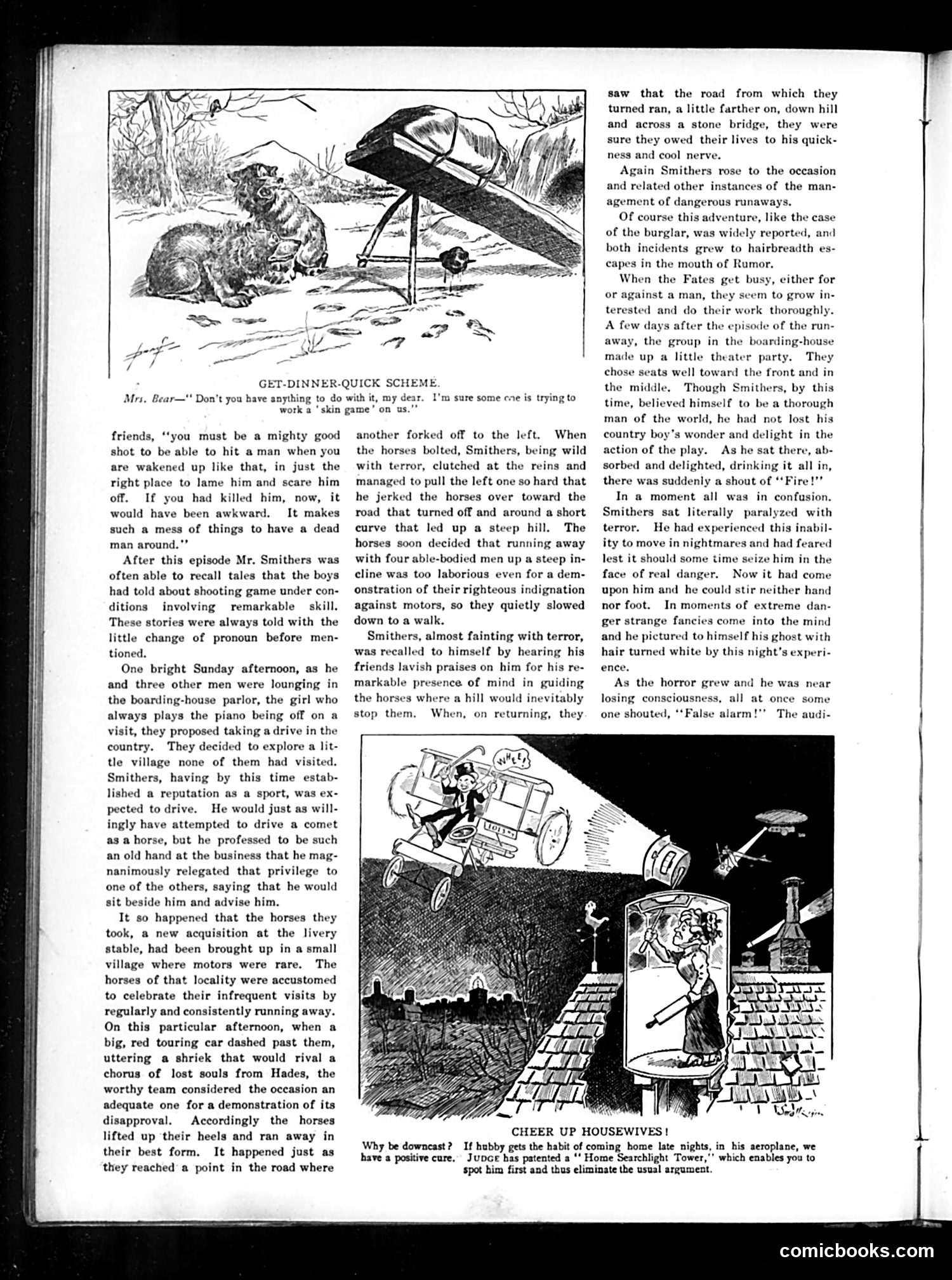
This page contains two satirical cartoons mocking a character named Smithers, a braggart who fabricates heroic tales. **Top cartoon**: Mrs. Bear warns her husband against a "skin game" (con scheme) involving a man trying to steal dinner. The joke plays on animal logic—bears naturally distrust human schemes. **Main narrative/bottom cartoon**: Smithers, a boarding-house resident with a reputation as a "sport" (sophisticate), repeatedly takes credit for accidents he didn't control. When runaway horses happen to turn up a hill (naturally slowing down), his friends praise his "quick nerve." He embellishes the story. Later, a theater fire or emergency occurs, likely exposing his cowardice and false reputation. **The satire**: Judge ridicules social climbers who fabricate stories to appear worldly and brave. Smithers's lies compound through "Rumor," illustrating how false reputations spread. The cartoon implicitly suggests that fate will eventually unmask such phonies. This reflects early 1900s anxieties about authenticity and pretense in American social life.
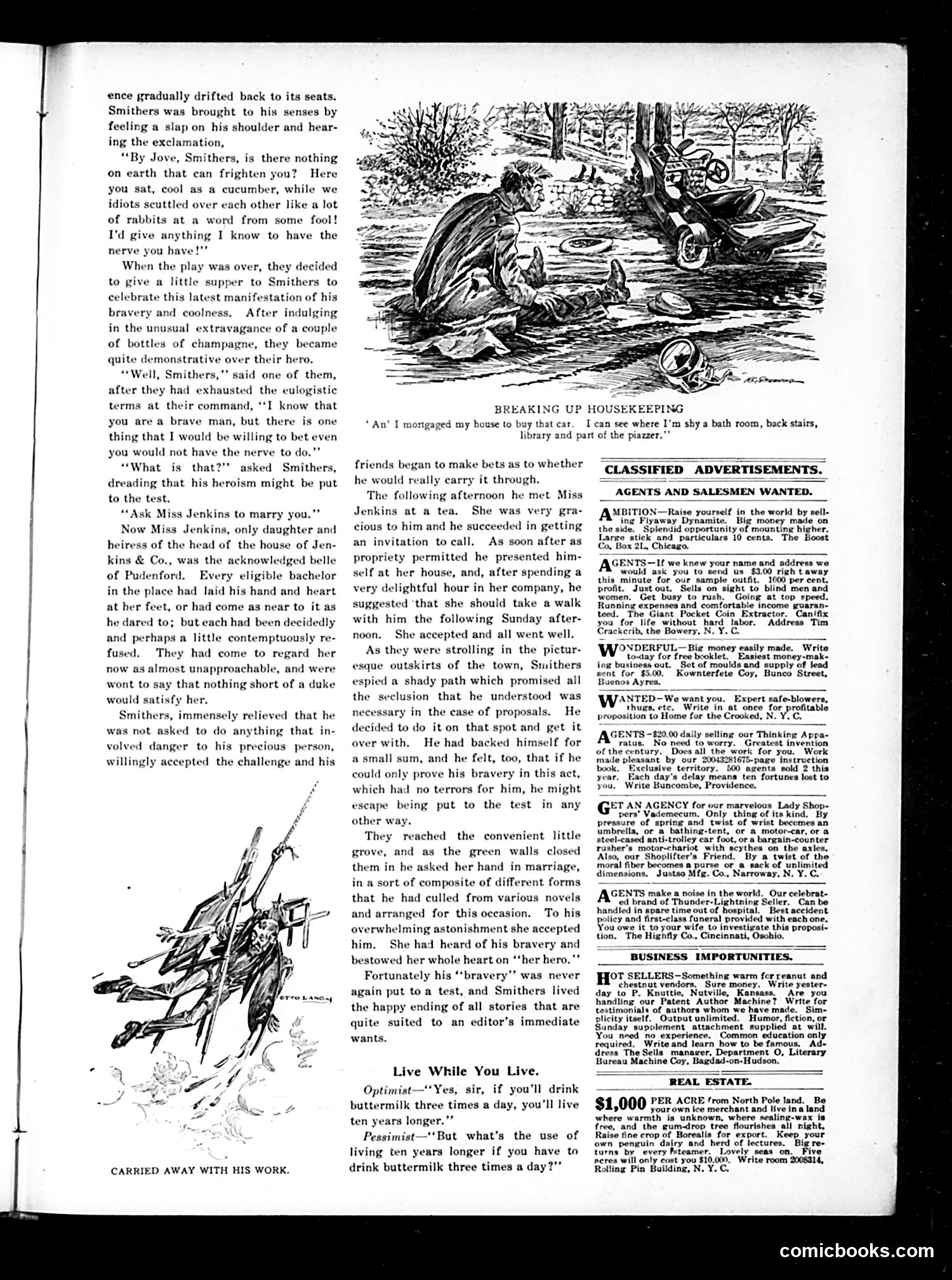
This page contains a serialized short story about a man named Smithers who accepts a dare to propose to Miss Jenkins, the most eligible (and resistant) bachelorette in town. The satire targets **romantic conventions of the era**: Smithers's "bravery" in proposing is treated as heroic, yet he's merely following the social script of courtship. The joke is that his theatrical, carefully-crafted proposal—cobbled from "various novels"—succeeds not through genuine courage but because Miss Jenkins has already decided he's brave based on his earlier reputation. The cartoon "Breaking Up Housekeeping" (lower right) satirizes **automobile ownership and financial irresponsibility**: a man has mortgaged his house to buy a car, leaving himself without basic home amenities (bath room, back stairs, library, porch). It mocks the era's automobile craze and working-class aspiration. The "Live While You Live" dialogue jokes about **health fads**: an optimist promotes buttermilk consumption for longevity; a pessimist questions whether extended life is worth the dietary sacrifice—typical period satire of wellness trends.
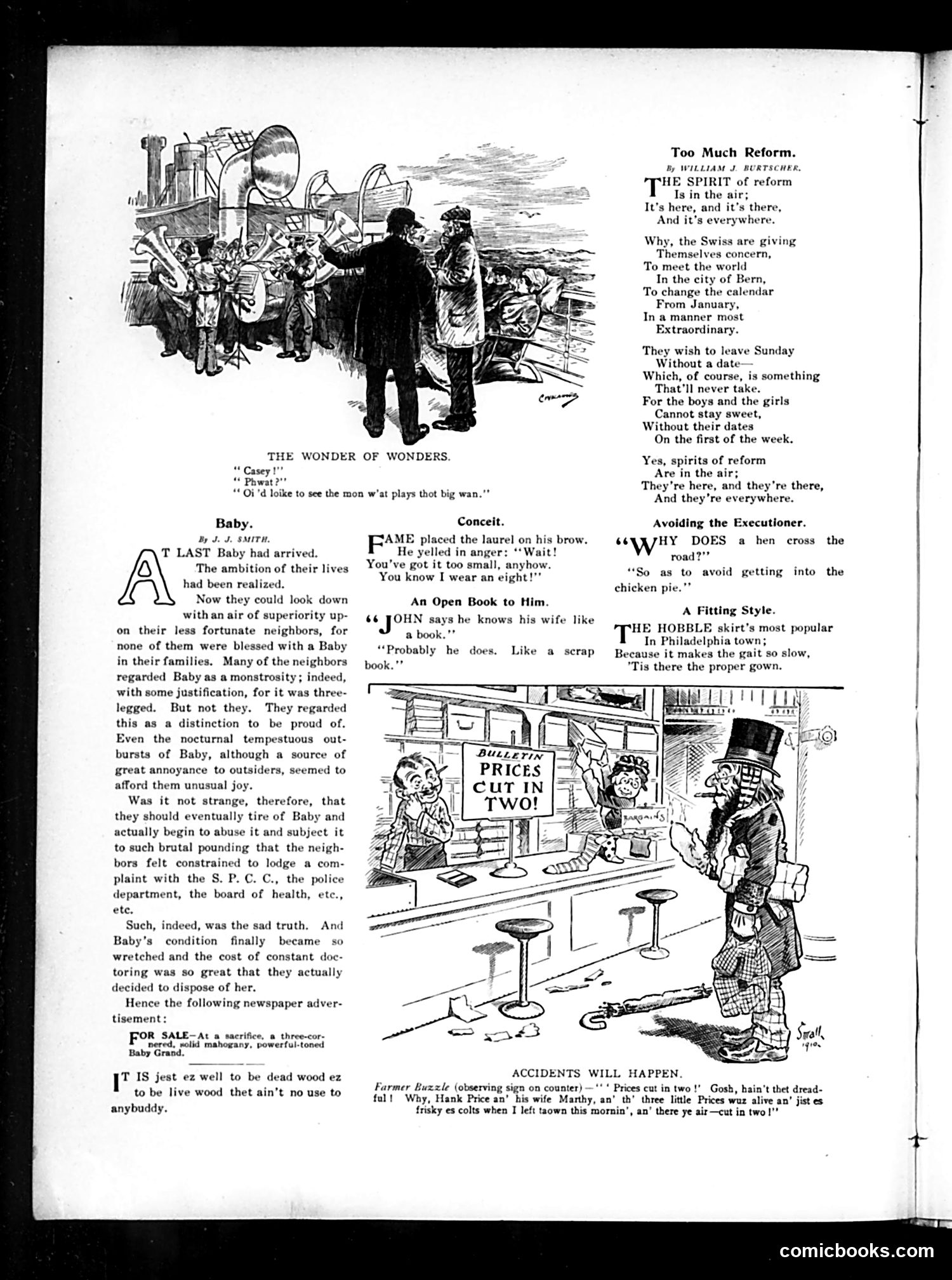
This page contains multiple satirical pieces typical of early 20th-century American humor: **"The Wonder of Wonders"** mocks parental pride by describing neighbors' jealousy over a "three-legged" baby—likely a mechanical piano or player piano (the image shows an elaborate machine). The satire targets the absurd status-seeking of ordinary people who boast about possessions while simultaneously abusing them. **"Too Much Reform"** by William J. Burtscher ridicules Swiss calendar reform efforts, specifically a proposal to remove Sunday's traditional date. The poem jokes that young people won't court without Sunday dating—mocking overzealous reformers as impractical busybodies. **Brief jokes** mock conceit, marital knowledge, hobble skirts (fashionable but restrictive women's clothing), and feature a rural character misreading a "Prices Cut in Two" store sign literally. The page exemplifies Judge's blend of social commentary, fashion criticism, and working-class humor targeting both pretentious reformers and common people's foibles.
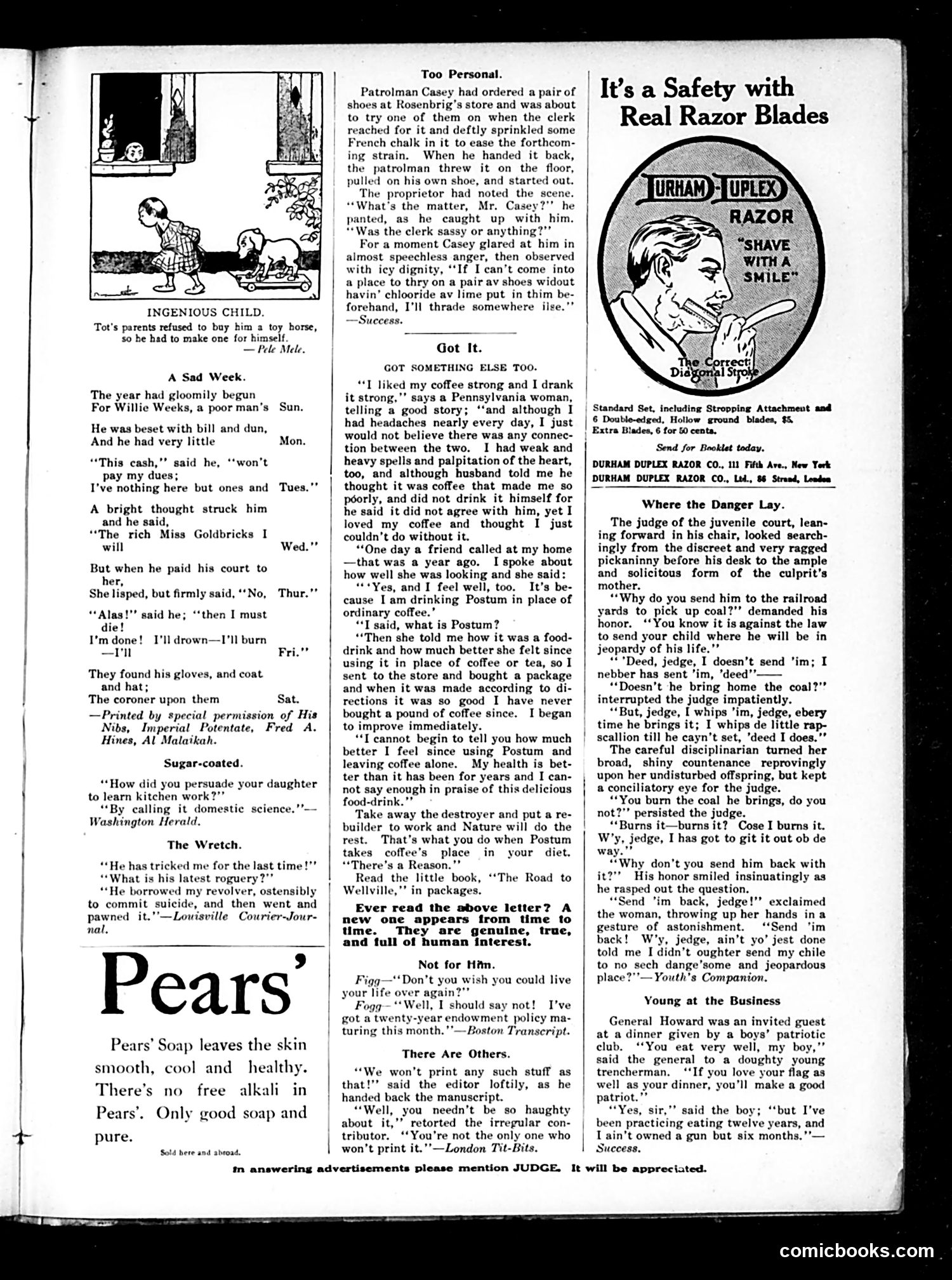
This page contains several short humorous pieces typical of Judge's satirical style: **"Ingenious Child"** shows a resourceful poor boy making his own toy horse from scraps—a gentle jab at class inequality and parental stinginess. **"A Sad Week"** is a cynical poem about Willie Weeks, a working-poor man drowning in bills. His desperate scheme to marry rich Miss Goldbricks fails, ending with his apparent suicide—dark humor about financial desperation common in the era. **"Too Personal"** mocks an Irish-accented patrolman (Patrolman Casey) who takes offense at a shoe clerk's standard practice of using French chalk to ease new shoes. The joke: he's oversensitive about this routine gesture. **"Got It"** is a Postum coffee-substitute advertisement disguised as reader testimonial, claiming coffee caused a woman's headaches and heart problems, cured by switching to Postum. The page also includes brief jokes about domestic science and a man who pawned a borrowed revolver. Overall, it reflects early 20th-century concerns about class, health remedies, and working-class life, with humor ranging from sentimental to darkly cynical.
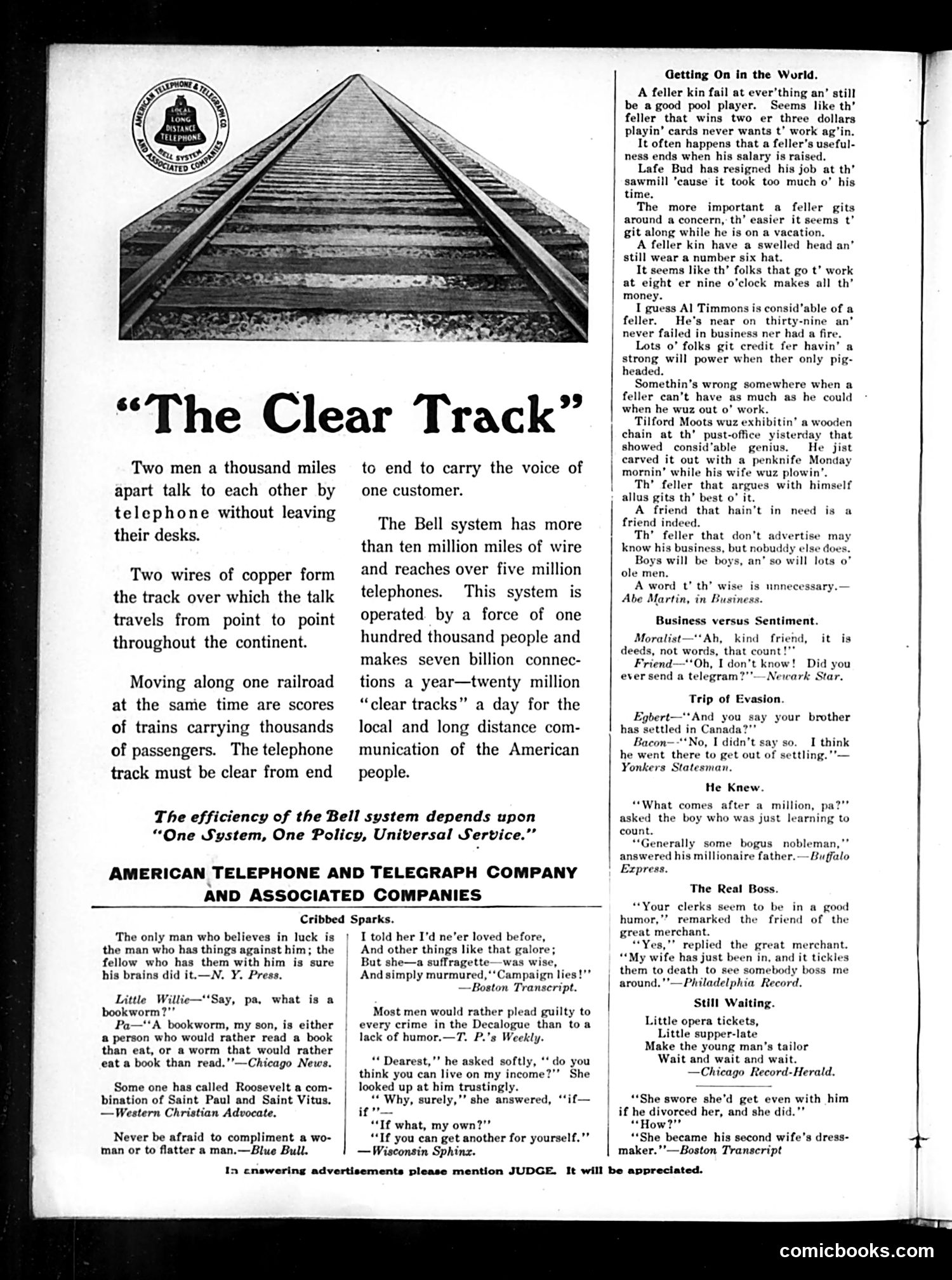
This page is primarily a corporate advertisement for American Telephone and Telegraph Company, promoting the Bell system's technological achievement and scale. The main image shows railroad tracks, used as a metaphor: just as trains require clear tracks to operate, telephone signals need unobstructed wire capacity. The advertisement emphasizes the Bell system's massive infrastructure—ten million miles of wire, five million phones, one hundred thousand employees—and claims it handles twenty million "clear tracks" daily. The tagline "One System, One Policy, Universal Service" reflects AT&T's monopoly positioning and corporate philosophy. The surrounding text consists of miscellaneous jokes and anecdotes ("Cribbed Sparks") on unrelated topics: luck, bookworms, Roosevelt, suffragettes, and romance. These filler items were typical of Judge magazine's satirical humor but carry no connection to the advertisement itself.
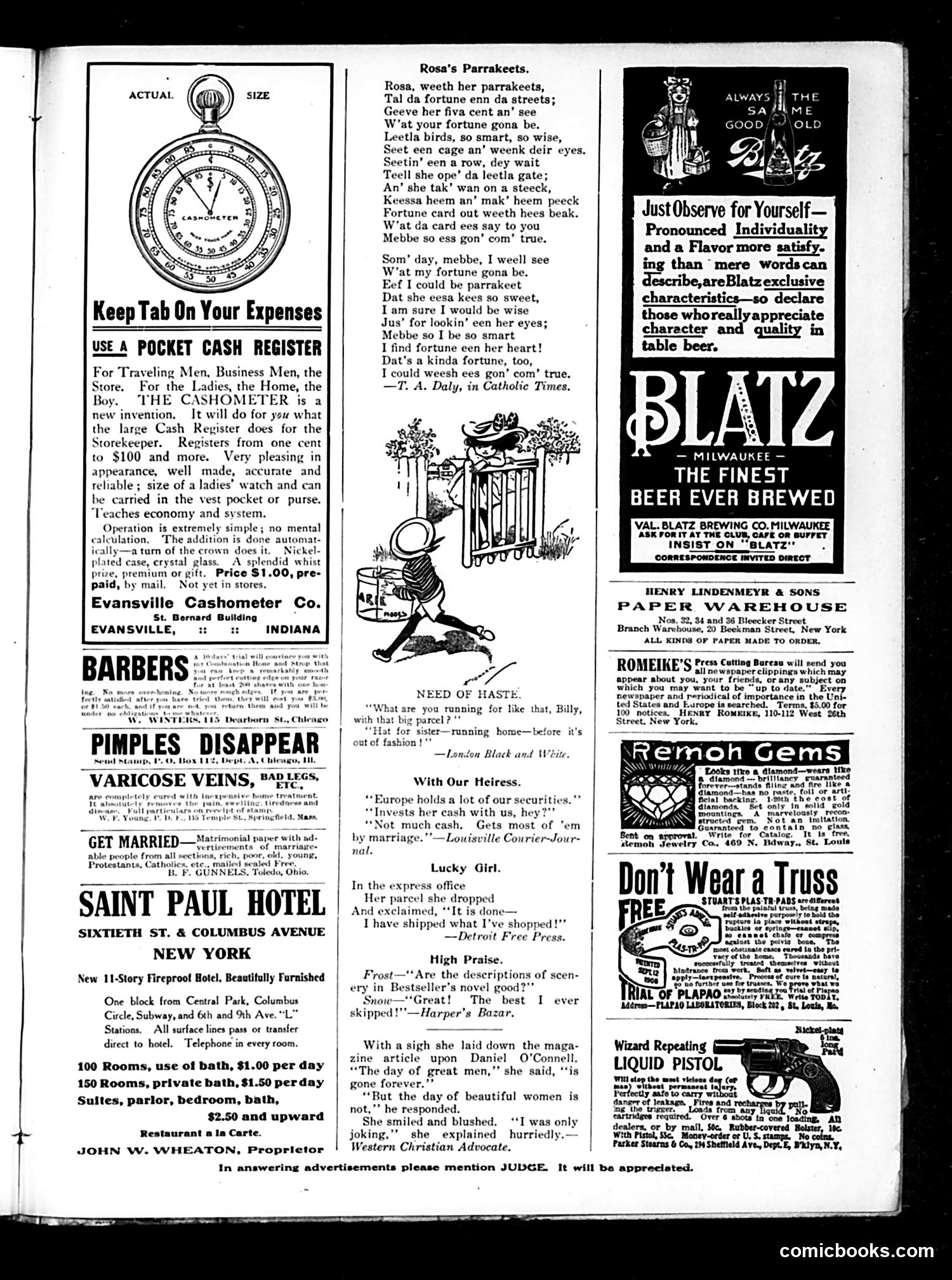
This page is primarily **advertisements and light satirical poetry**, not political cartoons. The main illustrated content is "Rosa's Parrakeets"—a sentimental poem in Italian-inflected dialect about a street vendor with fortune-telling parrots. The verse romanticizes working-class immigrant life (likely Italian), with the narrator imagining becoming a parrot to gaze into Rosa's eyes. The humor is gentle, playing on ethnic dialect rather than political satire. The short prose jokes ("Need of Haste," "Lucky Girl," "High Praise") are typical magazine filler: domestic humor about shopping, courtship, and reading habits—nothing satirical. The page is dominated by **period advertisements**: a pocket cash register, hotel, beer (Blatz), paper warehouse services, and a press-clipping bureau. These reveal consumer culture and business services of the era but carry no political content. There are **no identifiable political figures or sharp social critique** on this page—it represents Judge in its lighter, more commercial mode.
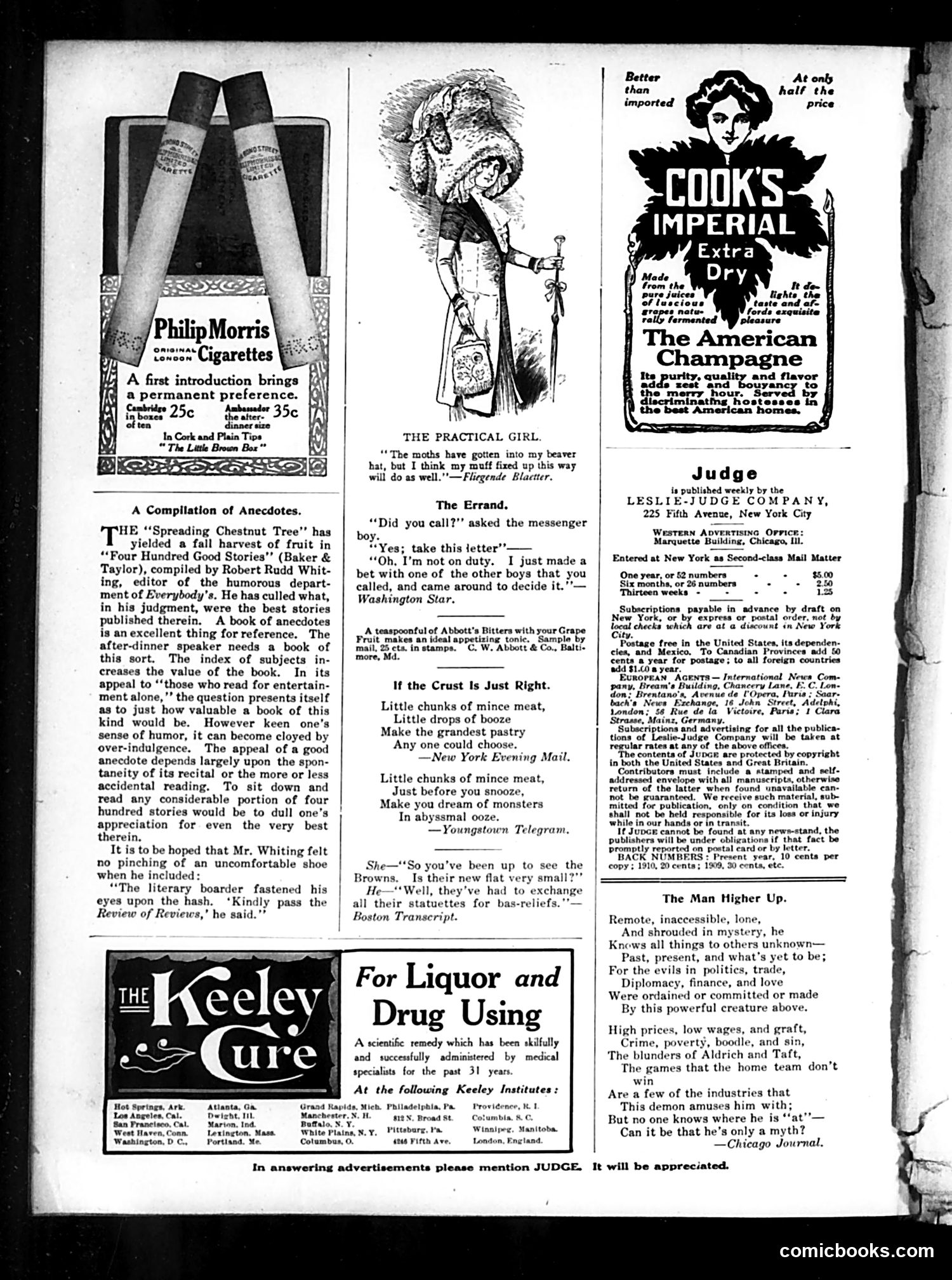
This page from *Judge* contains several brief humorous pieces typical of early 20th-century American satirical magazines: **"The Practical Girl"** mocks economical women, showing one repurposing a moth-eaten beaver hat by converting it into a muff—suggesting resourcefulness, though the humor implies this is absurdly practical. **"The Errand"** jokes about a messenger boy who placed a bet that he'd be called, then arrived to "decide" the wager rather than fulfill his duty—satirizing workplace laziness and dereliction. **"If the Crust Is Just Right"** presents paired verses about mince meat pie made with alcohol: one celebrates the pastry, the other mocks the digestive consequences—poking fun at the hangover effects of drinking. **"She/He" dialogue** ridicules social climbing—the couple exchanged valuable statuettes for cheap plaster replicas (bas-reliefs), presumably to appear fashionably modern, masking financial decline. The page is primarily **advertising and administrative content**, including cigarette and patent medicine ads typical of the era.
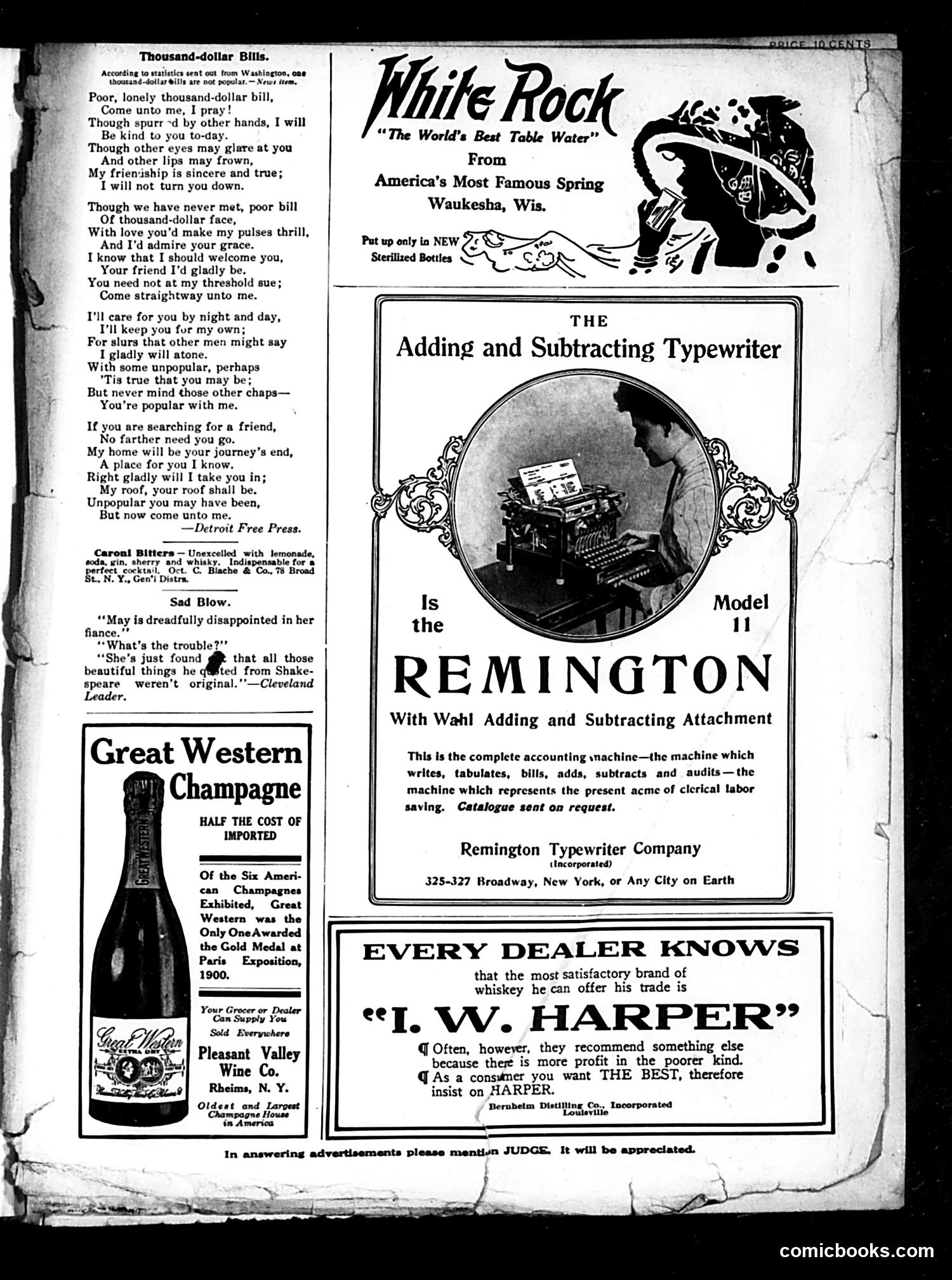
This page is primarily **advertisements with one satirical poem**, typical of Judge magazine's format. **The Main Satire:** The poem "Thousand-dollar Bills" personifies an unpopular $1,000 bill as a lonely, rejected figure. The speaker ironically courts it with romantic language, claiming to love it despite others shunning it. This satirizes **wealth inequality and social class prejudice**—the joke being that money itself becomes a social outcast when it's too large to circulate in ordinary commerce. According to the news item cited, thousand-dollar bills weren't actually used, making them figuratively "unpopular" in the marketplace. **Other Content:** The page contains standard period advertisements for White Rock water, Remington typewriters, Great Western Champagne, I.W. Harper whiskey, and Caroni Bitters. A brief joke about Shakespeare quotations appears as filler. The page demonstrates Judge's typical blend of social commentary disguised as humor alongside commercial advertising.
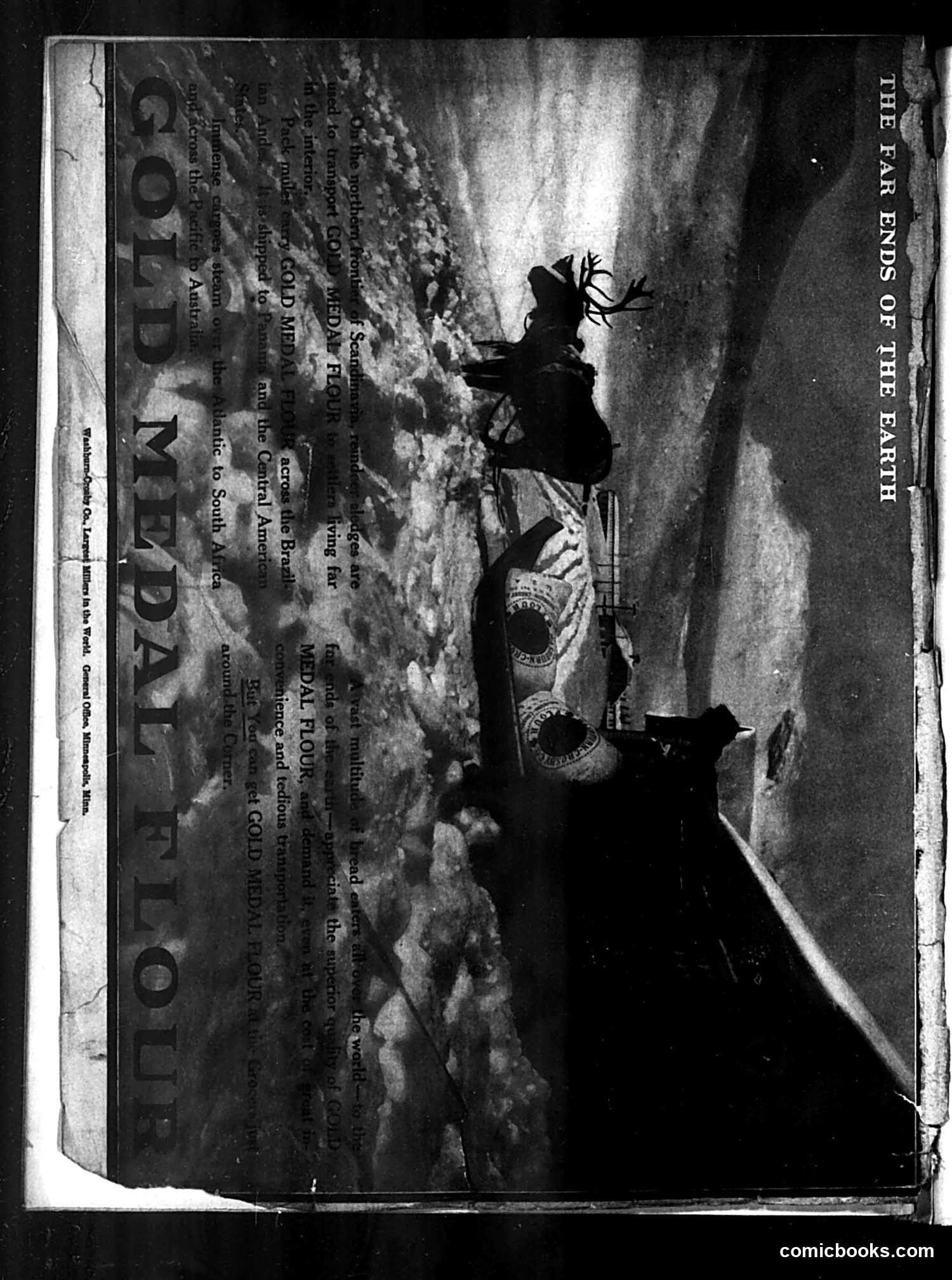
This appears to be a title page or cover from *Judge* magazine. The image shows a silhouetted figure in dramatic pose against a cloudy/atmospheric background. The figure has flowing hair and appears to be gesturing expressively, wearing what looks like decorated clothing with circular patterns. The visible text reads "THE FAR ENDS OF THE EARTH" (shown on the right edge), suggesting this introduces a story or satirical piece about distant lands or exotic locations. However, the OCR text is too fragmentary and unclear to identify specific political figures, events, or the satire's target. Without readable text explaining the content, I cannot reliably determine which historical situation, political commentary, or social issue this cartoon addresses. The dramatic styling suggests commentary on imperialism, exploration, or international affairs common to *Judge* magazine's era, but specifics remain unclear.