
Judge, 1911-01-07 · page 16 of 26
Judge — January 7, 1911 — page 16: what you’re looking at
What you’re looking at
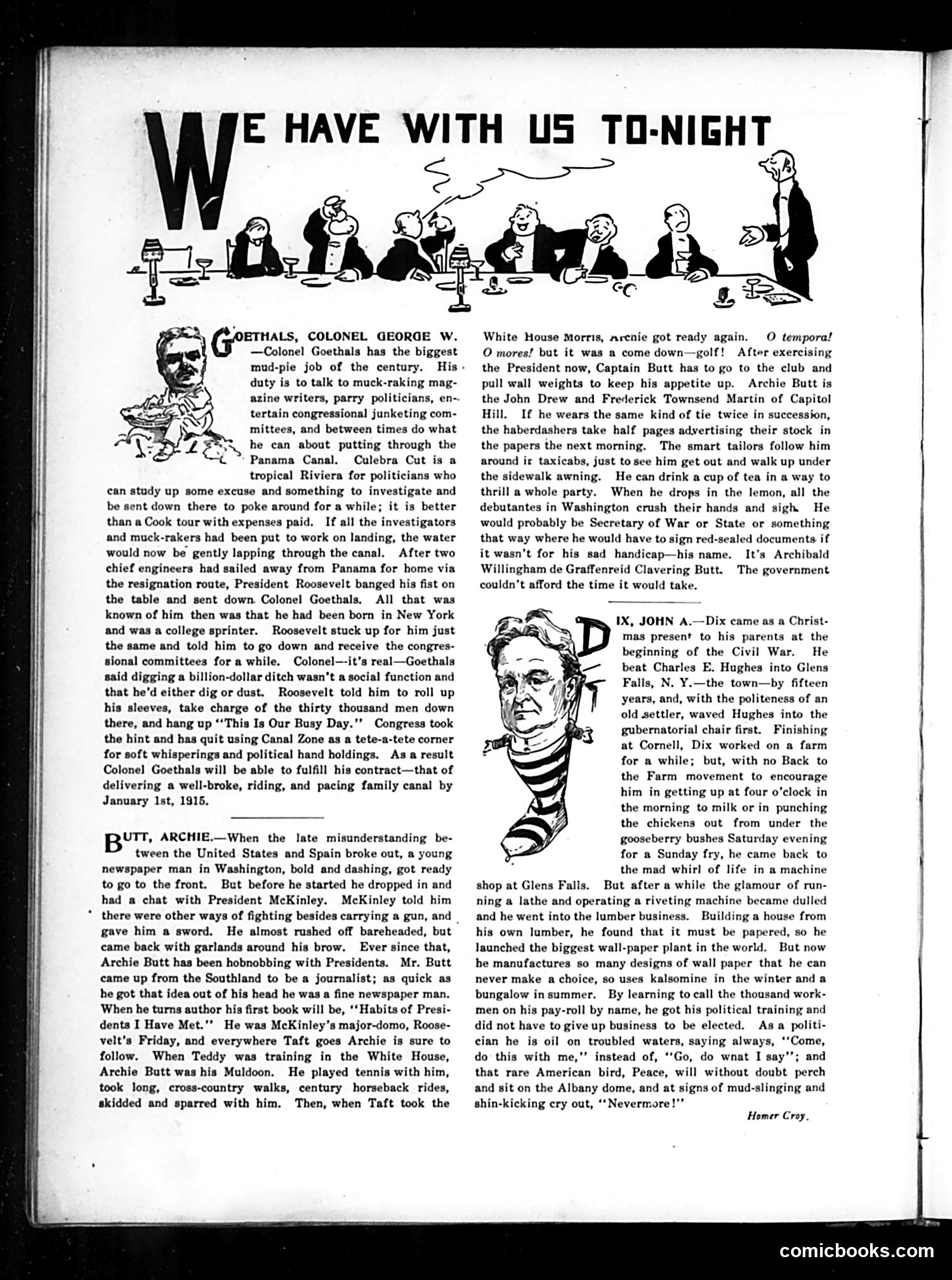
This page satirizes two prominent figures in the Taft administration (circa 1909-1913): **Colonel George W. Goethals** — The chief engineer overseeing the Panama Canal construction. The satire mocks how Congressional committees and muck-raking journalists constantly visit the Canal Zone under pretense of investigation, distracting from actual work. Judge praises Goethals for refusing to treat the project as a "social function" and forcing Congress to stop using it as a junket destination. **Archie Butt** — A military aide and presidential companion who served under McKinley, Roosevelt, and Taft. The satire affectionately ridicules him as a professional presidential hanger-on—someone whose sole talent is socializing with presidents and whose fashion choices supposedly influence Washington haberdashers. The humor turns on his usefulness being diminished under Taft compared to the athletically vigorous Roosevelt, forcing him to merely "pull wall weights" at clubs instead of exercising the President directly. Both pieces exemplify Judge's commentary on Washington's administrative inefficiency and social pretension.
📄 Transcribed text from this page (OCR, searchable)
Machine-transcribed from the original scan — historical spelling and the odd misread are preserved.
E HAVE WITH US TO-NIGHT / IETHALS, COLONEL GEORGE W. —Colonel Goethals has the biggest mud-pie job of the century. His - duty is to talk to muck-raking mag- azine writers, parry politicians, en-. tertain congressional junketing com- mittees, and between times do what he can about putting through the Panama Canal. Culebra Cut is a tropical Riviera for politicians who can study up some excuse and something to investigate and be sent down there to poke around for a while; it is better than a Cook tour with expenses paid. If all the investigators and muck-rakers had been put to work on landing, the water would now be gently lapping through the canal. After two chief engineers had sailed away from Panama for home via the resignation route, President Roosevelt banged his fist on the table and sent down Colonel Goethals. All that was known of him then was that he had been born in New York and was a college sprinter. Roosevelt stuck up for him just the same and told him to go down and receive the congres- sional committees for a while. Colonel—it’s real—Goethals said digging a billion-dollar ditch wasn't a social function and that he’d either dig or dust. Roosevelt told him to roll up his sleeves, take charge of the thirty thousand men down there, and hang up ‘‘This Is Our Busy Day.’’ Congress took the hint and has quit using Canal Zone as a tete-a-tete corner for soft whisperings and political hand holdings. As a result Colonel Goethals will be able to fulfill his contract—that of delivering a well-broke, riding, and pacing family canal by January Ist, 1915. UTT, ARCHIE.—When the late misunderstanding be- tween the United States and Spain broke out, a young newspaper man in Washington, bold and dashing, got ready to go to the front. But before he started he dropped in and had a chat with President McKinley. McKinley told him there were other ways of fighting besides carrying a gun, and gave him a sword. He almost rushed off bareheaded, but came back with garlands around his brow. Ever since that, Archie Butt has been hobnobbing with Presidents. Mr. Butt came up from the Southland to be a journalist; as quick as he got that idea out of his head he was a fine newspaper man. When he turns author his first book will be, ‘‘Habits of Presi- dents I Have Met.’’ He was McKinley’s major-domo, Roose- velt’s Friday, and everywhere Taft goes Archie is sure to follow. When Teddy was training in the White House, Archie Butt was his Muldoon. He played tennis with him, took long, cross-country walks, century horseback rides, skidded and sparred with him. Then, when Taft took the White House Morris, arcnie got ready again. O tempora! O mores! but it was a come down—golf! After exercising the President now, Captain Butt has to go to the club and pull wall weights to keep his appetite up. Archie Butt is the John Drew and Frederick Townsend Martin of Capitol Hill. If he wears the same kind of tie twice in succession, the haberdashers take half pages advertising their stock in the papers the next morning. The smart tailors follow him around ir taxicabs, just tosee him get out and walk up under the sidewalk awning. He can drink a cup of tea in a way to thrill a whole party. When he drops in the lemon, all the debutantes in Washington crush their hands and sigh He would probably be Secretary of War or State or something that way where he would have to sign red-sealed documents if it wasn’t for his sad handicap—his name. It's Archibald Willingham de Graffenreid Clavering Butt. The government couldn’t afford the time it would take. IX, JOHN A.—Dix came as a Christ- mas present to his parents at the beginning of the Civil War. He beat Charles E. Hughes into Glens Falls, N. Y.—the town—by fifteen years, and, with the politeness of an old settler, waved Hughes into the gubernatorial chair first. Finishing at Cornell, Dix worked on a farm for a while; but, with no Back to the Farm movement to encourage him in getting up at four o'clock in the morning to milk or in punching the chickens out from under the gooseberry bushes Saturday evening for a Sunday fry, he came back to the mad whirl of life in a machine shop at Glens Falls. But after a while the glamour of run- ning a lathe and operating a riveting machine became dulled and he went into the lumber business. Building a house from his own lumber, he found that it must be papered, so he launched the biggest wall-paper plant in the world. But now he manufactures so many designs of wall paper that he can never make a choice, so uses kalsomine in the winter anda bungalow insummer. By learning to call the thousand work- men on his pay-roll by name, he got his political training and did not have to give up business to be elected. Asa politi- cian he is oil on troubled waters, saying always, ‘‘Come, do this with me,”’ instead of, ‘‘Go, do wnat I say’’; and that rare American bird, Peace, will without doubt perch and sit on the Albany dome, and at signs of mud-slinging and shin-kicking cry out, ‘Nevermore !"” Homer Croy. comicbooks.com