
Judge, 1911-01-07 · page 6 of 26
Judge — January 7, 1911 — page 6: what you’re looking at
What you’re looking at
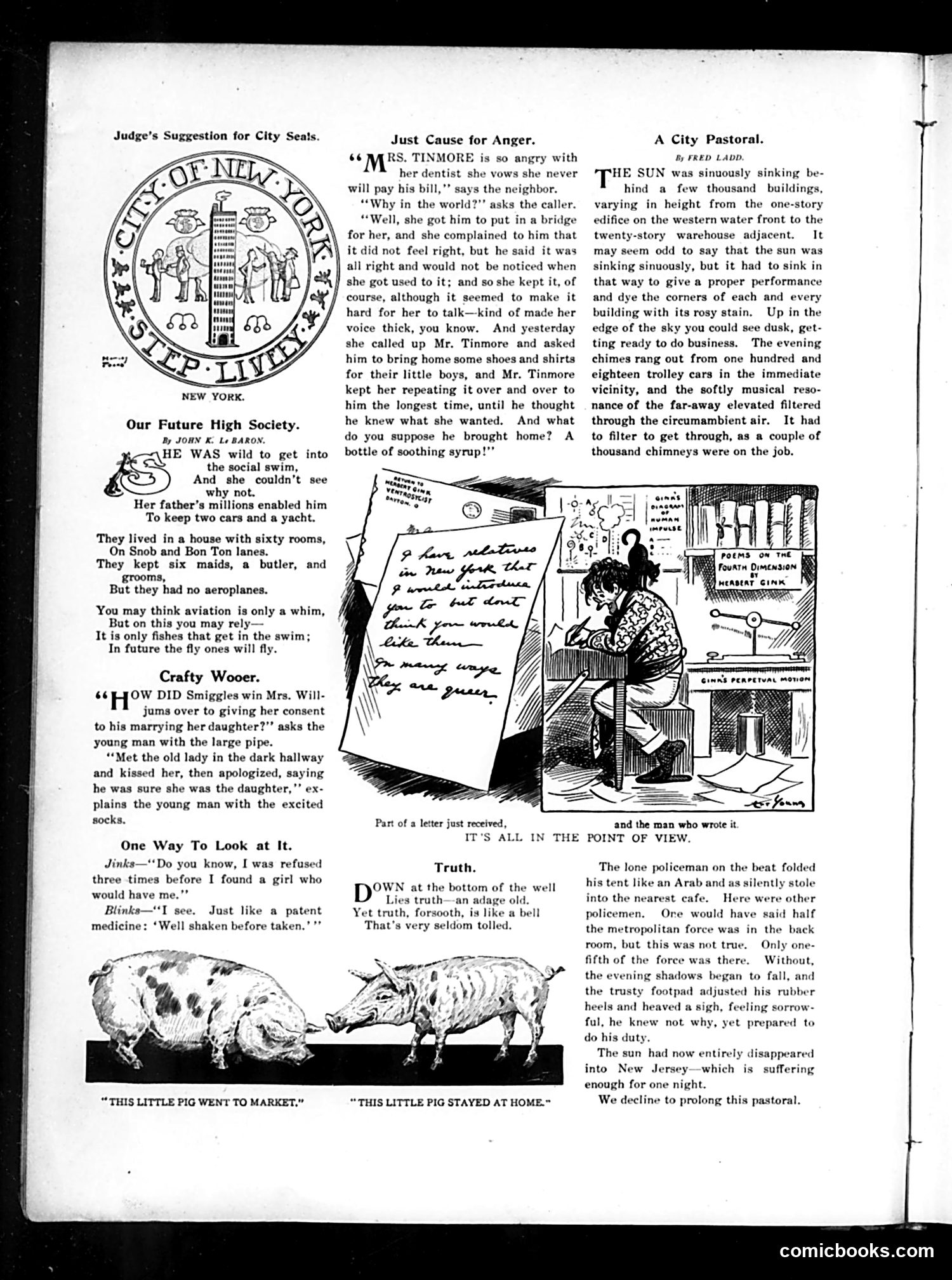
This page contains satirical humor pieces typical of early 20th-century American magazines: **"Our Future High Society"** mocks newly wealthy families attempting to join elite social circles. The joke: despite having mansions, servants, and yachts, they lack aeroplanes—suggesting that conspicuous consumption and status symbols constantly shift, making it impossible for the newly rich to ever truly "arrive" in society. **"Crafty Wooer"** is a brief joke about deception in courtship—a man wins a mother's consent by kissing her in the dark while claiming to mistake her for her daughter. **"Just Cause for Anger"** humorously depicts a woman's frustration when a dentist's dental bridge makes her speech unclear, leading to a miscommunication where he brings soothing syrup instead of shoes and shirts. **"A City Pastoral"** parodies flowery romantic literature by applying it absurdly to urban industrial landscapes—chimneys instead of nature, trolley cars instead of songbirds—and concludes with a policeman abandoning his post, satirizing urban decay and corruption. The content reflects Judge's satirical stance on American social pretension, urban life, and domestic absurdities.
📄 Transcribed text from this page (OCR, searchable)
Machine-transcribed from the original scan — historical spelling and the odd misread are preserved.
Judge’s Suggestion for City Seals. NEW YORK. Our Future High Society. By JOHN K: Le BARON. HE WAS wild to get into the social swim, And she couldn’t see why not. Her father’s millions enabled him To keep two cars and a yacht. They lived in a house with sixty rooms, On Snob and Bon Ton lanes. They kept six maids, a butler, and grooms, But they had no aeroplanes. You may think aviation is only a whim, But on this you may rely— It is only fishes that get in the swim; In future the fly ones will fly. Crafty Wooer. 66 HOW DID Smiggles win Mrs. Will- jums over to giving her consent to his marrying her daughter?” asks the young man with the large pipe. “Met the old lady in the dark hallway and kissed her, then apologized, saying he was sure she was the daughter,” ex- plains the young man with the excited socks, One Way To Look at It. Jinks—‘Do you know, I was refused three times before I found a girl who would have me Blinks—‘I see. medicine: ‘Well shaken before taken. Just like a patent “ THIS LITTLE PIG WENT TO MARKET,” Just Cause for Anger. oe RS. TINMORE is so angry with her dentist she vows she never will pay his bill,”’ 8 the neighbor. “*Why in the world?”’ asks the caller. “Well, she got him to put in a bridge for her, and she complained to him that it did not feel right, but he said it was all right and would not be noticed when she got used to it; and so she kept it, of / course, although it seemed to make it hard for her to talk—kind of made her voice thick, you know. And yesterday she called up Mr. Tinmore and asked him to bring home some shoes and shirts for their little boys, and Mr. Tinmore kept her repeating it over and over to him the longest time, until he thought he knew what she wanted. And what do you suppose he brought home? A bottle of soothing syrup!”’ il Part of a letter just received, IT’S ALL Truth. Dow at the bottom of the well I truth—an adage old Yet truth, forsooth, is like a bell That's very seldom tolled. “ THIS LITTLE PIG STAYED AT HOME.” A City Pastoral. by FRED LADD. HE SUN was sinuously sinking be- hind a few thousand buildings, varying in height from the one-story edifice on the western water front to the twenty-story warehouse adjacent. It may seem odd to say that the sun was sinking sinuously, but it had to sink in that way to give a proper performance and dye the corners of each and every building with its rosy stain. Up in the edge of the sky you could see dusk, get- ting ready to do business. The evening chimes rang out from one hundred and eighteen trolley cars in the immediate vicinity, and the softly musical reso- nance of the far-away elevated filtered through the circumambient air. It had to filter to get through, as a couple of thousand chimneys were on the job. and the man who wrote it IN THE POINT OF VIEW. The lone policeman on the beat folded his tent like an Arab and into the nearest cafe. H policemen. Ore would have said half the metropolitan force was in the back silently stole were other room, but this was not true. Only one- fifth of the force was there. Without, the evening shadows began to fall, and the trusty footpad adjusted his rubber heels and heaved a sigh, feeling sorrow- ful, he knew not why, yet prepared to do his duty. The sun had now entirely disappeared which is suffering into New Jersey enough for one night. We decline to prolong this pastoral. comicbooks.com