
Judge, 1911-01-07 · page 18 of 26
Judge — January 7, 1911 — page 18: what you’re looking at
What you’re looking at
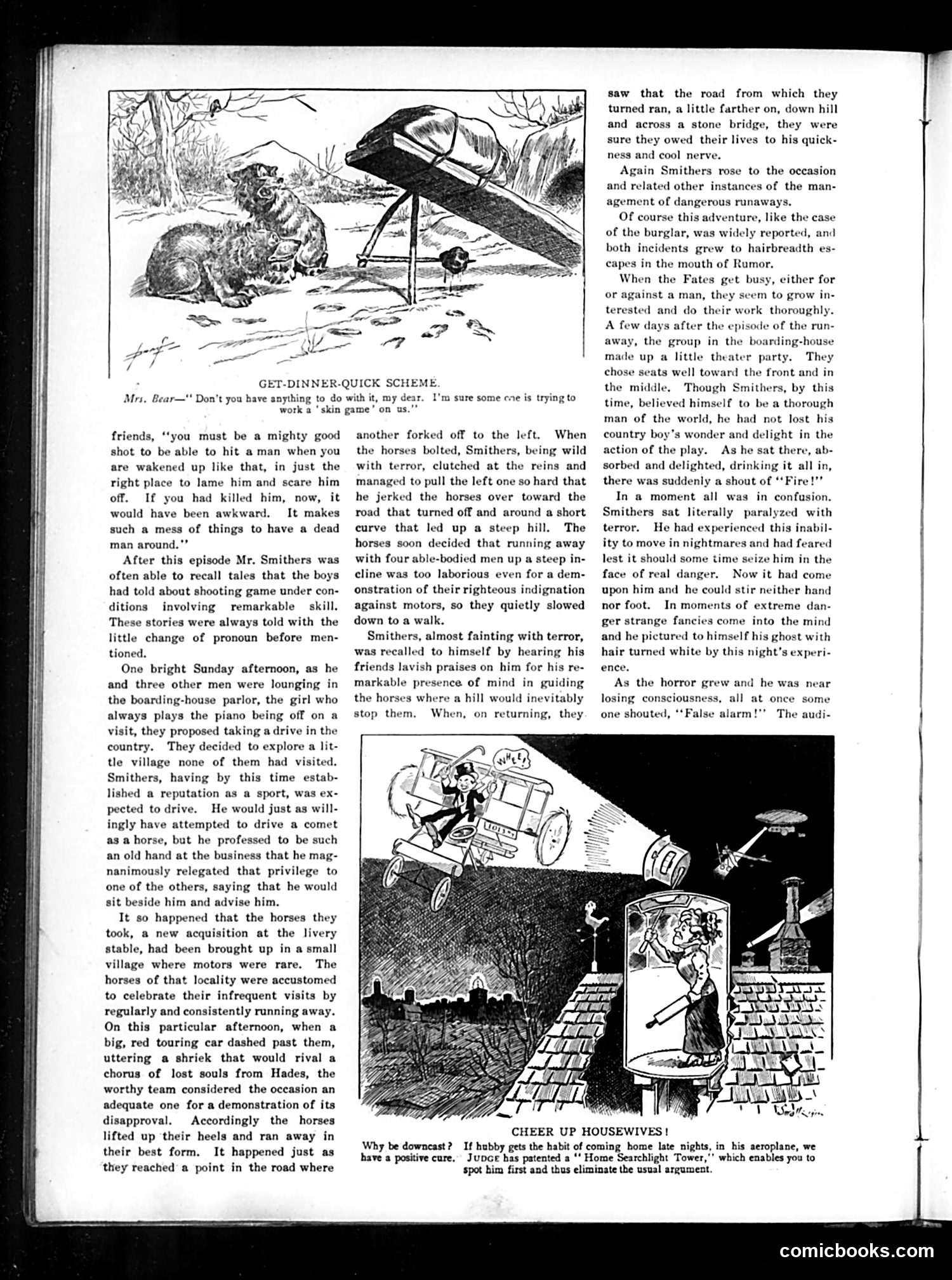
This page contains two satirical cartoons mocking a character named Smithers, a braggart who fabricates heroic tales. **Top cartoon**: Mrs. Bear warns her husband against a "skin game" (con scheme) involving a man trying to steal dinner. The joke plays on animal logic—bears naturally distrust human schemes. **Main narrative/bottom cartoon**: Smithers, a boarding-house resident with a reputation as a "sport" (sophisticate), repeatedly takes credit for accidents he didn't control. When runaway horses happen to turn up a hill (naturally slowing down), his friends praise his "quick nerve." He embellishes the story. Later, a theater fire or emergency occurs, likely exposing his cowardice and false reputation. **The satire**: Judge ridicules social climbers who fabricate stories to appear worldly and brave. Smithers's lies compound through "Rumor," illustrating how false reputations spread. The cartoon implicitly suggests that fate will eventually unmask such phonies. This reflects early 1900s anxieties about authenticity and pretense in American social life.
📄 Transcribed text from this page (OCR, searchable)
Machine-transcribed from the original scan — historical spelling and the odd misread are preserved.
GET-DINNER-QUICK SCHEME. Mrs. Bear—'* Don't you have anything to do with it, my dear. I'm sure some ene is trying to work a ‘skin game’ on us.” friends, “you must be a mighty good shot to be able to hit a man when you are wakened up like that, in just the right place to lame him and scare him off. If you had killed him, now, it would have been awkward. It makes such a mess of things to have a dead man around.”” After this episode Mr. Smithers was often able to recall tales that the boys had told about shooting game under con- ditions involving remarkable skill. These stories were always told with the little change of pronoun before men- tioned. One bright Sunday afternoon, as he and three other men were lounging in the boarding-house parlor, the girl who always plays the piano being off on a visit, they proposed taking a drive in the country. They decided to explore a lit- tle village none of them had visited. Smithers, having by this time es' lished a reputation as a sport, was ex- pected to drive. He would just as will- ingly have attempted to drive a comet as a horse, but he professed to be such an old hand at the business that he mag- nanimously relegated that privilege to one of the others, saying that he would sit beside him and advise him. It so happened that the horses they took, a new acquisition at the livery stable, had been brought up in a small village where motors were rare. The horses of that locality were accustomed to celebrate their infrequent visits by regularly and consistently running away. On this particular afternoon, when a big, red touring car dashed past them, uttering a shriek that would rival a chorus of lost souls from Hades, the worthy team considered the occasion an adequate one for a demonstration of its another forked off to the left. When the horses bolted, Smithers, being wild with terror, clutched at the reins and managed to pull the left one so hard that he jerked the horses over toward the road that turned off and around a short curve that led up a steep hill. The horses soon decided that running away with four able-bodied men up a steep in- cline was too laborious even for a dem- onstration of their righteous indignation against motors, so they quietly slowed down to a walk. Smithers, almost fainting with terror, was recalled to himself by hearing his friends lavish praises on him for his re- markable presence of mind in guiding the horses where a hill would inevitably stop them, When, on returning, they saw that the road from which they turned ran, a little farther on, down hill and across a stone bridge, they were sure they owed their lives to his quick- ness and cool nerve. Again Smithers rose to the occasion and related other instances of the man- agement of dangerous runaways. Of course this adventure, like the case of the burglar, was widely reported, and both incidents grew to hairbreadth es- capes in the mouth of Rumor. When the Fates get busy, either for or against a man, they seem to grow in- terested and do their work thoroughly. A few days after the episode of the run- away, the group in the boarding-house made up a little theater party. They chos ats well toward the front and in the middle. Though Smithers, by this time, believed himself to be a thorough man of the world, he had not lost his country boy’s wonder and delight in the action of the play. As he sat there, ab- sorbed and delighted, drinking it all in, there was suddenly a shout of “ In a moment all was in confusion. Smithers sat literally paralyzed with terror. He had experienced this inabil- ity to move in nightmares and had feared lest it should some time seize him in the face of real danger. Now it had come upon him and he could stir neither hand nor foot. In moments of extreme dan- ger strange fancies come into the mind and he pictured to himself his ghost with hair turned white by this night’s experi- ence. As the horror grew and he was near losing consciousness, all at once some one shouted, ‘‘False alarm!"" The audi- | disapproval. Accordingly the horses lifted up their heels and ran away in their best form. It happened just as they reached a point in the road where CHEER UP HOUSEWIVES! Why be downcast? If hubby gets the habit of coming home late nights, in his aeroplane, we have a positive cure. Jupce has patented a ‘' Home Searchlight Tower,"’ which enables you to ‘spot him first and thus eliminate the usual argument. comicbooks.com