
Judge, 1911-01-07 · page 22 of 26
Judge — January 7, 1911 — page 22: what you’re looking at
What you’re looking at
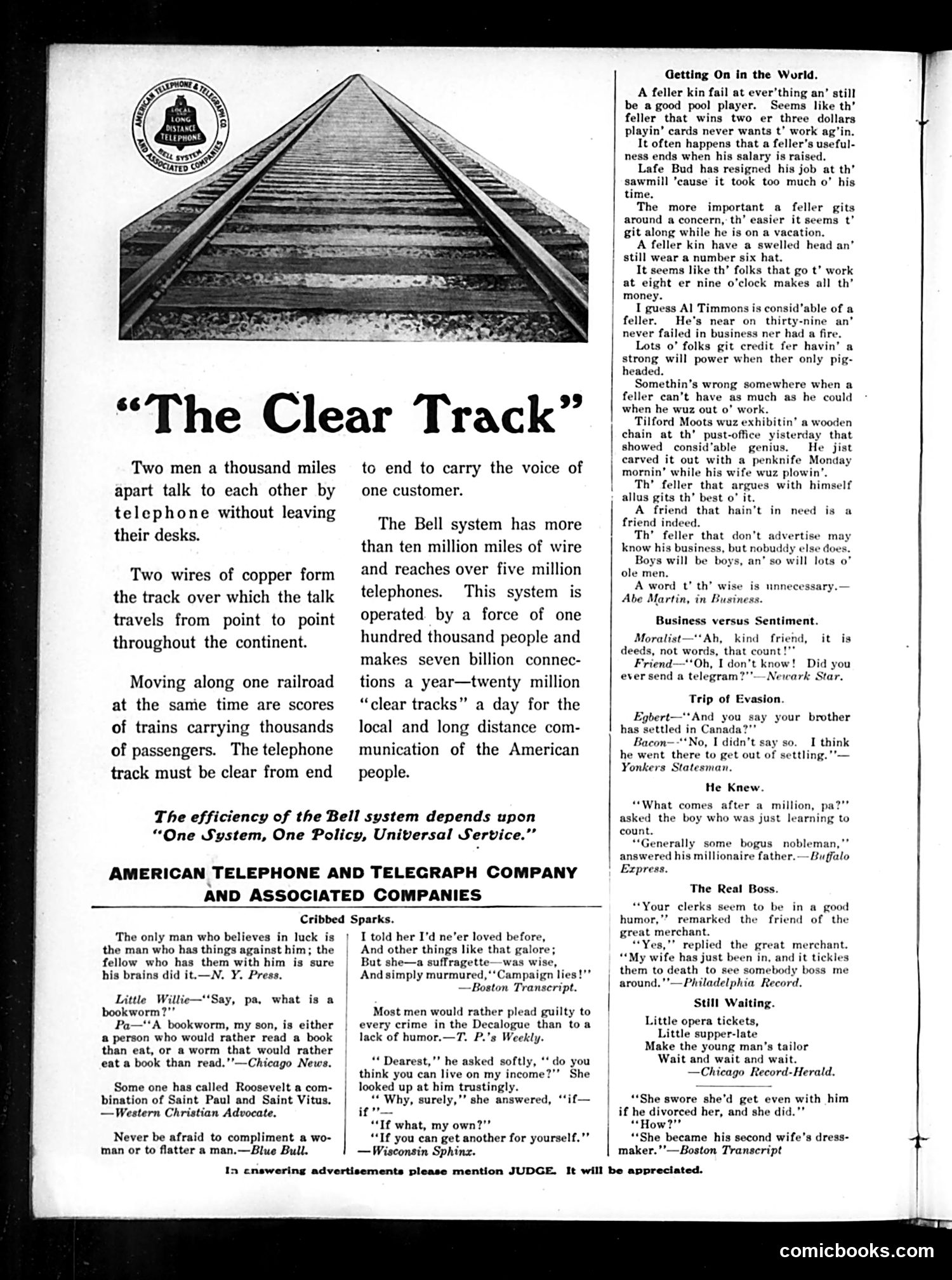
This page is primarily a corporate advertisement for American Telephone and Telegraph Company, promoting the Bell system's technological achievement and scale. The main image shows railroad tracks, used as a metaphor: just as trains require clear tracks to operate, telephone signals need unobstructed wire capacity. The advertisement emphasizes the Bell system's massive infrastructure—ten million miles of wire, five million phones, one hundred thousand employees—and claims it handles twenty million "clear tracks" daily. The tagline "One System, One Policy, Universal Service" reflects AT&T's monopoly positioning and corporate philosophy. The surrounding text consists of miscellaneous jokes and anecdotes ("Cribbed Sparks") on unrelated topics: luck, bookworms, Roosevelt, suffragettes, and romance. These filler items were typical of Judge magazine's satirical humor but carry no connection to the advertisement itself.
📄 Transcribed text from this page (OCR, searchable)
Machine-transcribed from the original scan — historical spelling and the odd misread are preserved.
“The Clear Track” Two men a thousand miles apart talk to each other by telephone without leaving their desks. Two wires of copper form the track over which the talk travels from point to point throughout the continent. Moving along one railroad at the same time are scores of trains carrying thousands of passengers. The telephone track must be clear from end to end to carry the voice of one customer. The Bell system has more than ten million miles of wire and reaches over five million telephones. This system is operated by a force of one hundred thousand people and makes seven billion connec- tions a year—twenty million “clear tracks” a day for the local and long distance com- munication of the American people. The efficiency of the Bell system depends upon “One System, One Policy, Universal Service.” AMERICAN TELEPHONE AND TELEGRAPH COMPANY AND ASSOCIATED COMPANIES Cribbed Sparks. The only man who believes in luck is the man who has things against him; the fellow who has them with him is sure his brains did it.—N. Y. Press. Little Willie—‘‘Say, pa, what is a bookworm?"’ Pa—'‘A bookworm, my son, is either a person who would rather read a book than eat, or a worm that would rather eat a book than read.’’—Chicago News. Some one has called Roosevelt a com- bination of Saint Paul and Saint Vitus. —Western Christian Advocate. Never be afraid to compliment a wo- man or to flatter a man.—Blue Bull. I told her I'd ne'er loved before, And other things like that galore; But she—a suffragette—was wise, And simply murmured, ‘‘Campaign lies!” —Boston Transcript. Most men would rather plead guilty to every crime in the Decalogue than toa lack of humor.—T. P.'s Weekly. ‘* Dearest,’’ he asked softly, *‘ do you think you can live on my income?"’ She looked up at him trustingly. Why, surely,’’ she answered, ‘if— it "— “If what, my own?” “If you can get another for yourself.’’ — Wisconsin Sphinz. | feller. Getting On in the World. A feller kin fai! ever’thing an’ still be a good pool player. Seems like th’ feller that wins two er three dollars playin’ cards never wants t’ work agin. It often happens that a feller’s useful- ness ends when his salary is raised. Lafe Bud has resigned his job at th’ sawmill ’cause it took too much o’ his time. The more important a feller gits around a concern, th’ easier it seems t’ git along while he is on a vacation. A feller kin have a swelled head an’ still wear a number six hat. It seems like th’ folks that go t’ work at eight er nine o'clock makes all th’ money. I guess Al Timmons is consid’able of a He's near on thirty-nine an’ never failed in business ner had a fire. Lots 0’ folks git credit fer havin’ a strong will power when ther only pig- headed. Somethin’s wrong somewhere when a feller can’t have as much as he could when he wuz out 0’ work. Tilford Moots wuz exhibitin’ a wooden chain at th’ pust-office yisterday that showed consid’able genius. He jist carved it out with a penknife Monday mornin’ while his wife wuz plowin’. Th’ feller that argues with himself allus gits th’ best o° it. A friend that hain’t in need is a friend indeed. Th’ feller that don't advertise may know his business, but nobuddy else de Boys will be boys, an’ so will lots o’ ole men. A word t’ th’ wise is unnecessary.— Abe Martin, in Business. Business versus Sentiment. Moralist—‘‘Ah, kind friend, it is deeds, not words, that count!"* Friend—‘‘Oh, I don’t know! Did you ever send a telegram?’'—Newark Star. Trip of Evasion. Egbert—*And you y your brother has settled in Canada? Bacon—-*‘No, I didn’t s: is ink he went there to get out of settling. ""— Yonkers Statesman. He Knew. “What comes after a million, pa?” asked the boy who was just learning to count. nerally some bogus nobleman,"’ answered his millionaire father. — Buffalo Express. The Real Boss. “Your clerks seem to be in a good humor,”’ remarked the friend of the great merchant. “Yes,"’ replied the great merchant. “*My wife has just been in, and it tickles them to death to see somebody boss me around.’’—Philadelphia Record. Still Waiting. Little opera tickets, Little supper-late Make the young man’s tailor Wait and wait and wait. —Chicago Record-Herald. “She swore she'd get even with him if he divorced her, and she did."" “How?"" “She became his second wife's dress- maker.’’—Boston Transcript In enswering advertisements please mention JUDGE. It will be appreciated. = comicbooks.com