
A complete issue · 27 pages · 1910
Judge — December 31, 1910
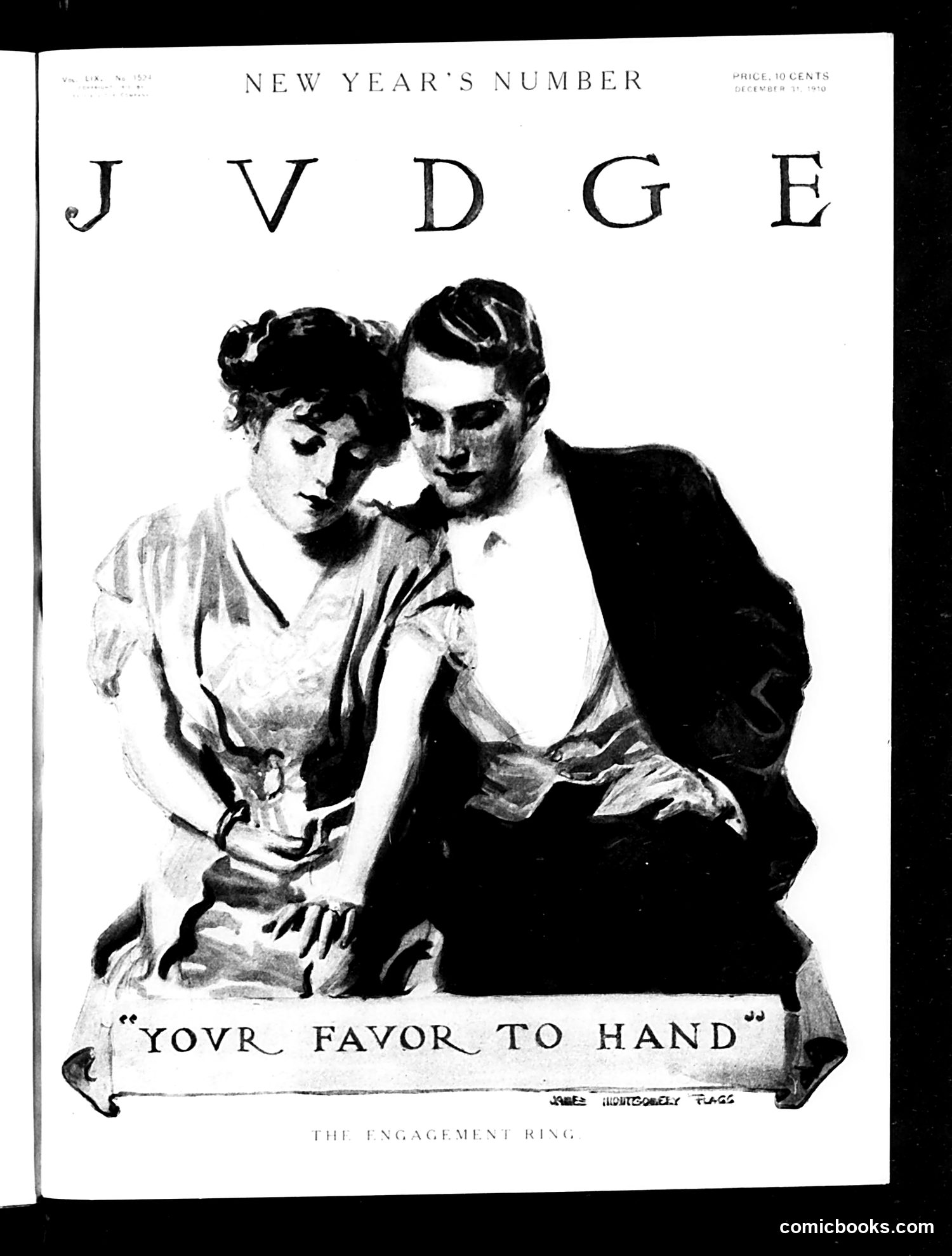
This is the New Year's Number cover of *Judge* magazine (December 31, 1910, priced at 10 cents). The illustration titled "The Engagement Ring" depicts a couple exchanging an engagement ring, with the caption "Your Favor to Hand." The satire appears to target the social custom of engagement rings as a commercial transaction rather than a romantic gesture. The formal, almost business-like poses and the phrase "Your Favor to Hand" (commercial language) suggest the magazine is mocking how engagement rings had become materialistic obligations—something "handed over" as duty rather than genuine affection. The New Year's timing implies social commentary on modern courtship conventions and consumer culture, particularly around jewelry as a required expense for marriage proposals.
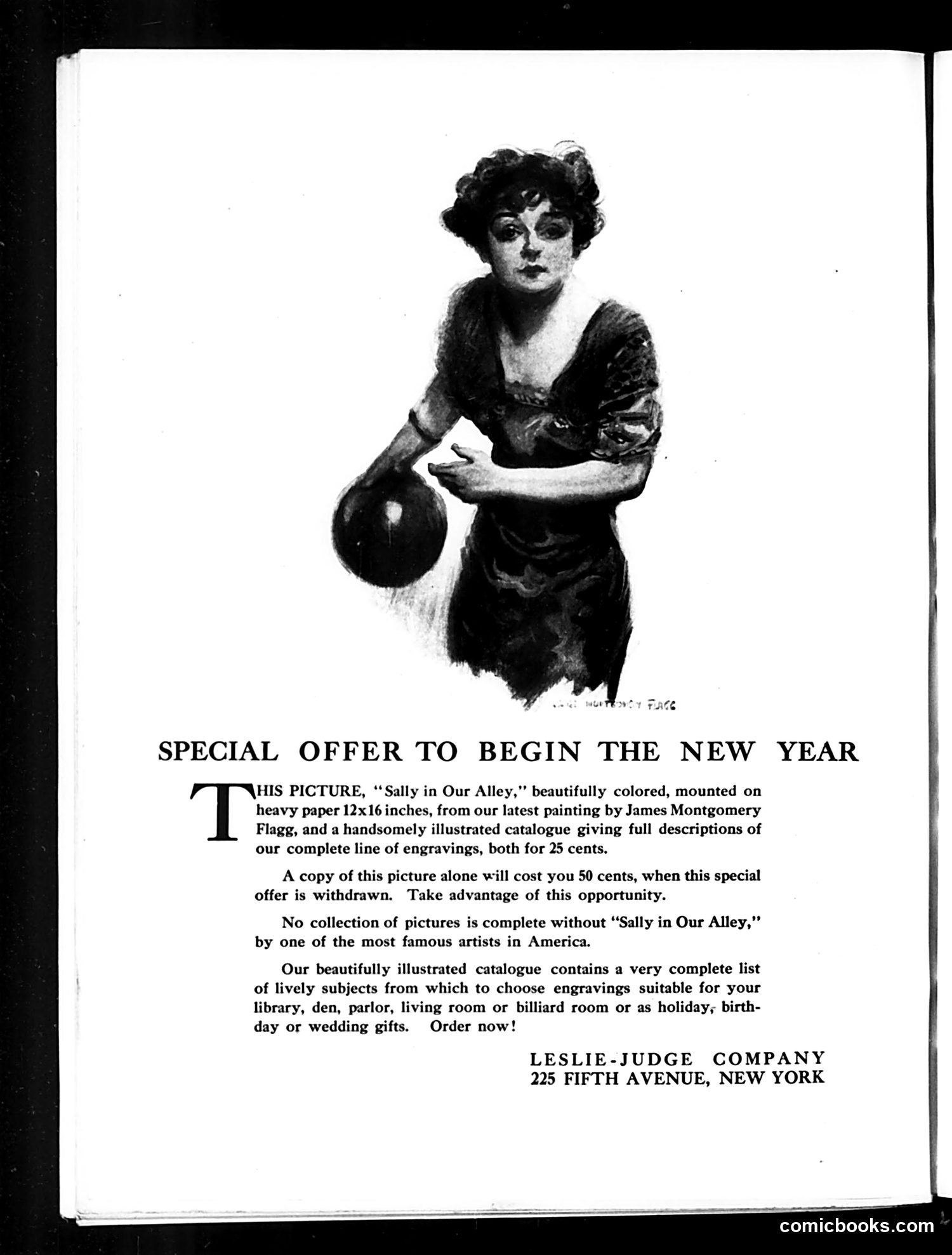
This page is primarily **advertising, not satire or political commentary**. The Leslie-Judge Company is promoting an engraving titled "Sally in Our Alley," painted by James Montgomery Flagg, a famous American illustrator of the era. The image shows a woman in dark clothing holding a bowling ball—likely depicting a character from popular culture or literature of the period. The advertisement emphasizes the picture's artistic merit and affordability: 25 cents for both the engraving and illustrated catalog, or 50 cents for the picture alone after the offer expires. The pitch targets middle-class buyers seeking affordable art for home decoration, positioning the work as a desirable collectible from "one of the most famous artists in America."
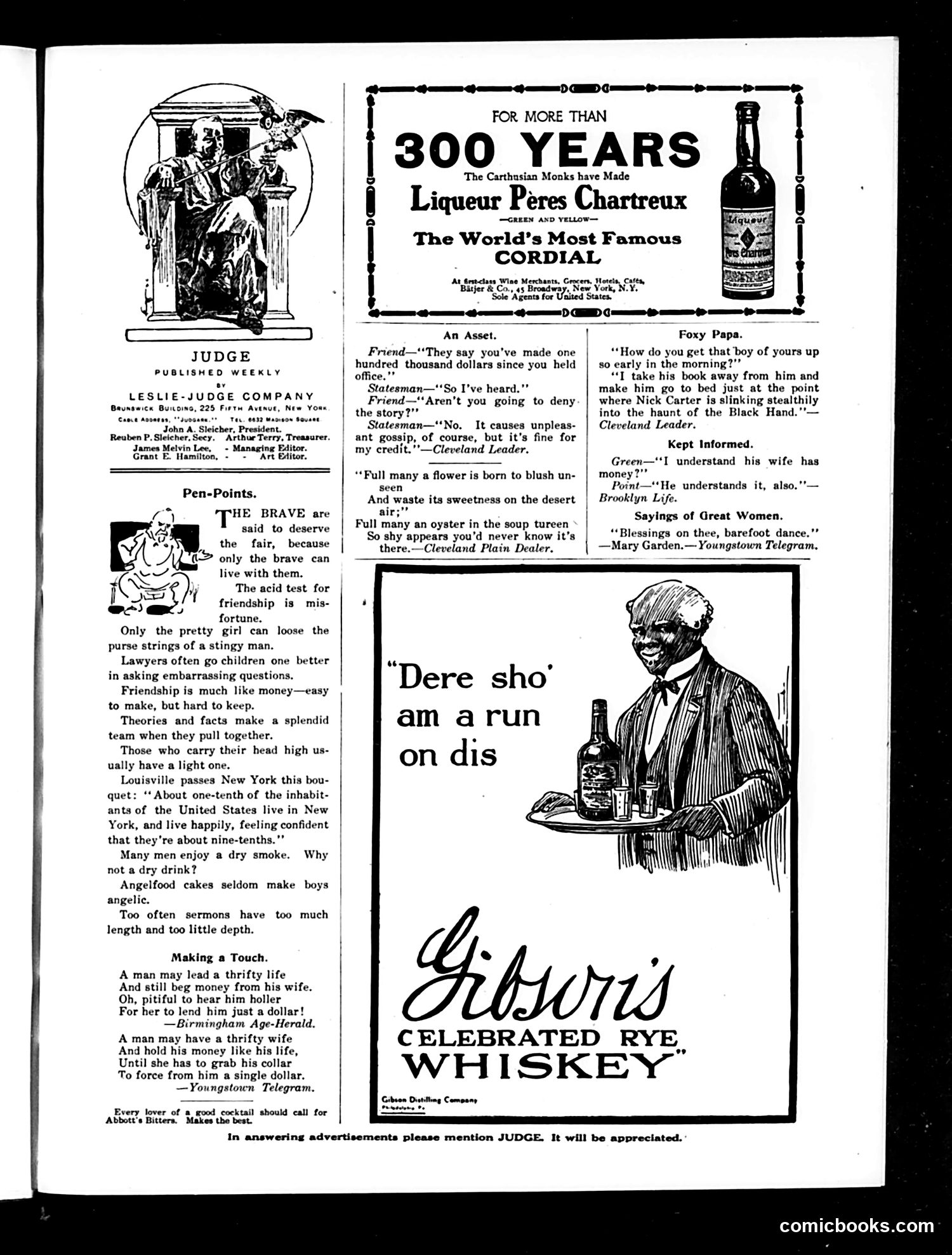
This page is primarily **advertising and humor columns** rather than political satire. The left side contains "Pen-Points," a humor column with brief witticisms about human nature—friendship, lawyers, marriage, and drinking. These are generic observations without political reference. The advertisements promote luxury goods: **Liqueur Pères Chartreux** (a French cordial claimed to be 300 years old) and **Gilbey's Celebrated Rye Whiskey**. The Gilbey's ad features a caricatured Black servant with exaggerated features saying "Dere sho' am a run on dis"—typical of the racist advertising imagery common in early 20th-century American publications. The page also includes brief comic anecdotes labeled "An Asset," "Foxy Papa," and "Sayings of Great Women"—light domestic humor without satirical intent.
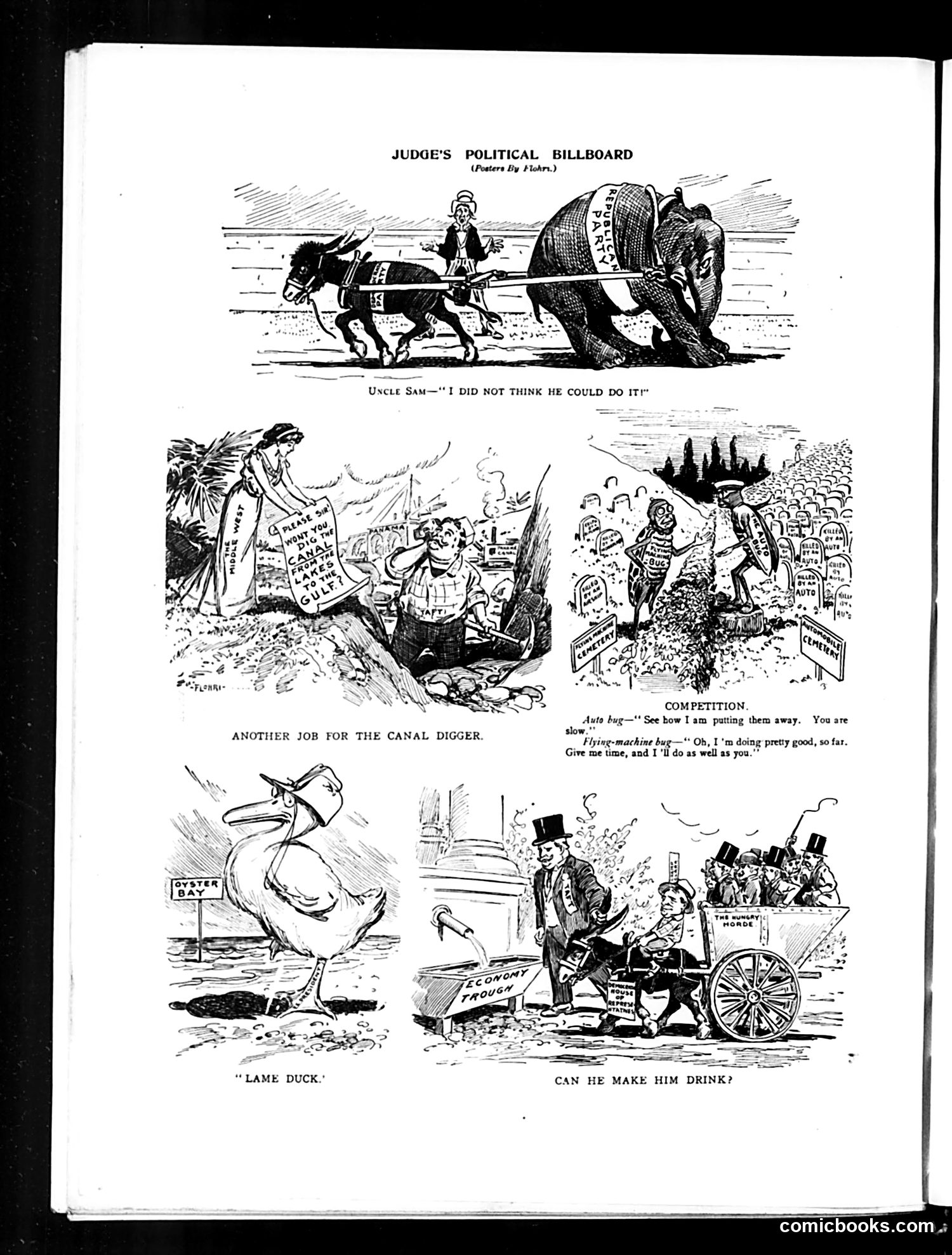
This page presents four satirical cartoons critiquing American political and social issues, likely from the late 19th or early 20th century. The top cartoon shows Uncle Sam struggling to pull a large elephant labeled with text (likely representing Republican Party or a political burden) while declaring "I DID NOT THINK HE COULD DO IT!" "Another Job for the Canal Digger" depicts manual laborers, referencing canal construction projects of the era. "Competition" shows contrasting work ethics between two laborers. "Lame Duck" features a disabled waterfowl—likely metaphorical commentary on political weakness. "Can He Make Him Drink?" depicts figures with a cart, possibly addressing temperance debates or political persuasion. The cartoons employ visual metaphors common to Gilded Age satire, though specific political targets remain unclear without additional context.
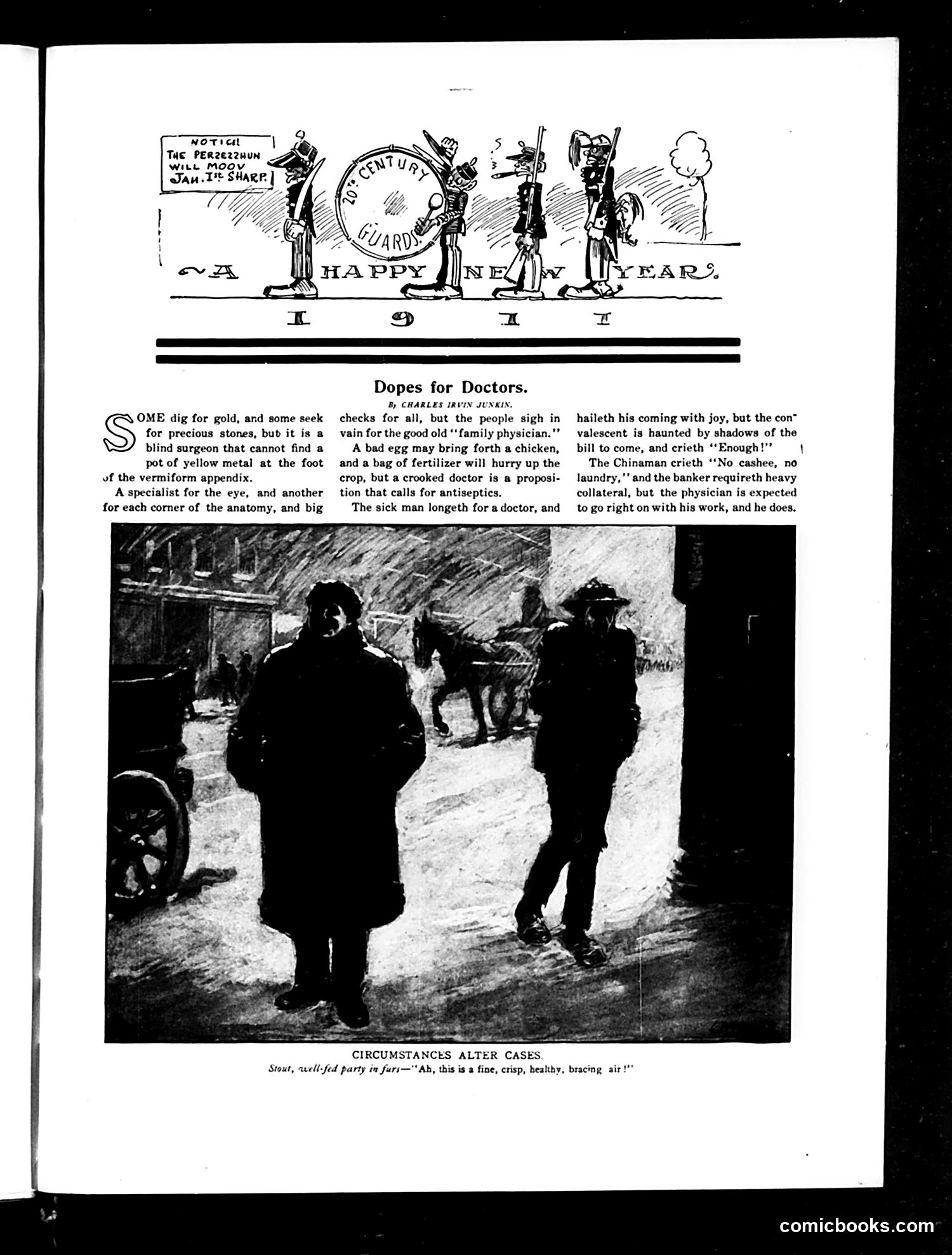
The top cartoon depicts the "20th Century Guardian" (labeled on a drum) with five figures representing New Year's resolutions, marching forward with weapons. The caption warns these resolutions "will prove sharp" — satirizing how people's good intentions typically fail. The main article by Charles Irvin Jenkins criticizes doctors who exploit patients. It mocks physicians seeking payment for dubious services, comparing crooked doctors to farmers selling bad crops. The accompanying photograph, titled "Circumstances Alter Cases," shows figures in what appears to be a tenement or poor neighborhood, with the caption sarcastically praising the "fine, crisp, healthy, bracing air" — likely criticizing doctors' indifference to poor patients' actual living conditions and health hazards.
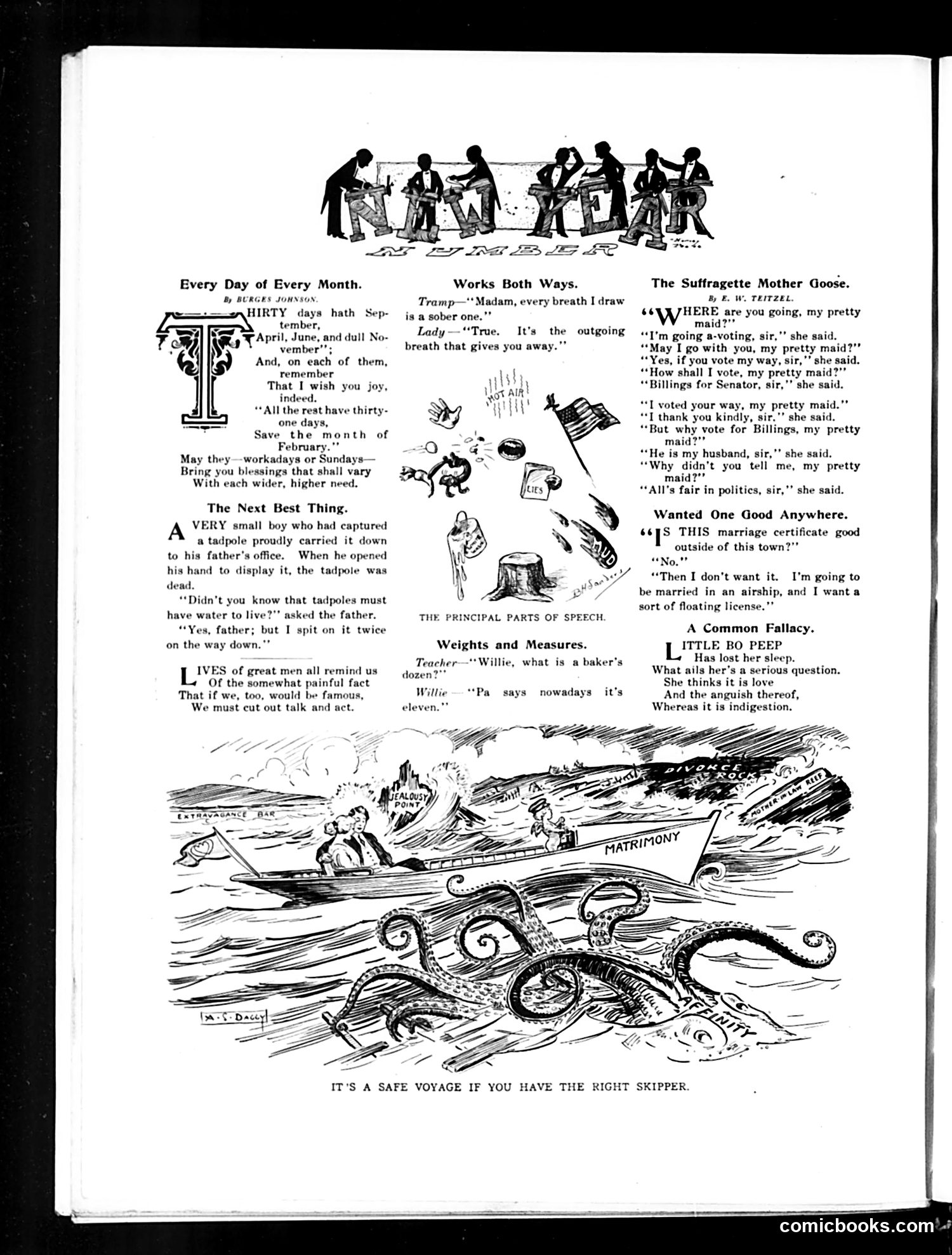
This page contains multiple short humorous pieces typical of early 20th-century American satirical magazines: **"The Suffragette Mother Goose"** parodies the nursery rhyme while satirizing women's suffrage. A young woman goes voting, and the punchline reveals she's simply voting for her husband's candidate—implying women voters lack independent judgment and merely follow their husbands' preferences. This mocks both the suffrage movement and women's autonomy. **"Wanted One Good Anywhere"** jokes about marriage certificates, with a man planning an airship wedding and wanting a "floating license"—absurdist humor with no apparent political point. **"The Suffragette Mother Goose"** is the page's primary satirical content, suggesting contemporary skepticism about female voters' independence. Other pieces are lighter fare: a boy killing his tadpole by spitting on it, a beggar's ironic claim about sobriety, and wordplay about bakers' dozens—typical period humor without deeper political meaning. The nautical illustration below references "the right skipper," likely generic maritime humor rather than specific political allegory.
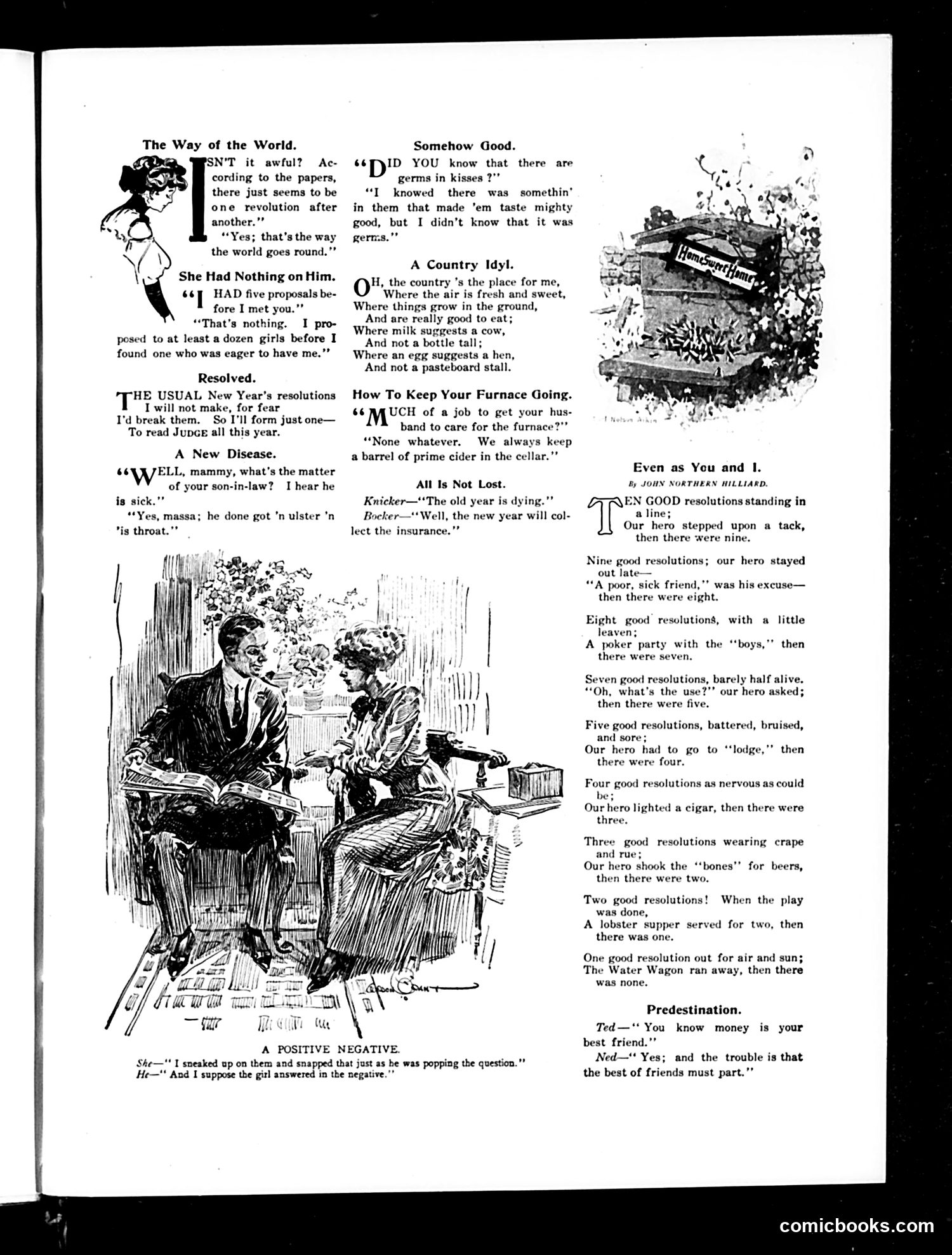
This page contains several short satirical pieces typical of early 20th-century American humor: **"The Way of the World"** mocks public obsession with constant political upheaval—a commentary on frequent governmental changes of that era. **"She Had Nothing on Him"** uses gender role reversal humor: a woman boasts of five marriage proposals; the man claims he proposed to a dozen women before finding one who'd accept him—satirizing male rejection and desperation. **"A New Disease"** features dialect humor with a Black servant character, punning on "ulster" (a coat) versus throat illness—typical of period minstrelsy humor now considered offensive. **"Even as You and I"** is the page's longest piece: a countdown poem tracking how quickly New Year's resolutions fail, with each stanza showing the protagonist abandoning them for social pleasures (late nights, poker, cigars, lodge meetings, lobster suppers). The final resolution literally "runs away" via "Water Wagon" (temperance movement reference). The cartoon illustration shows a couple examining insurance documents, reflecting post-Industrial Era concerns about financial security.
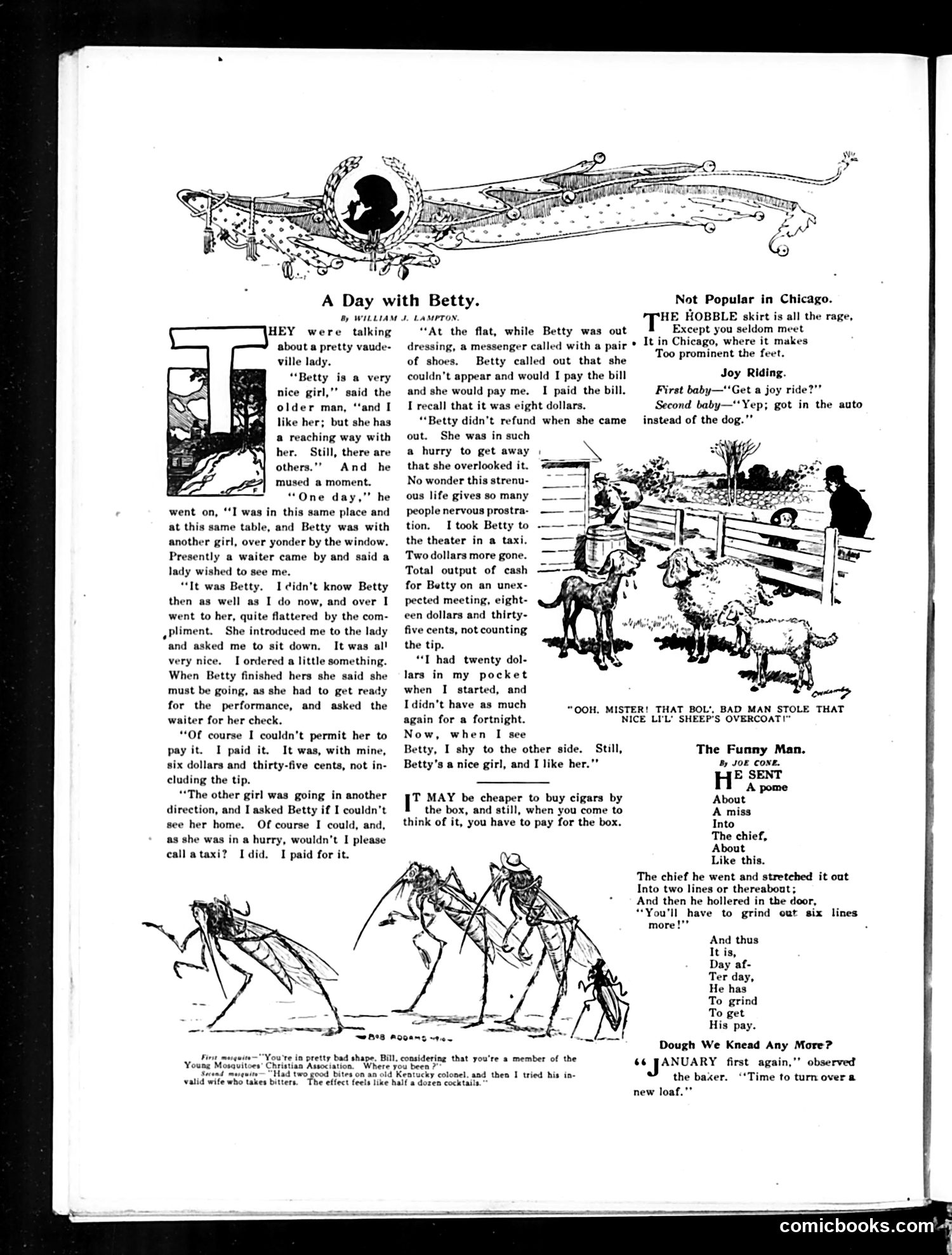
This story satirizes the emerging "modern girl" of the early 1900s—independent, working in entertainment (vaudeville), and unafraid to ask men for money. The narrator recounts a single outing where Betty extracts $18.35 from him through a series of small requests: a meal, shoes, theater tickets, and taxi rides. Each favor seems innocent individually, but collectively drain his wallet for a fortnight. The satire targets male anxiety about women's economic independence and perceived manipulative behavior. Betty isn't presented as malicious—she's simply "a nice girl"—yet the narrator now actively avoids her. The piece mocks both the new woman's financial assertiveness and the man's helpless complicity in funding her lifestyle, reflecting period anxieties about changing gender relations and women's participation in public life (working, attending theaters, traveling alone).
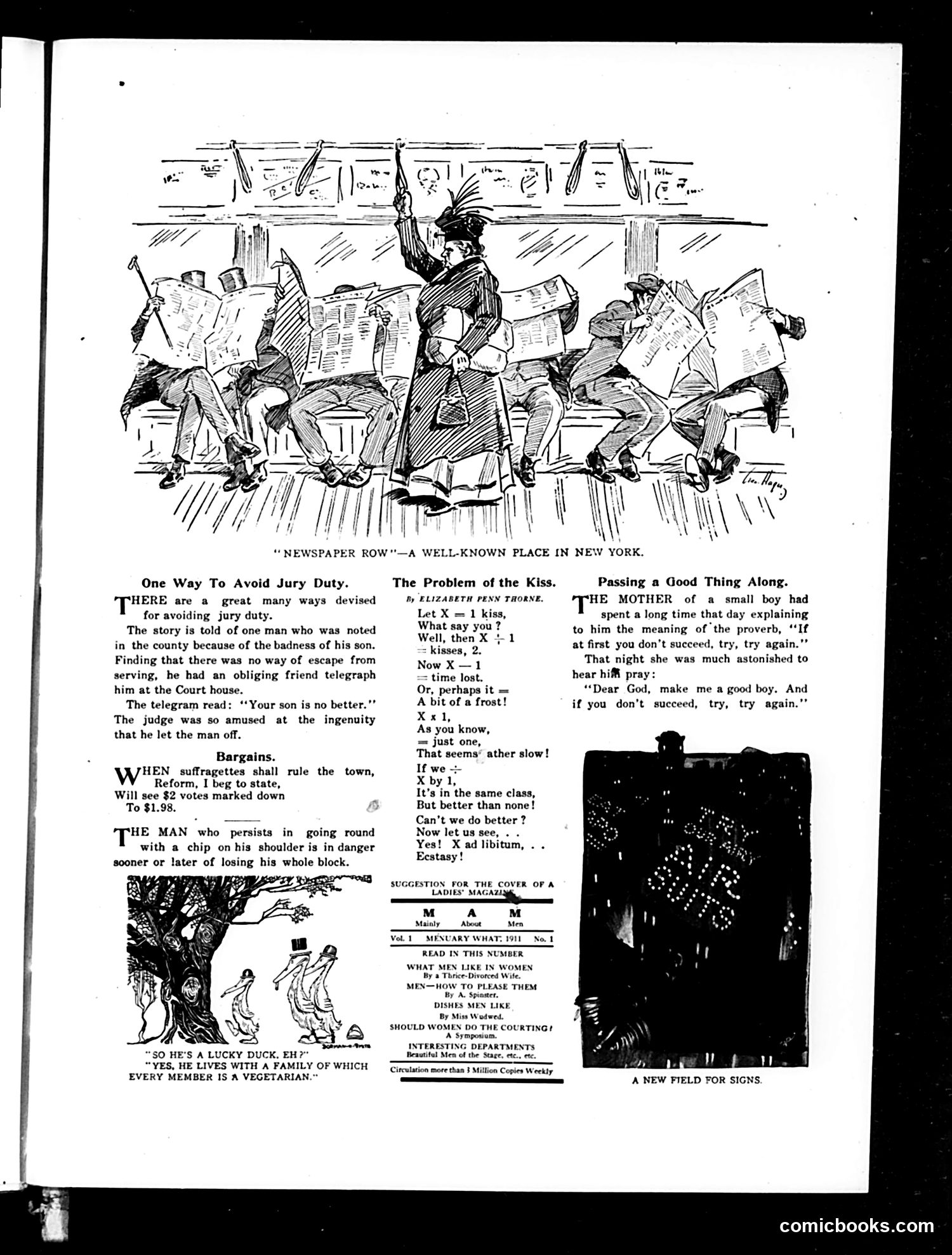
This page from Judge magazine (dated January 1911) contains several humor pieces satirizing early 20th-century American life: **Top cartoon:** "Newspaper Row" depicts journalists reading papers while sitting together—mocking the newspaper industry's self-referential culture. **Short humor pieces** target contemporary concerns: - **Jury duty avoidance:** Satirizes men seeking excuses from civic responsibility - **Suffragettes:** A barb at the women's suffrage movement, joking that female-run reform would cheapen voting (a "$2 votes marked down to $1.98") - **The Kiss problem:** A mathematical satire on romantic encounters, likely poking fun at advice columnists and romantic "formulas" **"M.A.M." magazine parody:** The fake magazine cover mocks publications targeting women, with ironic article titles by "Thrice-Divorced Wife" and "Spinster"—suggesting such magazines offered dubious relationship advice. **"Newspaper Row" and the kiss piece** reflect Judge's typical approach: witty, sometimes misogynistic social commentary aimed at educated readers familiar with current debates over women's roles and progressive reform.
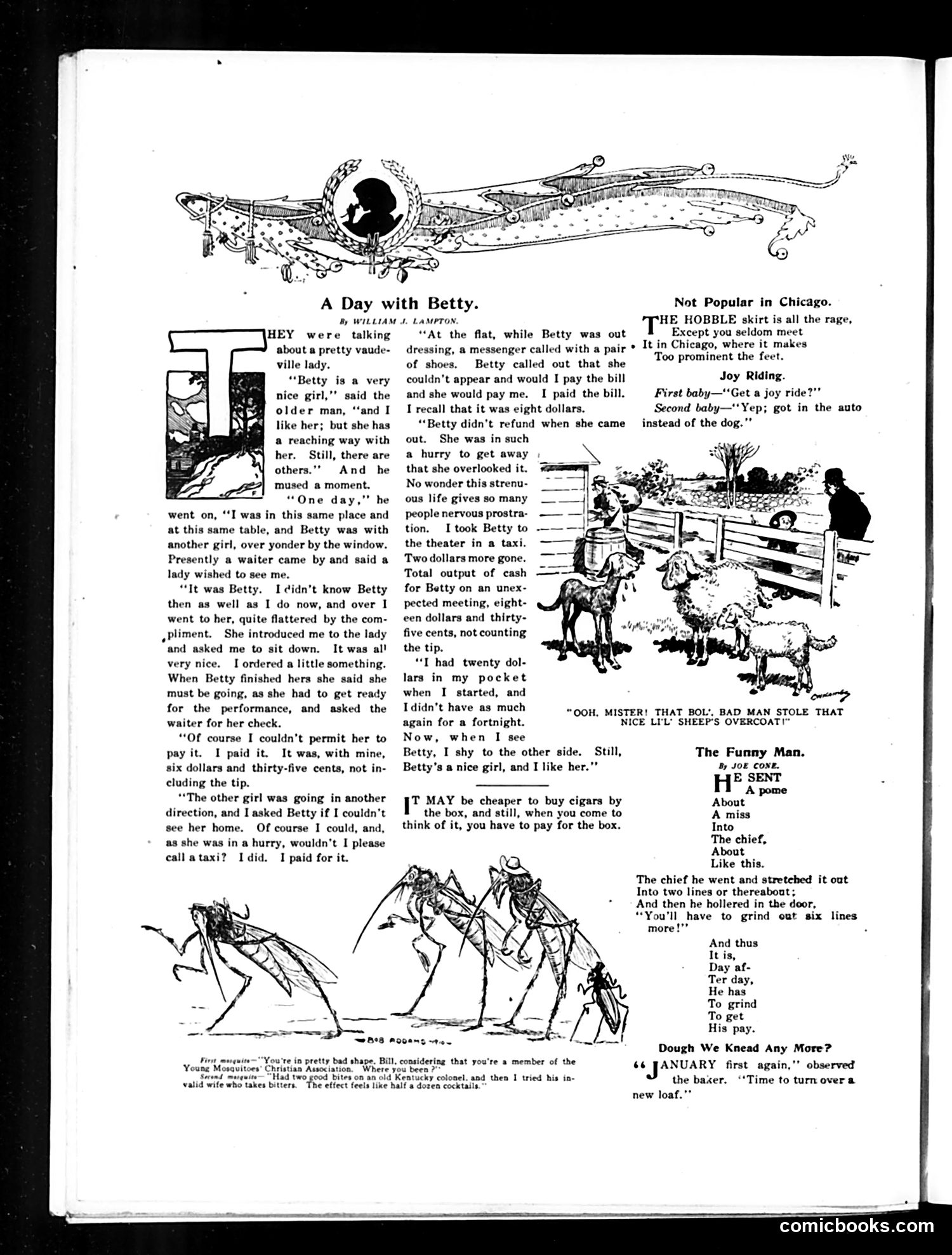
This Judge magazine page contains several humor pieces satirizing early 20th-century social dynamics: **"A Day with Betty"** mocks a common con: a vaudeville performer who extracts money from an admiring older gentleman through various "emergencies"—unpaid bills, taxi fares, theater tickets—totaling eighteen dollars. The satire targets both Betty's calculating manipulation and the gentleman's foolish susceptibility to flattery, leaving him financially depleted and avoiding her afterward. **"Not Popular in Chicago"** jokes that while hobble skirts (fashionably restrictive 1910s women's fashion) are trendy elsewhere, Chicago women reject them because the tight garment makes their feet too visible—a dig at Chicago women's practicality or foot appearance. **"The Funny Man"** satirizes editorial labor: a poet submits two lines; the editor demands six more lines to fill space, forcing endless grinding labor for minimal pay—commentary on exploitative publishing practices. **"Dough We Knead Any More?"** is a baker's New Year's pun about starting fresh ("turning over a new loaf"), playing on "knead/need." The illustrations include mosquitoes and a theft joke, unrelated to main stories.
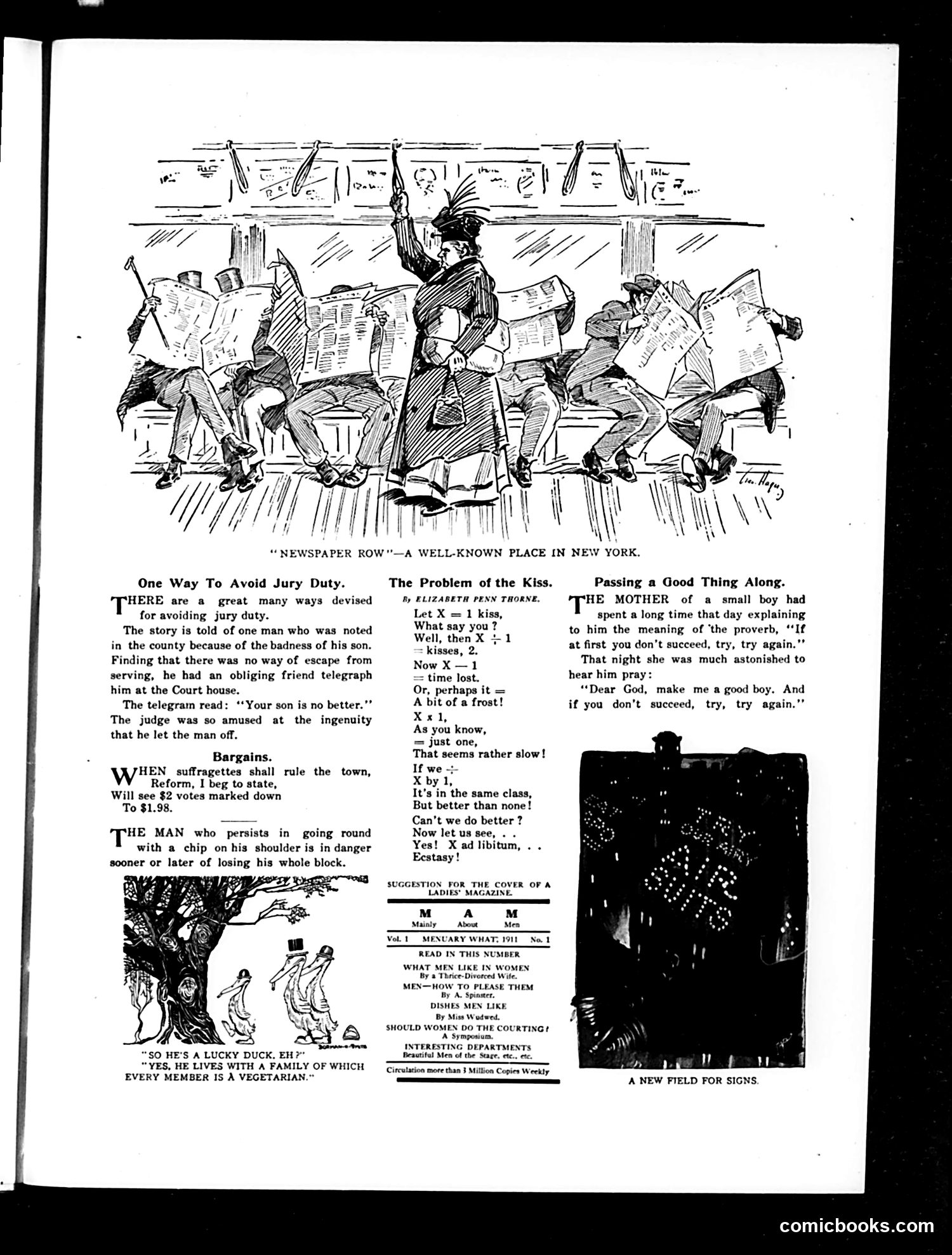
**"Newspaper Row"** depicts men reading newspapers on a New York street bench—a satirical look at public life in the city. **The jury duty anecdote** mocks how people escape civic obligations through clever schemes; the man's sympathetic story about his wayward son amuses the judge enough to dismiss him. **"Bargains"** satirizes the women's suffrage movement, suggesting that when women gain political power, even market prices will be artificially inflated—a common anti-suffrage jab implying women are poor economic managers. **"The Problem of the Kiss"** presents romantic mathematics as absurdist humor, playing with equations where X represents kisses, ultimately endorsing unlimited affection ("X ad libitum"). **The magazine cover suggestion** mockingly proposes a ladies' magazine entirely devoted to pleasing men, with articles by "thrice-divorced wives" and spinsters—satirizing both women's magazines and their presumed obsession with male approval. **"Passing a Good Thing Along"** is a gentle joke about a child literally applying his mother's proverb advice to prayer, misunderstanding her lesson about persistence.
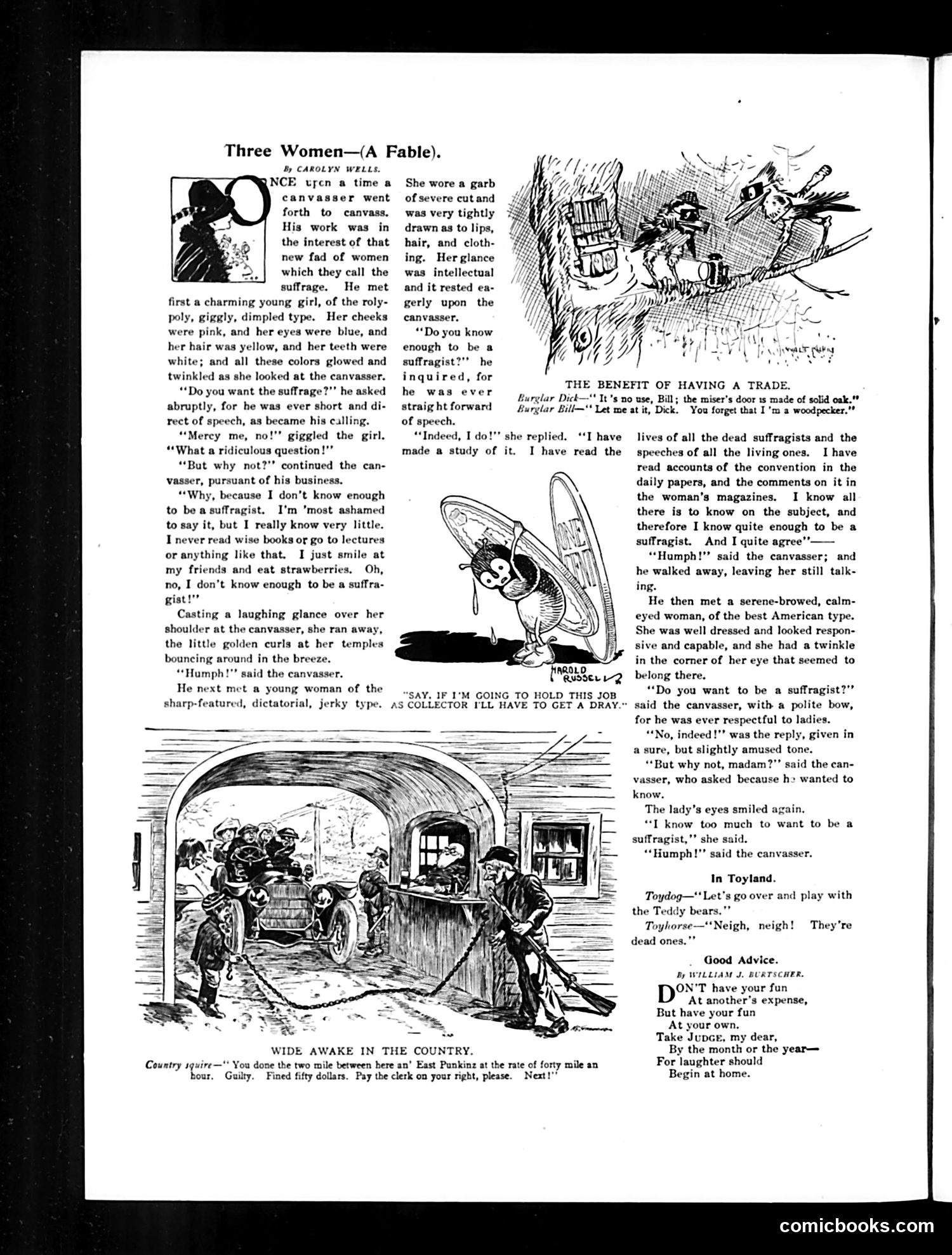
This satirical fable mocks women's suffrage advocacy by presenting three female types through a canvasser's eyes. The first—a giggly, decorative young woman—refuses suffrage, claiming ignorance. The second—sharp-featured and intense—enthusiastically supports it, having read extensively about conventions and speeches but demonstrating obsessive pedantry. The third—calm, capable, and genuinely intelligent—rejects suffrage precisely *because* she knows too much. The satire's point: Judge ridicules the suffrage movement by suggesting its most vocal supporters are either insufferably earnest or intellectually pretentious, while truly wise women reject it outright. The "moral" dismisses suffragism as unworthy of serious women's attention. This reflects early 20th-century anti-suffrage sentiment that portrayed activists as either frivolous or humorless zealots, contrasting them with an idealized "natural" woman who knows her place.
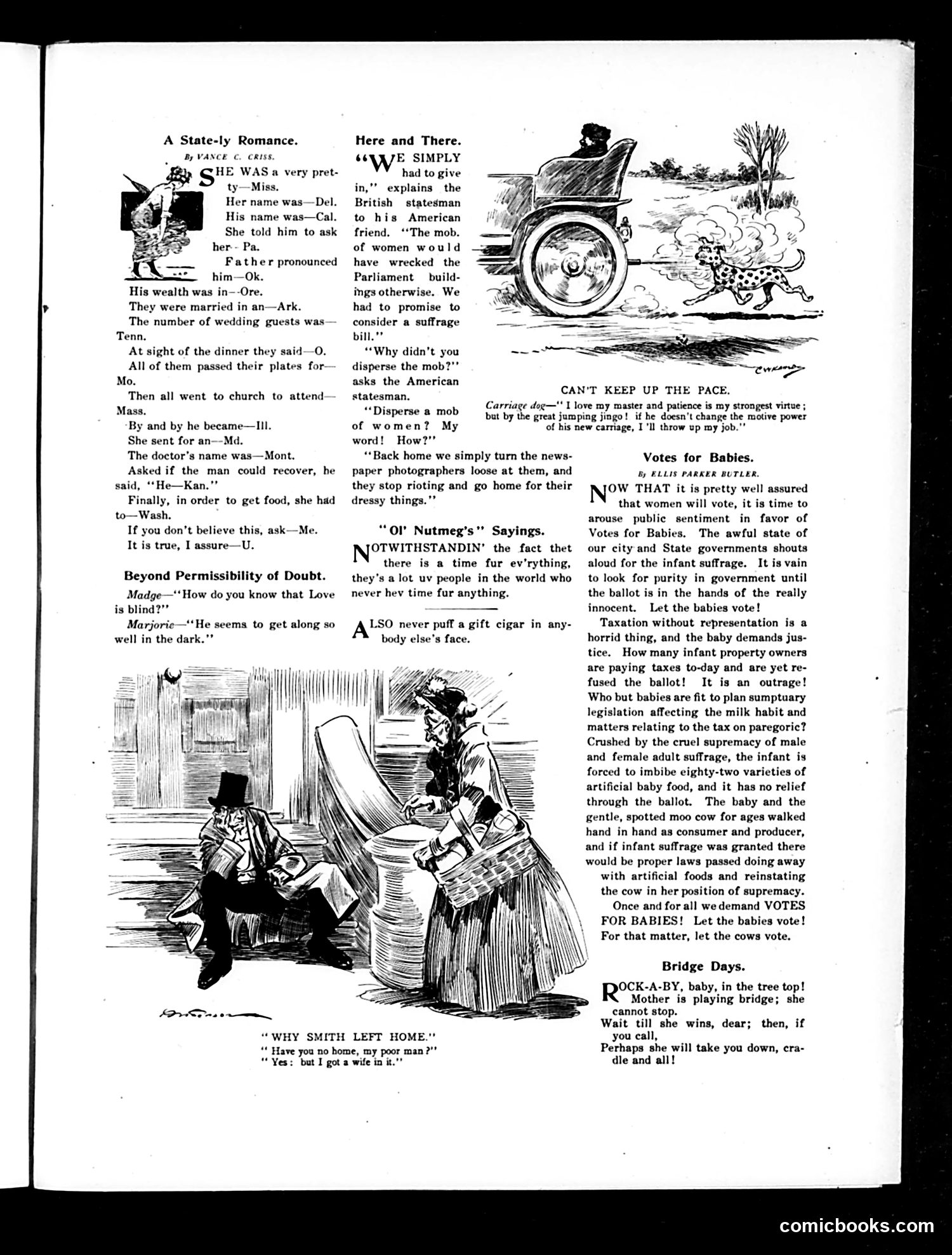
This page contains several satirical pieces reflecting early 20th-century American attitudes: **"A State-ly Romance"** is a pun-based joke where state abbreviations substitute for words (Del-Miss marries Cal, lives in Ore, marries in Ark, etc.). It's wordplay rather than political commentary. **"Here and There"** satirizes British suffragettes. A British statesman admits to a American peer that he capitulated on a suffrage bill because women "would have wrecked Parliament"—implying female protesters were violent and uncontrollable. The American's suggestion to deploy photographers to disperse them mocks both nations' approaches to women's activism. **"Votes for Babies"** by Ellis Parker Butler is satirical advocacy. Writing as women's suffrage became imminent, Butler ironically argues babies deserve voting rights too, since they're "really innocent" and affected by laws on milk and artificial baby food. The satire critiques adult suffrage debates by extending the logic absurdly. **"Bridge Days"** jokes that mothers prioritize card games over childcare—a common domestic stereotype of the era. The overall tone reflects Judge's skepticism toward women's political participation and social change.
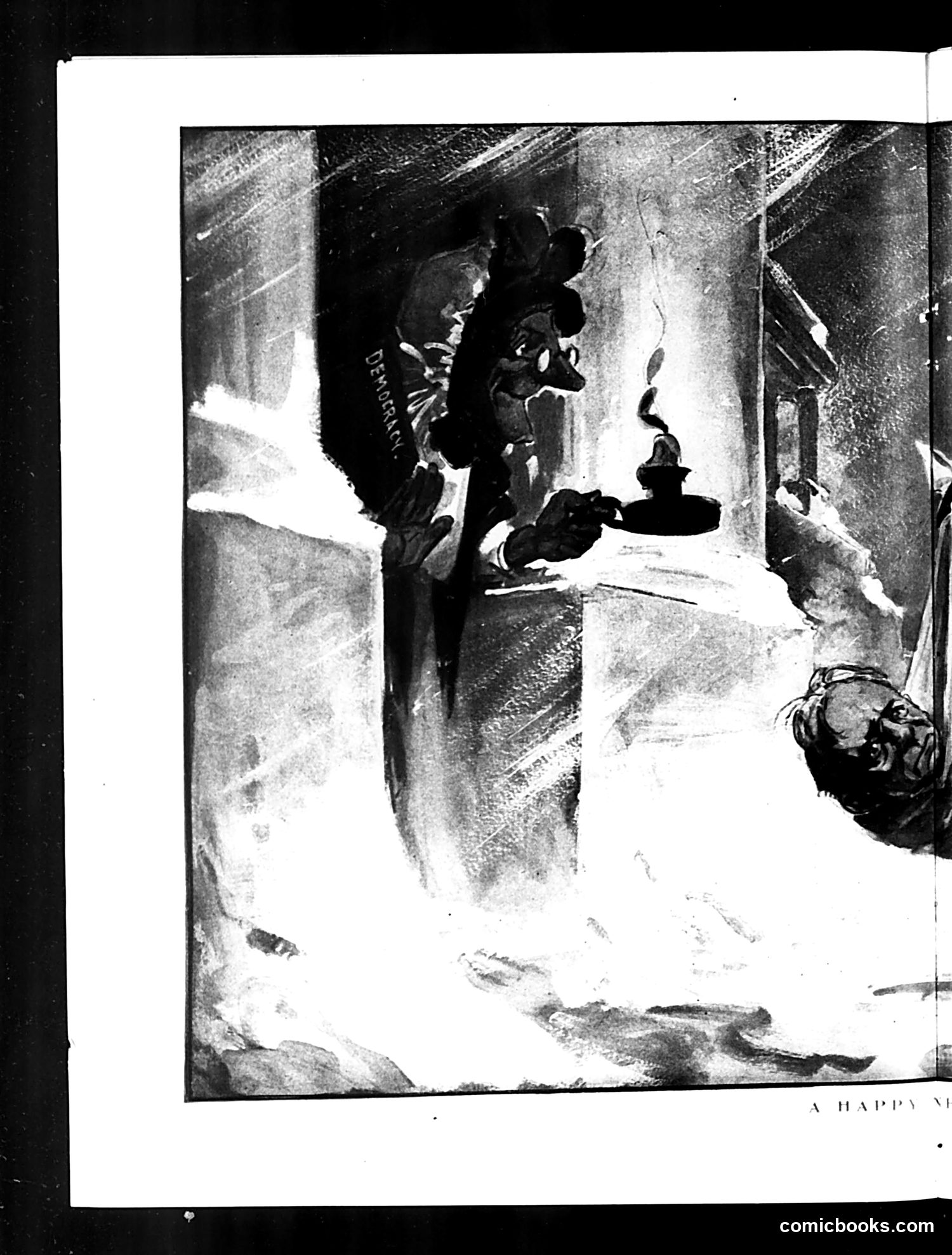
This page contains minimal legible text—the OCR appears corrupted or incomplete, with only "HAPPY" clearly visible at the bottom. The black and white photograph shows what appears to be a winter scene with snow, depicting several figures in dark clothing in an alleyway or confined space. One figure holds what looks like a lamp or light source. The composition and lighting suggest this might be illustrating a narrative scene—possibly from a story, serialized comic, or satirical piece about urban life, poverty, or a holiday theme (given "HAPPY" and the winter setting). Without clearer text or identifiable figures, I cannot definitively explain the specific political or social satire intended. This may be a photographic illustration accompanying an article or story rather than a traditional cartoon.
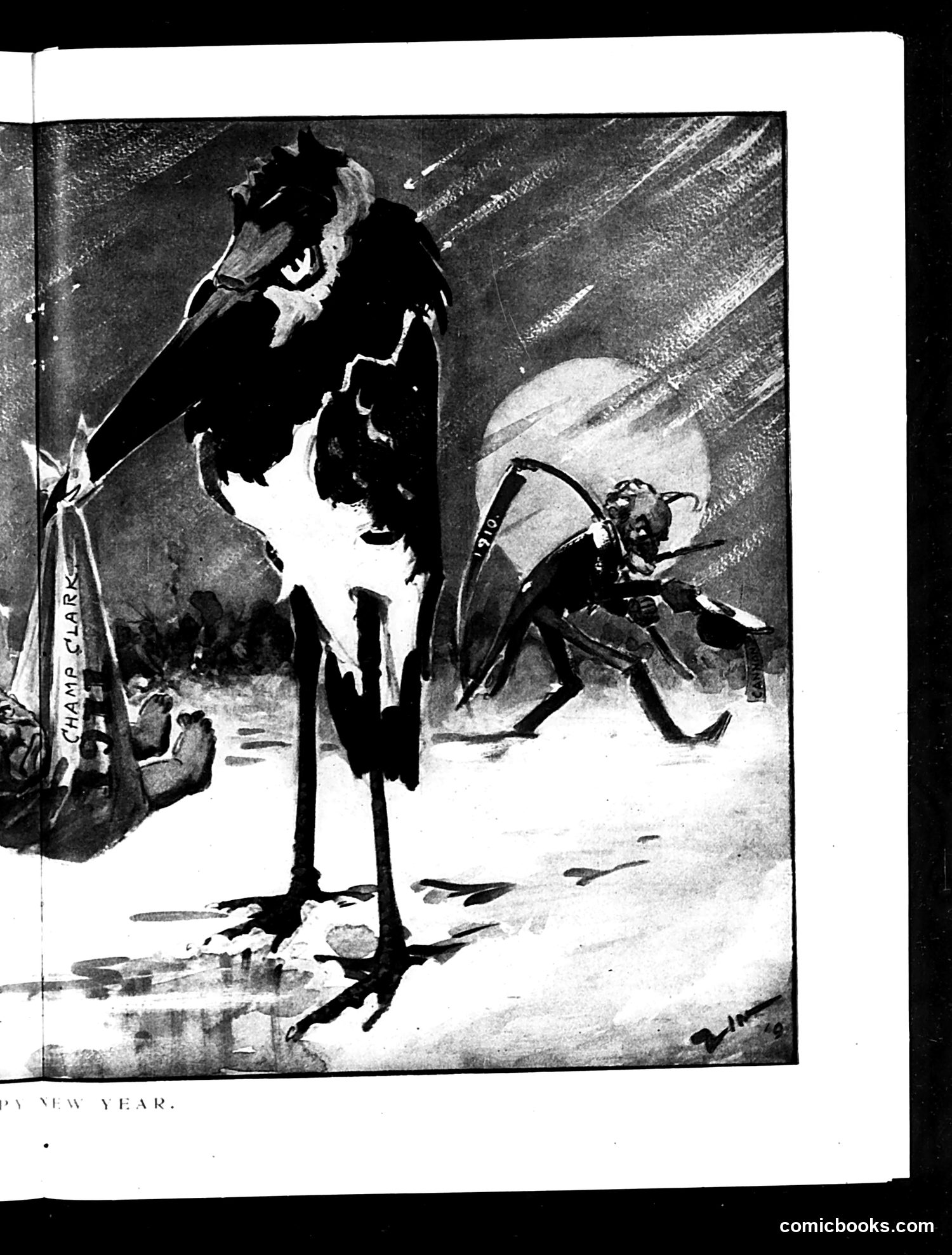
This appears to be a New Year-themed satirical illustration from *Judge* magazine. The image shows two figures in a snowy landscape: on the left, what appears to be an elderly or worn figure (possibly representing the outgoing year) holding a torch or staff, and on the right, a figure in formal dress (likely representing the incoming new year) also holding a torch. The cartoon likely satirizes the transition between years, possibly commenting on political or social conditions. However, the OCR text is minimal ("NEW YEAR" and "comicbooks.com"), making it difficult to identify specific political figures or events being referenced. The artistic style and presentation suggest social commentary typical of *Judge* magazine's satirical approach, but the precise meaning remains unclear without additional context or clearer text.
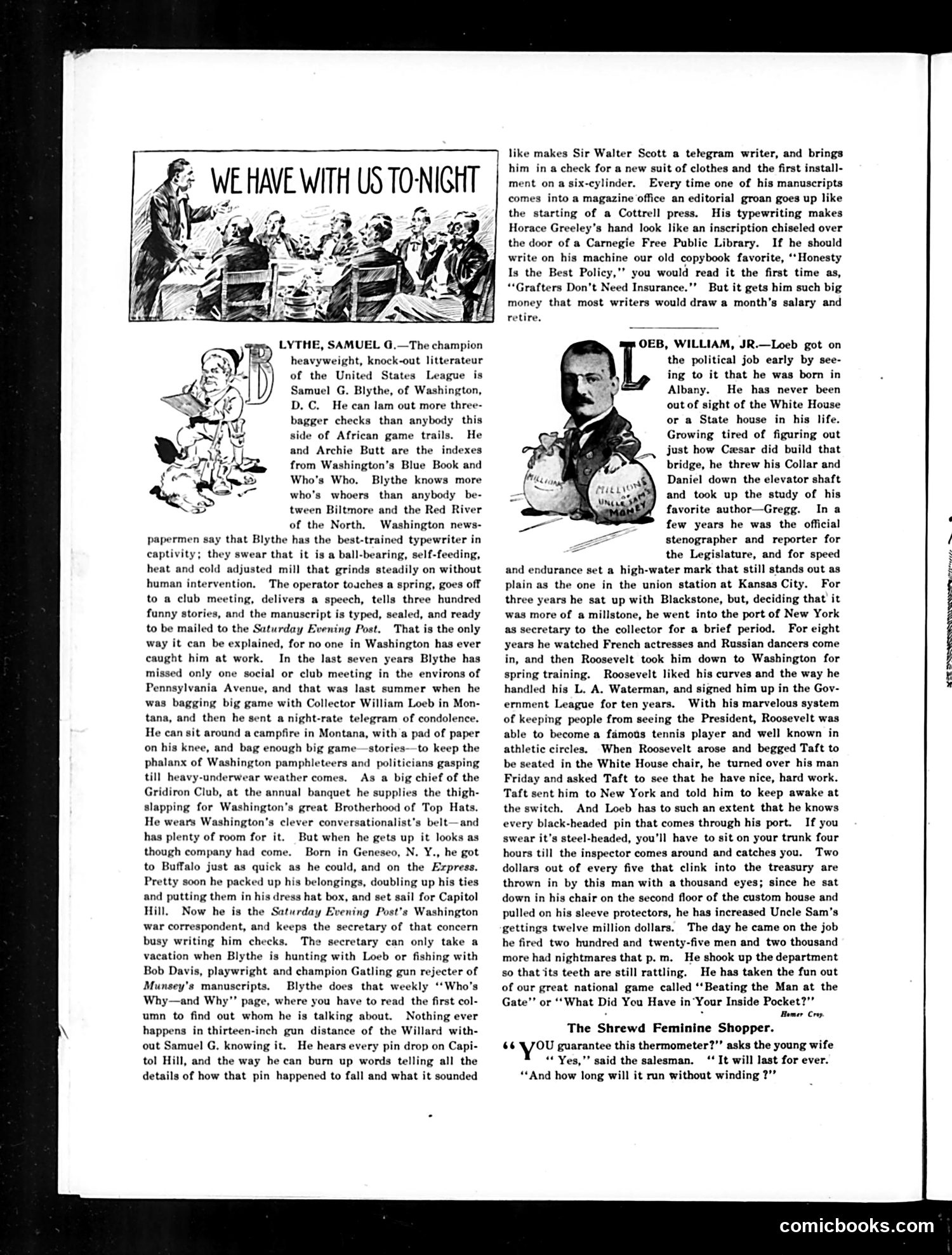
This page profiles two prominent Washington figures from the early 1900s: **Samuel G. Blythe** (top): A prolific writer for the *Saturday Evening Post* and Washington correspondent. The satire mocks his seemingly superhuman productivity—the text humorously suggests his typewriter works autonomously while he attends social events. He's portrayed as ubiquitous in Washington society, never missing a gathering, and capable of generating endless stories and articles. The joke centers on his inexplicable ability to produce vast amounts of publishable material despite appearing to do no actual work. He's connected to President Theodore Roosevelt's inner circle (William Loeb is mentioned). **William Loeb Jr.** (bottom, partial): Roosevelt's secretary and Albany political operative, depicted as a career government insider who never strayed far from power centers. The satire reflects *Judge* magazine's insider humor about Washington's powerful media and political figures during the Progressive Era.
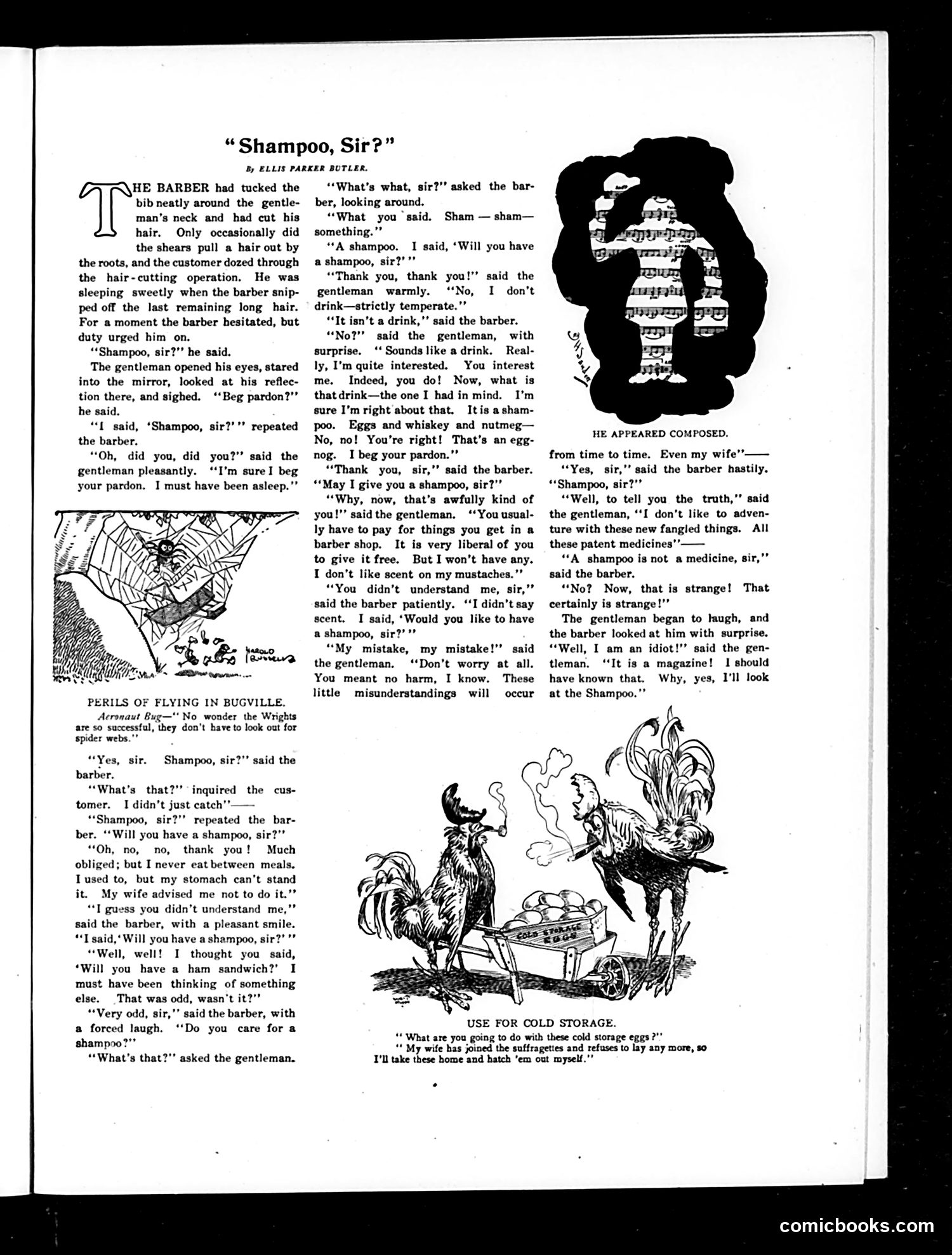
This is a humorous short story by Ellis Parker Butler about a barber repeatedly asking a customer if he wants a shampoo, but the customer chronically mishears the word. He interprets "shampoo" as "ham sandwich," "drink," "scent," and finally "magazine." The joke relies on the customer's deliberate obtuseness and absent-mindedness—he dozes during his haircut and remains distracted throughout. The barber's mounting frustration (shown as a "forced laugh") contrasts with the gentleman's cheerful obliviousness. The humor is absurdist: the gentleman invents increasingly nonsensical explanations rather than simply asking clarification. The page also includes two unrelated cartoons: one about aviation ("Perils of Flying in Bugville") and another about suffragettes refusing to lay eggs for cold storage—a contemporary political jab at the women's rights movement.
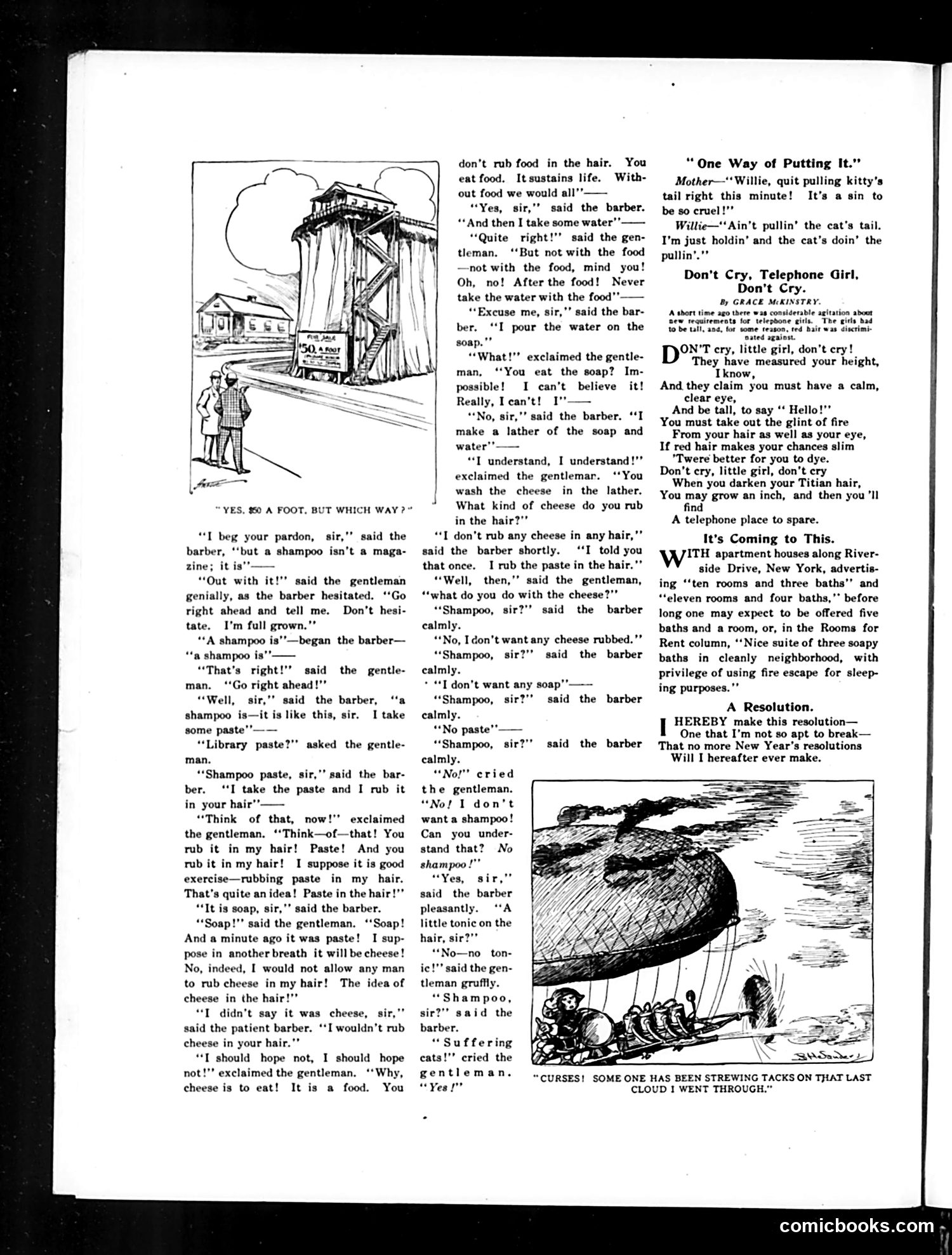
## Main Cartoon: "Yes, $80 a Foot, But Which Way?" This depicts a classic "absent-minded gentleman" vs. patient barber dialogue. The gentleman comically misunderstands each step of a shampoo—confusing "paste" with "cheese," insisting food shouldn't go in hair, and becoming increasingly confused about whether soap, paste, water, and tonic are being used. The barber's calm repetition of "Shampoo, sir?" as the gentleman grows more exasperated creates the humor. The satire targets upper-class gentlemen's pretentious pedantry and literal-minded obtuseness. His absurd logic ("cheese is food; you don't rub food in hair") mocks those who take themselves too seriously and exhaust working-class people with obtuse questioning. ## Supporting Pieces: - **"One Way of Putting It"**: Brief joke about Willie reframing pulling the cat's tail as the cat "doing the pulling"—wordplay on responsibility. - **"Don't Cry, Telephone Girl"**: Addresses contemporary regulations requiring telephone operators to meet appearance standards (height, hair color, composure), satirizing these arbitrary professional requirements.
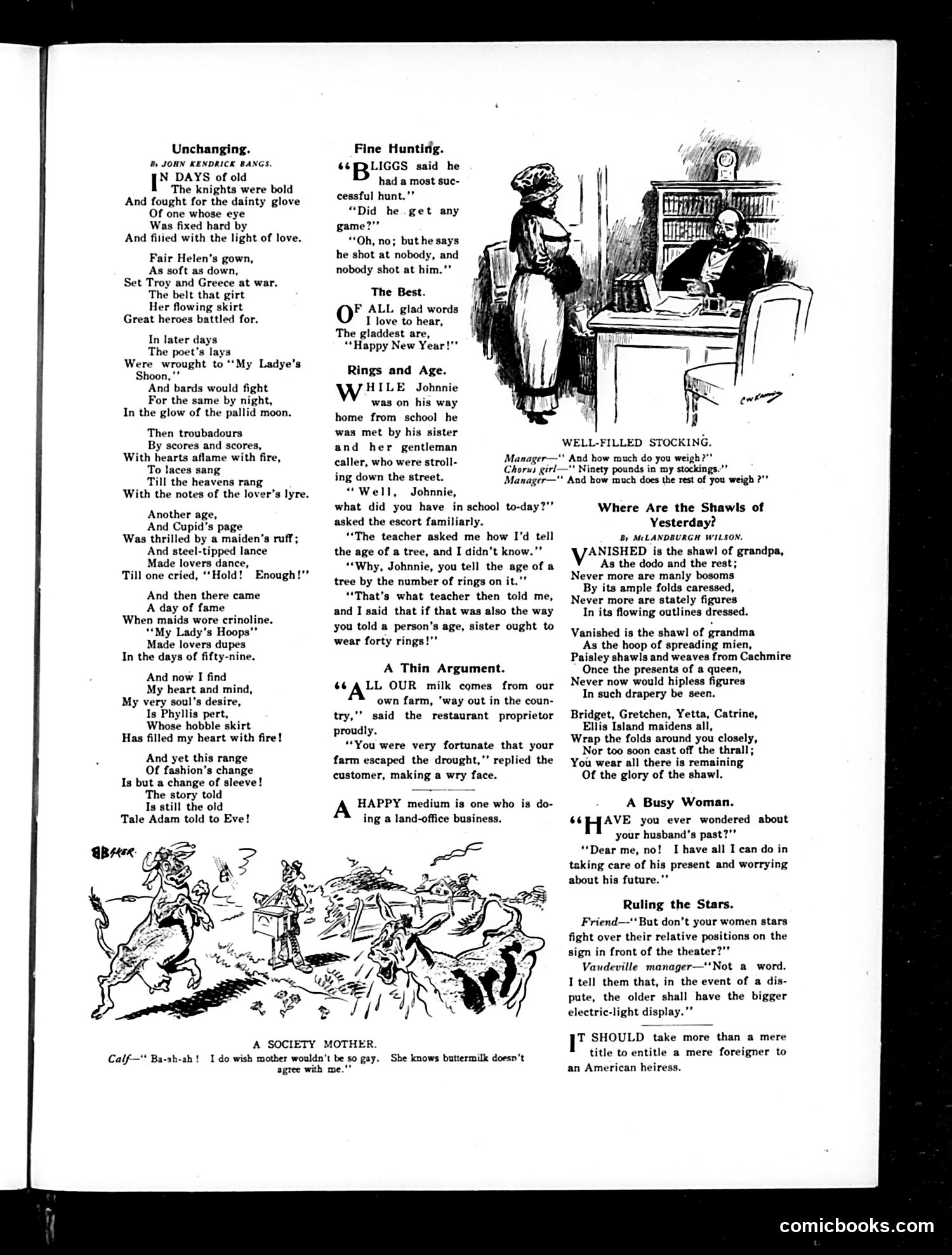
This page from Judge magazine contains several pieces of light satirical humor targeting early 20th-century social conventions: **"Unchanging"** (poem by John Kendrick Bangs): Satirizes romantic fashion cycles. The poet observes that despite changing fashions—from medieval knights fighting over gloves to Victorian crinolines to modern "hobble skirts"—male romantic desire remains constant. The joke: fashion constantly shifts, but human nature doesn't. **"Fine Hunting"**: A brief joke mocking poor marksmanship or cowardice, where "Briggs" claims a successful hunt despite shooting at and hitting nobody. **"Rings and Age"**: A child's joke where a boy remarks his sister should wear "forty rings" (like tree rings indicate age), insulting her assumed age. **"Where Are the Shawls of Yesterday?"**: Nostalgic verse lamenting the disappearance of fashionable shawls worn by earlier generations, noting that only immigrant women ("Ellis Island maidens") still wear them. **Other brief items** mock marital dynamics, theatrical hierarchies, and restaurant pretensions. The page represents typical Judge humor: topical, fashion-focused satire aimed at middle-class readers.
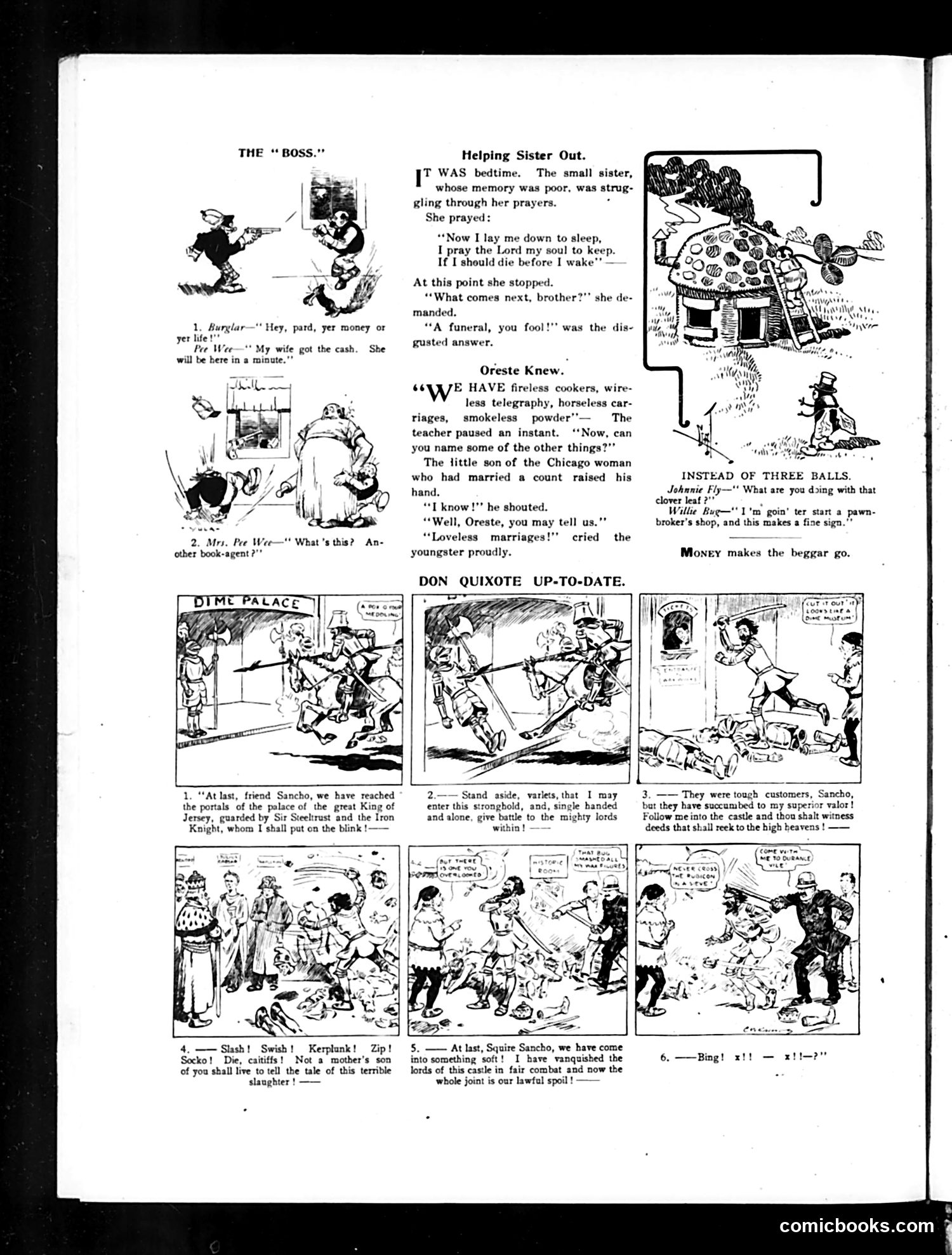
This page contains three satirical pieces typical of early 20th-century American humor: **"The Boss"** mocks working-class domestic life through a burglar who encounters a husband whose wife controls the finances—a joke about female economic power in marriage. **"Helping Sister Out"** uses a child's innocent prayer mistake to satirize sibling rudeness; the brother's crude answer about funerals is darkly humorous. **"Oreste Knew"** ridicules the modern obsession with "wireless" and "horseless" innovations by having a Chicago woman's son (named Oreste, suggesting European pretension) quip about "loveless marriages"—satirizing both technological fads and wealthy Americans marrying foreign nobility. **"Don Quixote Up-to-Date"** parodies the classic novel by replacing Spanish windmills with a modern attack on a "King of Jersey" stronghold, likely referencing New Jersey industrial monopolies or trusts. The outdated heroic language applied to modern corporate warfare creates the satire.
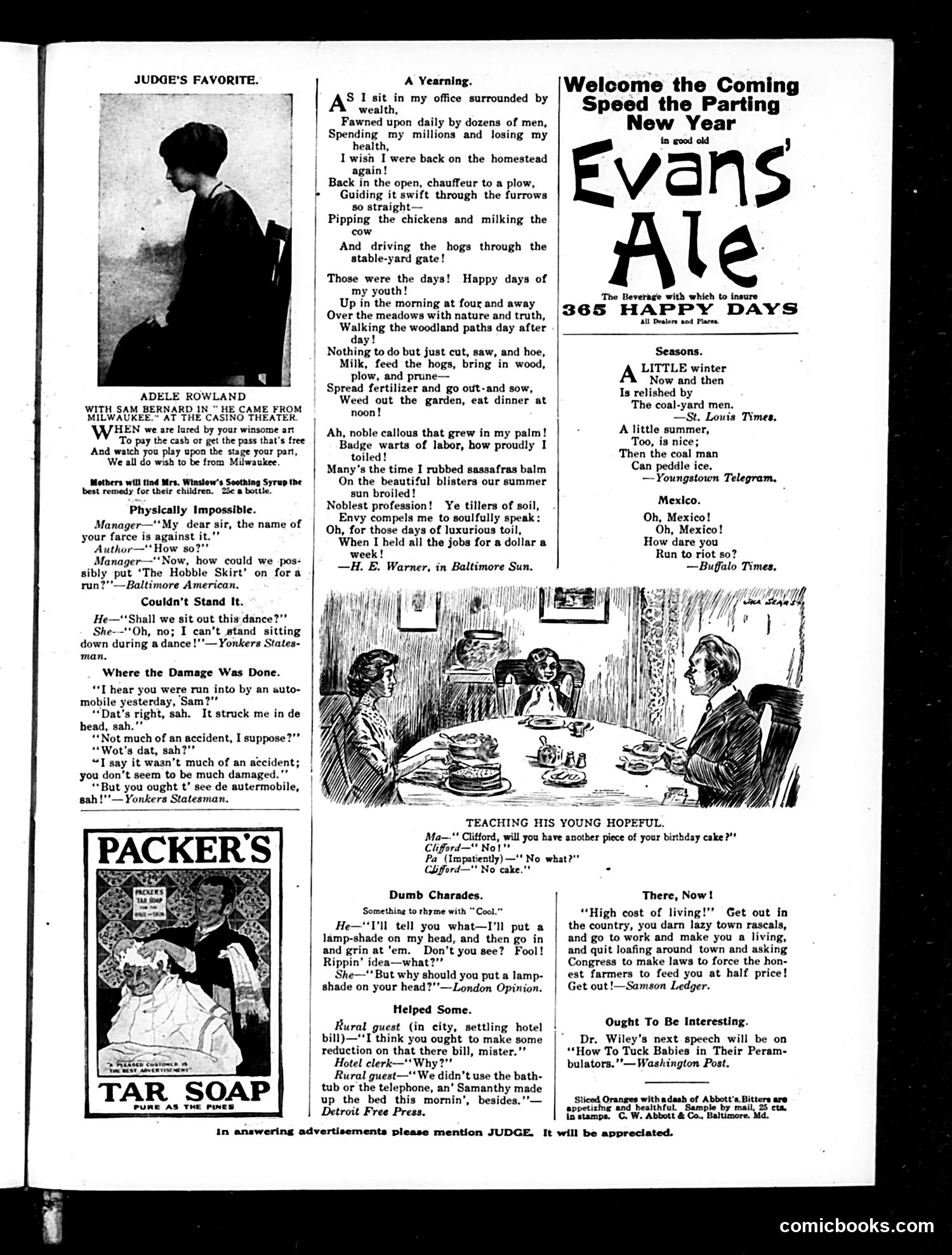
This page from Judge (a satirical weekly) mixes entertainment coverage with short humor pieces typical of early 20th-century magazines. **Top section:** Features actress Adele Rowland in a stage production, with a light poem praising her performance—typical celebrity puffery disguised as editorial content. **Main humor pieces:** Short jokes exploiting contemporary concerns. "Physically Impossible" mocks the "hobble skirt" fashion craze (restrictive skirts that limited movement). "Where the Damage Was Done" uses immigrant dialect humor (then-common in American comedy) for a punchline about an auto accident. **"A Yearning"** is satirical verse mocking wealthy industrialists' nostalgia for farm labor—the poet romanticizes backbreaking work while actually valuing only the "dollar a week" wage. The irony targets class pretension. **Bottom section** includes Evans Ale advertising, seasonal humor about coal delivery (heating fuel was essential), and political commentary attacking unemployed urbanites demanding government help, urging them instead toward rural farm work. The overall tone reflects Progressive-era anxieties about urbanization, labor, and class.
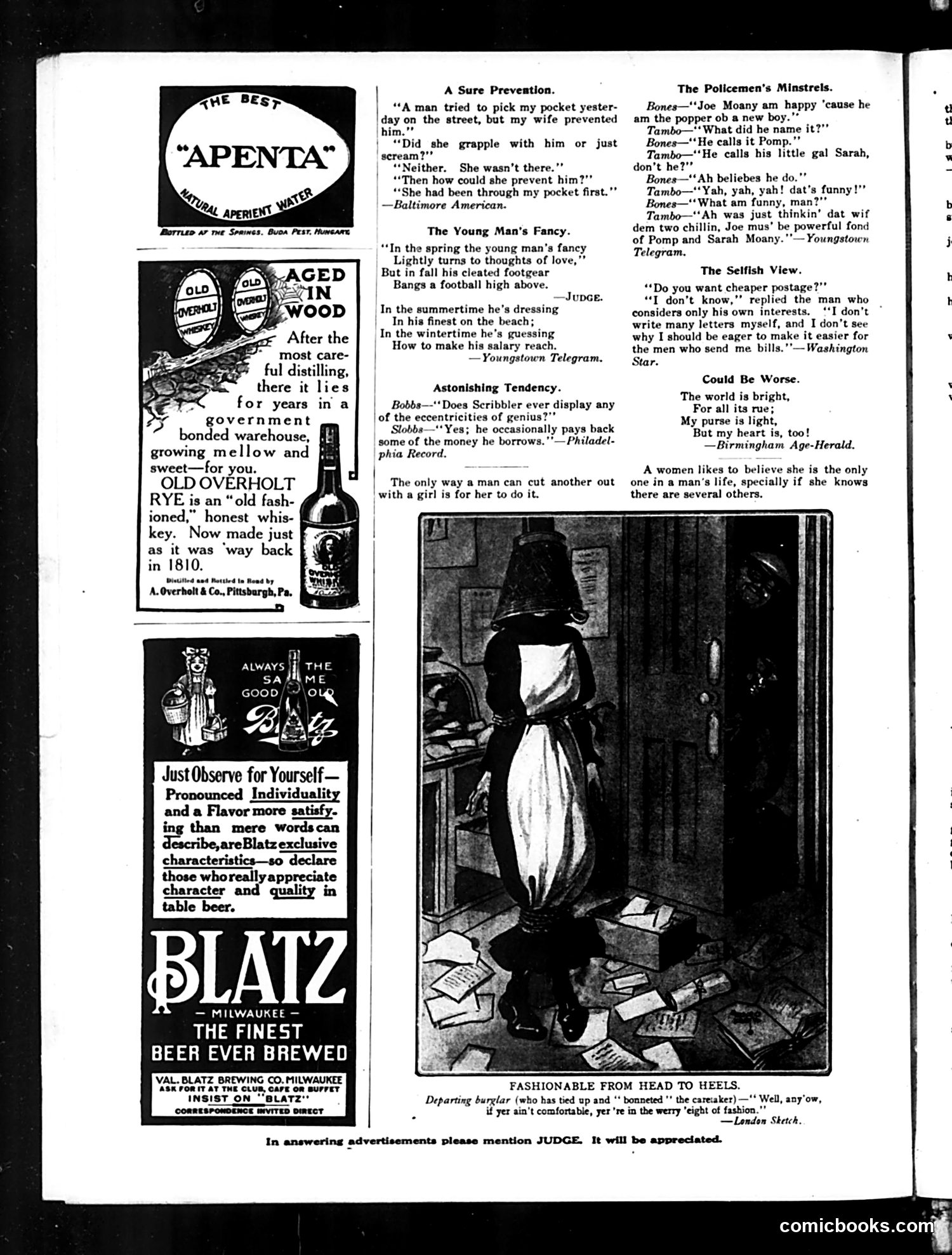
This page from **Judge** (a satirical American magazine) contains mostly **advertisements and humor columns** rather than political cartoons. The **main cartoon** depicts a burglar who has tied up and bonneted a caretaker during a robbery. The joke's satire is social/fashion-based: the burglar comments that despite the caretaker's uncomfortable position, she's fashionably dressed—a darkly humorous jab at how absurdly high women's fashion hats had become (the exaggerated bonnets were apparently so enormous they resembled the tied-up pose). The **humor columns** are genteel social satire: jokes about pocket-picking wives, young men's seasonal priorities (love in spring, football in fall), and a selfish man unwilling to support postal reform because *he* doesn't mail letters. The "Policemen's Minstrels" uses dated minstrel-show dialect humor (considered offensive today). **Advertisements** promote Old Overholt Rye whiskey and Blatz beer, emphasizing tradition and quality—typical early 20th-century alcohol marketing before Prohibition.
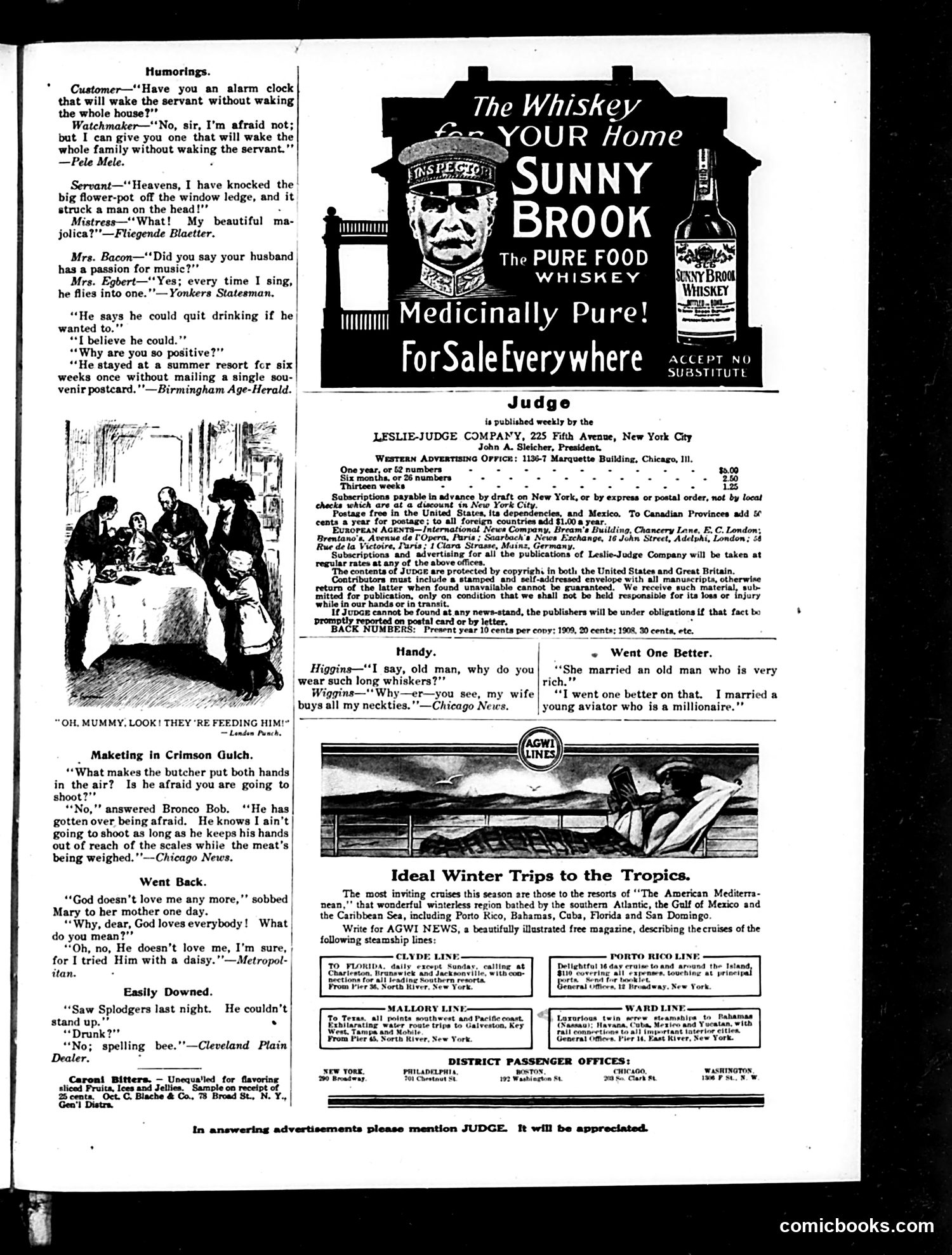
This page contains **brief humorous anecdotes** (typical of Judge magazine's "Humorings" section) plus **advertising and publication information**. The jokes satirize domestic life and class dynamics: - A watchmaker quips that alarm clocks can't selectively wake servants without families - A butcher keeps his hands visible while weighing meat to prevent customers from suspecting he's rigging the scales - A woman's long whiskers joke: his wife buys all his neckties, so he grows whiskers to hide cheap ones **The prominent advertisement** promotes "Sunny Brook" whiskey as "Medicinally Pure"—reflecting the early 1900s era when alcohol was marketed for health benefits before Pure Food regulations restricted such claims. The cartoon "OH, MUMMY, LOOK! THEY'RE FEEDING HIM!" (likely from *Punch*) appears to show a mother and child observing something, but context is unclear without the original caption. The page is primarily **lighthearted domestic humor** typical of period magazines, with class-conscious jokes about servants and working-class characters.
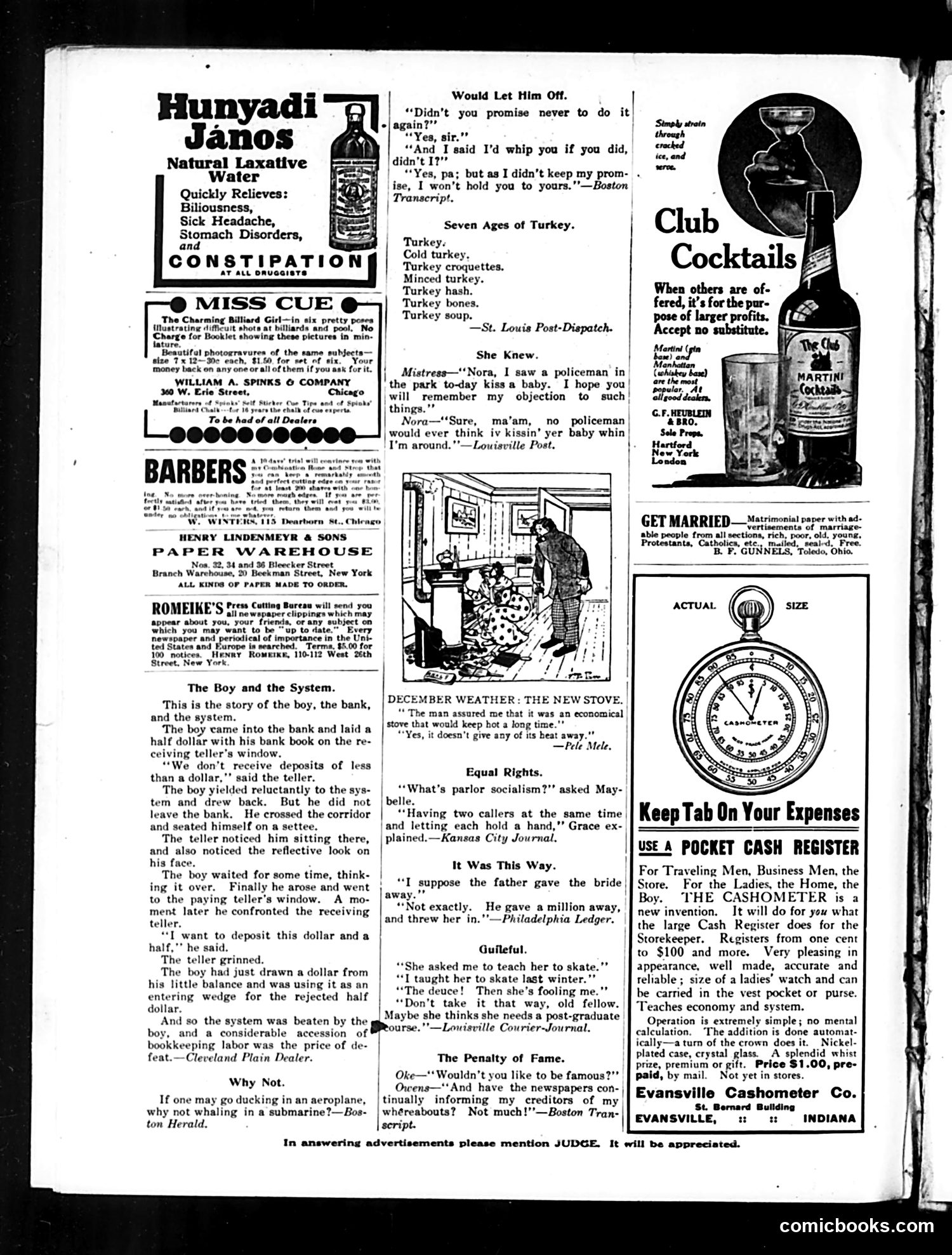
This page is primarily **advertising and humor**, typical of Judge magazine's format. The main illustrated cartoon (center) depicts a domestic scene where a woman scolds a man surrounded by scattered items—likely illustrating one of the brief jokes on the page, possibly "December Weather: The New Stove" about a stove that "doesn't give any of its heat away." The page contains numerous **one-liner jokes** addressing turn-of-the-century concerns: banking rigidity ("The Boy and the System"), gender dynamics ("She Knew," about a maid's confidence with policemen), and marriage ("It Was This Way," joking that a father gave away money rather than his daughter). The **advertisements**—for Hunyadi Janos laxative, billiard-girl photographs, and a press-clipping service—reflect period commerce. The humor is gentle, domestic, and somewhat moralistic (the boy outwits rigid banking rules; the maid knows her place). No specific political figures or major events are referenced; instead, these are observations about American middle-class life and social conventions of the era.
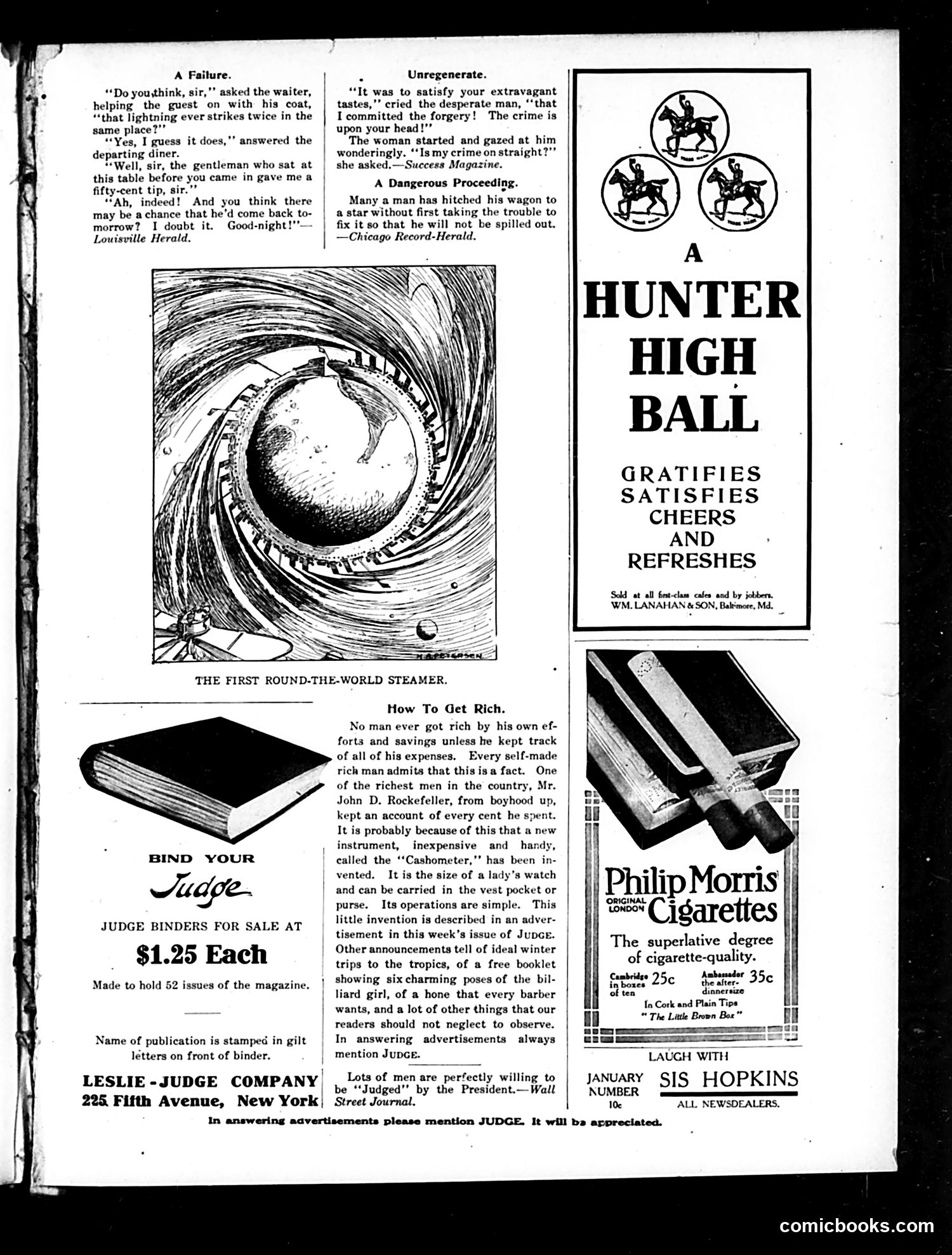
This page from Judge contains three short humorous anecdotes and period advertisements. The cartoons mock everyday social situations: 1. **"A Failure"** (Louisville Herald): A waiter hints that the previous diner left a generous fifty-cent tip, hoping the current guest might do the same. The guest sarcastically suggests he'll return tomorrow—clearly implying he won't, since good tipping is unlikely to repeat. 2. **"Unregenerate"** (Success Magazine): A man blames his wife's extravagant tastes for driving him to commit forgery. She responds by asking if her hat is on straight—suggesting her vanity completely misses the moral seriousness of his crime. 3. **"A Dangerous Proceeding"** (Chicago Record-Herald): This plays on the phrase "hitch your wagon to a star" (pursue ambitious dreams), joking that many men attempt this without securing their wagon first, risking a spill. The advertisements include Judge magazine binders, Philip Morris cigarettes, and Hunter High Ball whiskey—typical early 20th-century product placements. The humor relies on understated irony and wordplay common to period satirical magazines.
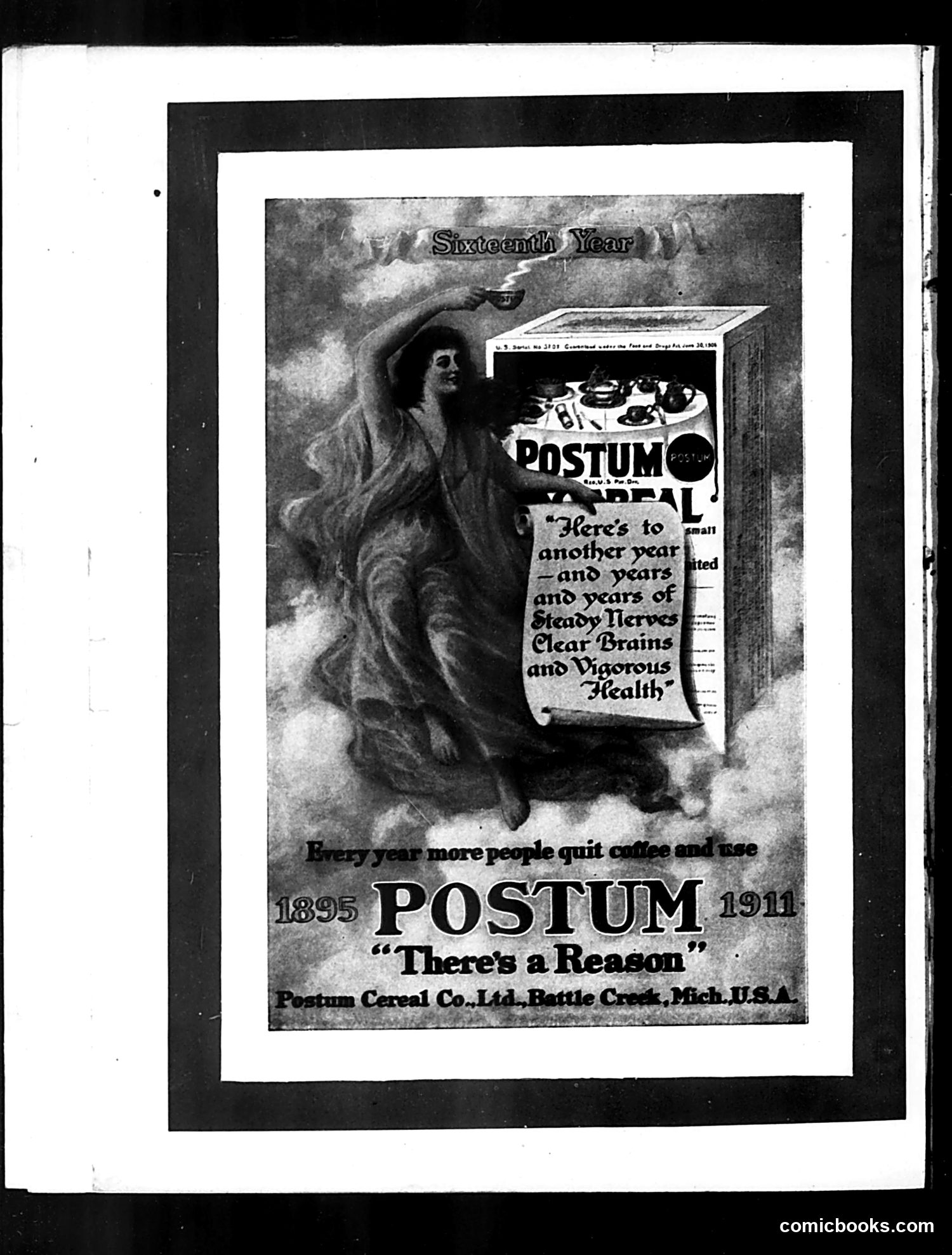
This is a **Postum cereal advertisement**, not political satire. The image shows a robed, ethereal female figure (likely representing health or wellness) floating among clouds, holding a Postum package. The ad's appeal targets health-conscious consumers of the early 1900s. The text promises "years and years of Steady Nerves Clear Brains and Vigorous Health" — claims typical of patent medicine-era marketing that attributed various ailments to coffee consumption. The tagline "Every year more people quit coffee and use POSTUM" (1895-1911) reflects the period's widespread belief that coffee was harmful. Postum, a caffeine-free grain-based beverage, marketed itself as a healthier alternative. The "Sixteenth Year" heading indicates this particular ad copy had been running successfully for sixteen years, emphasizing the product's established market presence.
I can see this is a page from Judge magazine, but the image is almost entirely black with only a white binding/edge visible on the left side. The OCR text provides only a website attribution ("comicbooks.com") with no actual article content or cartoon descriptions readable. Without visible text, captions, illustrations, or identifying details in the image itself, I cannot accurately identify any figures, political references, or explain any satire or jokes from this page. The image quality or scanning appears to have rendered the content illegible. To properly analyze this Judge magazine page, a clearer image or legible text would be necessary.