
Judge, 1910-12-31 · page 12 of 27
Judge — December 31, 1910 — page 12: what you’re looking at
What you’re looking at
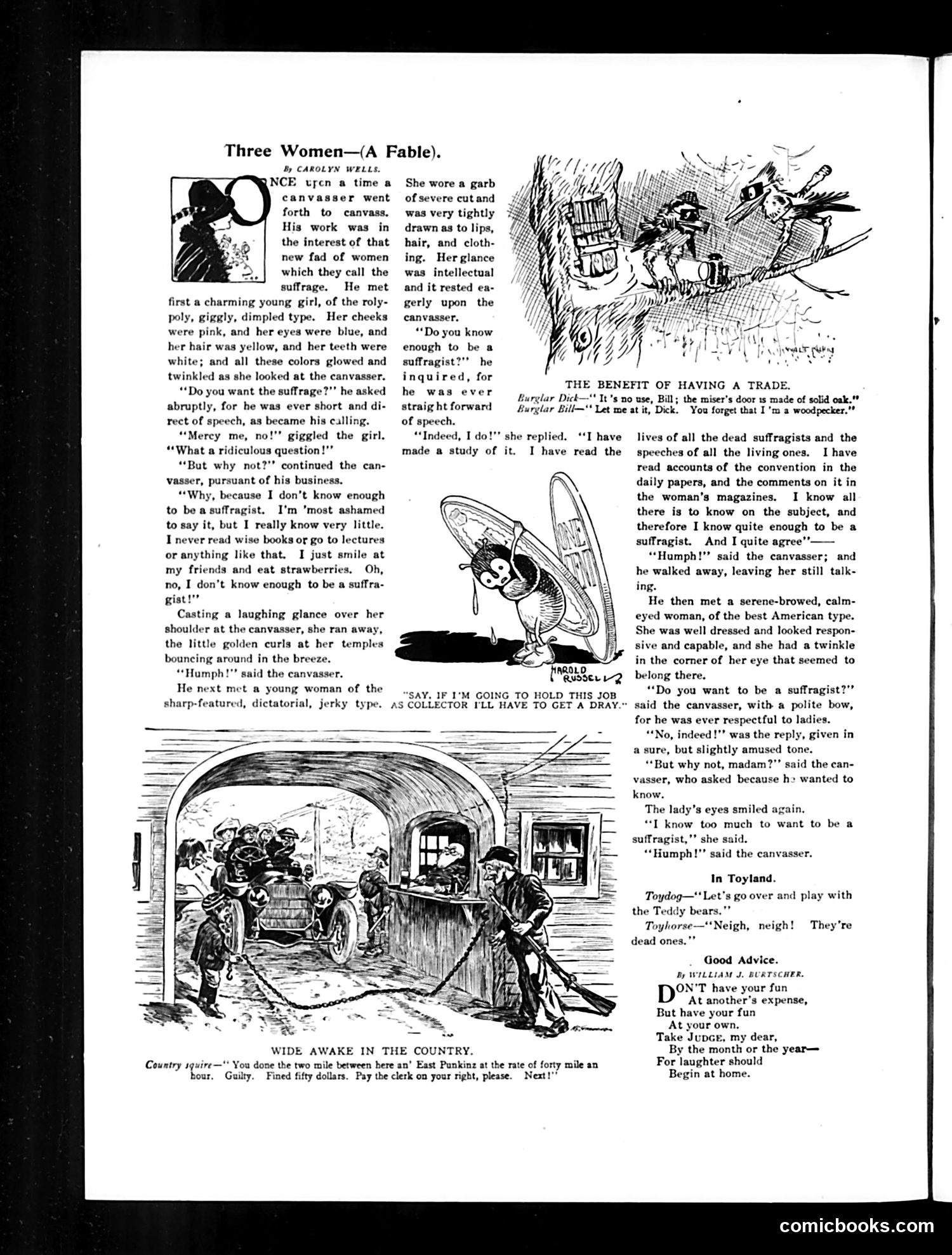
This satirical fable mocks women's suffrage advocacy by presenting three female types through a canvasser's eyes. The first—a giggly, decorative young woman—refuses suffrage, claiming ignorance. The second—sharp-featured and intense—enthusiastically supports it, having read extensively about conventions and speeches but demonstrating obsessive pedantry. The third—calm, capable, and genuinely intelligent—rejects suffrage precisely *because* she knows too much. The satire's point: Judge ridicules the suffrage movement by suggesting its most vocal supporters are either insufferably earnest or intellectually pretentious, while truly wise women reject it outright. The "moral" dismisses suffragism as unworthy of serious women's attention. This reflects early 20th-century anti-suffrage sentiment that portrayed activists as either frivolous or humorless zealots, contrasting them with an idealized "natural" woman who knows her place.
📄 Transcribed text from this page (OCR, searchable)
Machine-transcribed from the original scan — historical spelling and the odd misread are preserved.
Three Women—(A Fable). By CAROLYN WELLS. 2 NCE urcn a time a canvasser went forth to canvass. His work was in the interest of that new fad of women which they call the suffrage. He met first a charming young girl, of the roly- poly, giggly, dimpled type. Her cheeks w pink, and her eyes were blue, and her hair was yellow, and her teeth were white; and all these colors glowed and twinkled as she looked at the canvasser. “Do you want the suffrage?'’ he asked abruptly, for he was ever short and di- rect of speech, as became his calling. “Mercy me, no!"’ giggled the girl. “*What a ridiculous question !"" “But why not?’ continued the can- vasser, pursuant of his business. “Why, because I don’t know enough to be asuffragist. I'm 'most ashamed to say it, but I really know very little. I never read wise books or go to lectures or anything like that. I just smile at my friends and eat strawberries. Oh, no, I don’t know enough to be a suffra- gist!" Casting a laughing glance over her shoulder at the canvasser, she ran away, the little golden curls at her temples bouncing around in the breeze. “Humph!"’ said the canvasser. He next met a young woman of the sharp-featured, dictatorial, jerky type. She wore a garb of severe cut and was very tightly drawn as to lips, hair, and cloth- ing. Herglance was intellectual and it rested ea- gerly upon the canvasser. “Do you know enough to be a suffragist?"’ he inquired, for he was ever straig ht forward of speech. “Indeed, I do!" she replied. ‘I have made a study of it. I have read the Burglar Dick OLD t' MeL “2 “SAY, IF I'M GOING TO HOLD THIS JOB AS COLLECTOR I'LL HAVE TO GET A DRAY.~ WIDE AWAKE IN THE COUNTRY. Country squire—'* You done the two mile between here an’ East Punkinz at the rate of forty mile an hour, Guilty. Fined fifty dollars. Pay the clerk on your right, please. Next!"’ Burglar Bill—"* Let me at THE BENEFIT OF HAVING A TRADE. “* It's no use, Bill; the miser's door 1s made of solid oak.” Dick. You forget that I'm a woodpecker."* lives of all the dead suffragists and the speeches of all the living ones, I have read accounts of the convention in the daily papers, and the comments on it in the woman's magazines. I know all there is to know on the subject, and therefore I know quite enough to be a suffragist. And I quite agree”’. “‘Humph!"’ said the canvasser; and he walked away, leaving her still talk- ing. He then met a serene-browed, calm- eyed woman, of the best American type. She was well dressed and looked respon- sive and capable, and she had a twinkle in the corner of her eye that seemed to belong there. “Do you want to be a suffragist?”” said the canvasser, with a polite bow, for he was ever respectful to ladies. “No, indeed !"" was the reply, given in a sure, but slightly amused tone. “But why not, madam?” said the can- vasser, who asked because h» wanted to know. The lady’s eyes smiled again. “I know too much to want to be a suffragist,’’ she said. “Humph!” said the canvasser. In Toyland. Toydog—'* Let's go over and play with the Teddy bears.”” Toyhorse— dead ones.”” Good Advice. By WILLIAM J. BURTSCHER. Dee have your fun At another's expense, But have your fun At your own. Take Jupce, my dear, By the month or the year— For laughter should Begin at home. h, neigh! They're comicbooks.com