
Judge, 1910-12-31 · page 16 of 27
Judge — December 31, 1910 — page 16: what you’re looking at
What you’re looking at
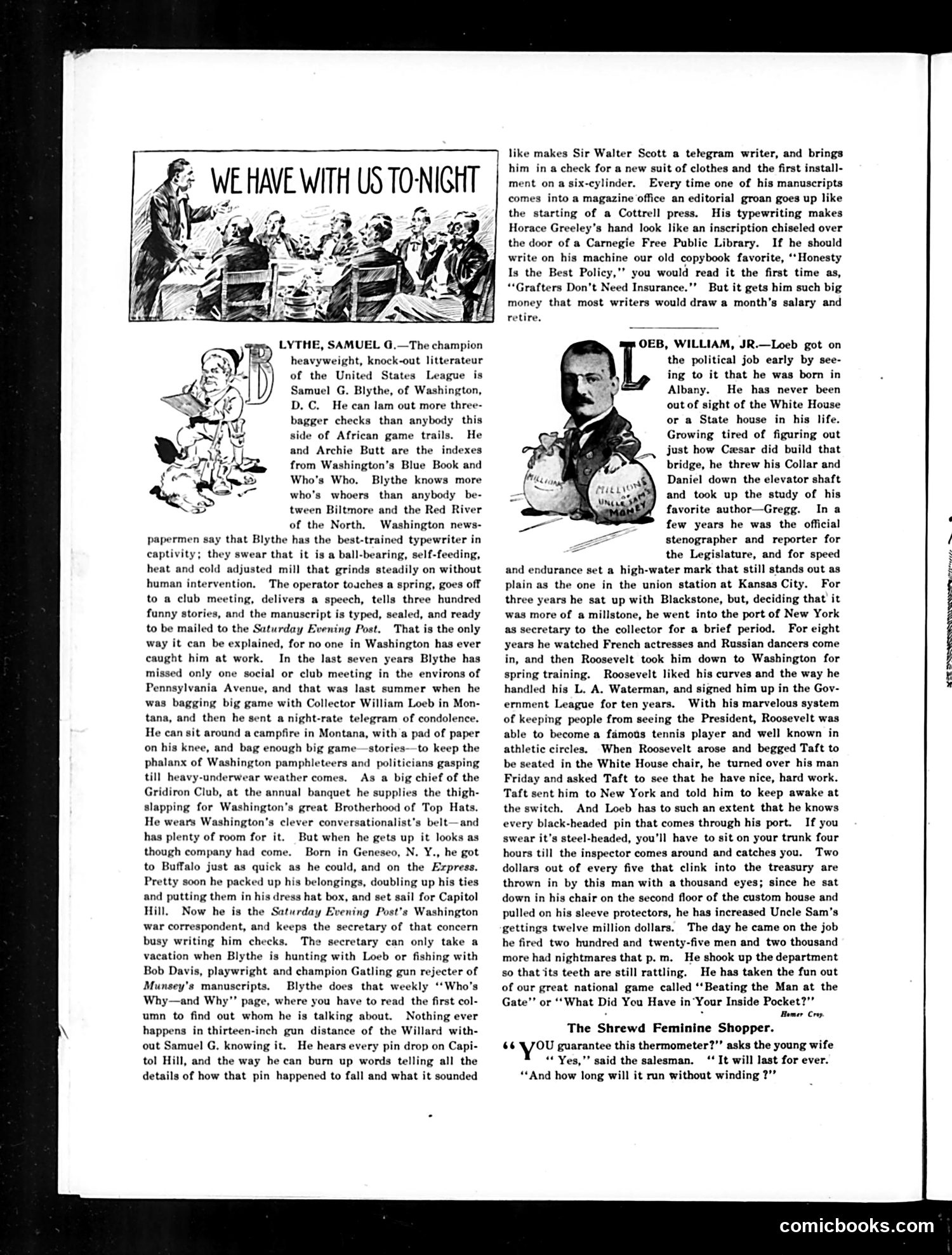
This page profiles two prominent Washington figures from the early 1900s: **Samuel G. Blythe** (top): A prolific writer for the *Saturday Evening Post* and Washington correspondent. The satire mocks his seemingly superhuman productivity—the text humorously suggests his typewriter works autonomously while he attends social events. He's portrayed as ubiquitous in Washington society, never missing a gathering, and capable of generating endless stories and articles. The joke centers on his inexplicable ability to produce vast amounts of publishable material despite appearing to do no actual work. He's connected to President Theodore Roosevelt's inner circle (William Loeb is mentioned). **William Loeb Jr.** (bottom, partial): Roosevelt's secretary and Albany political operative, depicted as a career government insider who never strayed far from power centers. The satire reflects *Judge* magazine's insider humor about Washington's powerful media and political figures during the Progressive Era.
📄 Transcribed text from this page (OCR, searchable)
Machine-transcribed from the original scan — historical spelling and the odd misread are preserved.
re WEHAVE WITH US TONIGHT LYTHE, SAMUEL G,.—The champion heavyweight, knock-out litterateur of the United States League is Samuel G. Blythe, of Washington, D.C. He can lam out more three- bagger checks than anybody this side of African game trails. He and Archie Butt are the indexes from Washington's Blue Book and Who's Who. Blythe knows more who's whoers than anybody be- tween Biltmore and the Red River of the North. Washington news- papermen say that Blythe has the best-trained typewriter in captivity; they swear that it is a ball-bearing, self-feeding, heat and cold adjusted mill that grinds steadily on without human intervention. The operator touches a spring, goes off to a club meeting, delivers a speech, tells three hundred funny stories, and the manuscript is typed, sealed, and ready to be mailed to the Saturday Evening Post. That is the only way it can be explained, for no one in Washington has ever caught him at work. In the last seven years Blythe has missed only one social or club meeting in the environs of Pennsylvania Avenue, and that was last summer when he was bagging big game with Collector William Loeb in Mon- tana, and then he sent a night-rate telegram of condolence. He can sit around a campfire in Montana, with a pad of paper on his knee, and bag enough big game—stories—to keep the phalanx of Washington pamphleteers and politicians gasping till heavy-underwear weather comes. As a big chief of the Gridiron Club, at the annual banquet he supplies the thigh- slapping for Washington’s great Brotherhood of Top Hats. He wears Washington's clever conversationalist’s belt—and has plenty of room for it. But when he gets up it looks as though company had come. Born in Geneseo, N. Y., he got to Buffalo just as quick as he could, and on the Express. Pretty soon he packed up his belongings, doubling up his ties and putting them in his dress hat box, and set sail for Capitol Hill. Now he is the Saturday Evening Post's Washington war correspondent, and keeps the secretary of that concern busy writing him checks. The secretary can only take a vacation when Blythe is hunting with Loeb or fishing with Bob Davis, playwright and champion Gatling gun rejecter of Munsey'’s manuscripts. Blythe does that weekly ‘Who's Why—and Why”’ page, where you have to read the first col- umn to find out whom he is talking about. Nothing ever happens in thirteen-inch gun distance of the Willard with: out Samuel G. knowing it. He hears every pin drop on Capi- tol Hill, and the way he can burn up words telling all the details of how that pin happened to fall and what it sounded ] like makes Sir Walter Scott a telegram writer, and brings him in a check for a new suit of clothes and the first install- ment on a six-cylinder. Every time one of his manuscripts comes into a magazine office an editorial groan goes up like the starting of a Cottrell press. His typewriting makes Horace Greeley’s hand look like an inscription chiseled over the door of a Carnegie Free Public Library. If he should write on his machine our old copybook favorite, ‘Honesty Is the Best Policy,"’ you would read it the first time as, “‘Grafters Don’t Need Insurance.’’ But it gets him such big money that most writers would draw a month’s salary and retire. OEB, WILLIAM, JR.—Loeb got on the political job early by see- ing to it that he was born in Albany. He has never been out of sight of the White House or a State house in his life. Growing tired of figuring out just how Cwsar did build that bridge, he threw his Collar and Dai down the elevator shaft and took up the study of his favorite author—Gregg. In a few years he was the official stenographer and reporter for the Legislature, and for speed and endurance set a high-water mark that still stands out as plain as the one in the union station at Kansas City. For three years he sat up with Blackstone, but, deciding that it was more of a millstone, he went into the port of New York as secretary to the collector for a brief period. For eight years he watched French actresses and Russian dancers come in, and then Roosevelt took him down to Washington for spring training. Roosevelt liked his curves and the way he handled his L, A. Waterman, and signed him up in the Gov- ernment League for ten years. With his marvelous system of keeping people from seeing the President, Roosevelt was able to become a famous tennis player and well known in athletic circles. When Roosevelt arose and begged Taft to be seated in the White House chair, he turned over his man Friday and asked Taft to see that he have nice, hard work. Taft sent him to New York and told him to keep awake at the switch. And Loeb has to such an extent that he knows every black-headed pin that comes through his port. If you swear it’s steel-headed, you'll have to sit on your trunk four hours till the inspector comes around and catches you. Two dollars out of every five that clink into the treasury are thrown in by this man with a thousand eyes; since he sat down in his chair on the second floor of the custom house and pulled on his sleeve protectors, he has increased Uncle Sam's gettings twelve million dollars. The day he came on the job he fired two hundred and twenty-five men and two thousand more had nightmares that p.m. He shook up the department so that its teeth are still rattling. He has taken the fun out of our great national game called ‘‘Beating the Man at the Gate”’ or ‘‘What Did You Have in‘Your Inside Pocket?”’ : . Homer Crop The Shrewd Feminine Shopper. oe you guarantee this thermometer?” asks the young wife “* Yes,’’ said the salesman. ‘‘ It will last for ever. “And how long will it run without winding ?” comicbooks.com eT ea