
Judge, 1910-12-31 · page 10 of 27
Judge — December 31, 1910 — page 10: what you’re looking at
What you’re looking at
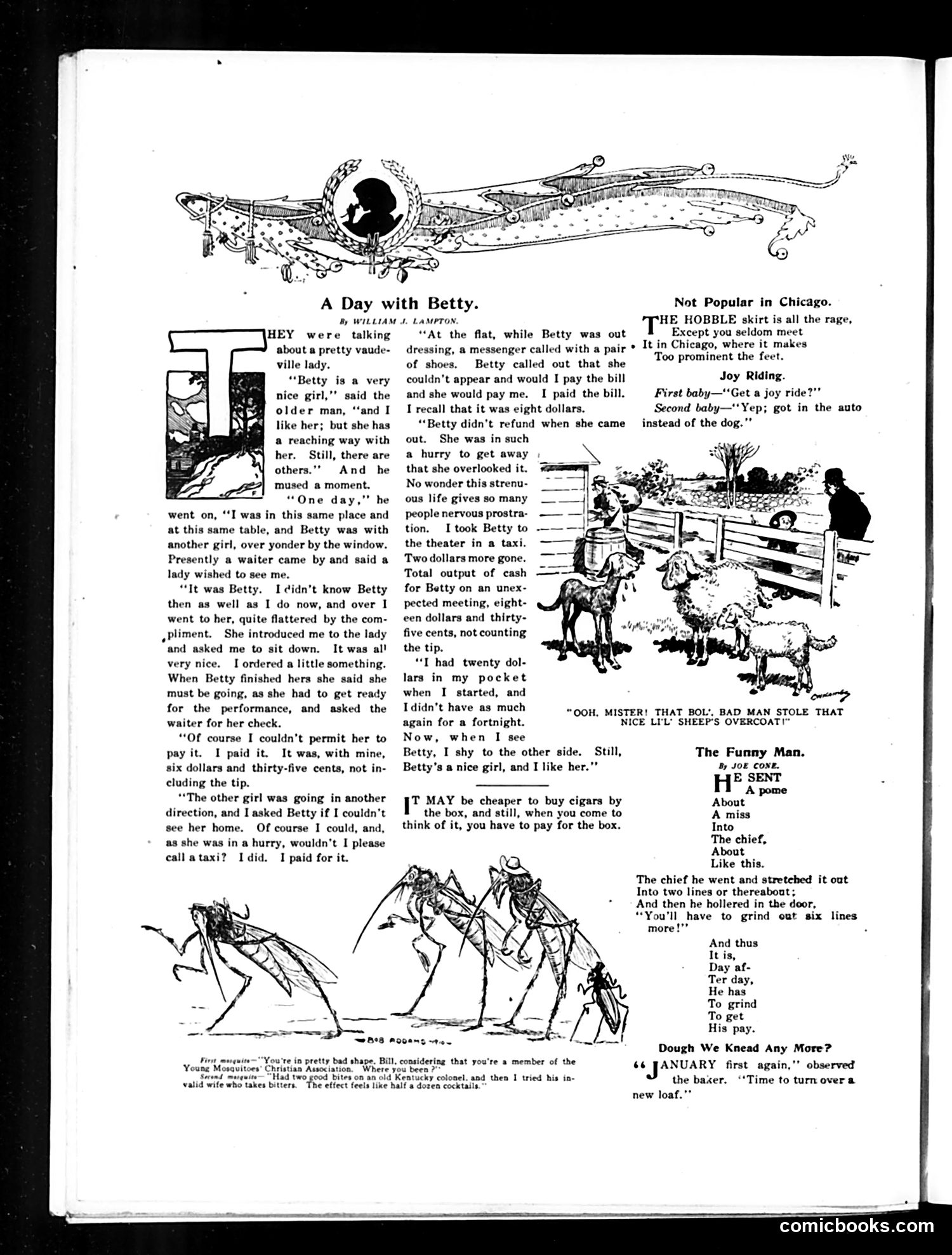
This Judge magazine page contains several humor pieces satirizing early 20th-century social dynamics: **"A Day with Betty"** mocks a common con: a vaudeville performer who extracts money from an admiring older gentleman through various "emergencies"—unpaid bills, taxi fares, theater tickets—totaling eighteen dollars. The satire targets both Betty's calculating manipulation and the gentleman's foolish susceptibility to flattery, leaving him financially depleted and avoiding her afterward. **"Not Popular in Chicago"** jokes that while hobble skirts (fashionably restrictive 1910s women's fashion) are trendy elsewhere, Chicago women reject them because the tight garment makes their feet too visible—a dig at Chicago women's practicality or foot appearance. **"The Funny Man"** satirizes editorial labor: a poet submits two lines; the editor demands six more lines to fill space, forcing endless grinding labor for minimal pay—commentary on exploitative publishing practices. **"Dough We Knead Any More?"** is a baker's New Year's pun about starting fresh ("turning over a new loaf"), playing on "knead/need." The illustrations include mosquitoes and a theft joke, unrelated to main stories.
📄 Transcribed text from this page (OCR, searchable)
Machine-transcribed from the original scan — historical spelling and the odd misread are preserved.
A Day with Betty. By WILLIAM J. LAMPTON. HEY were talking about a pretty vaude- ville lady. “Betty is a very nice girl,” said the older man, ‘and I like her; but she has a reaching way with her. Still, there are others."". And he mused a moment. “One day," he went on, ‘I was in this same place and at this same table, and Betty was with another girl, over yonder by the window. Presently a waiter came by and said a lady wished to see me. “It was Betty. Icidn’t know Betty then as well as I do now, and over I went to her, quite flattered by the com- ,Pliment. She introduced me to the lady and asked me to sit down. It was al! very nice. I ordered a little something. When Betty finished hers she said she must be going, as she had to get ready for the performance, and asked the waiter for her check. “Of course I couldn't permit her to pay it. I paid it. It was, with mine, six dollars and thirty-five cents, not in- cluding the tip. “The other girl was going in another direction, and I asked Betty if I couldn’t see her home. Of course I could, and, as she was in a hurry, wouldn’t I please call ataxi? Idid. I paid for it. “You're in pretty bad sha Christian Association. W veuity— “Had two good bites on an valid wife who takes bitters. “At the flat, while Betty was out dressing, a messenger called with a pai of shoes. Betty called out that she couldn't appear and would I pay the bill and she would pay me. I paid the bill. I recall that it was eight dollars. “Betty didn’t refund when she came out. She was in such a hurry to get away that she overlooked it. No wonder this strenu- ous life gives so many people nervous prostra- tion. I took Betty to the theater in a taxi. Two dollars more gone. Total output of cash for Betty on an unex- pected meeting, eight- een dollars and thirty- five cents, not counting the tip. “T had twenty dol- lars in my pocket when I started, and Ididn’t have as much again for a fortnight. Now, when I see Betty, I shy to the other side. Still, Betty's a nice girl, and I like her.”” r MAY be cheaper to buy cigars by the box, and still, when you come to think of it, you have to pay for the box. Bill, considering that you're a member of the you been ?” 4 Kentucky colonel. and then I tried his in- he effect feels like half a dozen cocktails. “OOH, MISTER! NICE LI'L’ SHEEP'S OVERCOAT!" Not Popular in Chicago. HE HOBBLE skirt is all the rage, Except you seldom meet ¢ + It in Chicago, where it makes Too prominent the feet. Joy Riding. First baby—‘‘Get a joy ride?” Second baby—'‘Yep; got in the auto instead of the dog.’ THAT BOL’, BAD MAN STOLE THAT The Funny Man. By JOE CONE. E SENT A pome About A miss Into The chief, About Like this. The chief he went and stretched it out Into two lines or thereabout; And then he hollered in the door, “You'll have to grind out six lines more!"" And thus It is, Day af- Ter day, He has To grind To get His pay. Dough We Knead Any More? SO JANUARY first again," observed the baxer. ‘‘Time to turn overa new loaf."" comicbooks.com