
A complete issue · 16 pages · 1906
Judge — September 22, 1906
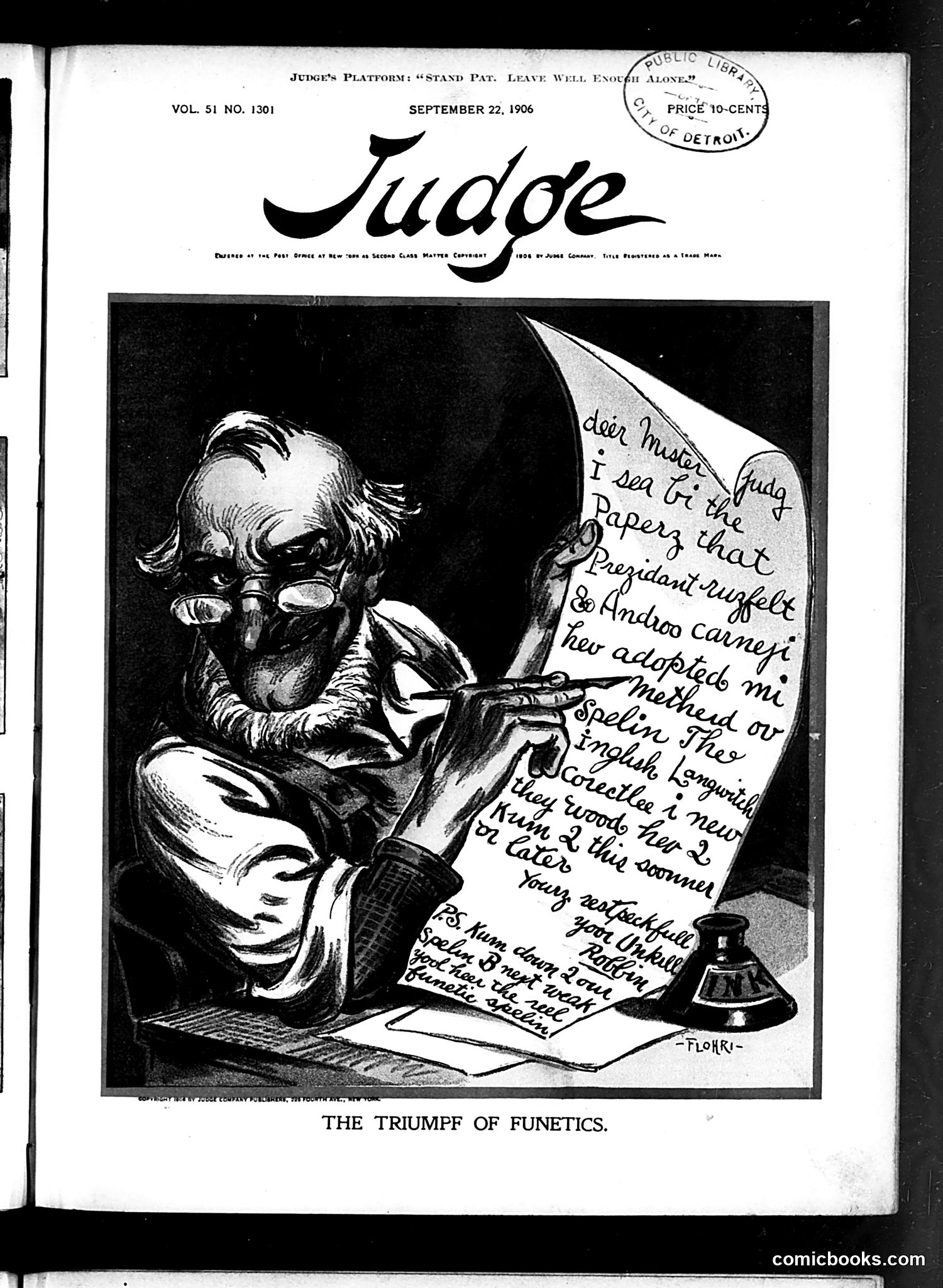
This cartoon satirizes the "funetic" spelling reform movement popular in early 1900s America. The caricatured figure appears to be a prominent advocate for simplified spelling (possibly President Theodore Roosevelt, who publicly supported the movement). The character holds a document listing "funetic" spellings and reformed words, with an inkwell nearby. The title mocks how the reform movement was "triumphing"—spreading influence despite widespread public ridicule. The satire targets the absurdity of phonetic spelling advocates' attempts to reshape English orthography. Judge magazine, a humor publication, used this cartoon to lampoon what many considered an eccentric, impractical linguistic crusade that violated centuries of established writing conventions.
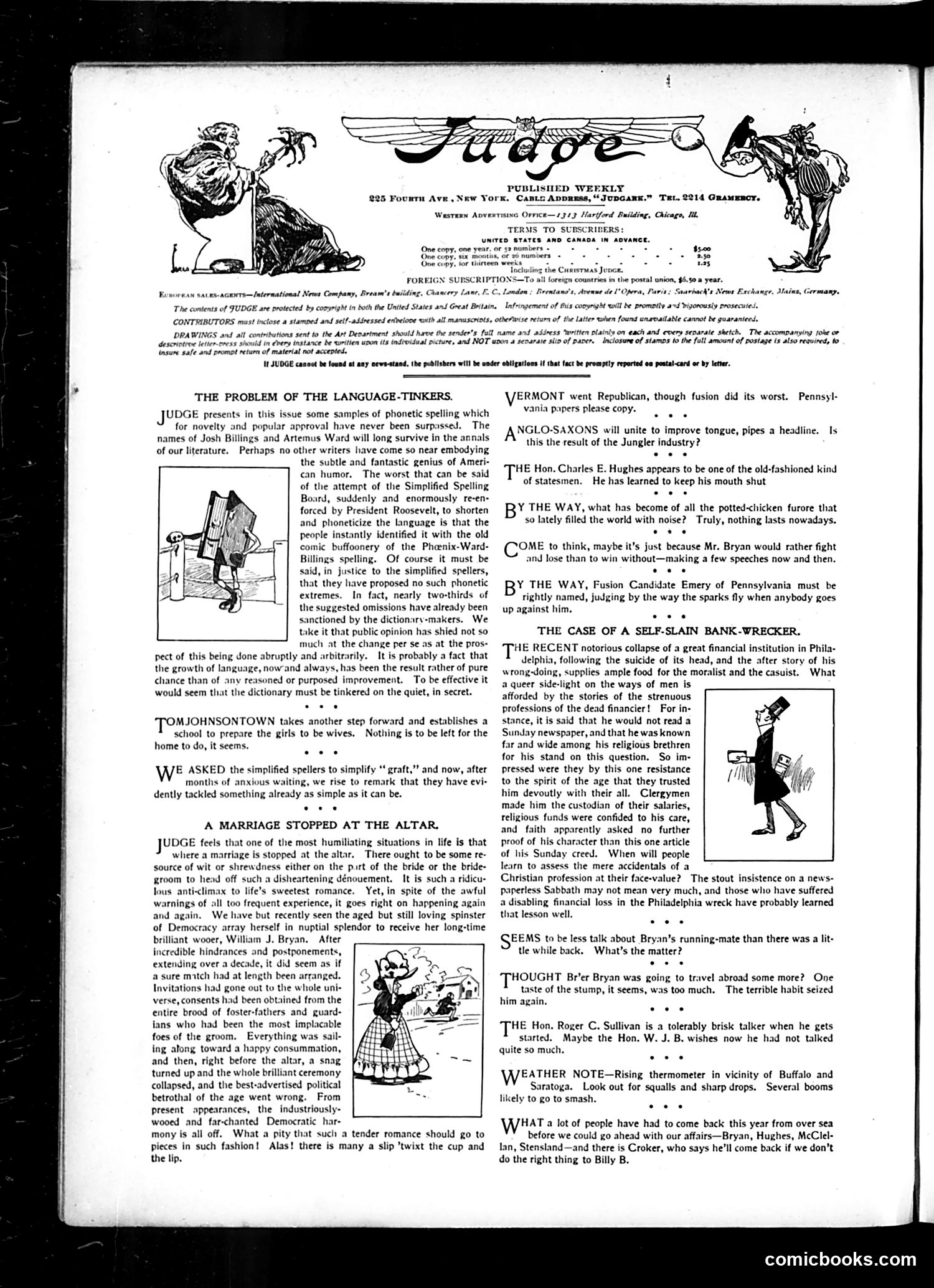
This page contains several short political commentary sections rather than a single cartoon. The pieces mock contemporary political figures and issues: **"The Problem of the Language-Tinkers"** satirizes simplified spelling reform efforts, likely referencing President Theodore Roosevelt's push for phonetic spelling simplification. The text criticizes this as an unnecessary disruption to language. **"A Marriage Stopped at the Altar"** uses marriage as a metaphor for political union, apparently criticizing a failed political alliance or merger. **Other sections** comment on various politicians including Charles E. Hughes, William Jennings Bryan, and Roger C. Sullivan, along with notes on financial scandals and weather. The illustrations show caricatured figures in exaggerated poses typical of Judge's satirical style. Without clearer dates or labels, specific identifications remain uncertain, but the overall purpose is lampooning contemporary political figures and reform movements through humor and caricature.
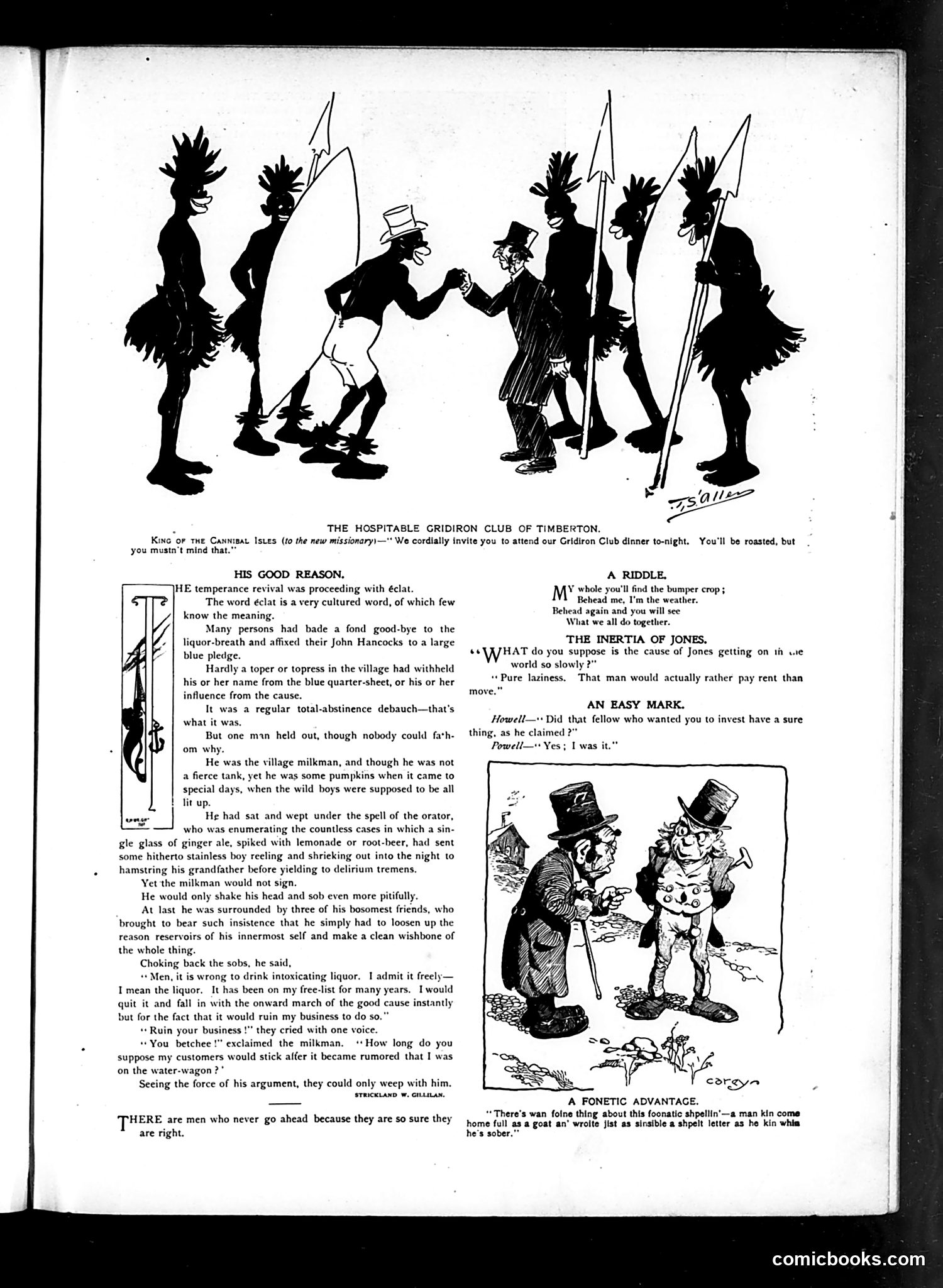
The top illustration satirizes **"The Hospitable Gridiron Club of Timberton,"** depicting what appears to be a cannibalistic dinner invitation. Figures with spiky hair (likely representing "savages" in period stereotypes) surround men in top hats, with the caption joking they'll be "roasted." This reflects late 19th/early 20th-century racist humor common to Judge magazine. The three text pieces below—"His Good Reason," "A Riddle," and "An Easy Mark"—are brief humorous anecdotes unrelated to the cartoon. "An Easy Mark" includes an illustration of two con-men characters discussing a financial scheme. The page primarily showcases Judge's typical content: crude ethnic humor combined with financial/social satire targeting gullible victims.
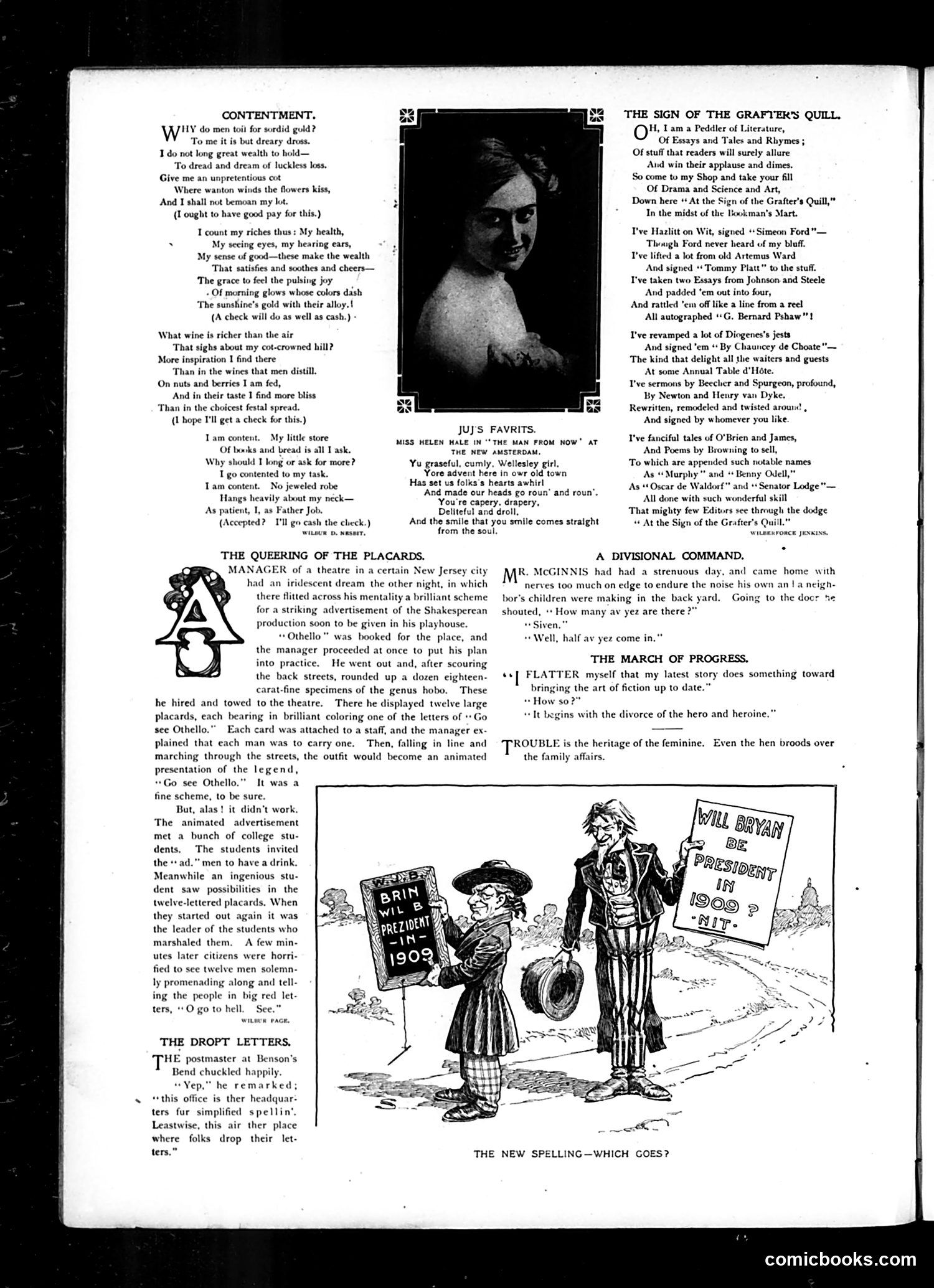
This political cartoon satirizes the spelling reform movement of the early 1900s. Two figures—appearing to represent political candidates or public figures—hold signs advocating for "Bryan for President in 1909" and related political messaging. The cartoon likely mocks William Jennings Bryan's political ambitions while also commenting on the contemporary simplified spelling reform initiative (promoted by President Theodore Roosevelt and others). The juxtaposition of political campaigning with spelling reform creates absurdist humor, suggesting these reform movements were equally questionable or ridiculous to the cartoonist. The title's question "Which Goes?" implies skepticism about whether either movement would succeed, treating political aspirations and linguistic reform as equivalently dubious propositions worthy of mockery.
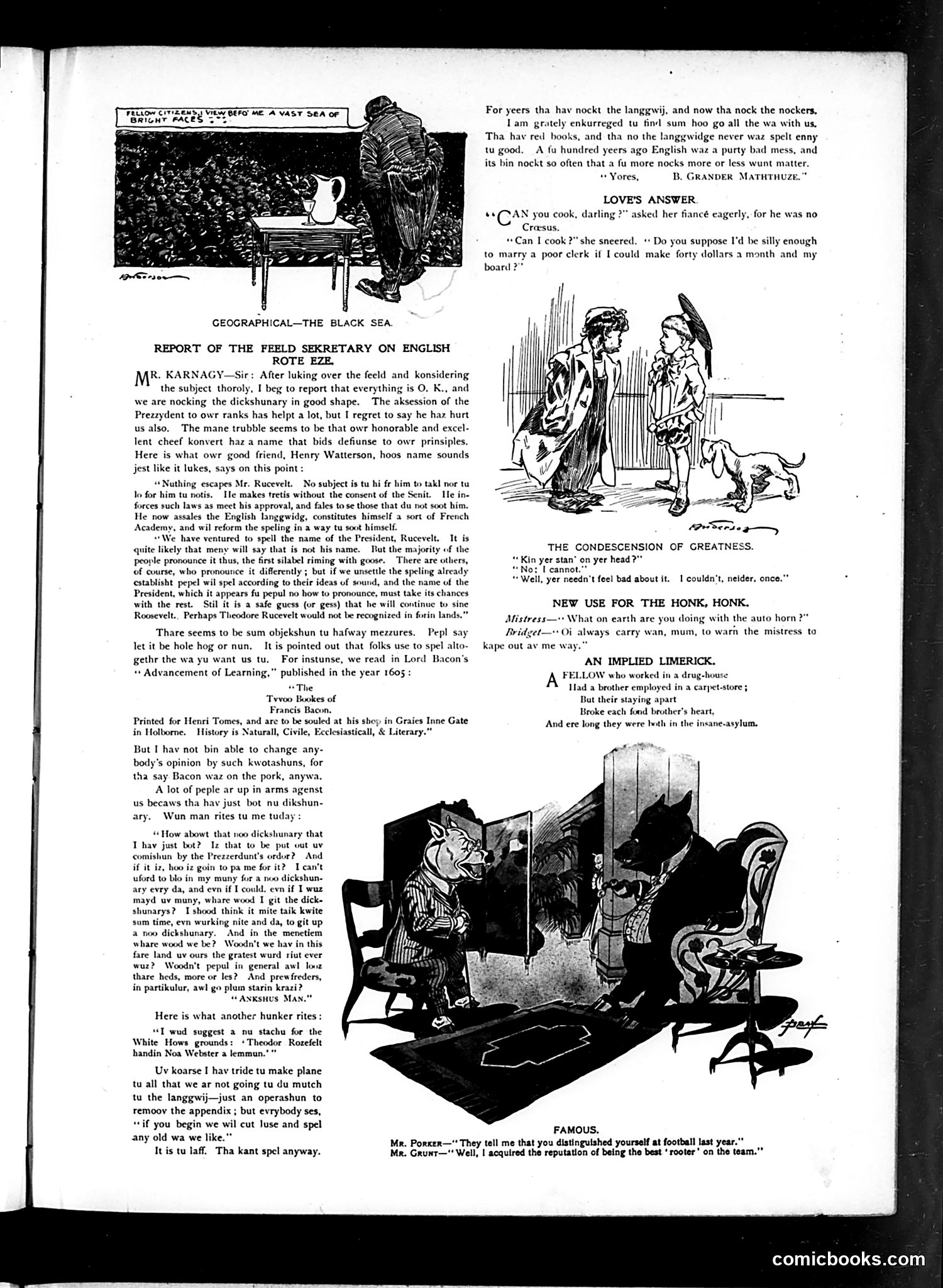
This page contains several discrete humor pieces rather than unified political satire: **"Geographical—The Black Sea"**: A simple visual joke about a table by the seaside with a pitcher. **"Report of the Field Secretary on English Note Eze"**: Mr. Karnagy discusses English spelling inconsistencies, particularly Theodore Roosevelt's name pronunciation and spelling debates. This references early 1900s discussions about Roosevelt and English language standardization. **"Love's Answer," "The Condescension of Greatness," "New Use for the Honk Honk"**: Brief romantic/social humor vignettes. **"An Implied Limerick" and "Famous"**: The bottom cartoon shows two men discussing football reputation—one claims he was the team's best "rooter" (supporter), a period-appropriate term. The page is primarily social humor rather than political commentary, typical of Judge's lighter content.
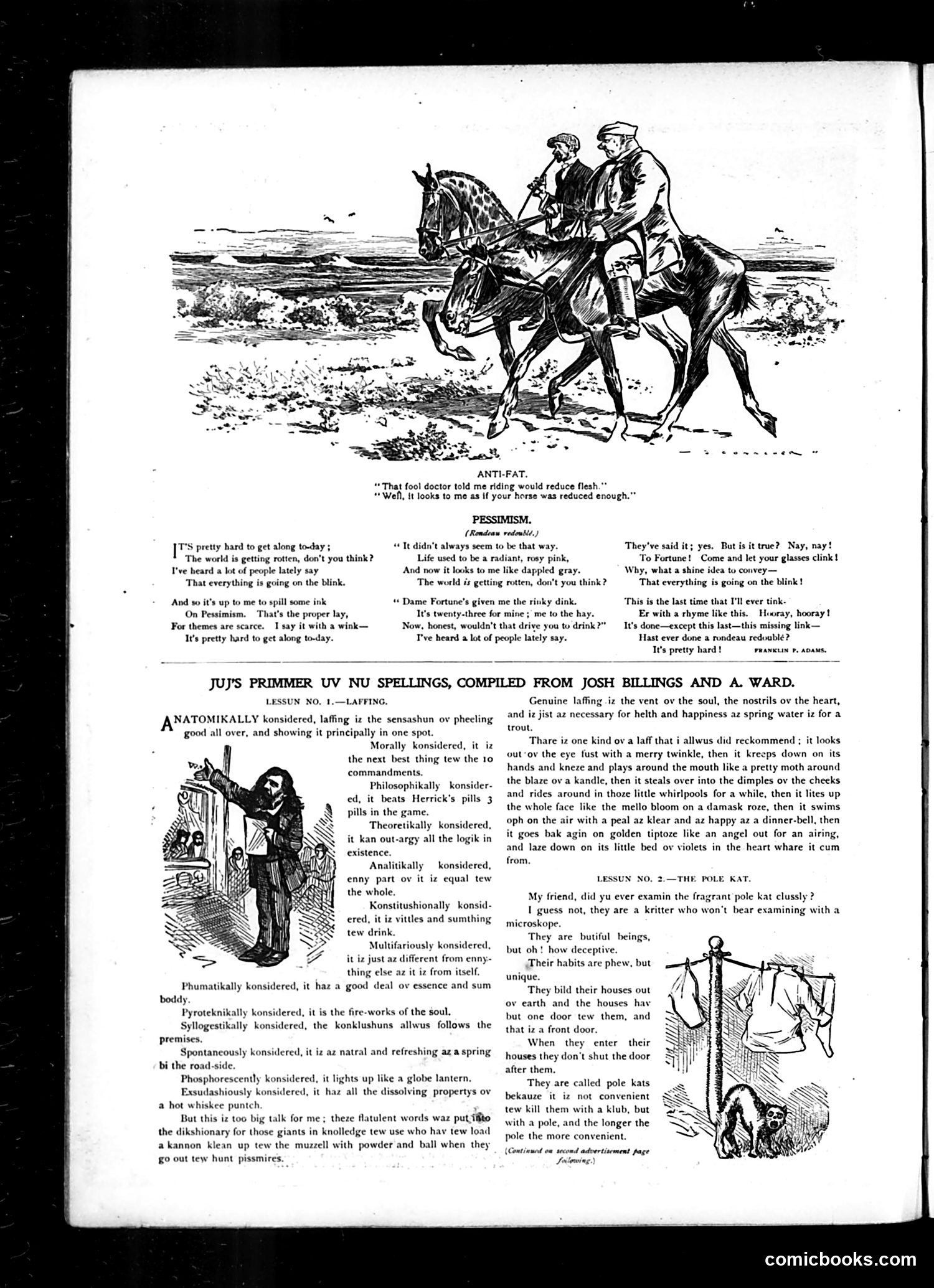
This page contains two main satirical pieces: **"Anti-Fat" Cartoon (top):** A visual joke about a doctor's weight-loss prescription. A heavyset person riding an undersized horse says their doctor recommended riding to reduce flesh. The companion replies the horse itself appears "reduced enough"—mocking both the ineffective medical advice and the horse's unfortunate condition from bearing excessive weight. **"Pessimism" Poem (center):** A rondeau redoublé by Franklin P. Adams criticizing contemporary doom-saying. Written during what appears to be a period of social anxiety, it mocks people claiming "everything is going on the blink" and the world is "getting rotten." Adams argues this pessimism is exaggerated, urging readers to celebrate life's pleasures instead—a lighthearted rebuke of widespread gloom. **"Ju's Primmer" (bottom):** Humorous phonetic spellings mimicking Josh Billings and Artemus Ward (19th-century folk humorists) defining "laffing" (laughing) and pole cats in deliberately misspelled, backwoods dialect for comedic effect.
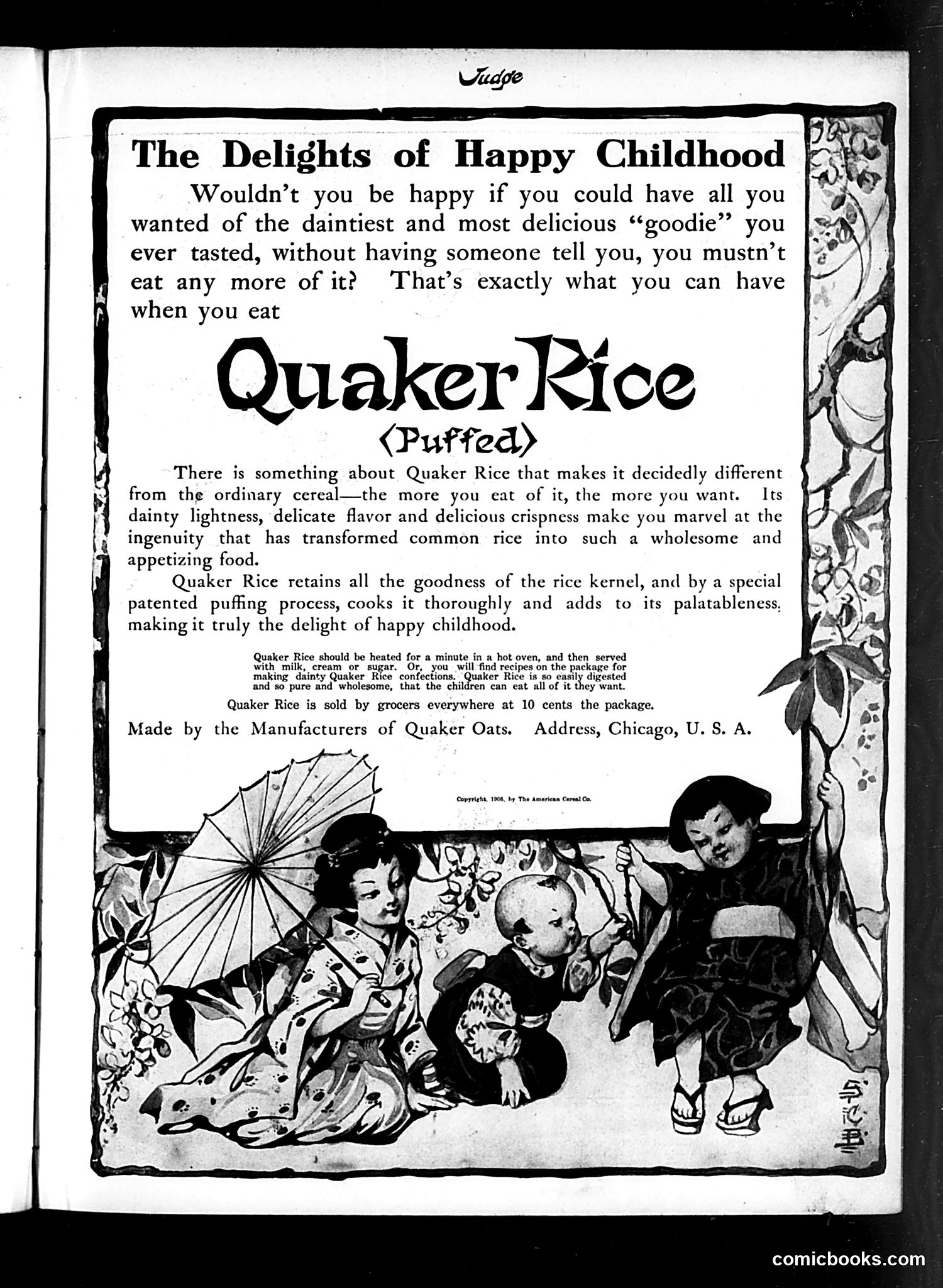
This is primarily a **commercial advertisement**, not satire. It promotes Quaker Rice (puffed cereal) to parents by appealing to childhood fantasy—the idea that children could eat unlimited sweets without parental restriction. The accompanying illustration depicts **happy children enjoying themselves outdoors** with parasols and flowers, visualizing the carefree joy the product promises to deliver. The advertisement's selling point exploits parental anxiety: parents could feel virtuous allowing unlimited consumption since Quaker Rice is "pure and wholesome" and "easily digested," unlike typical candy or "goodies." The headline cleverly reframes parental permission as liberation from typical rules. The price (10 cents) and manufacturer attribution anchor it as genuine period advertising. Judge magazine regularly featured such advertisements alongside satirical content.
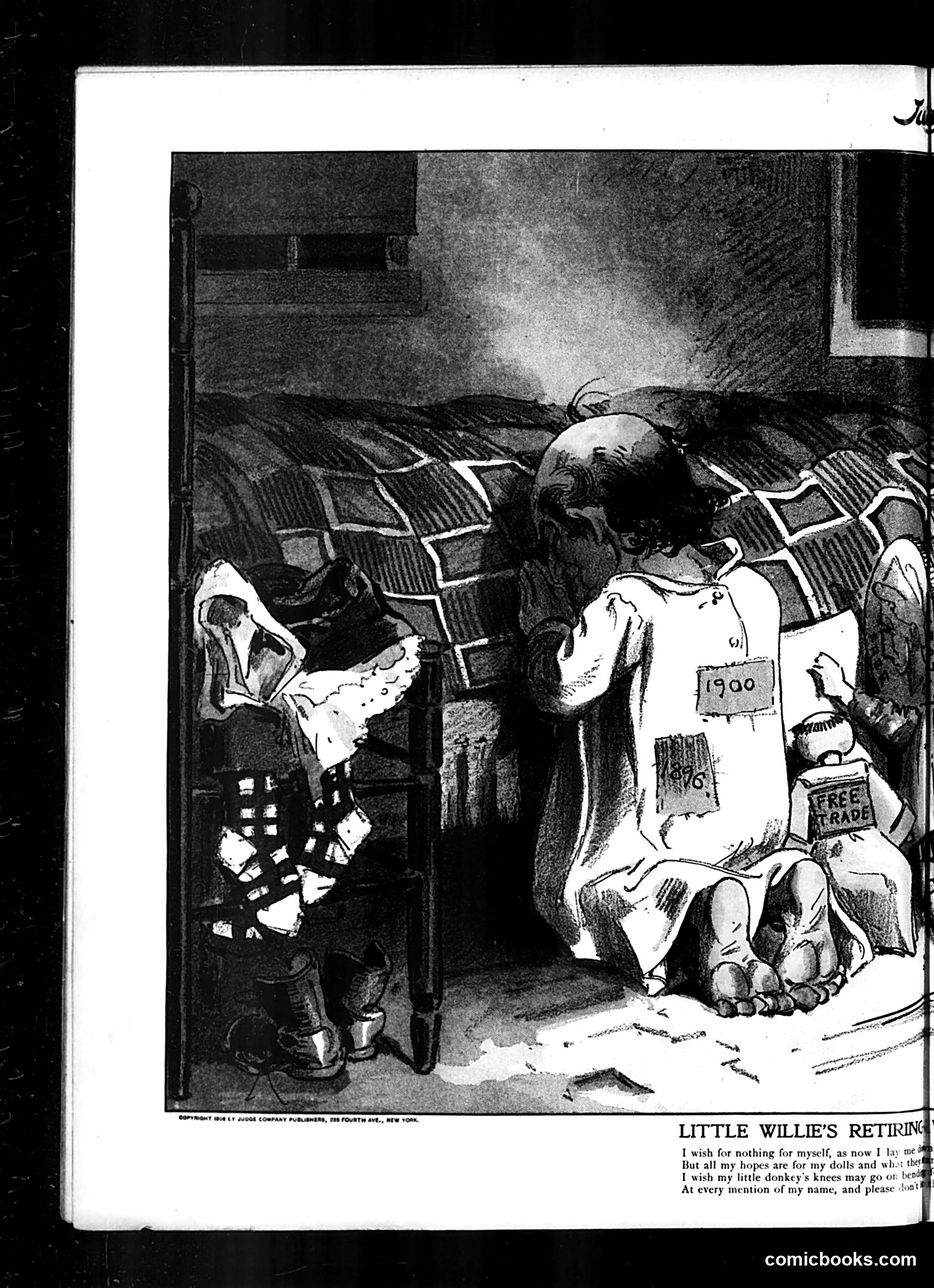
This political cartoon satirizes British imperial decline around 1900. The figure labeled "1900" (representing Britain's new century) sits on a bed marked "FREE TRADE," appearing diminished and weary. A smaller figure in Scottish dress (possibly representing a British politician or the public) stands nearby looking distressed. The satire critiques Britain's fading economic and political dominance as the 20th century begins. The "free trade" label suggests anxiety about Britain's traditional economic policy losing effectiveness against rising industrial competitors. The cartoonist suggests Britain itself is "retiring"—withdrawing from its previously dominant global position. This reflects real late-Victorian concerns about British imperial supremacy being challenged by emerging powers like Germany and America.
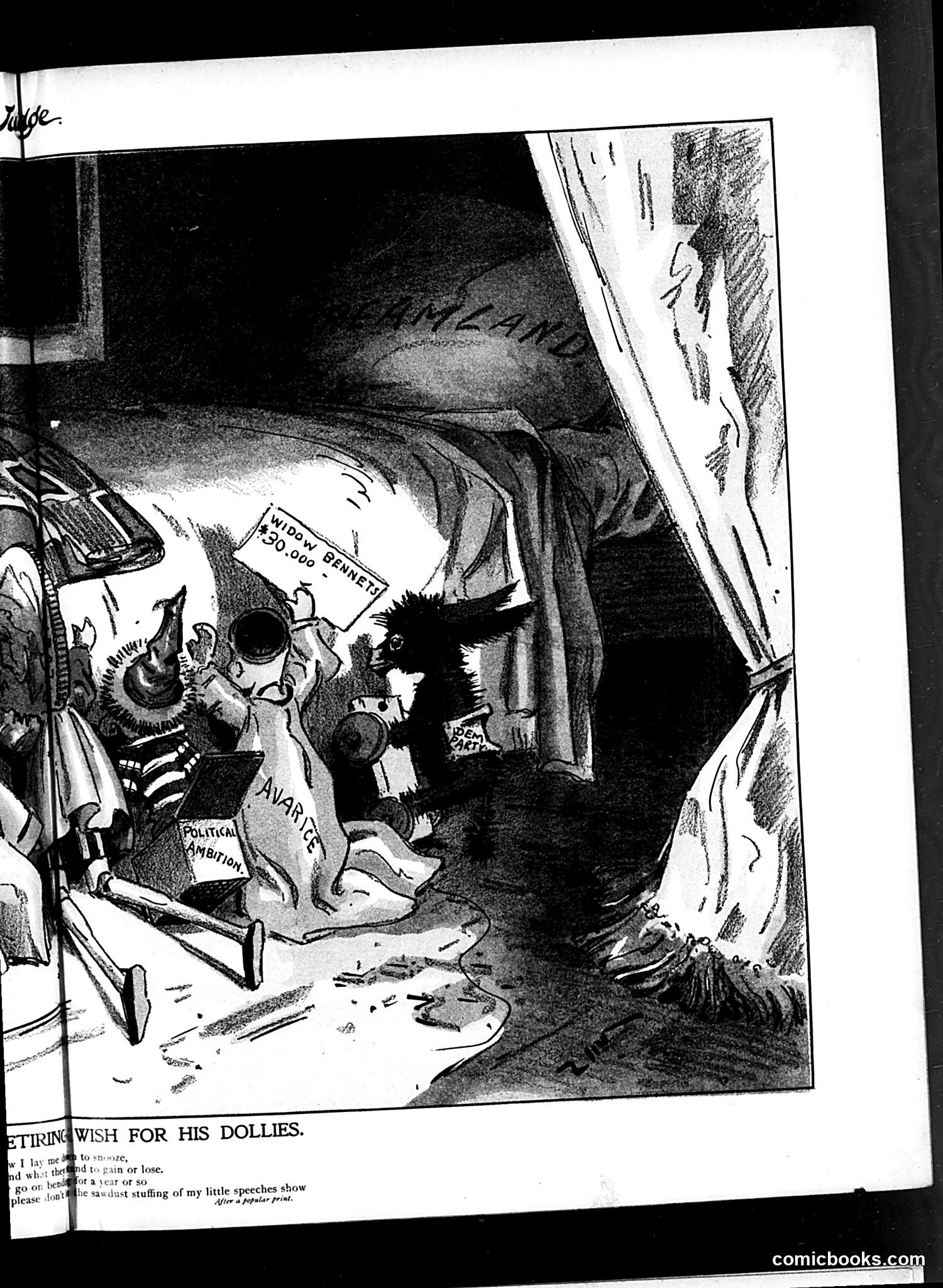
This appears to be a political satire cartoon titled "A RETIRING WISH FOR HIS DOLLIES" (text partially visible at bottom). The image depicts a figure in a cave or confined space surrounded by various labeled objects including "POLITICAL AMBITION," "WIDOW BENNETT," and what appears to be "AVARICE." The cartoon satirizes a politician's retirement, suggesting he's surrounded by the corrupting influences and materialistic concerns that motivated his career—his "dollies" (money/wealth). The cave setting implies he's retreating or being isolated. The "sawdust stuffing of my little speeches" reference suggests his public statements were hollow and insincere. Without knowing the specific date or politician referenced, the broader satire critiques political hypocrisy: a public figure claiming noble motives while actually driven by greed and ambition.
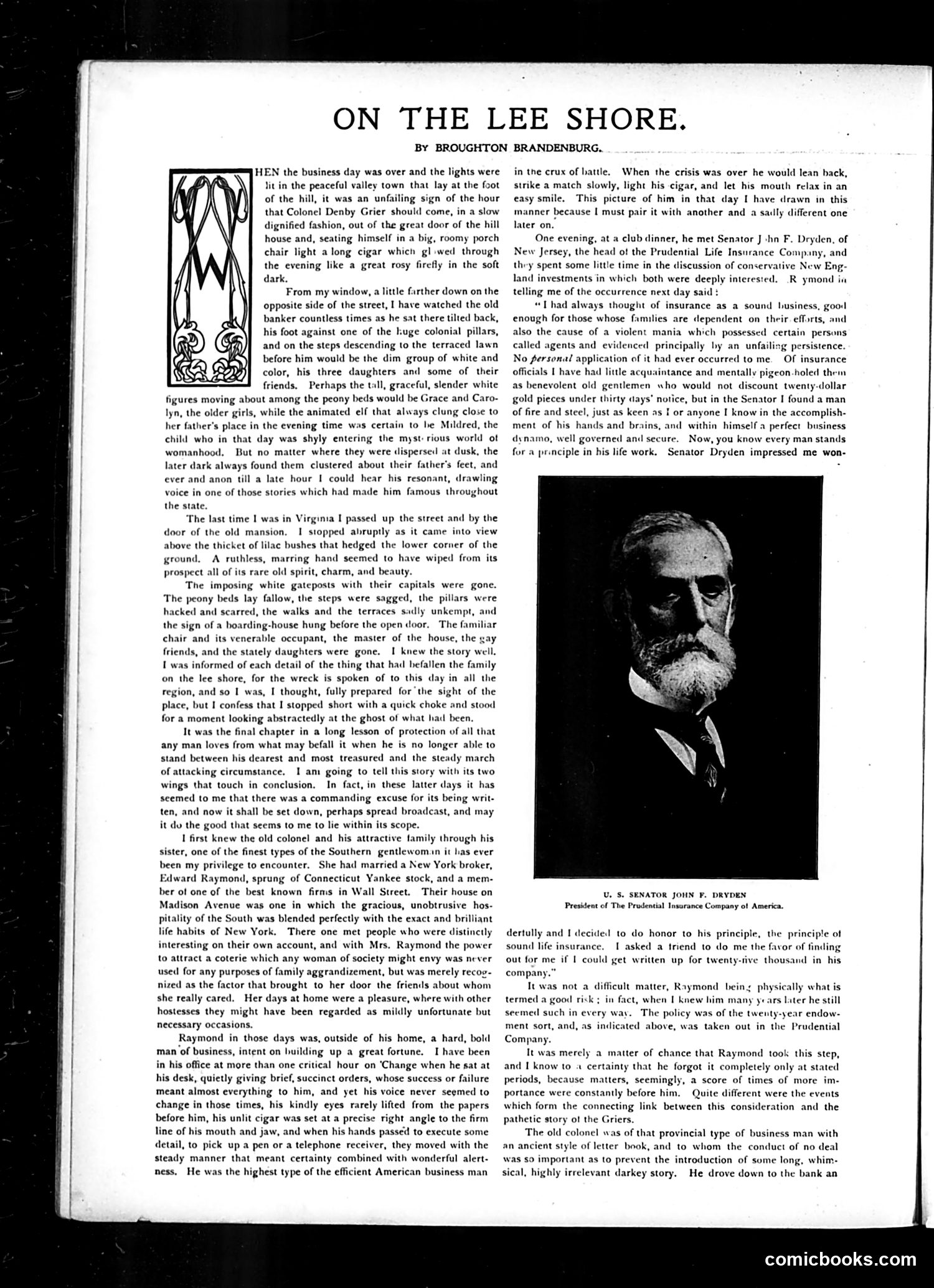
This is the opening of a serialized short story in Judge magazine, not primarily a political cartoon. The illustrated portrait shows Senator John F. Dryden, identified as "President of The Prudential Insurance Company of America." The narrative concerns Colonel Denby Grier, a Southern gentleman of Virginia whose mansion and family life deteriorate into ruin—the house becomes a boarding-house, his daughters disappear, the graceful estate decays. The author uses this domestic tragedy to illustrate "a long lesson of protection of all that any man loves from what may befall it when he is no longer able to stand between his dearest and most treasured." The story appears to moralistically explore financial ruin and loss of social standing. Dryden's inclusion suggests the narrative endorses life insurance as that crucial "protection"—the Prudential message embedded in a sentimental tale of a family's downfall.
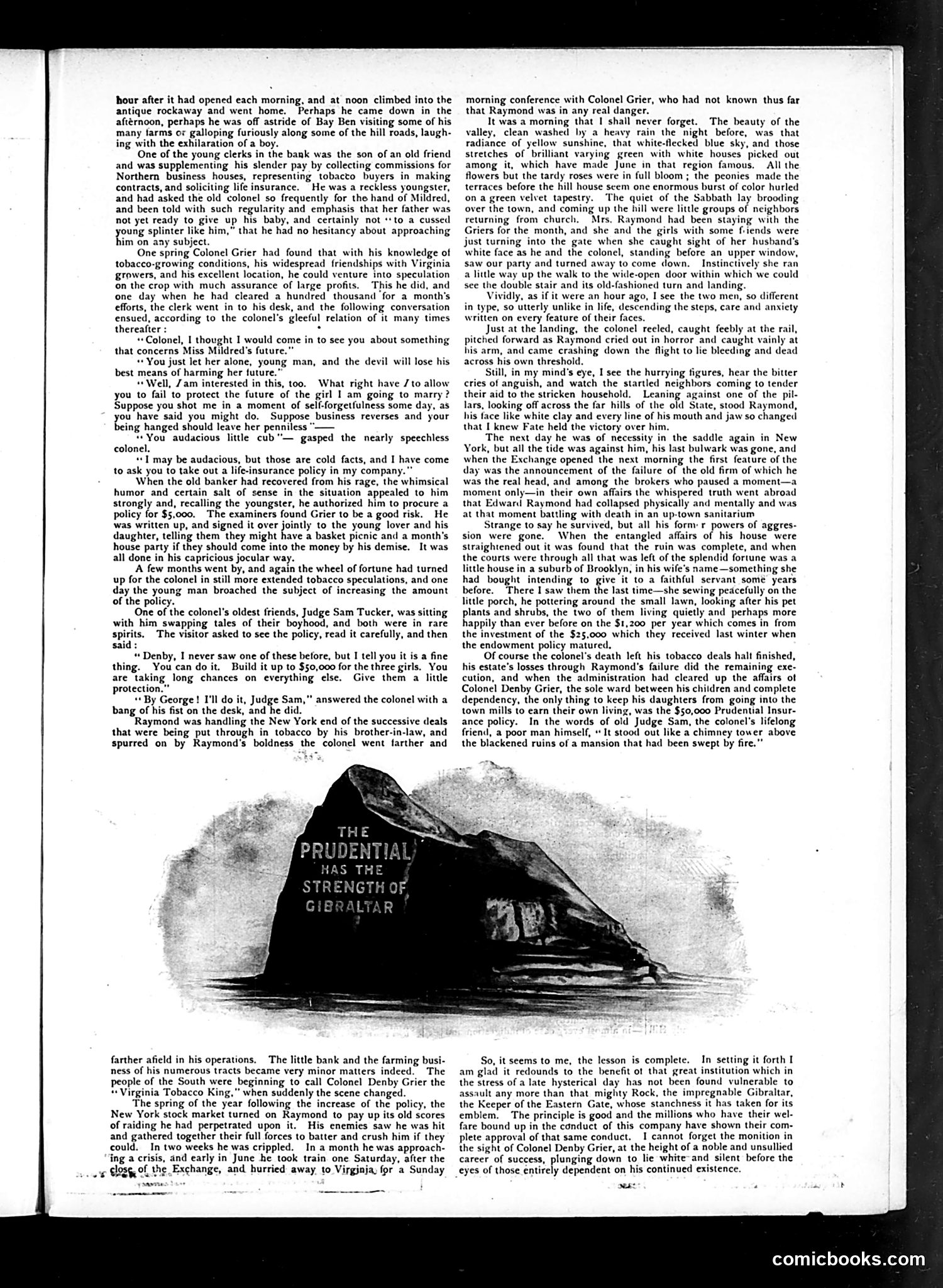
This page contains a narrative story rather than a political cartoon. The illustrated advertisement at bottom—"The Prudential Has the Strength of Gibraltar"—is the only cartoon element visible. The main text describes Colonel Denby Grier, a Virginia tobacco banker and speculator. The story illustrates how a young clerk audaciously persuades Grier to purchase life insurance ($5,000 initially, later $50,000) by arguing that as Grier's future son-in-law, he has a stake in protecting Grier's daughters financially. Grier finds the youngster's brass amusing and agrees. The satire targets two things: (1) aggressive insurance salesmanship and (2) wealthy men's reckless financial speculation during the tobacco boom. The implication is that Grier's increasingly bold business ventures make the insurance ironically necessary—he's taking dangerous risks that justify protective policies for his dependents. The Prudential ad reinforces the narrative's message: life insurance provides security against life's uncertainties.
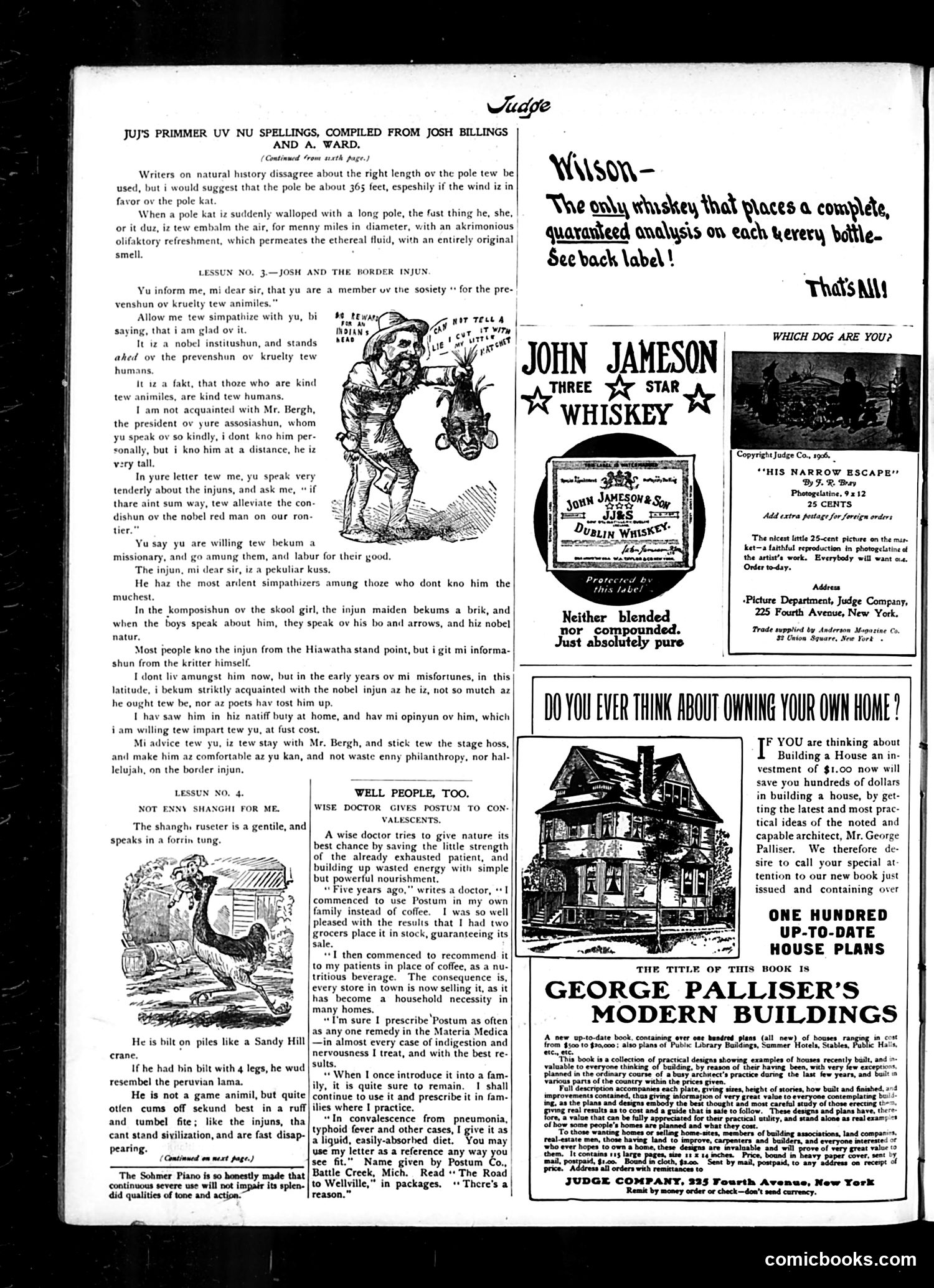
This page contains **humor pieces and advertisements** rather than political cartoons. **Content:** The main text is "Juj's Primmer uv Nu Spellings"—a mock instructional piece in deliberately misspelled dialect attributed to humorists Josh Billings and Artemus Ward. It includes a lesson on capturing skunks and another on Native Americans ("border injuns"), written in exaggerated phonetic spelling for comedic effect. The satire targets sentimental Victorian attitudes about Indigenous peoples, contrasting romanticized literary portrayals with the author's claimed firsthand (unflattering) experience. **Advertisements:** The page includes ads for John Jameson whiskey, a book on house plans by George Palliser, and a testimonial for Postum (a coffee substitute). The humor relies on dialect comedy and puncturing genteel pretensions—common Judge magazine fare of this era.
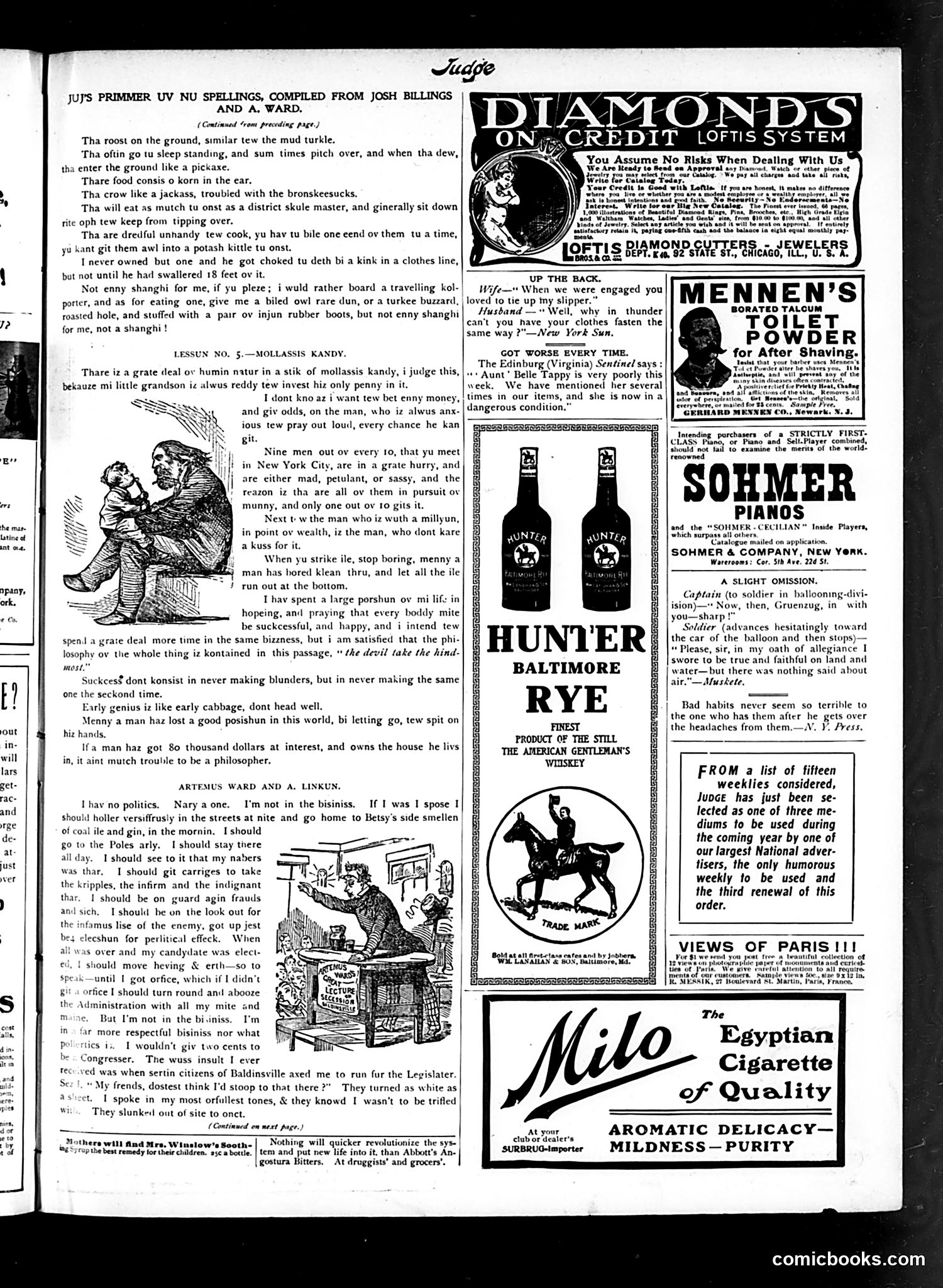
This page contains humorous pseudo-historical "lessons" written in deliberately misspelled dialect, attributed to 19th-century humorists Josh Billings and Artemus Ward. The main text mocks rural American speech and folk wisdom through exaggerated phonetic spelling ("tew" for "to," "korn" for "corn"). The political content appears in the "Artemus Ward and A. Linkun" section, where the narrator claims complete political disinterest while ironically describing typical political operative behavior—canvassing voters, organizing transportation, watching for fraud, and seeking office. This satirizes the hypocrisy of politicians who claim neutrality while actively engaged in partisan mechanics. The page is primarily filled with period **advertisements** (diamonds, whiskey, pianos, powder, cigarettes), indicating this is a commercial magazine relying on paid endorsements alongside satirical content.
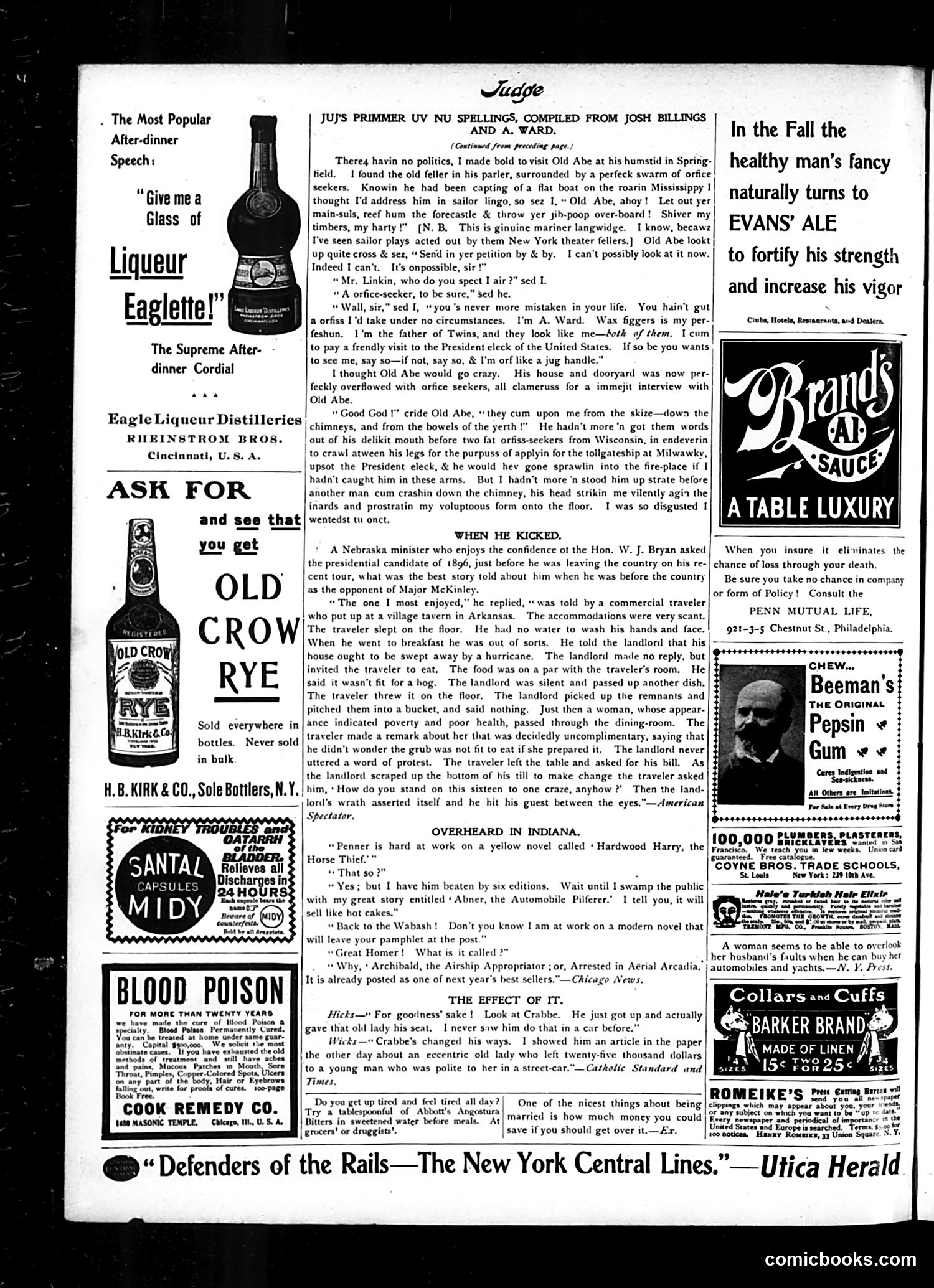
This page is primarily **advertisements and humorous prose sketches**, not political cartoons. The main text content is "Juss Primmer uv Nu Spellings," a satirical piece apparently mocking both **office-seekers and Abraham Lincoln**. Written in exaggerated dialect (attributed to Josh Billings and A. Ward—19th-century humorists), it depicts a visitor named A. Ward meeting President-elect Lincoln at his home in Springfield. The joke centers on Lincoln being overwhelmed by hordes of office-seekers (people seeking government jobs) demanding attention. Ward's sailor-lingo greeting deliberately confuses Lincoln, who mistakes him for another office-seeker—the satirical point being that these patronage-hungry visitors were so numerous and annoying they'd become a stock complaint about political life. A secondary anecdote about **William Jennings Bryan** (1896 presidential candidate) follows, featuring a traveler's complaint about poor accommodations. The remainder of the page consists of period **advertisements** for liqueur, Old Crow whiskey, medical remedies, and other products—typical of Judge magazine's revenue model.
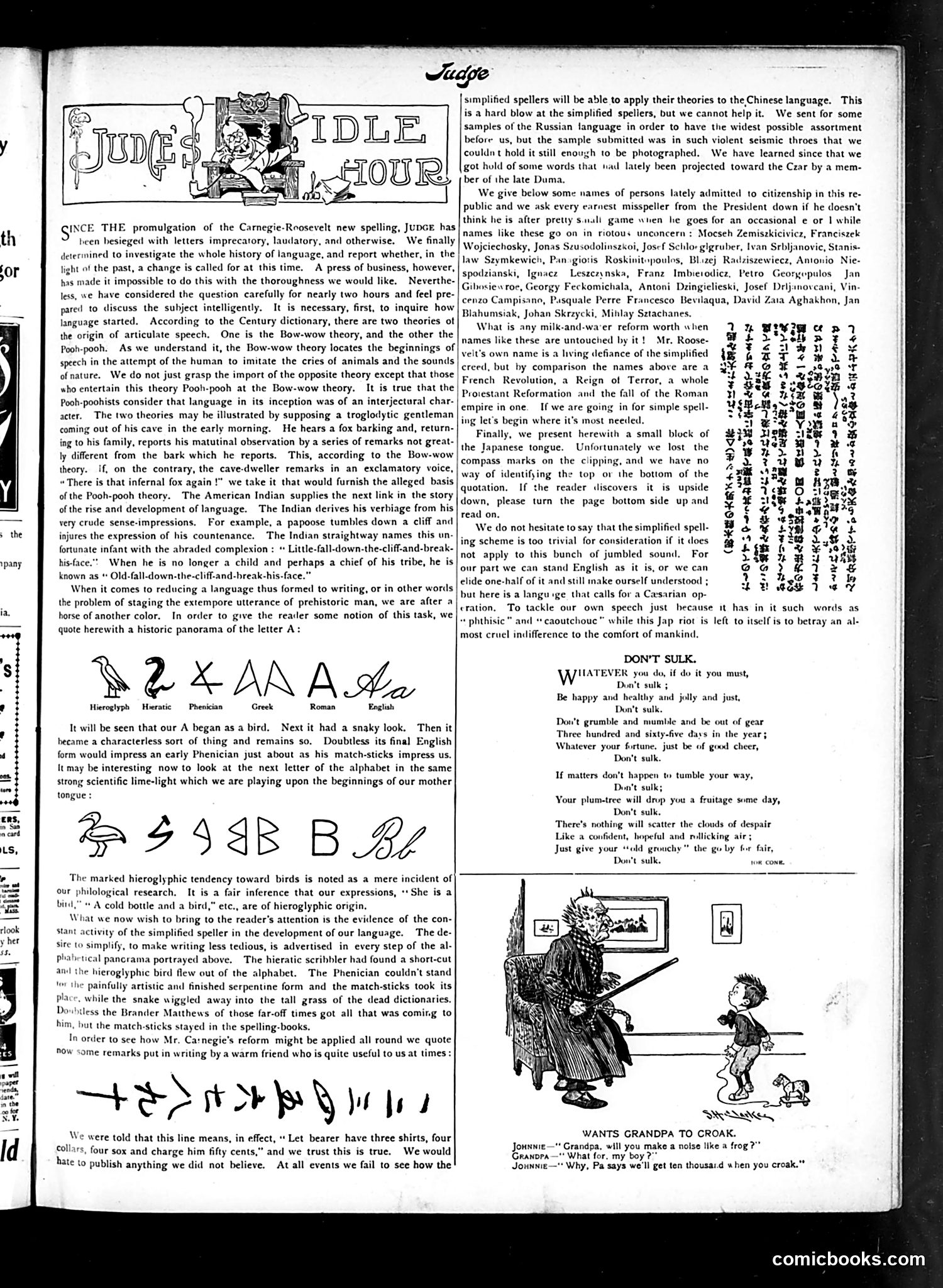
This page satirizes President Theodore Roosevelt and Andrew Carnegie's push for simplified spelling reform (a real early-1900s initiative). Judge mocks the effort by tracing the absurd "history" of how the letter A evolved from a hieroglyph bird to its current form—suggesting that if spelling naturally simplified over millennia, why force artificial changes now? The article humorously catalogs unpronounceable names of Eastern European origin to argue that if we can't standardize *those*, simplified spelling is trivial. It ridicules the reform as pseudo-scientific while pretending to take it seriously, examining language origins through the "Bow-wow theory" (imitation of animal sounds) versus the "Pooh-pooh theory" (exclamations). The bottom cartoon, "Wants Grandpa to Croak," is unrelated—a simple joke about a child asking grandfather to make frog sounds. The satire's point: spelling reform is unnecessary tinkering with natural linguistic evolution.
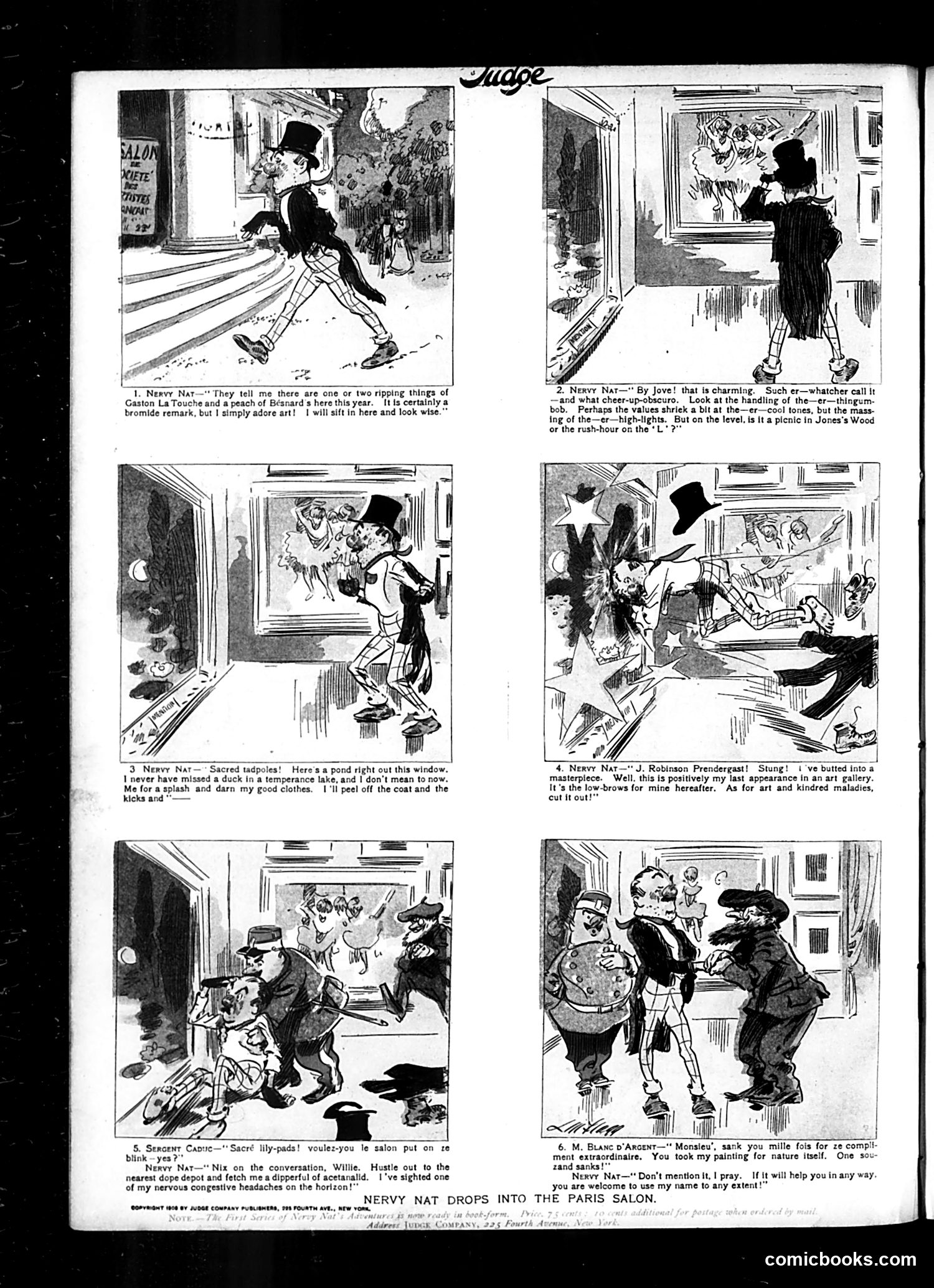
This is a satirical comic strip mocking an American philistine visiting the prestigious Paris Salon art exhibition. "Nervy Nat" is an uncultured buffoon who pretends to appreciate fine art while actually understanding nothing about it—he uses pretentious nonsense phrases ("thingum," "cheer-up-obscuro") to sound knowledgeable. The humor escalates through increasingly absurd behavior: he nearly jumps out a window chasing ducks, accidentally enters a private studio, mistakes an artist's work for nature, and embarrassingly offers his name as a reference. The French characters respond with patient condescension to his crude American antics. The satire targets American tourists' cultural pretensions and ignorance, as well as the pomposity of the art world itself. "Judge" magazine frequently ridiculed both American social climbers and European affectation in the early 20th century.