
Judge, 1906-09-22 · page 4 of 16
Judge — September 22, 1906 — page 4: what you’re looking at
What you’re looking at
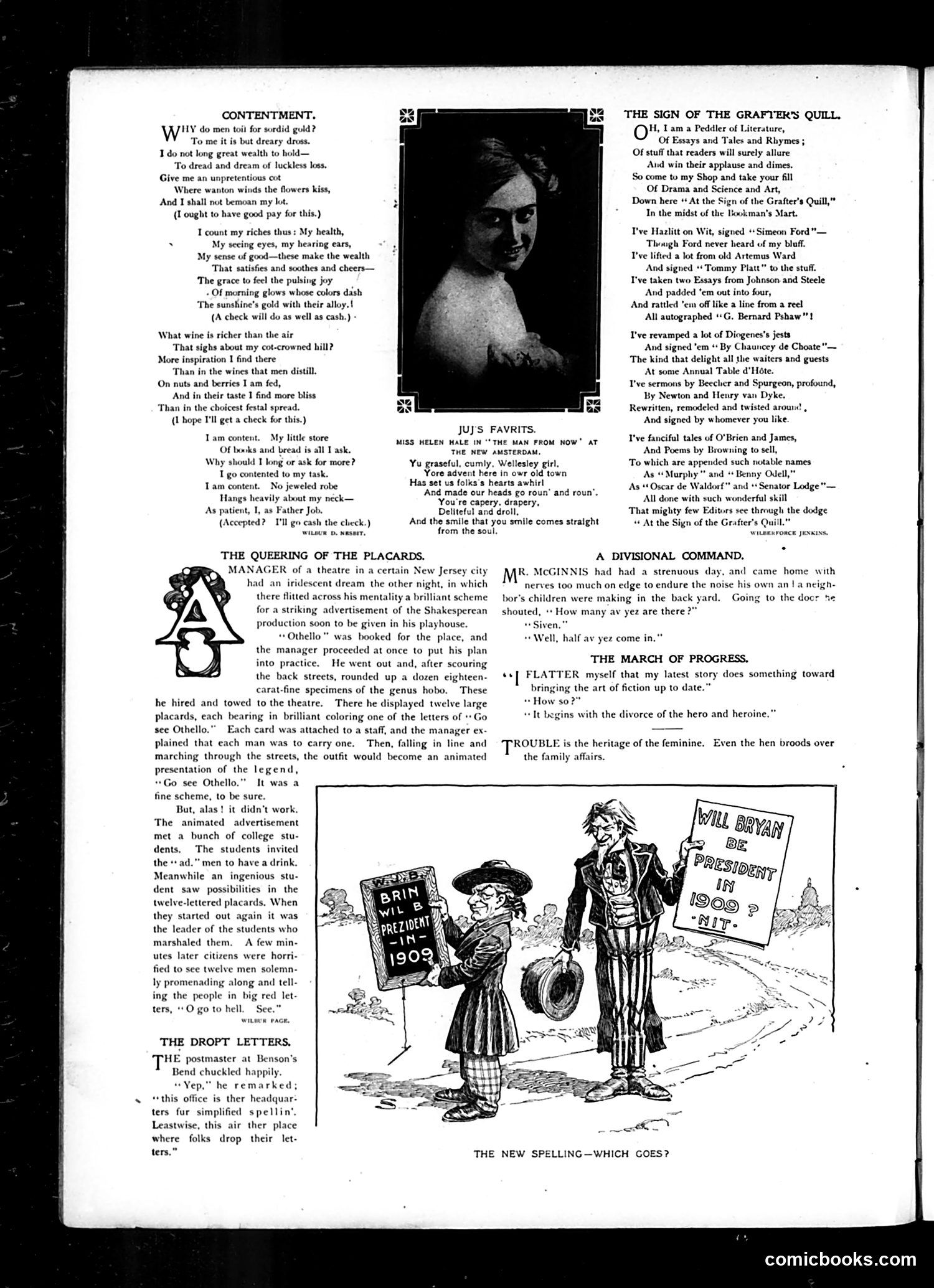
This political cartoon satirizes the spelling reform movement of the early 1900s. Two figures—appearing to represent political candidates or public figures—hold signs advocating for "Bryan for President in 1909" and related political messaging. The cartoon likely mocks William Jennings Bryan's political ambitions while also commenting on the contemporary simplified spelling reform initiative (promoted by President Theodore Roosevelt and others). The juxtaposition of political campaigning with spelling reform creates absurdist humor, suggesting these reform movements were equally questionable or ridiculous to the cartoonist. The title's question "Which Goes?" implies skepticism about whether either movement would succeed, treating political aspirations and linguistic reform as equivalently dubious propositions worthy of mockery.
📄 Transcribed text from this page (OCR, searchable)
Machine-transcribed from the original scan — historical spelling and the odd misread are preserved.
CONTENTMENT. HY do men toil for sordid gold? To me it is but dreary dross. I do not long great wealth to hold— To dread and dream of luckless loss. Give me an unpretentious cot Where wanton winds the flowers kiss, And I shall not bemoan my lo (ought to have good pay for this.) I count my riches thus: My health, My seeing eyes, my hearing ears, My sense of good—these make the wealth That satisfies and soothes and cheers— ‘The grace to feel the pulsing joy + Of morning glows whose colors dash ‘The sunshine’s gold with their alloy.{ (A check will do as well as cash.) - What wine is richer than the air That sighs about my cot-crowned hill? tion I find there Than in the wines that men distill. On nuts and berries I am fed, And in their taste I find more bliss Than in the choicest festal spread. (I hope T'll get a check for this.) Tam content. My little store Of books and bread is all Task. Why should T long or ask for more? T go contented to my task. Tam content. No jeweled robe Hangs heavily about my neck— As patient, I, as Father Job. (Accepted? I'll go cash the check.) WILDUN D. NESBIT. : pa as JUJ'S FAVRITS. MISS MELEN MALE IN "THE MAN FROM NOW" AT THE NEW AMSTERDAM. Yu graseful, cumly, Wellesley girl, Yore advent here in owr old town Has set us folks's hearts awhirl ‘And made our heads go roun’ and roun’, You're capery, drapery, Deliteful and droll, And the smile that you smile comes straight from the soul. THE SIGN OF THE GRAFTER’S QUILL, H, Iam a Peddler of Literature, Of Essays and Tales and Rhymes ; Of stuff that readers will surely allure And win their applause and dimes. So come to my Shop and take your fill Of Drama and Science and Art, Down here * At the Sign of the Grafter’s Quill, In the midst of the Bookman’s Mart. I've Hazlitt on Wit, signed “Simeon Ford"— Though Ford never heard of my blufl T’ve lifted a lot from old Artemus Ward And signed “Tommy Platt" to the stuff. T’ve taken two Essays from Johnson and Steele And padded ‘em out into four, And rattled ‘em off like a line from a reel Alll autographed “G. Bernard Pshaw""! I've revamped a lot of Diogenes’s jests And signed "em “ By Chauncey de Choate "— The kind that delight all the waiters and guests At some Annual Table d’Hote. I've sermons by Beecher and Spurgeon, profound, By Newton and Henry van Dyke, Rewritten, remodeled and twisted aroun, And signed by whomever you like I've fanciful tales of O’Brien and James, And Poems by Browning to sell, To which are appended such notable names As “Murphy and Benny Odell,"* As “Oscar de Waldorf” and ** Senator Lodge" — All done with such wonderful skill That mighty few Editors see through the dodge + At the Sign of the Grafter’s Quill.” WILBEXPORCE JENKINS, THE QUEERING OF THE PLACARDS. MANAGER of a theatre in a certain New Jersey city had an iridescent dream the other night, in which there flitted a ity a brilliant scheme for a striking advertisement of the Shakesperean production soon to be given in his playhouse. ** Othello” was booked for the place, and the manager proceeded at once to put his plan into practice, He went out and, after scouring the back streets, rounded up a dozen eighteen- carat-fine specimens of the genus hobo. These he hired and towed to the theatre. There he displayed twelve larg placards, each bearing in brilliant coloring one of the letters of see Othello.” Each card was attached to a staff, and the manager ex- plained that each man was to carry one. Then, falling in line and marching through the streets, the outfit would become an animated ross his ment presentation of the legend, So see Othello.” It was a e scheme, to be sure. But, alas! it didn’t work. The animated advertisement met a bunch of college stu- dents, The students invited the “ad.” men to have a drin| Meanwhile an ingenious stu- dent saw possibilities in the twelve-lettered placards, When they started out again it was the leader of the students who marshaled them, A few min- utes later citizens were horri- fied to see twelve men solemn- ly promenading along and tell- ing the people in big red let- ters, “0 go to hell. See.” THE DROPT LETTERS. THE postmaster at Benson's Bend chuckled happily. “Yep,” he remarked; “this office is ther headquar: ters fur simplified spellin’. Leastwise, this air ther place where folks drop their let- A DIVISIONAL COMMAND. R. MCGINNIS had had a strenuous day, and came home with nerves too much on edge to endure the noise his « ing in the back yard. Going to the docr ne nantaneigh- bor’s children were mal shouted, «* How many av yez are there? ** Siven.” + Well, half av yez come in. THE MARCH OF PROGRESS. R myself that my latest story does something toward g the art of fiction up to date.” + How so?” “It begins with the divorce of the hero and heroine,” ROUBLE is the heritage of the feminine. Even the hen broods over the family affairs. THE NEW SPELLING—WHICH GOES? comicbooks.com