
Judge, 1906-09-22 · page 11 of 16
Judge — September 22, 1906 — page 11: what you’re looking at
What you’re looking at
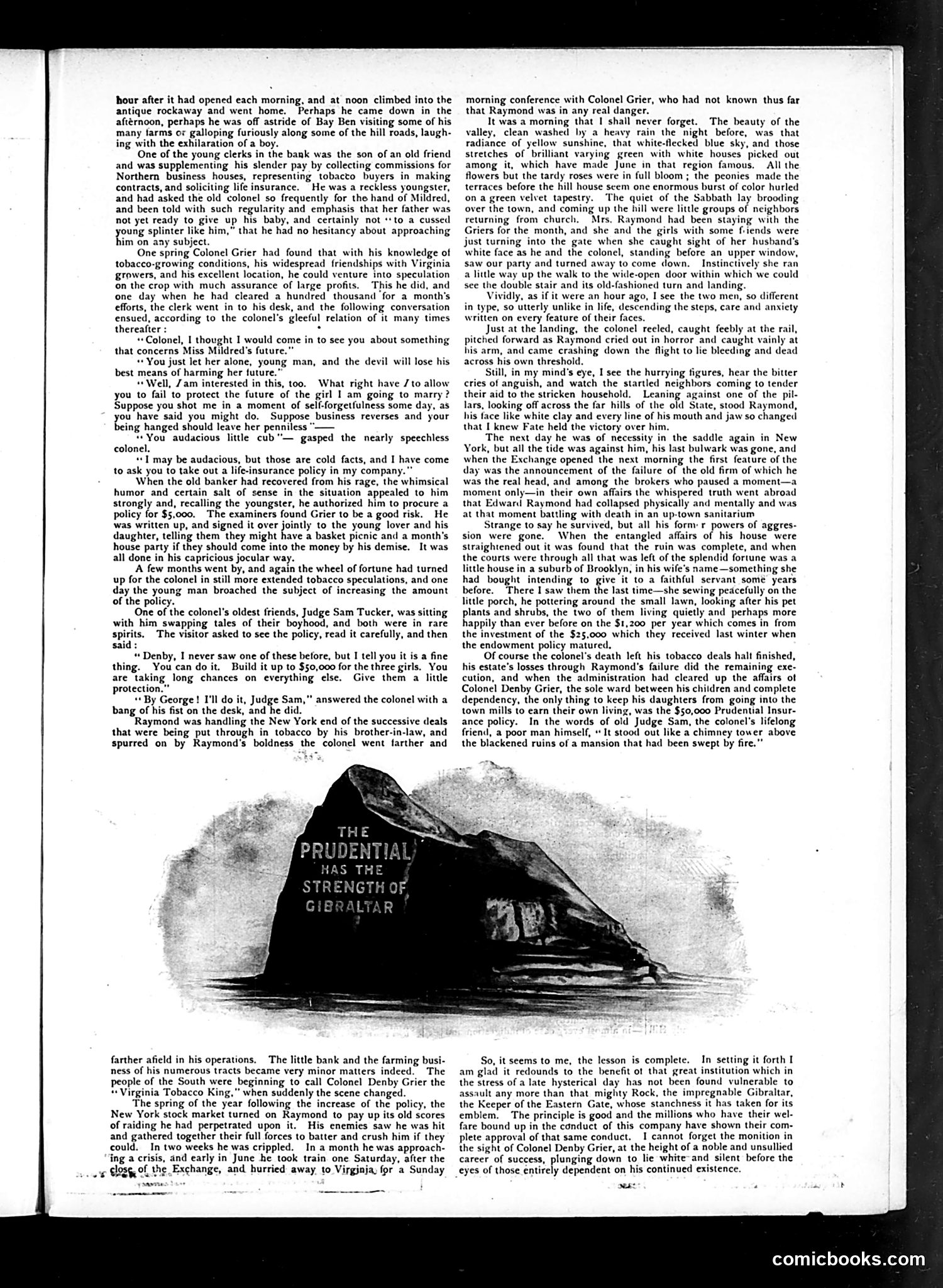
This page contains a narrative story rather than a political cartoon. The illustrated advertisement at bottom—"The Prudential Has the Strength of Gibraltar"—is the only cartoon element visible. The main text describes Colonel Denby Grier, a Virginia tobacco banker and speculator. The story illustrates how a young clerk audaciously persuades Grier to purchase life insurance ($5,000 initially, later $50,000) by arguing that as Grier's future son-in-law, he has a stake in protecting Grier's daughters financially. Grier finds the youngster's brass amusing and agrees. The satire targets two things: (1) aggressive insurance salesmanship and (2) wealthy men's reckless financial speculation during the tobacco boom. The implication is that Grier's increasingly bold business ventures make the insurance ironically necessary—he's taking dangerous risks that justify protective policies for his dependents. The Prudential ad reinforces the narrative's message: life insurance provides security against life's uncertainties.
📄 Transcribed text from this page (OCR, searchable)
Machine-transcribed from the original scan — historical spelling and the odd misread are preserved.
hour after it had opened each morning, and at noon climbed into the antique rockaway and went home. Perhaps he came down in the afternoon, perhaps he was off astride of Bay Ben visiting some of his many farms or galloping furiously along some of the hill roads, laugh- ing with the exhilaration of a boy. One of the young clerks in the bank was the son of an old friend and was supplementing his slender pay by collecting commissions for Northern business houses, representing tobacto buyers in making contracts, and soliciting life insurance. He was a reckless youngster, and had asked the old colonel so frequently for the hand of Mildred, and been told with such regularity and emphasis that her father was not yet ready to give up his baby, and certainly not *+to a cussed oung splinter like him,” that he had no hesitancy about approaching im on any subject. One spring Colonel Grier had found that with his knowledge of tobacco-growing conditions, his widespread friendships with Virginia growers, and his excellent location, he could venture into speculation on the crop with much assurance of large profits. This he did, and one day when he had cleared a hundred thousand ‘for a month's efforts, the clerk went in to his desk, and the following conversation ensued, according to the colonel’s gleeful relation of it many times thereafter : ‘ *Colonel, 1 thought I would come in to see you about something that concerns Miss Mildred’s future.” + You just let her alone, young man, and the devil will lose his best means of harming her future.” + Well, Zam interested in this, too. What right have /to allow you to fail to protect the future of the girl | am going to marry? Suppose you shot me in a moment of self-forgetfulness some day, as ou have said you might do. Suppose business reverses and your Being hanged should leave her penniless "—— ‘You audacious little cub"— gasped the nearly speechless colonel. “I may be audacious, but those are cold facts, and I have come to ask you to take out a life-insurance policy in my company. When the old banker had recovered from his rage, the whimsical humor and certain salt of sense in the situation appealed to him strongly and, recalling the youngster, he authorized him to procure a policy for $5,000. The examiners found Grier to be a good risk. He was written up, and signed it over jointly to the young lover and his daughter, telling them they might have a basket picnic and a month's house party if they should come into the money by his demise. It was all done in his capricious jocular way. A few months went by, and again the wheel of fortune had turned up for the colonel in still more extended tobacco speculations, and one day the young man broached the subject of increasing the amount of the policy. One of the colonel's oldest friends, Judge Sam Tucker, was sitting with him swapping tales of their boyhood, and both were in rare spirits. The visitor asked to see the policy, read it carefully, and then said: Denby, I never saw one of these before, but I tell you it is a fine thing. You can do it. Build it up to $50,000 for the three girls. You are taking long chances on everything else. Give them a little protection.” «By George! I'll do it, Judge Sam,” answered the colonel with a bang of his fist on the desk, and he did. Raymond was handling the New York end of the successive deals that were being put through in tobacco by his brother-in-law, and spurred on by Raymond's boldness the colonel went farther and farther afield in his operations. The little bank and the farming busi- ness of his numerous tracts became very minor matters indeed. The people of the South were beginning to call Colonel Denby Grier the “Virginia Tobacco King,” when suddenly the scene changed. The spring of the year following the increase of the policy, the New York stock market turned on Raymond to pay up its old scores of raiding he had perpetrated upon it. His enemies saw he was hit and gathered together their full forces to batter and crush him if they could. In two weeks he was crippled. In a month he was approach- ing a crisis, and early in June he took train one Saturday, after the glosg of the Exchange, and hurried away. to Virginia, for a Sunday morning conference with Colonel Grier, who had not known thus far that Raymond was in any real danger. It was a morning that I shall never forget. The beauty of the valley, clean washed by a heavy rain the night before, was that radiance of yellow sunshine, that white-flecked blue sky, and those stretches of brilliant varying green with white houses picked out among it, which have made June in that region famous. All the flowers but the tardy roses were in full bloom ; the peonies made the terraces before the hill house scem one enormous burst of color hurled on agreen velvet tapestry. The quiet of the Sabbath lay brooding over the town, and coming up the hill were little groups of neighbors returning from church, Mrs. Raymond had been staying with the Griers for the month, and she and the girls with some fiends were just turning into the gate when she caught sight of her husband's white face as he and the colonel, standing before an upper window, saw our party and turned away to come down. —_Instinctively she ran a little way up the walk to the wide-open door within which we could see the double stair and its old-fashioned turn and landing. Vividly, as if it were an hour ago, I see the two men, so different in type, so utterly unlike in life, descending the steps, care and anxiety written on every feature of their faces. Just at the landing, the colonel recled, caught feebly at the rail, pitched forward as Raymond cried out in horror and caught vainly at his arm, and came crashing down the flight to lie bleeding and dead across his own threshold. Still, in my mind’s eye, I see the hurrying figures, hear the bitter cries of anguish, and watch the startled neighbors coming to tender their aid to the stricken household. Leaning against one of the pil- lars, looking off across the far hills of the old State, stood Raymond, his face like white clay and every line of his mouth and jaw so changed that I knew Fate held the victory over him. The next day he was of necessity in the saddle again in New York, but all the tide was against him, his last bulwark was gone, and when the Exchange opened the next morning the first feature of the day was the announcement of the failure of the old firm of which he was the real head, and among the brokers who paused a moment—a moment only—in their own affairs the whispered truth went abroad that Edward Raymond had collapsed physically and mentally and was at that moment battling with death in an up-town sanitarium Strange to say he survived, but all his form: r powers of aggres- sion were gone. When the entangled affairs of his house were straightened out it was found that the ruin was complete, and when the courts were through all that was left of the splendid fortune was a little house in a suburb of Brooklyn, in his wife’s name—something she had bought intending to give it to a faithful servant some years before. There I saw them the last time—she sewing peacefully on the little porch, he pottering around the small lawn, looking after his pet plants and shrubs, the two of them living quietly and perhaps more happily than ever before on the $1,200 per year which comes in from the investment of the $25,000 which they received last winter when the endowment policy matured, Of course the colonel’s death left his tobacco deals halt finished, his estate’s losses through Raymond's failure did the remaining exe- cution, and when the administration had cleared up the affairs of Colonel Denby Grier, the sole ward between his children and complete dependency, the only thing to keep his daughters from going into the town mills to earn their own living, was the $50,000 Prudential Insur- ance policy. In the words of old’ Judge Sam, the colonel’s lifelong friend, a poor man himself, « It stood out like a chimney tower above the blackened ruins of a mansion that had been swept by fire.” So, it seems to me, the lesson is complete. In setting it forth I am glad it redounds to the benefit ot that great institution which in the stress of a late hysterical day has not been found vulnerable to assault any more than that mighty Rock, the impregnable Gibraltar, the Keeper of the Eastern Gate, whose stanchness it has taken for its emblem. The principle is good and the millions who have their wel- fare bound up in the conduct of this company have shown their com- plete approval of that same conduct. I cannot forget the monition in the sight of Colonel Denby Grier, at the height of a noble and unsullied career of success, plunging down to lie white-and silent before the eyes of those entirely dependent on his continued existence. vee: a comicbooks.com