
Judge, 1906-09-22 · page 15 of 16
Judge — September 22, 1906 — page 15: what you’re looking at
What you’re looking at
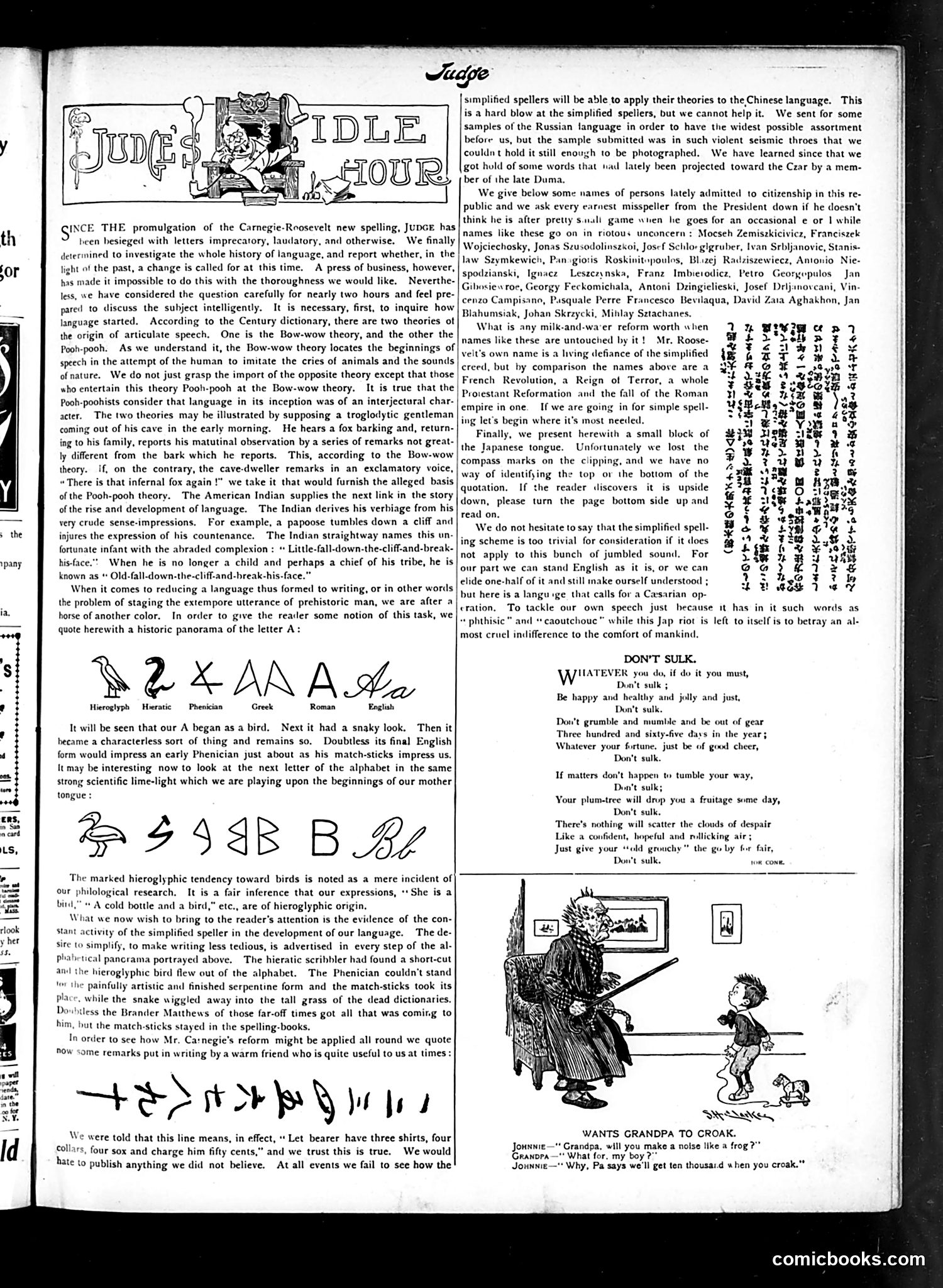
This page satirizes President Theodore Roosevelt and Andrew Carnegie's push for simplified spelling reform (a real early-1900s initiative). Judge mocks the effort by tracing the absurd "history" of how the letter A evolved from a hieroglyph bird to its current form—suggesting that if spelling naturally simplified over millennia, why force artificial changes now? The article humorously catalogs unpronounceable names of Eastern European origin to argue that if we can't standardize *those*, simplified spelling is trivial. It ridicules the reform as pseudo-scientific while pretending to take it seriously, examining language origins through the "Bow-wow theory" (imitation of animal sounds) versus the "Pooh-pooh theory" (exclamations). The bottom cartoon, "Wants Grandpa to Croak," is unrelated—a simple joke about a child asking grandfather to make frog sounds. The satire's point: spelling reform is unnecessary tinkering with natural linguistic evolution.
📄 Transcribed text from this page (OCR, searchable)
Machine-transcribed from the original scan — historical spelling and the odd misread are preserved.
» the pany wuape (CE THE promulgation of the Carnegie-Roosevelt new spelling, JUDGE has -en besieged with letters imprecatory, laudatory, and otherwise. We finally determined to investigate the whole history of language, and report whether, in the light of the past, a change is called for at this time. A press of business, however, has made it impossible to do this with the thoroughness we would like. Neverthe- less, we have considered the question carefully for nearly two hours and feel pre- pared to discuss the subject intelligently. It is necessary, first, to inquire how language started. According to the Century dictionary, there are two theories of the origin of articulate speech. One is the Bow-wow theory, and the other the Pooh-pooh. As we understand it, the Bow-wow theory locates the beginnings of speech in the attempt of the human to imitate the cries of animals and the sounds of nature. We do not just grasp the import of the opposite theory except that those who entertain this theory Pooh-pooh at the Bow-wow theory. It is true that the Pooh-poohists consider that language in its inception was of an interjectural char- acter. The two theories may be illustrated by supposing a troglodytic gentleman coming out of his cave in the early morning. He hears a fox barking and, return- ing to his family, reports his matutinal observation by a series of remarks not great- ly different from the bark which he reports. This, according to the Bow-wow theory. If, on the contrary, the cave-dweller remarks in an exclamatory voice, «There is that infernal fox again!" we take it that would furnish the alleged basis of the Pooh-pooh theory. The American Indian supplies the next link in the story of the rise and development of language. The Indian derives his verbiage from his very crude sense-impressions. For example, a papoose tumbles down a cliff and injures the expression of his countenance. The Indian straightway names this un- fortunate infant with the abraded complexion : « Little-fall-down-the-cliff-and-break- his-face.?. When he is no longer a child and perhaps a chief of his tribe, he is known as ** Old-fall-down-the-cliff-and-break-his-face.” When it comes to reducing a language thus formed to writing, or in other words the problem of staging the extempore utterance of prehistoric man, we are after a horse of another color. In order to give the reader some notion of this task, we quote herewith a historic panorama of the letter A: YVPexXL ANA eH Hoeratic —Phenician Greek Roman English Hieroglyph It will be seen that our A began asa bird. Next it had a snaky look. Then it hecame a characterless sort of thing and remains so. Doubtless its final English form would impress an early Phenician just about as his match-sticks impress us. It may be interesting now to look at the next letter of the alphabet in the same strong scientific lime-light which we are playing upon the beginnings of our mother tongue : @S4IIB BY marked hieroglyphic tendency toward birds is noted as a mere incident of our philological research, It is a fair inference that our expressions, “+ She is a bind,” «A cold bottle and a bird,” ete., are of hieroglyphic origin. What we now wish to bring to the reader's attention is the evidence of the con- stant activity of the simplified speller in the development of our language. The de- sire to simplify, to make writing less tedious, is advertised in every step of the al- Phabetical pancrama portrayed above, The hieratic scribbler had found a short-cut an the hieroglyphic bird flew out of the alphabet. The Phenician couldn't stand ‘or the painfully artistic and finished serpentine form and the match-sticks took its place, while the snake wiggled away into the tall grass of the dead dictionaries. simplified spellers will be able to apply their theories to the Chinese language. This is a hard blow at the simplified spellers, but we cannot help it. We sent for some samples of the Russian tanguage in order to have the widest possible assortment before us, but the sample submitted was in such violent seismic throes that we couldnt hold it still enough to be photographed. We have learned since that we got hold of some words that nail lately been projected toward the Czar by a mem- ber of the late Duma. We give below some names of persons lately admitted to citizenship in this re- public and we ask every earnest misspeller from the President down if he doesn't think he is after pretty ssalt game when he goes for an occasional e or | while names like these go on in riotous unconcern : Mocseh Zemiszkicivicz, Franciszek Wojciechosky, Jonas Szusodolinszkoi, Josef Schlor gigruber, Ivan Srbljanovic, law Szymkewich, Panogiotis Roskinitopoulos, Blizej Radziszewiecz, Antonio Nie- spodzianski, Ignacz Leszezynska, Franz Imbierodicz, Petro Georyepulos Jan Gibosiew roe, Georgy Feckomichala, Antoni Dzingielieski, Josef Drljanoveani, Vin- cenzo Campisano, Pasquale Perre Francesco Bevilaqua, David Zaia Aghakhon, Jan Blahumsiak, Johan Skrzycki, Miblay Sztachanes. What is any milk-and-wa’er reform worth when names like these are untouched by it! Mr, Roose- velt’s own name is a hving defiance of the simplified creed, but by comparison the names above are a French Revolution, a Reign of Terror, a whole Proiestant Reformation and the fall of the Roman empire in one. If we are going in for simple spell- ing let's begin where it’s most needed. Finally, we present herewith a small block of the Japanese tongue. Unfortunately we lost the compass marks on the clipping, and we have no way of identifying the top or the bottom of the quotation. If the reader discovers it is upside down, please turn the page bottom side up and Pry eeu ss S¥ELYS meee aan KRONA VER vere <astee ees Pray re bees bet oss MIA AaANGPKAI 30) & ee SHU MEE ROMs wsevRw ks! BEE (se SAS jovi OR Srx: ay 228 io: S. Fret as Safe OR pars PKEPROw ayy prea ay BRR Sony a Teuser read on. We do not hesitate to say that the simplified spell- ing scheme is too trivial for consideration if it does not apply to this bunch of jumbled sound. For our part we can stand English as it is, or we can elide one-half of it and still make ourself understood ; but here is a languige that calls for a Cxsarian op- cration, To tackle our own speech just because it has in it such “ phthisic” and “caoutchoue” while this Jap riot is left to itself is to betray an al- most cruel indifference to the comfort of mankind, ° Conners SOR SREK UY. iy it (BRBOKRK A DEDAE HeOrR pag a Sonued MHI KP Ae mR awwese 2 words as DON’T SULK. WHATEVER you do, if do it you must Don't sulk Be happy and healthy and jolly and just, Don't sulk. Don't grumble and mumble and be out of gear Three hundred and sixty-five days in the year; Whatever your fortune, just be of good cheer, Don't sulk. If matters don’t happen to tumble your way, Don't sulk; Your plumetree will drup you a fruitage some day, Don't sulk, nthing will scatter the clouds of despair nd rollicking air; the go by for fair, There's Like a confident, hopeful Just give your “old grouchy” Don't sulk. Dovbiless the Brander Matthews of those far-off times got all that was coming to him, but the match-sticks stayed in the spelling-books. In order to see how Mr. Carnegie’s reform might be applied all round we quote now some remarks put in writing by a warm friend who is quite useful to us at times : +E) OD dea We were told that this line means, in effect, “Let bearer have three shirts, four collars, four sox and charge him fifty cents,” and we trust this is true, We would hate to publish anything we did not believe. At all events we fail to sce how the WANTS GRANDPA TO CROAK. Jonnnie—" Grandpa, will you make a noise like a frog?” Grawora—"* What for. my boy?” Jounnie—"* Why, Pa says we'll get ten thousai.d when you croak.” comicbooks.com