
A complete issue · 16 pages · 1906
Judge — July 28, 1906
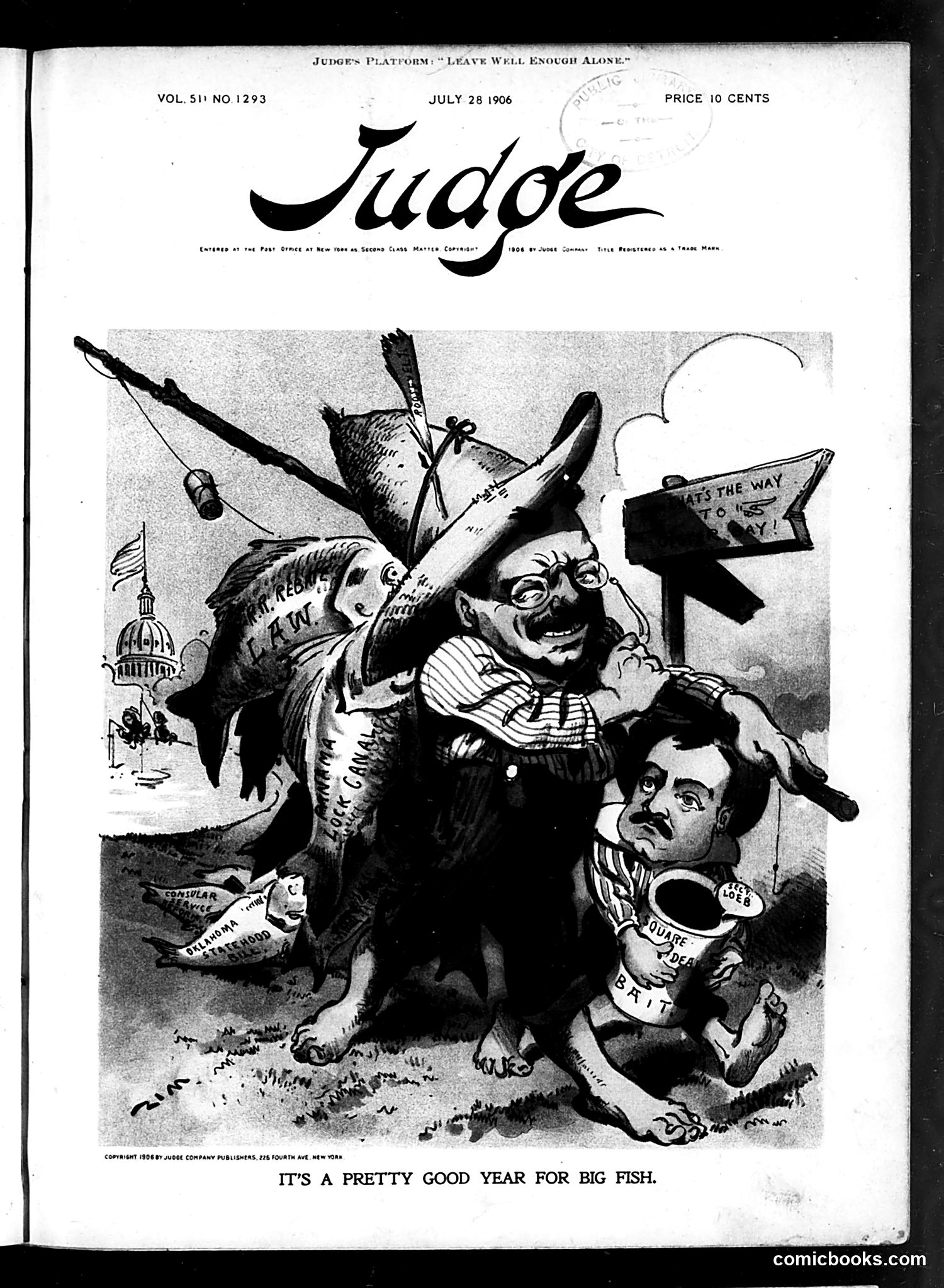
This July 1906 Judge magazine cartoon uses aquatic metaphor to satirize political power dynamics. A large fish wearing military regalia dominates two smaller figures in naval uniforms, labeled with names suggesting political or military officials (text is partially unclear in the image). The Capitol building appears in the background, indicating federal government context. The caption "It's a Pretty Good Year for Big Fish" suggests commentary on how powerful political figures or corporate interests are thriving while others struggle—a common Progressive Era critique of monopolies and political corruption. The "way to" directional sign hints at manipulation or misdirection of policy. Without clearer label identification, the specific figures and incident remain uncertain, though the satire clearly targets power imbalances in early 1900s American politics.
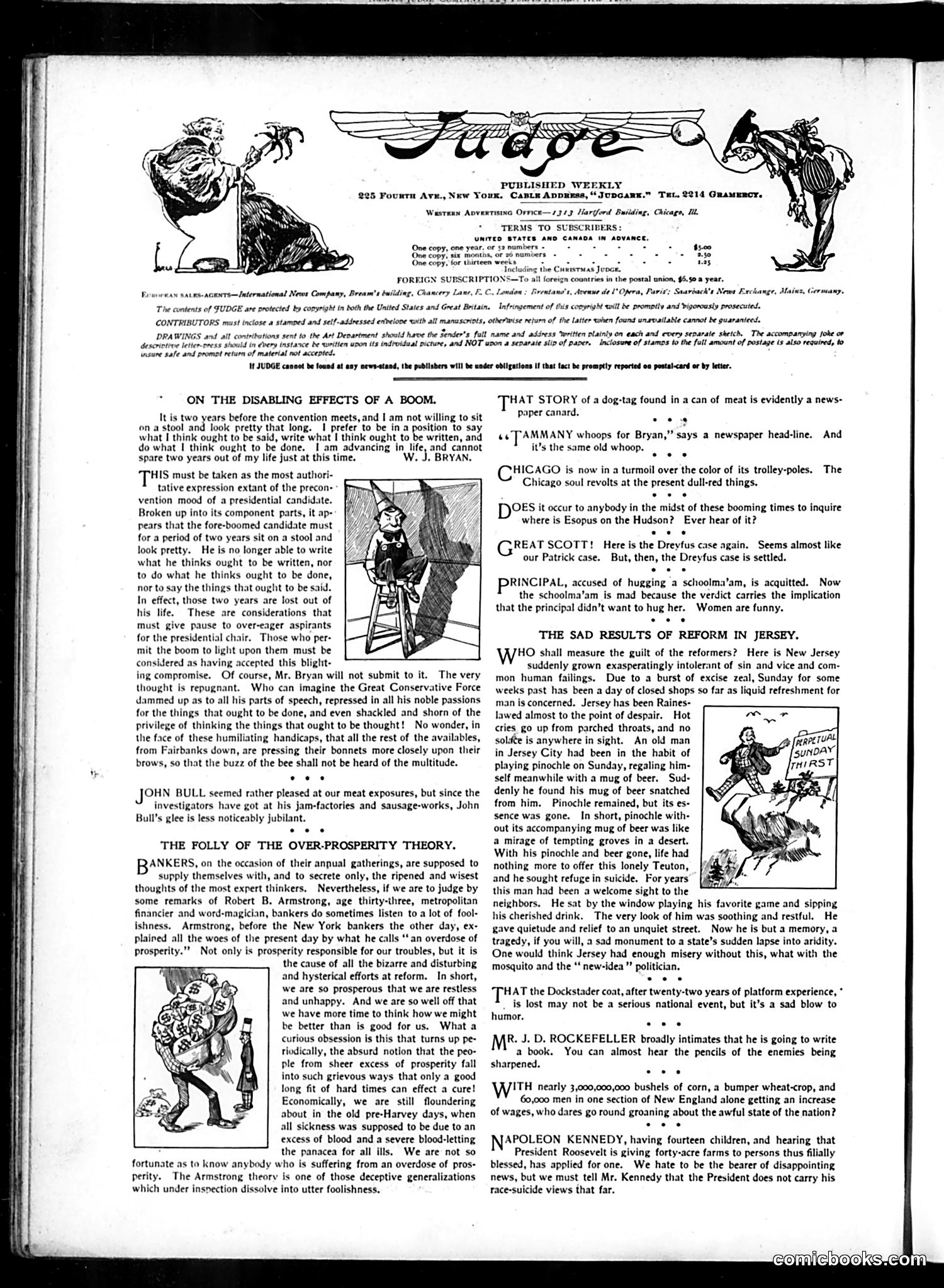
This page from Judge magazine contains several short satirical pieces and illustrations targeting contemporary issues and figures. The main cartoon shows a man at a window, illustrating "The Sad Results of Reform in Jersey"—a critique of New Jersey's reform movement. The text describes a man who lost his job due to reform efforts, ironically forcing him toward suicide despite the reformers' good intentions. Other brief satirical items mock: - W.J. Bryan's political positioning ("On the Disabling Effects of a Boom") - Chicago's trolley-pole color choices - A principal's corporal punishment policies - Robert B. Armstrong's excessive prosperity claims The page also includes commentary on Rockefeller's planned book and references to "Napoleon Kennedy" (likely a political figure's child), showing Judge's typical approach: quick jabs at politicians, reform movements, and social absurdities of the era.
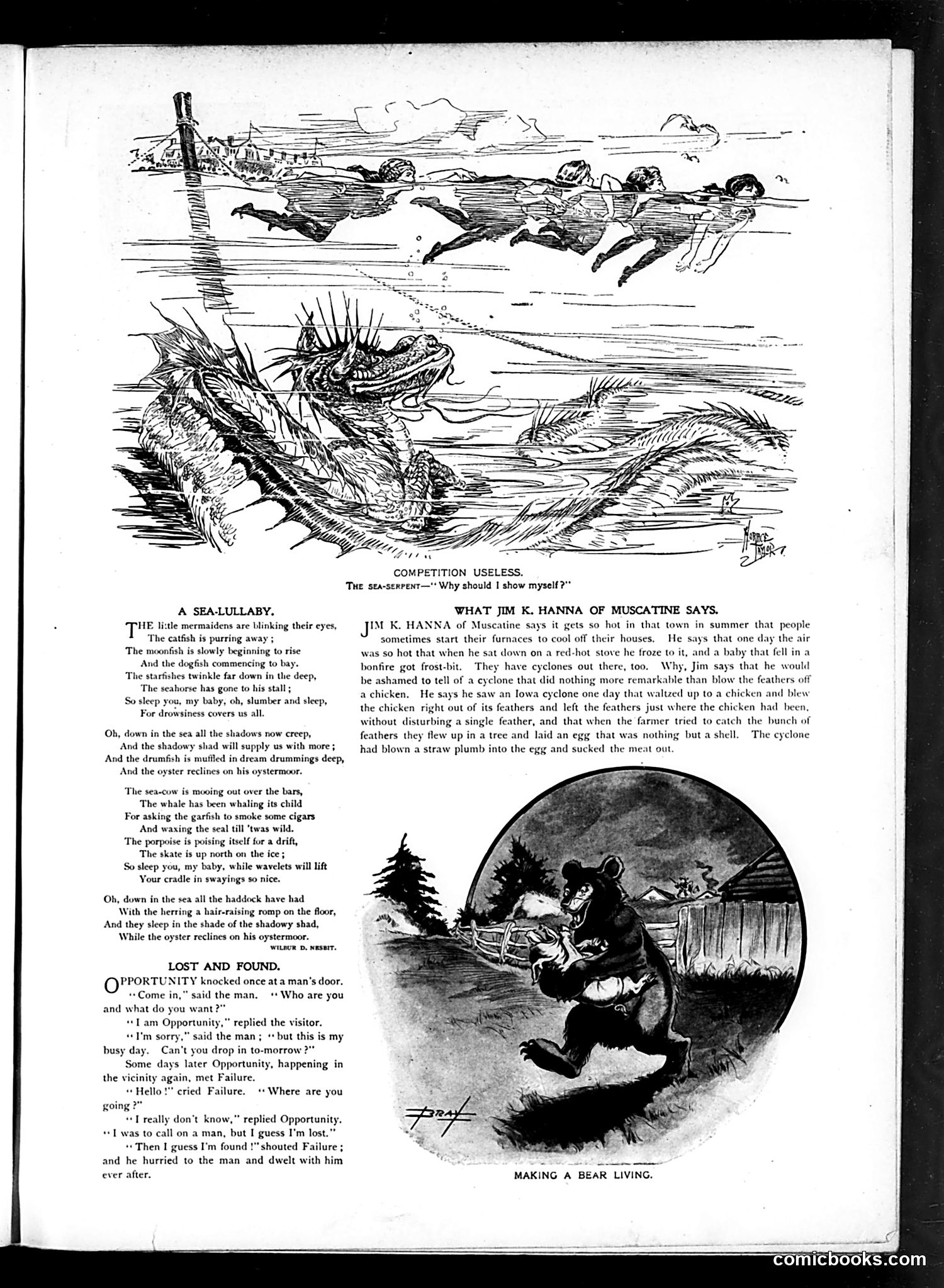
This page contains three unrelated pieces of satirical content typical of Judge magazine: 1. **"A Sea-Lullaby"** - A poem about marine creatures indifferent to human concerns, likely commentary on nature's indifference to human problems. 2. **"Competition Useless"** - Top cartoon showing a sea-serpent observing swimmers, with text mocking Jim K. Hanna's anecdote about Iowa cyclones. The satire appears to ridicule exaggerated tall tales about extreme weather. 3. **"Lost and Found"** - A fable where Opportunity meets Failure, illustrating the adage that opportunity only knocks once. When the man is too busy to answer, Failure takes Opportunity's place permanently—social commentary on missed chances. 4. **"Making a Bear Living"** - Bottom illustration showing someone in a bear costume, likely satirizing some contemporary practice or person, though context is unclear. The page exemplifies Judge's mix of satirical poetry, cautionary fables, and topical cartoons.
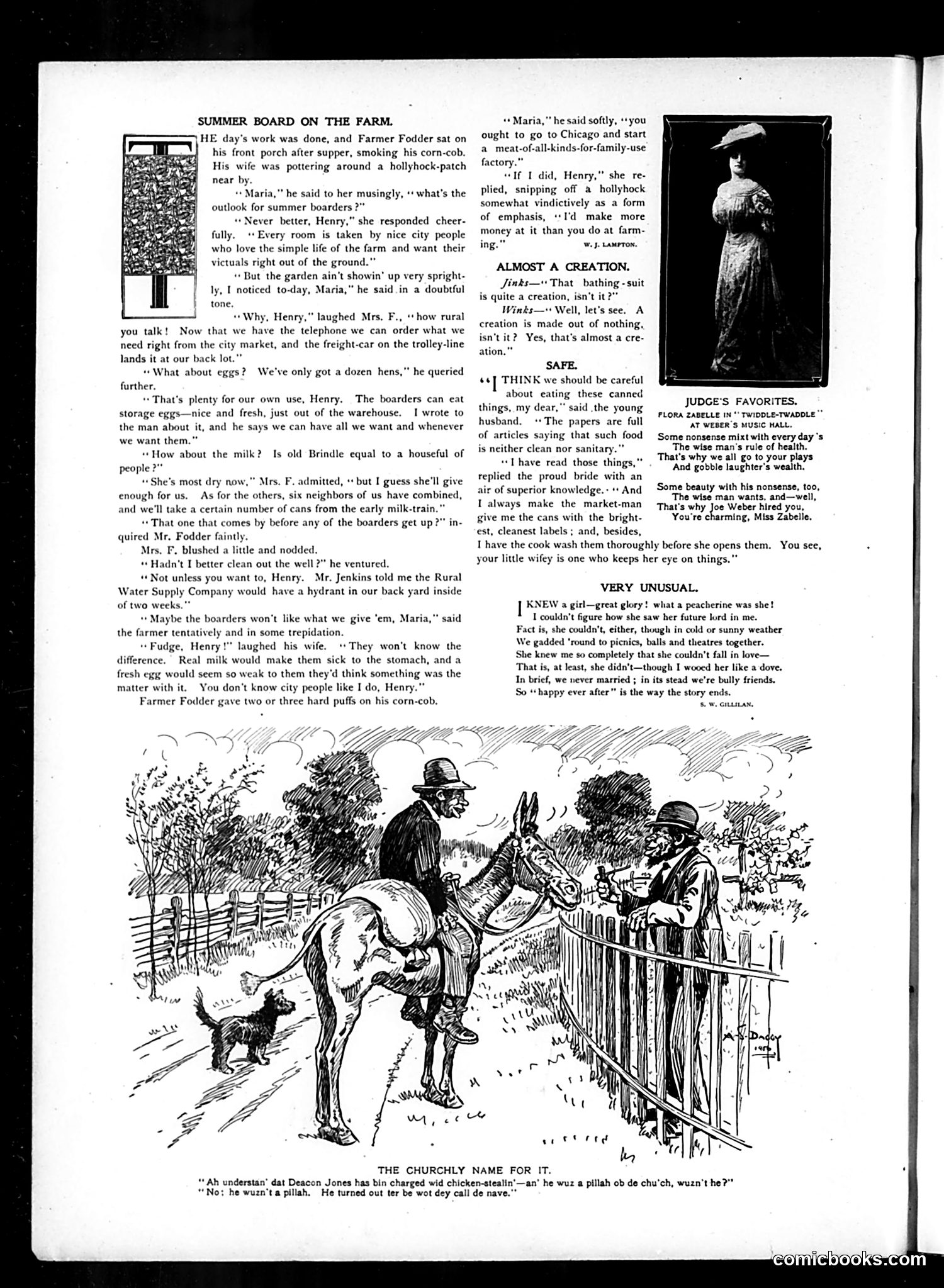
This page satirizes the urban-rural divide of early 20th-century America. The main story depicts city boarders staying on a farm, with Mrs. Folder (the farmer's wife) discussing practical farm concerns—eggs, milk, canned goods—with her husband Henry. The humor targets both groups: city people romanticizing farm life while remaining ignorant of agricultural realities, and farmers uncertain about city visitors' expectations. References to "the telephone" and "freight-car on the trolley-line" suggest recent technological changes creating friction between rural and urban cultures. The bottom cartoon, "The Churchly Name for It," depicts a horse theft, with a deacon accused of "chicken-stealin'" — satirizing rural moral hypocrisy and the gap between religious respectability and actual behavior. The overall satire mocks class pretensions and cultural misunderstandings during America's rapid urbanization.
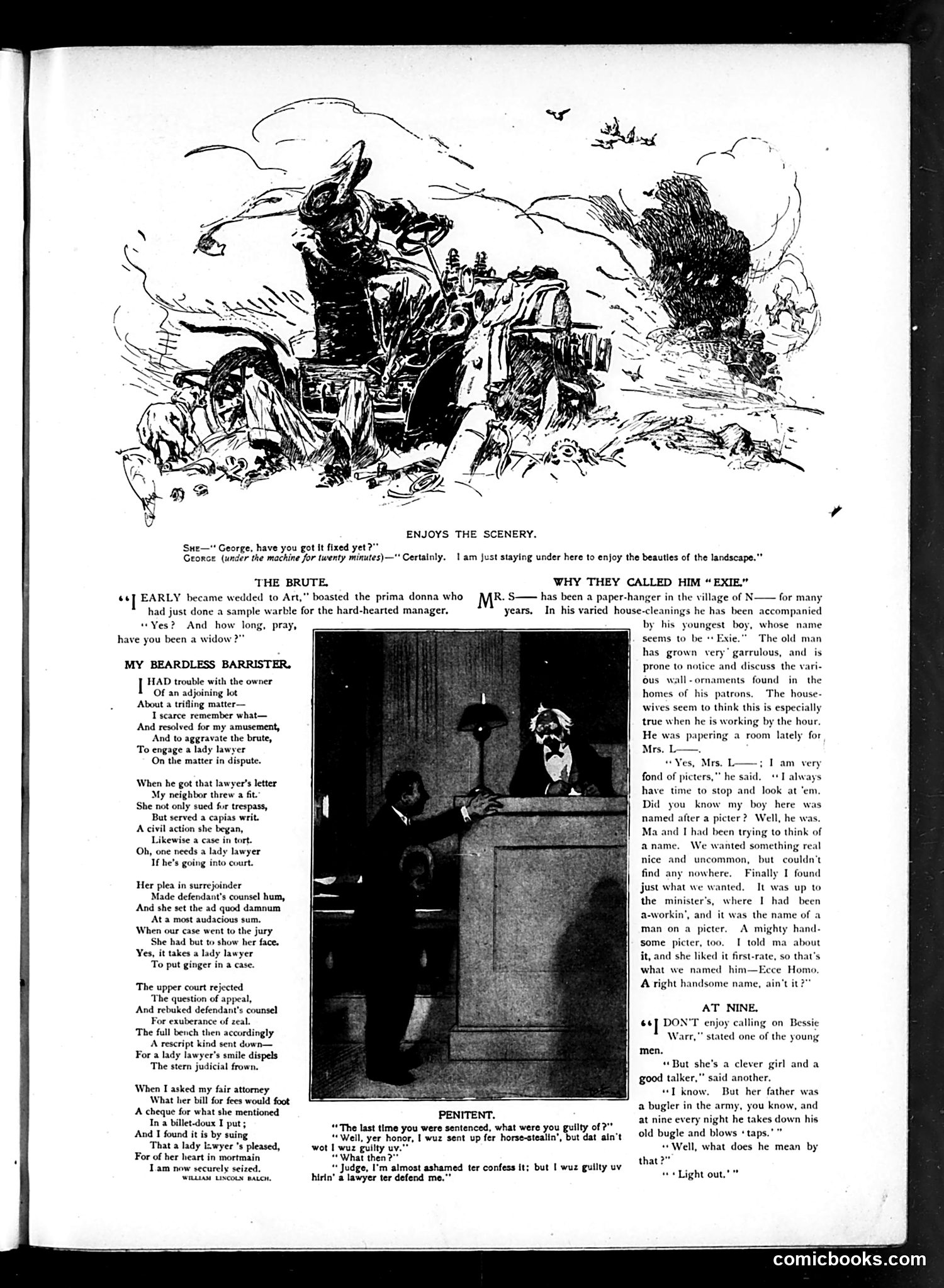
This page contains three distinct pieces: 1. **Top cartoon "Enjoys the Scenery"**: A couple in a carriage admire landscape while George (apparently the driver) stays focused on work. The joke appears to be about class differences—the wealthy passengers enjoy leisure while servants remain dutiful. 2. **"My Beardless Barrister"** (poem, left column): A satirical verse about a young lawyer who successfully defended a woman in court through clever legal maneuvering, apparently winning a case through procedural rather than substantive arguments. 3. **Right side stories**: Two anecdotal pieces—one about naming a dog "Ecce Homo" after a minister's portrait, another about a young woman's questionable reputation based on her father's military background. The overall tone is lighthearted social commentary on legal absurdities and class dynamics.
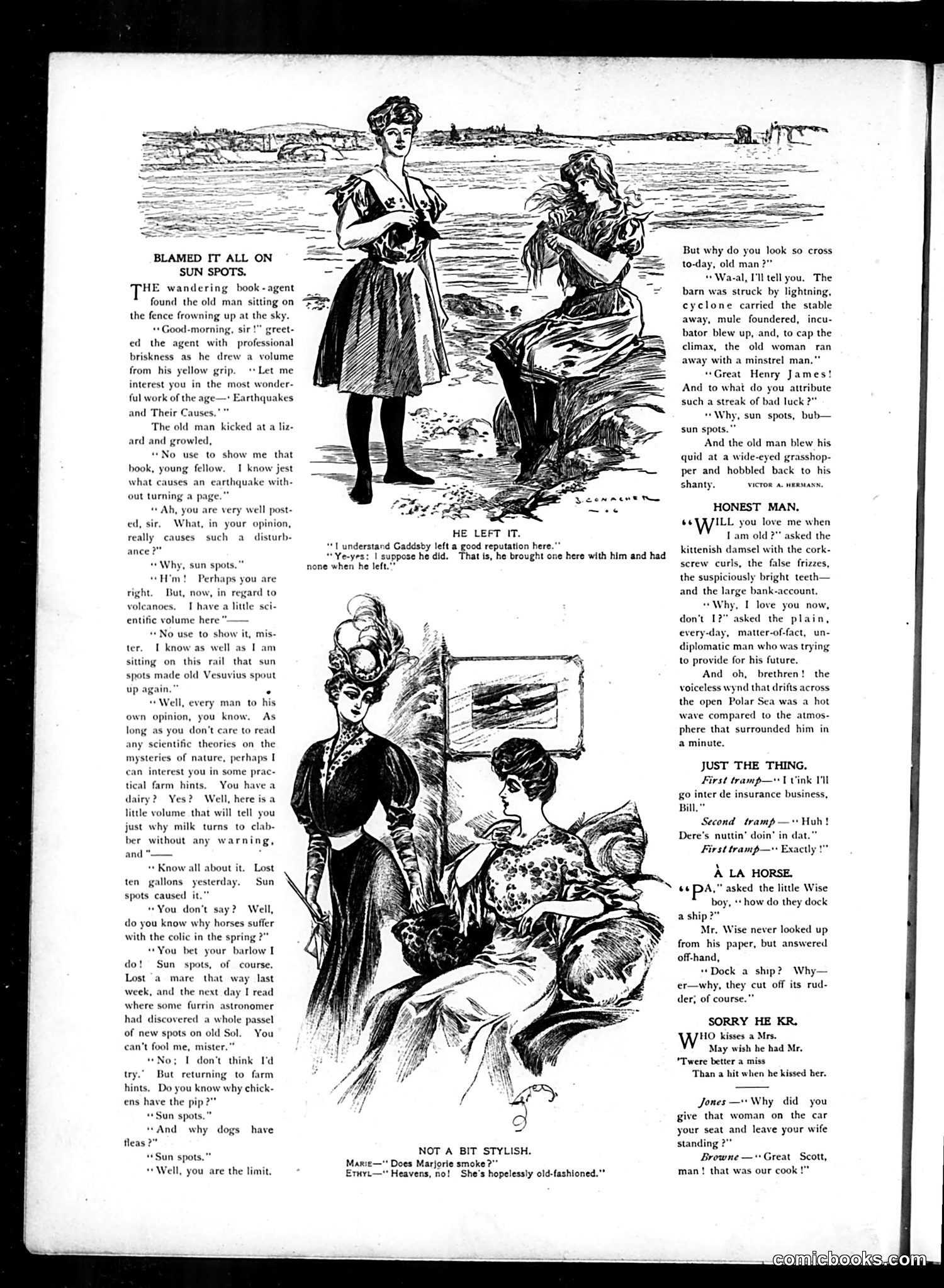
This page from Judge magazine contains several separate humorous pieces typical of early 20th-century satirical publications. **"Blamed It All on Sun Spots"** mocks rural superstition. A traveling book agent tries selling self-help volumes to a stubborn farmer who dismisses every agricultural problem—spoiled milk, sick horses, chicken disease—as caused by sun spots. The joke ridicules folk explanations for natural phenomena and rural resistance to scientific education. **"Honest Man"** presents ironic commentary on materialistic courtship: a plain, working man asks if his sweetheart loves him, but she's evidently attracted only to his wealth and appearance (false hair, bright teeth, bank account). The "voiceless wind" comparison emphasizes his emotional devastation. The remaining short pieces are brief comic jokes: insurance salesmen have no business, a father misexplains ship-docking, and a man confuses his cook for his wife—typical period humor relying on slapstick misunderstanding. The illustrations use period line-drawing style. Overall, the page reflects early 1900s preoccupations: rural-versus-urban attitudes, materialism in romance, and physical comedy.
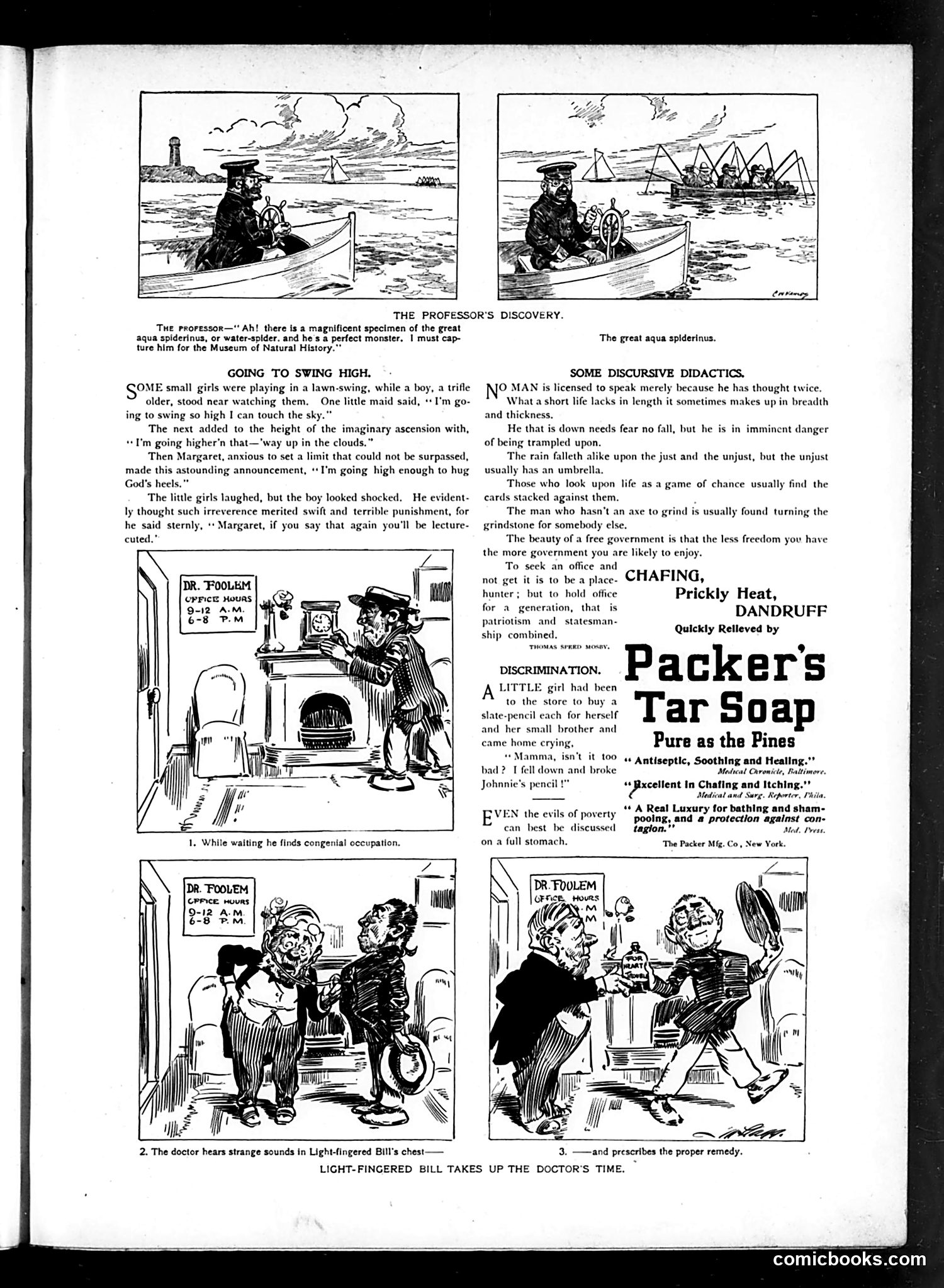
This page contains multiple unrelated items typical of early 20th-century satirical magazines: **Top comics:** "The Professor's Discovery" shows a naturalist identifying a "water-spider" (likely a joke about an absurd specimen). "Going to Swing High" depicts children boasting about swinging height until Margaret shockingly claims she'll "hug God's heels"—the boy's shocked reaction satirizes religious prudishness over innocent childish exaggeration. **Middle section:** "Light-Fingered Bill Takes Up the Doctor's Time" is a three-panel comic about a petty thief ("Light-fingered Bill") who visits Dr. Foolem's office with suspicious chest sounds. The doctor prescribes a remedy—the joke appears to be that the doctor's solution addresses the thief's actual problem (stolen goods causing distress) rather than legitimate illness. **Philosophical observations:** Brief satirical quips about government, poverty, and human nature. **Advertisement:** Parker's Tar Soap dominates the right side, promoting relief for chafing and skin irritation with medical endorsements. The page is primarily advertising with light comedy filler.
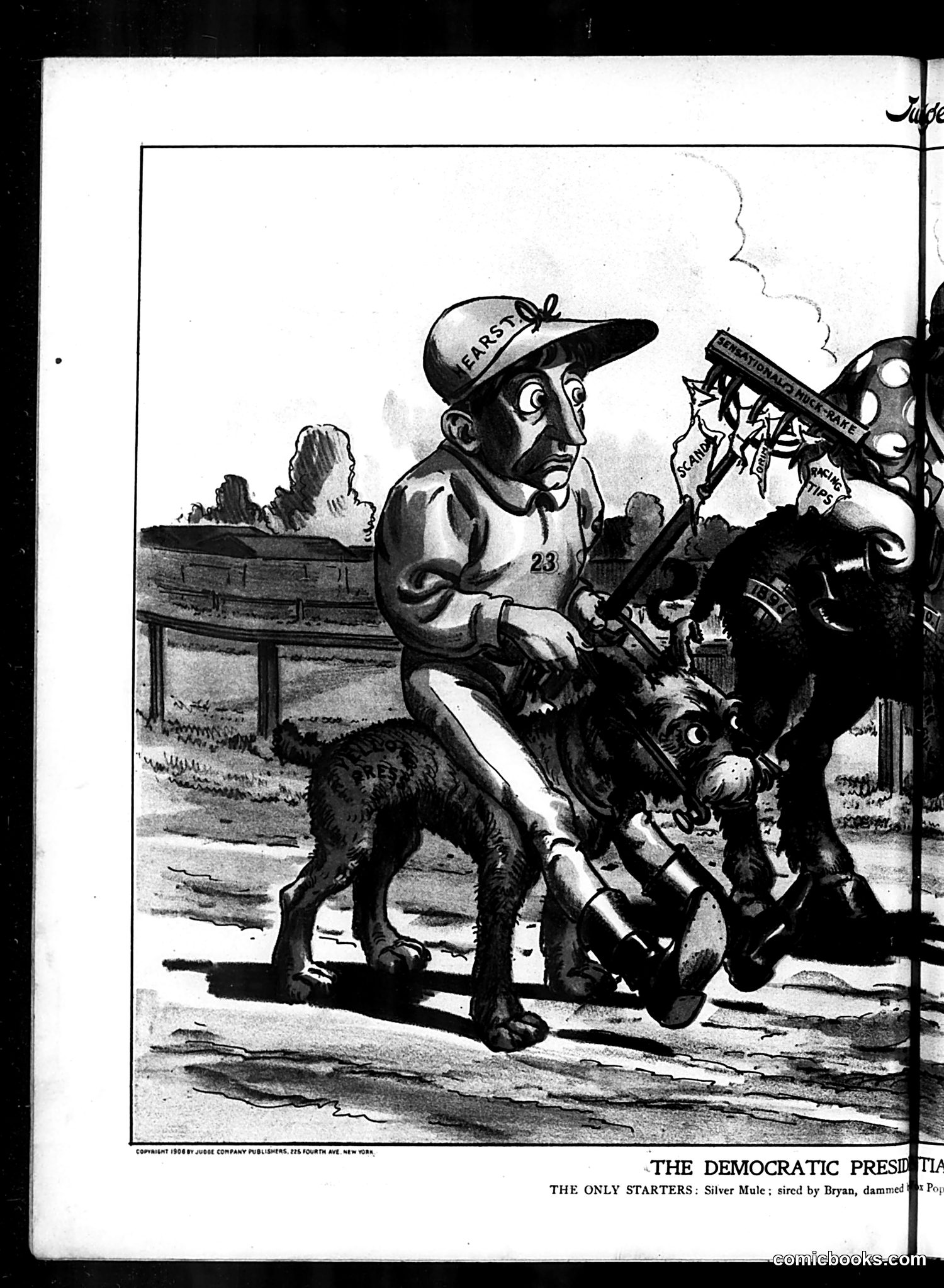
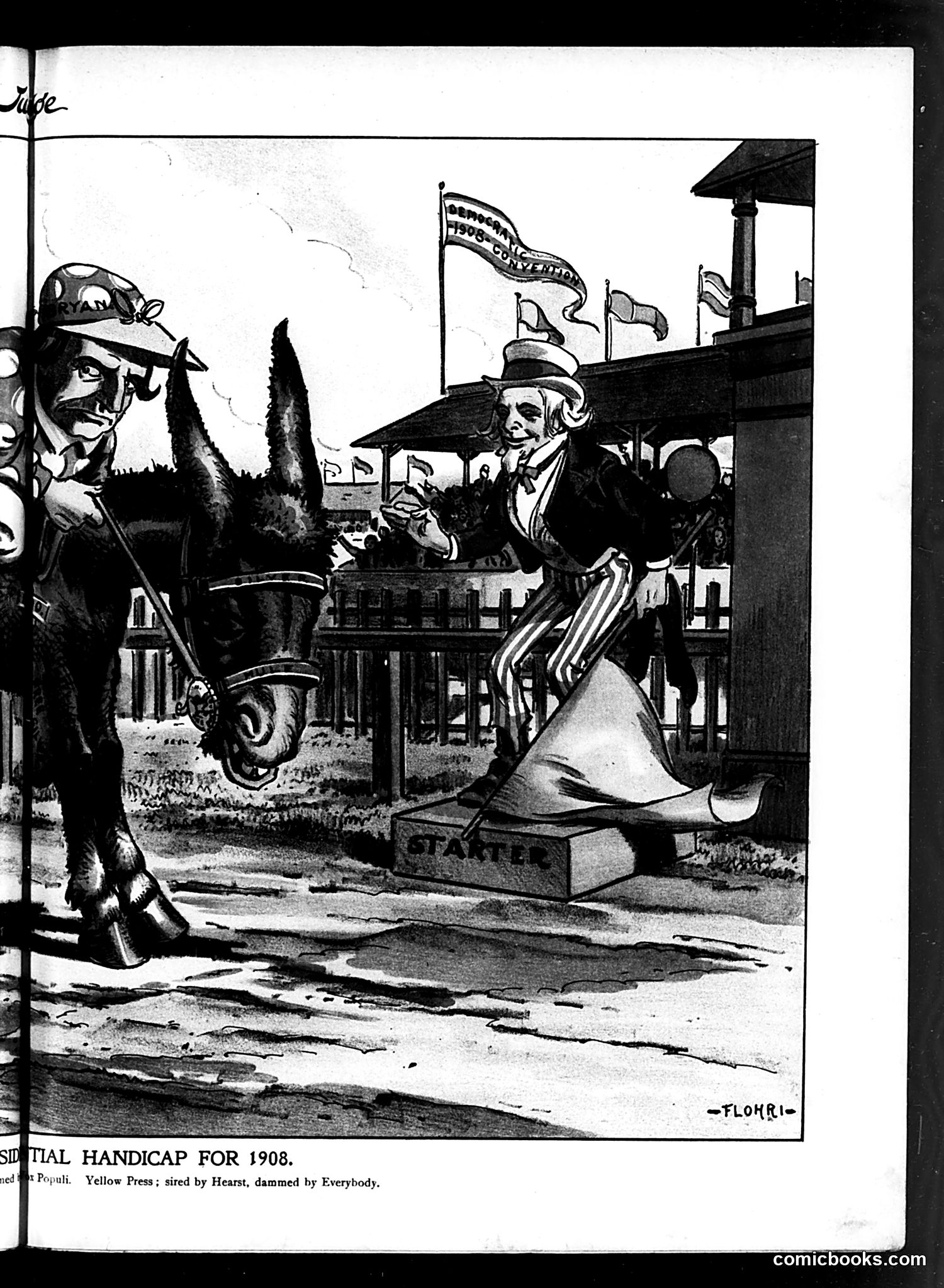
This Judge magazine cartoon satirizes the Democratic Party's presidential prospects. The figure labeled "23" (likely referring to a candidate or year) rides a disheveled mule labeled "THE ONLY STARTERS: Silver Mule; sired by Bryan, damned [by Pop]"—a reference to William Jennings Bryan, who championed "free silver" as a monetary policy. The cartoon mocks Democrats as having only this worn-out, problematic "starter" (candidate) available for the race. The mule's poor condition and Bryan's association with a failed or controversial cause ("damned") suggest the party's weak position. The caricatured rider appears anxious or struggling to control the animal, reinforcing the message that Democratic leadership is riding an unreliable, exhausted platform into an election.
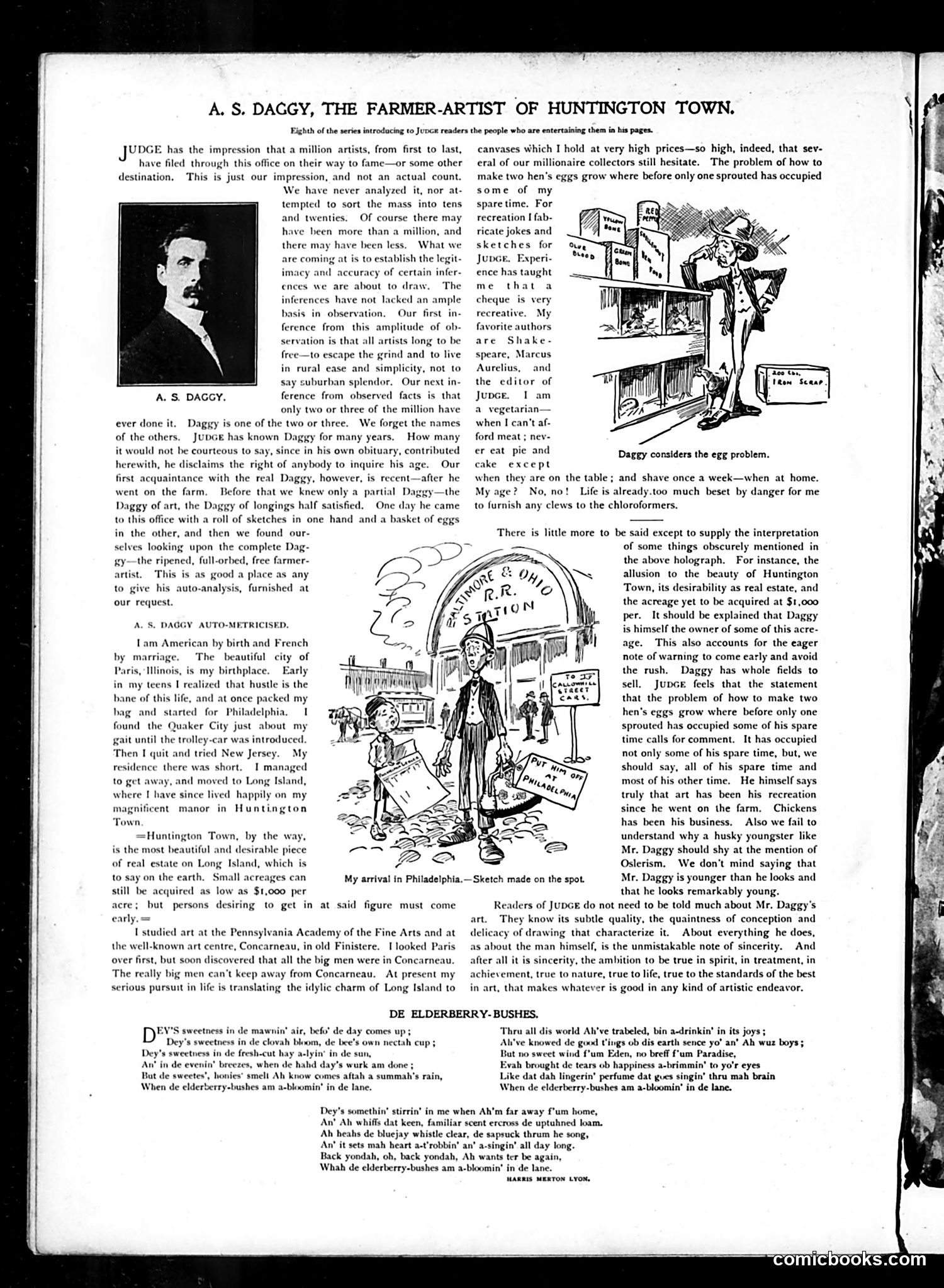
This is a profile/interview piece introducing A. S. Daggy, a contributing artist to *Judge*, the satirical magazine. The cartoons illustrate Daggy's humorous self-description. **Who he is:** A farmer-artist living in Huntington Town, Long Island, who studied at the Pennsylvania Academy of Fine Arts and in Concarneau, France, then abandoned urban life for rural simplicity. **The satire:** Daggy's deadpan autobiography mocks both struggling artists and pretentious rural gentry. He claims to sell paintings at inflated prices to hesitant millionaires, farm real estate at inflated prices to eager buyers, and creates jokes/sketches for *Judge* primarily because payment ("cheque") is "recreative." His vegetarianism is qualified—he eats meat, pie, and cake when available. The cartoons show him at a train station and managing poultry, visually reinforcing the gap between artistic pretension and practical farm life. **The joke:** Daggy represents the American artist archetype—romanticizing rural escape while remaining fundamentally self-interested and commercially motivated.

This is **not a political cartoon or satire**, but a straightforward product advertisement for Quaker Rice cereal, published in *Judge* magazine around 1906. The page features an illustration of an Asian man (likely Japanese, given the snow-capped volcanic mountains in the background, appearing to reference Mount Fuji) in traditional dress, positioned as an exotic, authoritative figure endorsing the product. This reflects early-1900s marketing conventions: associating rice with "Oriental" authenticity and prestige. The ad emphasizes the novelty of "puffing"—a new processing technique that expands rice kernels—as a modern innovation combining traditional wholesomeness with contemporary food science. The copy promises health benefits and universal appeal to children and adults alike, while noting the bargain price of 10 cents per package. The inclusion of this advertisement in *Judge* suggests the magazine accepted commercial content alongside satire.
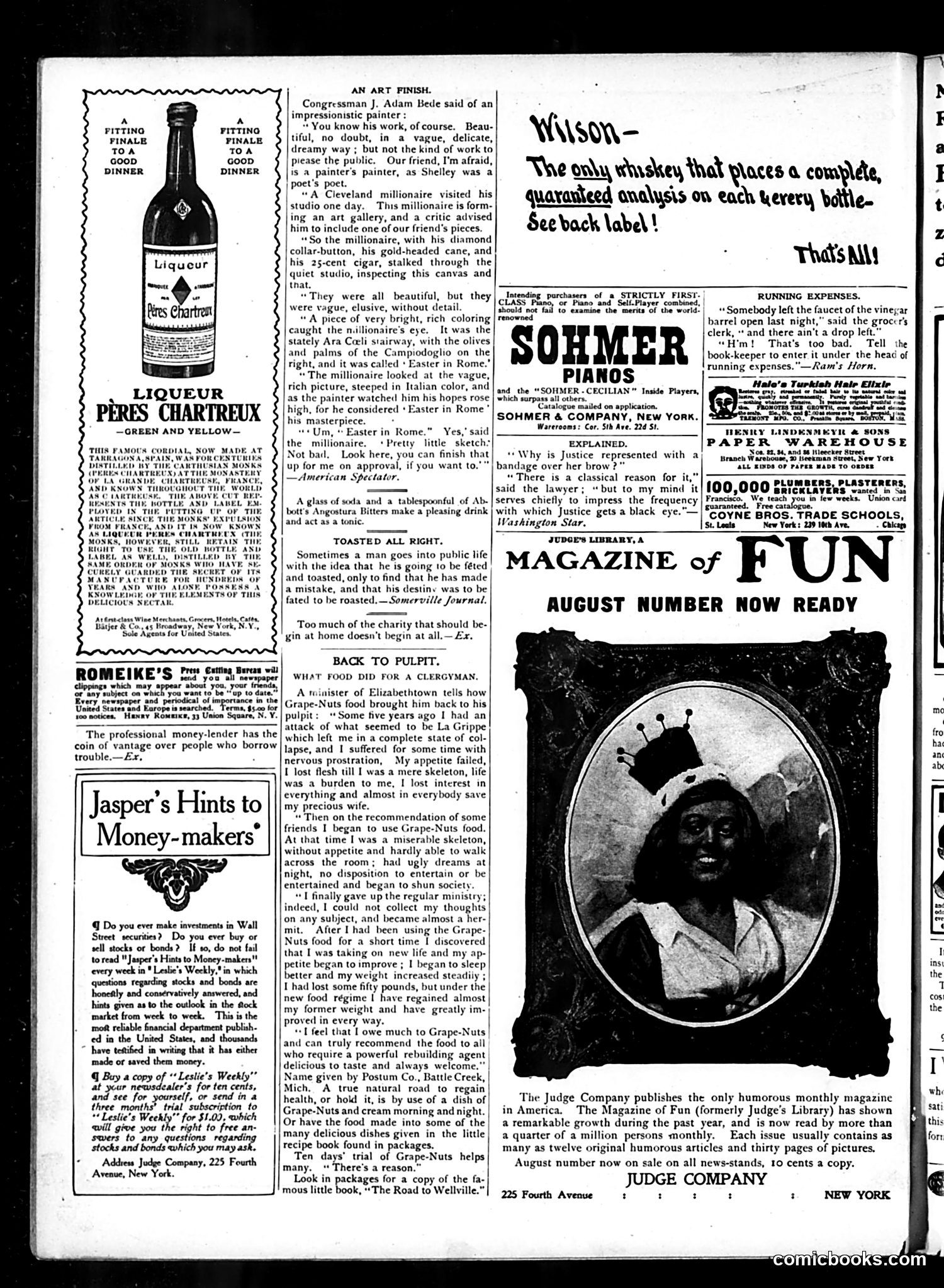
This page is primarily **advertising and filler content** from Judge magazine, not political satire. The main elements: **"An Art Finish"** (top): A congressman's anecdote mocking impressionistic art. The joke: a wealthy industrialist visits an artist's studio, admires only a detailed, representational painting of Roman stairs ("Easter in Rome"), dismissing the impressionistic works as incomplete "sketches." The satire targets both vague modern art and the crude taste of newly rich industrialists who prefer literal, decorative realism to avant-garde work. **Other content**: Brief humorous one-liners about hypocrisy ("charity that should begin at home"), professional money-lenders, and public figures who expect praise but receive criticism instead ("feted" vs. "roasted"). The page is dominated by **advertisements** for liqueur, financial advice columns, and food products—typical of Judge's revenue model. No identifiable political figures appear, and no current events are referenced beyond the art world's divide between modernism and commercialism.
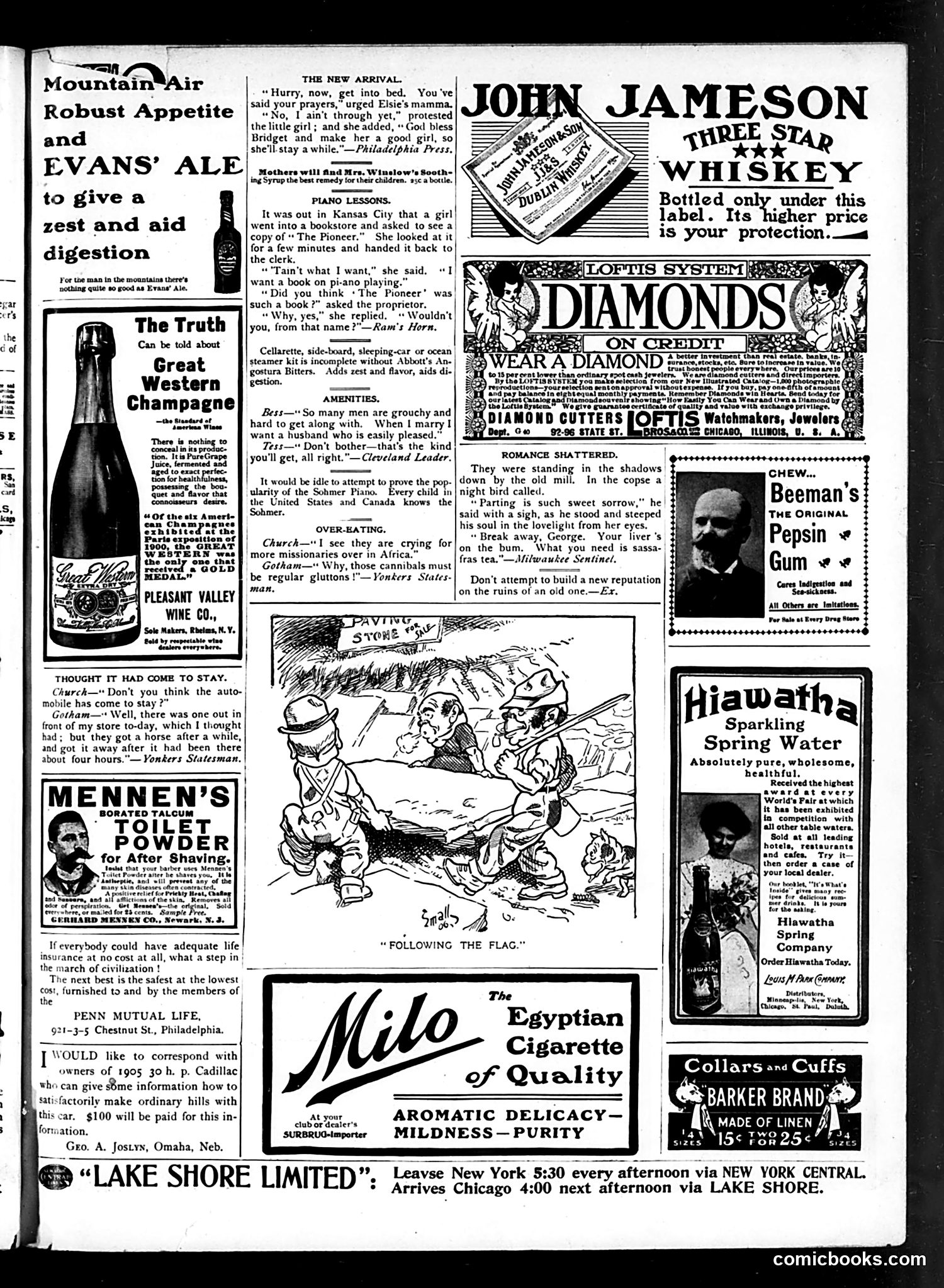
This page (mostly advertisements with brief comic snippets) satirizes early-1900s American life. The main cartoon, "Following the Flag," depicts what appears to be colonial or military figures—likely referencing American imperial expansion (the Philippines campaign was contemporary). The joke's specifics are unclear, but it reflects Judge's commentary on U.S. foreign policy. The text jokes reveal period attitudes: one pun confuses "The Pioneer" (a book) with "pi-ano" playing, mocking rustic ignorance. Another ridicules cannibals as "gluttons" for wanting missionaries—offensive by modern standards, reflecting era racism. A third jokes that automobiles aren't reliable, needing horses for actual transportation—contemporary skepticism about new technology. The dense advertisements (whiskey, diamonds, talcum powder, life insurance) reflect the magazine's revenue model and era's commercial culture, including now-banned products like patent medicines with unregulated ingredients.
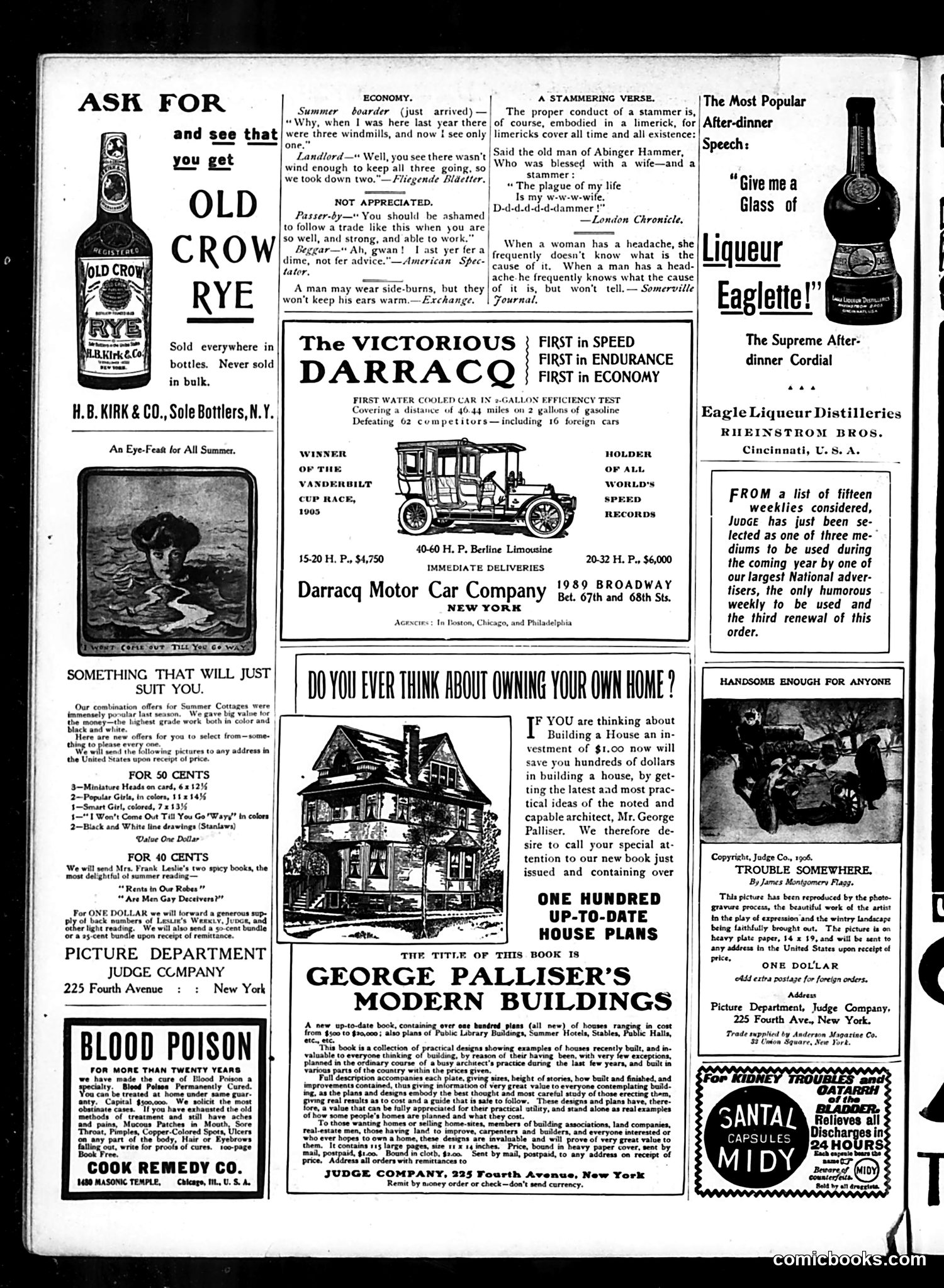
This page from Judge magazine is primarily **advertising**, with satirical humor pieces interspersed throughout. The cartoons/jokes include: **"Economy"**: A landlord removed two windmills because insufficient wind couldn't power all three—absurd logic masquerading as frugality. **"Not Appreciated"**: A beggar rejects a passerby's moral criticism about begging, deflecting with humor rather than engaging the lecture. **"A Stammering Verse"**: A limerick about a man with a stammering speech impediment complaining about his wife—light wordplay humor. **"Headaches"**: Contrasts women and men: women don't know their headache's cause; men know but won't admit it—mild gender satire about stubbornness/dishonesty. The remaining content is commercial advertising for Old Crow Rye whiskey, Darracq automobiles, Eagle Liqueur, real estate books, blood poison treatment, and Judge's own back issues and picture department. This reflects the magazine's business model of mixing editorial satire with paid advertising.

This is a **Schlitz beer advertisement**, not political satire. The page promotes Schlitz as a health beverage, making claims typical of early 20th-century beer marketing: - Beer is characterized as "the national beverage" promoting "vigor and health" - Malt and hops are presented as food and tonic with medicinal properties - Alcohol content is downplayed as "but a trifle" - The ad emphasizes purity, filtration, and sterilization as quality markers The decorative hops borders and ornamental design reflect period advertising aesthetics. The tagline identifies Schlitz as "The Beer That Made Milwaukee Famous," referencing Milwaukee's historical prominence in American brewing. This reflects pre-Prohibition era (likely 1910s-1920s) marketing that made health claims now considered misleading or false.
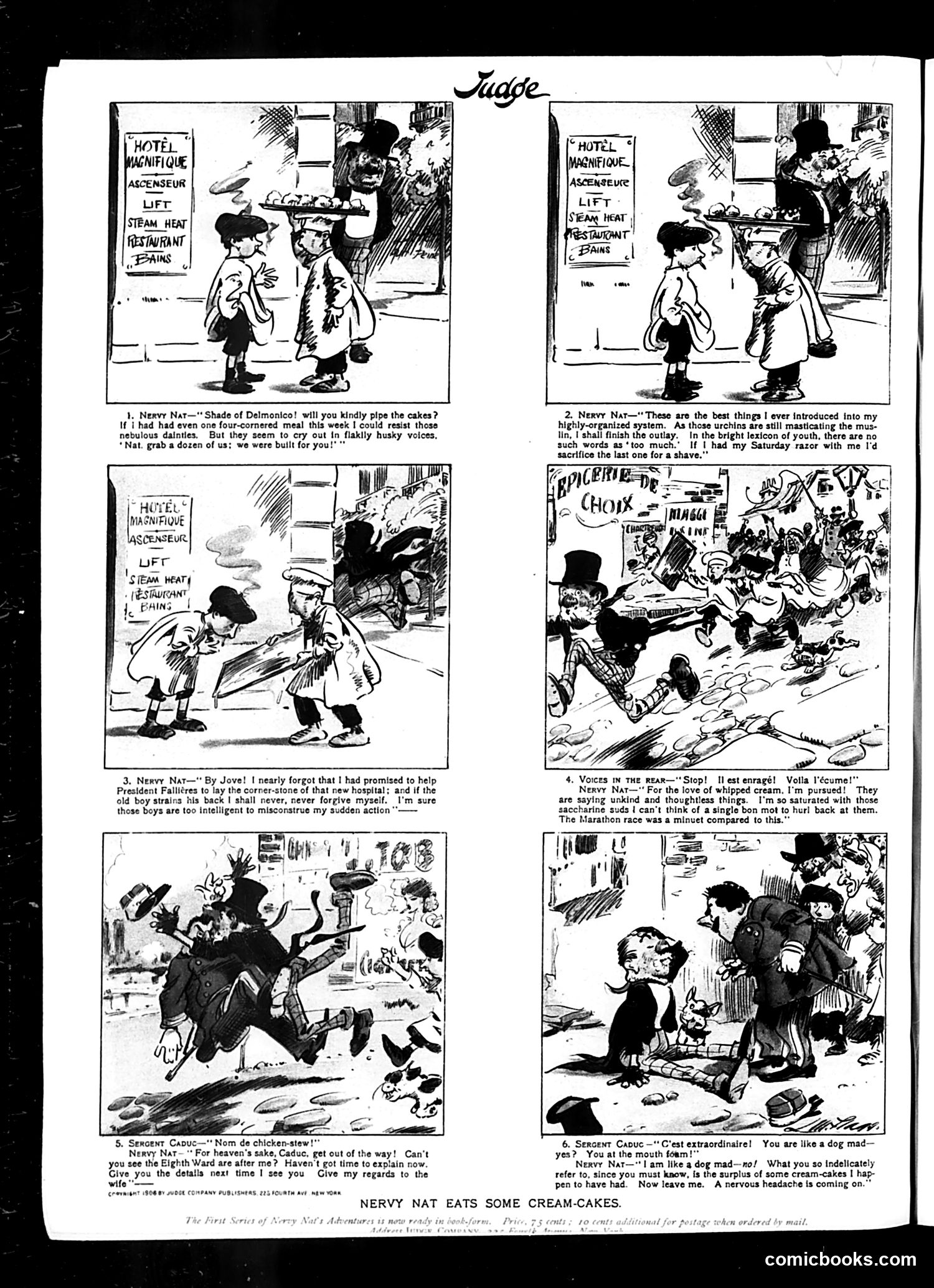
This is a humorous comic strip following "Nervy Nat," a character who becomes comically obsessed with cream-cakes at a fancy hotel. The satire mocks his pretensions and absent-mindedness: he abandons his promise to help President Fallières lay a hospital cornerstone, flees from the "Eighth Ward" (likely political rivals or constituents), and eventually becomes so covered in cream that pursuing Parisians mistake his appearance for rabies. The humor derives from physical comedy—the contrast between Nat's sophisticated hotel setting and gentlemanly pretensions versus his gluttonous, undignified behavior. French dialogue and references to Delmonico's (a famous restaurant) establish the upscale setting. The strip appears to satirize corrupt or negligent public figures who abandon their duties for personal indulgence, a common Judge magazine theme of the era.