
Judge, 1906-07-28 · page 10 of 16
Judge — July 28, 1906 — page 10: what you’re looking at
What you’re looking at
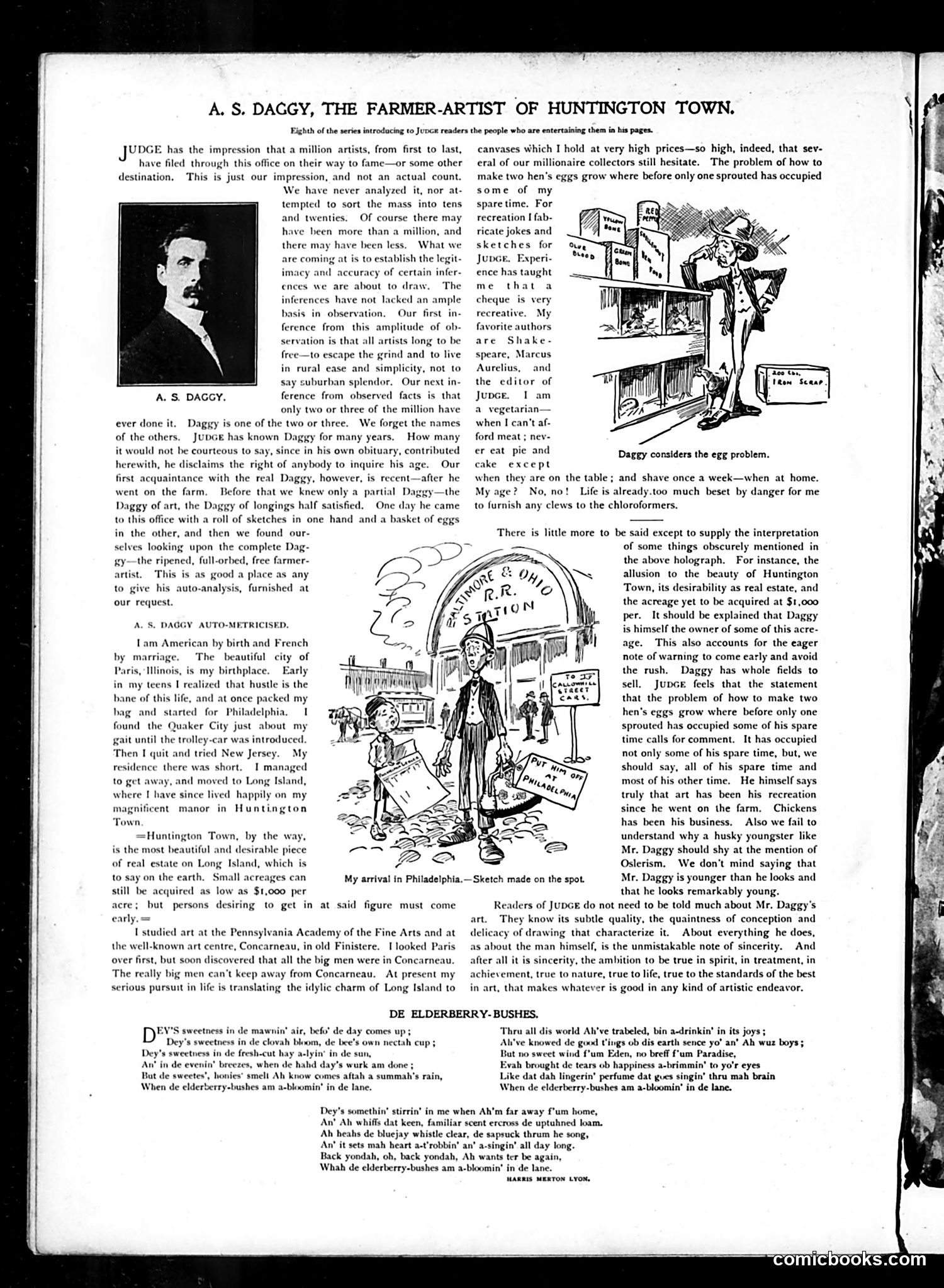
This is a profile/interview piece introducing A. S. Daggy, a contributing artist to *Judge*, the satirical magazine. The cartoons illustrate Daggy's humorous self-description. **Who he is:** A farmer-artist living in Huntington Town, Long Island, who studied at the Pennsylvania Academy of Fine Arts and in Concarneau, France, then abandoned urban life for rural simplicity. **The satire:** Daggy's deadpan autobiography mocks both struggling artists and pretentious rural gentry. He claims to sell paintings at inflated prices to hesitant millionaires, farm real estate at inflated prices to eager buyers, and creates jokes/sketches for *Judge* primarily because payment ("cheque") is "recreative." His vegetarianism is qualified—he eats meat, pie, and cake when available. The cartoons show him at a train station and managing poultry, visually reinforcing the gap between artistic pretension and practical farm life. **The joke:** Daggy represents the American artist archetype—romanticizing rural escape while remaining fundamentally self-interested and commercially motivated.
📄 Transcribed text from this page (OCR, searchable)
Machine-transcribed from the original scan — historical spelling and the odd misread are preserved.
A. S. DAGGY, THE FARMER-ARTIST OF HUNTINGTON TOWN. Eighth of the series introducing to Junc readers the people who are entertaining them in his pages. UDGE has the impression that a million artists, from first to last, have filed through this office on their way to fame—or some other This is just our impression, and not an actual count. We have never analyzed it, nor at- tempted to sort the mass into tens and twenties. Of course there may have bs na million, and there may have be What we at is to establish the legit- destination, more tha n less. are comir cy and accuracy of certa - ences we are about to draw, The inferences have not lacked an ample is in observati Our first in- ference from this amplitude of ob- servation is that all artists long to be free—to escape the grind and to live in rural ease and simplicity, not to say Our next in- ference from observed facts is that only two or three of the million have We forget the names How many suburban splendor. A. S. DAGGY. ever done it of the others. it would not be courteous to sa herewith, he disclaims the ri first acquaintance with the real Daggy, however, went on the farm. Before that we knew only Daggy of art, the Daggy of longings half satisfied. to this office with a roll of sketches in one hand in the other, and then we found our- selves looking upon the complete Dag- gy—the ripened, full-orbed, free farmer- artist. This is as good a place as any to give his auto-analysis, furnished at Daggy is one of the two or three. Jupce has known Daggy for many years, since in his own obituary, contributed ht of anybody to inquire his age. Our is recent—after he partial Daggy—the One di ame da basket our request. A. 8. DAGGY AUTO-METRICISED. Tam American by birth and French by marriage, The beautiful city of aris,-Ilinois, is my birthplace. Early in my teens I realized that hustle is the bane of this life, and at once packed my bag and started for Philadelphia. 1 found the Quaker City just about my ar was introduced. = i i aman sa I gait until the trolley ‘Then I quit and tried New Jersey. My residence there was short. I managed to get away, and moved to Long Island, where I have since lived happily on my magnificent. manor in Huntington Town, =Huntington Town, by the w: is the most beautiful and desirable piec of real estate on Long Island, which is to say on the earth, Small acreages can still be acquired as low as $1,000 per acre; but persons desiring to get in at said figure must come carly.= I studied art at the Pennsylvania Academy of the Fine Arts and at the well-known art centre, Concarneau, in old Finistere. [looked Paris over first, but soon discovered that all the big men were in Concarneau. The really big men can't keep away from Concarneau. At present my serious pursuit in life is translating the idylic charm of Long Island to My arrival in Philadelphia.—Sketch made on the spot. canvases Which I hold at very high prices—so high, indeed, that sev- eral of our millionaire collectors still hesitate. The problem of how to make two hen's eggs grow where before only one sprouted has occupied some of my spare time. For recreation I fab- ricate jokes and sketches for Jupce. Experi- ence has taught that a cheque is very recreative. My favorite authors are Shake- speare, Marcus Aurelius, and the editor of Ju 1 am a vegetarian— when I can’t af- ford meat me nev- er eat pie and cake except when they are on the table; and shave once a week—when at home. My age? No, no! Life is already.too much beset by danger for me to furnish any clews to the chloroformers. Dagey considers the egg problem. There is little more to be said except to supply the interpretation of some things obscurely mentioned in the above holograph. For instance, the allusion to the beauty of Huntington Town, its desirability as real estate, and the acreage yet to be acquired at $1,000 per. It should be explained that Daggy is himself the owner of some of this acre- age, This also accounts for the eager note of warning to come early and avoid the rush. Daggy has whole fields to sell. JuDGE feels that the statement that the problem of how to make two hen's eggs grow where before only one sprouted has occupied some of his spare time calls for comment. It has occupied not only some of his spare time, but, we should say, all of his spare time and most of his other time. He himself says truly that art has been his recreation since he went on the farm. Chickens has been his business. Also we fail to understand why a husky youngster like Mr. Daggy should shy at the mention of Oslerism. We don’t mind saying that Mr. Daggy is younger than he looks and that he looks remarkably young. Readers of JUDGE do not need to be told much about Mr. Daggy's They know its subtle quality, the quaintness of conception and delicacy of drawing that characterize it. About everything he does, as about the man himself, is the unmistakable note of sincerity. And after all it is sincerity, the ambition to be true in spirit, in treatment, in achievement, true to nature, true to life, true to the standards of the best *r is good in any kind of artistic endeavor. art. in art, that makes whate DE ELDERBERRY- BUSHES. air, bef’ de day comes up ah bloom, de bee’s own nectah cup DEVS srcetness in de maw Dey's sweetness in de cle Dey's sweetness in de fresh-cut h yin’ in de sun, An’ in de evenin’ breezes, when de hahd day's wurk am done ; But de sweetes’, honies’ smelt Ah know comes aftah a summah's rain, When de elderberry-bushes am a-bloomin’ in de lane. Dey’s somethin An’ Thru all dis world Ah've trabeled, bin a-drinkin’ in its joys ; Ab've knowed de good tings ob dis earth sence yo’ an’ Ah wuz boys ; But no sweet wind f'um Eden, no breff f'um Paradise, Evah brought de tears ob happiness a-brimmin’ to yo'r eyes Like dat dah lingerin’ perfume dat gues singin’ thru mah brain When de elderberry-bushes am a-bloomin’ in de lane. stirrin’ in me when Ah'm far away f'um home, Ah whiffs dat keen, familiar scent ercross de uptuhned loam. Ah heahs de bluejay whistle clear, de sapsuck thrum he song, An’ it sets mah heart a-t'robbin’ an’ a-singin’ all day long. Back yondah, oh, back yondah, Ab wan Whah de elderberry-bushes am a-bloomi: jer be again, in de lane. MARRIS MERTON LYOX, icbhooks.com