
Judge, 1906-07-28 · page 4 of 16
Judge — July 28, 1906 — page 4: what you’re looking at
What you’re looking at
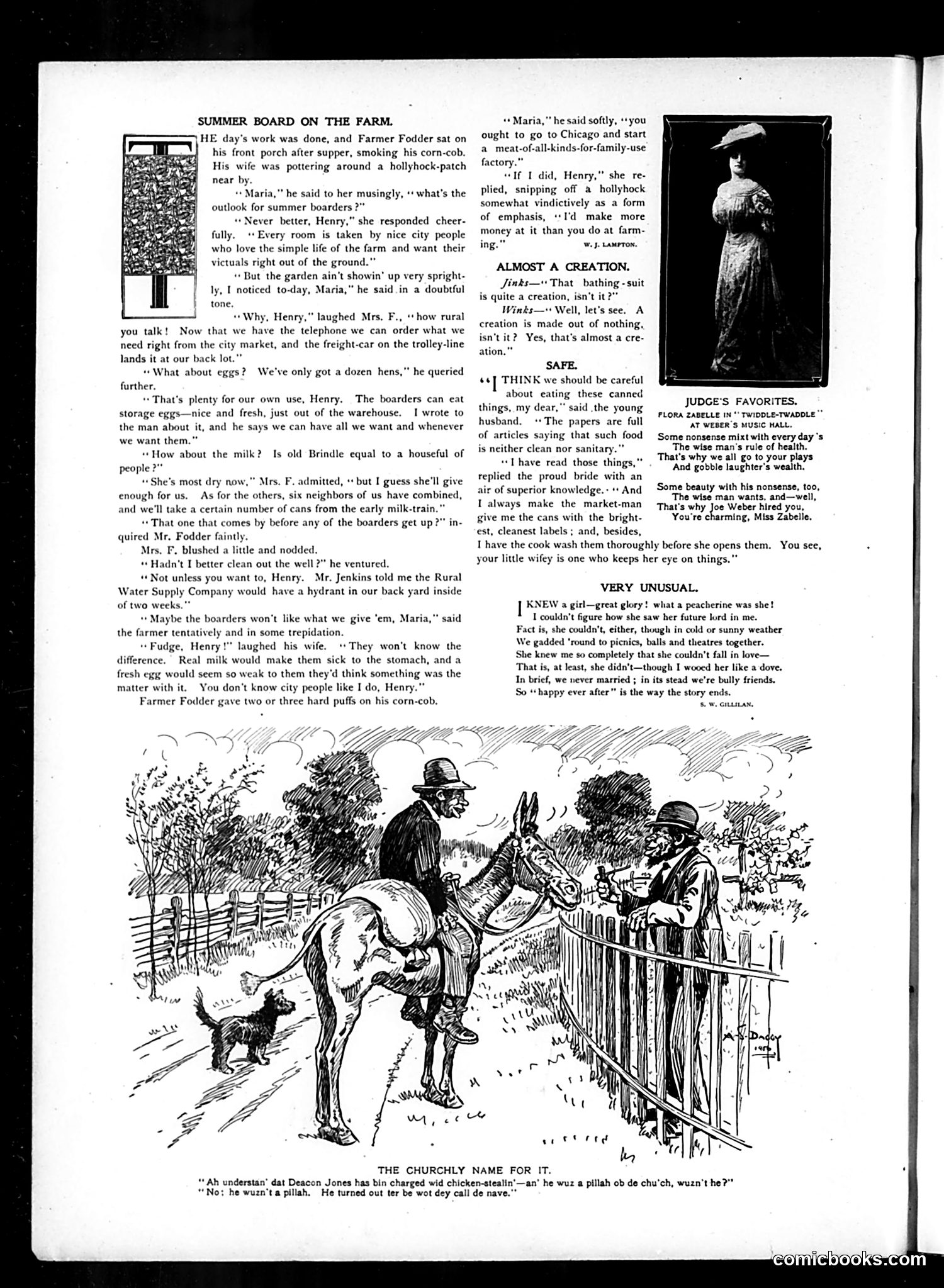
This page satirizes the urban-rural divide of early 20th-century America. The main story depicts city boarders staying on a farm, with Mrs. Folder (the farmer's wife) discussing practical farm concerns—eggs, milk, canned goods—with her husband Henry. The humor targets both groups: city people romanticizing farm life while remaining ignorant of agricultural realities, and farmers uncertain about city visitors' expectations. References to "the telephone" and "freight-car on the trolley-line" suggest recent technological changes creating friction between rural and urban cultures. The bottom cartoon, "The Churchly Name for It," depicts a horse theft, with a deacon accused of "chicken-stealin'" — satirizing rural moral hypocrisy and the gap between religious respectability and actual behavior. The overall satire mocks class pretensions and cultural misunderstandings during America's rapid urbanization.
📄 Transcribed text from this page (OCR, searchable)
Machine-transcribed from the original scan — historical spelling and the odd misread are preserved.
SUMMER BOARD ON THE FARM. HE day's work was done, and Farmer Fodder sat on his front porch after supper, smoking his corn-cob. His wife was pottering around a hollyhock-patch near by. “+ Maria,” he said to her musingly, + what's the outlook for summer boarders 2” “Never better, Henry,” she responded cheer- fully. ry room is taken by nice city people who love the simple life of the farm and want their victuals right out of the ground.” “But the garden ain't showin’ up very spright- ly, I noticed to-day, Maria,” he said.in a doubtful tone. “Why, Henry,” laughed Mrs, F., «how rural you talk! Now that we have the telephone we can order what we need right from the city market, and the freight-car on the trolley-line lands it at our back lot.” «What about eggs? We've only got a dozen hens,” he queried further. “That's plenty for our own use, Henry. The boarders can eat storage eggs—nice and fresh, just out of the warehouse. I wrote to the man about it, and he says we can have all we want and whenever we want them.” “How about the milk? Is old Brindle equal to a houseful of people 2" e's most dry now,” Mrs. F. admitted, « but I guess she'll give enough for us. As for the others, six neighbors of us have combined, and we'll take a certain number of cans from the early milk-train.”” “That one that comes by before any of the boarders get up? quired Mr. Fodder faintly. Mrs, F, blushed a little and nodded. Hadn't I better clean out the well ?” he ventured. ant to, Henry. Mr. Jenkins told me the Rural y would have a hydrant in our back yard inside “Not unless you Water Supply Comp: of two weeks.” ybe the boarders won't like what we give ‘em, Maria,” said the farmer tentatively and in some trepidation. «Fudge, Henry!" laughed his wife. «They won't know the difference. Real milk would make them sick to the stomach, and a fresh egg would seem so weak to them they'd think something was the matter with it. You don’t know city people like I do, Henry Farmer Fodder gave two or three hard puffs on his corn-cob. "he said softly, “you ought to go to Chicago and start a meat-of-all-kinds-for-family-use factory.” If I did, Henry,” she re- plied, sniping off a hollyhock somewhat vindictively as a form of emphasis, “I'd make more money at it than you do at farm- ing. ALMOST A CREATION. Jinks— That bathing -suit is quite a creation, isn’t it?” Winks—* Well, let's see. A creation is made out of nothing, isn't it? Yes, that’s almost a cre- ation.” W. J. LAMPTON. SAFE. $4] THINK we should be careful about eating these canned things, my ¢ said .the young husband. «The papers are full of articles saying that such food is neither clean nor sanitary «Thave read those things,” replied the proud bride with an air of superior knowledge.- « And I always make the market-man give me the cans with the bright- est, cleanest labels; and, besides, JUDGE'S FAVORITES. FLORA ZABELLE IN“ TWIDDLE-TWADDLE ‘AT WEBER'S MUSIC MALL. Some nonsense mixt with every day's The wise man’s rule of health. That's why we all go to your plays ‘And gobble laughter's wealth. ‘Some beauty with his nonsense, too, The wise man wants, and—well, That's why Joe Weber hired you, You're charming, Miss Zabelie. T have the cook wash them thoroughly before she opens them. You see, your little wifey is one who keeps her eye on things.” VERY UNUSUAL. | KNEW 2 girl—great glory! what a peacherine was shet I couldn't figure how she saw her future lord in me. Fact is, she couldn't, either, though in cold or sunny weather We gadded ‘round to picnics, balls and theatres together. She knew me so completely that she couldn't fall in love— ‘That is, at least, she didn't—though I wooed her like a dove. In brief, we never married ; in its stead we're bully friends. So “happy ever after” is the way the story ends. THE CHURCHLY NAME FOR IT. “Ah understan’ dat Deacon Jones has bin charged wid chicken-stealin’ He turned out ter be wot dey call de nave. “Not he wuzn't a pillah. SW, CILLILAN, an’ he wuz a pillah ob de chu’ch, wuzn't he?”