
Judge, 1906-07-28 · page 2 of 16
Judge — July 28, 1906 — page 2: what you’re looking at
What you’re looking at
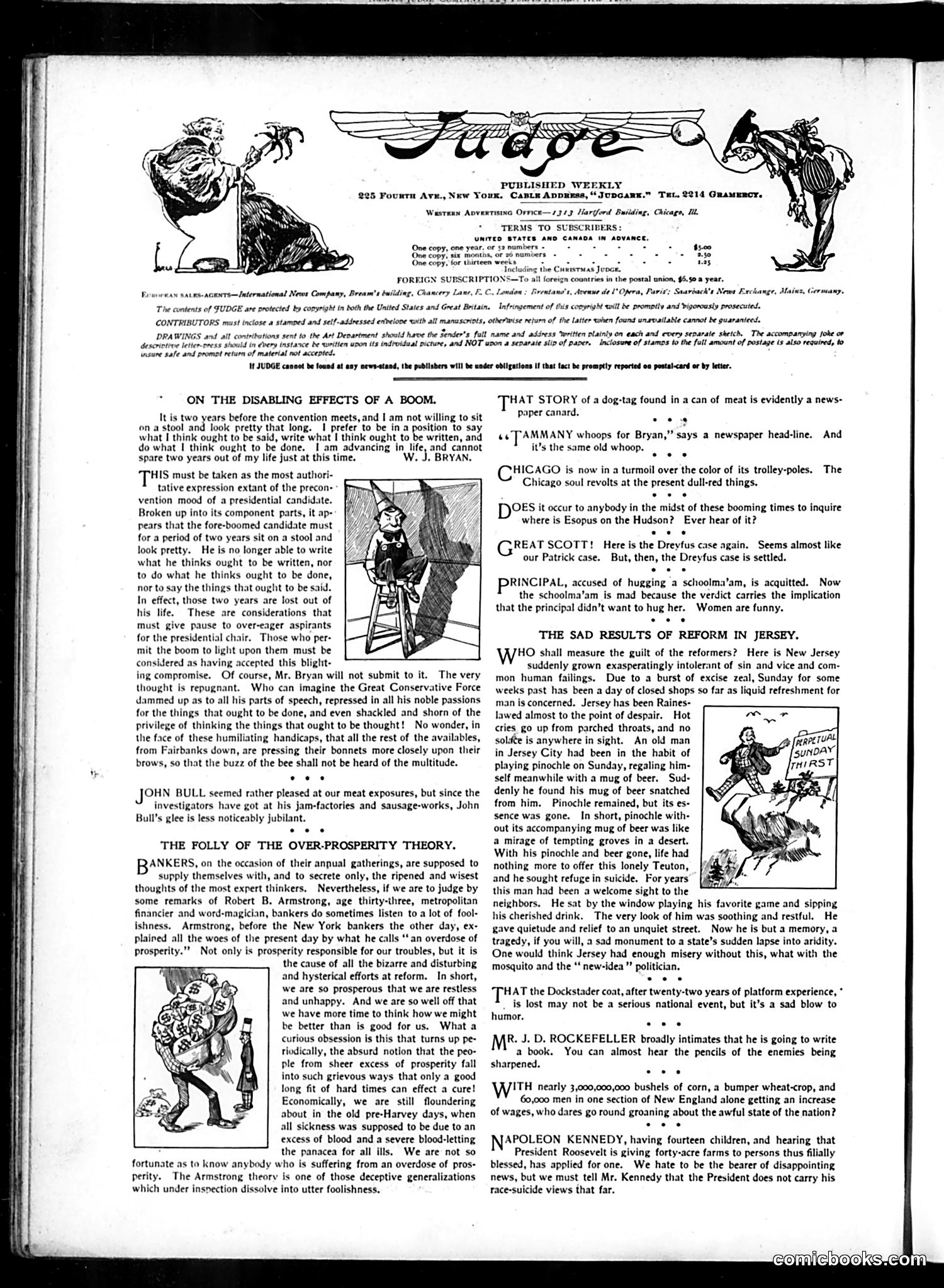
This page from Judge magazine contains several short satirical pieces and illustrations targeting contemporary issues and figures. The main cartoon shows a man at a window, illustrating "The Sad Results of Reform in Jersey"—a critique of New Jersey's reform movement. The text describes a man who lost his job due to reform efforts, ironically forcing him toward suicide despite the reformers' good intentions. Other brief satirical items mock: - W.J. Bryan's political positioning ("On the Disabling Effects of a Boom") - Chicago's trolley-pole color choices - A principal's corporal punishment policies - Robert B. Armstrong's excessive prosperity claims The page also includes commentary on Rockefeller's planned book and references to "Napoleon Kennedy" (likely a political figure's child), showing Judge's typical approach: quick jabs at politicians, reform movements, and social absurdities of the era.
📄 Transcribed text from this page (OCR, searchable)
Machine-transcribed from the original scan — historical spelling and the odd misread are preserved.
7— SSF AFE 225 Fourtn Ave., New Youre. C. Wasreen Apvertisixc 0 unre One copy, one year. or One copy, six months, oF 29 numbers = ‘One copy, tor thirteen weeks FOREIGN SUBSCRIPTIONS—To PUBLISHED WEEKLY Appures,“Jopcanx.” Tet. 2214 Gramercy. 313 Hartford Building, Oricage, I. TERMS TO SUBSCRIBERS: STATES AND CANADA IN ADVANCE. s2 numbers = : ze ts.c0 er rie £7) a fe 1a the Cumtsratas Juce. countries in the postal union, $6.$0 a year. Fiuurwan satms-acenrrs—Iaternational News Company, Bream's building, Chancery Lane, F.C. London : Brentano's, Avenue de" Opera, Parit’s Saariach's News Exchange, Mains, ( The contents of FUDGE are protected by copyright in both the United States and Great Britain. Infringement of this conyright will be promptiy and rigorously prosecuted. CONTRIBUTORS must inciose a stamped and self-addressed endelove with all manuscriots, otherwise return of the Latter when found unavailaNe cannot be guaranteed. DRAWINGS and all conhitations sent 10 the Art Department should have the Sender's full name and adivess Yeritienslainly on each and every separate sketch. The accompanying Joke or descrivtove letter-cress should in Overy instance be written upon its indroidaal picture, and NOT upon a separate slip of paper. inclosure of stamps to the full amount of postage (s also required, to insure safe and prompt return of matertal not accepted. 1 JUDGE cansot be fousd at asy ews-stand, the publishers will be under obligations If that fact be promptly reported oa postal-card or by letter. ON THE DISABLING EFFECTS OF A BOOM. It is two years before the convention meets, and | am not willing to sit on a stool and look pretty that long. I prefer to be ina position to say what I think ought to be said, write what I think ought to be written, and do what I think ought to be done. [am advancing in life, and cannot spare two years out of my life just at this time. W. J. BRYAN. 'HIS must be taken as the most authori- tative expression extant of the precon- vention mood of a presidential candidate. Broken up into its component parts, it ap- pears that the fore-boomed candidate must for a period of two years sit on a stool and look pretty. He is no longer able to write what he thinks ought to be written, nor to do what he thinks ought to be done, nor to say the things that ought to be said. In effect, those two years are lost out of his life. These are considerations that must give pause to over-eager aspirants for the presidential chair. Those who per- mit the boom to light upon them must be considered as having accepted this blight- ing compromise. Of course, Mr. Bryan will not submit to it. The very thought is repugnant. Who can imagine the Great Conservative Force dammed up as to all his parts of speech, repressed in all his noble passions for the things that ought to be done, and even shackled and shorn of the privilege of thinking the things that ought to be thought! No wonder, in the face of these humiliating handicaps, that all the rest of the availables, from Fairbanks down, are pressing their bonnets more closely upon their brows, so that the buzz of the bee shall not be heard of the multitude. Je : HN BULL seemed rather pleased at our meat exposures, but since the Bull’s glee is less noticeably jubilant investigators have got at his jam-factories and sausage-works, John ‘THE FOLLY OF THE OVER-PROSPERITY THEORY. BANKERS, on the occasion of their annual gatherings, are supposed to supply themselves with, and to secrete only, the ripened and wisest thoughts of the most expert thinkers, Nevertheless, if we are to judge by some remarks of Robert B. Armstrong, age thirty-three, metropolitan financier and word-magician, bankers do sometimes listen to a lot of fool- ishness. Armstrong, before the New York bankers the other day, ex- plained all the woes of the present day by what he calls ‘an overdose of prosperity."” Not only is prosperity responsible for our troubles, but it is the cause of all the bizarre and disturbing and hysterical efforts at reform. In short, we are so prosperous that we are restless and unhappy. And we are so well off that we have more time to think how we might be better than is good for us. What a curious obsession is this that turns up pe- riodically, the absurd notion that the peo- ple from sheer excess of prosperity fall into such grievous ways that only a good long fit of hard times can effect a cure! Economically, we are still floundering about in the old pre-Harvey days, when all sickness was supposed to be due to an excess of blood and a severe blood-letting the panacea for all ills. We are not so fortunate as to know anybody who is suffering from an overdose of pros- Perit: The Armstrong theory is one of those deceptive generalizations which under inspection dissolve into utter foolishness. HAT STORY of a dog-tag found in a can of meat is evidently a news- paper canard, “TA CHICAGO is now in a turmoil over the color of its trolley-poles. Chicago soul revolts at the present dull-red things. OES it occur to anybody in the midst of these booming times to inquire where is Esopus on the Hudson? Ever hear of it? eee Here is the Dreyfus case again. Seems almost like But, then, the Dreyfus case is settled. PRINCIPAL, accused of hugging a schoolma’am, is acquitted. Now the schoolma’am is mad because the verdict carries the implication that the principal didn’t want to hug her. Women are funny. . ‘THE SAD RESULTS OF REFORM IN JERSEY. WHDO shall measure the guilt of the reformers? Here is New Jersey suddenly grown exasperatingly intolerant of sin and vice and com- mon human failings. Due to a burst of excise zeal, Sunday for some weeks past has been a day of closed shops so far as liquid refreshment for man is concerned. Jersey has been Raines- lawed almost to the point of despair. Hot cries go up from parched throats, and no soldte is anywhere in sight. An old man in Jersey City had been in the habit of playing pinochle on Sunday, regaling him- self meanwhile with a mug of beer. Sud- denly he found his mug of beer snatched from him. Pinochle remained, but its es- sence was gone. In short, pinochle with- out its accompanying mug of beer was like a mirage of tempting groves in a desert. With his pinochle and beer gone, life had nothing more to offer this lonely Teuton, and he sought refuge in suicide. For years this man had been a welcome sight to the neighbors. He sat by the window playing his favorite game and sipping his cherished drink. The very look of him was soothing and restful. He gave quietude and relief to an unquiet street. Now he is but a memory, a tragedy, if you will, a sad monument to a state’s sudden lapse into aridity. One would think Jersey had enough misery without this, what with the mosquito and the “ new-idea’’ politician. 7 ee AT the Dockstader coat, after twenty-two years of platform experience, * humor. Sar MMANY whoops for Bryan,” says a newspaper head-line. And it’s the same old whoop. The REAT SCOTT! our Patrick case. is lost may not be a serious national event, but it’s a sad blow to R. J. D. ROCKEFELLER broadly intimates that he is going to write a book. You can almost hear the pencils of the enemies being sharpened. W'th nearly 3,000,000,000 bushels of corn, a bumper wheat-crop, and 60,000 men in one section of New England alone getting an increase of wages, who dares go round groaning about the awful state of the nation? APOLEON KENNEDY, having fourteen children, and hearing that President Roosevelt is giving forty-acre farms to persons thus filially blessed, has applied for one. We hate to be the bearer of disappointing news, but we must tell Mr. Kennedy that the President does not carry his race-suicide views that far.