
A complete issue · 16 pages · 1906
Judge — March 3, 1906
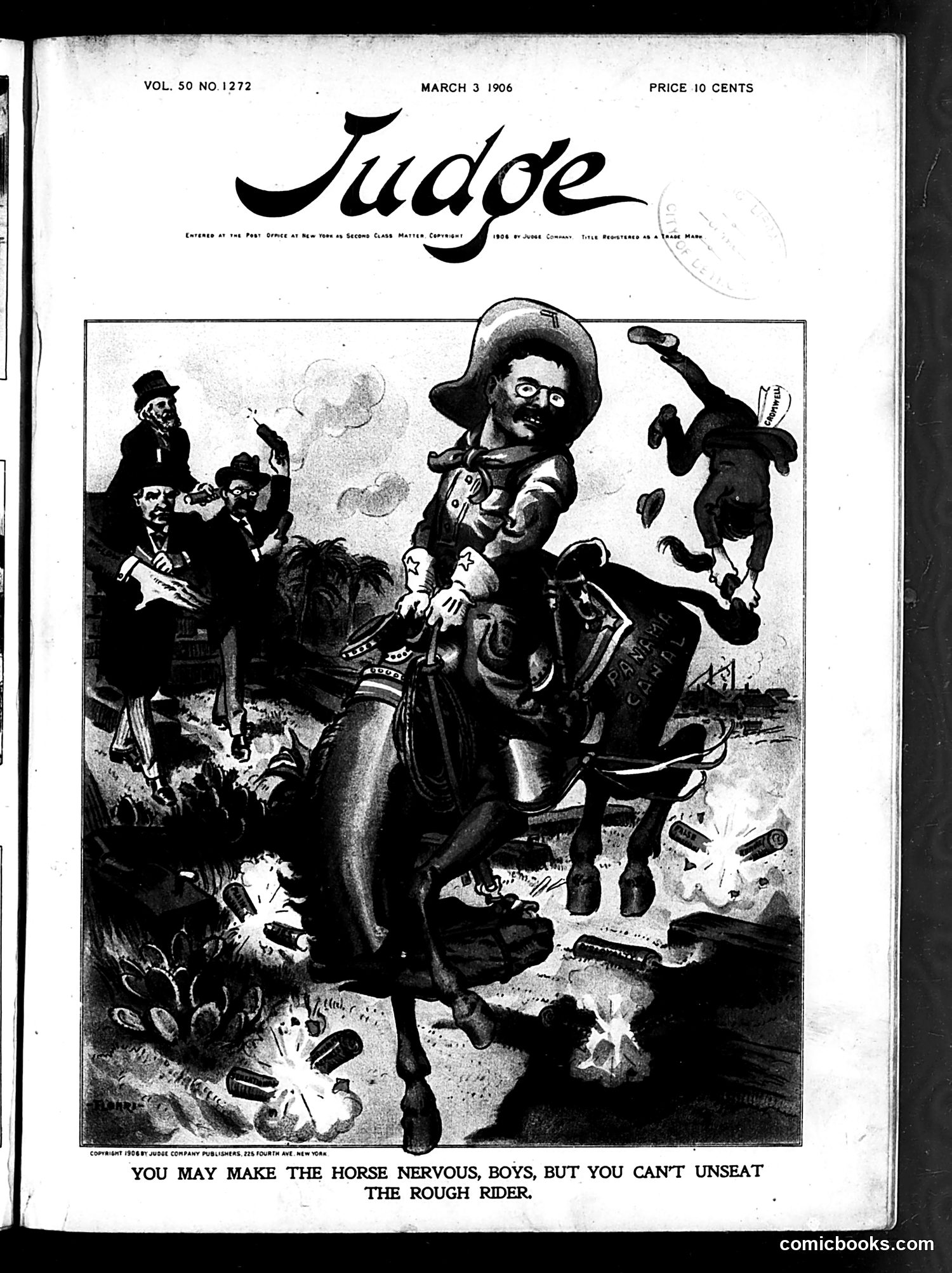
This political cartoon satirizes Theodore Roosevelt, depicted as a mounted "Rough Rider" (referencing his famous cavalry unit from the Spanish-American War). The caption reads: "You may make the horse nervous, boys, but you can't unseat the rough rider." The smaller figures on the left appear to be political opponents or critics attempting to unsettle Roosevelt through various means—shown as literal disturbances around his horse. The satire suggests that despite their efforts, Roosevelt remains firmly in control and unshakeable from power. This likely references Roosevelt's dominance of American politics during his presidency (1901-1909) and mocks the ineffectiveness of his political opposition. The "Rough Rider" imagery invokes his tough, masculine persona that defined his public image.
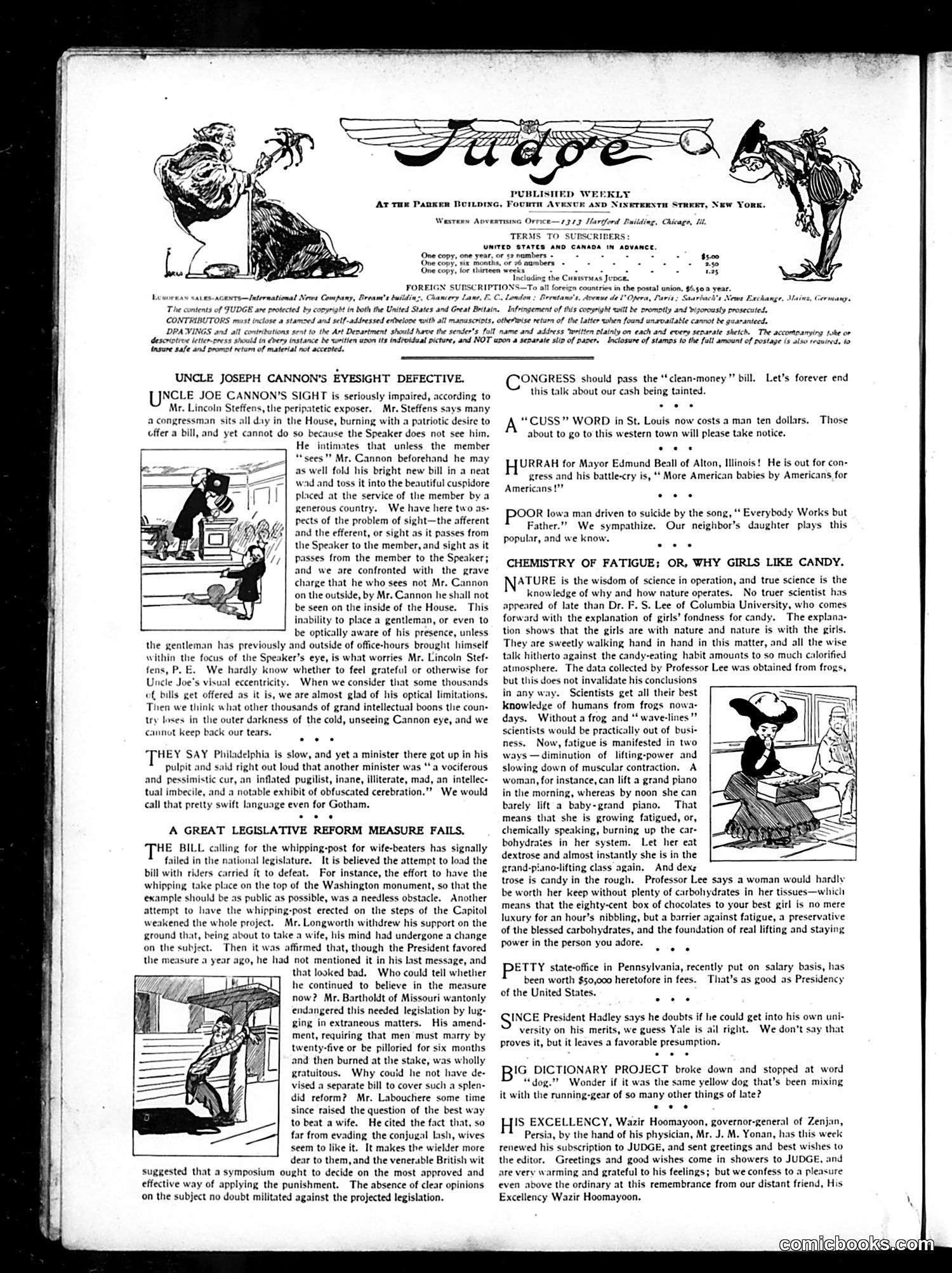
The page contains several brief political/social commentaries rather than a single coherent cartoon. **"Uncle Joseph Cannon's Eyesight Detective"** mocks House Speaker Joseph Cannon's alleged blindness to a congressman's poor vision problem—a joke about selective oversight. The cartoon shows Cannon unable to see issues before him despite claiming attention to House matters. **Other brief items** critique various targets: a "clean-money" bill, Mayor Edmund Heat's patriotic claims, a suicide prompted by song lyrics, and legislative failures regarding wife-beating punishment. **"Chemistry of Fatigue"** satirizes pseudo-scientific explanations for girls' chocolate consumption, suggesting this reflects growing "scientific" justifications for consumer behavior. The page exemplifies *Judge*'s typical format: stacked satirical observations on current events, politicians, and social foibles, requiring period context to fully appreciate specific references.
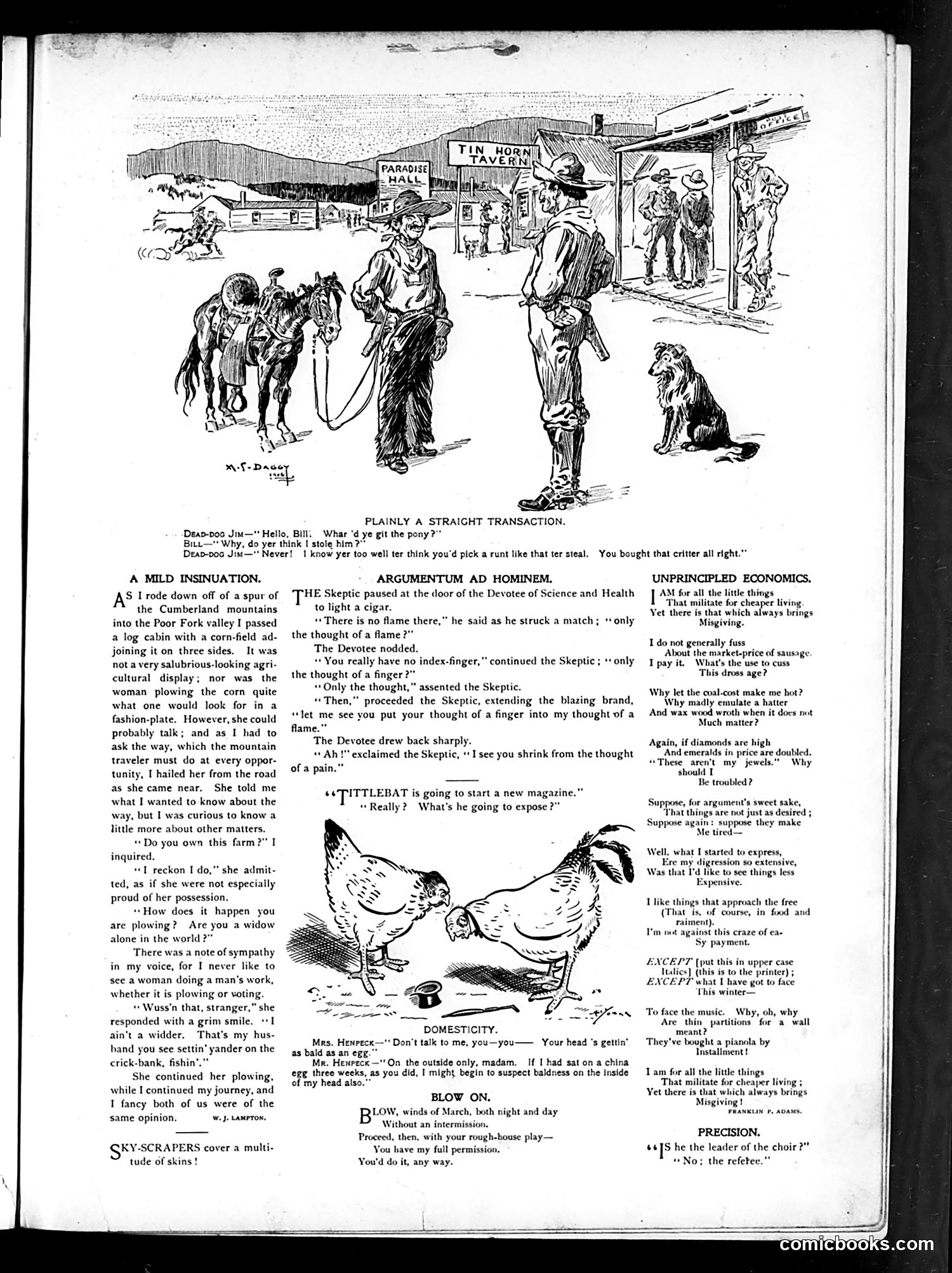
The main illustration depicts a Western tavern scene ("Tin Horn Tavern," "Paradise Hall") with cowboys, horses, and a dog. The caption "Plainly a Straight Transaction" introduces a dialogue between "Dead-Dog Jim" and "Bill" about stealing a pony—the joke being that Bill justifies the theft as a legitimate "transaction." The page contains several short humorous pieces and poems addressing various topics: skepticism about science, economic complaints, domestic life (featuring chickens), and musical precision. These appear to be general social satire rather than political commentary. The overall tone is typical of Judge's late-19th/early-20th-century humor—mixing frontier humor, domestic comedy, and philosophical quips about contemporary life and human nature. No specific political figures or events appear identifiable.
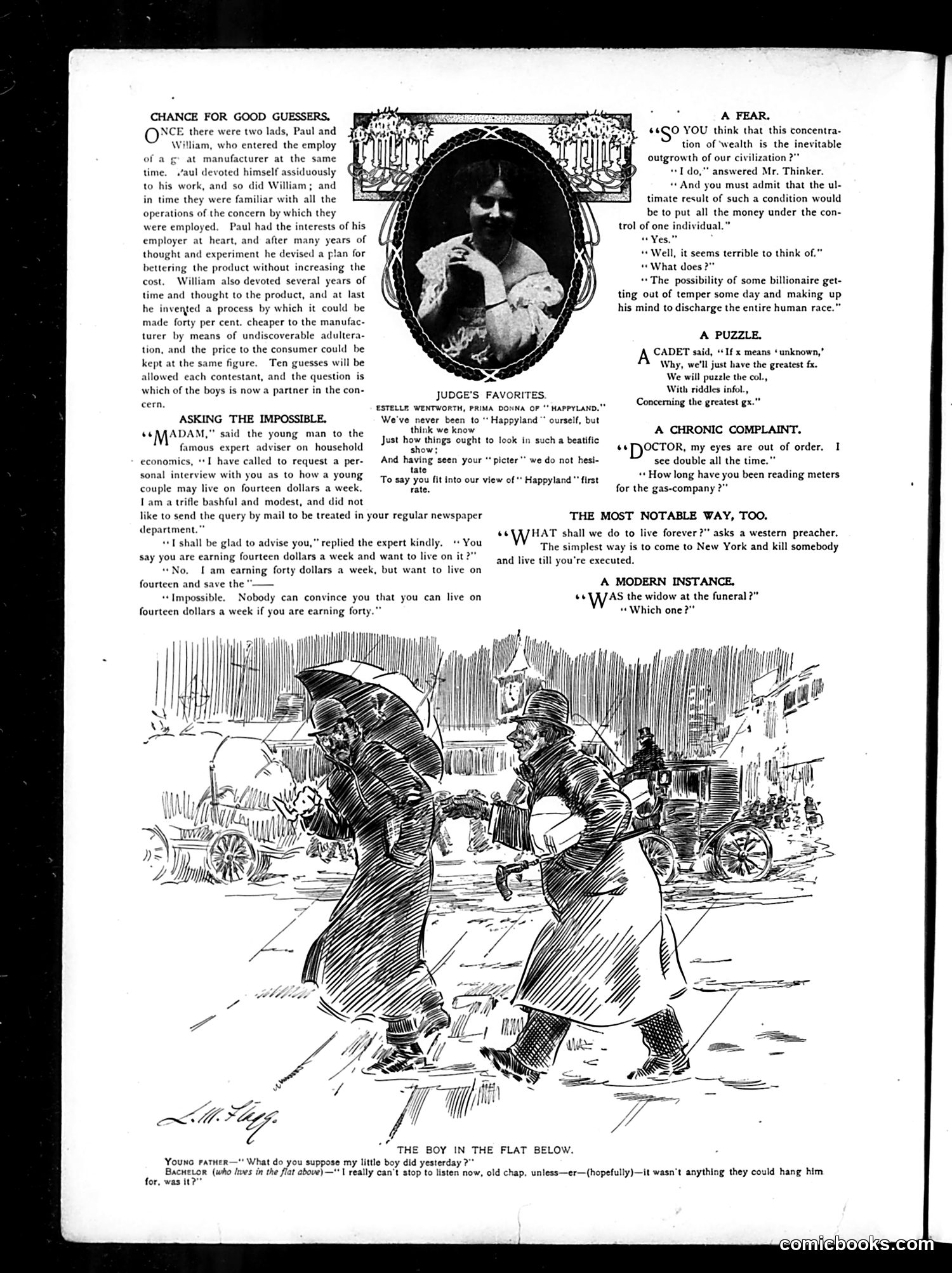
This page contains multiple satirical pieces typical of Judge magazine's format: **"Asking the Impossible"** mocks an "economic expert" advising a couple to live on fourteen dollars weekly—presented as absurd advice disconnected from reality. **"Judge's Favorites"** appears to be a humorous poem about "Happyland," suggesting editorial commentary on idealistic thinking. The large cartoon **"The Boy in the Flat Below"** depicts two men in the street apparently fighting or struggling, with a caption about a young boy's misbehavior and his father's inability to discipline him—satirizing parental authority and urban domestic chaos. Various other brief comic items fill the page, including "A Fear," "A Puzzle," and "A Chronic Complaint," typical of Judge's miscellaneous humor format. The overall tone suggests late 19th or early 20th-century American anxieties about economics, family discipline, and urban life.
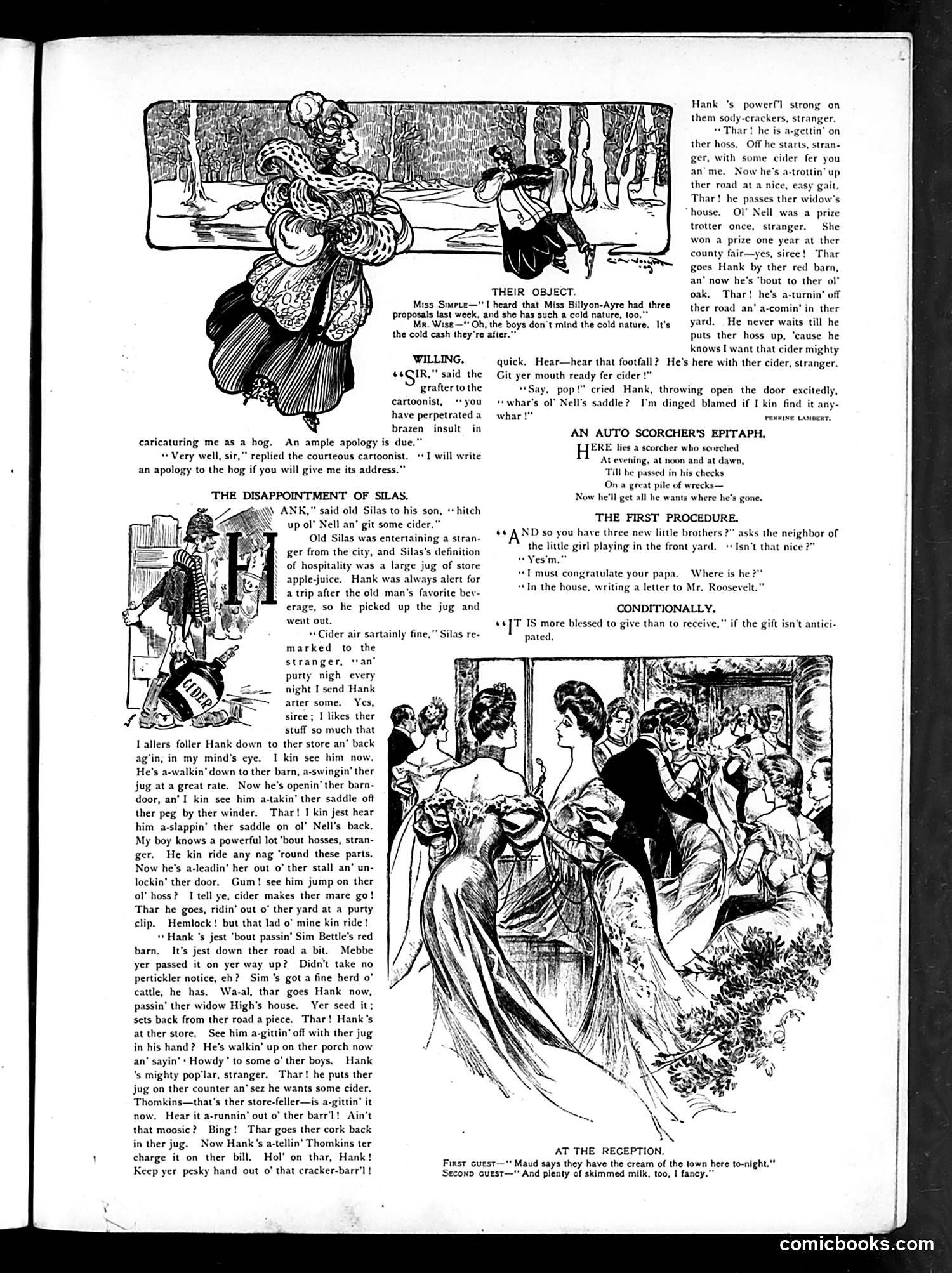
This page contains several short humorous stories rather than political cartoons. The main narratives—"Their Object," "The Disappointment of Silas," "An Auto Scorcher's Epitaph," "The First Procedure," and "At the Reception"—are domestic comedies and social satire typical of early 20th-century Judge magazine. The humor targets: - Marital dynamics and courtship (Miss Sturge's multiple proposals) - Rural simplicity (old Silas's misunderstanding about cider) - Urban dangers (automobile recklessness) - Social pretension (guests at receptions) - Parenting anxieties These are gentle, universal social observations rather than political commentary. The accompanying illustrations are period woodcut-style drawings depicting the scenarios described. The content reflects Judge's focus on satirizing everyday American life and social conventions.
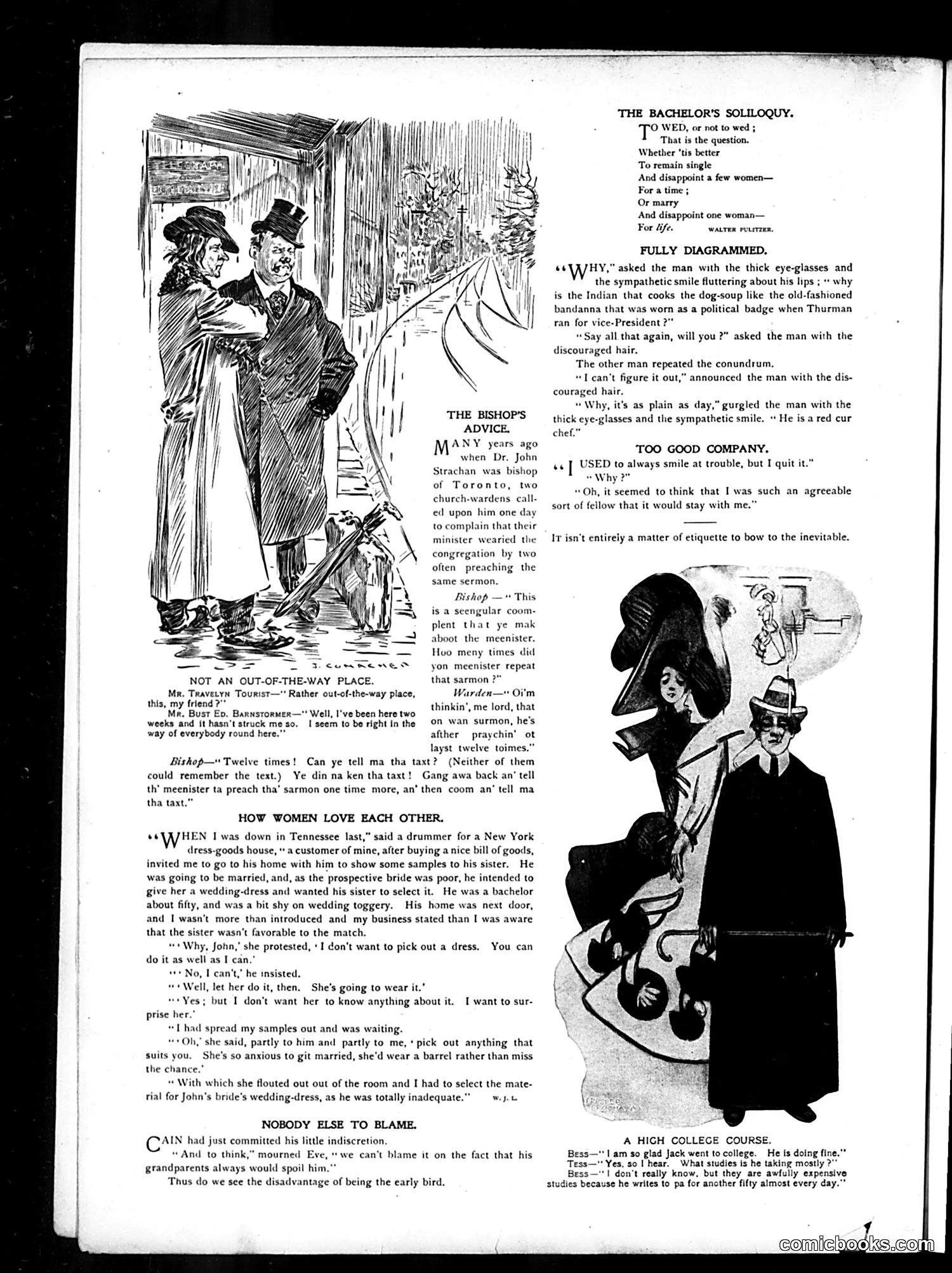
This page contains multiple satirical pieces typical of late 19th/early 20th-century American humor: **"The Bishop's Advice"**: A humorous anecdote about Bishop John Strachan of Toronto (historical figure), mocking both the complaining church-wardens and the minister's repetitive preaching. The bishop's solution—have the minister preach the same sermon twelve MORE times so parishioners can remember the text—satirizes institutional inefficiency and absurd authority. **"How Women Love Each Other"**: Satirizes female competitiveness and cattiness. A sister deliberately sabotages her brother's engagement by refusing to help select his bride's wedding dress, then insults the fiancée's desperation to marry, forcing the traveling salesman to handle the selection. **"The Bachelor's Soliloquy"** and other brief pieces mock marriage, suggesting bachelors disappoint multiple women temporarily while married men disappoint one woman permanently—common misogynistic humor of the era. **"A High College Course"**: Jokes about college being primarily social rather than academic. The overall tone reflects Judge's satirical approach: mocking human folly, particularly regarding marriage, gender relations, and institutional authority.
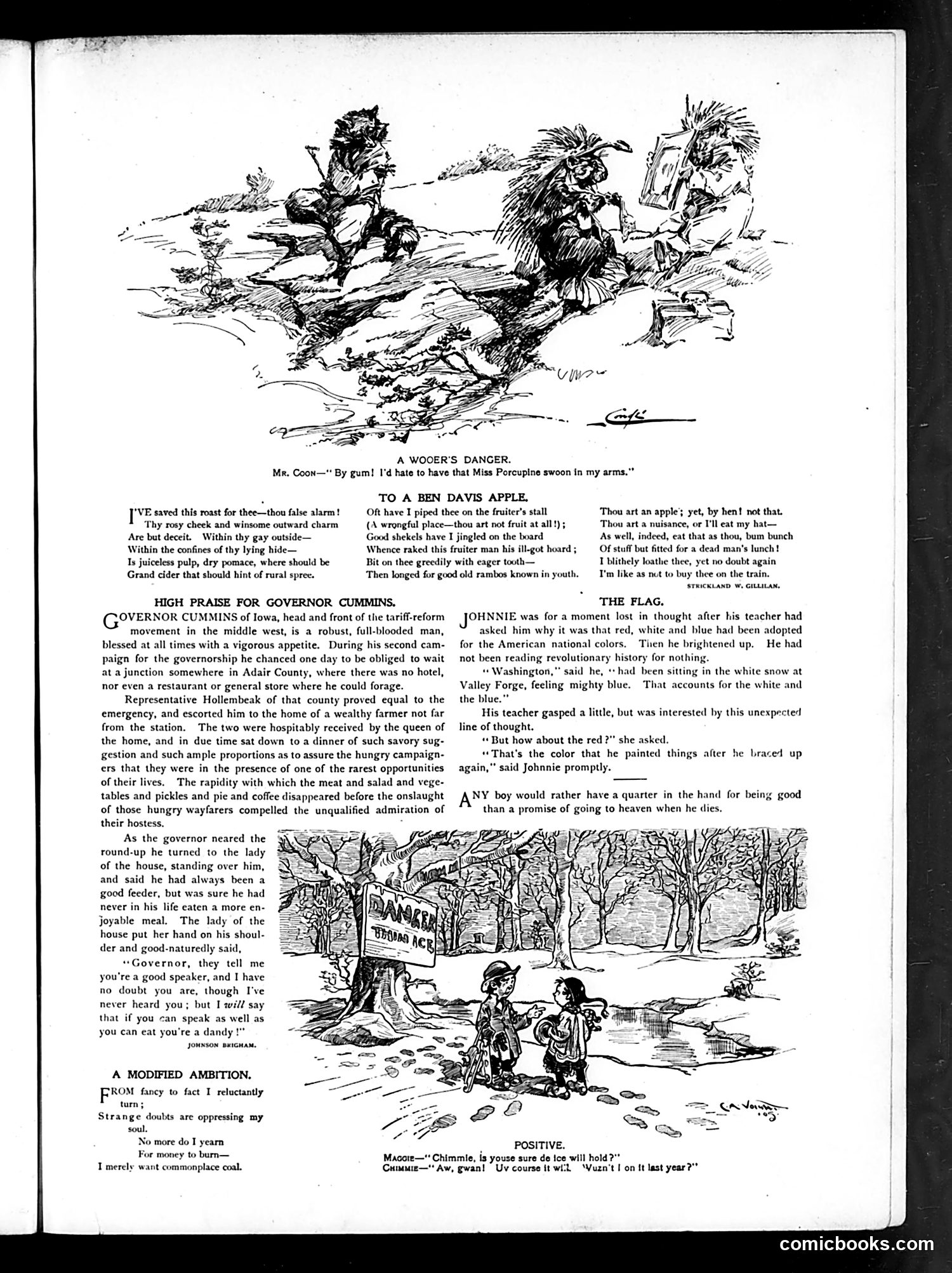
This page contains several satirical pieces typical of early 20th-century American humor: **"A Wooer's Danger"** depicts a racist caricature labeled "Mr. Coon" (a derogatory term), making a pun about a "Miss Porcupine"—standard minstrel-era humor. **"To a Ben Davis Apple"** is a mock-poetic complaint about buying disappointing fruit—a common consumer gripe personified. **"High Praise for Governor Cummins"** praises Iowa Governor Albert B. Cummins, a Progressive reformer and tariff-reform advocate. The anecdote humorously flatters him by noting his impressive appetite during a campaign stop, implying vigor and vitality. **"The Flag"** is a children's joke where a student absurdly explains American flag colors through Washington at Valley Forge—white snow, blue mood, red from painting after recovery. **"A Modified Ambition"** cynically jokes that a boy prefers immediate payment over religious promises for good behavior. The page blends political praise, consumer satire, ethnic humor, and family comedy—typical Judge content mixing topical references with accessible jokes.
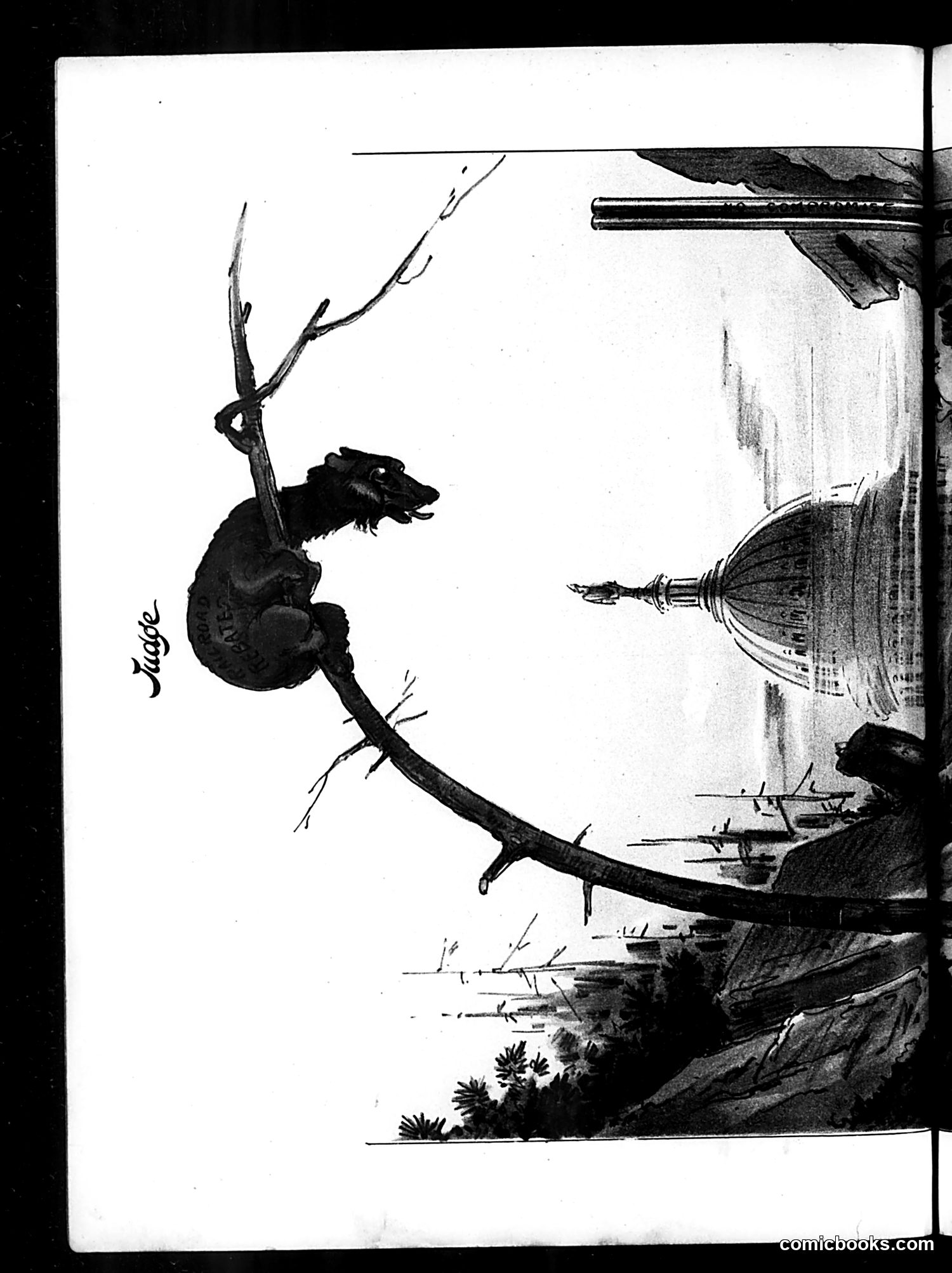
This appears to be a single illustrated cartoon from *Judge* magazine, though the OCR text only returns the website source. The image shows a figure (labeled "Judge" in the left margin) perched on a gnarled branch, depicted as a dark creature with an animal-like head. The composition is surreal and dreamlike, with architectural or landscape elements visible on the right side. Without legible accompanying text or caption, the specific political or social commentary remains unclear. The artistic style suggests early-to-mid 20th century satirical illustration. The "Judge" figure may represent the magazine itself or a personified concept of judgment/justice, but the intended target of satire cannot be determined from the visible image alone.
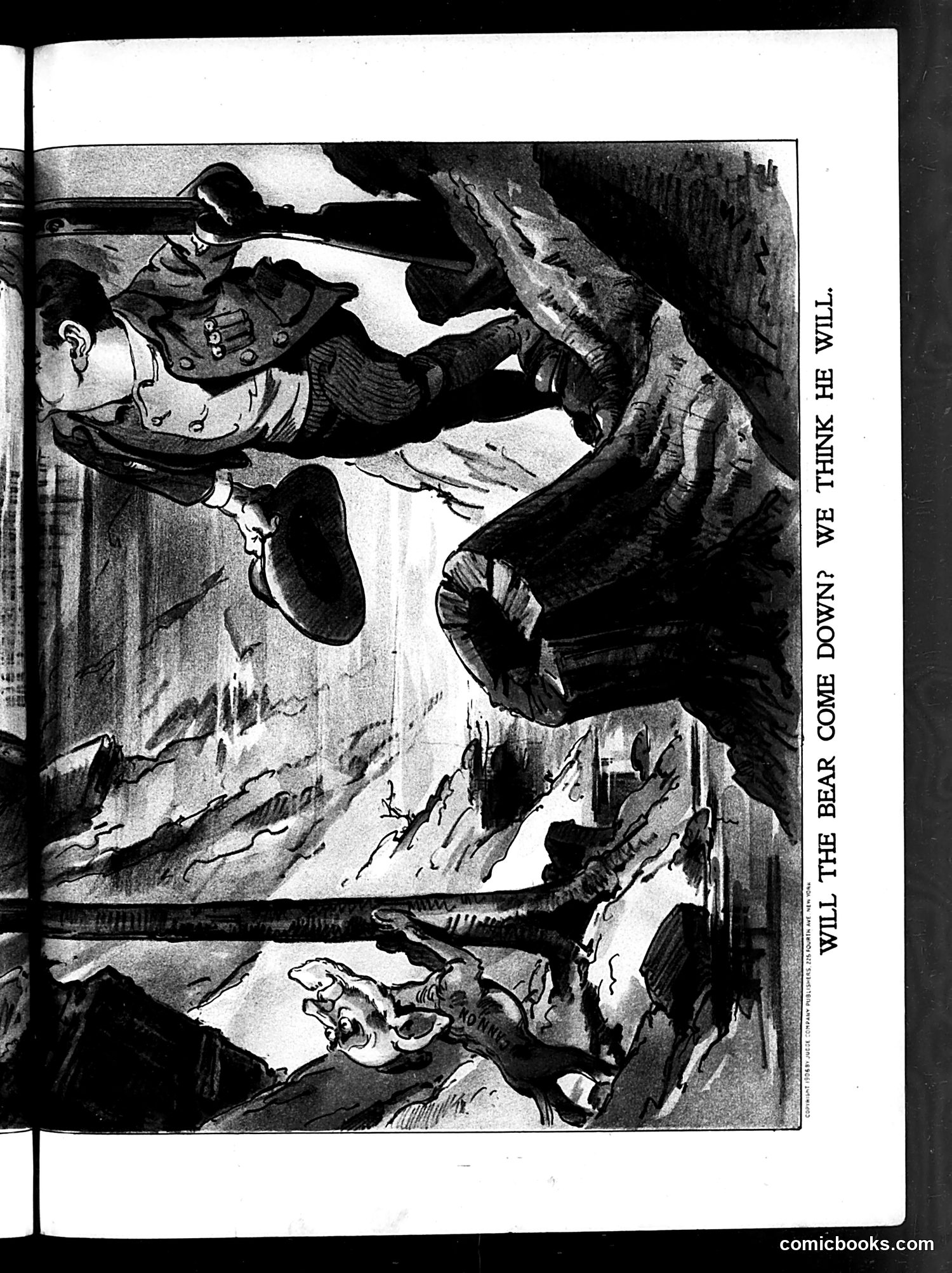
This page contains a political cartoon titled "WILL THE BEAR COME DOWN? WE THINK HE WILL" (text visible on right margin). The image depicts a figure in military uniform confronting a large bear on what appears to be a mountainous or rocky terrain. The bear likely represents Russia, a common satirical symbol in American political cartoons of the era. The cartoon appears to commentary on Russian political or military actions, with the soldier figure (possibly representing American or Western interests) challenging or confronting Russian aggression or ambitions. The phrase "come down" suggests Russia retreating from an aggressive position. However, without a specific date visible on this Judge magazine page, I cannot identify the precise historical event being referenced. The satirical point seems to center on whether Russian aggression will be checked or forced to withdraw.
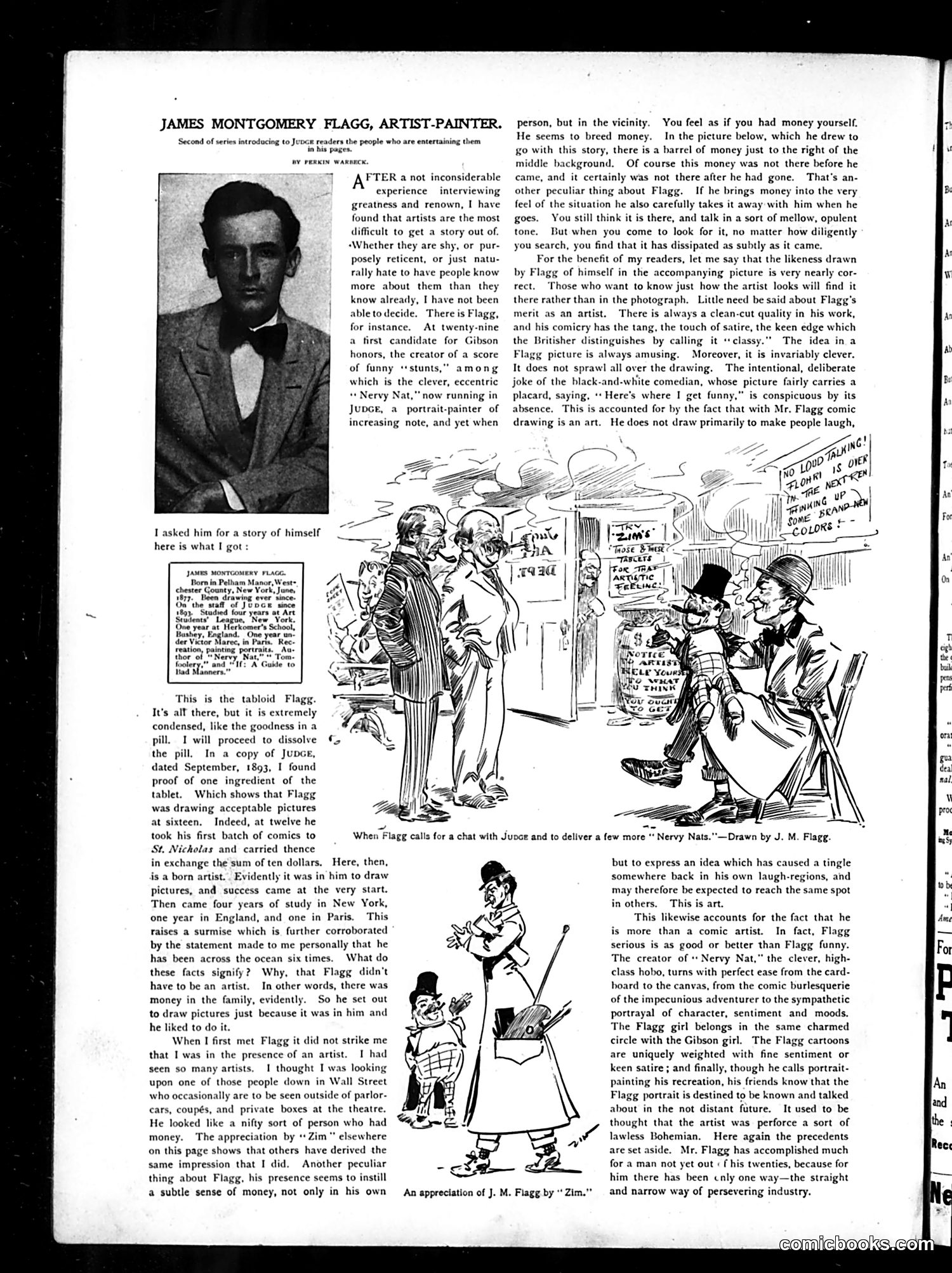
This is a profile of artist James Montgomery Flagg, presented as the second in Judge magazine's series on entertainers contributing to the publication. The page establishes Flagg's credentials: a successful painter and cartoonist by his twenties who created humorous comic strips and portraits. The text emphasizes his apparent wealth—his family had money, he studied internationally (New York, England, Paris), and traveled frequently. The accompanying cartoons illustrate Flagg's artistic style: sharp, satirical line drawings with deliberate wit rather than broad comedy. One sketch humorously shows him summoning figures (possibly referencing his work creating characters), while another depicts him as a confident, well-dressed man. The author notes Flagg possessed a peculiar quality: his mere presence seemed to evoke affluence in others—what the text playfully describes as "breeding money," which mysteriously disappears once he leaves. This is essentially a promotional feature celebrating Flagg's talent and rising prominence in American illustration and comic arts.
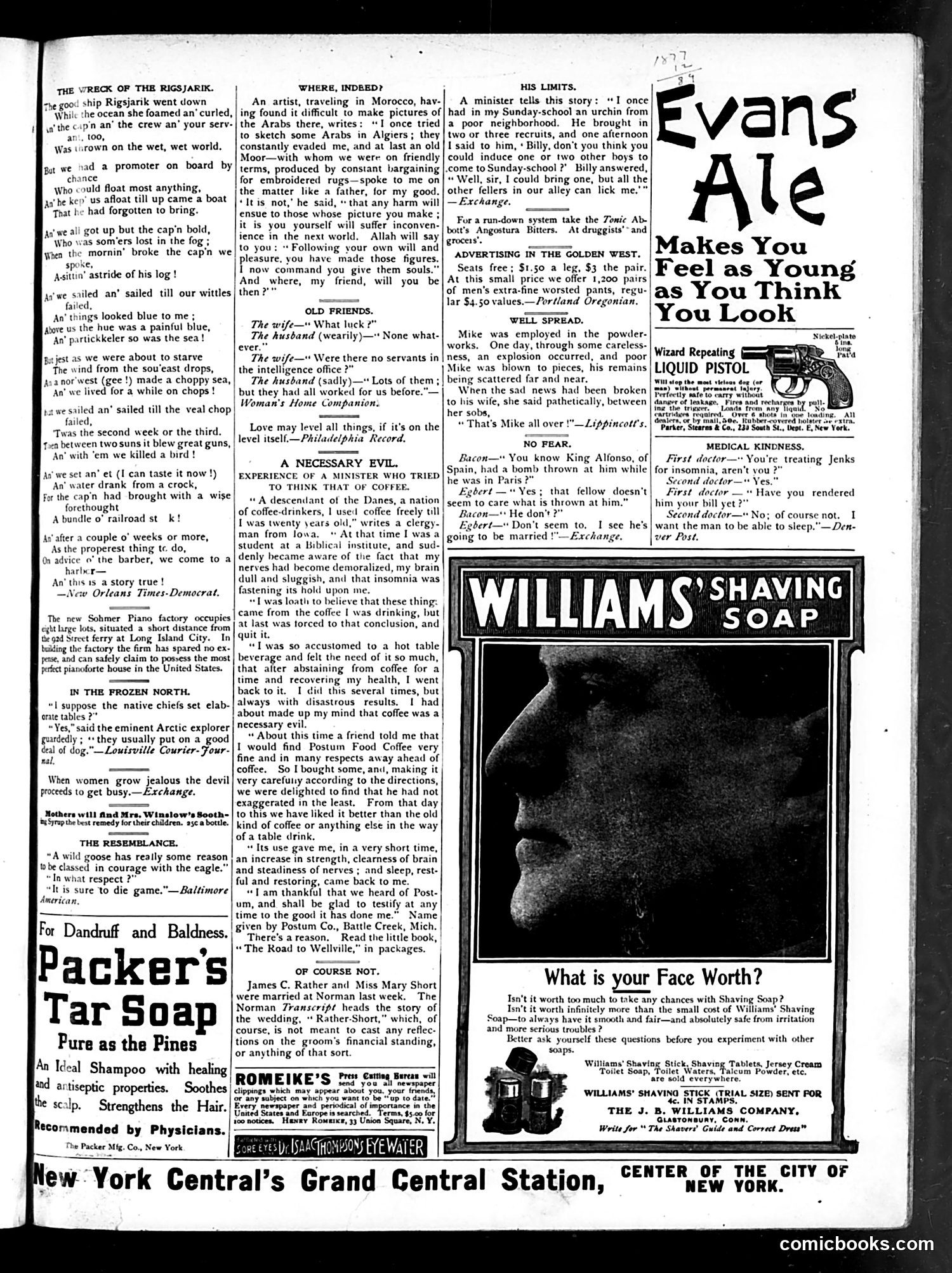
This page is primarily **advertisements and humorous filler content** rather than political satire. The main text piece, "The Wreck of the Rigsjarik," is a **tall tale poem** about a shipwreck—a common 19th-century humor format. It features exaggerated mishaps (a promoter who forgets to bring a boat, surviving on veal chops, a captain riding a log) told in mock-heroic dialect verse. The remaining content consists of **brief comedic anecdotes** about everyday life: Arctic explorers discussing native food, a wild goose's courage, a wife questioning a husband's job-hunting success. These rely on simple wordplay and domestic humor rather than political commentary. The bulk of the page is **commercial advertising** for products like Packer's Tar Soap, Williams' Shaving Soap, and pianos—typical for Judge magazine, which subsidized its satirical content through paid advertisements. This appears to be a **non-political issue**, focusing instead on general entertainment and advertising revenue.
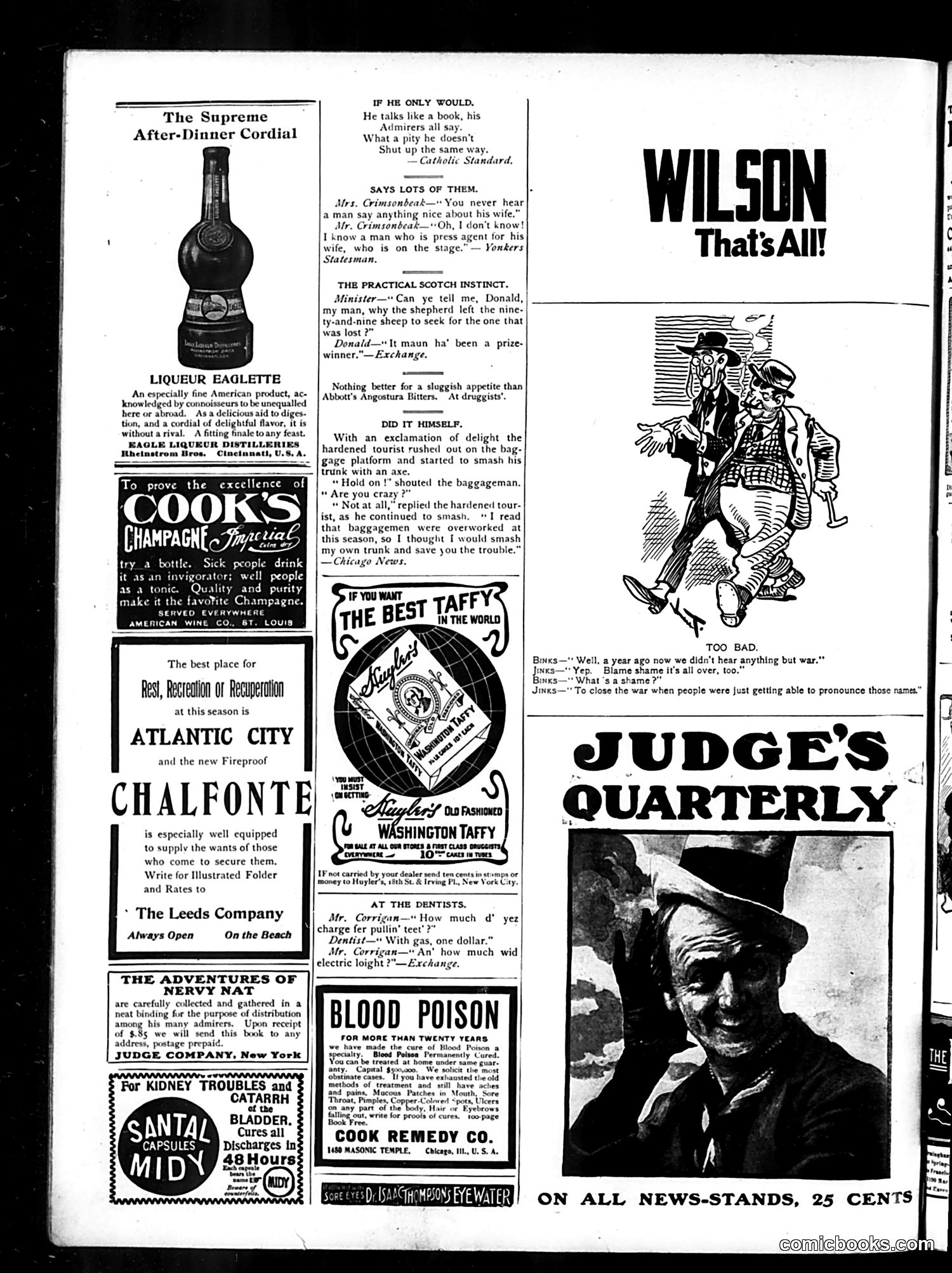
This page is primarily **advertising** with scattered brief jokes and one cartoon. The central cartoon titled "WILSON—That's All!" depicts a figure (likely President Woodrow Wilson) being embraced or manipulated by another character, satirizing Wilson's post-WWI prominence or perceived weakness. The accompanying dialogue jokes about Americans struggling to pronounce foreign names during wartime, then losing interest once the war ended—a dig at public attention span and America's presumed withdrawal from international affairs after World War I. The page is dominated by period advertisements for liqueurs, champagne, resort hotels, medical remedies (including a "Blood Poison" cure), and patent medicines typical of 1920s publications. These reflect contemporary consumer culture and attitudes toward health and leisure. The scattered one- or two-line jokes address mundane topics: spousal communication, Scottish frugality, and dentist prices—standard magazine filler humor of the era.
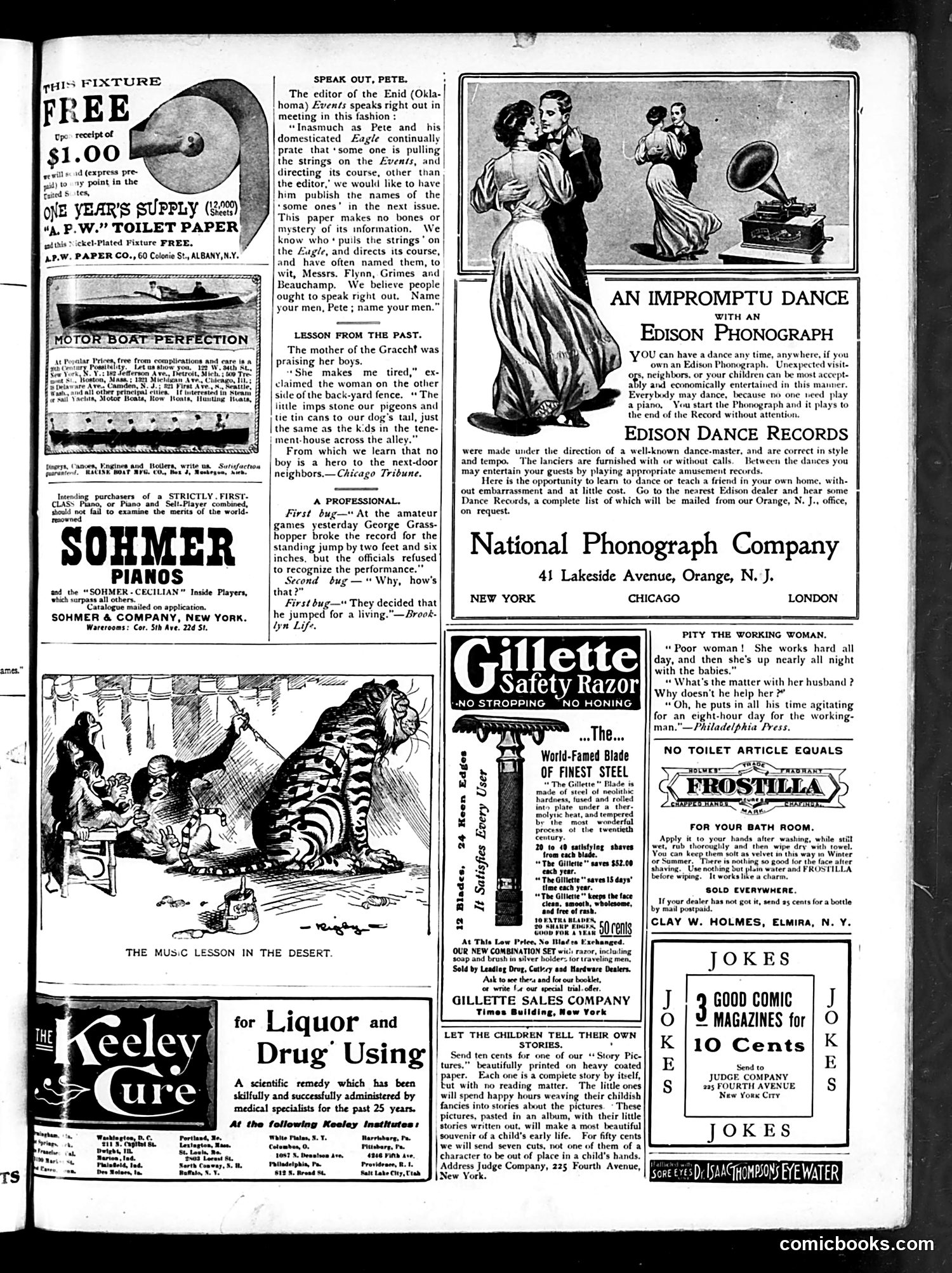
This page is primarily **advertising** with one notable cartoon titled "The Music Lesson in the Desert" (lower left), showing a figure apparently being attacked by a zebra—a visual gag about an unexpected, chaotic "music lesson." The main editorial content is "Speak Out, Pete," where the Enid, Oklahoma *Events* editor challenges Pete to publicly name whoever supposedly controls his newspaper's editorial direction. The referenced figures—Flynn, Grimes, and Beauchamp—are local Oklahoma figures, now obscure to modern readers. A classical anecdote, "Lesson from the Past," compares modern children unfavorably to the Gracchi brothers' mother's famous sons, suggesting contemporary parenting has declined. The page otherwise features advertisements for **Edison Phonographs** (dance records), **Sohmer Pianos**, **Gillette Safety Razors**, and other consumer goods typical of early-20th-century Judge advertising. The brief jokes scattered throughout mock everyday situations—amateur sporting performances, husbands neglecting housework for labor activism—reflecting period social concerns rather than political satire.
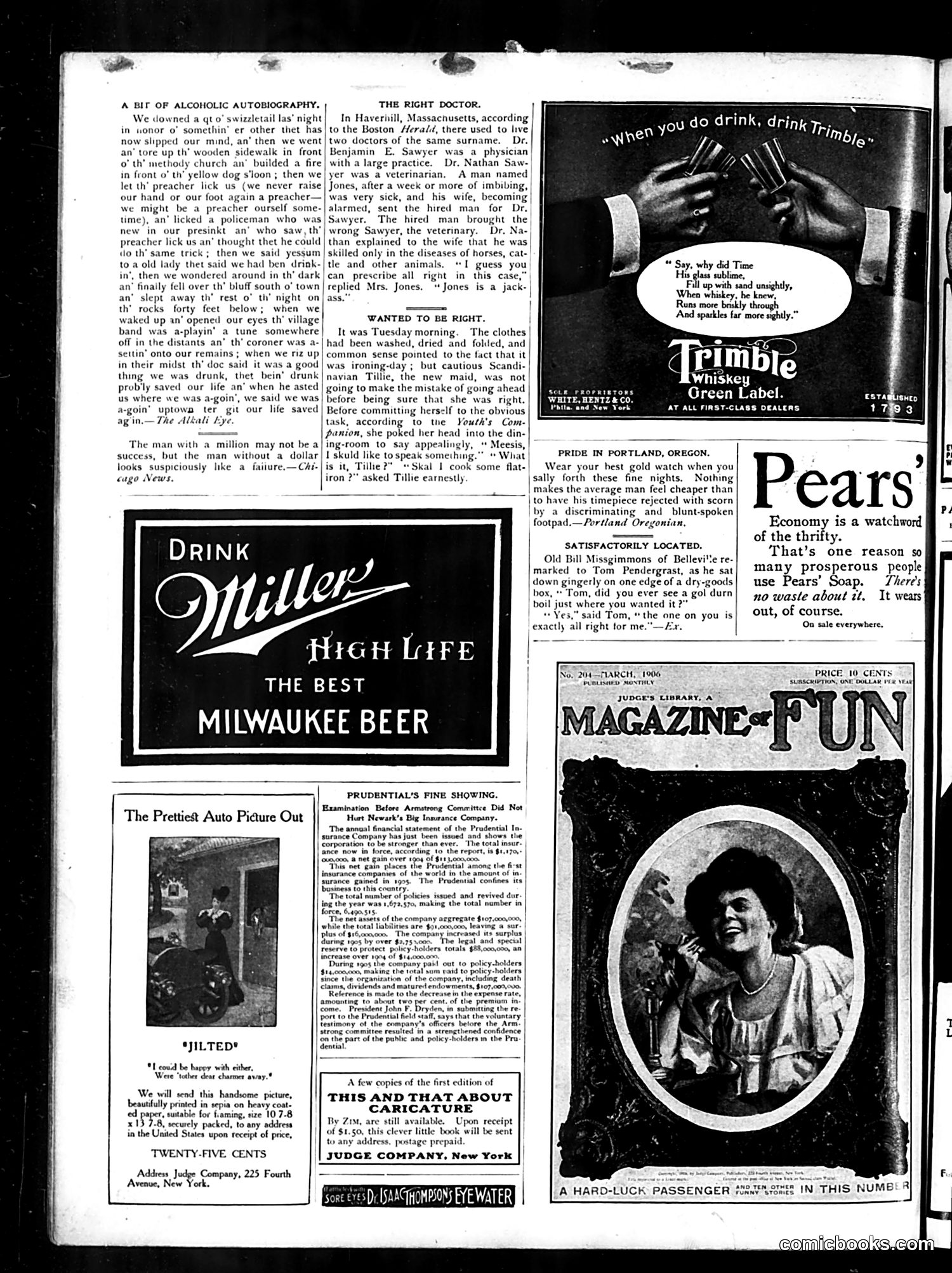
This page is primarily **advertising and filler content** from Judge magazine (March 1906). The main items are: 1. **"A Bit of Alcoholic Autobiography"** - A humorous dialect piece narrating a drunk man's chaotic night of vandalism, fighting, and eventual collapse. The humor relies on exaggerated vernacular and the character's obliviousness to his own destructive behavior. 2. **"The Right Doctor"** - A brief joke about a man mistakenly summoning a veterinarian instead of a physician, with the wife's punchline implying her husband is animalistic ("a jackass"). 3. **"Wanted to Be Right"** - A short anecdote about a cautious Scandinavian maid seeking permission before ironing clothes, playing on ethnic stereotype humor. The page is otherwise dominated by **period advertisements** (Miller beer, Trimble whiskey, Pears' soap) and a notice about *Magazine of Fun*. The content reflects early-1900s humor conventions: dialect comedy, ethnic stereotyping, and slapstick scenarios.
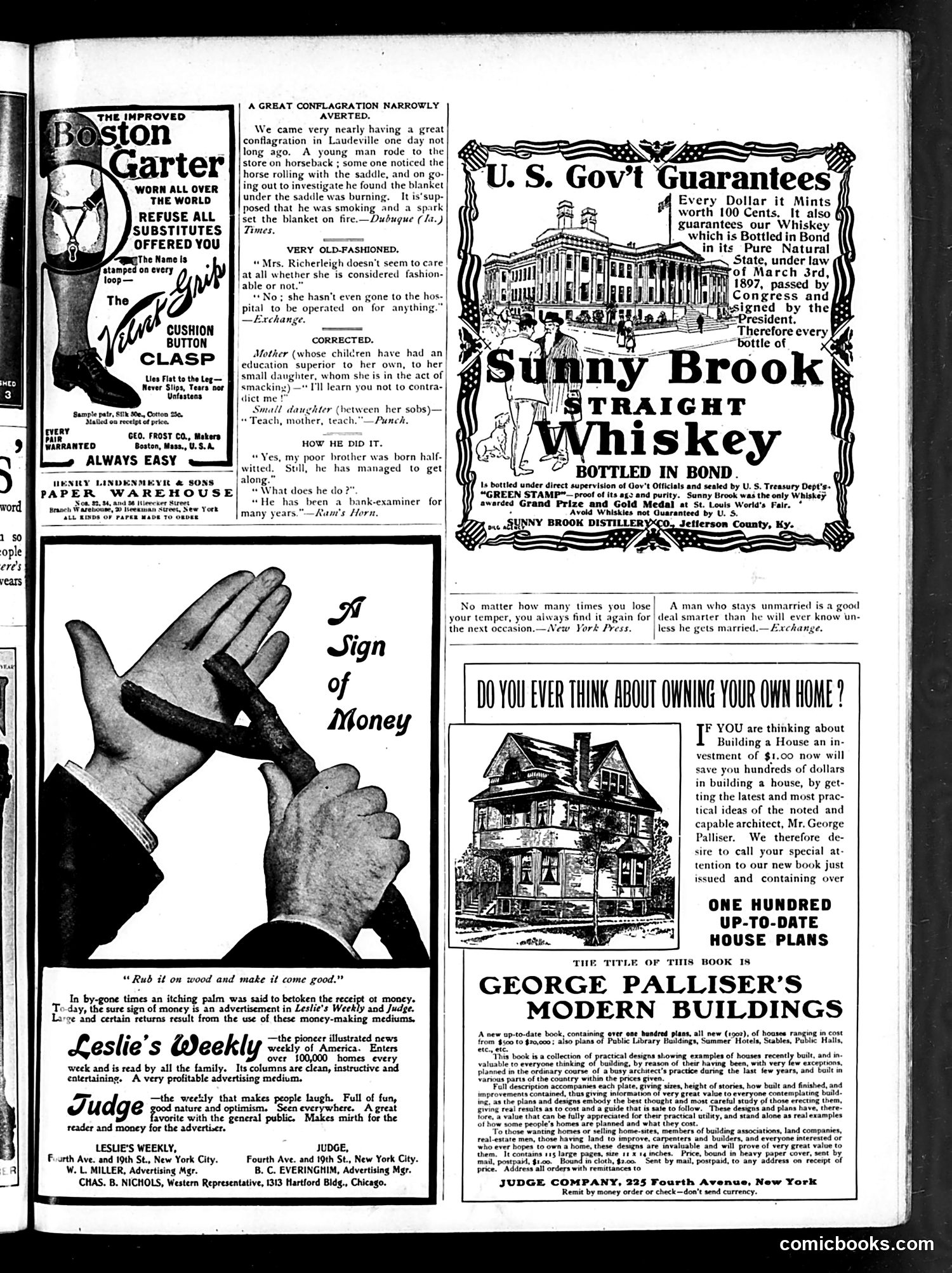
This page is primarily **advertising**, with only brief satirical content. The small humor pieces mock old-fashioned attitudes: a society woman who refuses modernization (not even undergoing fashionable surgery), and a child correcting her mother's grammar—inverting expected authority. These gently ridicule both extreme conservatism and educated children undermining parental respect. The dominant content advertises **Sunny Brook Whiskey**, emphasizing U.S. government guarantees and "Green Stamp" certification—reassurance language targeting consumers concerned about product authenticity during an era of widespread patent medicines and adulterated goods. The whiskey's "Bottled in Bond" status under 1897 federal law guaranteed age and purity. Other ads promote self-improvement (house-building plans by architect George Palliser) and publications themselves—Leslie's Weekly and Judge—using the ironic conceit that money's modern "sign" is advertising in these magazines rather than traditional symbols. The page reflects **early 1900s consumer culture**: emphasis on government certification, home ownership aspiration, and advertising's growing power.
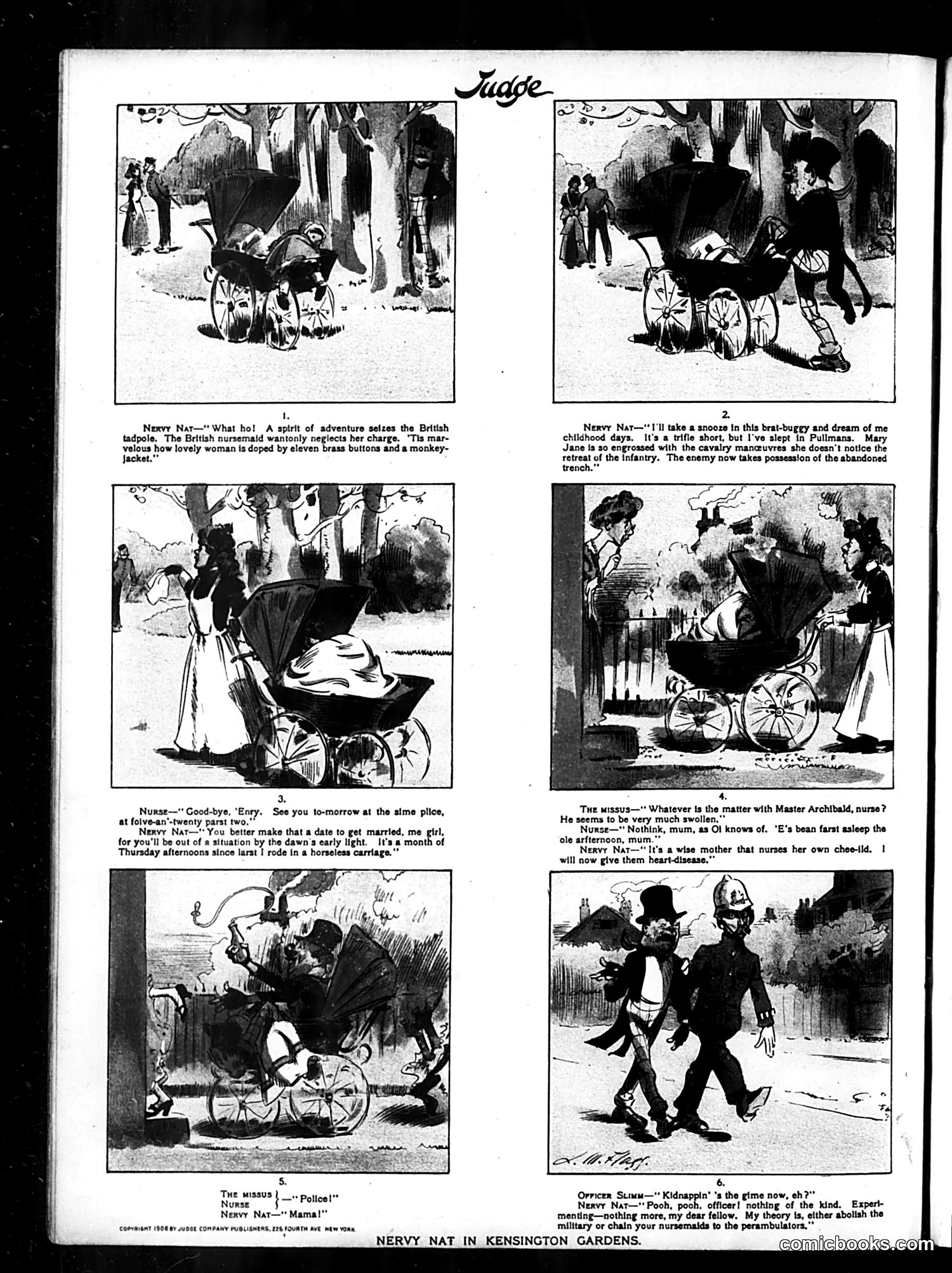
This is a serial comic strip following "Nervy Nat," an Irish character (indicated by the accent and dialect), who creates chaos by stealing a baby carriage in London's prestigious Kensington Gardens. The satire targets: 1. **British class pretension**: The nursemaid is distracted by a soldier's uniform ("eleven brass buttons and a monkey-jacket"), neglecting her charge—mocking the British upper class's vanity and the servant class's gullibility. 2. **Military posturing**: References to "cavalry maneuvers" and "infantry" satirize the British military's prominence in public life. 3. **Parenting incompetence**: The comic ridicules both nursemaids and mothers as neglectful guardians. 4. **Kidnapping jokes**: The final panel's reference to "kidnappin'" makes light of child abduction, which was a real contemporary crime concern. The humor relies on Nervy Nat's Irish roguishness disrupting British propriety in a fashionable location. The strip appears designed for working-class readers who enjoyed seeing the respectable classes and their institutions mocked.