
Judge, 1906-03-03 · page 10 of 16
Judge — March 3, 1906 — page 10: what you’re looking at
What you’re looking at
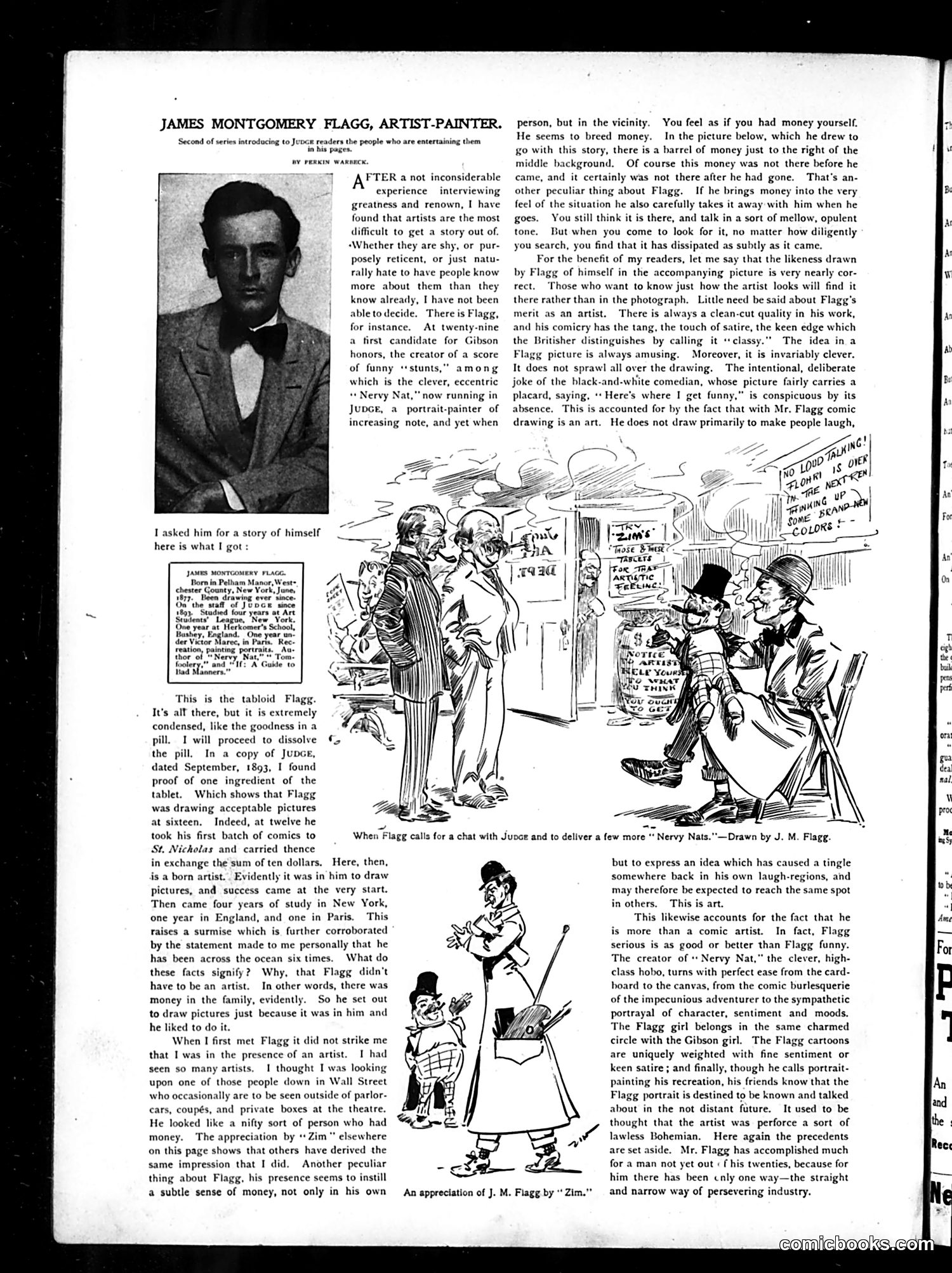
This is a profile of artist James Montgomery Flagg, presented as the second in Judge magazine's series on entertainers contributing to the publication. The page establishes Flagg's credentials: a successful painter and cartoonist by his twenties who created humorous comic strips and portraits. The text emphasizes his apparent wealth—his family had money, he studied internationally (New York, England, Paris), and traveled frequently. The accompanying cartoons illustrate Flagg's artistic style: sharp, satirical line drawings with deliberate wit rather than broad comedy. One sketch humorously shows him summoning figures (possibly referencing his work creating characters), while another depicts him as a confident, well-dressed man. The author notes Flagg possessed a peculiar quality: his mere presence seemed to evoke affluence in others—what the text playfully describes as "breeding money," which mysteriously disappears once he leaves. This is essentially a promotional feature celebrating Flagg's talent and rising prominence in American illustration and comic arts.
📄 Transcribed text from this page (OCR, searchable)
Machine-transcribed from the original scan — historical spelling and the odd misread are preserved.
JAMES MONTGOMERY FLAGG, ARTIST-PAINTER. Second of series introducing to Juoce readers the people who are entertaining them in his pages. By PERKIN WAKRECK. AFTER a not inconsiderable experience _ interviewing greatness and renown, I have found that artists are the most difficult to get a story out of. +Whether they are shy, or pur- posely reticent, or just natu- rally hate to have people know more about them than they know already, I have not been abletodecide. There is Flagg, for instance. At twenty-nine a first candidate for Gibson honors, the creator of a score of funny « stunts,” among which is the clever, eccentric at," now running in . A portrait-painter of increasing note, and yet when Lasked him for a story of himself here is what I got : Dorn ia Pelham Manor, West ¥ w York, Jane, Bushey, England. One year cm: der Victor Maree, in Part. Rec= This is the tabloid Flagg. It's alf there, but it is extremely condensed, like the goodness in a pill. I will proceed to dissolve the pill. In a copy of Jupce, dated September, 1893, I found proof of one ingredient of the tablet. Which shows that Flagg was drawing acceptable pictures at sixteen, Indeed, at twelve he took his first batch of comics to St, Nicholas and carried thence in exchange the sum of ten dollars. Here, then, is a born artist. Evidently it was in him to draw pictures, and success came at the very start. Then came four years of study in New York, one year in England, and one in Paris. This raises a surmise which is further corroborated by the statement made to me personally that he has been across the ocean six times. What do these facts signify? Why, that Flagg didn’t have to be an artist. In other words, there was money in the family, evidently. So he set out to draw pictures just because it was in him and he liked to do it. When I first met Flagg it did not strike me that I was in the presence of an artist. I had seen so many artists. I thought I was looking upon one of those people down in Wall Street who occasionally are to be seen outside of parlor- cars, coupés, and private boxes at the theatre. He looked like a nifty sort of person who had money. The appreciation by “Zim” elsewhere on this page shows that others have derived the same impression that I did. Another peculiar thing about Flagg, his presence seems to instill a subtle sense of money, not only in his own ‘An appreciation of J. M. Flagg by “Zim.” person, but in the vicinity. You feel as if you had money yourself. He seems to breed money. In the picture below, which he drew to go with this story, there is a barrel of money just to the right of the middle background. Of course this money was not there before he came, and it certainly was not there after he had gone. That's an- other peculiar thing about Flagg. If he brings money into the very feel of the situation he also carefully takes it away with him when he goes. You still think it is there, and talk in a sort of mellow, opulent tone. But when you come to look for it, no matter how diligently you search, you find that it has dissipated as subtly as it came. For the benefit of my readers, let me say that the likeness drawn by Flagg of himself in the accompanying picture is very nearly cor- rect. Those who want to know just how the artist looks will find it there rather than in the photograph. Little need be said about Flagg’s merit as an artist. There is always a clean-cut quality in his work, and his comicry has the tang, the touch of satire, the keen edge which the Britisher distinguishes by calling it “classy.” The idea in a Flagg picture is always amusing. Moreover, it is invariably clever. It does not sprawl all over the drawing. The intentional, deliberate joke of the black-and-white comedian, whose picture fairly carries a placard, saying, ‘«Here’s where I get funny,” is conspicuous by its absence. This is accounted for by the fact that with Mr. Flagg comic drawing is an art. He does not draw primarily to make people laugh, Lat ASU zane — erry | TMro CE When Flagg calls for a chat with Jupce and to deliver a few more ‘* Nervy Nats.""—Drawn by J. M. Flagg. but to express an idea which has caused a tingle somewhere back in his own laugh-regions, and may therefore be expected to reach the same spot in others. This is art. This likewise accounts for the fact that he is more than a comic artist. In fact, Flagg serious is as good or better than Flagg funny. The creator of « Nervy Nat,” the clever, high- class hobo, turns with perfect ease from the card- hoard to the canvas, from the comic burlesquerie of the impecunious adventurer to the sympathetic portrayal of character, sentiment and moods. The Flagg girl belongs in the same charmed circle with the Gibson girl. The Flagg cartoons are uniquely weighted with fine sentiment or keen satire ; and finally, though he calls portrait- painting his recreation, his friends know that the Flagg portrait is destined to be known and talked about in the not distant future. It used to be thought that the artist was perforce a sort of lawless Bohemian. Here again the precedents are set aside. Mr. Flagg has accomplished much for a man not yet out « f his twenties, because for him there has been caly one way—the straight and narrow way of persevering industry.