
Judge, 1906-03-03 · page 6 of 16
Judge — March 3, 1906 — page 6: what you’re looking at
What you’re looking at
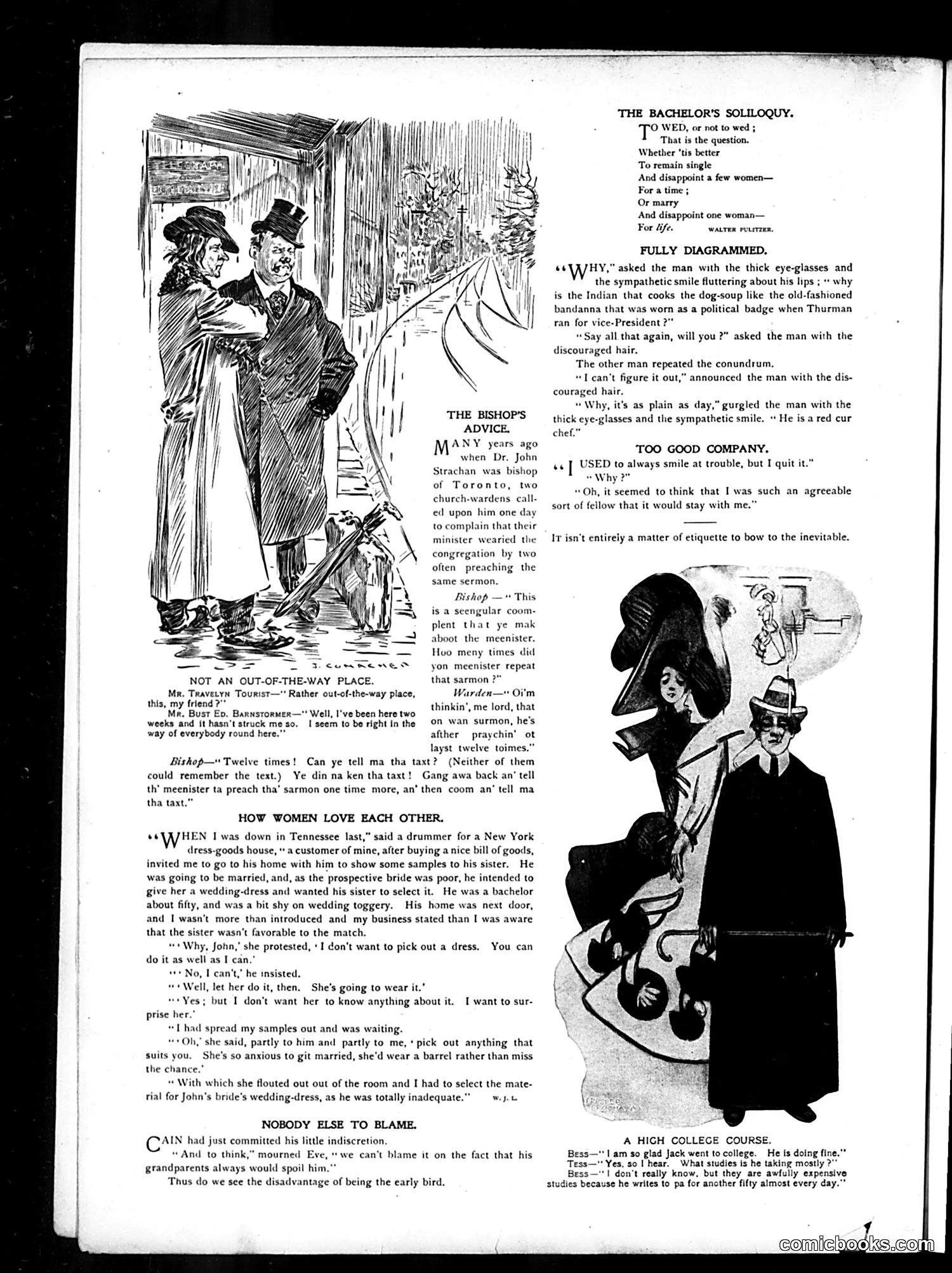
This page contains multiple satirical pieces typical of late 19th/early 20th-century American humor: **"The Bishop's Advice"**: A humorous anecdote about Bishop John Strachan of Toronto (historical figure), mocking both the complaining church-wardens and the minister's repetitive preaching. The bishop's solution—have the minister preach the same sermon twelve MORE times so parishioners can remember the text—satirizes institutional inefficiency and absurd authority. **"How Women Love Each Other"**: Satirizes female competitiveness and cattiness. A sister deliberately sabotages her brother's engagement by refusing to help select his bride's wedding dress, then insults the fiancée's desperation to marry, forcing the traveling salesman to handle the selection. **"The Bachelor's Soliloquy"** and other brief pieces mock marriage, suggesting bachelors disappoint multiple women temporarily while married men disappoint one woman permanently—common misogynistic humor of the era. **"A High College Course"**: Jokes about college being primarily social rather than academic. The overall tone reflects Judge's satirical approach: mocking human folly, particularly regarding marriage, gender relations, and institutional authority.
📄 Transcribed text from this page (OCR, searchable)
Machine-transcribed from the original scan — historical spelling and the odd misread are preserved.
THE BISHOP'S ADVICE, NY years ago when Dr. John Strachan was bishop of Toronto, two church-wardens call- ed upon him one day to complain that their minister wearied the WSS congregation by two often preaching the same sermon. Bishop —* This is a seengular coom- plent that ye mak aboot the meenister. Hoo meny times did yon meenister repeat that sarmon ?” Warden—" Oi'm thinkin’, me lord, that on wan surmon, he's afther praychin’ ot layst twelve toimes.” Can ye tell ma tha taxt? (Neither of them Gang awa back an’ tell 3 commenes NOT AN OUT-OF-THE-WAY PLACE. Mr. Traveyn Tourist—"' Rather out-of-the-way place, this, my friend ?”* Mr, Bust Ep. Barnsrormer—"' Well, I've been here two weeks and it hasn't struck me so. I seem to be right in the way of everybody round here."* Bishop—' Twelve times! could remember the text.) Ye din na ken tha taxt ! th’ meenister ta preach tha’ sarmon one time more, an’ then coom an’ tell ma tha taxt.” HOW WOMEN LOVE EACH OTHER. S6\\JHEN I was down in Tennessee last,” said a drummer for a New York dress-goods house, a customer of mine, after buying a nice bill of goods, invited me to go to his home with him to show some samples to his sister. He was going to be married, and, as the prospective bride was poor, he intended to give her a wedding-dress and wanted his sister to select it. He was a bachelor about fifty, and was a bit shy on wedding toggery. His home was next door, and I wasn't more than introduced and my business stated than I was aware that the sister wasn’t favorable to the match. “+ Why, John,’ she protested, «I don’t want to pick out a dress. do it as well as I can.” + No, I can't,’ he insisted. ++ Well, let her do it, then, She's going to wear it." “Yes; but I don't want her to know anything about it. prise her.” “Thad spread my samples out and was waiting. “+ Oh,’ she said, partly to him and partly to me, ‘ pick out anything that suits you, She's so anxious to git married, she'd wear a barrel rather than miss the chance.” “With which she flouted out out of the room and I had to select the mate- rial for John’s bride’s wedding-dress, as he was totally inadequate.” You can I want to sur- wee NOBODY ELSE TO BLAME. IN had just committed his little indiscretion. “And to think,” mourned Eve, “we can’t blame it on the fact that his grandparents always would spoil him." Thus do we see the disadvantage of being the early bird. ‘THE BACHELOR'S SOLILOQUY. ‘0 WED, or not to wed ; That is the question. Whether ‘tis better To remain single And disappoint a few women— For a time ; Or marry And disappoint one woman— For fife. FULLY DIAGRAMMED. S6\VHY," asked the man with the thick eye-glasses and the sympathetic smile fluttering about his lips ; « why is the Indian that cooks the dog-soup like the old-fashioned bandana that was worn as a political badge when Thurman ran for vice-President ?" “Say all that again, will you 2” asked the man with the discouraged hair. The other man repeated the conundrum. “Tcan’t figure it out,” announced the man with the dis- couraged hair. “Why, it’s as plain as day,” gurgled the man with the thick eye-glasses and the sympathetic smile, “He is a red cur chef.” TOO GOOD COMPANY. 64 [ USED to always smile at trouble, but I quit it.” “Why 2?" “Oh, it seemed to think that Iwas such an agreeable sort of fellow that it would stay with me.” Ir isn’t entirely a matter of etiquette to bow to the inevitable. A HIGH COLLEGE COURSE. “Lam so glad Jack went to college. He is doing fine. Tess—"' Yes, so | hear. What studies is he taking mostly ?"° Bess—"! don’t really know, but they are awfully expensive studies because he writes to pa for another fifty almost every day.””