
A complete issue · 53 pages · 1897
Judge — December 18, 1897
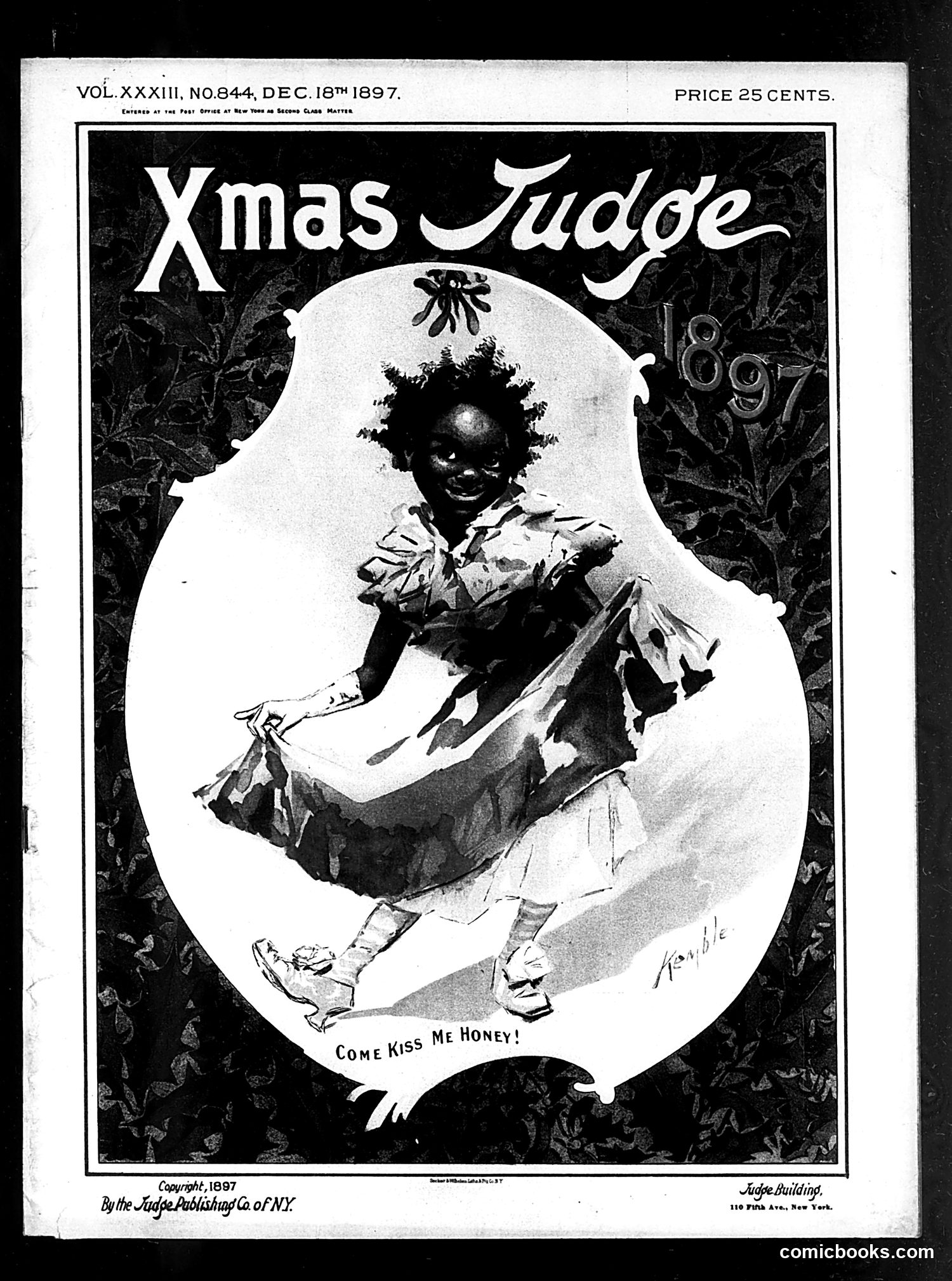
This cover illustration depicts a child depicted with exaggerated racial caricature features, wrapped in what appears to be a large fudge or candy wrapper, with the caption "Come Kiss Me Honey!" The artwork uses the child as a product—literally presenting the figure as confection. The satire likely comments on commercial Christmas culture and commodification, though the specific target isn't entirely clear from the image alone. The racial caricature reflects the deeply offensive visual conventions common in 1890s American media. The "Judge" publishing credit and date confirm this is from the well-known satirical magazine. Without additional context, the precise social or political commentary remains somewhat ambiguous, though the degrading imagery is unmistakably rooted in period racism.
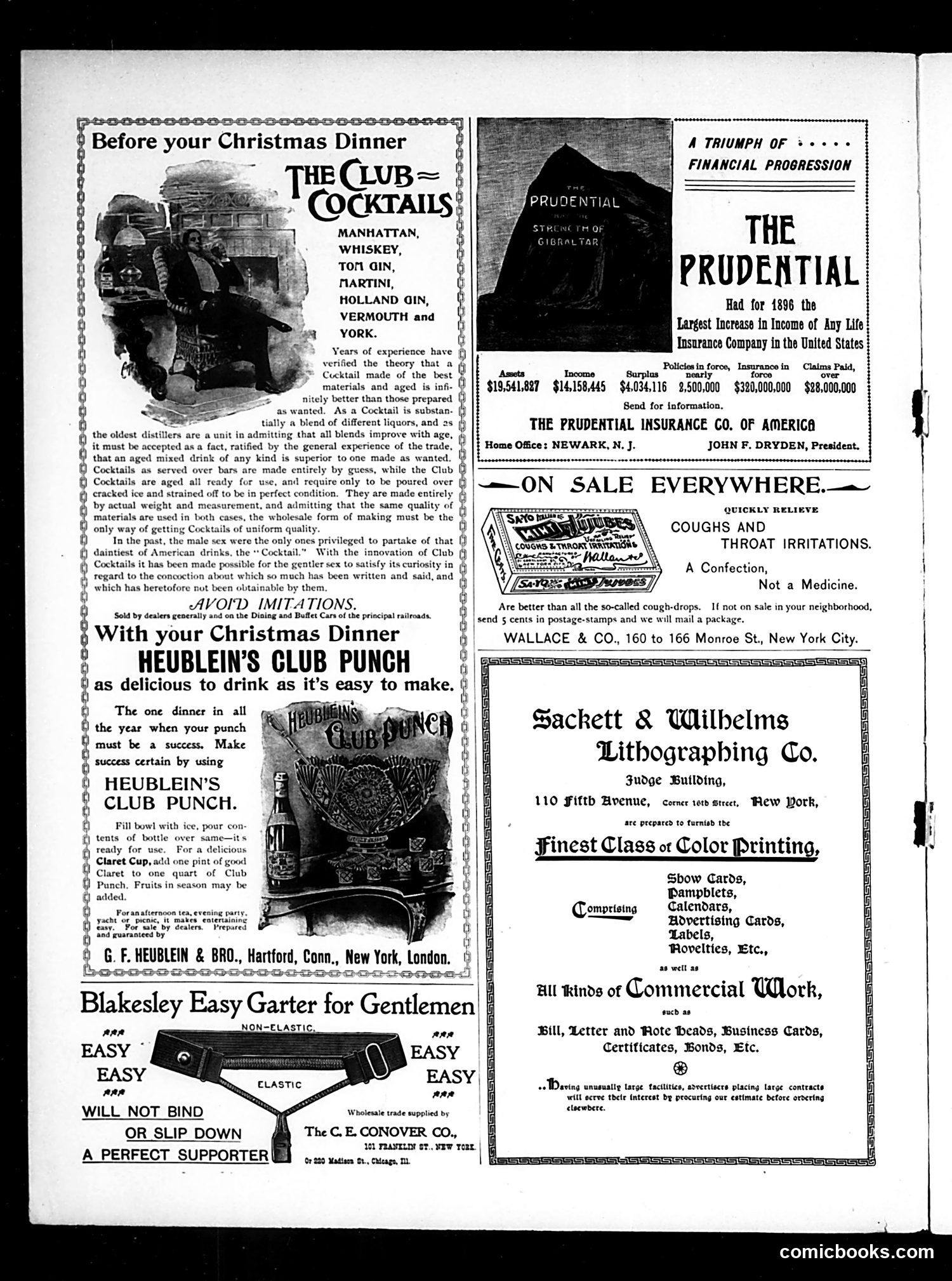
This page is primarily **advertising content** rather than satirical cartoon material. It contains five distinct advertisements from circa 1900: 1. **The Club Cocktails** - promotes pre-made cocktail mixtures 2. **The Prudential Insurance Company** - boasts of financial growth and increased insurance income 3. **Coughs and Throat Irritations remedy** - a commercial confection, explicitly "not a medicine" 4. **Sackett & Wilhelms Lithographing Co.** - offers printing services 5. **Blakesley Easy Garter** - advertises an elastic garter for gentlemen The page lacks political satire or caricature. Instead, it reflects **turn-of-century consumer culture**, with products marketed for holiday entertaining, financial security, and personal comfort. The advertisements reveal period attitudes toward alcohol, insurance, patent remedies, and masculine fashion.
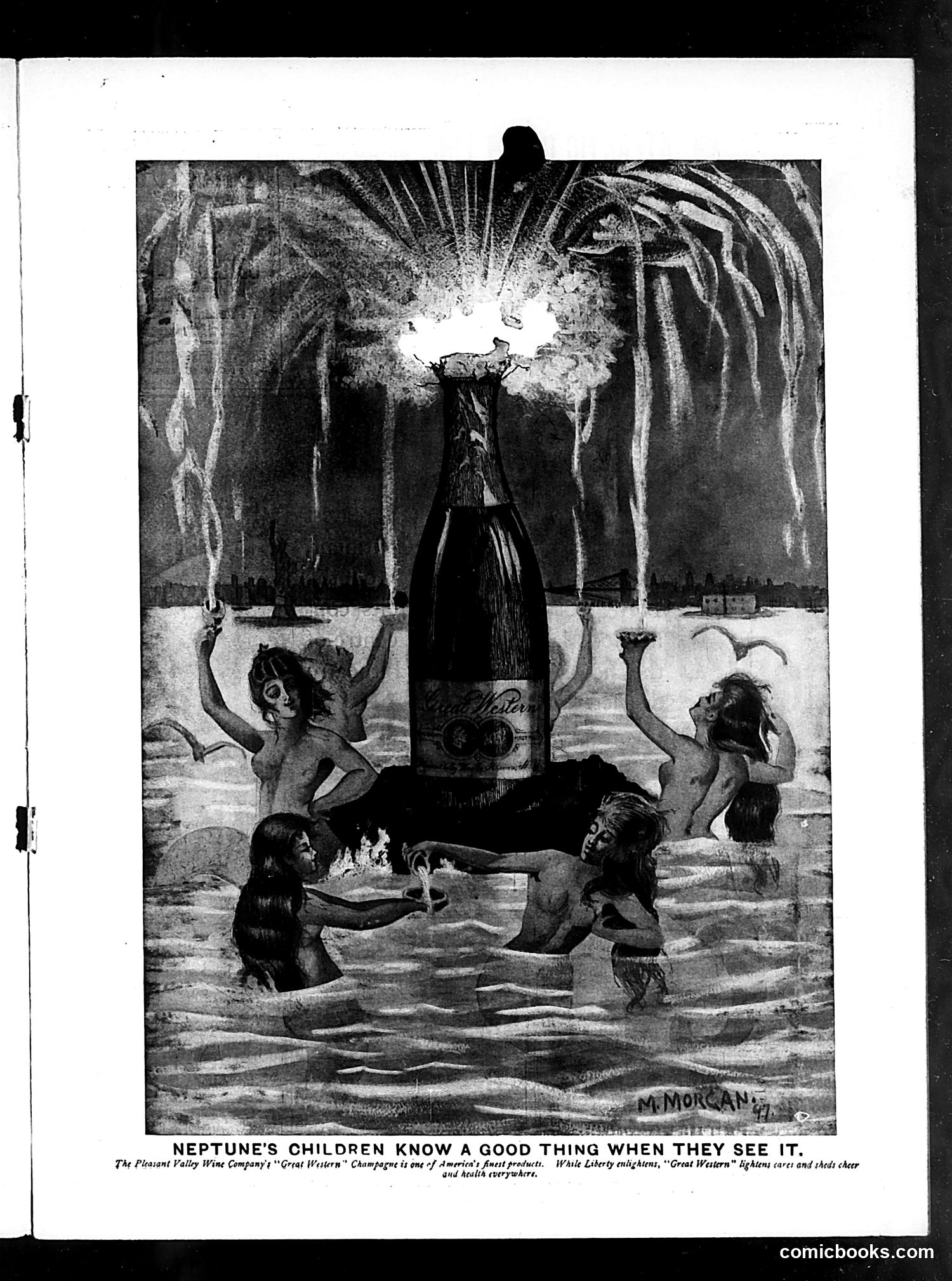
This is a **wine advertisement** disguised as satire, created by artist McMorgan for Pleasant Valley Wine Company's "Great Western" champagne brand. The image depicts cherubic figures (Neptune's children) in water surrounding a large champagne bottle, with light rays emanating from above. The caption claims "Neptune's children know a good thing when they see it," presenting the wine as universally recognized quality. The satire is minimal—essentially the joke is that even mythological sea creatures would appreciate this American champagne. This represents late 19th/early 20th-century advertising strategy: placing commercial messages within Judge's satirical format to reach affluent readers. The "Great Western" branding suggests competing with European champagne imports through nationalist appeal.
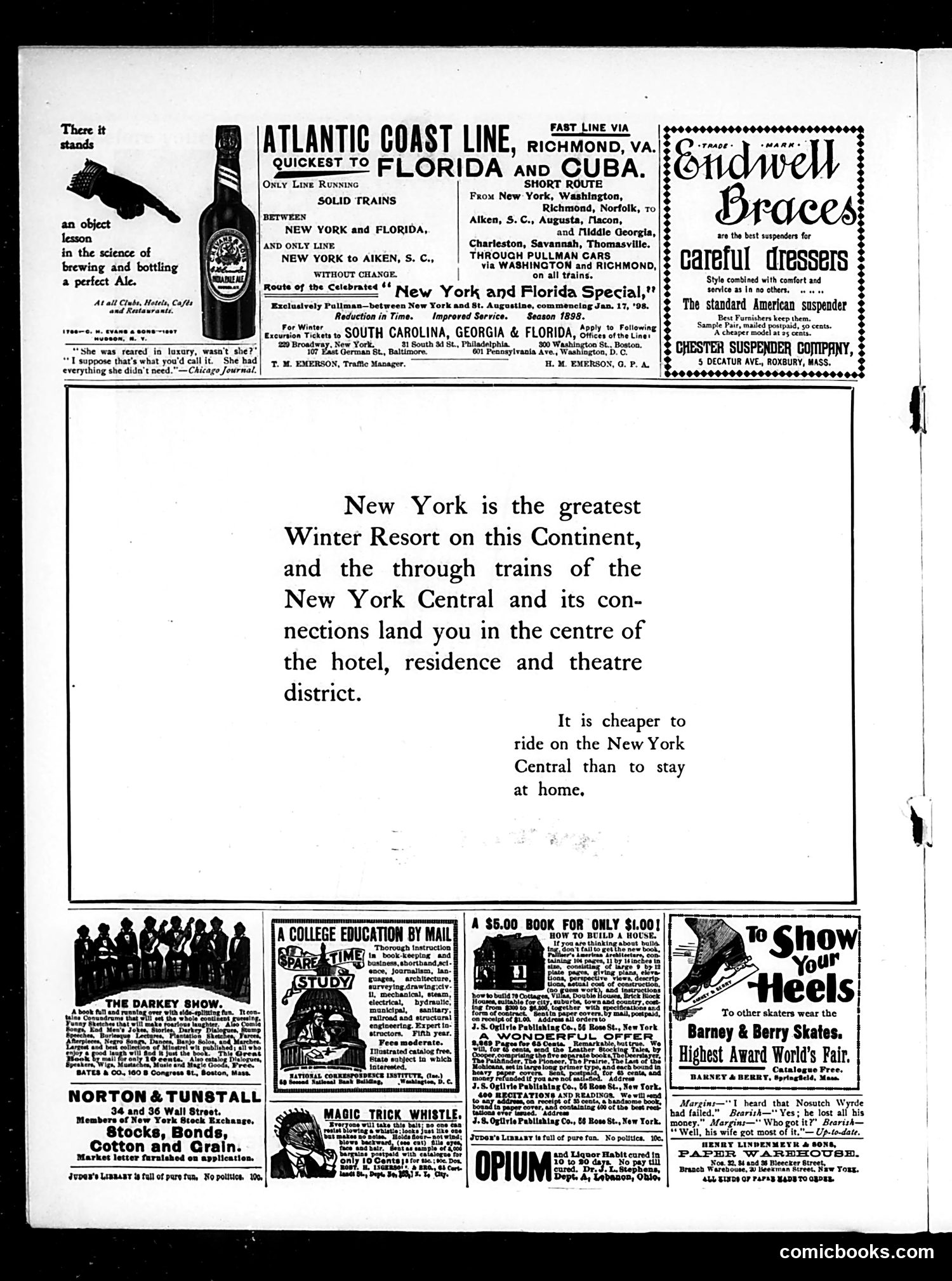
This page is predominantly **advertising** rather than editorial content or political satire. The visible material consists almost entirely of commercial advertisements from the 1890s era. The major ads include: - **Atlantic Coast Line Railway** promoting trains to Florida and Cuba - **Kendall Braces** (suspenders) - **New York Central Railroad** claiming it's cheaper to ride their trains than stay home - **Barney & Berry Skates** (World's Fair award winner) - **Norton & Tunstall** (stocks and bonds broker) - Various other period products (magic whistles, opium treatments, paper warehouse) There appears to be one small **cartoon** at bottom left labeled "The Darkey Show," but the image quality makes specific satirical content unclear. The page reflects late 19th-century American commercial culture and advertising strategies, with no identifiable political satire or notable commentary visible. It's a typical advertising-heavy issue page from Judge magazine's run.
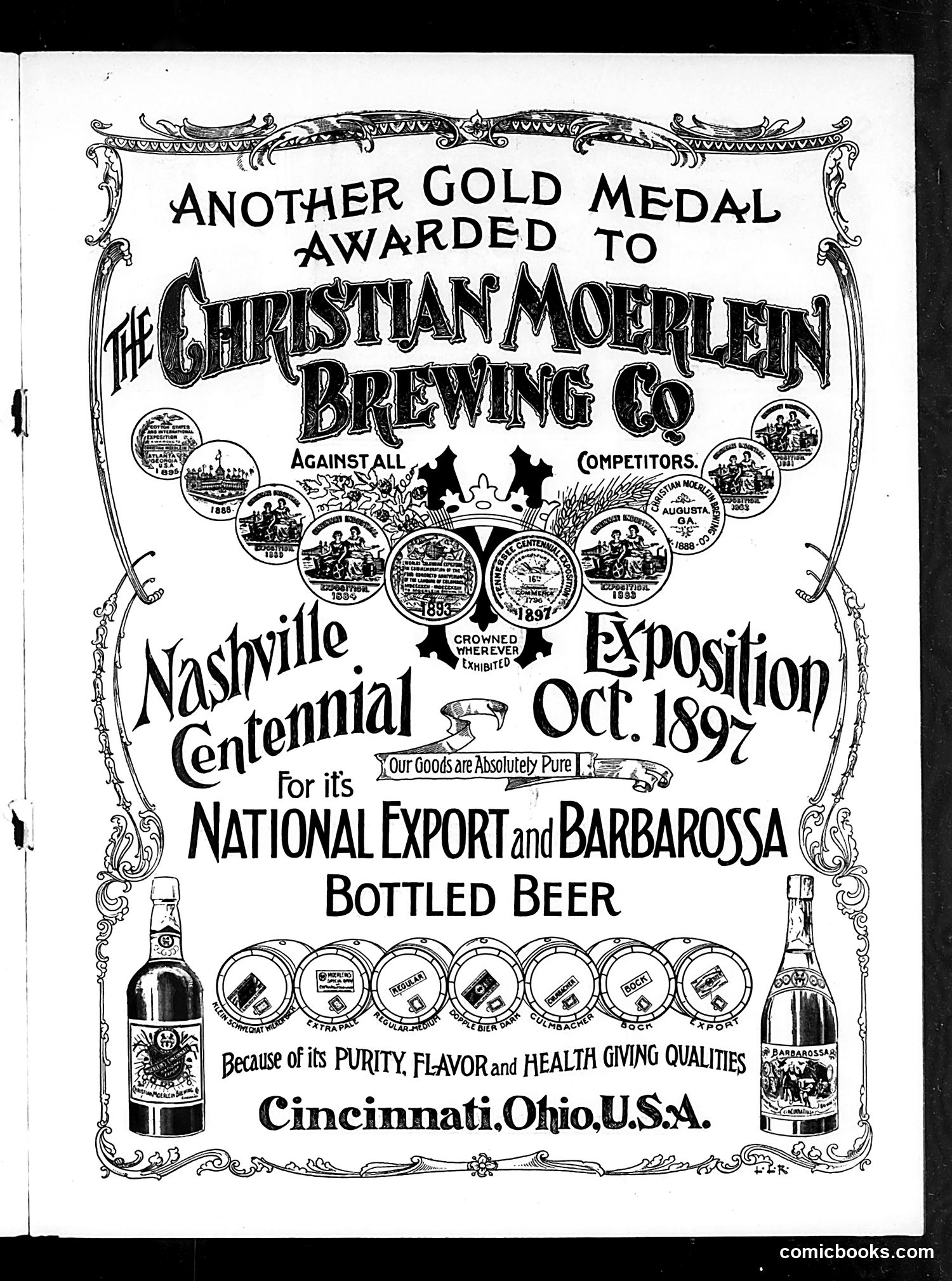
This page is **primarily an advertisement**, not political satire. It promotes the Christian Moerlein Brewing Company of Cincinnati, Ohio, celebrating a gold medal award won at the Nashville Centennial Exposition in October 1897. The ad emphasizes the brewery's competitive success ("Against All Competitors") and displays multiple medal medallions representing various awards. It advertises two beer products: "National Export" and "Barbarossa Bottled Beer," highlighting their "purity, flavor and health-giving qualities"—standard marketing language for the era when brewers made medicinal claims about beer. The decorative border and ornate typography are typical of 1890s advertising design. There is no satirical content; this is straightforward commercial promotion leveraging an international exposition award to boost sales credibility.
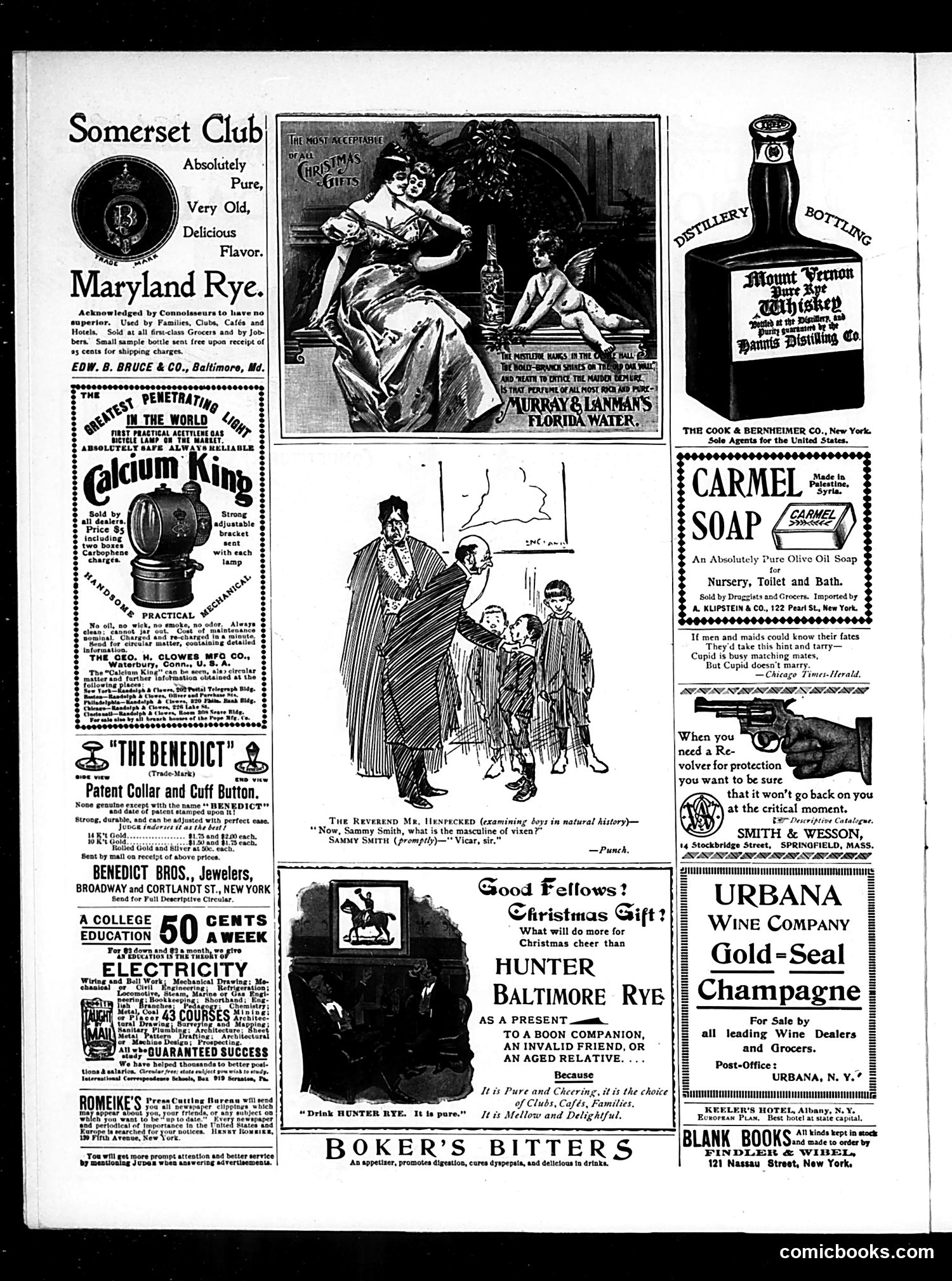
This page is primarily **advertising**, typical of Judge's revenue model. The single cartoon appears in the upper-middle section, captioned "The Reverend Mr. Henpecked (examining boys in natural history)." **The Cartoon's Joke:** A schoolmaster asks young Sammy Smith the masculine form of "vixen" (a female fox). The boy answers "Vicar, sir"—a pun conflating the animal term with a clergyman. The humor relies on the teacher's apparent henpecked nature (his name) making him seem emasculated, so the boy's answer cleverly insults him by suggesting only clergy, not laymen, represent masculinity. **Context for Modern Readers:** This plays on Victorian assumptions about male authority and respectability. The joke's sting depends on understanding "vicar" as both a religious position and an implicit social commentary on weakened masculinity—a common theme in period satire mocking hen-pecked husbands. The surrounding advertisements (whiskey, soap, firearms, champagne) reflect Gilded Age consumer culture targeting affluent male readers.
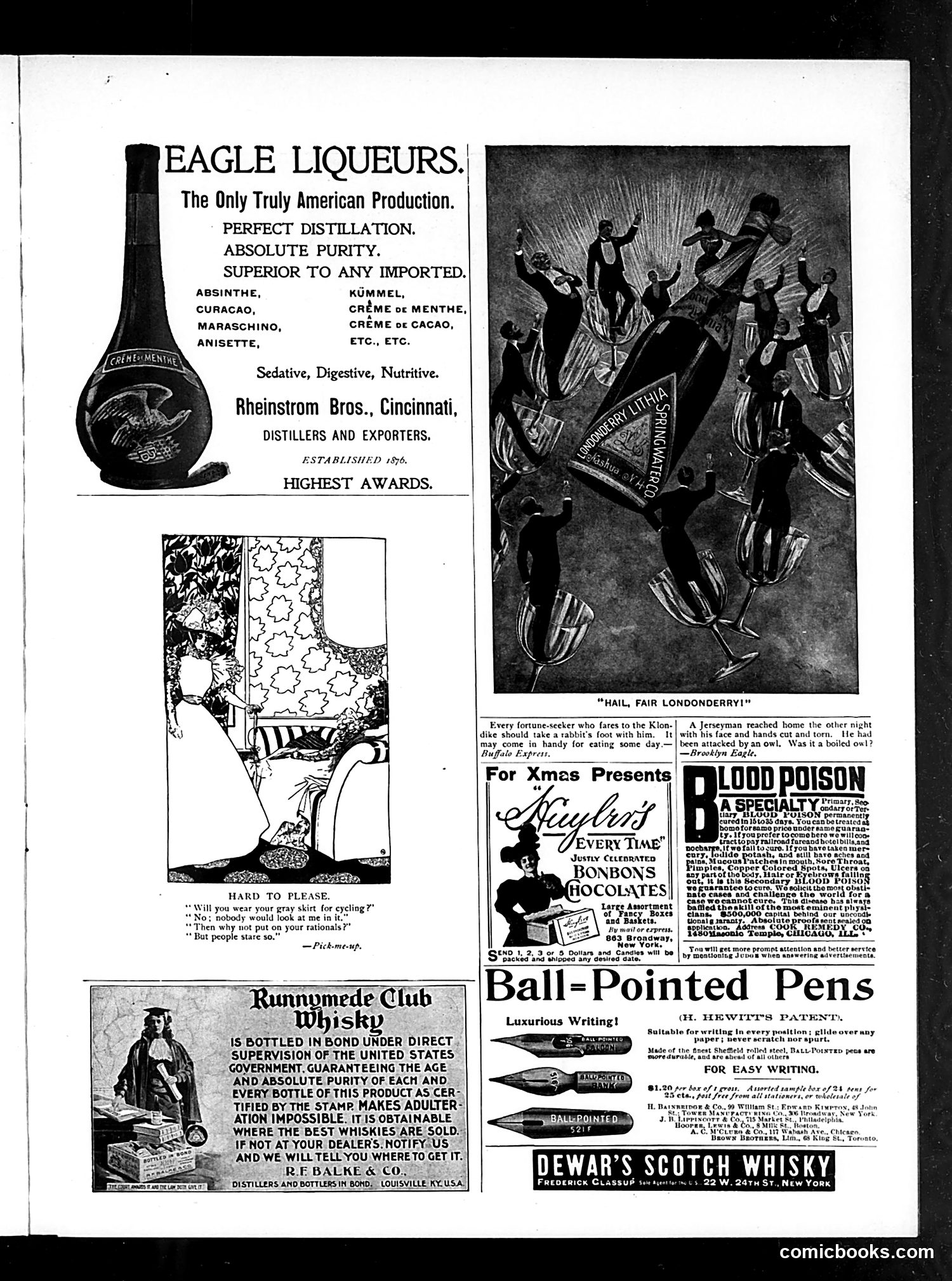
This page is primarily **advertising** with minimal satirical content. The main cartoon is "Hard to Please," a small joke about Victorian women's fashion. A woman refuses to wear a gray cycling skirt because "nobody would look at me in it," then rejects "rationals" (loose pants worn for cycling) because "people stare so"—mocking women caught between fashion propriety and practical comfort for the new activity of cycling. The page otherwise consists of liquor and product advertisements typical of Judge magazine's era: Eagle Liqueurs, Runnomede Club Whisky, Dewar's Scotch Whisky, ball-pointed pens, Skylarks chocolates, and a "Blood Poison" medical treatment ad. One small humorous item mocks fortune-seekers heading to the Klondike Gold Rush, suggesting they bring rabbit's feet—"for eating some day." The overall content reflects early 1900s consumer culture and genteel social anxieties rather than political satire.
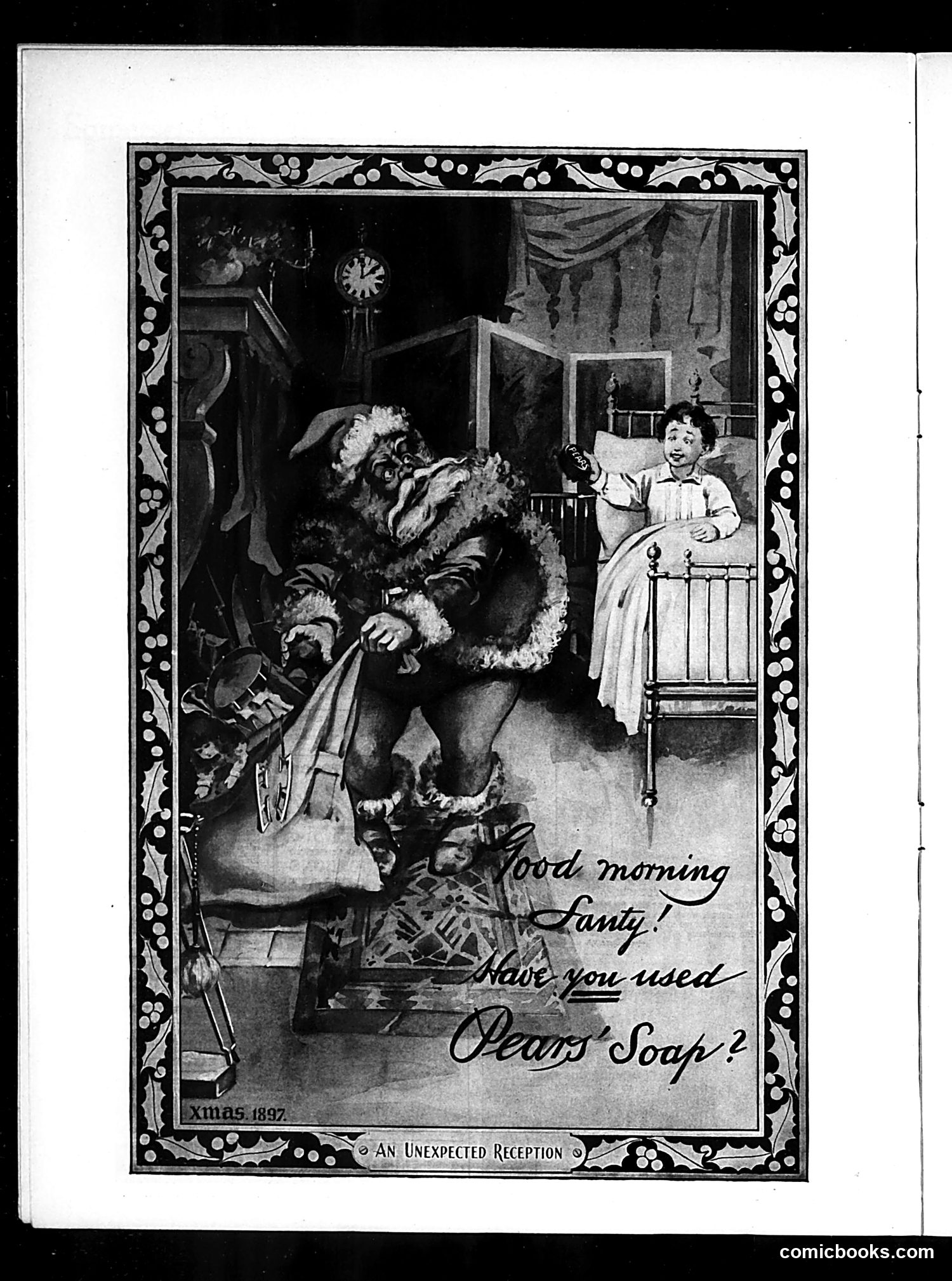
This is a commercial advertisement for Pears' Soap disguised as satirical content. The image depicts Santa Claus arriving at a child's bedroom on Christmas Eve, but the child appears startled or frightened rather than delighted—hence "An Unexpected Reception." The joke plays on the contrast between Santa's traditionally jolly appearance and the child's genuine alarm at encountering him. The text's query—"Have you used Pears Soap?"—suggests the advertisement's satirical premise: perhaps Santa looks so disheveled from his journey that he appears unrecognizable or threatening, implying that Pears' Soap could improve one's appearance. This reflects late-Victorian advertising tactics using humor to sell consumer products.
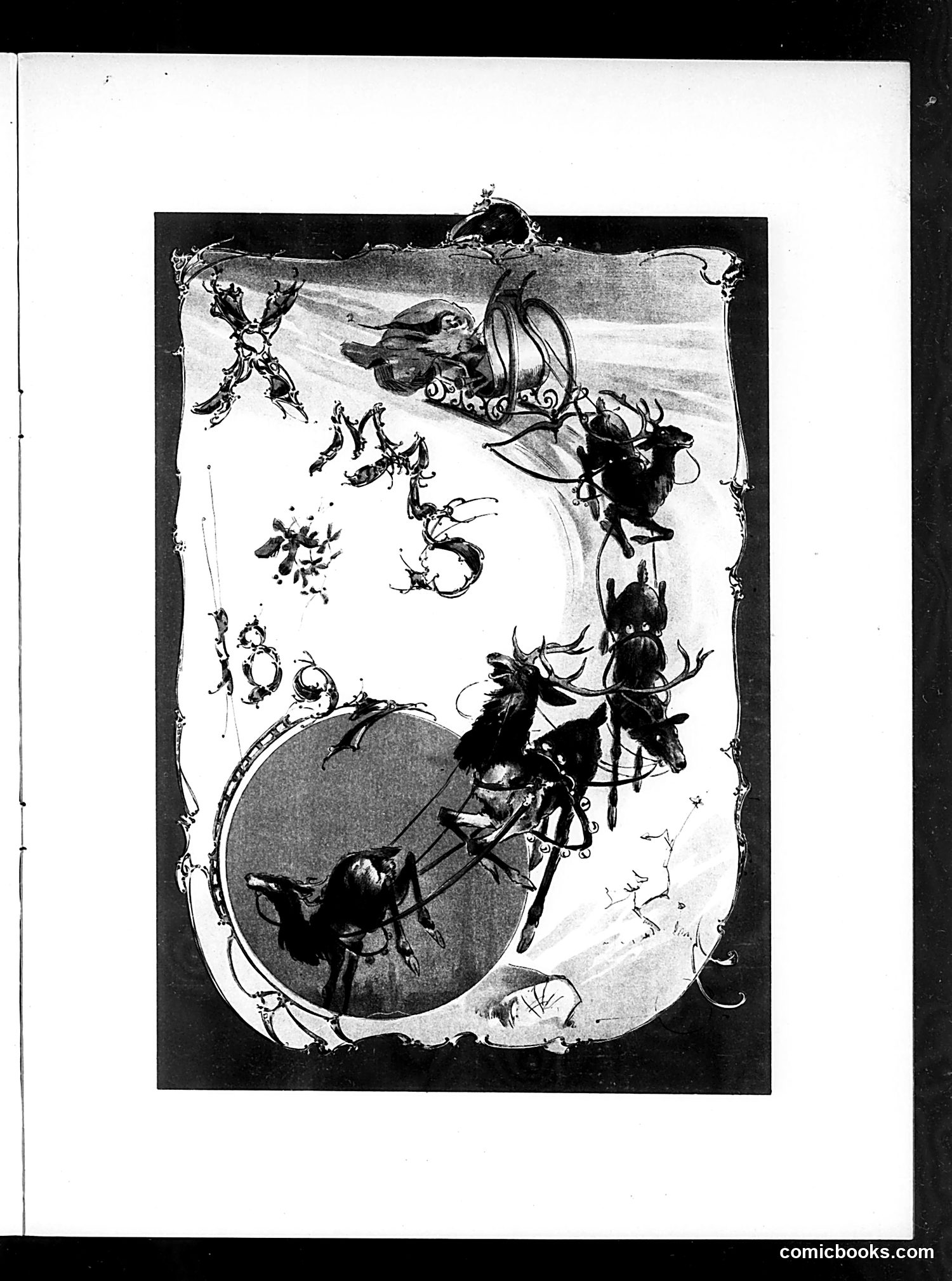
I can see this is a satirical illustration from Judge magazine featuring insects or bugs in various scenes. The image shows what appears to be insects engaged in different activities - some appear to be fighting or in conflict, others are shown with vehicles or mechanical devices, and there's a large circular element (possibly representing the moon or a wheel) with insects gathered around it. However, without legible text on the page itself identifying the specific political figures, events, or social commentary being referenced, I cannot confidently explain what particular satire is intended. The decorative border and composition suggest this is a full-page satirical cartoon, but the specific references remain unclear from the image alone. The OCR text provided only shows a website attribution and no actual article content.
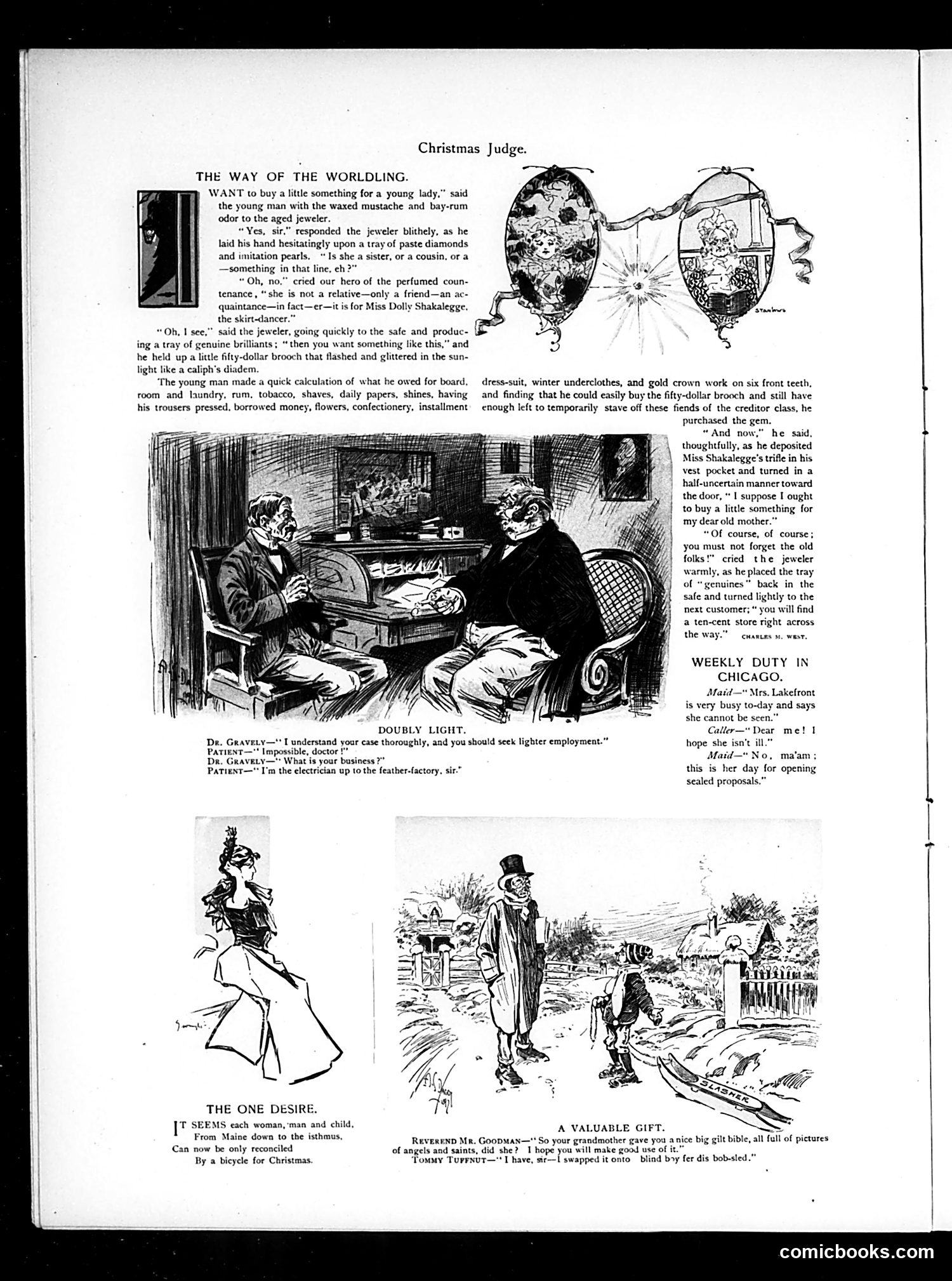
This page contains several satirical pieces mocking upper-class courtship and materialism: **"The Way of the Worldling"** depicts a young man buying expensive jewelry for "Miss Dolly Shakalegge," a skirt-dancer (performer). The jeweler's key reaction—switching from fake diamonds to genuine ones upon learning the gift is for a dancer rather than a relative—satirizes how society judges women's moral worth and adjusts its standards accordingly. The young man, despite owing money for clothing, teeth work, and basic expenses, purchases the brooch anyway, then contemplates buying his mother a gift—mocking misplaced priorities and superficial values. **"Weekly Duty in Chicago"** jokes about a wealthy society woman ("Mrs. Lakefront") being unavailable because it's her day for "opening sealed proposals"—a veiled reference to accepting bribes or corrupt dealings. **"The One Desire"** is verse about bicycles as universal Christmas gifts. **"A Valuable Gift"** depicts a boy swapping a religious gift bible for a bobsled—criticizing youth's materialism over spirituality. The overall theme: modern materialism and shallow social values replacing traditional morality.
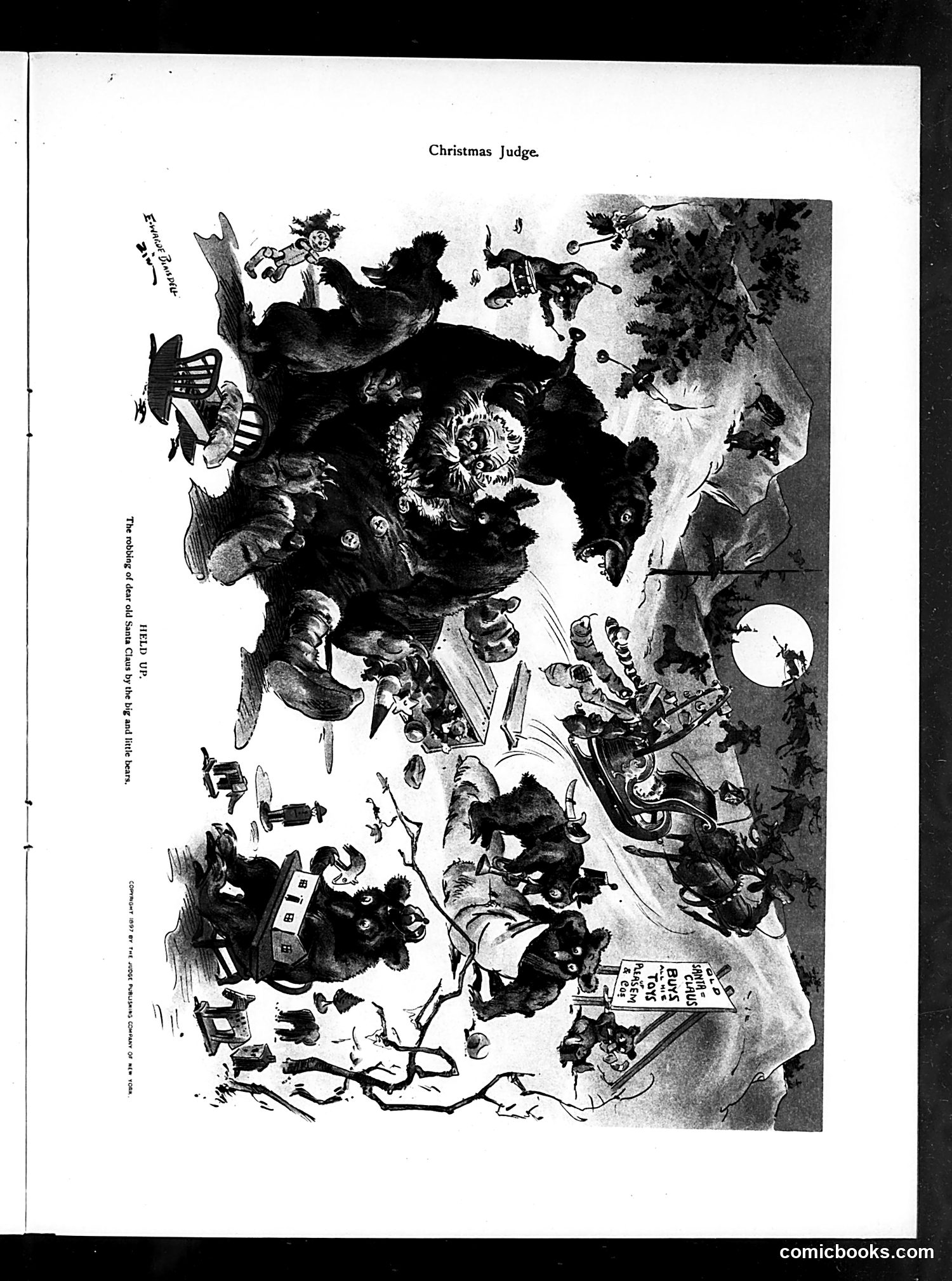
This is a satirical illustration titled "The robbing of dear old Santa Claus by the big and little bears." The cartoon uses bears as political metaphors—likely representing Russia (the "big bear") and smaller nations or financial entities (the "little bears")—attacking Santa Claus, who symbolizes American Christmas prosperity and generosity. The scene depicts chaotic violence with Santa being robbed and assaulted, suggesting anxieties about foreign threats to American wealth and holiday abundance during the early 20th century. The satire critiques both large imperial powers and smaller predatory actors who threaten American economic security and seasonal prosperity. Without a specific date visible, the exact historical context remains unclear, but the imagery reflects common period fears about international theft and destabilization.
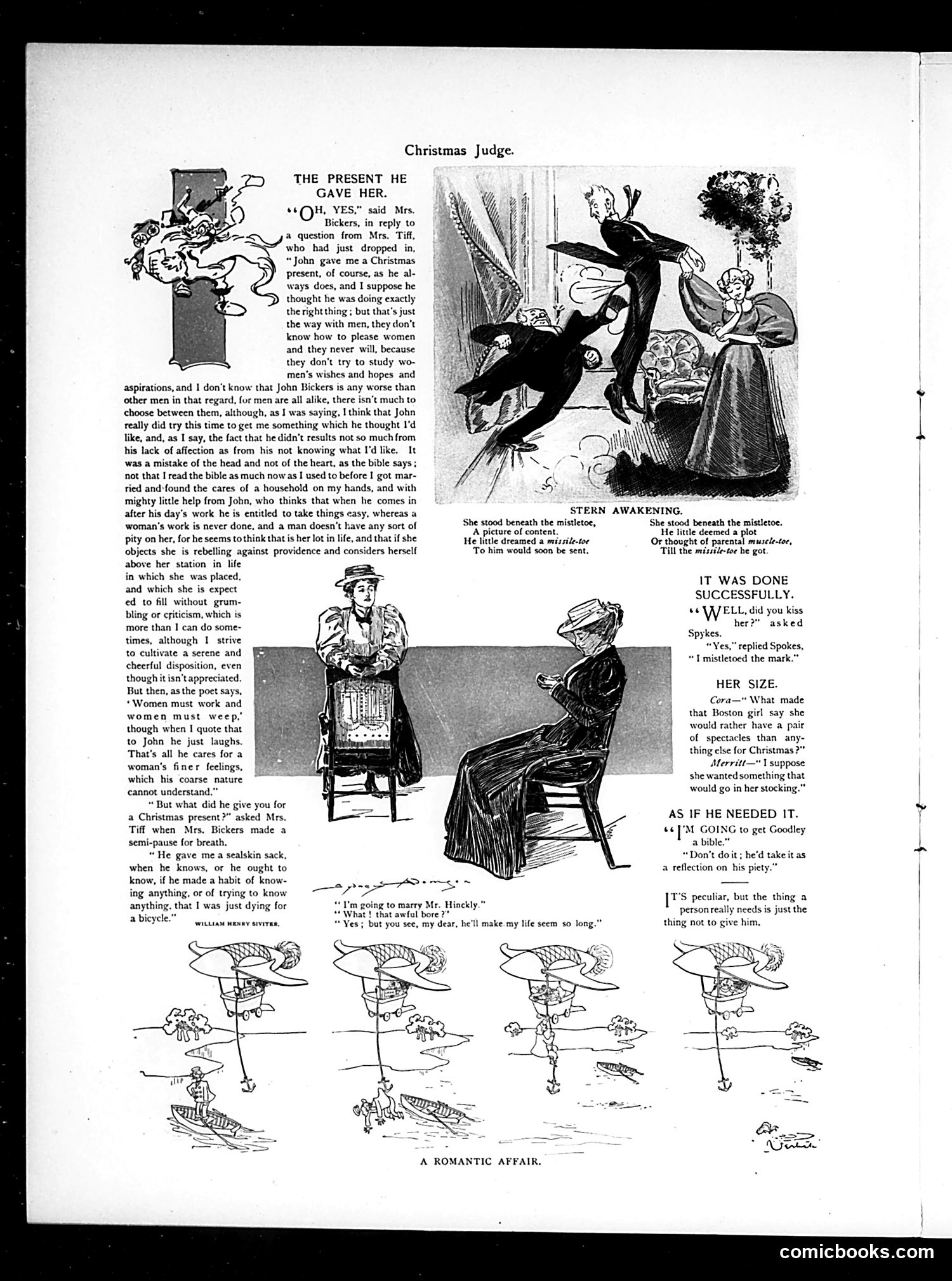
This page from *Judge* magazine contains several Christmas-themed satirical pieces: **Main Story: "The Present He Gave Her"** depicts Mrs. Bickers's complaint that her husband John gave her a sealskin jacket when she wanted a bicycle. The satire targets both husbands (who don't understand women's desires) and wives (whose endless complaints reveal their discontent). Mrs. Bickers's lengthy, circular grievance—mixing domestic frustrations with philosophical musings—parodies women's perceived tendency toward nagging while implying men lack consideration. **Smaller Cartoons** play on mistletoe traditions: - "Stern Awakening" shows a woman under mistletoe receiving a punch ("missile-toe") instead of a kiss - Other sketches joke about Christmas gift-giving's absurdities The overall message: Neither sex understands the other, making domestic satisfaction impossible. The humor relies on period gender stereotypes and domestic friction as comedy.
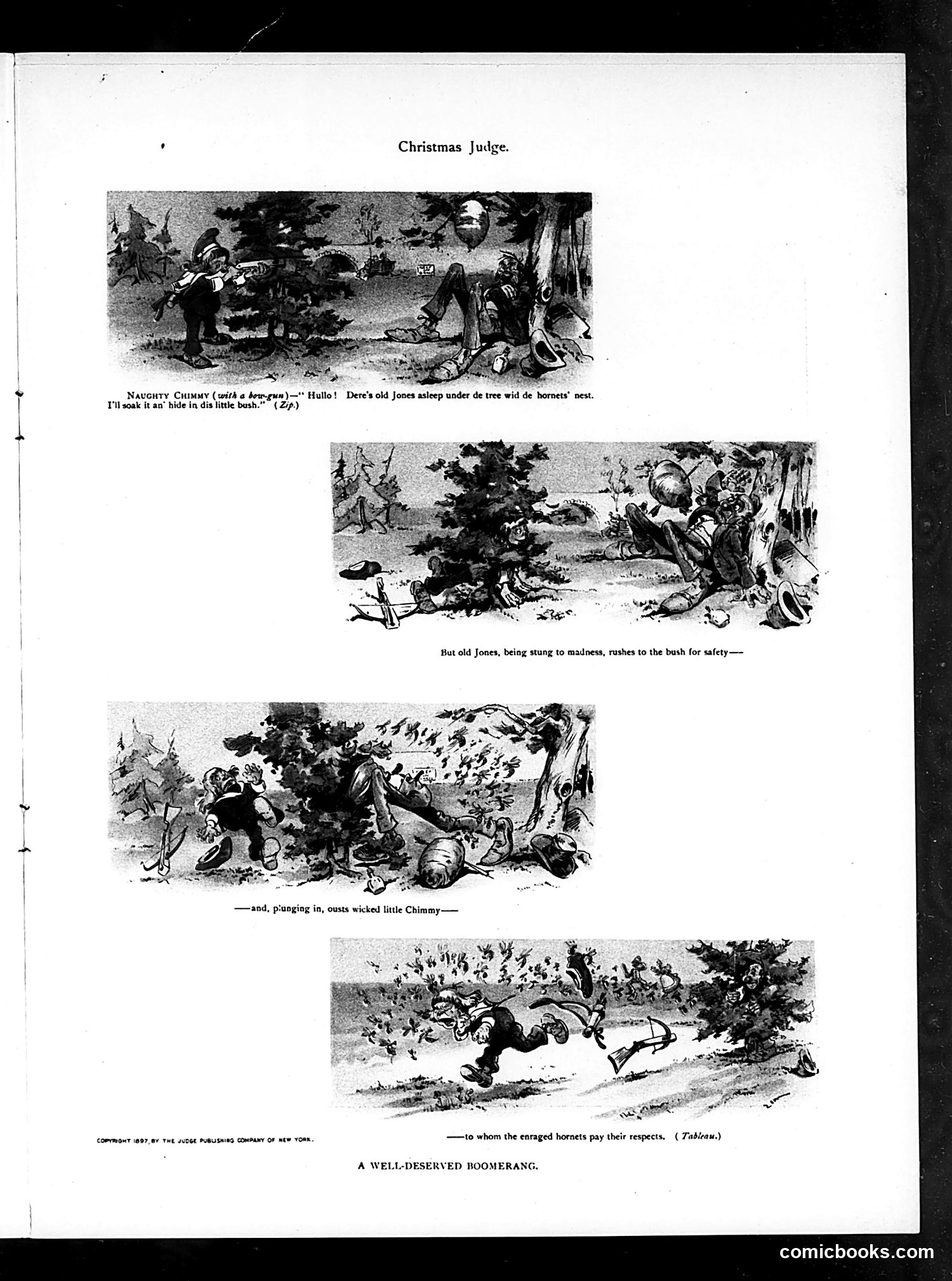
This is a four-panel comic strip titled "A Well-Deserved Boomerang" depicting a Christmas prank gone wrong. **The Setup:** A character identified as "Naughty Chimmy" (a child with an exaggerated accent, "wid de hornets' nest") discovers an older man named Jones sleeping beneath a tree and decides to soak a hornet's nest with water and hide it nearby—a cruel practical joke. **The Payoff:** The subsequent panels show the consequences: Jones flees the bush in panic, and the enraged hornets attack Chimmy instead, who runs away being chased. **The Satire:** The title "A Well-Deserved Boomerang" references the boomerang metaphor—the prank literally comes back to harm the prankster. This appears to be a morality tale typical of 1907 children's humor in *Judge* magazine: cruel tricks backfire on those who attempt them. The crude dialect suggests the character is meant as working-class or immigrant.
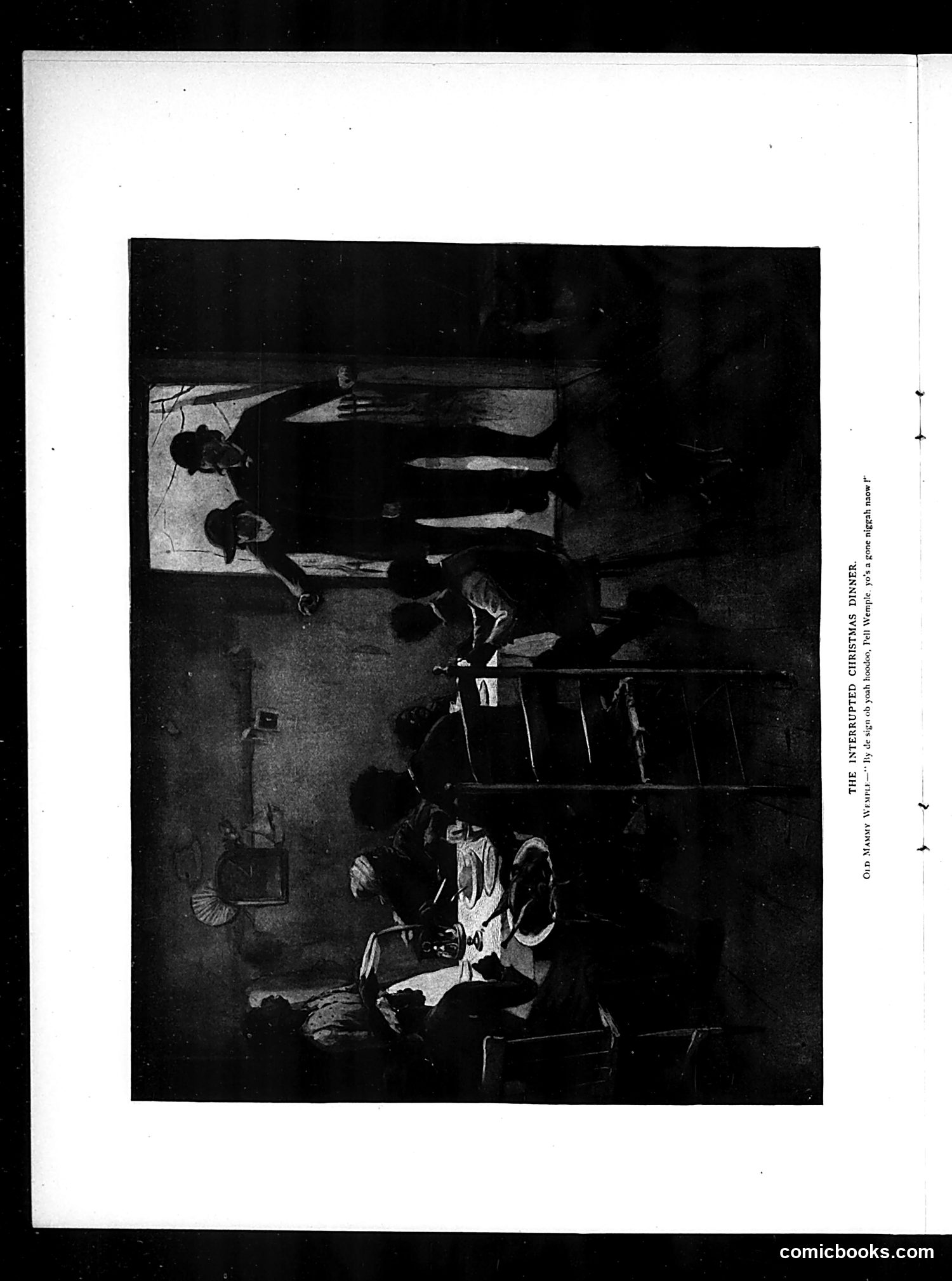
I can see this is a black and white photograph or illustration titled "THE INTERRUPTED CHRISTMAS DINNER" (visible on the right margin). The image appears to show an indoor domestic scene, rotated 90 degrees, depicting what seems to be a family dinner interrupted by some event or intrusion. However, the OCR text is largely illegible/corrupted, making it impossible to identify the specific satirical point, historical figures involved, or political context. Without clear readable text explaining the cartoon's message or date, I cannot reliably explain what social or political commentary Judge magazine intended here. To properly analyze this cartoon's meaning, a clearer version of the accompanying text or caption would be needed.
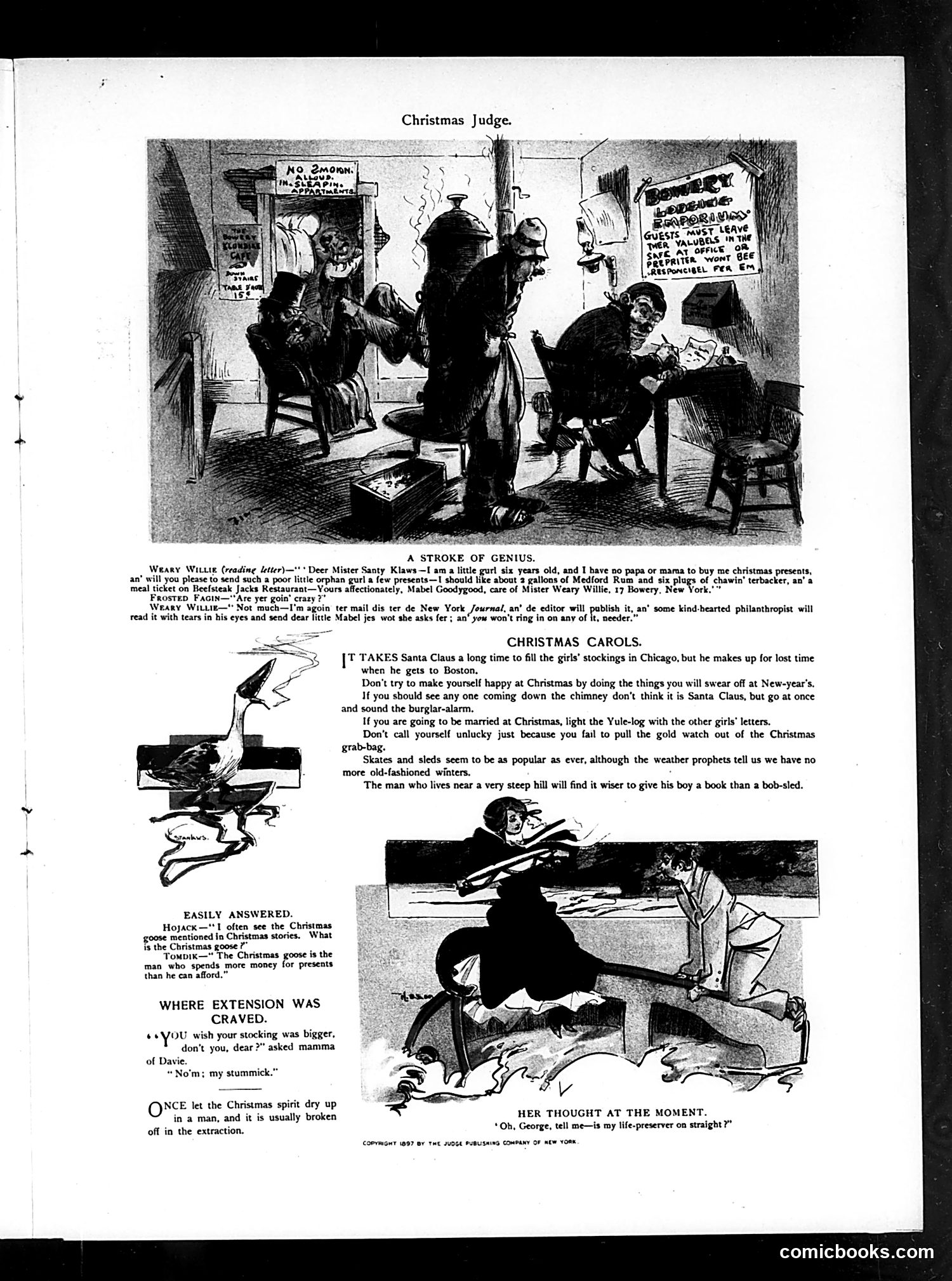
This Judge magazine page uses Christmas as a framework for satirizing urban poverty and hypocrisy. The main cartoon depicts "Weary Willie" (a stock character representing the homeless poor) reading a letter from a supposed orphan girl requesting alcohol and food—clearly a con to manipulate charitable donors. Willie plans to mail it to the *New York Journal*, banking on sentimental readers to send money that he'll pocket rather than give the child. The satire targets both the gullible wealthy who donate based on emotional appeals and the con artists exploiting their charity. References to "Medford Rum" and specific Bowery addresses ground this in Gilded Age New York poverty. Supporting items mock Christmas excess ("Christmas goose" = spendthrift), children's materialistic wishes, and holiday clichés. The page suggests Christmas charity is easily manipulated—a sharp critique of progressive-era sentimentality about the poor.
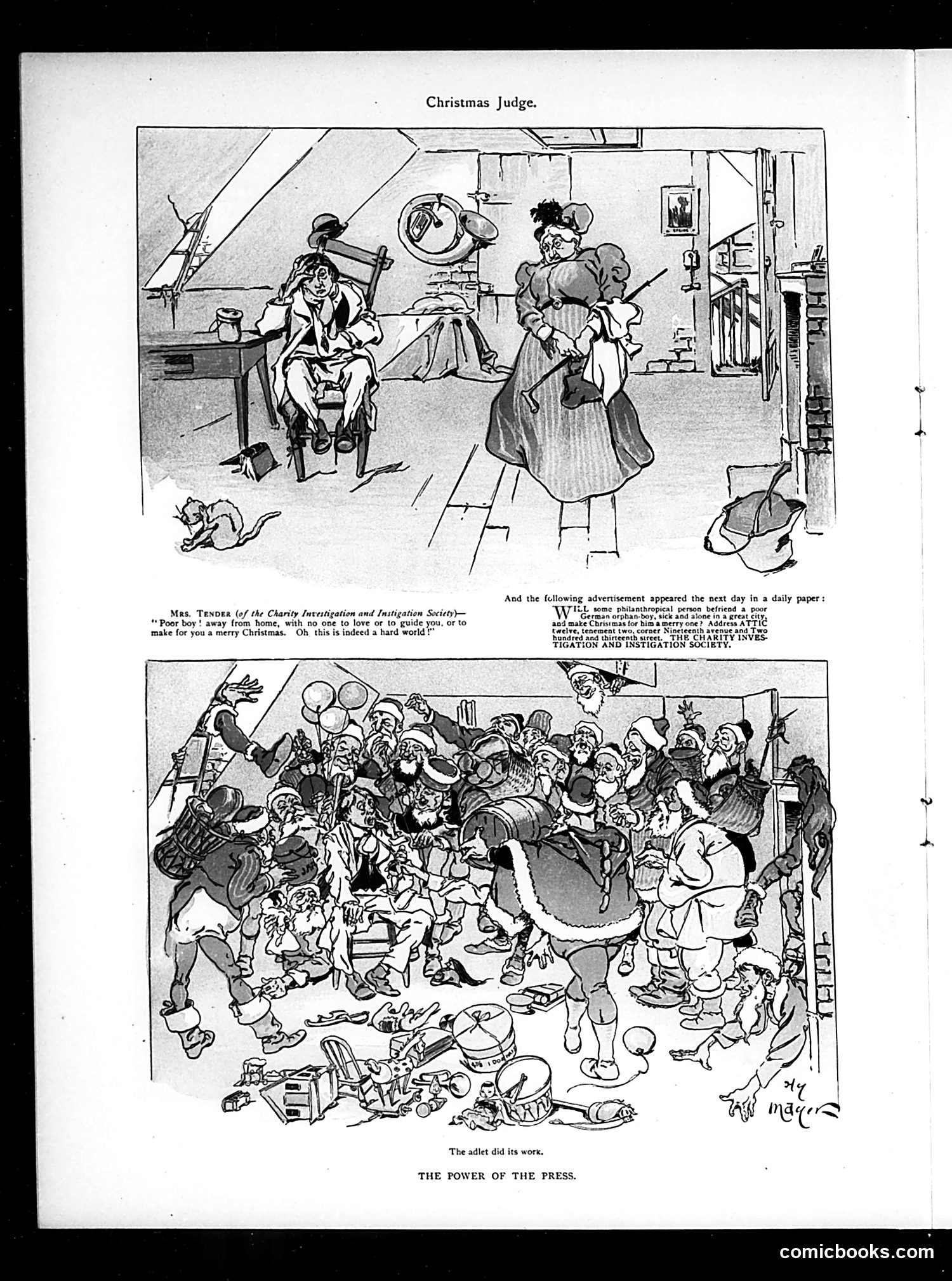
This two-panel Judge cartoon illustrates press influence on charitable outcomes. The **top panel** depicts a charity worker attempting to help a destitute boy, with limited resources and public attention. The **bottom panel** shows the same situation transformed—now a massive crowd has gathered with abundant donations and supplies, labeled "The adlet did its work." The satire criticizes and praises simultaneously: it mocks the charity organization's initial ineffectiveness while celebrating how **newspaper publicity** ("the power of the press") mobilized public compassion and resources. The advertisement between panels, requesting donations for poor children, ironically demonstrates this principle in action—the cartoon itself serves as advocacy material. The underlying message: media attention drives charitable giving more effectively than direct appeals alone.
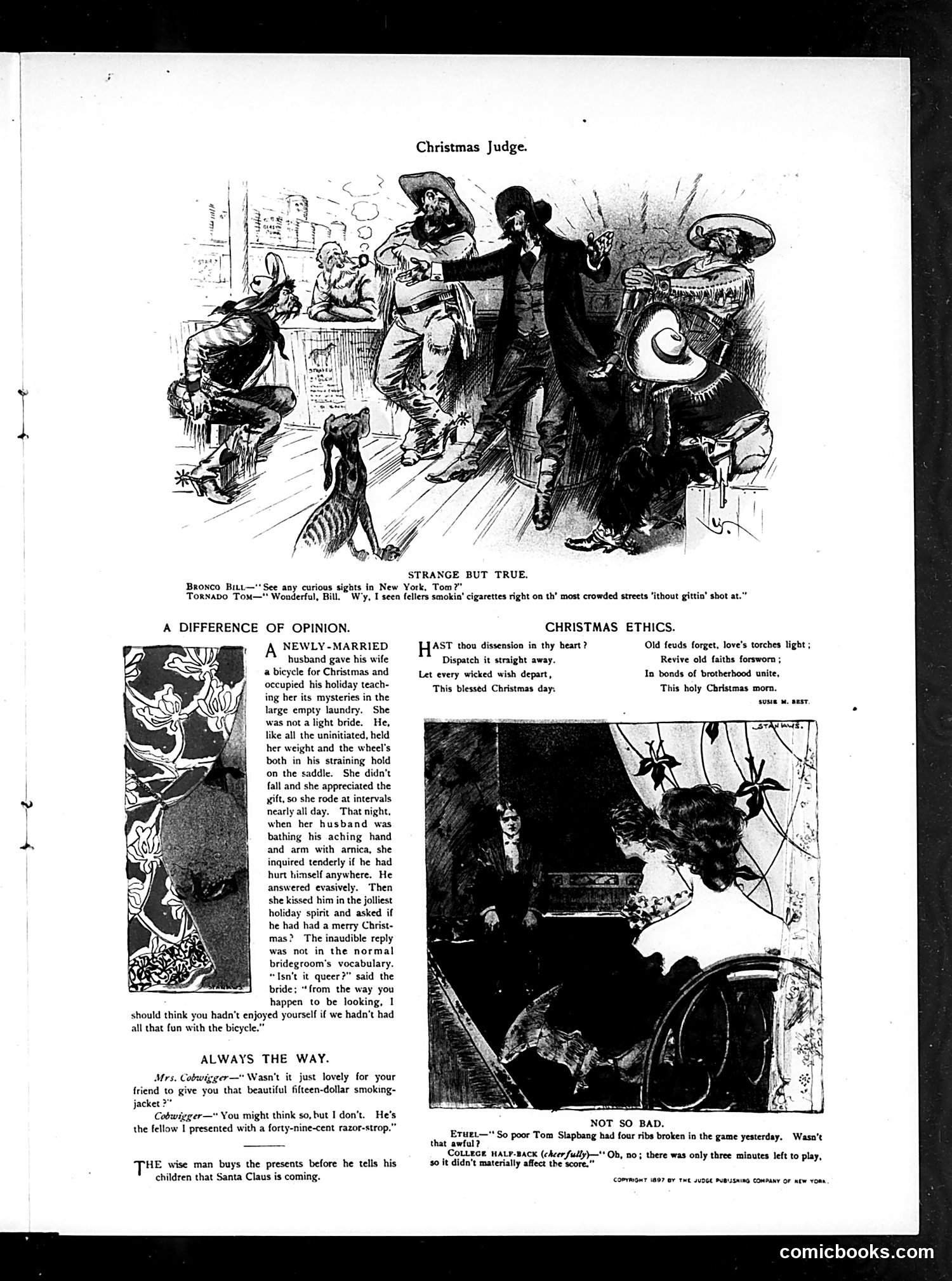
This page from Judge magazine contains multiple holiday-themed satirical items: **"Strange But True"** mocks the era's newfound public smoking, with a frontier character amazed that city dwellers smoke cigarettes openly on crowded streets without being shot at—a joke about changing social norms. **"A Difference of Opinion"** satirizes newlywed dynamics: a husband strains teaching his heavy bride to ride a bicycle (a new craze), then claims soreness. The wife's obliviousness to his suffering while praising the gift mocks both spousal communication and women's enthusiastic adoption of bicycles. **"Always the Way"** jokes about gift-giving hypocrisy: a man complains his friend gave him an expensive smoking jacket, when he'd only given that friend a cheap razor-strop. **"Christmas Ethics"** offers sentimental verse about holiday forgiveness. **"Not So Bad"** contains dark humor about college football: a player's four broken ribs are dismissed because he only missed the final three minutes of the game—satirizing the era's brutal, dangerous sport. The overall tone reflects late-19th/early-20th-century American middle-class anxieties about technology, marriage, and athletics.
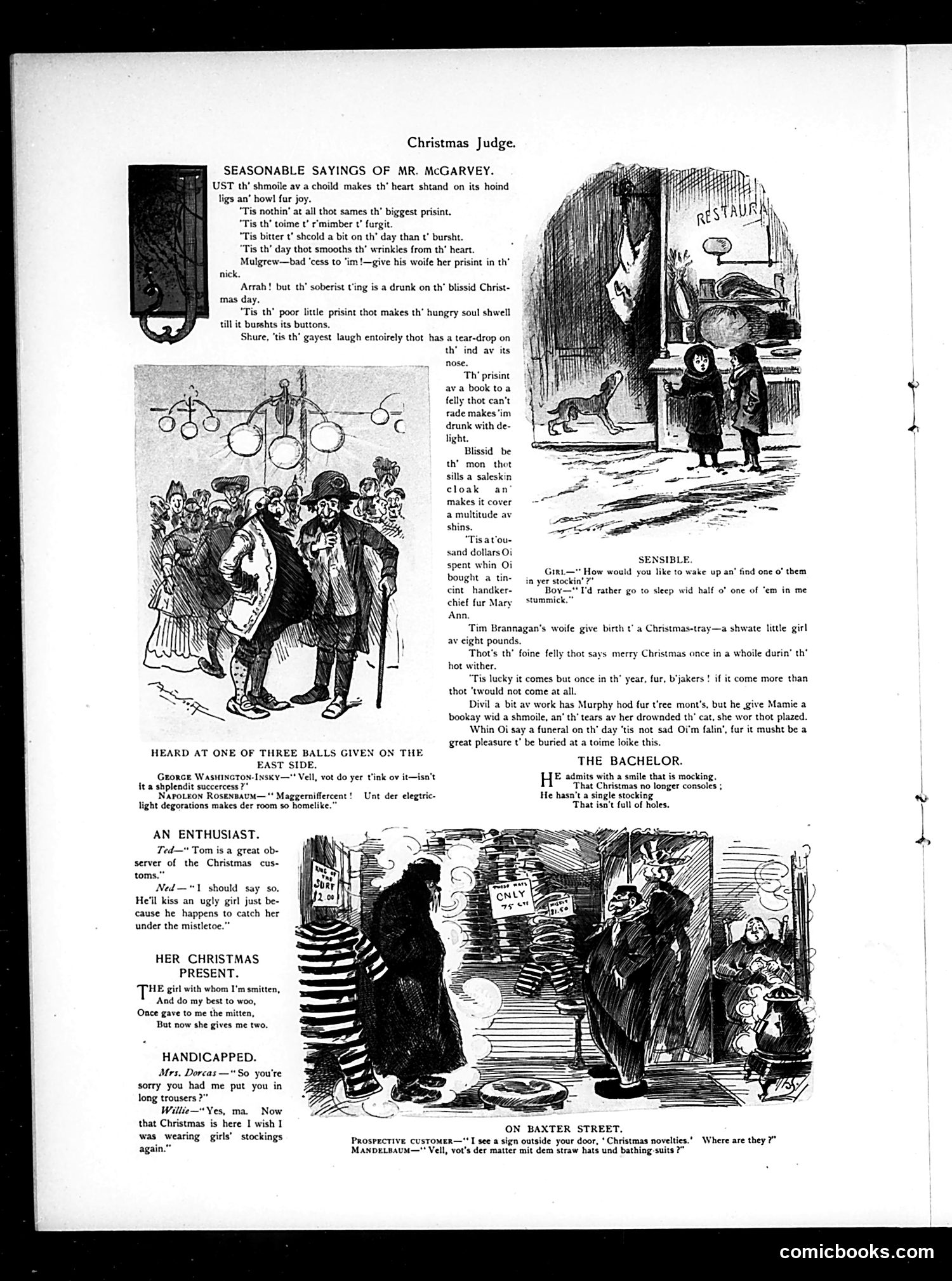
This page from Judge magazine contains Irish-American dialect humor and holiday social satire typical of late 19th/early 20th-century American comedy. **"Seasonable Sayings of Mr. McGarvey"** presents an Irish immigrant character (indicated by phonetic dialect spelling: "th'" for "the," "shmoile" for "smile") offering sentimental and cynical Christmas observations. The humor relies on ethnic stereotyping—portraying Irish-Americans as sentimental drunks and the working poor. **Other sketches mock:** - **"An Enthusiast"**: A man kissing an ugly girl under mistletoe—absurd Christmas tradition humor - **"Her Christmas Present"**: Gender role reversal joke (she previously rejected him, now gives him "two" of something) - **"Handicapped"**: A boy preferring girls' stockings to long trousers—implying they're fuller/warmer - **Lower East Side ball scene**: Jewish immigrants with Anglicized names discussing elaborate decorations - **"On Baxter Street"**: A Jewish shopkeeper trying to sell winter items as "Christmas novelties"—ethnic humor about immigrants' commercial opportunism The satire targets immigrant communities, urban poverty, and working-class Christmas desperation.
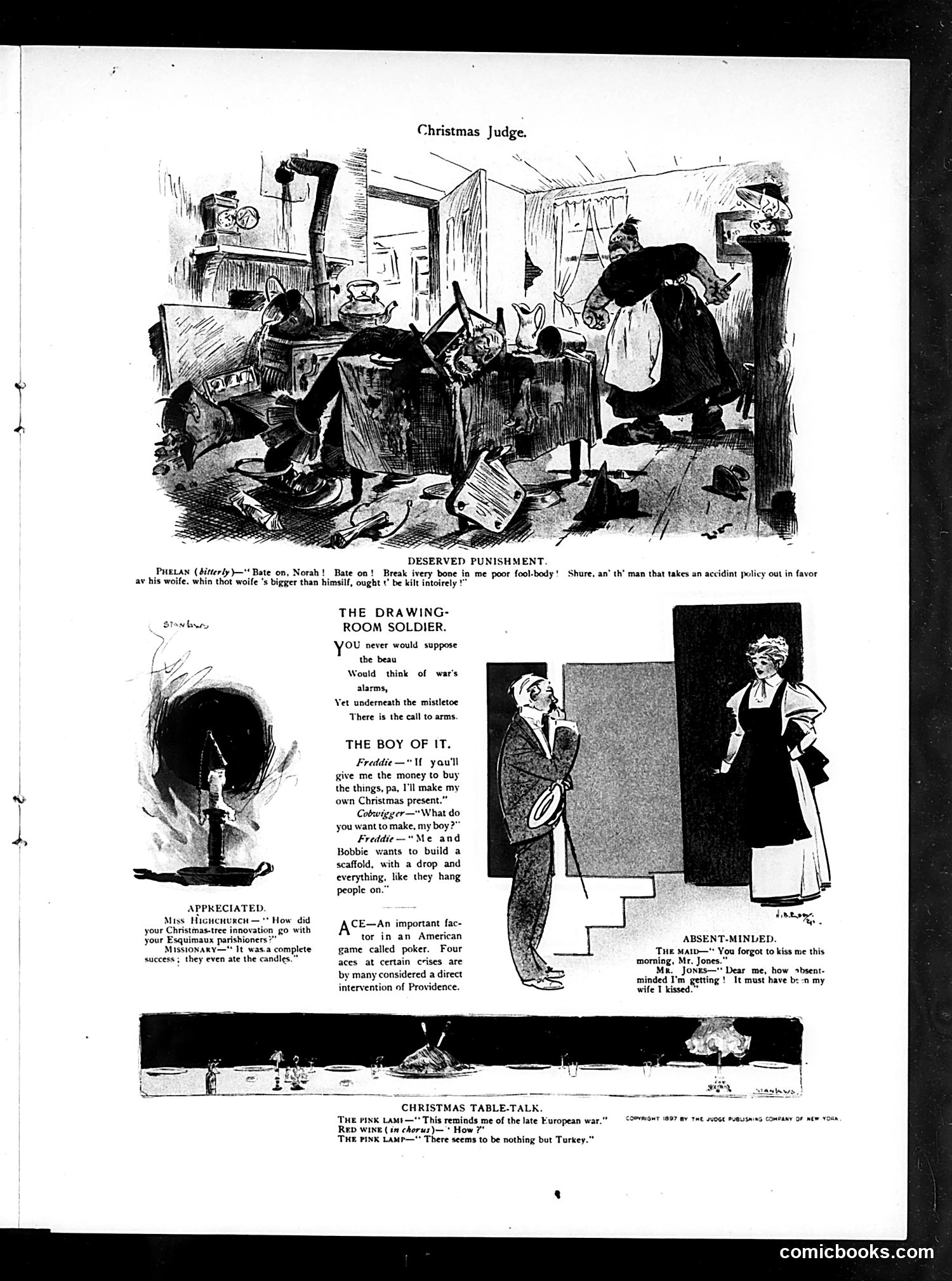
This page contains multiple short satirical pieces typical of Judge's humor: **"Deserved Punishment"** depicts domestic violence played for laughs—an Irish couple where the wife beats her husband, justified because he took out life insurance in her favor (implying she'd benefit from his death). The satire targets both spousal abuse normalization and insurance fraud. **"The Drawing-Room Soldier"** is a short poem about a fashionable gentleman who appears refined but harbors military ambitions, playing on the contrast between peacetime pretense and martial impulses. **"The Boy of It"** jokes about a child wanting money to build a gallows "like they hang people on"—dark humor about childhood morbidness. **"Absent-Minded"** is a marital joke: Mr. Jones forgot to kiss his maid this morning and absentmindedly kissed his wife instead, implying infidelity. **"Christmas Table-Talk"** offers holiday dinner conversation where wine drinkers find the meal reminds them of "the late European war" because "there seems to be nothing but Turkey"—a play on carving turkey and political references to Ottoman/Turkish conflicts. The humor reflects Victorian-era sensibilities about domestic life, class, and propriety.
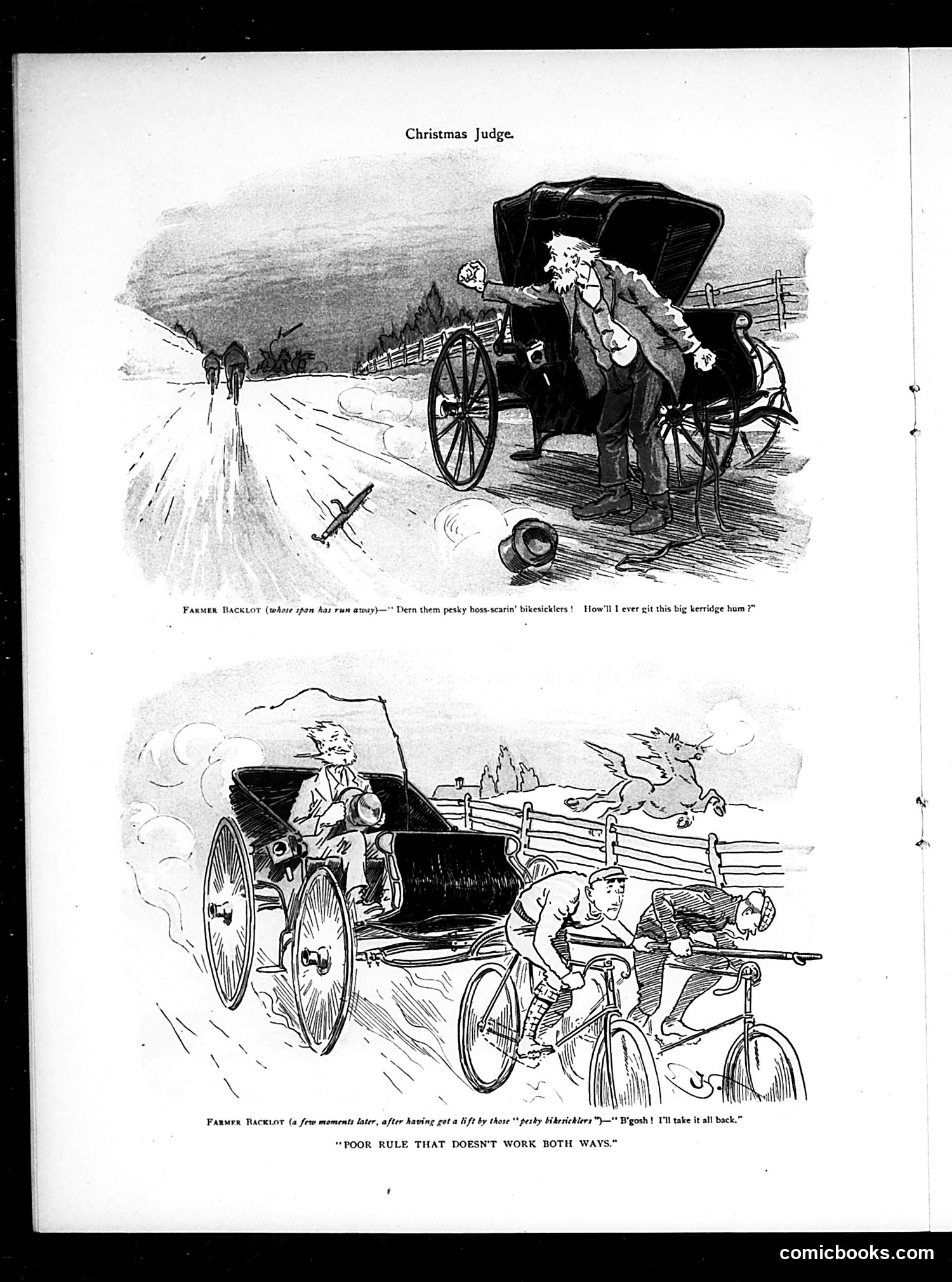
This two-panel cartoon satirizes road-sharing conflicts between vehicles and bicyclists around the early 1900s. **Top panel:** A farmer (Rackiot) with his horse-drawn carriage curses at bicyclists on the road, calling them "pesky" nuisances and claiming he'll never give them a ride. **Bottom panel:** The same farmer, now stranded, receives help from those same bicyclists. He admits he was wrong and takes back his complaints. **The satire:** The title "Poor Rule That Doesn't Work Both Ways" critiques the farmer's hypocrisy—he despises bicyclists sharing the road until he needs their assistance. The cartoon mocks those who demand privileges for themselves while denying them to others. It reflects period tensions between different road users competing for space on newly motorized/wheeled thoroughfares, while advocating for mutual respect and reciprocal courtesy among travelers.
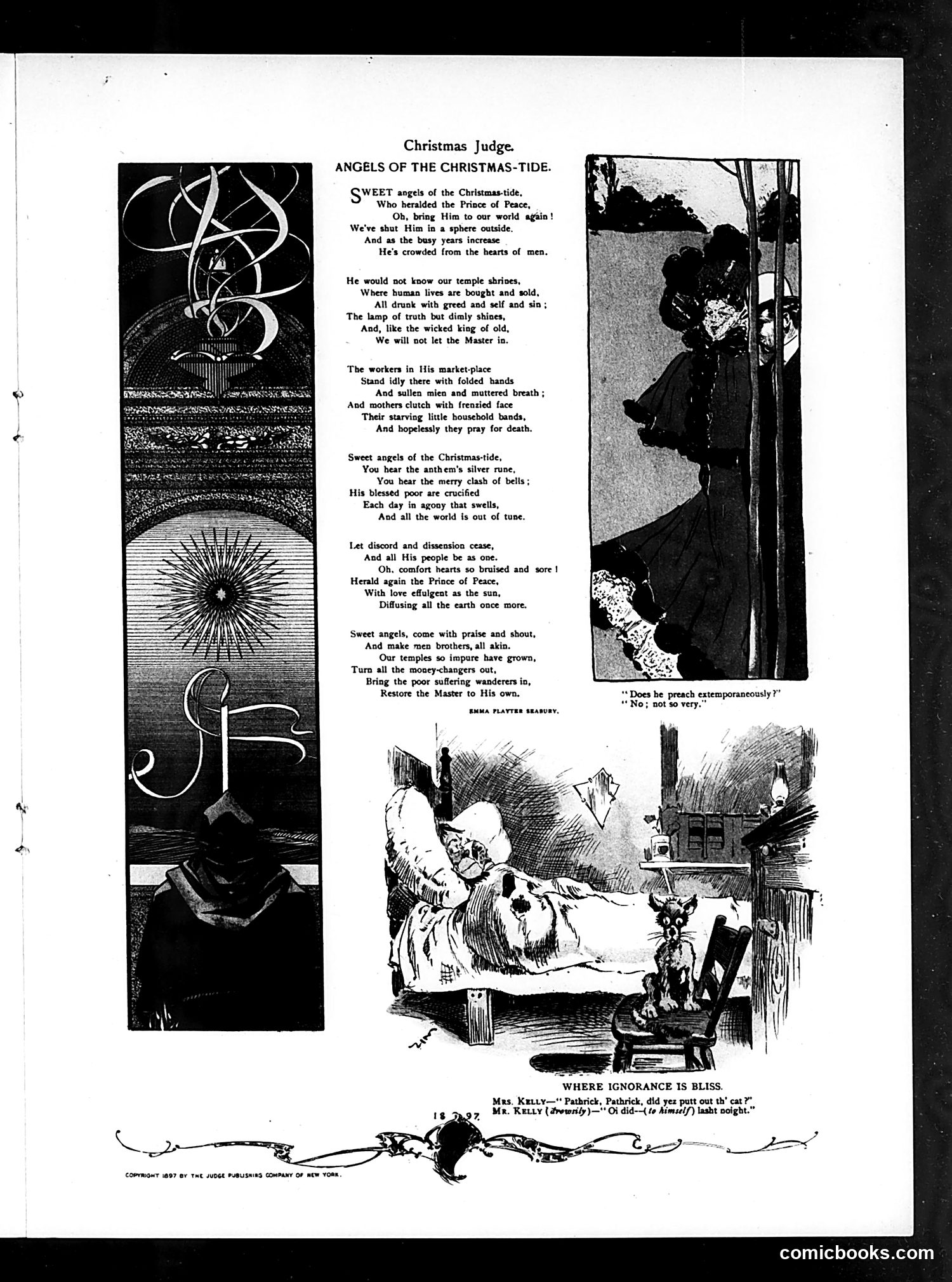
This page contains social criticism wrapped in Christmas-themed religious imagery. **Main Poem ("Angels of the Christmas-Tide")**: A moral critique comparing modern America to biblical corruption. The poet laments that Christ's message of peace has been displaced by greed, commercialism, and labor exploitation. References to "money-changers" (evoking Christ's temple cleansing) and "workers...with folded hands" suggest criticism of both capitalist excess and workers' suffering during the Gilded Age. The poem appeals to restore Christian values of caring for the poor and treating people as brothers rather than commodities. **Lower Cartoons**: - Upper right: Appears to satirize religious hypocrisy or preaching - Lower: "Where Ignorance is Bliss" depicts working-class Irish immigrants (suggested by dialect spelling), humorously showing domestic life disconnected from the broader social problems the poem addresses The page's overall message: American society has abandoned Christian principles for profit, while the poor suffer—a common Progressive Era critique of 1890s inequality.
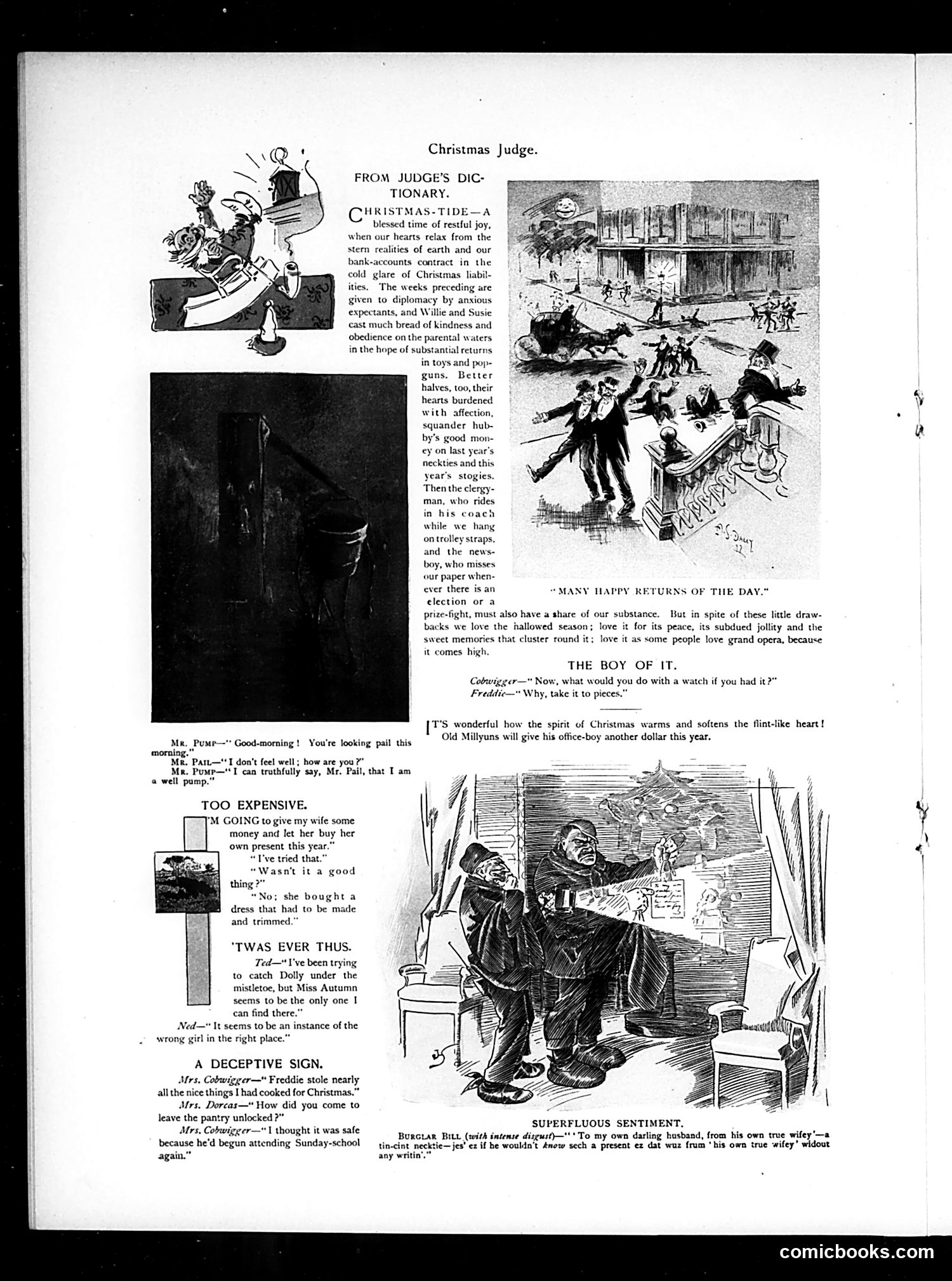
This page from Judge magazine presents holiday-themed humor mocking Victorian-era Christmas customs and hypocrisy. The "Dictionary" definition satirizes how Christmas spending contradicts its spiritual meaning—families go into debt buying gifts while children perform obedience to earn toys, wives squander husbands' money on neckties, and even clergy and newsboys demand compensation. The accompanying comic sketches mock specific Christmas behaviors: a wife buying an expensive dress despite her husband's cost-cutting attempt; a boy wanting to disassemble a watch rather than appreciate it; failed mistletoe romance; and a burglar disgusted by a wife's generic gift inscription to her husband, implying marital indifference hidden behind sentimental gestures. The satire targets bourgeois materialism, domestic tension, and the gap between Christmas's supposed spiritual values and actual greedy, cynical behavior—particularly how money and social obligation drive the season rather than genuine affection.
This page from *Judge* magazine features a single satirical illustration titled "Christmas Judge," though the specific political figures or references are difficult to identify with certainty from the image alone. The cartoon appears to depict caricatured characters in a Christmas-themed scene, rendered in the magazine's characteristic black-and-white engraving style. The illustration uses exaggerated facial features typical of late 19th/early 20th-century political cartooning. Without clearer visibility of identifying details or accompanying article text explaining the specific targets, I cannot definitively state which political figures or social issues this cartoon satirizes. The Christmas framing suggests commentary on holiday-related social conditions or hypocrisy, though the exact satirical point remains unclear from the image quality and available text alone.
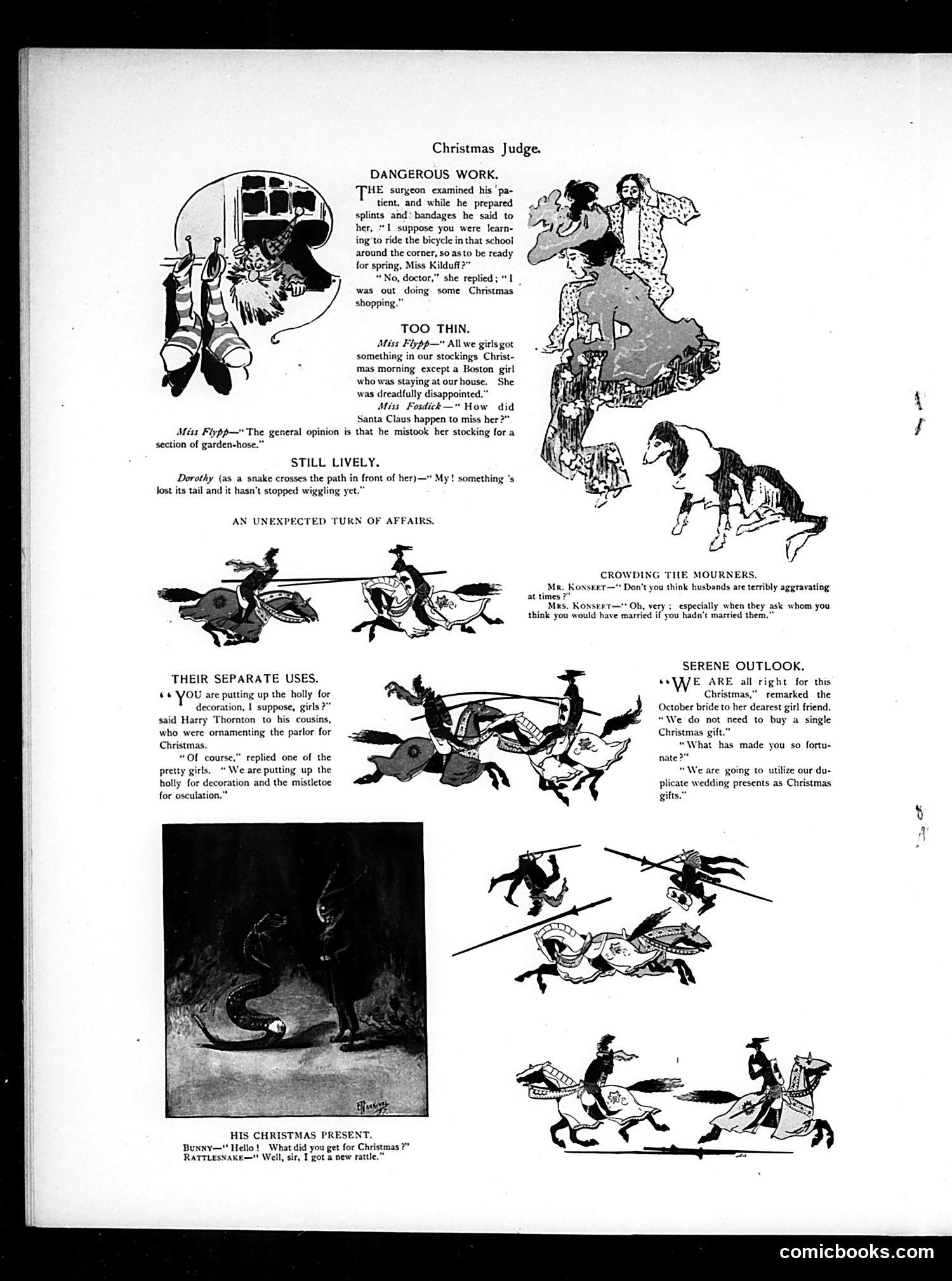
This is a Christmas-themed humor page from *Judge* magazine featuring several short jokes and satirical vignettes about holiday season mishaps and social customs. **Key jokes:** - "Dangerous Work": A surgeon treats a woman injured while Christmas shopping—satirizing the frenzy and physical hazard of holiday retail. - "Too Thin": A Boston girl receives nothing in her stocking because Santa mistook it for a garden hose—mocking her thinness. - "Still Lively": A snake loses its tail but continues moving—absurdist humor. - "Their Separate Uses": Young women distinguish between holly (decoration) and mistletoe (for kissing/"osculation")—acknowledging courting customs. - "Serene Outlook": A recently married couple plans to regift duplicate wedding presents as Christmas gifts—satirizing newlywed practicality and gift-giving conventions. The humor relies on period-specific details: bicycle safety concerns, Christmas shopping culture, courtship rituals involving mistletoe, and the social phenomenon of duplicate wedding gifts.
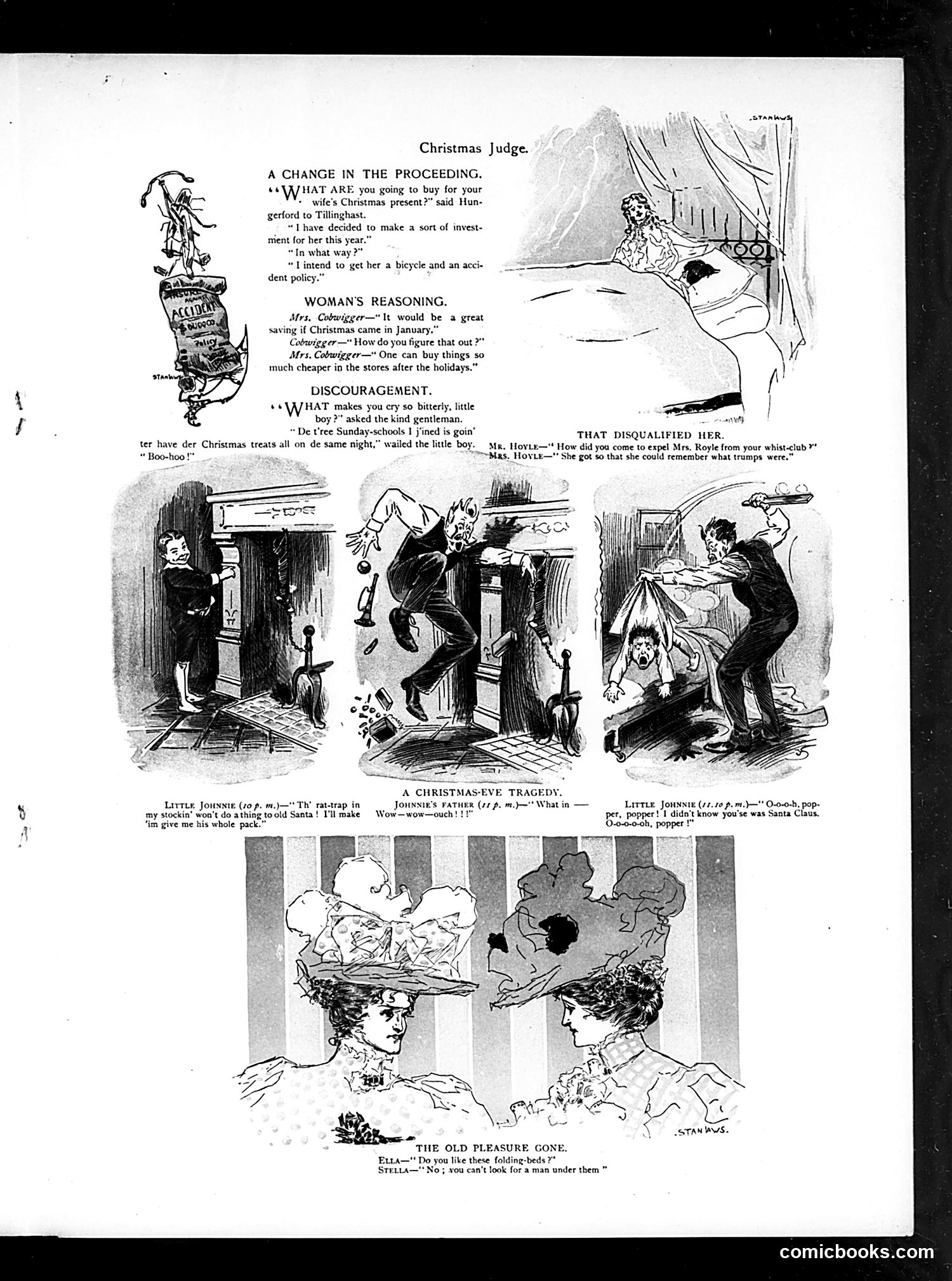
This *Judge* magazine page collects holiday-themed humor targeting early 1900s social anxieties and gender dynamics: **"A Change in the Proceeding"** mocks the bicycle craze and women's newfound mobility—a husband buys his wife both a bicycle AND accident insurance, implying women cyclists are reckless dangers. **"Woman's Reasoning"** satirizes female illogic: a wife wants Christmas in January to exploit post-holiday store sales, missing the obvious contradiction. **"Discouragement"** jokes about a boy upset that three different Sunday schools schedule Christmas treats simultaneously—poking fun at religious institutional excess. **"That Disqualified Her"** ridicules a woman expelled from her whist club for developing too good a memory at card games, implying women shouldn't be competent competitors. **The street scenes** show children's disappointment on Christmas morning with disappointing gifts and the discovery that "Santa" is their father. **"The Old Pleasure Gone"** suggests women once enjoyed hiding under folding beds to spy on men—a presumed lost pleasure of Victorian courtship rituals. Overall, the satire reflects anxiety about changing gender roles and modernization.
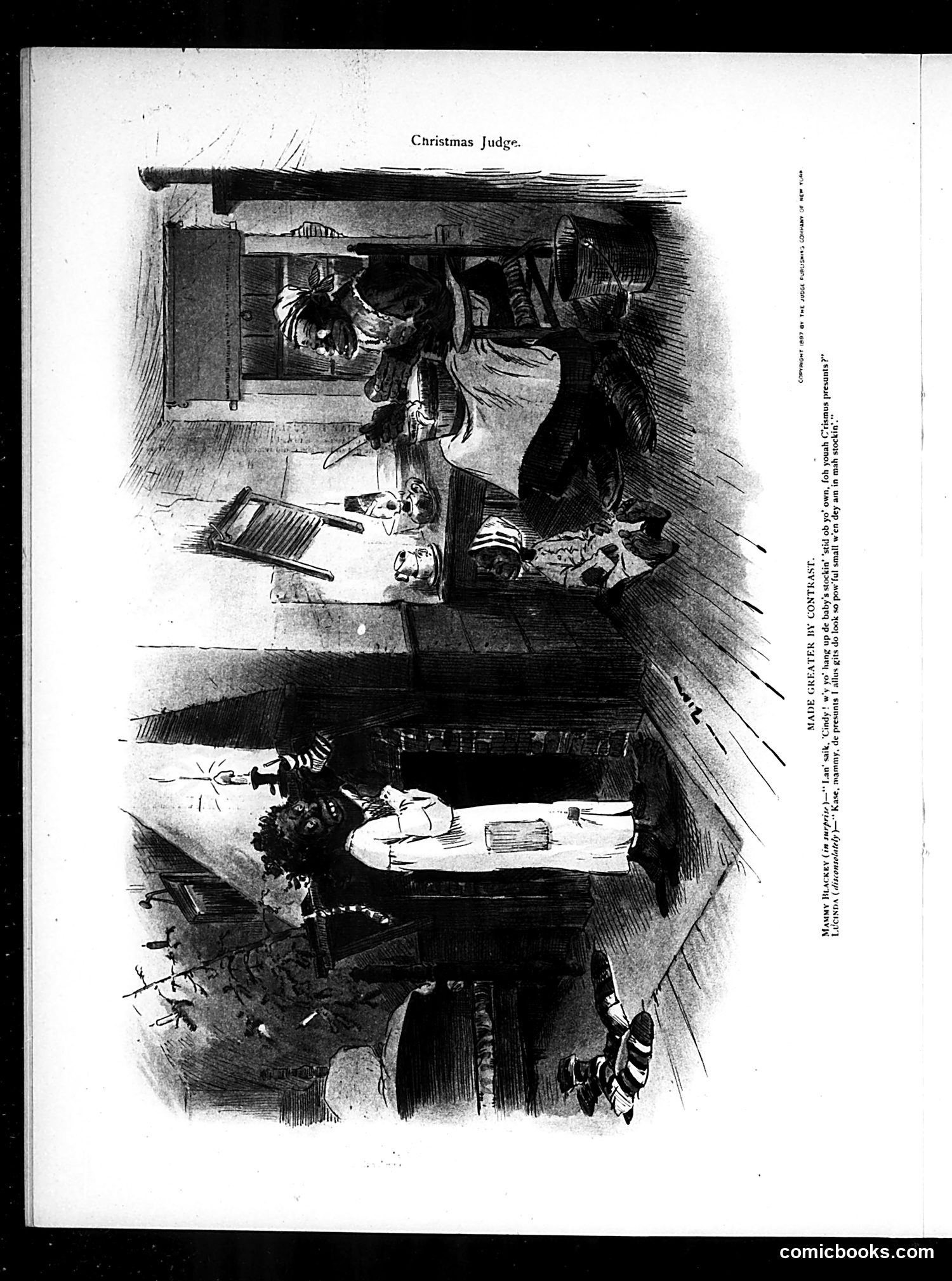
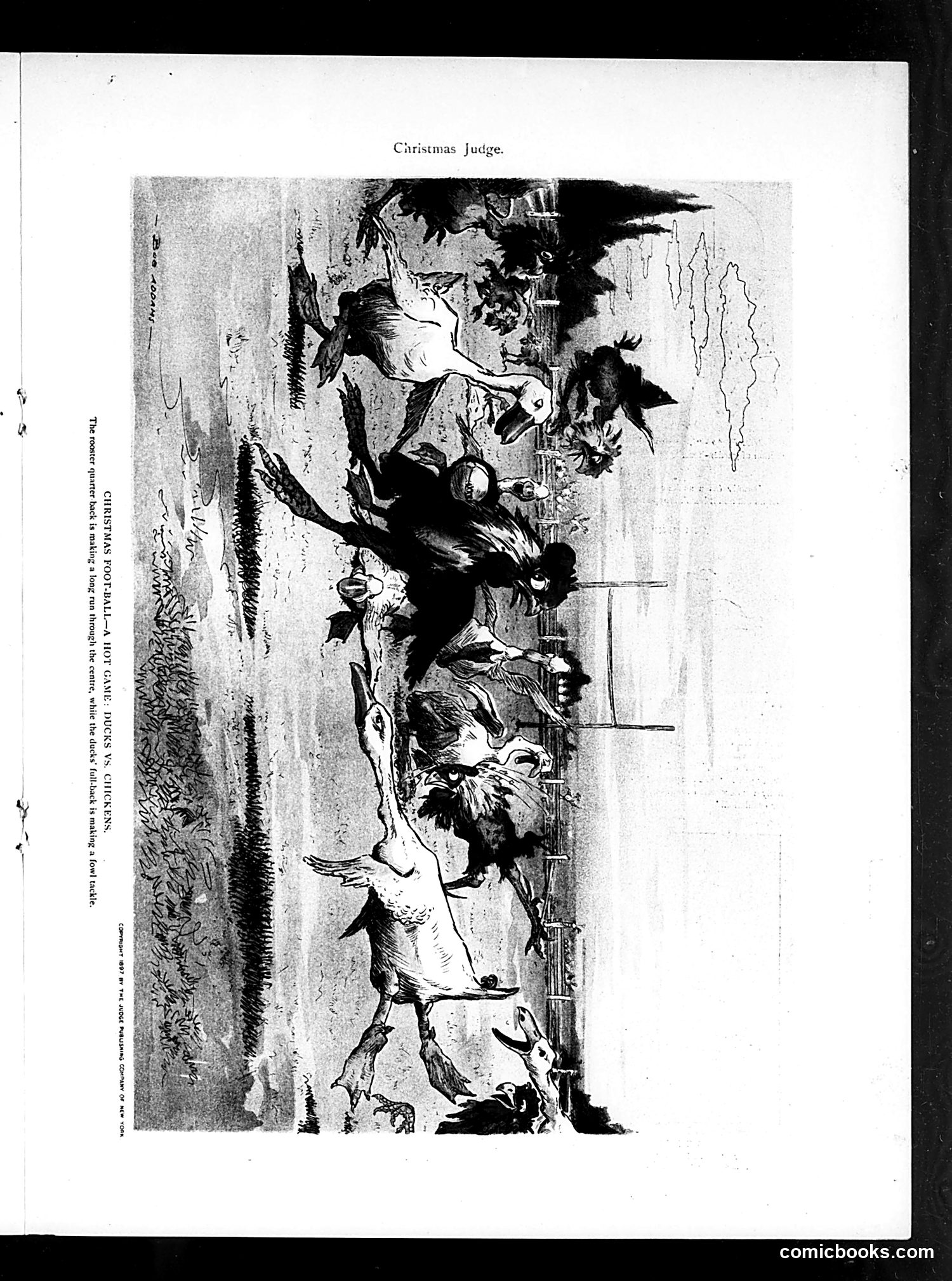
This appears to be a Victorian-era satirical illustration from *Judge* magazine titled "Christmas Judge." The image depicts what seems to be a courtroom or judicial scene during the Christmas season, shown from an unusual rotated perspective. The cartoon likely satirizes the judicial system's treatment of Christmas cases or offenders during the holidays. The figures appear to include a judge and various petitioners or defendants in a crowded courtroom setting, with scattered documents and evidence. However, the OCR text is heavily corrupted and unreadable, making it impossible to identify specific historical figures, cases, or political references with certainty. Without legible text explaining the cartoon's specific targets or context, I cannot reliably explain which judge or cases are being mocked, or what particular social commentary Judge magazine intended. The style and presentation suggest holiday-themed legal satire, but specifics remain unclear.
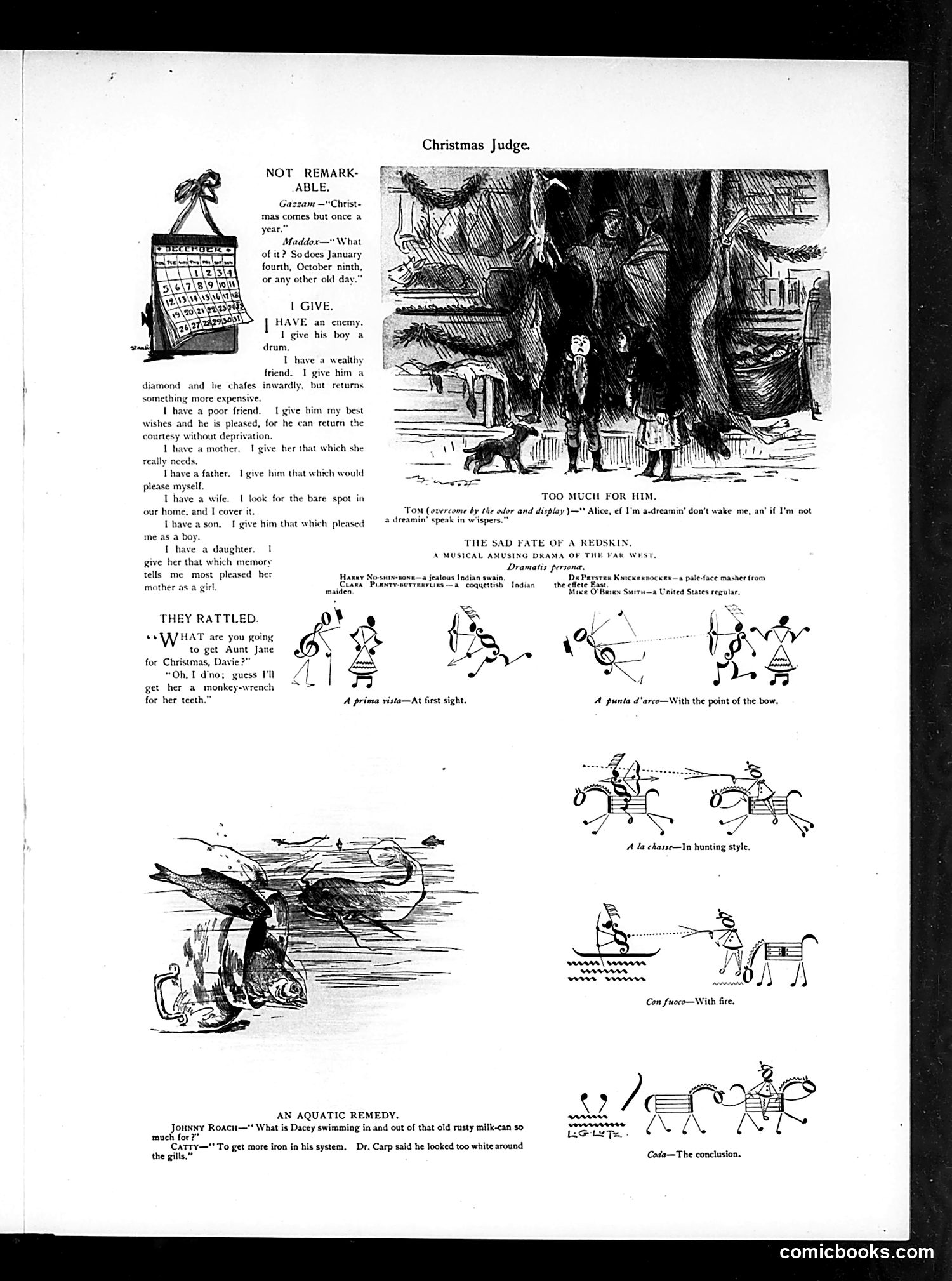
This page contains holiday-themed humor typical of late 19th-century American satire. "NOT REMARKABLE" mocks the cliché that "Christmas comes but once a year" by noting other dates also recur annually. "I GIVE" presents contrasting gift-giving philosophies: expensive gifts to the wealthy create obligation, while modest gifts to the poor bring genuine pleasure. The implication satirizes social pretense and the awkwardness of class-based gift exchanges. "THEY RATTLED" is a crude joke: a boy plans to give his aunt a monkey-wrench "for her teeth," suggesting she needs dental work—implying she's unattractive or old. "AN AQUATIC REMEDY" ridicules folk medicine: a doctor prescribes swimming in a rusty milk-can to add "iron" to a pale patient's system, playing on the double meaning of iron as both a nutrient and a literal metal. "THE SAD FATE OF A KINSKIN" (bottom right) appears to be a musical comedy sketch involving Native American characters and a white suitor, using period racial caricatures common to Judge magazine.
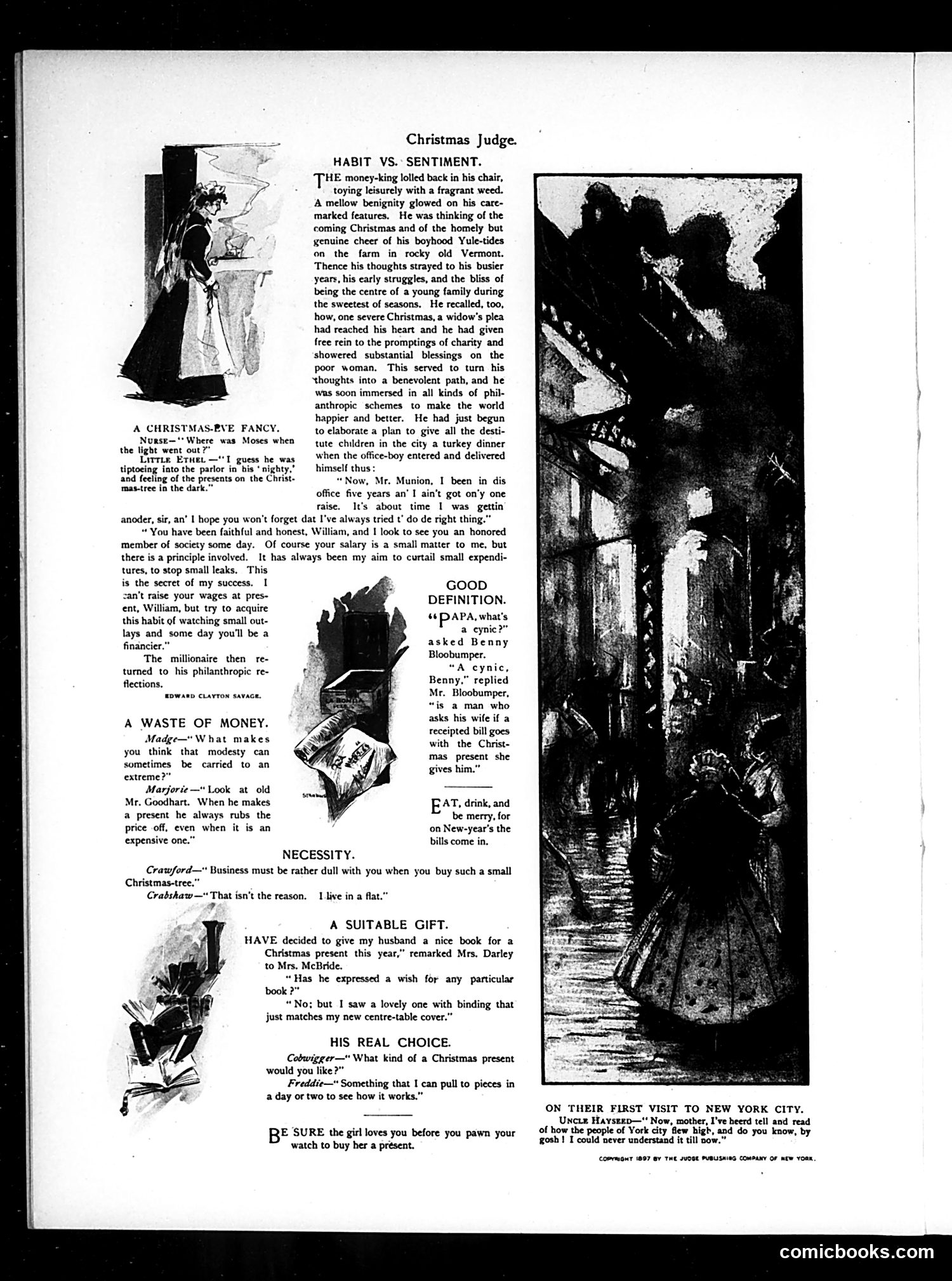
This page satirizes the hypocrisy of wealthy philanthropists, particularly through the main story "Habit vs. Sentiment." The central narrative features a millionaire (likely representing a Gilded Age robber baron) who becomes sentimental about Christmas—recalling his Vermont farm boyhood and charitable impulses. He begins planning generous turkey dinners for poor children. However, when his office boy William requests a modest raise after five faithful years, the wealthy man refuses, citing his principle of "curtailing small expenditures" to maintain financial success. The satire is sharp: the same man who romanticizes benevolence cannot extend basic kindness to his own employee. His charity is theatrical sentiment divorced from daily habit. The accompanying joke sections reinforce this theme—a "cynic" is defined as someone who checks whether a Christmas gift receipt was included, and other vignettes mock miserly gift-giving practices among the wealthy. The cartoon targets the contradiction between conspicuous philanthropy and actual generosity toward working-class people in one's immediate sphere.
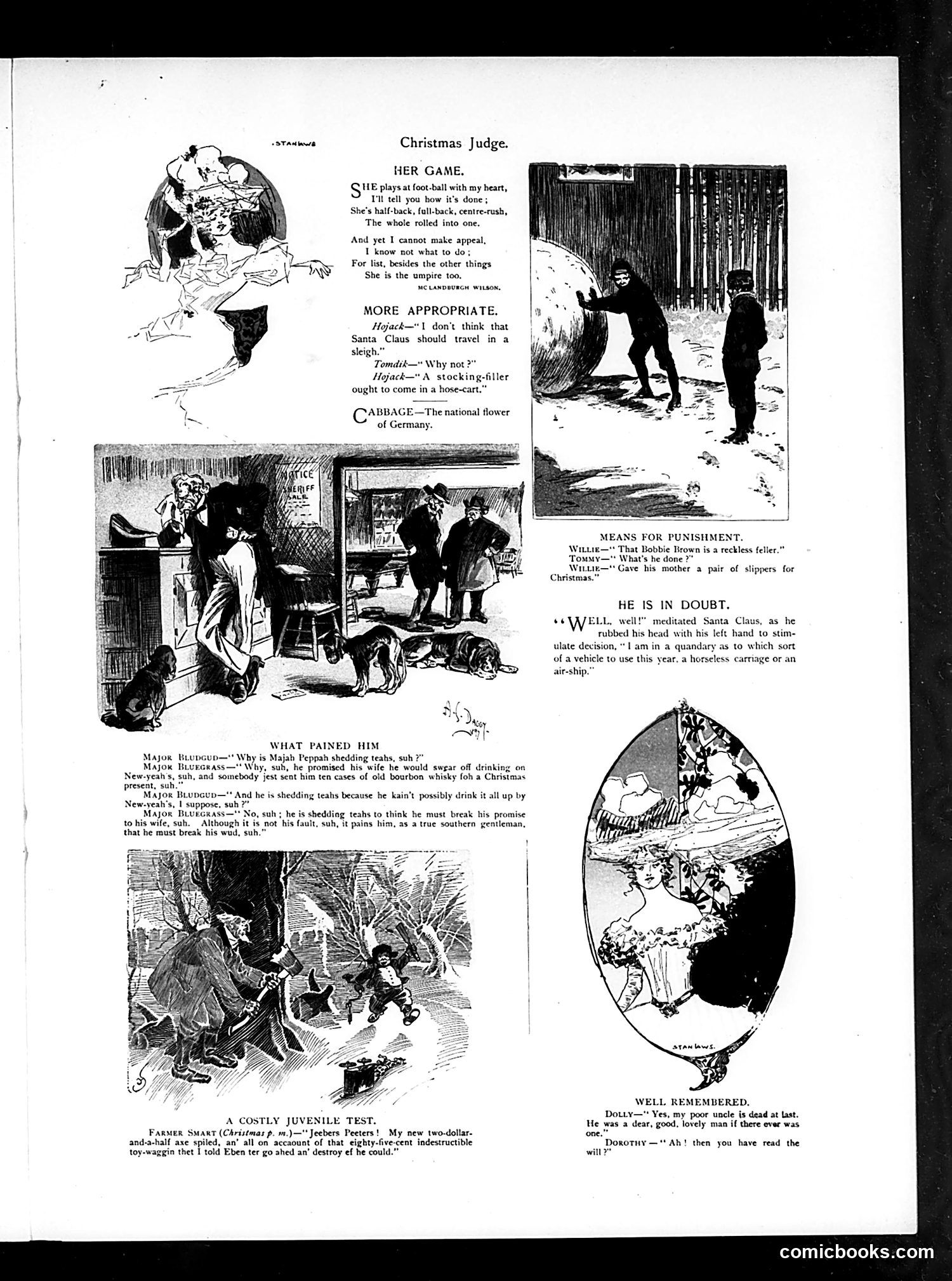
This holiday-themed satirical page from *Judge* magazine contains several brief comic sketches mocking Victorian-era social conventions: **"Her Game"** mocks romantic entanglement through sports metaphors—a woman controls a man completely, playing every position while also serving as umpire, leaving him helpless. **"More Appropriate"** jokes about Santa's transportation, suggesting a "stocking filler" should travel via "hose-cart" rather than sleigh—a crude double entendre. **"Means for Punishment"** presents dark humor: giving slippers as a Christmas gift is portrayed as recklessly dangerous. **"What Pained Him"** uses stereotypical Southern dialect to satirize masculine weakness: a man receives whisky despite promising his wife to abstain, and he's tormented by having to break his word—suggesting men are enslaved by both alcohol and marital promises. **"A Costly Juvenile Test"** depicts parental foolishness: an inexpensive toy destroys an expensive tool, illustrating children's destructive nature and poor parental judgment in gift-giving. The overall tone is cynical about relationships, masculinity, and family life.
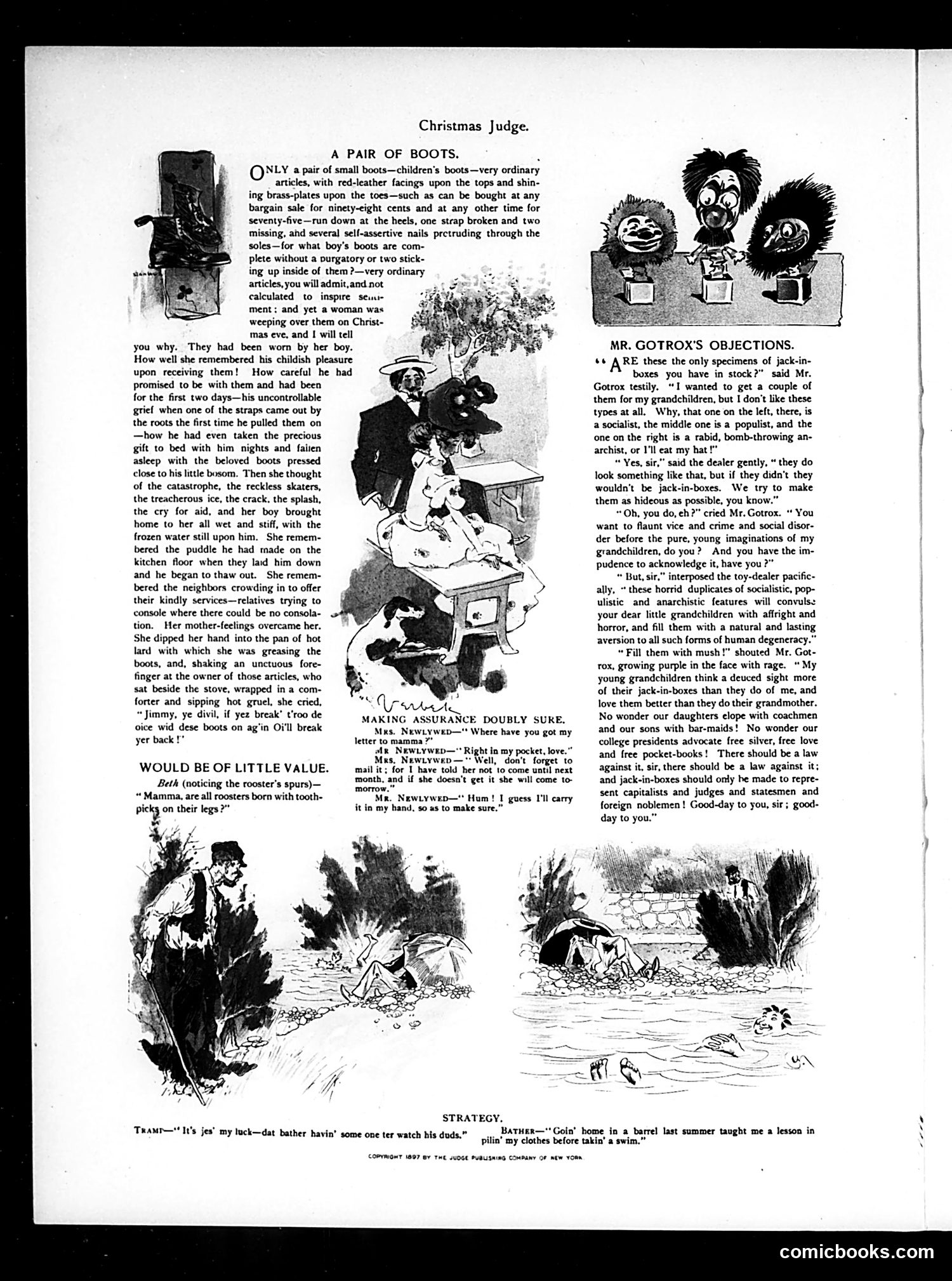
This page contains several humorous sketches satirizing American life and values. **"A Pair of Boots"** is a sentimental story about a poor Irish mother grieving her drowned son's worn boots—a poignant contrast to the ordinary object itself. **"Mr. Gotrox's Objections"** mocks wealthy conservatives. Mr. Gotrox complains that jack-in-the-box toys depicting "socialists," "populists," and "anarchists" are corrupting influences on his grandchildren. The toy dealer cleverly responds that these grotesque caricatures actually *deter* children from such ideologies. The satire targets both Gotrox's moral panic about radical politics and his obliviousness to how his own fear-mongering works. **"Strategy"** and **"Would Be of Little Value"** are brief comic vignettes about domestic life and childhood—the rooster spurs joke and the newlywed couple's domestic moment. The overall tone reflects late-19th-century anxiety about socialism, anarchism, and immigration while simultaneously mocking the upper classes' overwrought fears.
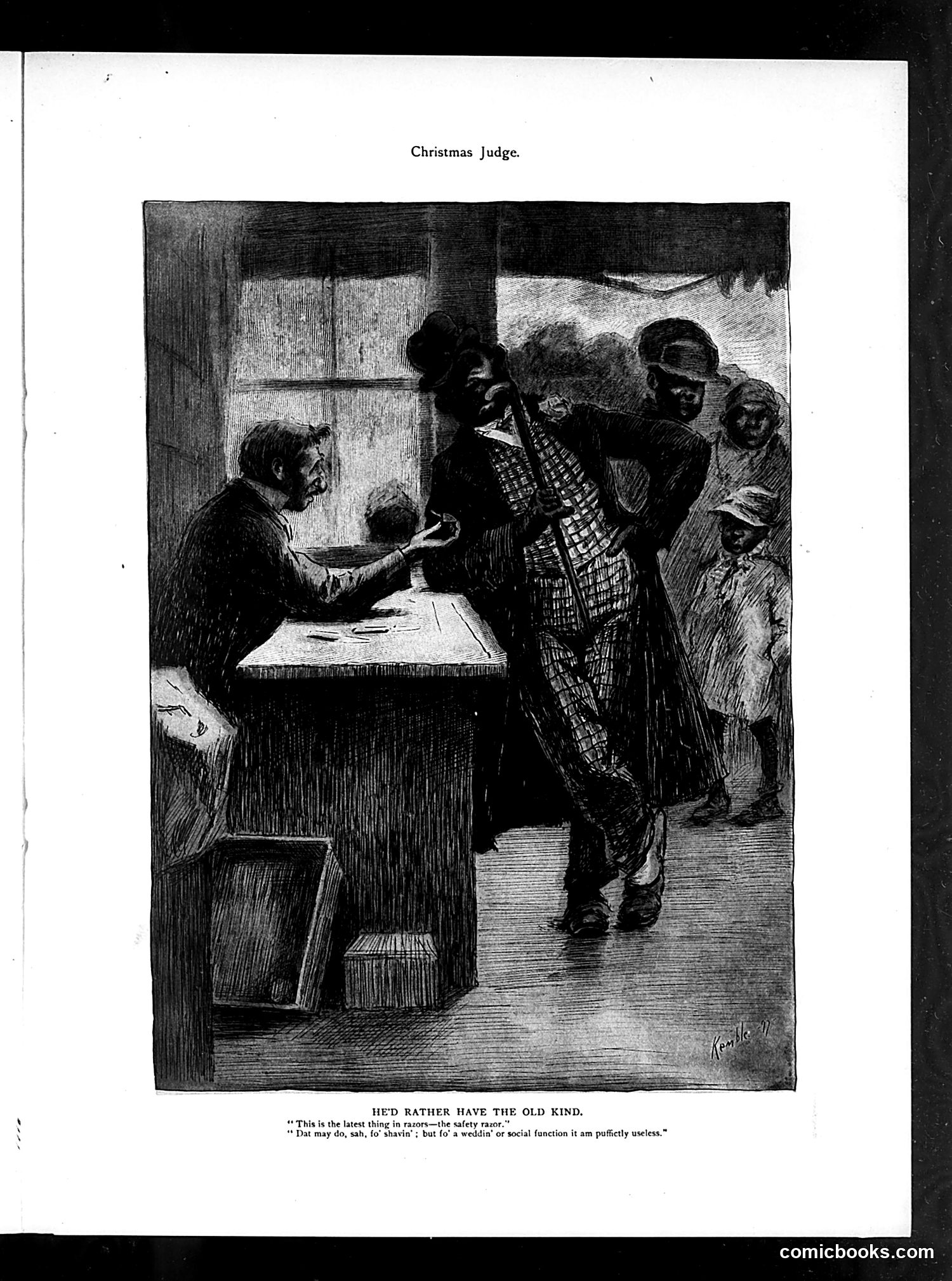
This satirical cartoon depicts a Black man rejecting a modern safety razor in favor of a traditional straight razor. The joke relies on a racist stereotype: the caption suggests he prefers the old razor because straight razors are more impressive or prestigious for "weddin' or social function"—implying Black men valued displaying weapons as status symbols. The humor (by 1890s standards) targeted both modern technology adoption and relied on dehumanizing caricature. The man's dialect and the visual portrayal reinforce period racial stereotypes. The cartoon mocks both the "latest thing" (safety razors) and reflects prejudiced assumptions about Black social values, using a Christmas-themed Judge magazine publication to make this "joke" palatable to contemporary audiences.
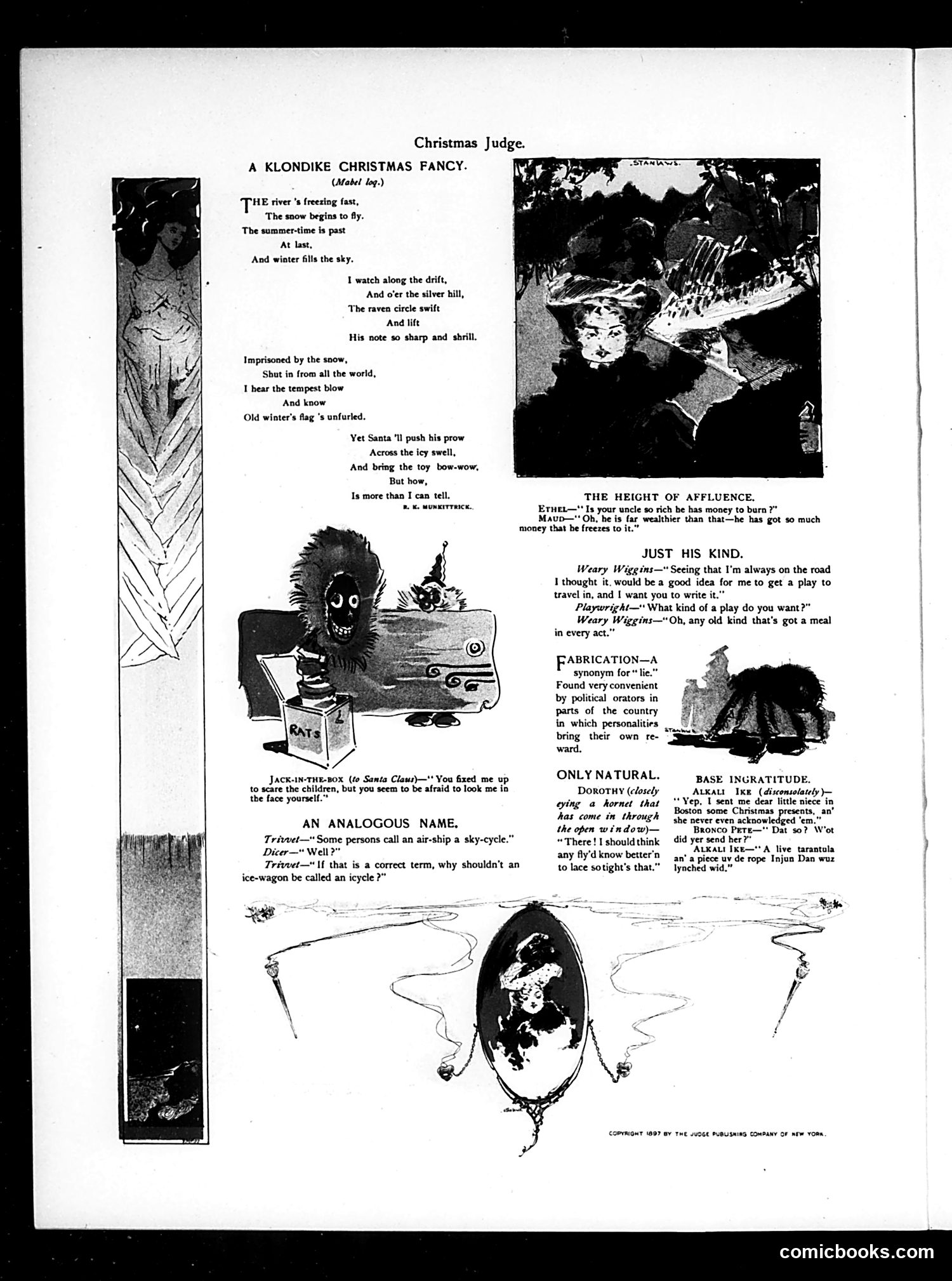
This is a Christmas-themed page from Judge magazine featuring multiple short humorous items typical of late 19th-century American satire. **Main Content:** The page opens with "A Klondike Christmas Fancy," a sentimental poem about winter isolation during the Klondike Gold Rush era, questioning how Santa will deliver toys in such harsh conditions. **The Cartoons & Jokes:** - **Jack-in-the-Box/Santa**: A jack-in-the-box confronts Santa about being designed to frighten children while Santa himself appears afraid—social commentary on hypocrisy. - **"Analogous Name"**: A pun comparing "air-ship" (early aviation) to "sky-cycle" and suggesting ice-wagons become "icycles"—wordplay typical of the era. - Various brief satirical quips mock political dishonesty ("Fabrication"), wealth obsession, theatrical desperation, and frontier rough behavior. The humor relies on period-specific references (airships, Klondike gold rush) and genteel Victorian wit. The overall tone targets social pretension and human folly—standard Judge magazine fare for readers of that era.
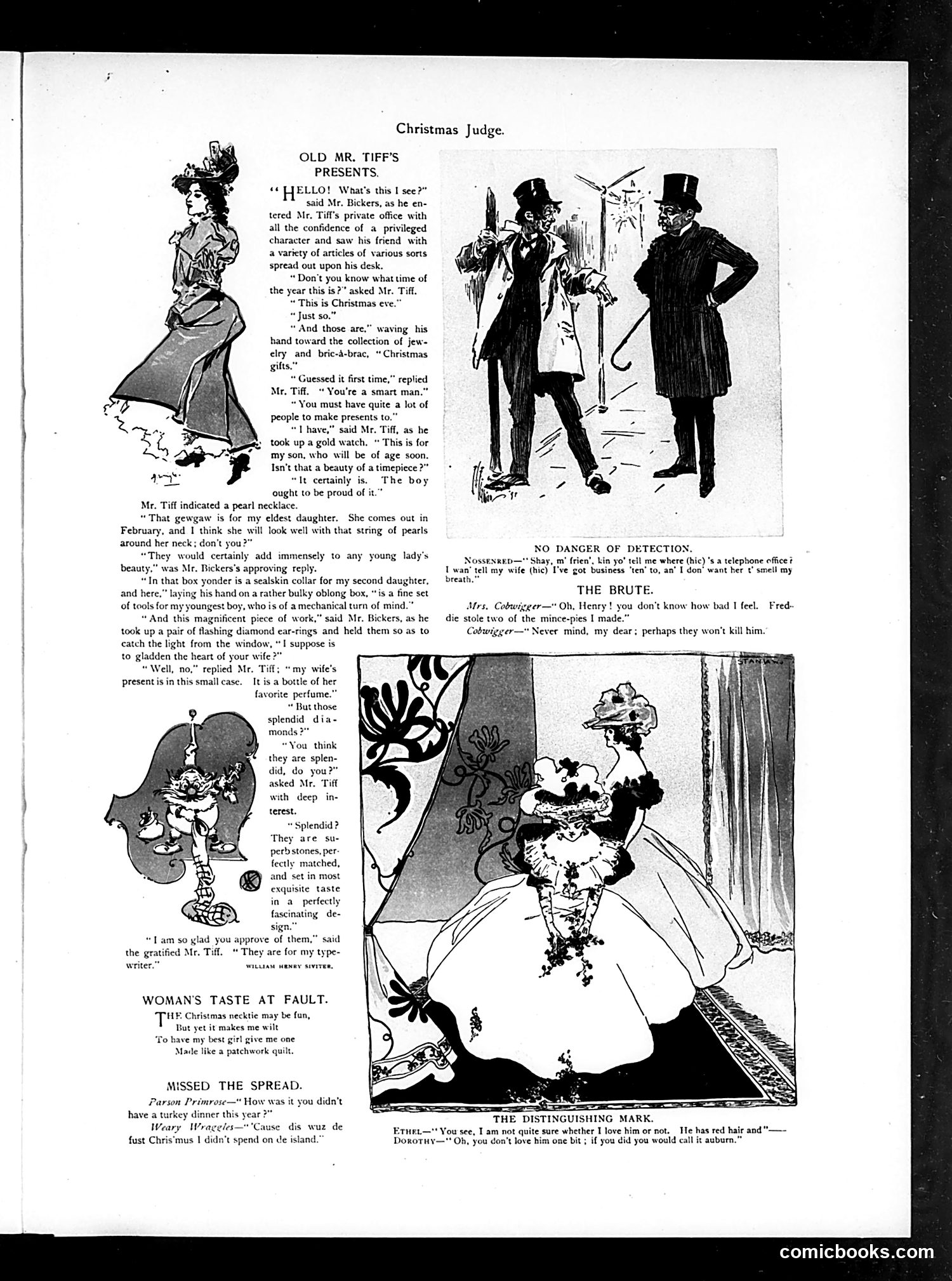
This humorous domestic sketch satirizes wealthy men's misguided Christmas gift-giving. Mr. Tiff displays expensive presents for his children—a gold watch, pearl necklace, diamond ear-rings, sealskin collar—yet his wife receives only a bottle of perfume in a small case. The joke mocks the husband's obliviousness: he proudly shows Mr. Bickers the diamonds, which Bickers assumes are for the wife. When corrected, Tiff reveals they're for "my type-writer"—his secretary or mistress. The satire targets men who lavish luxury goods on themselves or their paramours while relegating wives to trivial gifts. This reflects class anxieties about infidelity and the proper (or improper) allocation of marital wealth during the Gilded Age. The surrounding comic vignettes—about unsatisfactory Christmas gifts and marital discord—reinforce the theme of holiday gift-giving as a barometer of domestic relationships.
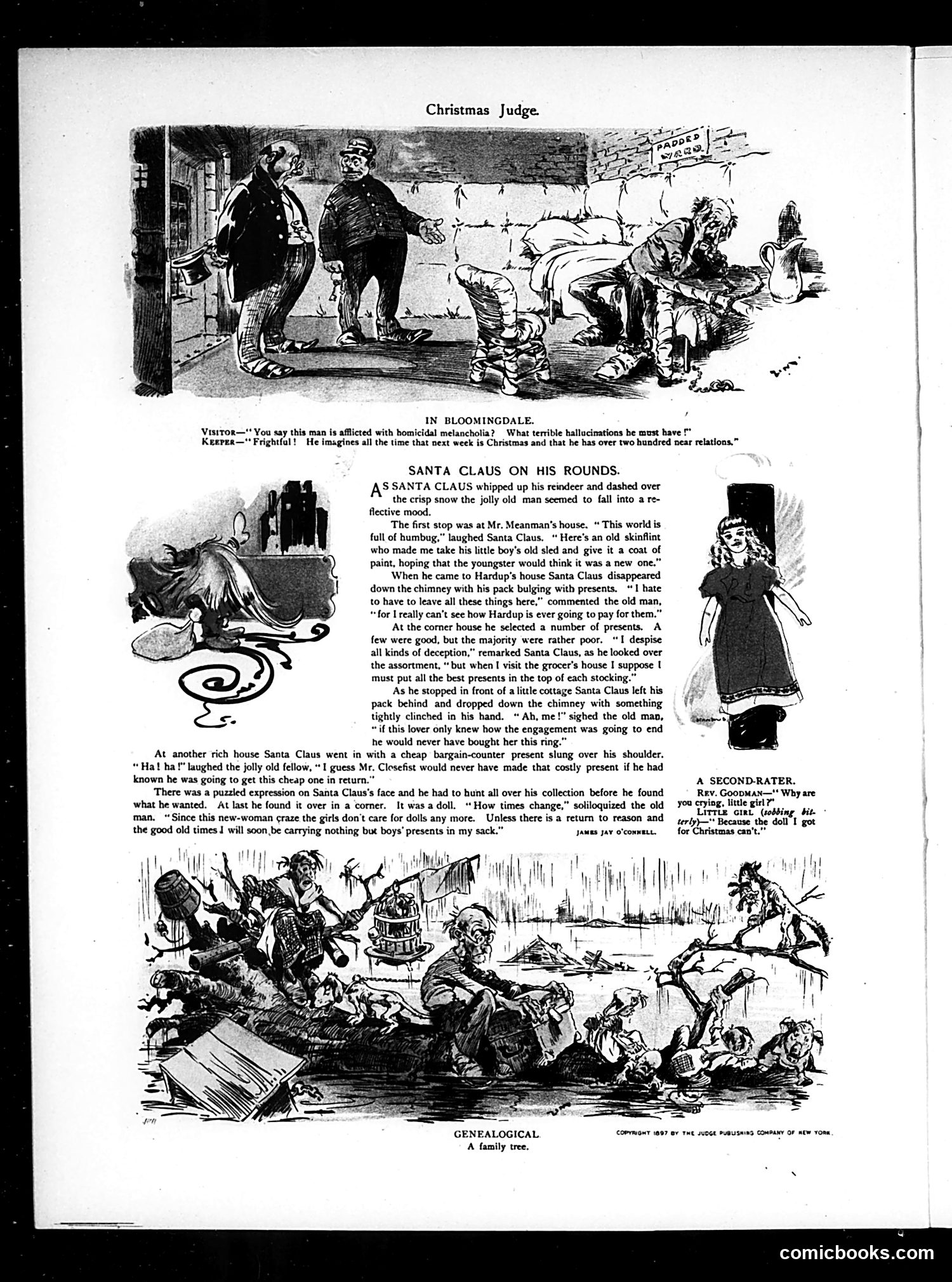
This satirical page mocks Christmas commercialism and social hypocrisy through several vignettes: **"In Bloomingdale"**: A dark joke equating Christmas dread with mental illness—imagining "next week is Christmas" and having "two hundred near relations" is presented as homicidal delusion, satirizing the stress of holiday obligations and family gatherings. **"Santa Claus on His Rounds"**: Santa observes moral contradictions: misers regifting old sleds as "new," generous poor families he can't afford to help, grocers receiving deceptive presents, and wealthy "cheapskates" getting inferior gifts. The satire exposes class hypocrisy and the disconnect between Christmas ideals and reality. **"A Second-Rater"**: A reverend laments that girls no longer want dolls due to the "new-woman craze," forcing him to give unfashionable gifts. This mocks changing gender expectations and outdated masculine bewilderment. **Bottom cartoon**: "A family tree" depicts Christmas chaos—presumably satirizing family dysfunction during holidays. The overall message critiques commercialism, social pretense, and the gap between Christmas's supposed meaning and actual behavior.
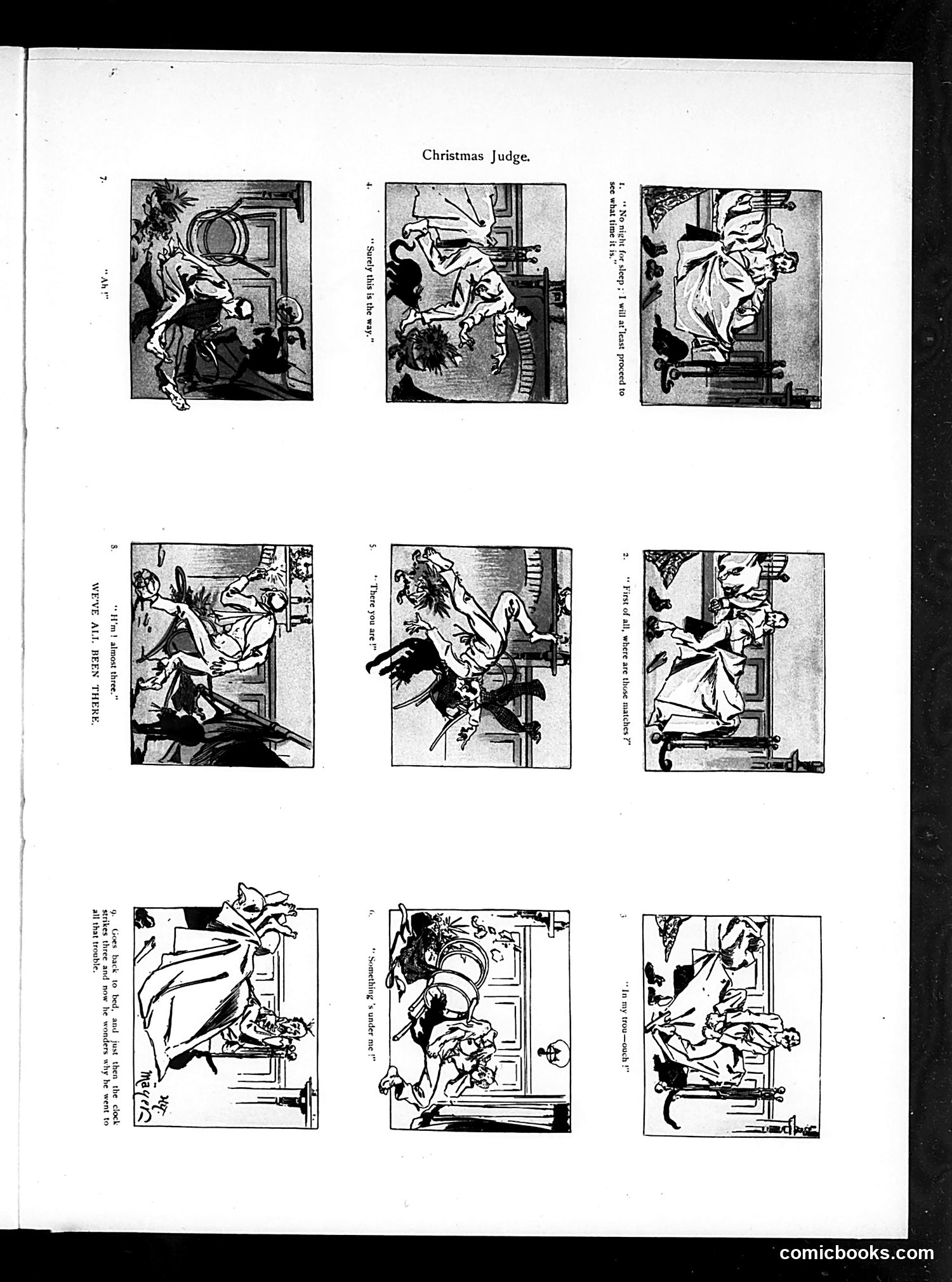
This page from *Judge* magazine presents a nine-panel comic strip titled "Christmas Judge." The panels depict what appears to be a chaotic Christmas scene with exaggerated characters in comedic situations—figures tumbling, fighting, or engaged in slapstick business around domestic settings and doorways. The exact satirical targets are unclear from the image alone, though the "Christmas Judge" title suggests commentary on holiday excess, family chaos, or contemporary social behavior during the season. The crude, energetic drawing style and physical comedy are typical of late 19th/early 20th-century American satirical humor in *Judge*. Without clearer text identifying specific figures or clearer historical context, the precise political or social references remain uncertain.
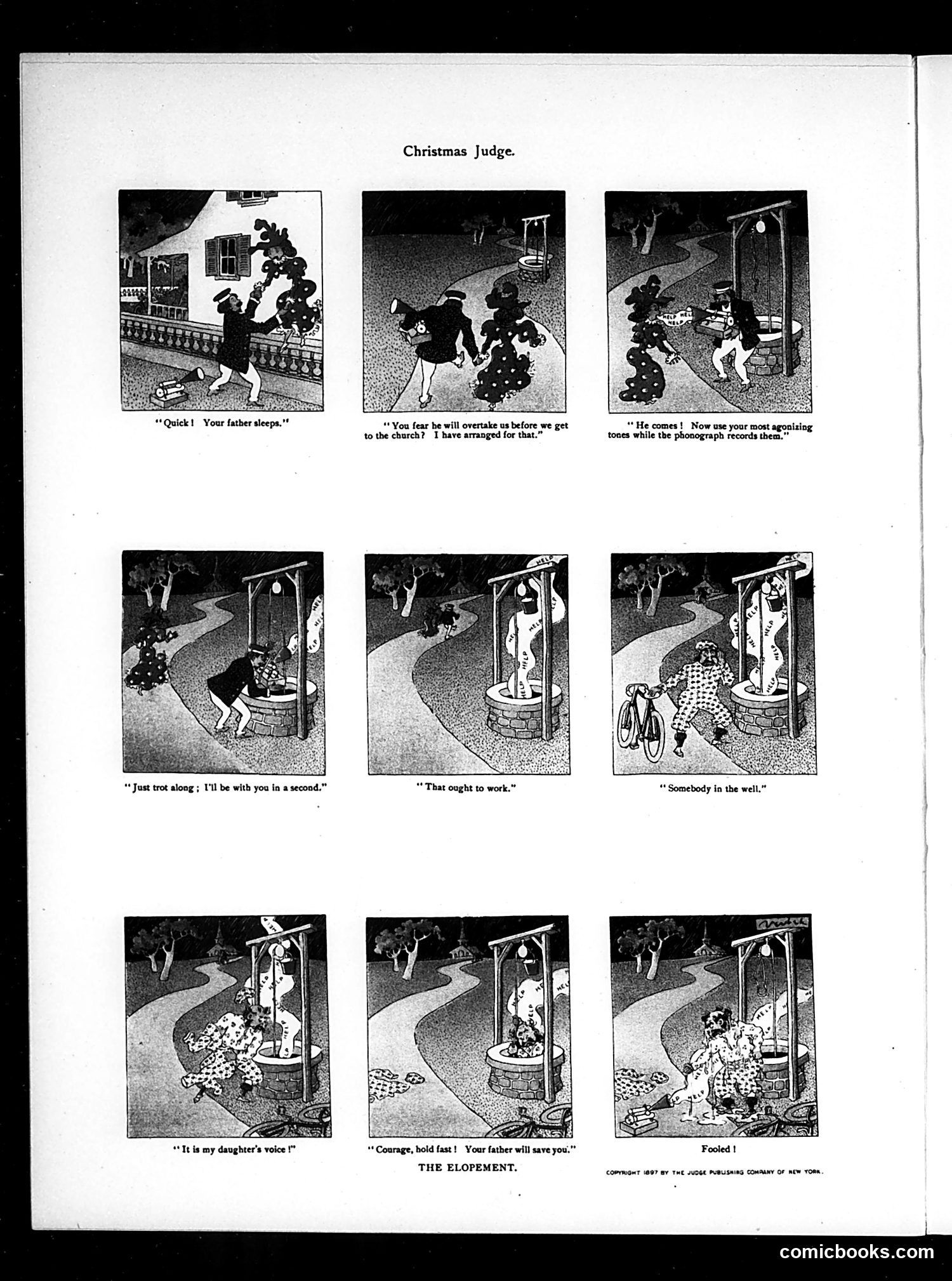
This 1897 Judge comic strip satirizes the melodramatic "elopement" plot common to Victorian literature and theater. A young couple attempts to flee, presumably to elope against her father's wishes. The humor lies in the increasingly absurd obstacles and schemes: the father sleeping, arranging for interference, using a phonograph to record "agonizing tones" (likely fake distress calls), hiding "somebody in the well," and a bicycle-assisted escape. Each panel escalates the theatrical desperation. The final panel's caption "Fooled!" suggests the entire scheme backfires or fails—the father outwits them. The satire mocks both the predictable tropes of Victorian romance narratives and the elaborate, often ridiculous lengths characters go to in such stories. It's essentially a parody of romantic melodrama popular in contemporary theater and literature.
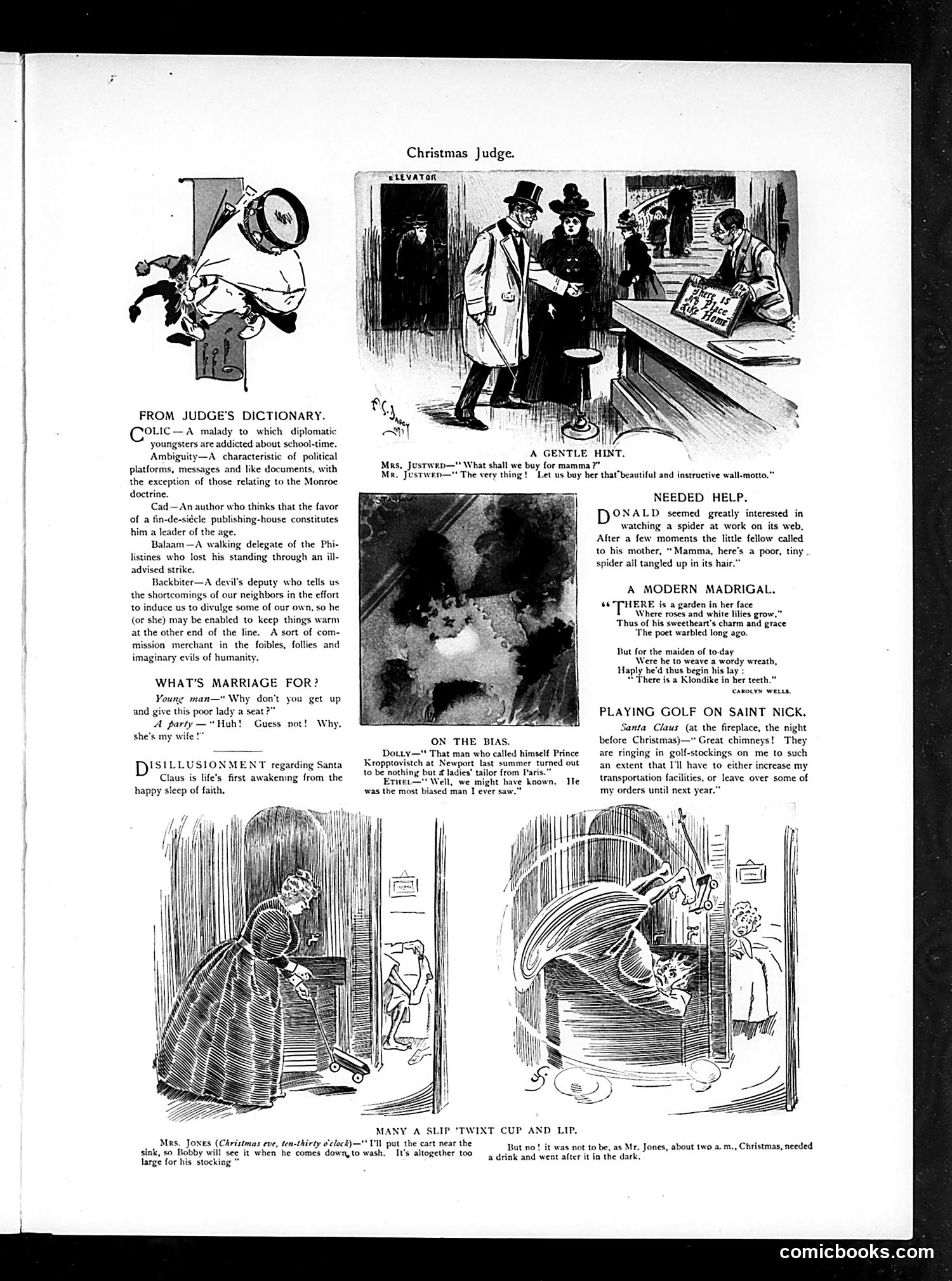
This page from *Judge* magazine contains satirical dictionary definitions, holiday-themed jokes, and cartoons mocking various social types and contemporary trends. **Key Content:** The "Judge's Dictionary" section ridicules political and social figures—including diplomats, authors claiming false authority, and union "walking delegates" (labor organizers). The term "Balaam" likely references a biblical figure associated with betrayal, suggesting strikers who lost credibility. **Holiday Humor:** Multiple cartoons mock Christmas customs and domestic life: a husband refusing his seat to a pregnant woman because "she's my wife"; parents buying wall-mottos as gifts; a mother hiding a cart in a sink for her son's stocking. **Contemporary References:** One joke targets "Prince Kropptovistch," a con artist exposed as merely a Parisian tailor—likely satirizing wealthy Americans' gullibility toward fake European nobility. **Modern Touch:** "A Modern Madrigal" contrasts romantic poetry with modern dentistry obsession—women's teeth rather than beauty—suggesting early 1900s anxieties about changing social values. The humor targets middle-class hypocrisy, materialism, and social pretension.
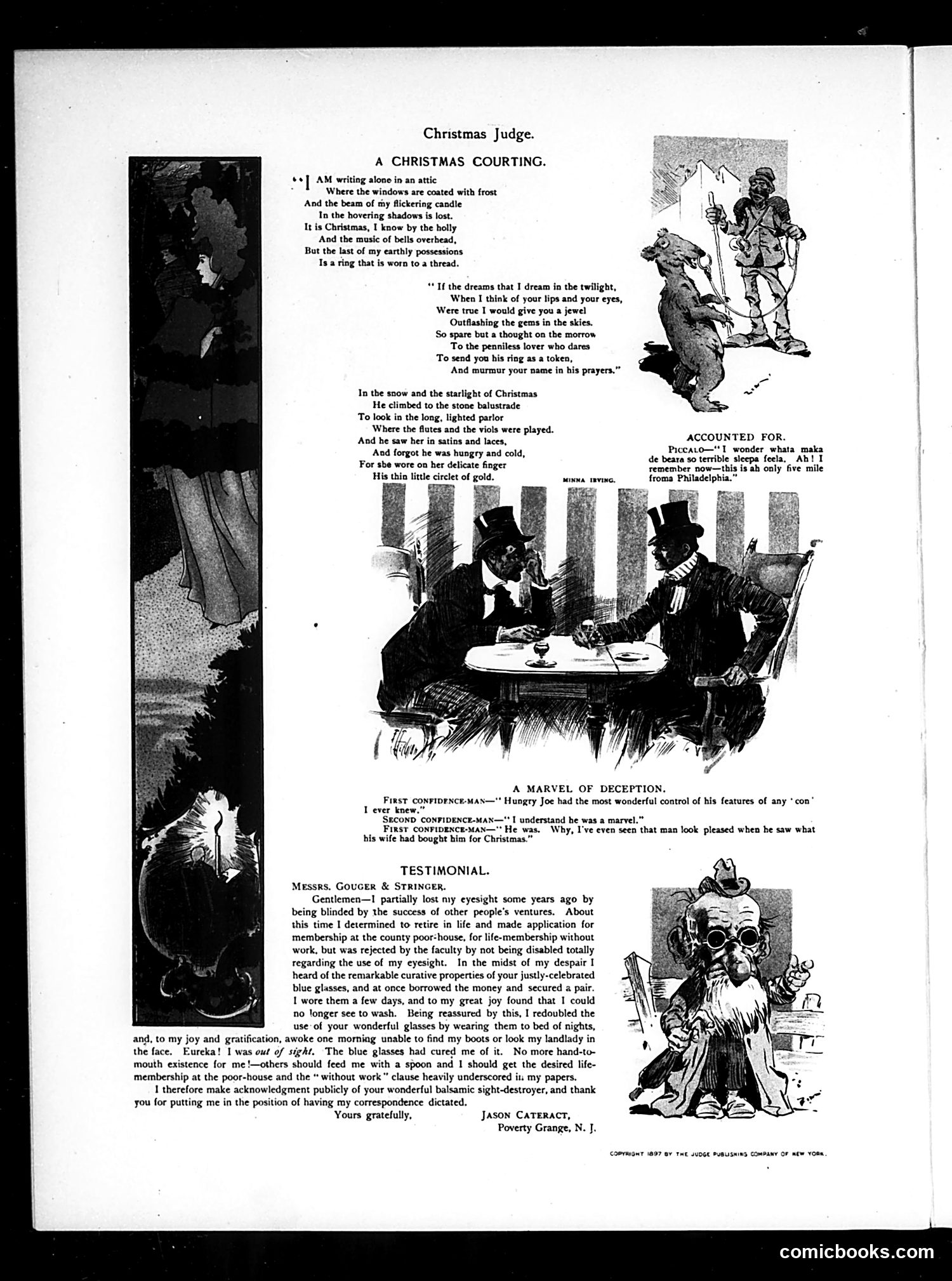
This 1897 page contains three distinct satirical pieces: **"A Christmas Courting"** (poem with illustrations): A sentimental narrative about a poor lover who gives his beloved a threadbare gold ring while she celebrates Christmas in wealth and comfort. The satire mocks sentimental Christmas romance—the contrast between his poverty and her luxury undermines the emotional sincerity. **"Accounted For"** (small cartoon): A figure (identified as "Piccaro") observes a sleeping bear, attributing its drowsiness to being five miles from Philadelphia. This appears to be ethnic humor mocking Italian immigrants' speech patterns and reasoning. **"A Marvel of Deception"** (cartoon dialogue): Con artists discuss "Hungry Joe's" remarkable ability to control his facial expressions—the joke being he could even *look pleased* receiving unwanted Christmas gifts from his wife. This satirizes both marital discord and con-artist psychology. **"Testimonial"** (mock advertisement): A satirical endorsement of "blue glasses" by someone claiming they deliberately blinded him so he could qualify for poorhouse admission. The satire targets both deceptive medical advertising and welfare fraud schemes.
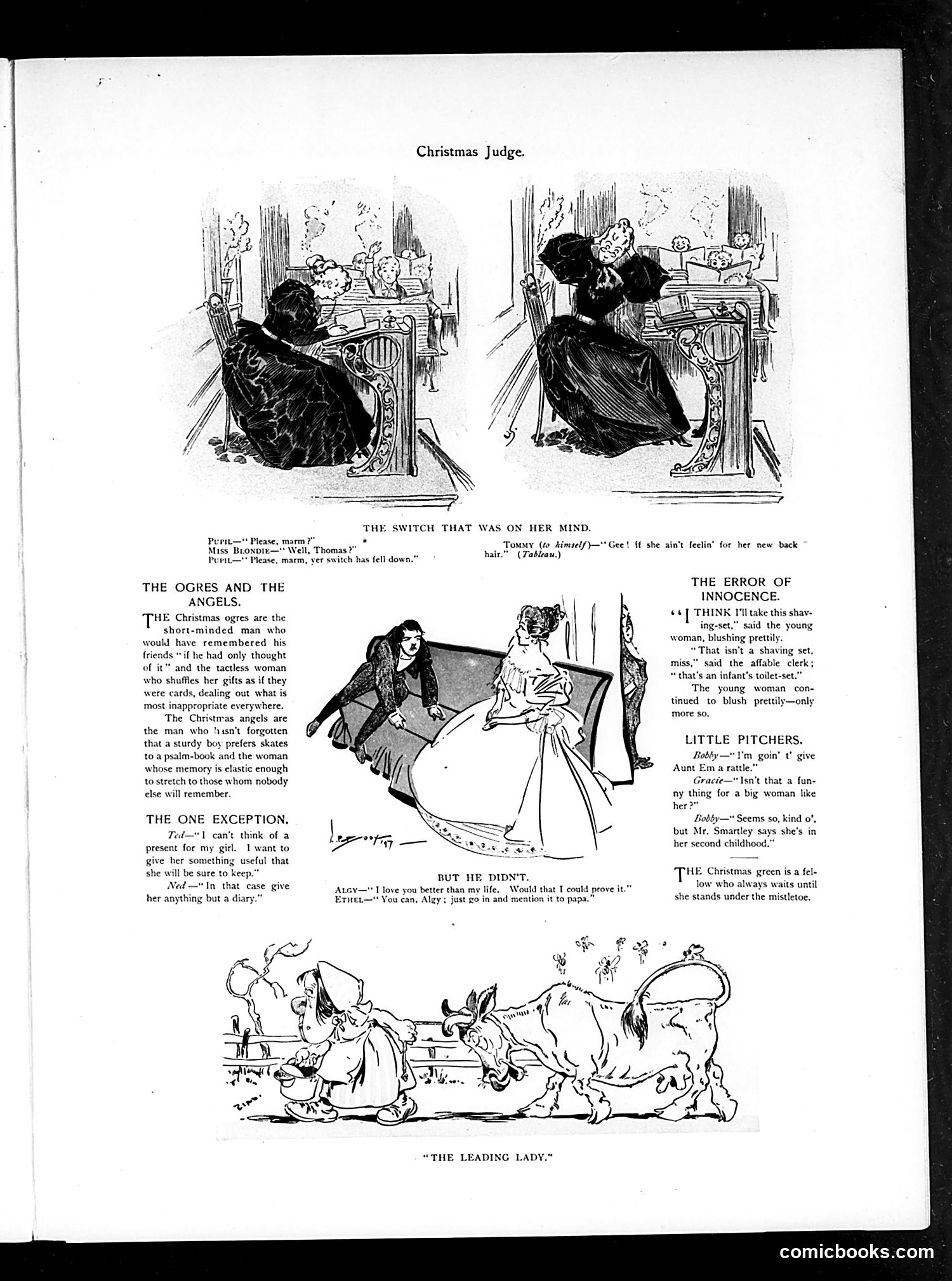
This page from *Judge* magazine presents multiple Christmas-themed comedic sketches satirizing social behavior and gift-giving etiquette. **"The Ogres and the Angels"** contrasts thoughtless gift-givers (the "ogres" who forget friends or give inappropriate presents) with considerate ones (the "angels" who remember recipients' actual preferences). **"The One Exception"** jokes that a man cannot give his girlfriend a useful gift—specifically a diary—because she won't keep it; the implication is she'd use it for personal secrets rather than preserve it long-term. **"The Switch That Was on Her Mind"** and related sketches depict romantic and domestic situations with double meanings involving physical contact and courtship customs. **"The Error of Innocence"** humorously depicts a young woman's embarrassment when she mistakes a shaving set for an infant's toilet-set—the humor derives from her innocent mistake being misinterpreted as something else. **"The Christmas Green"** explains mistletoe tradition: a fellow who waits until positioned under mistletoe to declare affection. The cartoons reflect late-19th/early-20th-century social mores around gift-giving, courtship, and domestic propriety.
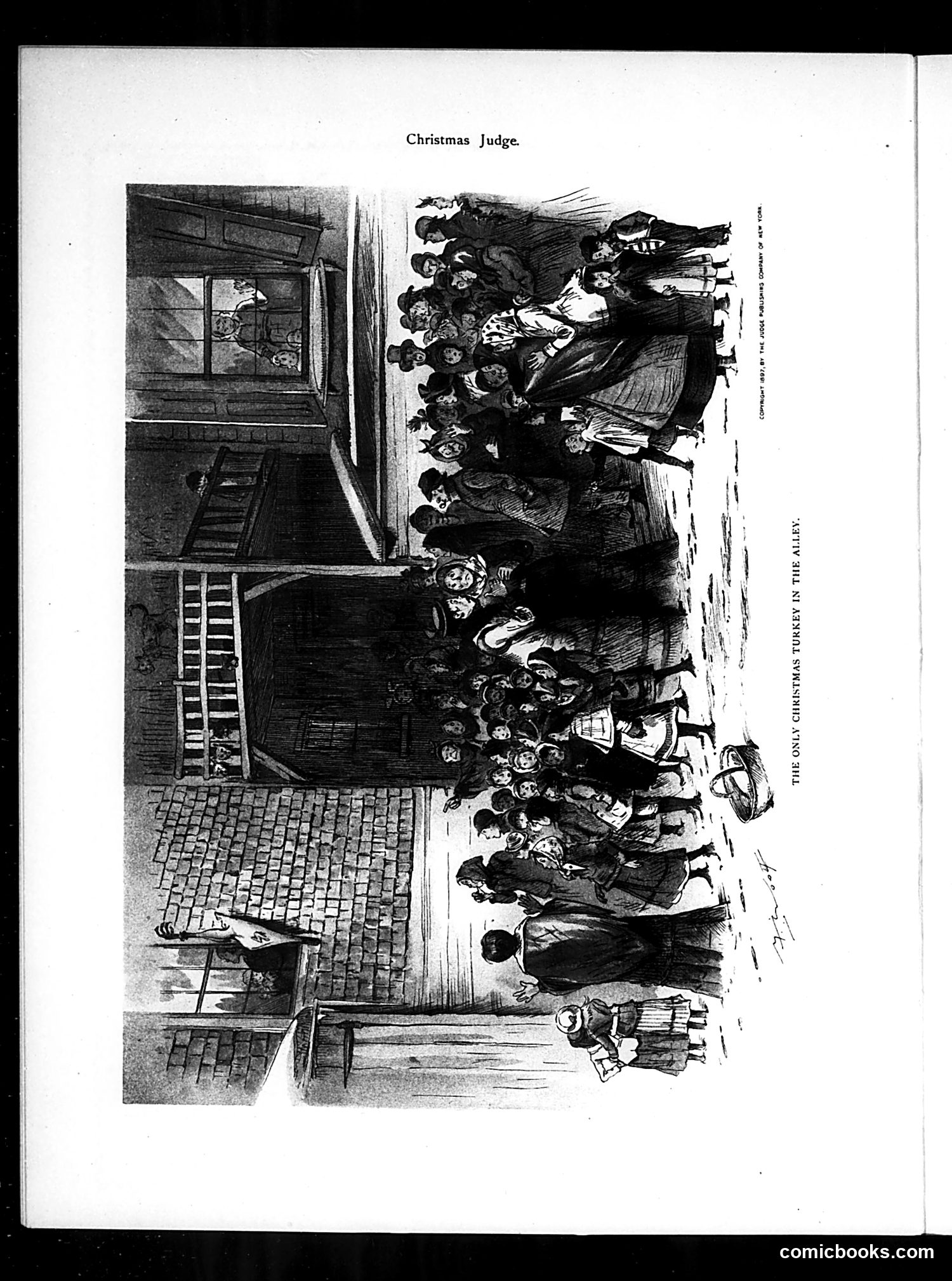
This page titled "Christmas Judge" depicts a crowded interior scene, likely a courtroom or judicial setting. The image shows numerous figures gathered around what appears to be a judge's bench or elevated seat on the left. The style and composition suggest this is social or political satire about the judicial system during the Christmas season. The OCR text is largely corrupted and unreadable, making specific identification of figures or precise political references unclear. However, the cartoon likely satirizes either: judicial corruption, overcrowded courts, the treatment of poor defendants during the holidays, or judicial incompetence during the Christmas period. Without legible text or clearer visual details identifying specific historical figures or events, I cannot confidently specify which particular judge, case, or political moment this references.
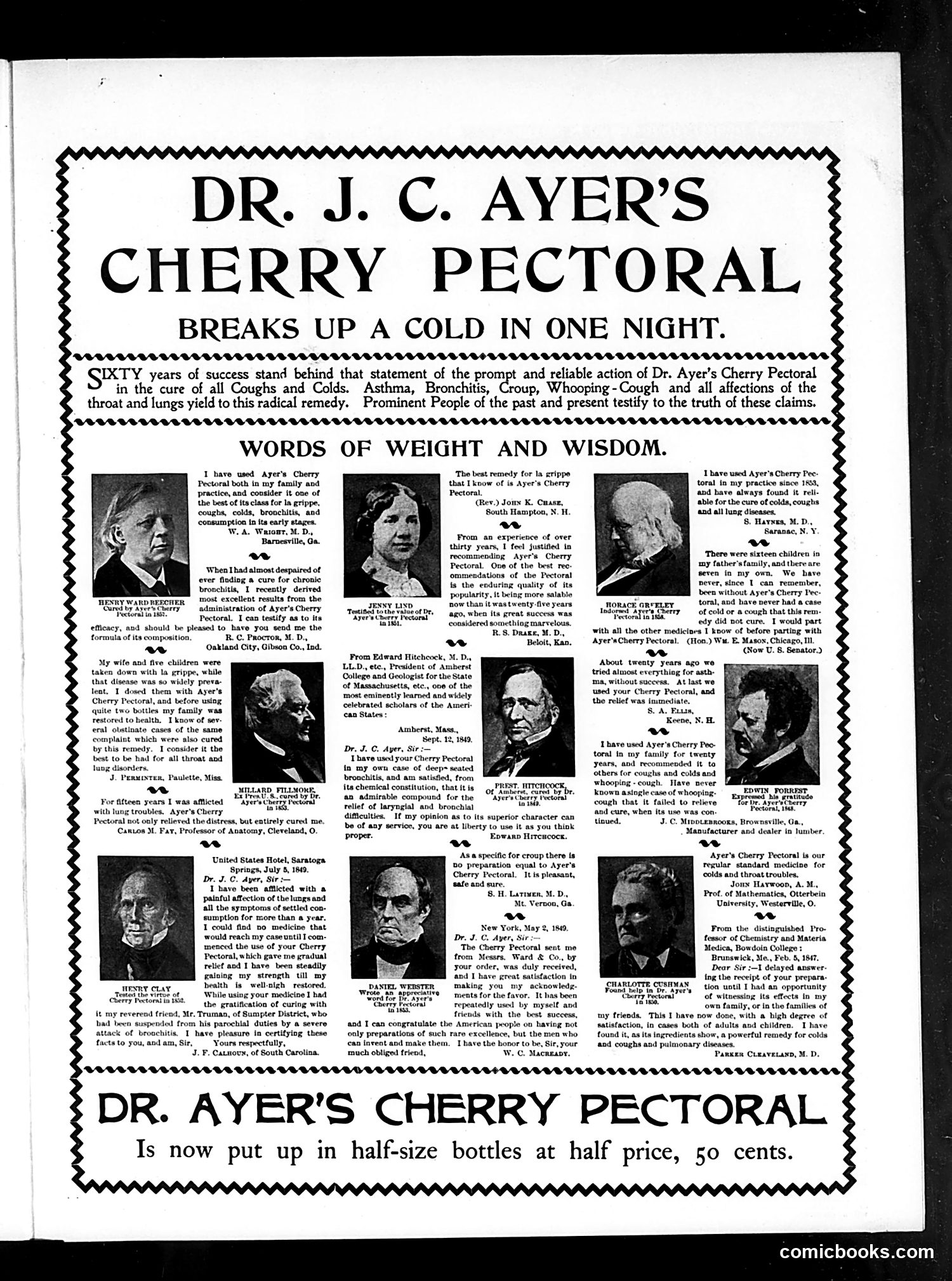
This is **not a cartoon or satirical content**—it's a full-page advertisement for Dr. Ayer's Cherry Pectoral, a 19th-century patent medicine. ## What This Is A testimonial advertisement featuring photographs of prominent people (physicians, clergy, educators, and celebrities like Jenny Lind, the famous Swedish singer) endorsing a cough syrup that claims to "break up a cold in one night." ## Historical Context This reflects pre-FDA regulation medicine marketing (likely 1880s-1890s based on style). Patent medicines made extravagant health claims without scientific evidence. The use of authority figures' endorsements—especially doctors and respected public figures—was standard persuasion tactics of the era, before such testimonials were regulated or scrutinized. ## The Point By modern standards, this appears as amusing snake-oil salesmanship. The "sixty years of success" claim and the parade of credentialed endorsers were designed to appear scientific and trustworthy, but made unsubstantiated medical promises that would be illegal under today's consumer protection laws.
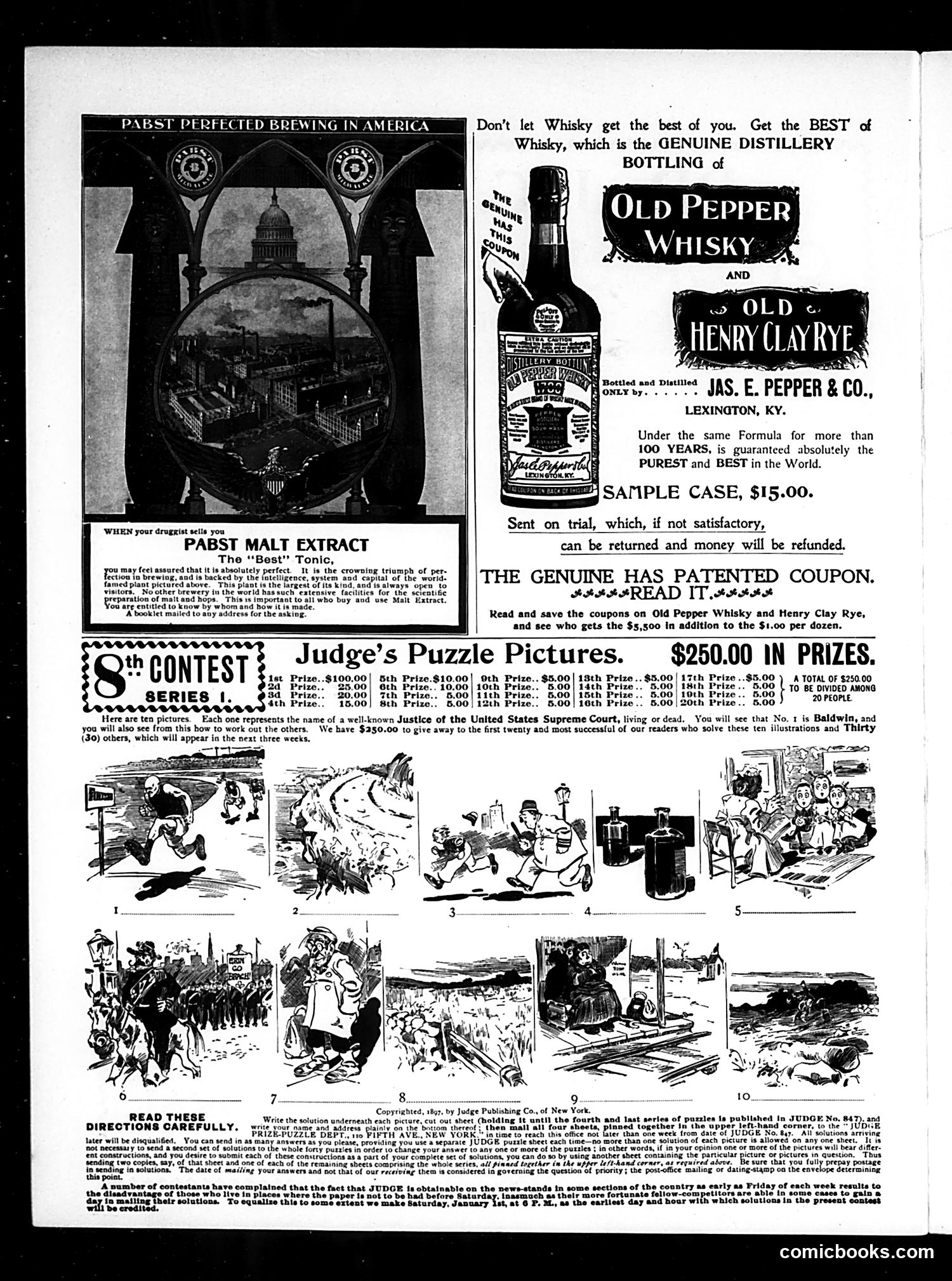
This page is primarily **advertising and contest content** rather than political satire. The upper section contains two whisky advertisements: Pabst Malt Extract (promoted as a health "tonic") and Old Pepper Whisky/Henry Clay Rye, both marketed with claims of purity and quality. These ads reflect the era's patent medicine culture and before modern food/drug regulations. The main content is Judge's "**Puzzle Pictures**" contest—readers must identify ten U.S. Supreme Court justices from illustrated scenes (one example shown: "Baldwin"). The contest offers $250 in prizes ($20,000+ in modern value) across thirty puzzles published over three weeks. The detailed instructions emphasize proper submission format: cutting, pinning sheets, including addresses, and mailing to the magazine's Fifth Avenue office. **No political commentary is evident.** This page demonstrates how early magazines monetized reader engagement through contests while selling patent medicines and spirits—common practices before advertising regulation.
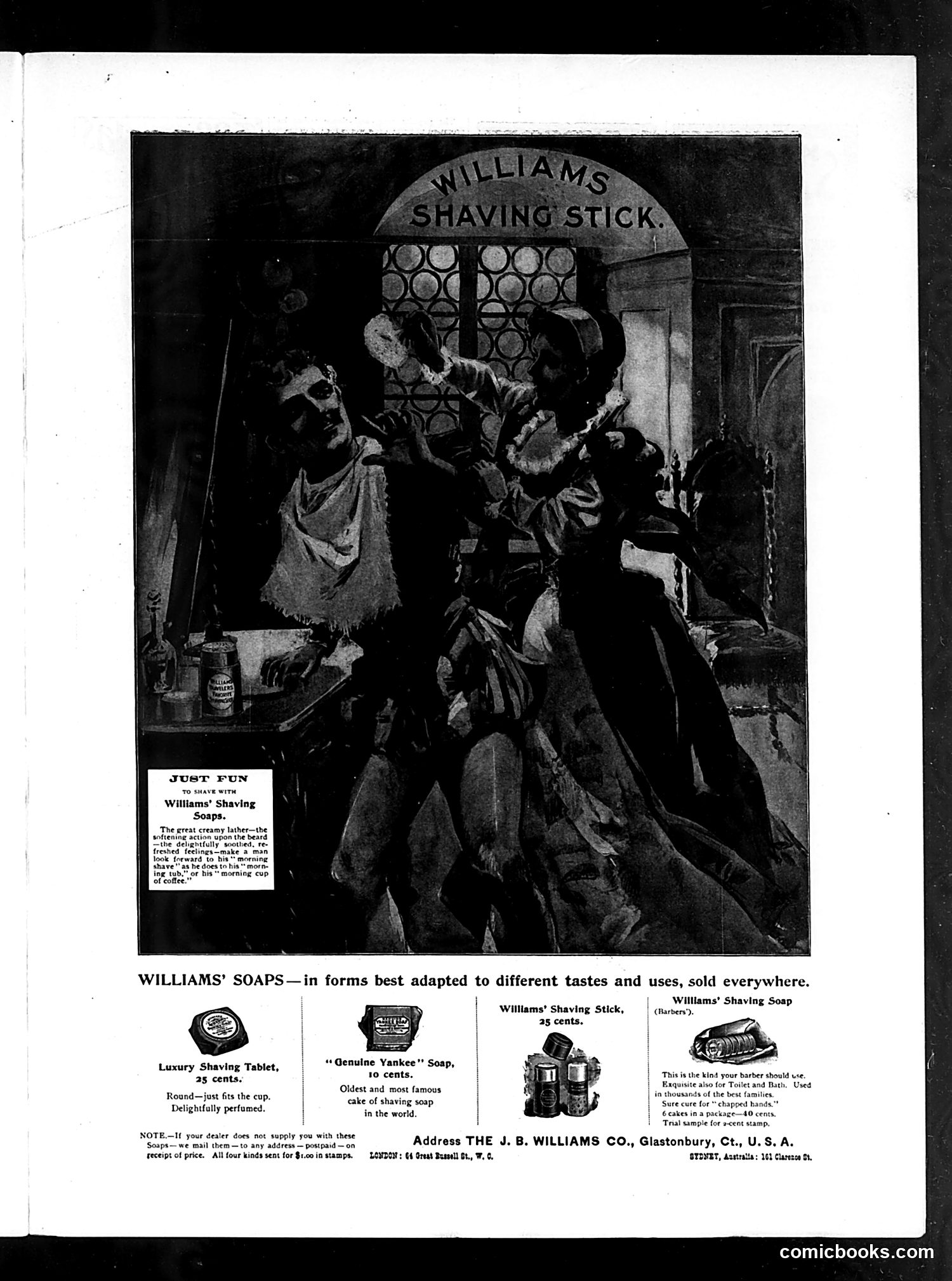
This page is primarily **advertising, not political satire**. It presents a product advertisement for Williams' Shaving Soaps by the J.B. Williams Company. The large illustration depicts a comedic barbershop scene—likely meant to be humorous rather than satirical—showing a barber applying shaving lather to customers' faces. The caption reads "JUST FUN / TO SHAVE WITH / Williams' Shaving Soaps," emphasizing the product's pleasant user experience. Below, the ad displays four product variants: a Luxury Shaving Tablet, "Genuine Yankee" Soap, a Shaving Stick, and a Barber's Shaving Soap, each with prices and descriptions highlighting their quality and uses. The ad notes availability at dealers or through mail order. This is a straightforward commercial advertisement typical of Judge magazine's revenue model, not editorial satire or political commentary.
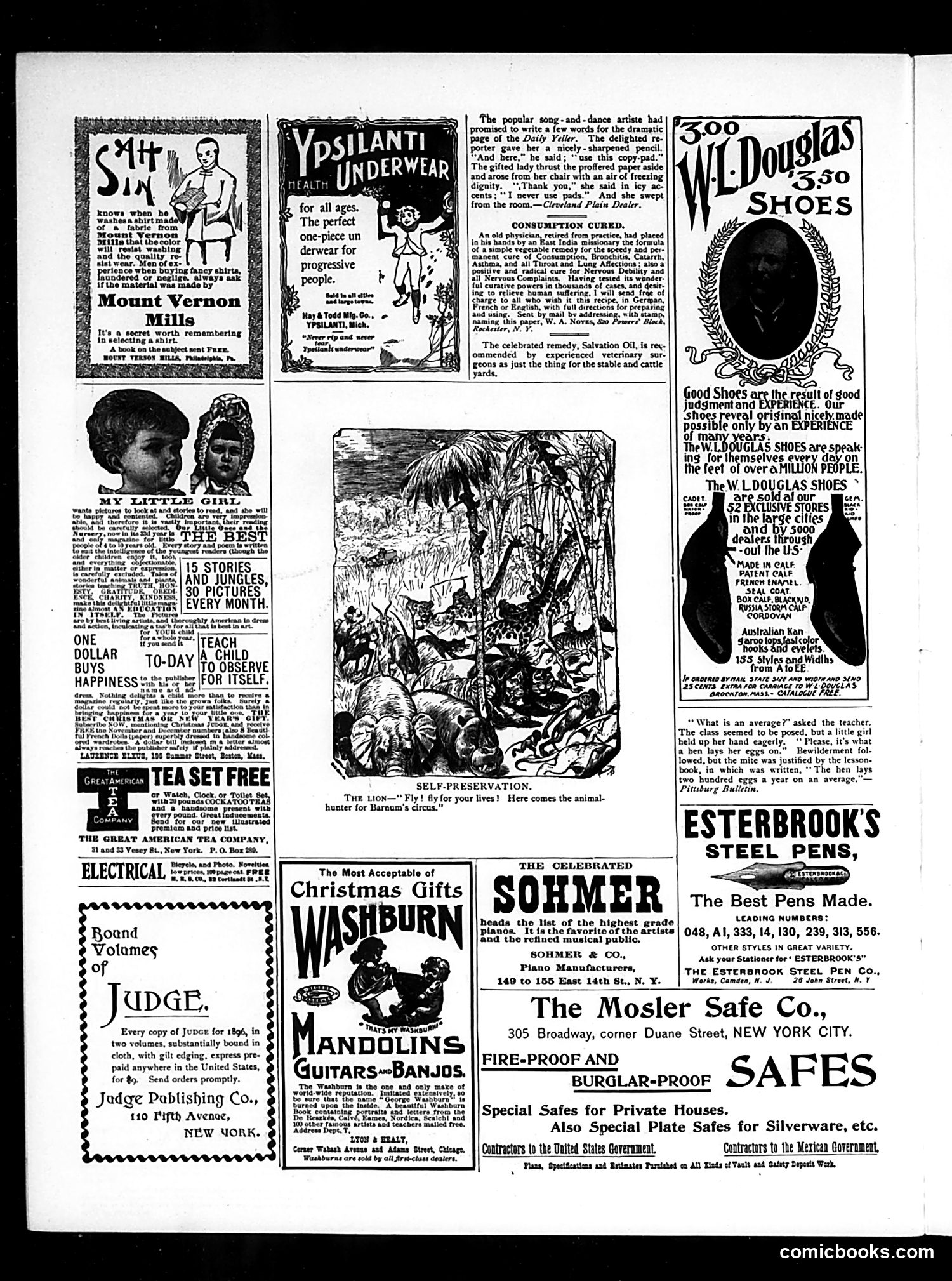
This page is primarily **advertising** with one small cartoon joke. The main satirical content is minimal. **The Cartoon ("Self-Preservation"):** A simple visual gag shows animals fleeing with the caption "Fly! fly for your lives! Here comes the animal-hunter for Barnum's circus." This references P.T. Barnum's famous traveling circus, which captured and displayed exotic animals. The joke plays on animals' instinctive fear of capture. **Other Notable Content:** - A brief joke about a song-and-dance actress who refuses to write on a "pad," claiming she "never uses pads"—likely a play on words about theatrical egos or cleanliness - A joke about a student misunderstanding "average" (thinking it's a nest because hens "lay eggs on an average") **The Rest:** The page consists almost entirely of period product advertisements: shirt fabric (Mount Vernon Mills), underwear (Ypsilanti), shoes (W.L. Douglas), musical instruments (Washburn), safes, and writing pens. This reflects Judge's business model of mixing editorial content with paid advertising.
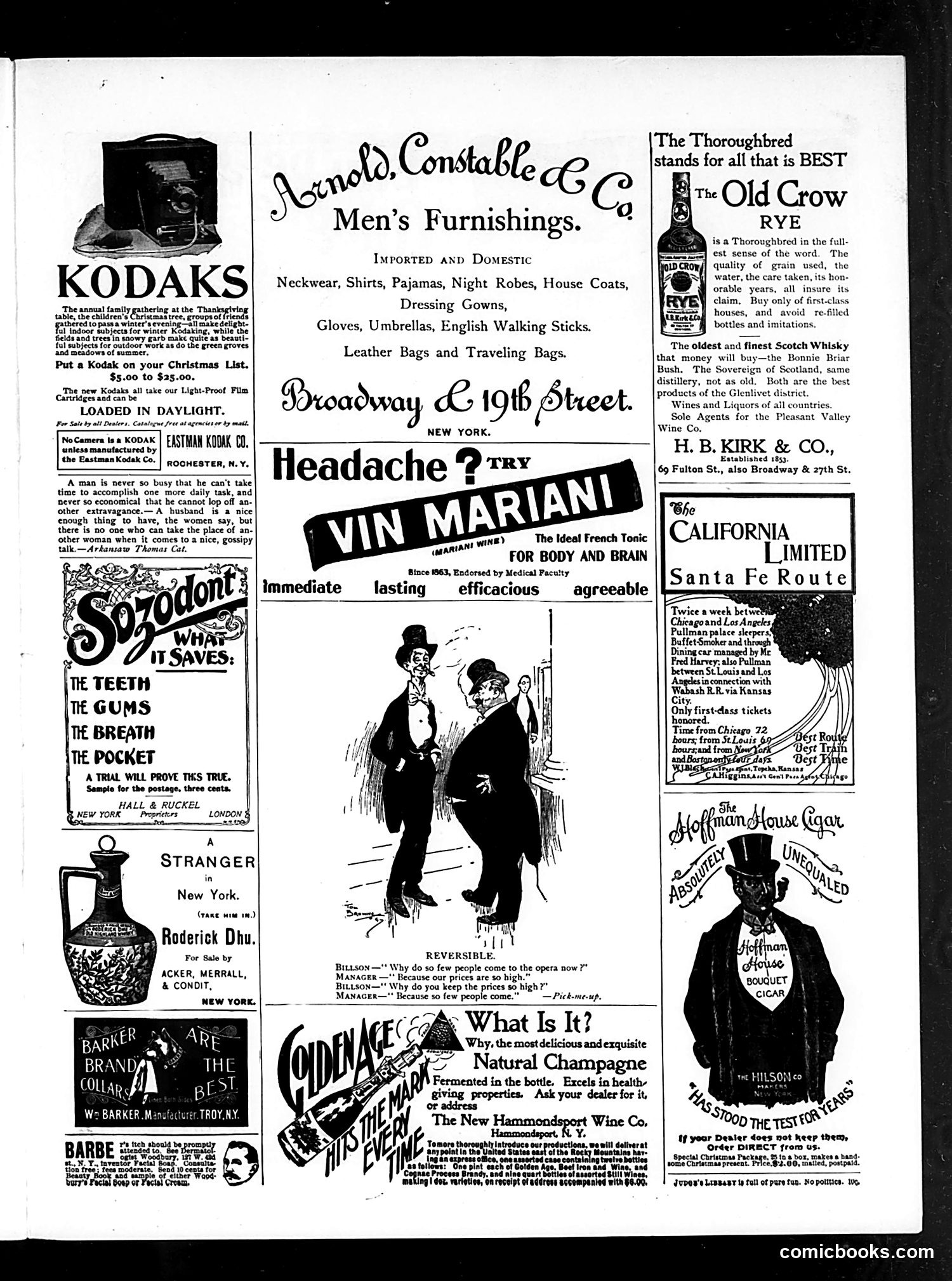
This is primarily an **advertising page** from Judge magazine, featuring various consumer product ads from the early 1900s (Kodak cameras, whiskey, patent medicines, railroads). The only **satirical cartoon** on the page is titled "REVERSIBLE," showing two well-dressed men in conversation. The joke presents a circular economic logic problem: **The Setup:** One man asks why so few people attend the opera now, given its high prices. The other responds that prices are high *because* so few people attend. When asked why prices remain high despite low attendance, he replies it's *because* attendance is low. **The Satire:** This mocks the absurd circular reasoning of theater management—they've created a self-fulfilling prophecy where high prices discourage attendance, which then justifies keeping prices high. It's a critique of poor business logic and elitism that prices out the middle class from cultural venues, ultimately harming the opera itself. The cartoon captures a real tension in early 1900s American entertainment: venues pricing themselves into decline while blaming market conditions rather than their own decisions.
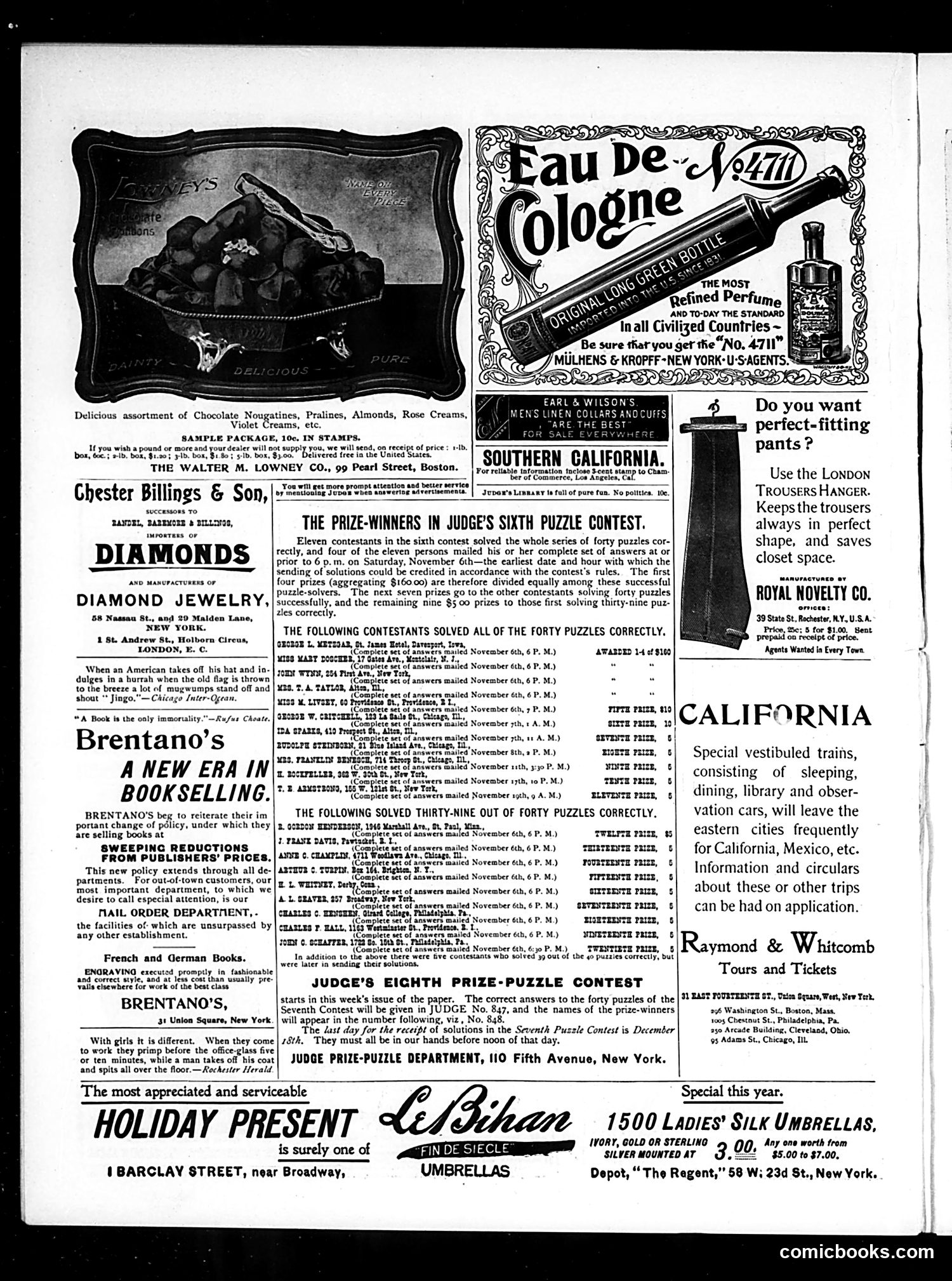
This Judge magazine page contains no political cartoon or satire. It's dominated by: **Contest Results**: Judge's sixth puzzle contest, listing winners who solved 40 puzzles correctly. Four contestants tied for first prize ($25 each), with seven others receiving $10 prizes and nine receiving $5 prizes. **Advertisements**: Including chocolates (Lowney), diamonds (Chester Billings & Son), Eau de Cologne, London Trousers Hanger, California train travel, Raymond & Whitcomb tours, and Le Bihan umbrellas. **Small Quoted Items**: Brief humorous observations, such as one contrasting how American men and women behave at work. The page functions as a typical early-1900s magazine spread mixing editorial content with revenue-generating paid advertising. There is no discernible satirical commentary or cartoon to analyze.
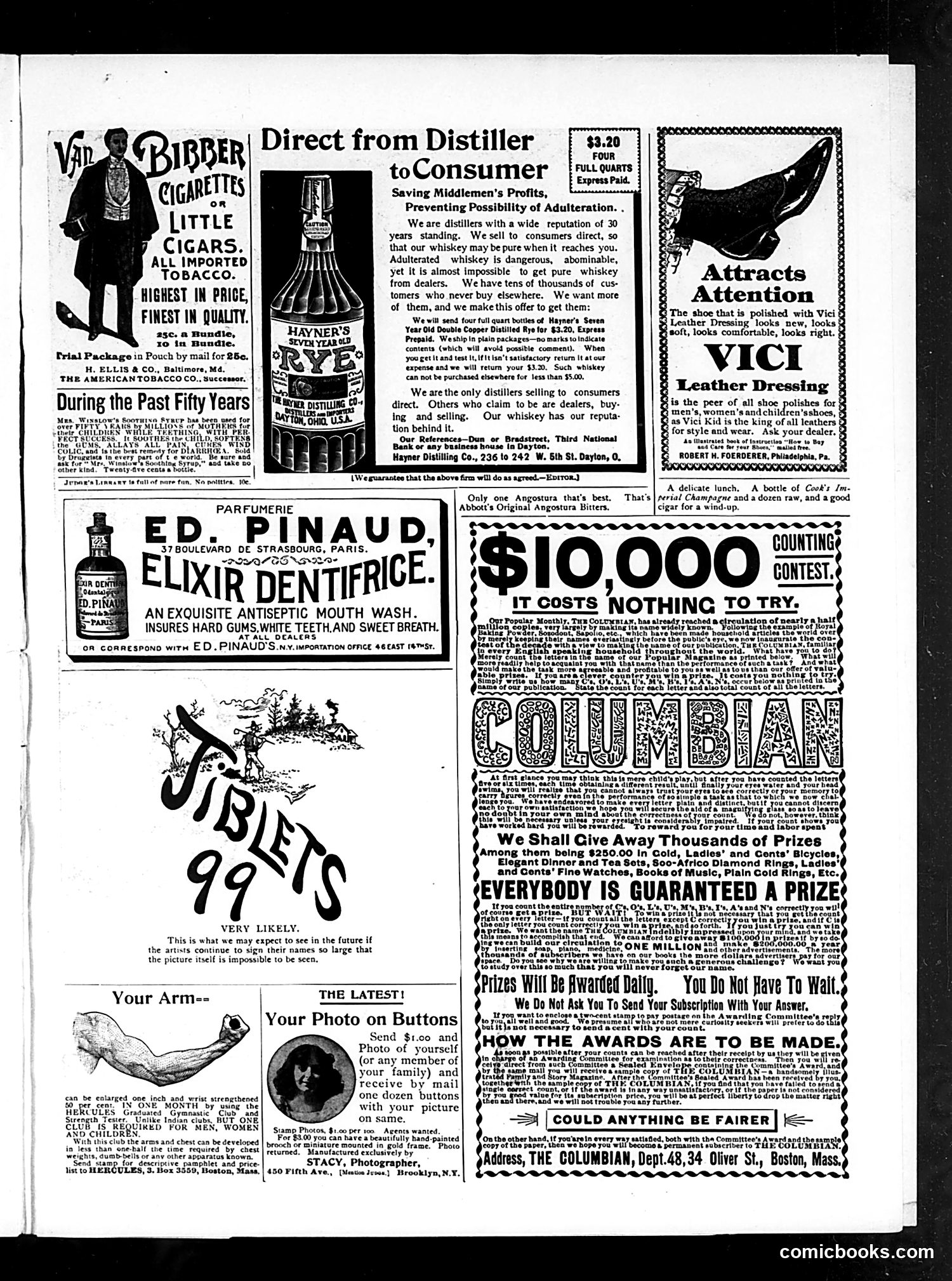
This page is primarily **advertising**, not political satire. It contains multiple product advertisements typical of early 1900s magazines: The dominant content includes whiskey direct-sales pitches (Hayner Distilling), shoe polish (Vici), cigars (Van Bibber), dental products (Ed. Pinaud), and a large **$10,000 prize contest** from "The Columbian" magazine promising giveaways of bicycles, watches, and diamond rings. The small cartoon at bottom-left titled "SIBLETS" appears to be self-referential humor about magazine illustration—commenting that artists' signatures have become so large they obscure the actual artwork. The only potentially satirical element is the upper-left ad claiming direct whiskey sales prevent adulteration, which implicitly mocks dealers' practices. Otherwise, this is a straightforward advertisement page showcasing common early-20th-century consumer goods and dubious prize-contest schemes that were prevalent in period publications.
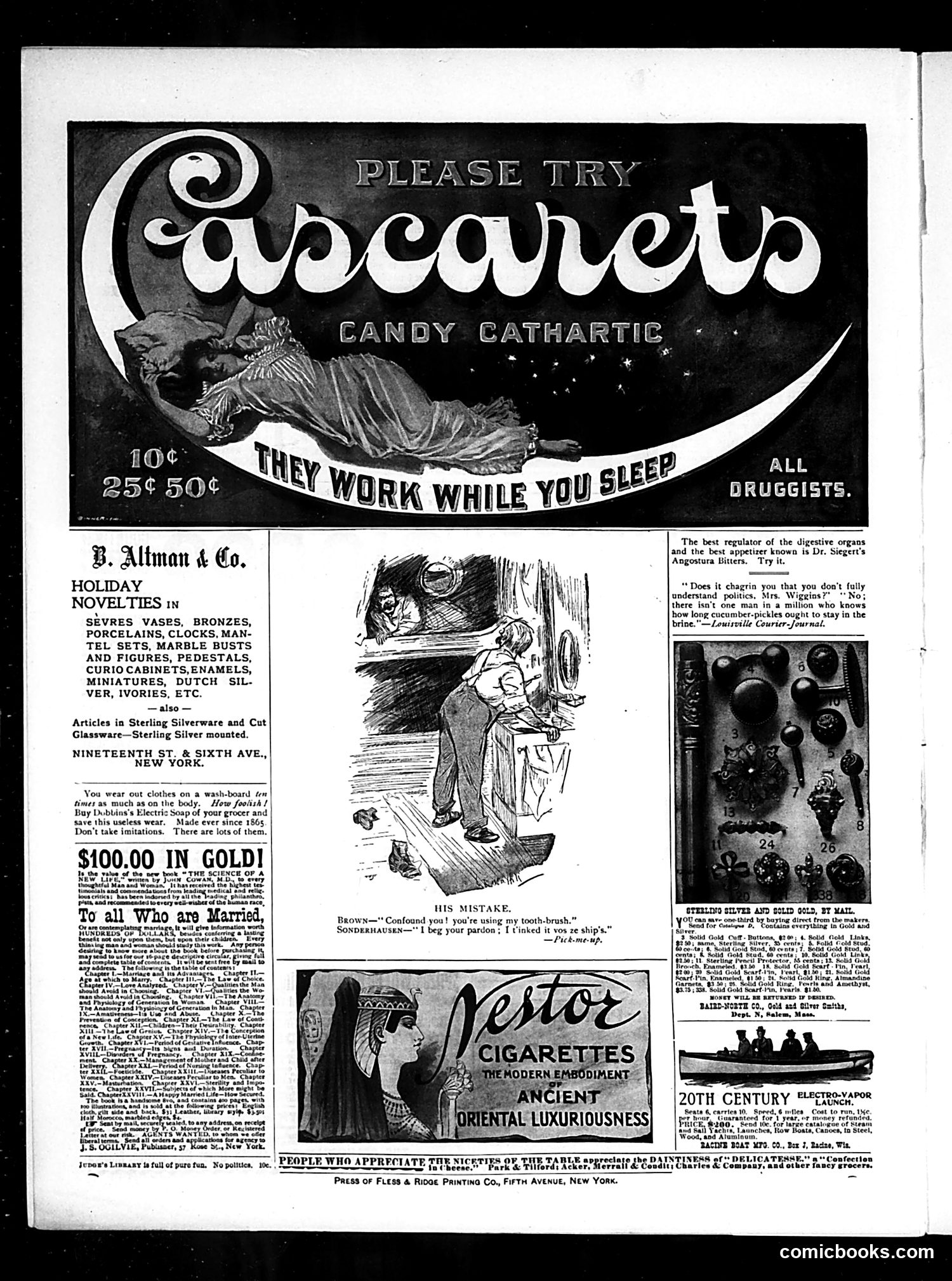
This appears to be primarily an **advertising page** from Judge magazine, dominated by commercial notices rather than political satire. The main cartoon, titled "His Mistake," shows two figures—Brown and Sonderhausen—in a humorous misunderstanding about a toothbrush versus a ship. The joke relies on a thick accent ("tinked it vos ze ship's"), typical of early-20th-century ethnic humor stereotyping German immigrants. The comedy is simple domestic farce. Above this is a brief text joke from the Louisville Courier-Journal, also domestic humor about wives not understanding politics. The page is otherwise filled with **advertisements**: Altman & Co.'s holiday novelties, Cascarets candy laxatives ("they work while you sleep"), Dubbins's soap, sterling silver items, Nestor cigarettes, and Dr. Siegert's bitters. These reflect period consumer goods and patent medicine claims (notably laxatives and digestive aids). The "$100 in Gold" reference appears to be a contest or prize offer. **The satirical content is minimal**—this is fundamentally a commercial product page using light humor to support advertising revenue.
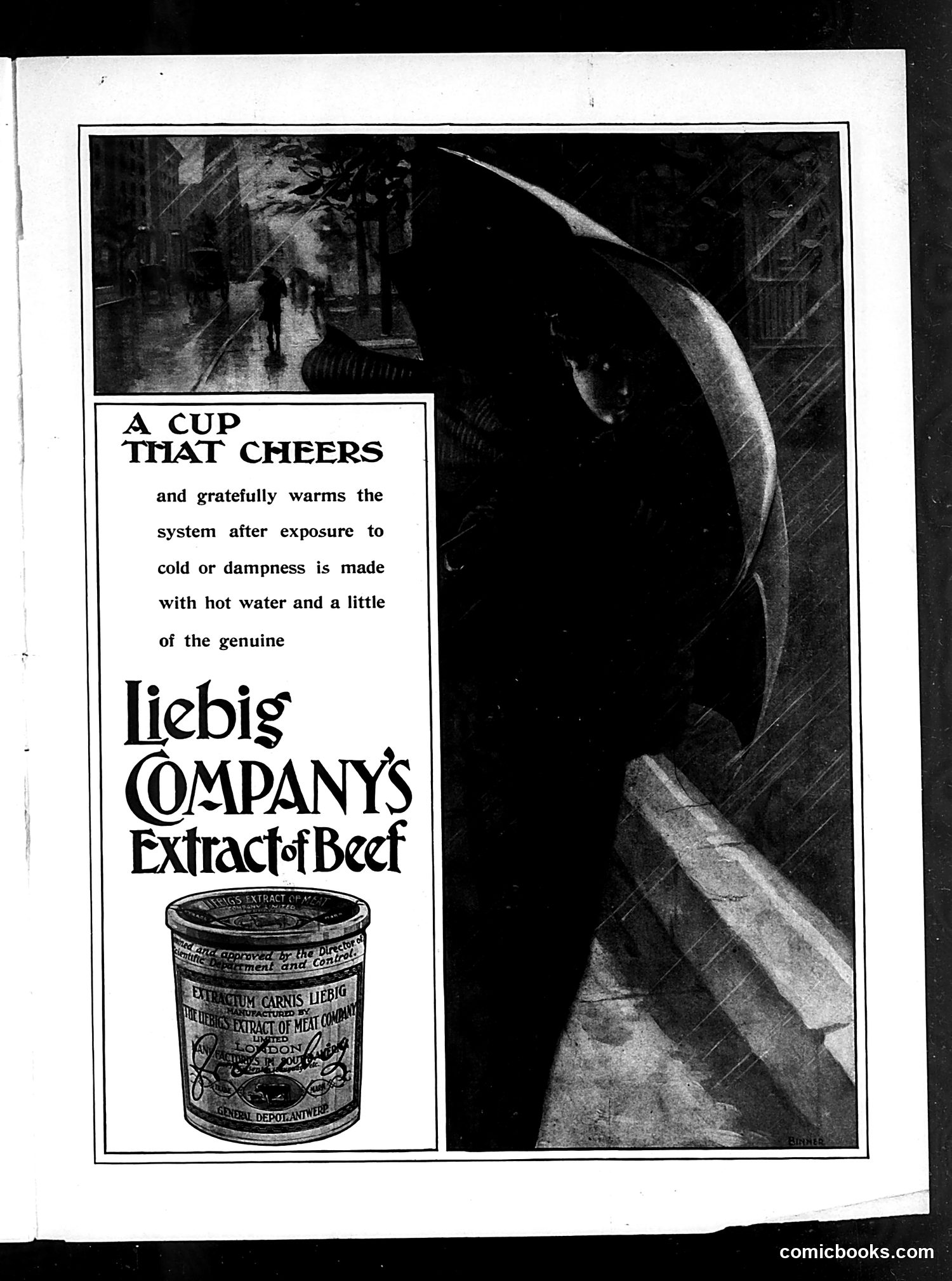
This page is primarily an **advertisement** for Liebig Company's Extract of Beef, not political satire. The left side contains promotional copy describing the product as warming and cheering after cold exposure. The right side shows a photograph of a person in dark clothing holding a cup, presumably demonstrating the product's comfort. The "A Cup That Cheers" headline plays on the famous phrase about tea from Cowper's poem, positioning beef extract as similarly comforting. The Liebig extract was a popular Victorian-era beef bouillon product marketed for its restorative health properties. This represents typical early 20th-century *Judge* magazine advertising rather than satirical content—magazines regularly mixed editorial cartoon material with advertisements to fund publication.
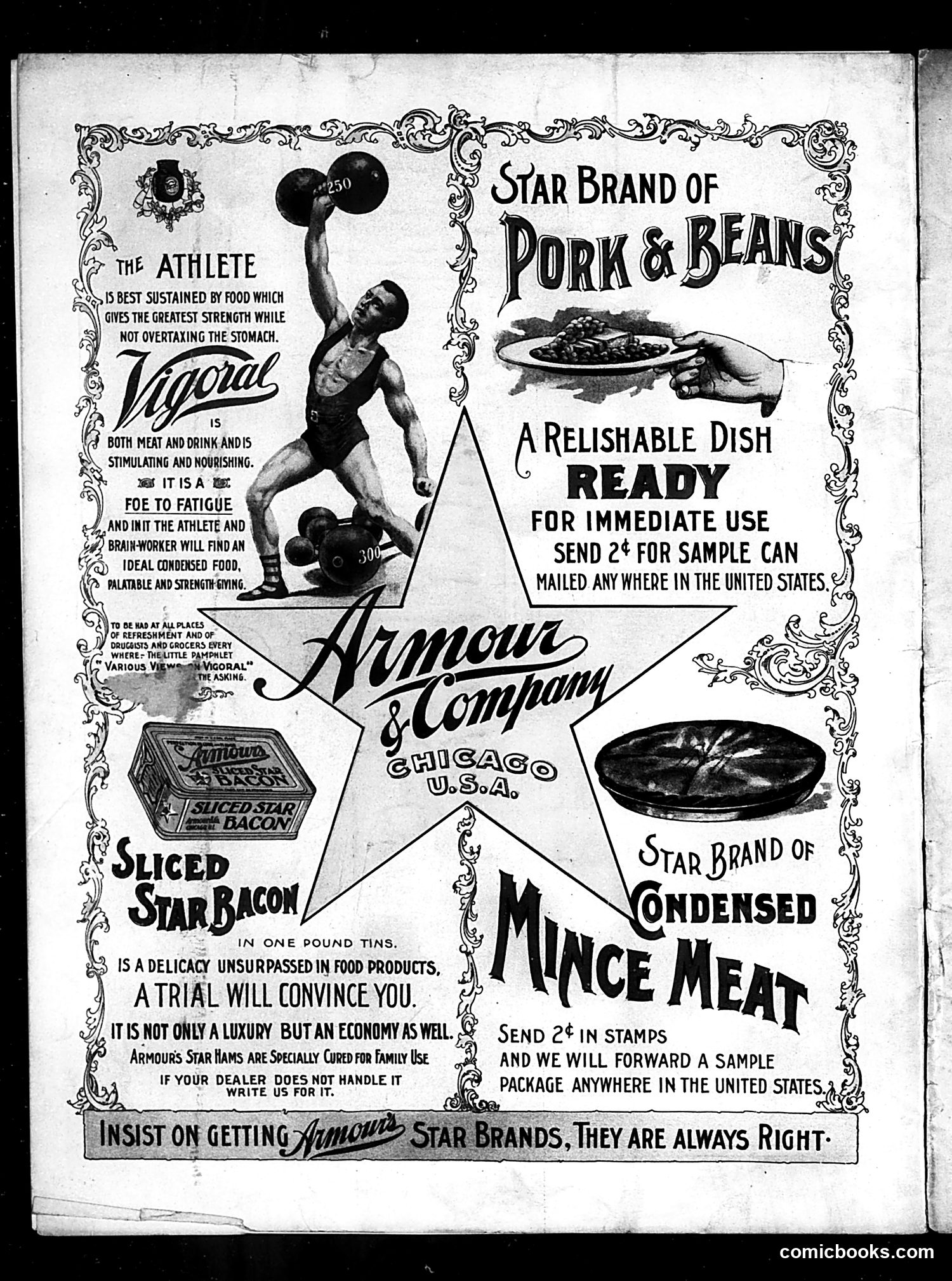
This is primarily **advertising content**, not satire or political commentary. The page features Armour & Company meat product advertisements from Chicago. The central image shows a muscular athlete lifting dumbbells, used to promote Vigoral (appears to be a meat-based food product). The ad claims meat provides strength without stomach burden—a common early 20th-century health marketing pitch. Three Star Brand products are advertised: Pork & Beans, Sliced Star Bacon, and Condensed Mince Meat. Each offers sample cans for 2¢ in stamps. The page reflects period marketing assumptions: athletes need meat for strength, convenience foods are economical luxuries, and working people (including "brain-workers") require substantial meat-based nutrition. There's no apparent satirical intent—Judge simply sold advertising space to major meat packers targeting readers.
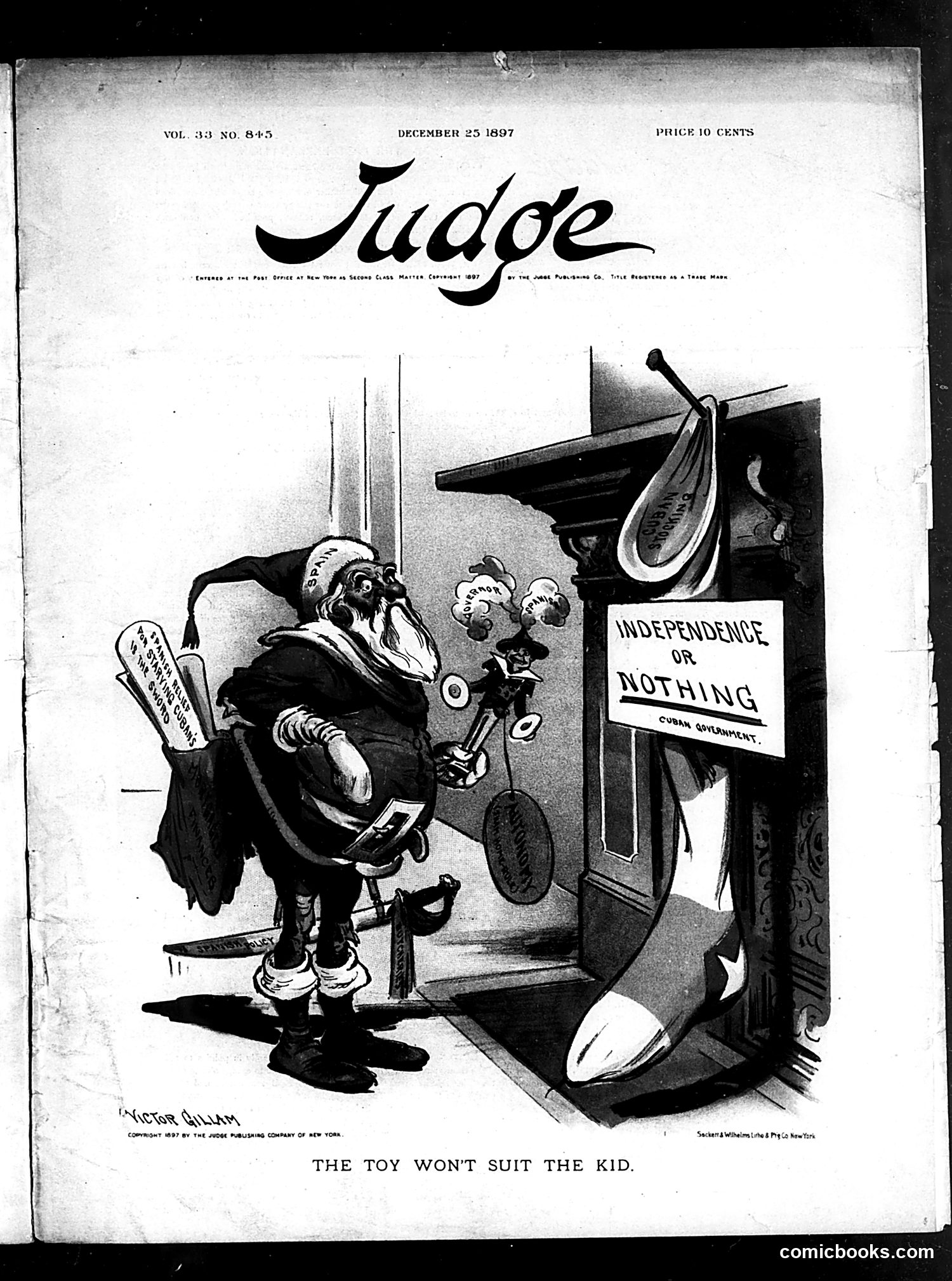
This political cartoon satirizes Cuba's struggle for independence from Spain. The "toy" refers to Cuban independence or self-governance, presented as unsuitable for Cuba (depicted as a child). An old man with a beard—representing Spain or Spanish authority—examines the toy labeled "INDEPENDENCE OR NOTHING" (Cuban Government demand), appearing skeptical or dismissive. The satire critiques Spain's unwillingness to grant Cuba genuine autonomy, treating Cuban self-determination as an impractical plaything. Published during the final years before the Spanish-American War (1898), the cartoon reflects American public discourse about Spanish colonial oppression in Cuba. The metaphor of a child receiving an unsuitable gift mocks Spain's paternalistic refusal to acknowledge Cuba's mature political demands.
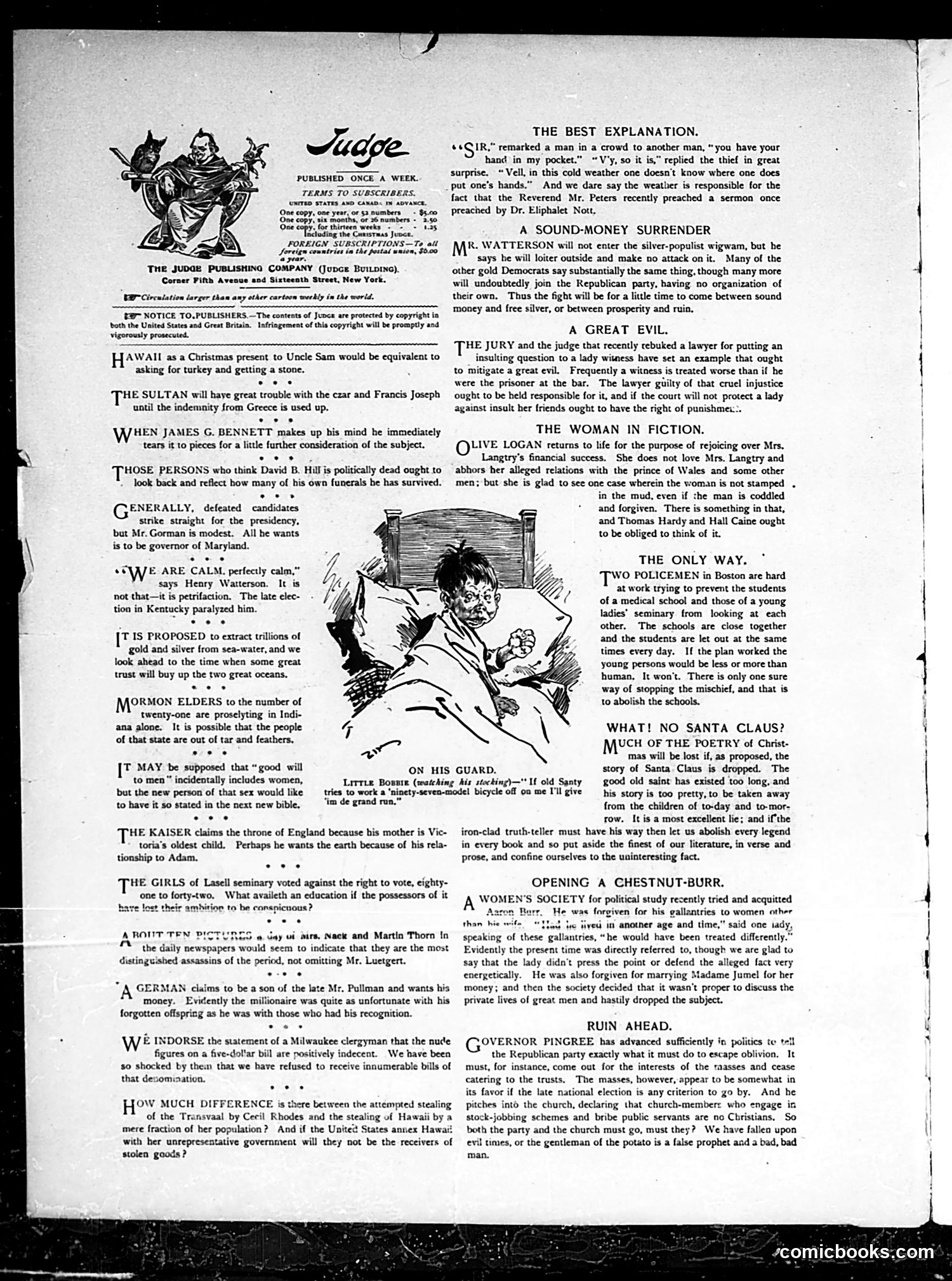
This is a typical Judge editorial page mixing brief satirical comments with cartoons. The main visible cartoon shows a child guarding his Christmas stocking from Santa Claus, making a joke about a "ninety-seven-model bicycle"—contemporary humor about unreliable new technology. The brief editorial items mock various political and social figures of the era: James G. Bennett (newspaper publisher), Henry Watterson (Kentucky editor), the German Kaiser claiming England's throne, Mormon missionaries in Indiana, and debates over Hawaiian annexation. One item ridicules Lasell seminary girls voting against women's suffrage. Another mocks the "good will to men" Christmas phrase for excluding women. The "Best Explanation" reprints a joke about a pickpocket caught with his hand in someone's pocket, then blames the weather—apparently paralleling a sermon plagiarism scandal involving Reverend Peters and Dr. Nott. Overall, these are quick jabs at contemporary politics, religion, and social hypocrisy typical of 1890s satirical journalism.
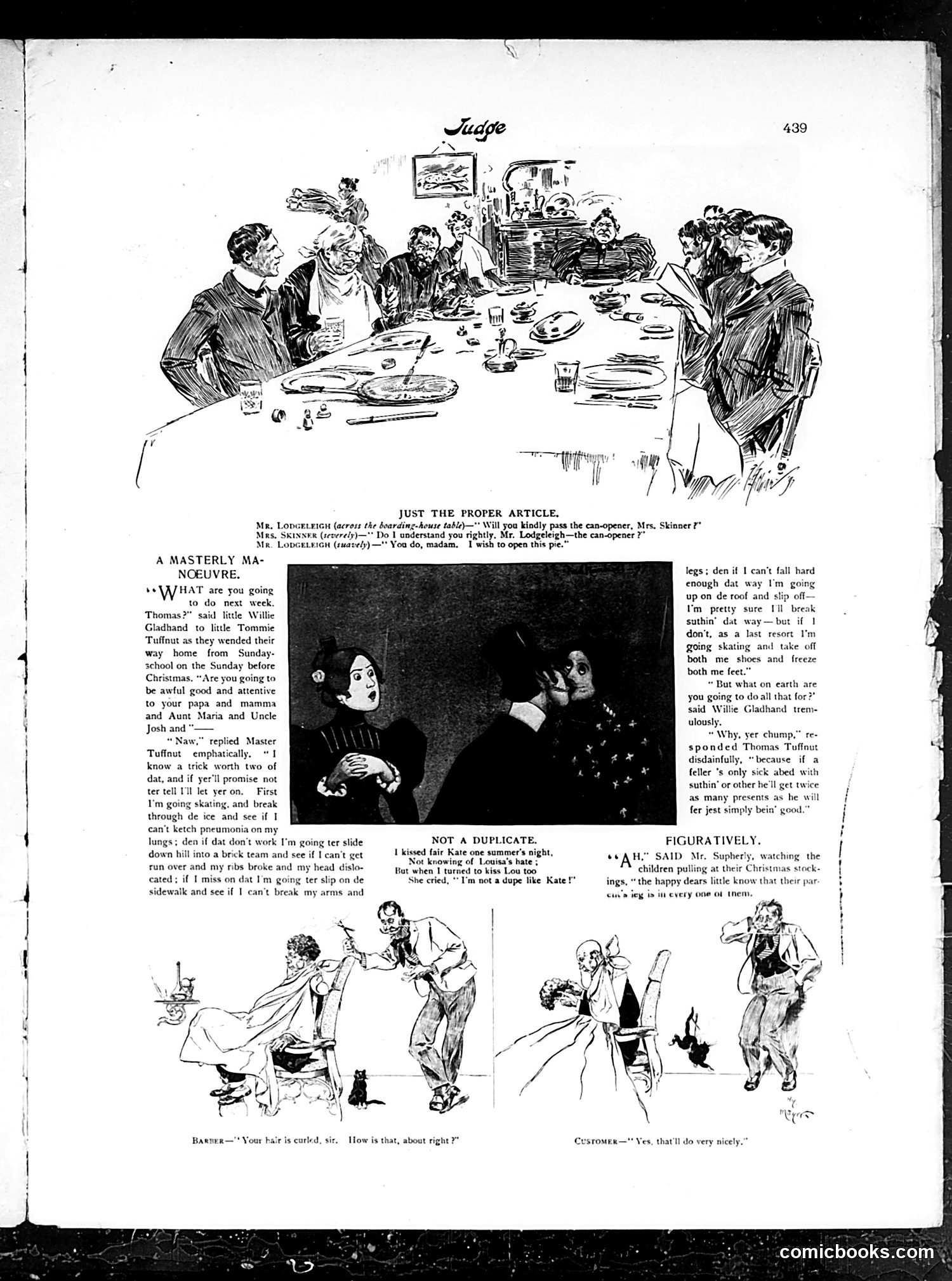
This page contains satirical humor typical of Judge magazine's style: **"Just the Proper Article"** depicts a boarding-house dinner scene where Mr. Lodgeleigh repeatedly asks Mrs. Skinner to pass a "can-opener," eventually revealing he wants to open a pie. The joke plays on miscommunication and social awkwardness—the absurdity of requesting a can-opener at a dinner table suggests either deliberate rudeness or confusion, mocking pretentious boarding-house etiquette. **"A Masterly Manoeuvre"** presents a monologue by young Thomas Tuffnut explaining his Christmas strategy: he'll deliberately injure himself (pneumonia, broken ribs, broken arms, frostbite) to receive more presents while bedridden than if merely "good." The satire mocks both children's manipulative logic and the era's culture of gift-giving excess. The remaining illustrated vignettes show barber and customer interactions, likely satirizing everyday social conventions of the period. The overall tone critiques American middle-class manners, materialism, and the dubious logic employed by children and adults alike.