
Judge, 1897-12-18 · page 22 of 53
Judge — December 18, 1897 — page 22: what you’re looking at
What you’re looking at
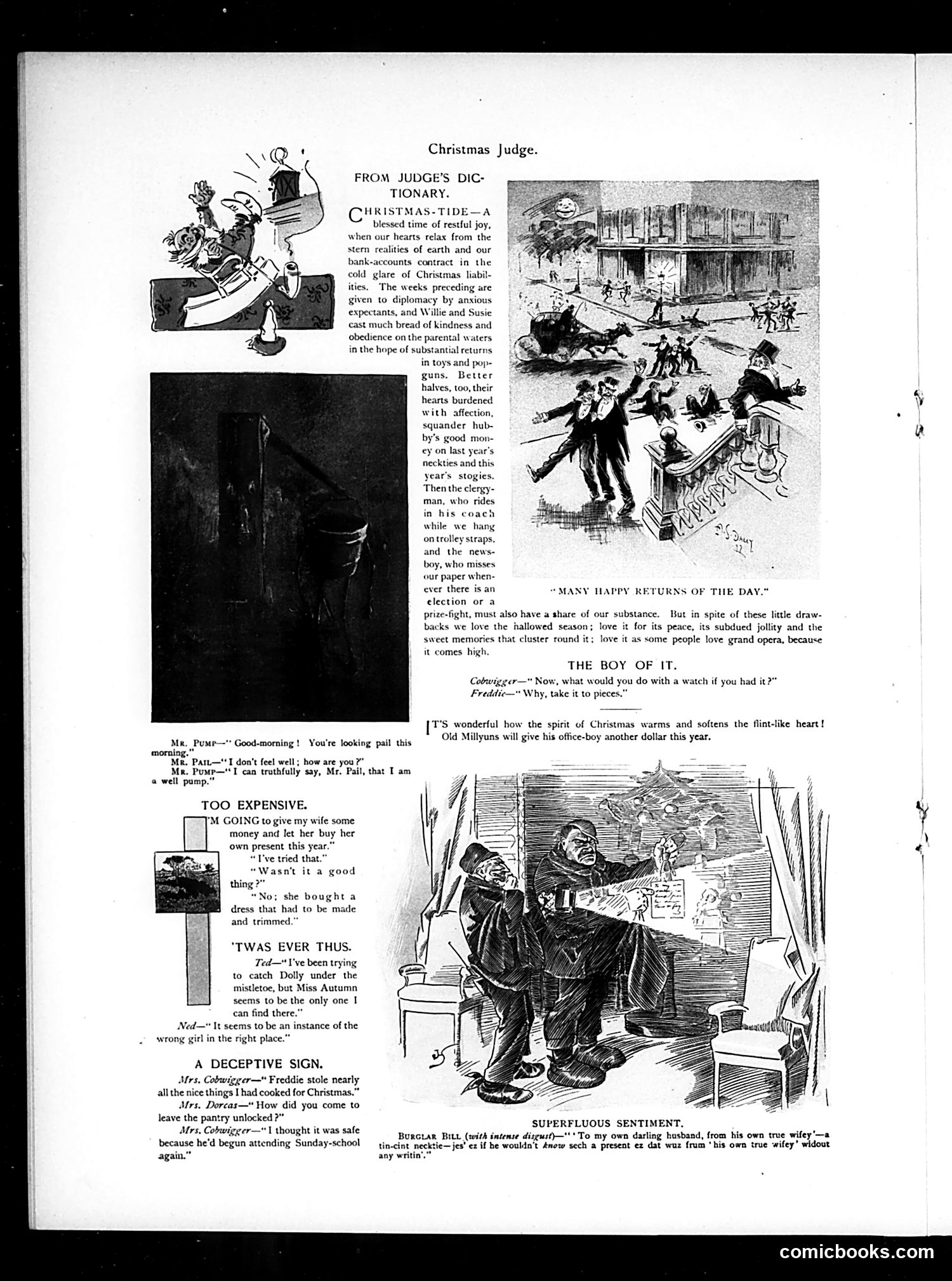
This page from Judge magazine presents holiday-themed humor mocking Victorian-era Christmas customs and hypocrisy. The "Dictionary" definition satirizes how Christmas spending contradicts its spiritual meaning—families go into debt buying gifts while children perform obedience to earn toys, wives squander husbands' money on neckties, and even clergy and newsboys demand compensation. The accompanying comic sketches mock specific Christmas behaviors: a wife buying an expensive dress despite her husband's cost-cutting attempt; a boy wanting to disassemble a watch rather than appreciate it; failed mistletoe romance; and a burglar disgusted by a wife's generic gift inscription to her husband, implying marital indifference hidden behind sentimental gestures. The satire targets bourgeois materialism, domestic tension, and the gap between Christmas's supposed spiritual values and actual greedy, cynical behavior—particularly how money and social obligation drive the season rather than genuine affection.
📄 Transcribed text from this page (OCR, searchable)
Machine-transcribed from the original scan — historical spelling and the odd misread are preserved.
Christmas Judge. FROM JUDGE'S DIC- TIONARY. CHRISTMAS-TIDE—A blessed time of restful joy, when our hearts relax from the stem realities of earth and our bank-accounts contract in the cold glare of Christmas liabil- ities. The weeks preceding are given to diplomacy by anxious expectants, and Willie and Susie cast much bread of kindness and obedience on the parental waters in the hope of substantial returns in toys and pop- guns. Better halves, too, their hearts burdened with affection, squander hub- by's good mon- ey on last year's neckties and this, year’s stogies. Then the clergy- man, who rides in his coach while we hang on trolley straps, and the news- boy, who misses our paper when- ever there is an election or a MANY HAPPY RETURNS OF THE DAY." prize-fight, must also have a share of our substance. But in spite of these little draw- backs we love the hallowed season; love it for its peace, its subdued jollity and the sweet memories that cluster round it; love it as some people love grand opera, because it comes high. THE BOY OF IT. Cobwigger—" Now, what would you do with a watch if you had it?” Freddie—" Why, take it to pieces.” [7°S wonderful how the spirit of Christmas warms and softens the flint-tike heart! Mi: Pune" Good-noraiog’ “You're looking jail this Old Millyuns will give his office-boy another dollar this year. morning. MR. ParL—"I don't feel well ; how are you?” Mr. Pump—T can truthfully say, Mr. Pail, that T am well pump.”” TOO EXPENSIVE. 'M GOING to give my wife some money and let her buy her own present this year.” I've tried that Wasn't it a good —* 0; she bought a dress that had to be made and trimmed.” “TWAS ER THUS. Ted— I've been trying to catch Dolly under the mistletoe, but Miss Autumn seems to be the only one I can find there.” Yed—" It seems to be an instance of the wrong girl in the right place.”* A DECEPTIVE SIGN. Mrs, Cobwigger—" Freddie stole nearly all the nice things I had cooked for Christmas.” Mrs, Dorcas—" How did you come to : leave the pantry unlocked ?" rE Mrs, Cohvigger—"1 thought it was safe Sve Oe ee ‘ : BURGLAR Bite (with intense disgust)—"'* To my own darling husband, from his own true wifey’—a because he'd begun attending Sunday-school gin.cint _necktie— jes’ ez if he wouldn't Anow sech a present ez dat wuz frum ‘his own true wifey’ widout again.” ‘tin’. comicbooks.com