
A complete issue · 16 pages · 1891
Judge — July 18, 1891
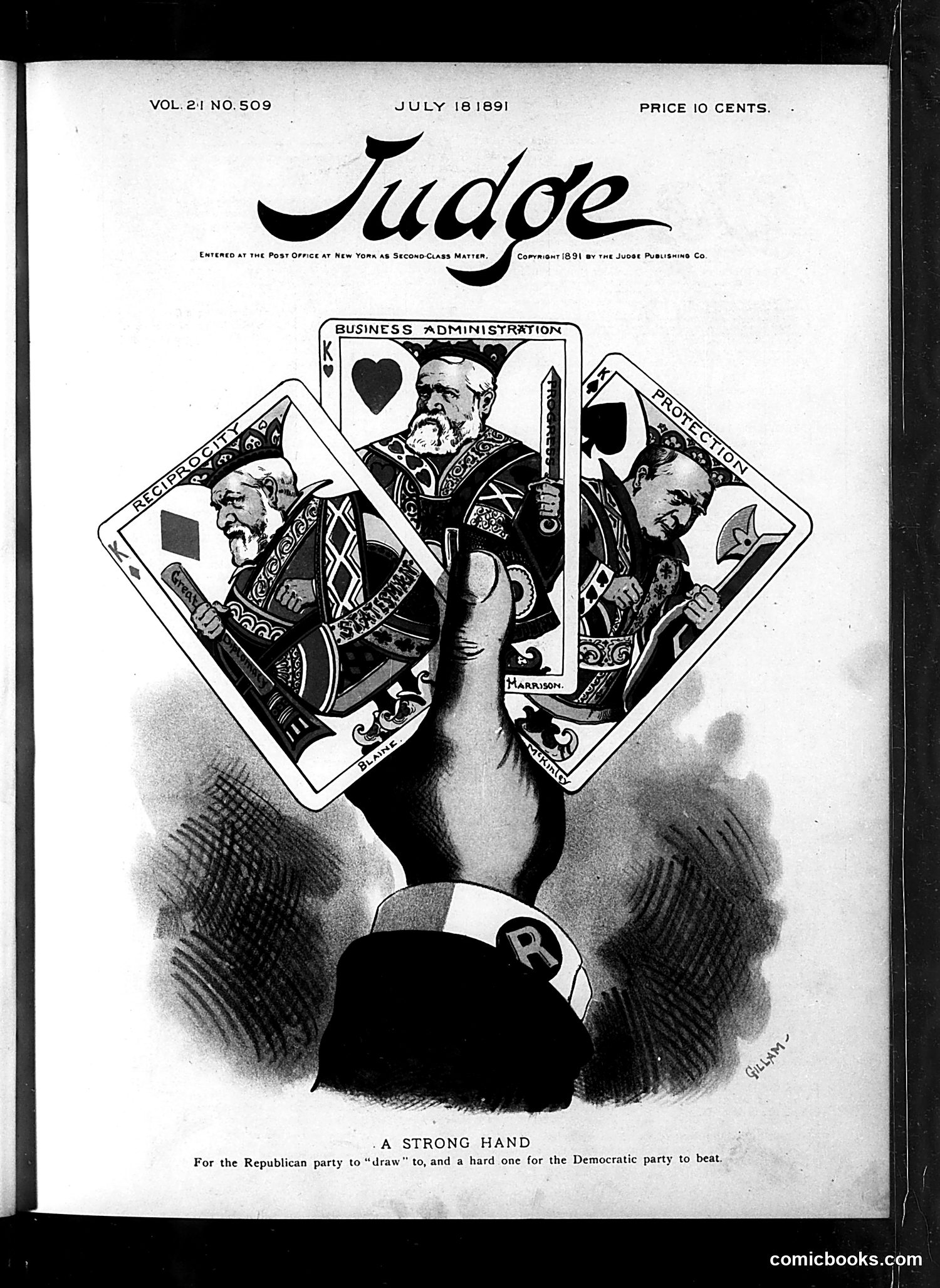
This political cartoon satirizes the 1892 U.S. presidential election under the section "Business Administration." A strong hand (labeled "R" for Republican) holds three playing cards depicting political figures—appearing to be Republican leaders. The caption states: "A strong hand / For the Republican party to 'draw' to, and a hard one for the Democratic party to beat." The imagery uses poker metaphors to suggest the Republican party holds winning cards in the upcoming election. The playing-card format positions politicians as strategic assets in electoral competition. This reflects late-19th-century partisan politics, where Judge magazine (Republican-leaning) promoted GOP candidates through satirical commentary on presidential contests and governance.
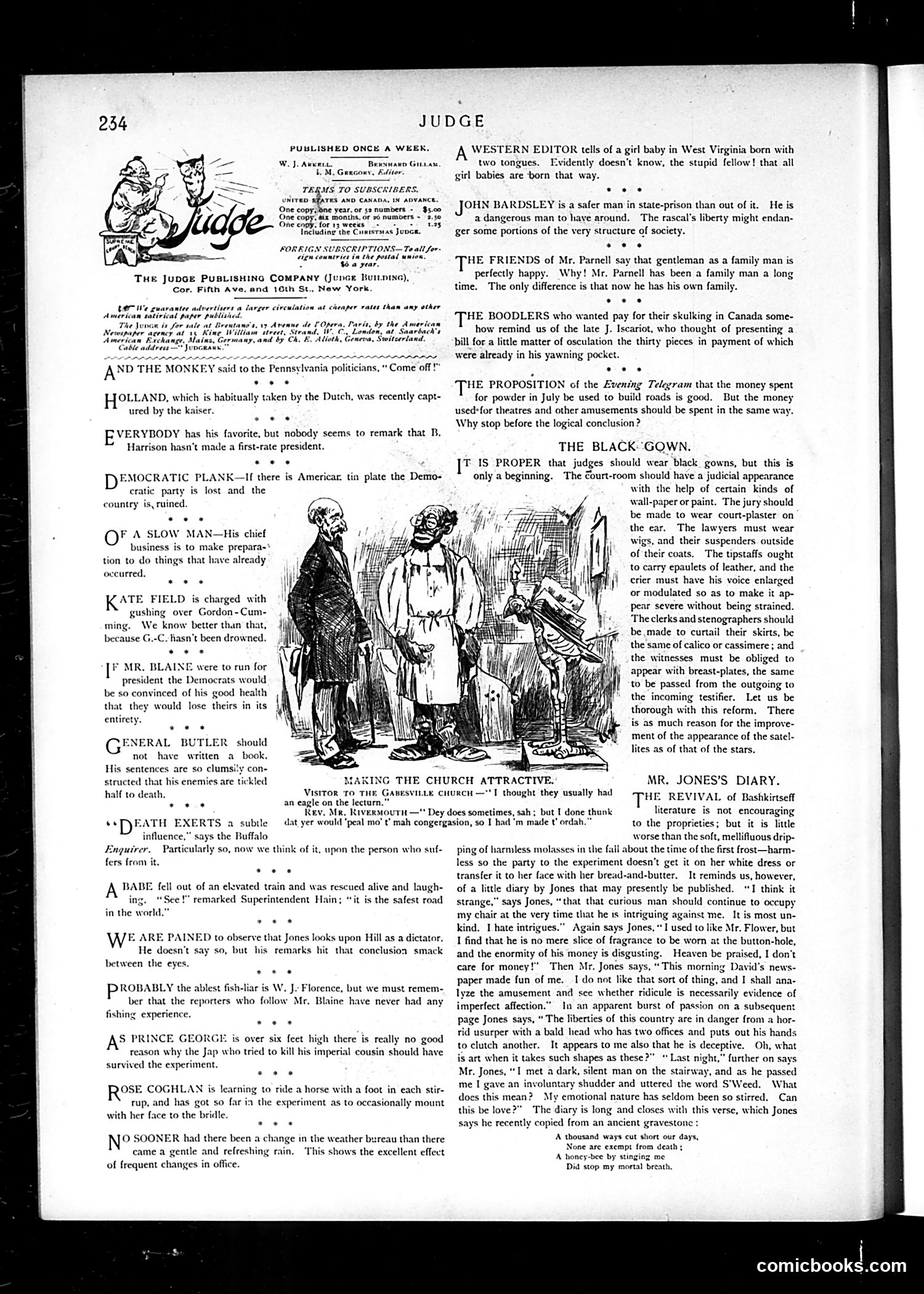
The cartoon depicts two figures—apparently a clergyman and a woman—discussing church attendance. The caption quotes a visitor to a Gainesville church saying "I thought they usually had an even dozen in the room" and references Rev. Wordsworth's reply about congregant numbers sometimes being low. The satire critiques efforts to make churches more appealing to attract worshippers. The joke appears to be that despite attempts at making the church "attractive," attendance remains sparse. The cartoon mocks both the church's struggling membership and the absurdity of cosmetic improvements failing to draw crowds when deeper issues (presumably spiritual or organizational) are the real problem. The surrounding text contains miscellaneous social commentary and anecdotes typical of Judge's satirical format.
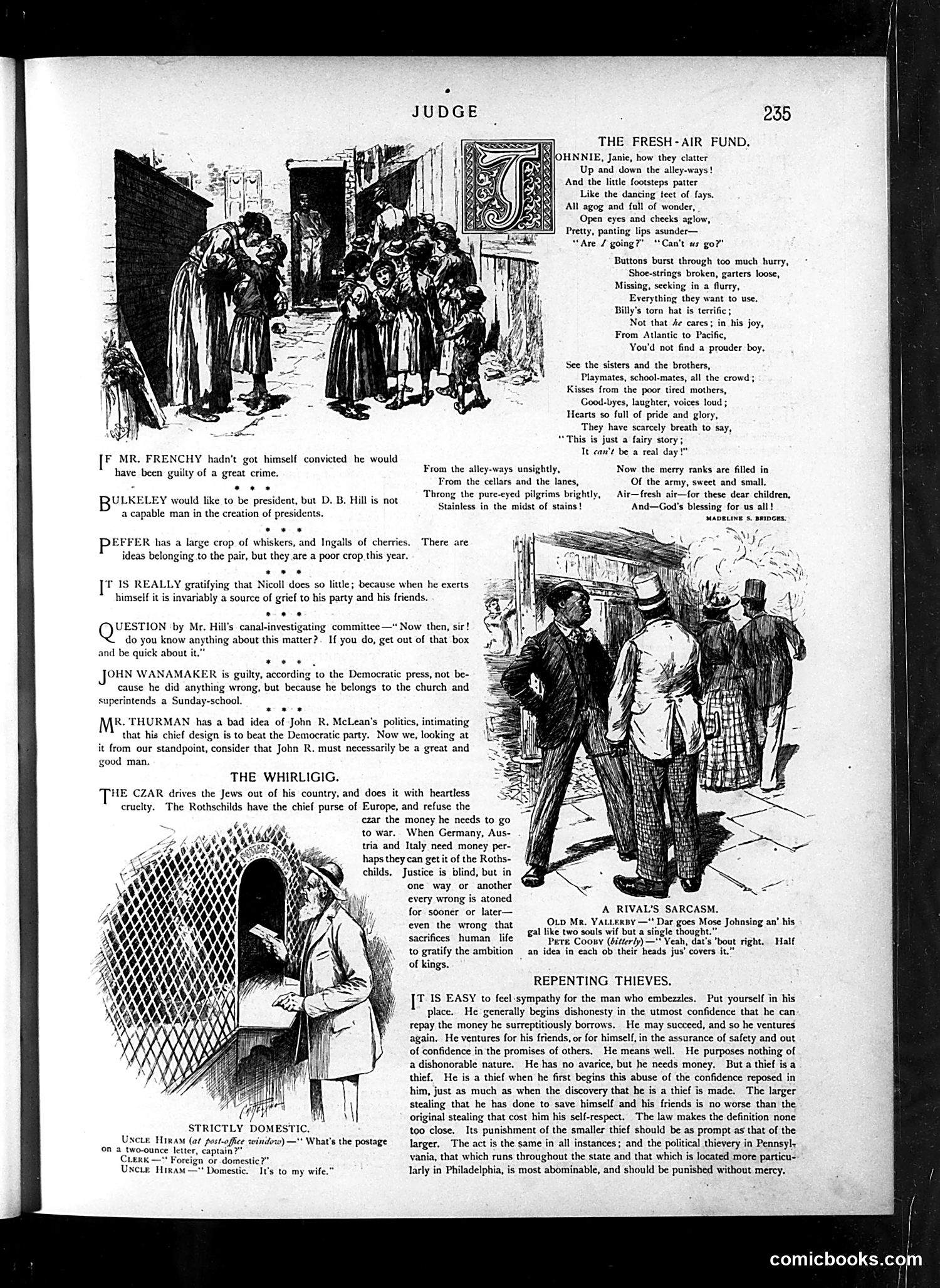
This page contains several political satirical pieces typical of early 20th-century Judge magazine: **"The Fresh-Air Fund"** (top): A poem with illustration mocking a charitable program sending poor urban children to the countryside. The verse suggests the children return in worse condition—torn clothes, broken items—implying the program's ineffectiveness or the children's uncontrollability. **Political Jabs** (middle): Brief satirical comments on contemporary figures including references to Mr. Frenchy, Bulkeley, Peffer, and John Wanamaker, criticizing their political affiliations and character. **"The Whirligig"** (lower left): Commentary on the Czar expelling Jews and European tensions around war financing. **"Repenting Thieves"** (bottom): A morality piece discussing criminal psychology and punishment philosophy in Pennsylvania. The overall tone reflects Judge's conservative Republican perspective and focus on urban social issues.
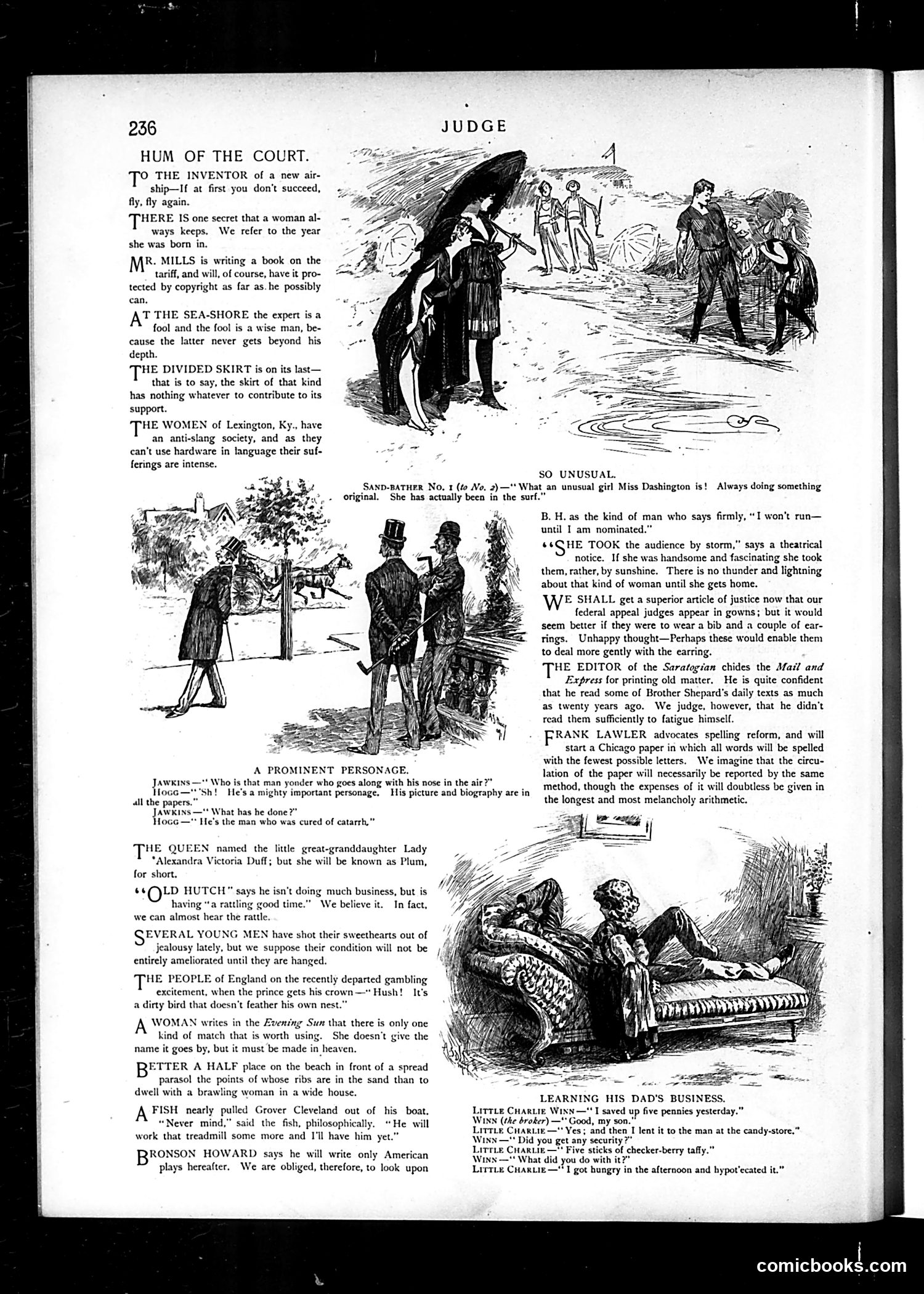
This page from Judge magazine contains brief satirical observations on contemporary topics (circa late 1800s). Key items include: **Social Commentary:** - Mockery of women hiding their age and the "divided skirt" fashion trend as impractical - Criticism of federal judges now wearing formal gowns, suggesting they need bibs and earrings to handle cases fairly - Jabs at spelling reform advocate Frank Lawler's Chicago newspaper venture **Political/Media Satire:** - Mr. Mills copyrighting a tariff book (commentary on protectionism) - Editorial disputes between newspapers (*Mail and Express* vs. the *Saratogian*) - A "prominent personage" reduced to being known only for curing his catarrh—mocking celebrity based on trivial accomplishments **Illustrations** show period beach scenes and everyday life vignettes supporting the text's humorous observations about human behavior and contemporary fads. The page is primarily light social humor rather than hard political satire, targeting fashion, vanity, and journalistic absurdities.
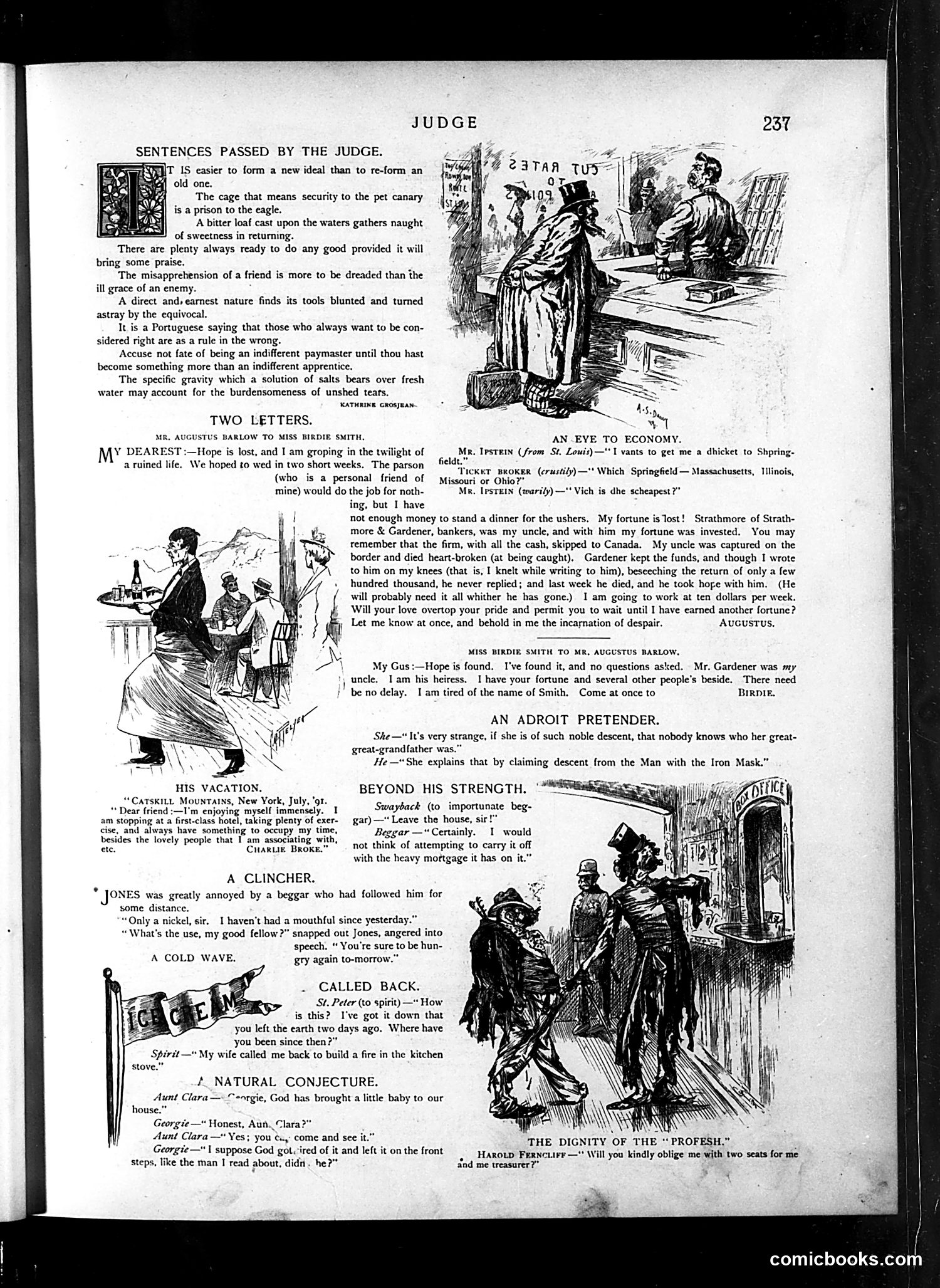
This page from Judge contains satirical vignettes mocking various social types and situations of the 1890s era. **"Two Letters"** presents a comedic reversal: Augustus writes desperately to his fiancée that he's lost his fortune and cannot afford a wedding dinner; Birdie replies she's inherited wealth from her uncle Gardener and will marry him immediately. The joke satirizes fortune-hunting and the arbitrary nature of wealth. **"An Adroit Pretender"** mocks social climbers claiming noble ancestry they cannot substantiate—specifically someone claiming descent from "the Man with the Iron Mask," a literary figure, suggesting fabricated genealogy. **Other brief sketches** include immigrant confusion over geography ("Which Springfield?"), a beggar's predictable return ("You're sure to be hungry again to-morrow"), and similar comedic observations about human nature and social pretension. The page also opens with philosophical aphorisms by Kathrin Grosjean about pride, friendship, and character—typical Judge editorial content. The accompanying illustrations use caricature to emphasize the absurdity of these social situations and character types.
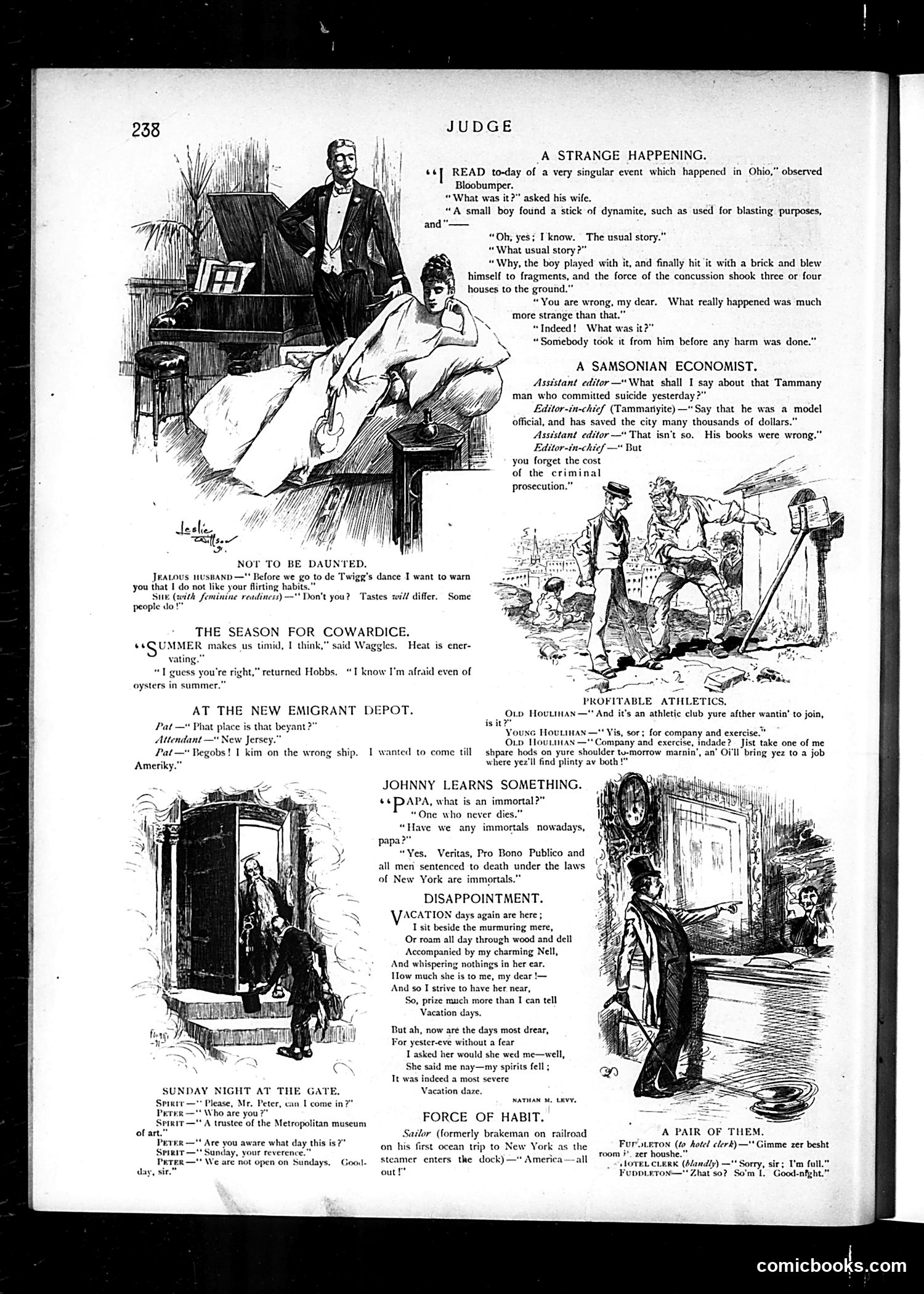
This page contains multiple brief satirical pieces typical of Judge's humor: **"A Strange Happening"** mocks predictable news reporting—the wife assumes any dynamite story ends with a child's accidental death, making the actual outcome (adult intervention preventing harm) seem absurdly unusual by comparison. **"A Samsonian Economist"** satirizes Tammany Hall corruption. A Tammany official who committed suicide is praised as "model" despite embezzling, because prosecution costs would exceed his theft—darkly suggesting corruption is economically rational. **"Not to be Daunted"** presents marital tension: a jealous husband warns against flirting; his wife dismisses his concerns, implying infidelity or indifference. Minor pieces mock cowardice (fear of oysters), Irish immigration confusion, and New York's capital punishment ("immortals" are death-row inmates—a dark reference to NY's execution laws). The cartoons use working-class and immigrant characters for humor, reflecting period stereotypes. Overall, the page targets urban corruption, marital discord, and social pretension through brief comedic vignettes.
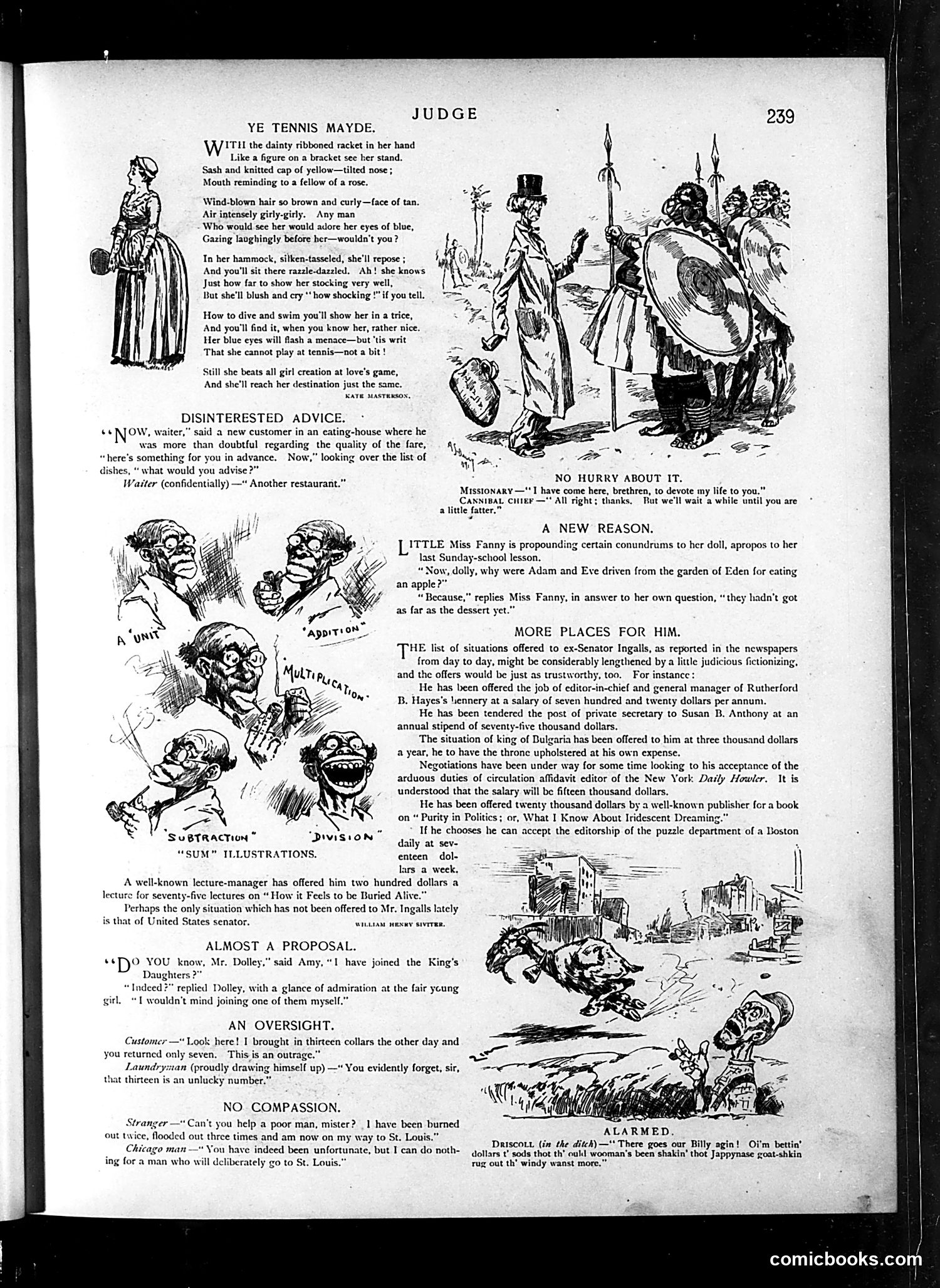
This page from Judge contains several distinct satirical pieces targeting social attitudes of the era: **"Ye Tennis Mayde"**: A poem mocking the "New Woman"—athletic, independent young women playing tennis. The satire suggests these modern women are flirtatious yet incompetent at sports, ultimately defined by romantic conquest rather than genuine athleticism. **"Disinterested Advice"**: A joke about restaurant quality, with a waiter sarcastically recommending "another restaurant" when asked for advice—commentary on dubious dining establishments. **"No Hurry About It"**: A cannibal joke reflecting period racial stereotypes, with dark humor about a missionary being "fattened up" before consumption. **"More Places for Him"**: Political satire ridiculing ex-Senator Ingalls through absurd fictional job offers (editor of a "Daiily Howler," king of Bulgaria). It suggests he's unemployable and his political career is finished. The remaining pieces are brief jokes about children's logic and domestic mishaps. Overall, the page satirizes modern women, restaurant standards, and a fallen politician.
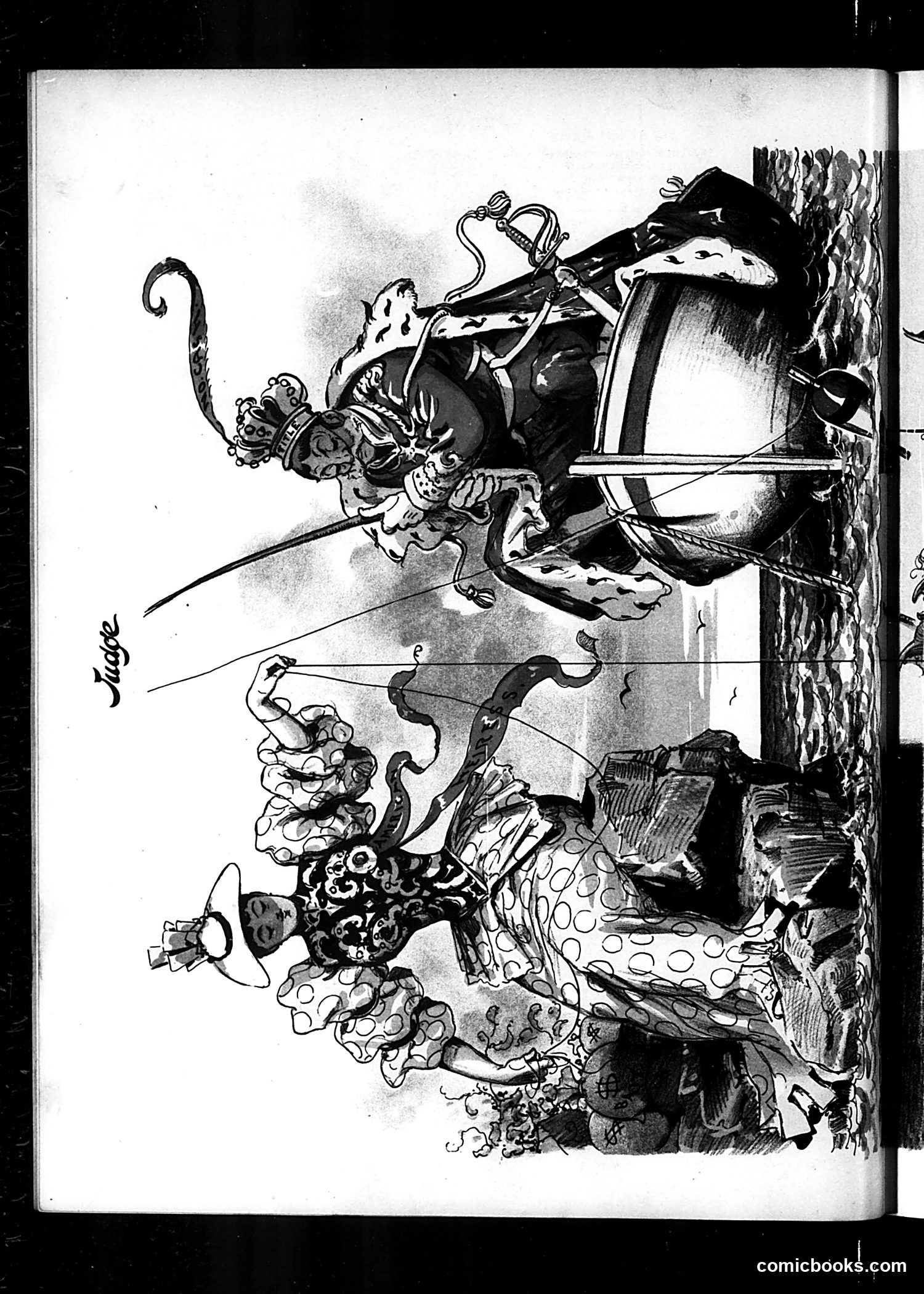
I can see this is a black and white satirical cartoon from *Judge* magazine, but the OCR text provided is essentially unreadable—it appears to be garbled characters rather than actual words. From the IMAGE alone, I can observe: The cartoon shows exaggerated figures in what appears to be a chaotic scene. There are ornately dressed characters with elaborate details, including patterned clothing. The style is characteristic of late 19th or early 20th-century American political cartooning, with heavy use of caricature and grotesque exaggeration typical of *Judge* magazine's satirical approach. However, **without legible text or a visible caption**, I cannot reliably identify the specific figures, the political event being referenced, or the cartoon's intended satirical point. To provide accurate historical context, I would need either clearer text or additional identifying information visible on the page.
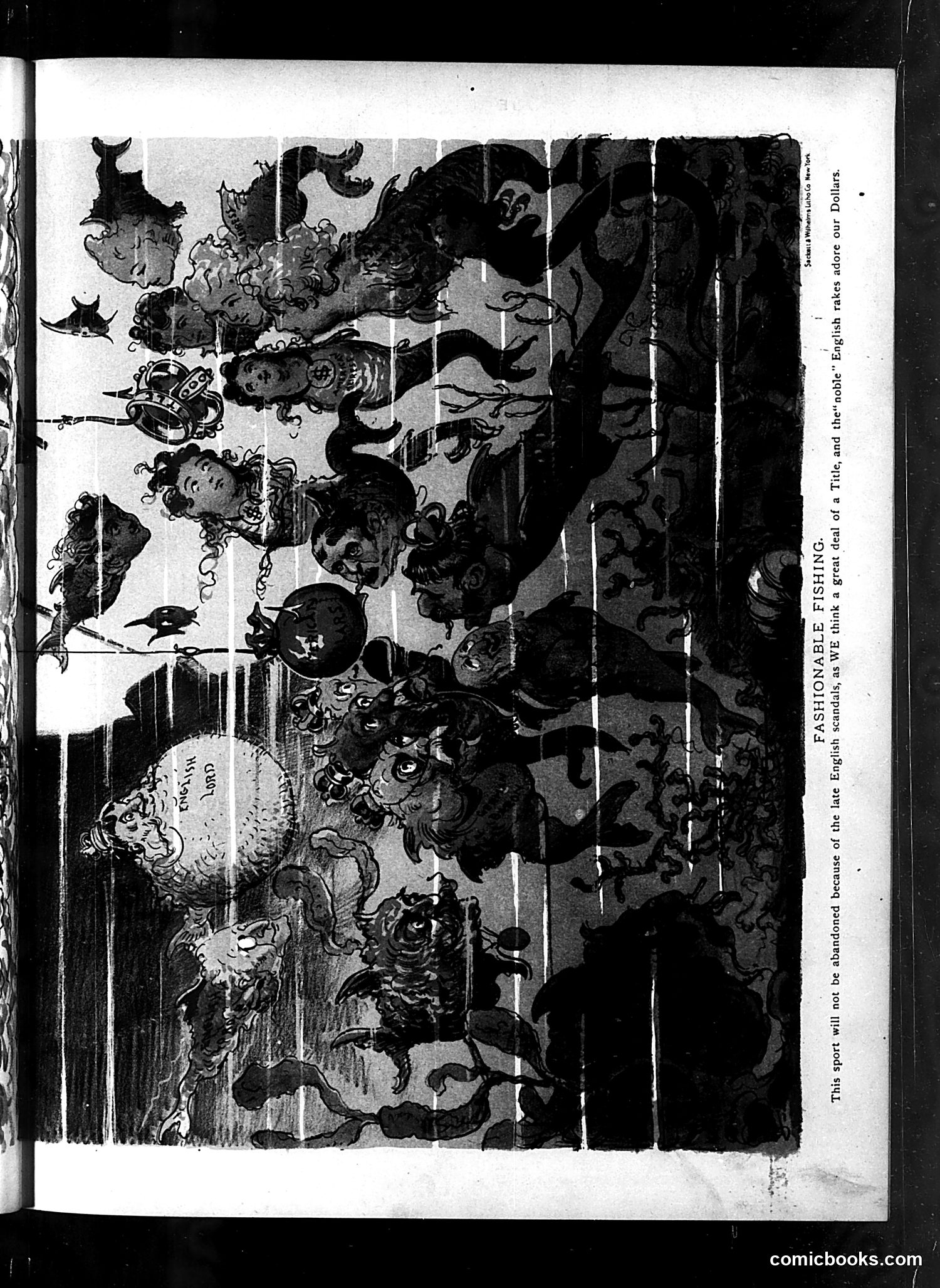
This appears to be a satirical illustration titled "Fashionable Fishing" depicting wealthy individuals engaged in leisure activity. The image shows multiple figures in elaborate dress fishing or attempting to fish, rendered in a caricatured style typical of Gilded Age satire. The cartoon likely critiques the fashionable leisure pursuits of the wealthy elite—their obsession with appearing refined and "in vogue" while engaging in traditionally simple activities. The exaggerated clothing and poses suggest mockery of pretension and artificiality among the upper classes. The OCR text is largely corrupted and unreadable, preventing precise identification of specific political figures or contemporary references. However, the overall satirical approach targets class vanity and the performative nature of wealthy society's recreational habits during this period of American social commentary.
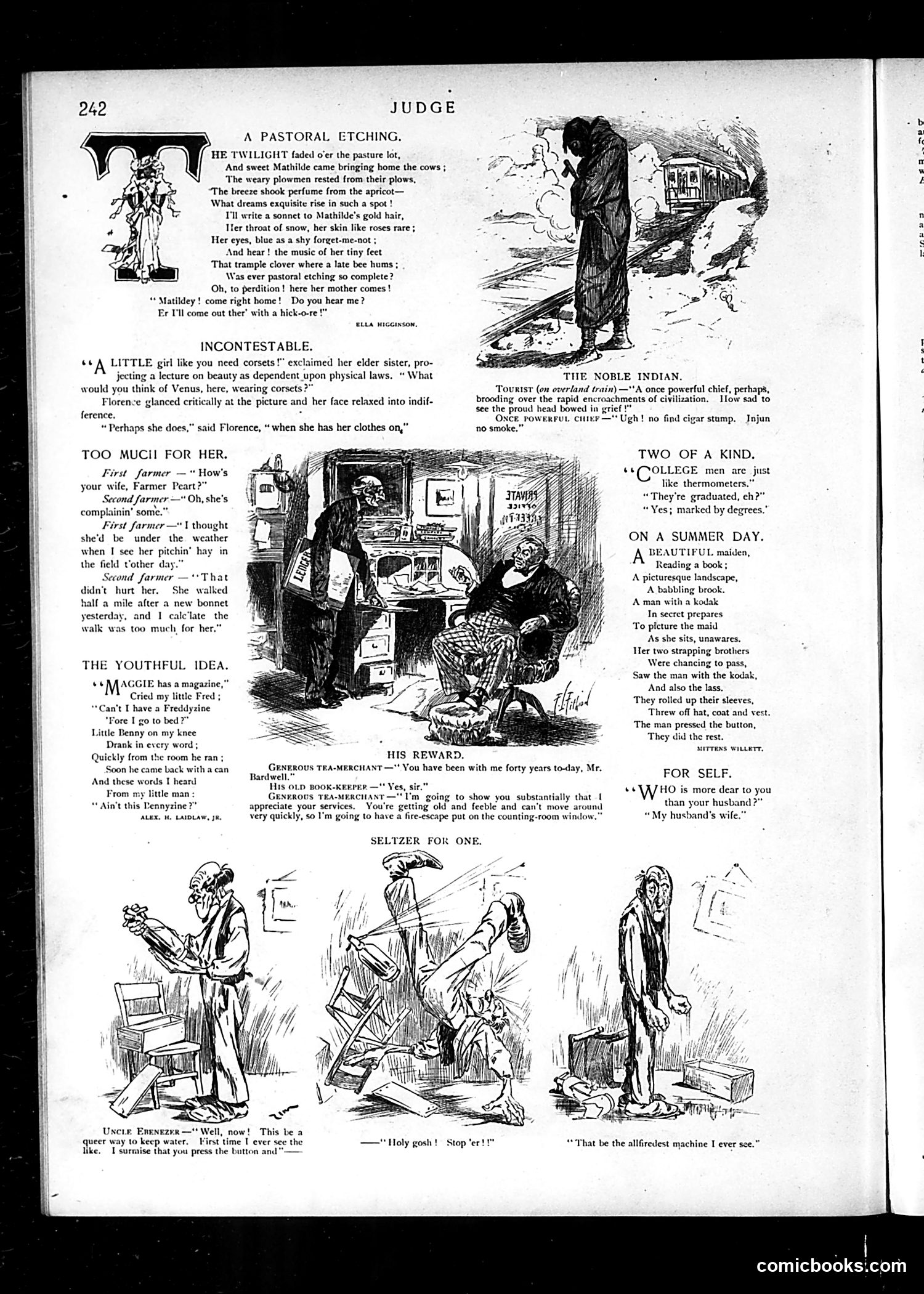
This page from *Judge* contains multiple short humorous pieces typical of late 19th/early 20th-century American satire: **"A Pastoral Etching"** mocks romantic poetry—a suitor composes flowery verses about a peasant girl bringing home cows, only to have the moment shattered by her mother's shrill interruption with a hickory switch threat. **"Incontestable"** jokes about women's corsetry: a sister argues corsets are necessary; her sister counters by pointing to a classical Venus statue, then quips that Venus only looks natural *without* clothes. **"The Noble Indian"** presents a racial stereotype: a tourist observes a "once powerful chief" now reduced to complaining about lack of cigar stamps—colonial-era satire mocking both Indigenous decline and commercial triviality. **"Too Much for Her"** depicts a rural wife whose husband sees no harm in her doing heavy farm labor, but worries a half-mile walk for a new bonnet exhausted her—mocking male illogic about women's capabilities. Other pieces mock magazine proliferation, miserly employers, romance photography interrupted by protective brothers, and marital irony.
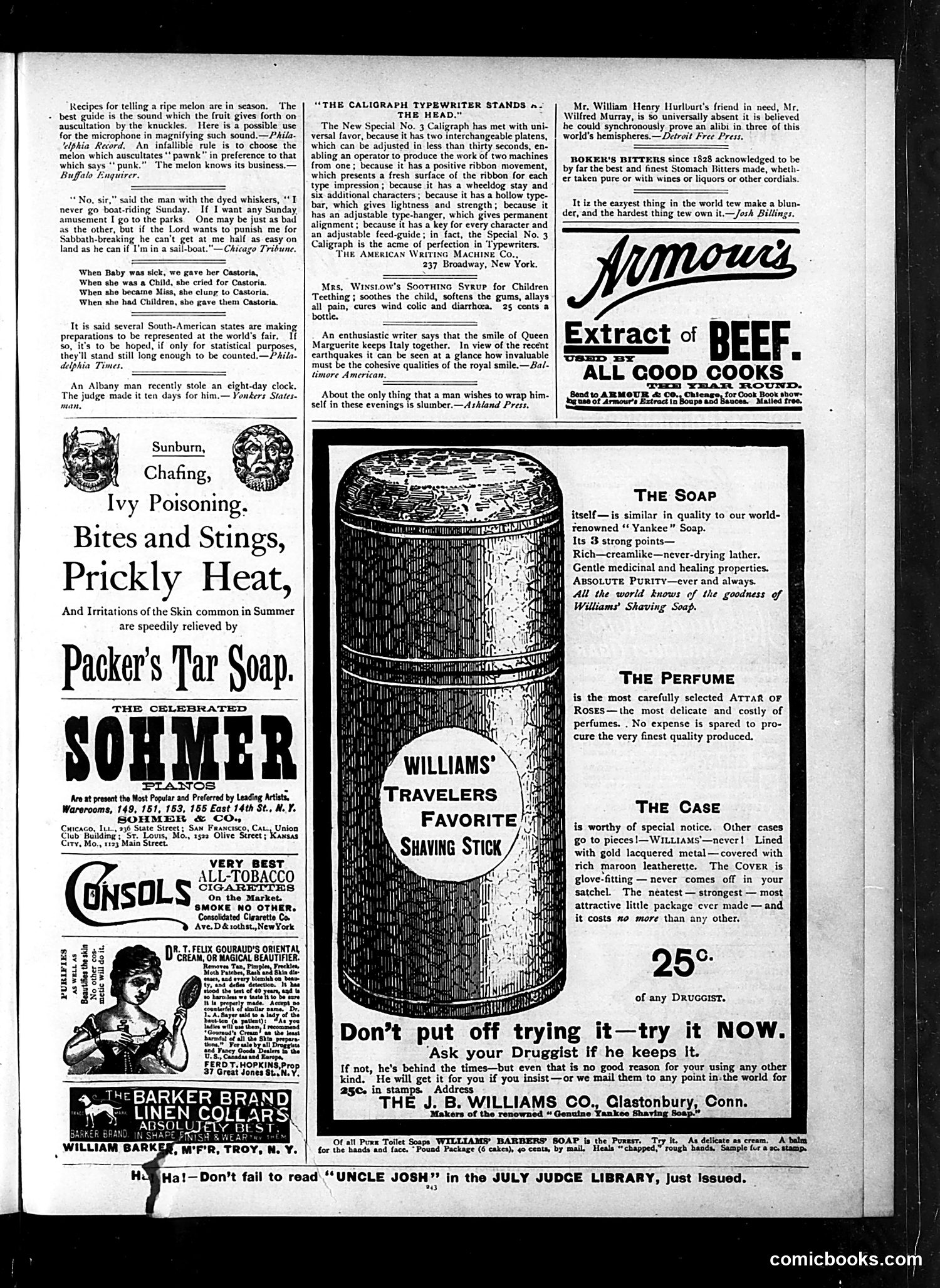
This is primarily an **advertising page** from Judge magazine, interspersed with brief satirical quips rather than a coherent political cartoon. The content includes: **Satirical snippets** on unrelated topics: melon-selecting advice, Sunday boat-riding as divine punishment, a pun about a stolen clock receiving extra jail time, and commentary on South American states at a world's fair. **Numerous advertisements** for period products: Packer's Tar Soap, Sohmer pianos, Caligraph typewriters, shaving sticks, cigars, and beauty creams—typical of late 19th-century Judge issues. **Social humor**: References to William Henry Hurlburt (likely a public figure, unclear without more context) and his absent friend; a joke about mothers giving children Castoria across generations. The page reflects **Judge's format**—mixing short, snappy jokes on contemporary life with commercial endorsements. There is no sustained satirical argument or identifiable political cartoon; instead, it's a miscellaneous collection of brief observations on everyday American life and commerce.
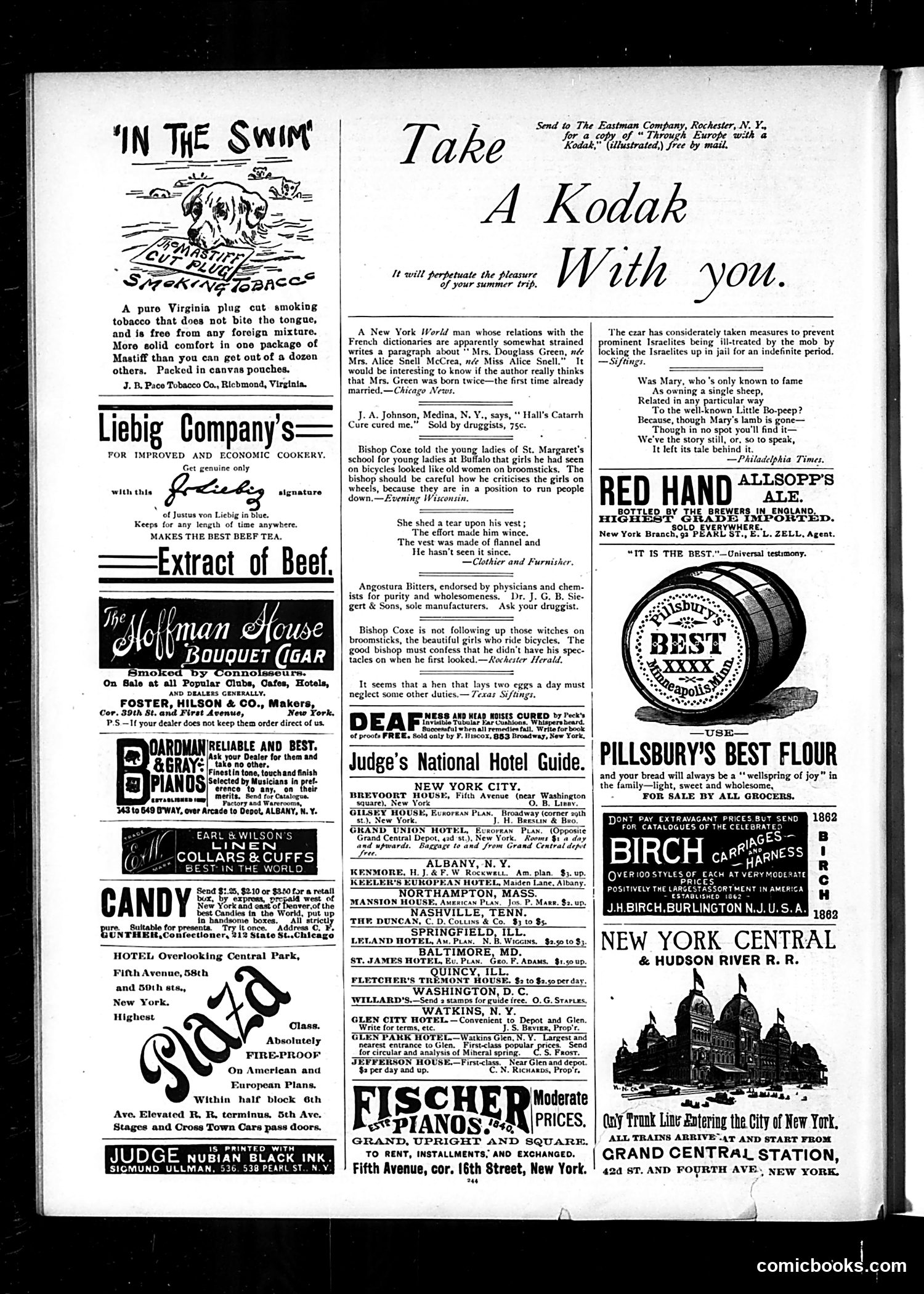
This page is primarily advertising, with a left sidebar and bottom section containing product ads (tobacco, beef extract, pianos, collars, candy, hotels). The center and right contains brief satirical items typical of *Judge* magazine's humor. The cartoon "In the Swim" (top left) depicts a dog smoking a pipe—a simple visual joke playing on the phrase to mock pretension or foolishness. The text snippets are short satirical observations. Notable: a joke about confusing newspaper phrasing where a woman is described with multiple maiden names, making it sound as though she was "born twice—the first time already married." Another mocks Bishop Coxe for calling bicycling women "old women on broomsticks," then notes the bishop should be careful since cyclists can "run people down." A third jokes about a flannel vest becoming permanently stained by a woman's tears. These are light, society-page humor typical of the era—wordplay, gentle mockery of public figures, and observations on contemporary fashions (bicycles, flannel clothing).
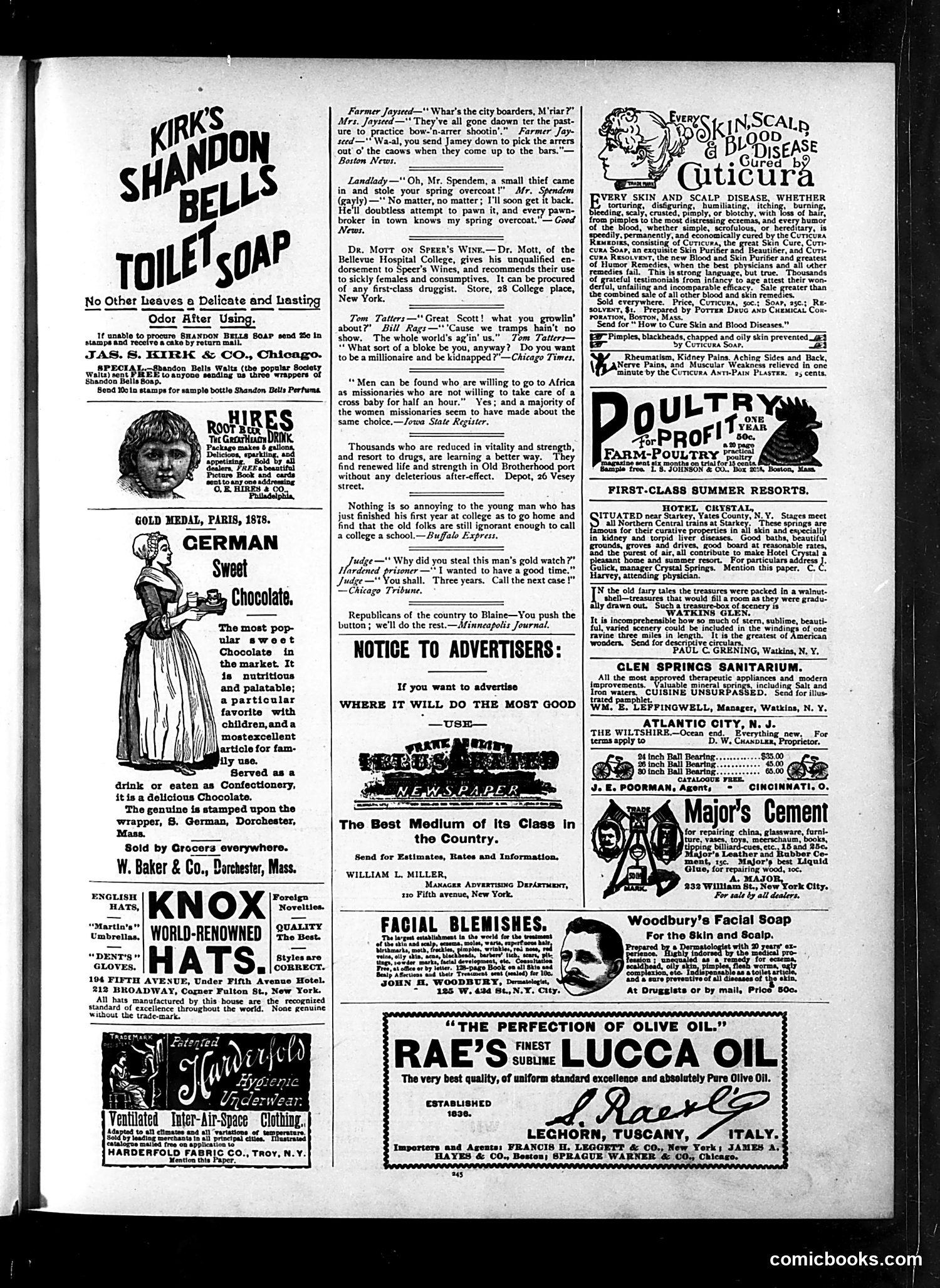
This is primarily an **advertising page** from Judge magazine, with several brief comic anecdotes interspersed. The page contains no political cartoons, but rather displays period advertisements for consumer goods (soap, chocolate, hats, olive oil) alongside short humorous stories. The comic bits present gentle, domestic humor typical of the era: - **"Farmer Jayseek"** joke: Urban "boarders" practice archery; arrows end up in the farmer's cows—satirizing city people's incompetence with rural life. - **"Tom Tatters" tramps dialogue**: Social commentary on hobos' difficult circumstances, with dark humor about their lack of opportunity. - **College student joke**: Poking fun at young men's embarrassment that their parents don't understand higher education terminology. - **Republican/Blaine reference**: A political quip (likely from the 1884 election era) suggesting Republicans should let Blaine take the lead. The page primarily functions as commercial real estate for advertisers rather than as satirical commentary.
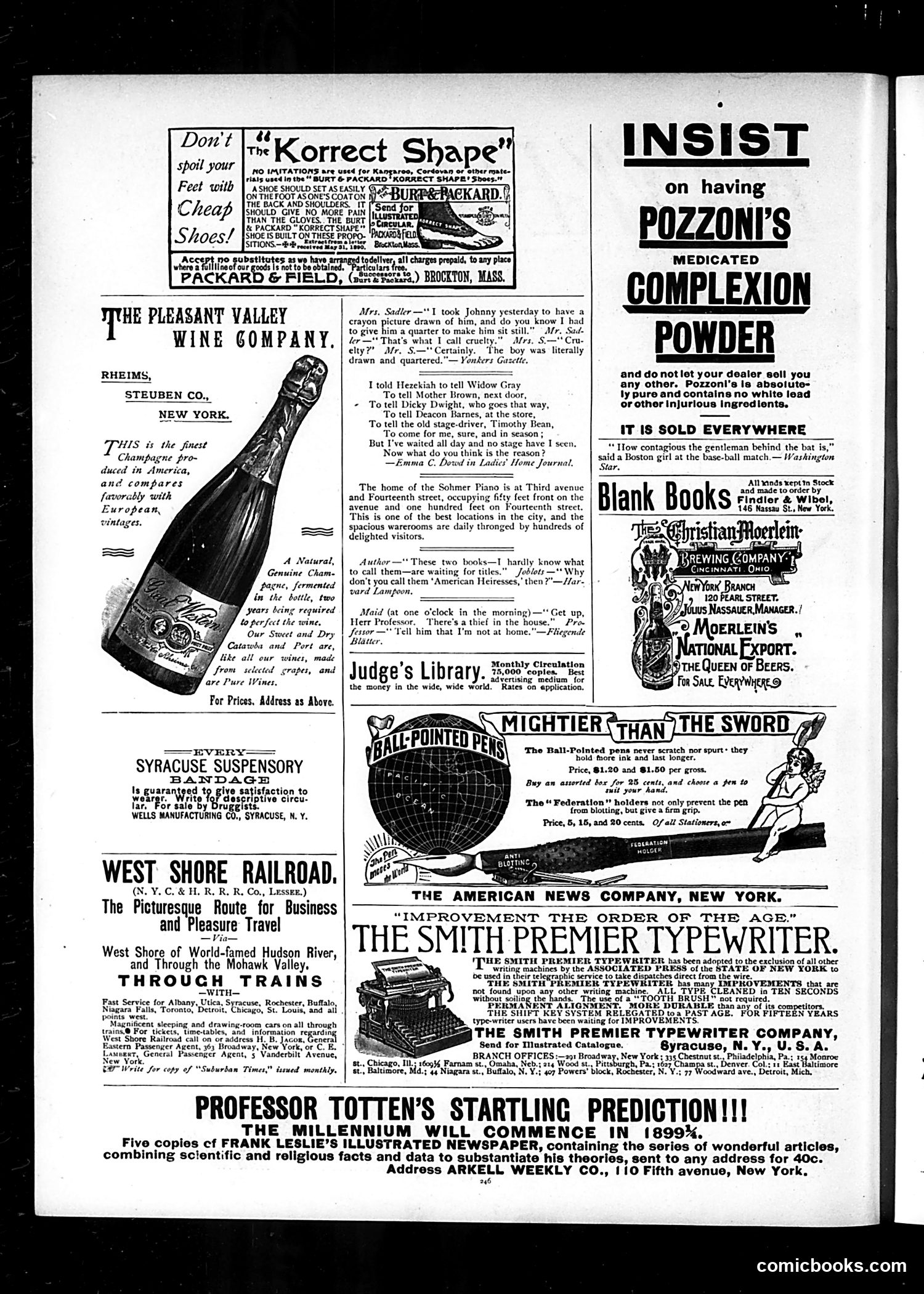
This page is primarily **advertising**, typical of Judge magazine's revenue model. The content includes: **Notable Advertisements:** - Shoe ads ("Korrect Shape" by Burt & Packard) - Wine and champagne promotions - Pozzoni's complexion powder (marketed as "medicated" and lead-free—significant because lead was commonly used in cosmetics then, causing health problems) - Typewriters, railroad services, and publishing supplies **Humor Content:** The page includes brief comic anecdotes about domestic life and wordplay ("drawn and quartered" pun). One joke involves a child needing payment to sit for a portrait—mild social satire about childhood behavior. **Historical Context:** The ads reveal period concerns: cosmetic safety, transportation options, and typewriter technology as modern innovation. Professor Totten's prediction about "the millennium" (1899) at bottom reflects fin-de-siècle anxieties about the approaching new century. Overall, this reflects late-19th-century consumer culture and gentle, family-appropriate humor typical of Judge's editorial approach.
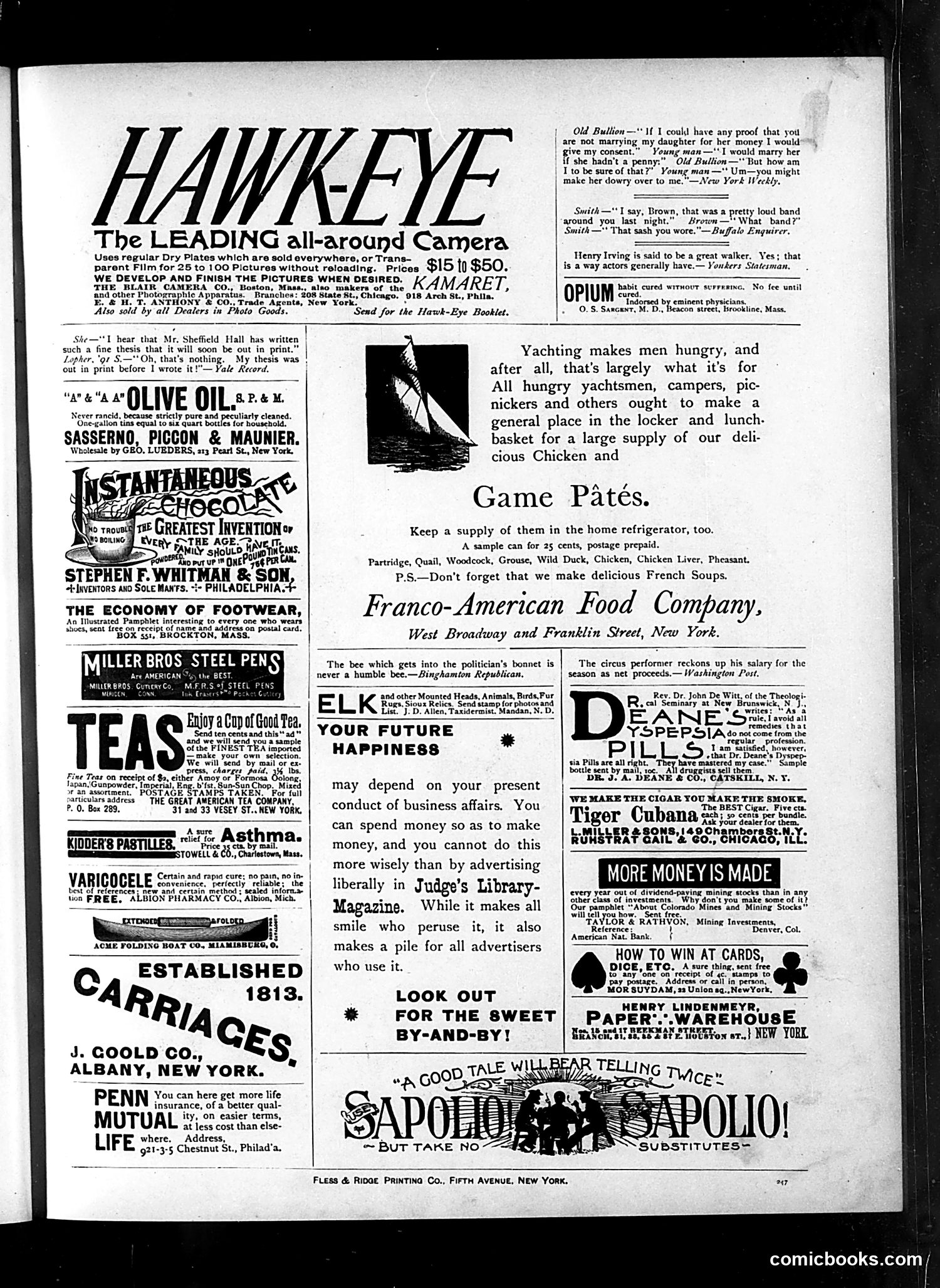
This is primarily an **advertising page** from Judge magazine, not a political cartoon page. The page consists almost entirely of commercial advertisements for various products (cameras, tea, pens, food, patent medicines, etc.). The few satirical **jokes** included are brief and conventional: - A gag about a young man courting a wealthy girl, joking he'd marry her without money—then suggesting she give him her dowry anyway (mocking fortune hunters) - A pun about a man wearing a "loud band" (sash) that looked like a band playing music - A quip that politicians get "bee in their bonnet" (the bee isn't humble, unlike the saying suggests) These represent typical **light social satire** of the era—gentle mockery of courtship customs, wordplay, and political vanity. There are no identifiable caricatures of specific political figures or events. The page reflects Judge's format of mixing advertisements with brief humorous observations about everyday life and human nature.
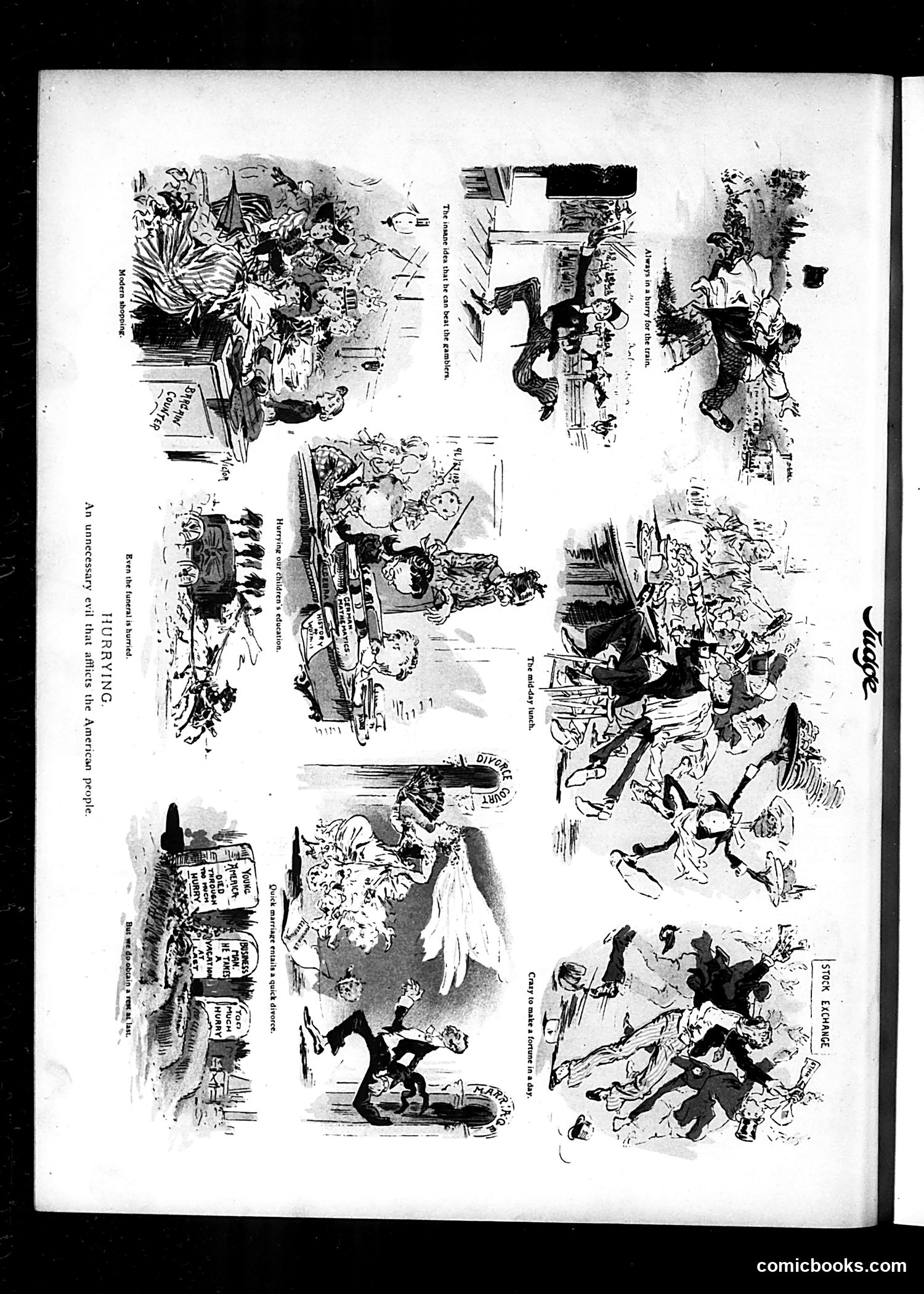
This page contains multiple satirical cartoons critiquing American life and society. The visible cartoons appear to focus on themes of haste and modern convenience culture. "Hurrying" (top left) seems to satirize the frantic pace of American life, possibly commenting on rushed funerals or hasty social practices. "Modern shopping" (bottom) likely mocks contemporary consumer behavior and retail practices. The cartoons use exaggerated caricatures and chaotic scenes typical of Judge's style to mock what the editors viewed as absurdities in American culture—specifically the rush and commercialism of modern life, even extending to solemn occasions like funerals. Without clearer OCR text identifying specific political figures or dated references, the exact targets remain somewhat unclear, though the general satire targets American consumerism and the accelerating pace of modern society.