
Judge, 1891-07-18 · page 3 of 16
Judge — July 18, 1891 — page 3: what you’re looking at
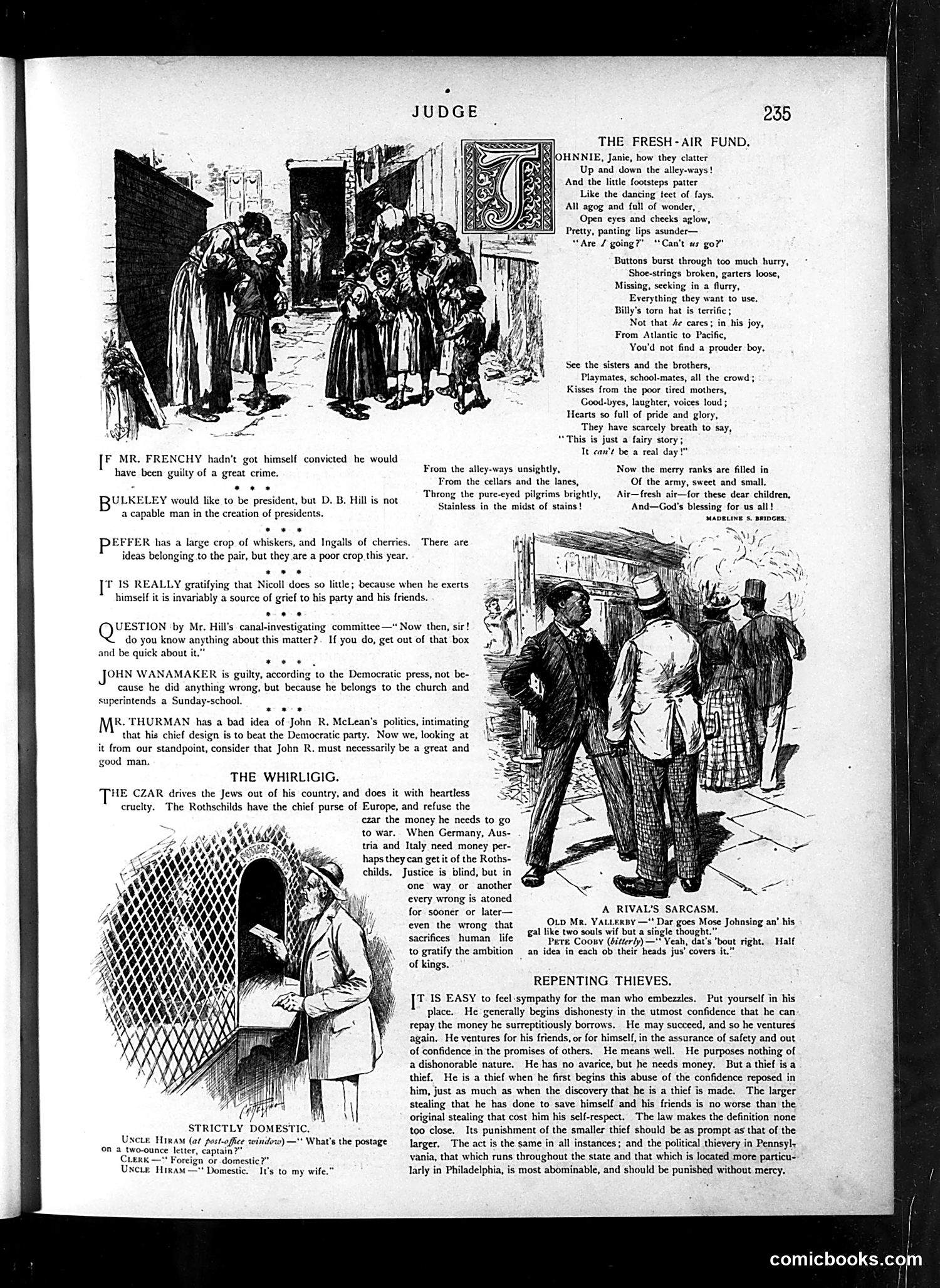
What you’re looking at
This page contains several political satirical pieces typical of early 20th-century Judge magazine: **"The Fresh-Air Fund"** (top): A poem with illustration mocking a charitable program sending poor urban children to the countryside. The verse suggests the children return in worse condition—torn clothes, broken items—implying the program's ineffectiveness or the children's uncontrollability. **Political Jabs** (middle): Brief satirical comments on contemporary figures including references to Mr. Frenchy, Bulkeley, Peffer, and John Wanamaker, criticizing their political affiliations and character. **"The Whirligig"** (lower left): Commentary on the Czar expelling Jews and European tensions around war financing. **"Repenting Thieves"** (bottom): A morality piece discussing criminal psychology and punishment philosophy in Pennsylvania. The overall tone reflects Judge's conservative Republican perspective and focus on urban social issues.
📄 Transcribed text from this page (OCR, searchable)
Machine-transcribed from the original scan — historical spelling and the odd misread are preserved.
235 e THE FRESH-AIR FUND. SOHNNIE, Janie, how they clatter Up and down the alley-ways! And the little footsteps patter Like the dancing tect of fays. All agog and full of wonder, Open eyes and checks aglow, Pretty, panting lips asunder— “Are J going?” “Can't us go?” Buttons burst through too much hurry, Shoe-strings broken, garters loose, Missing, secking in a flurry, Everything they want to use. Billy's torn hat is terrific; Not that Ze cares; in his joy, From Atlantic to Pacific, You'd not find a prouder boy. See the sisters and the brothers, Playmates, school-mates, all the crowd ; Kisses from the poor tired mothers, Goodbyes, laughter, voices loud ; Hearts so full of pride and glory, They have scarcely breath to say, A “This is just a fairy stor [F MR. FRENCHY hadn't got himself convicted he would 3 ee cae ae have [bees auliy ol a greacterane’ From the alley-ways unsightly, Now the merry ranks are filled in . aC From the cellars and the lanes, Of the army, sweet and small, ULKELEY would like to be president, but D.B. Hillis not THO%S the pureeyed pilgrims brightly, Air—fresh air—for these dear children, . e Stainless in the midst of stains! And—God's blessing for us all! a capable man in the creation of presidents. MADELINE S. BRIDGES. eae EFFER has a large crop of whiskers, and Ingalls of cherries. There are ideas belonging to the pair, but they are a poor crop.this year. ieee [T 1S REALLY gratifying that Nicoll does so little; because when he exerts himself it is invariably a source of grief to his party and his friends. see UESTION by Mr. Hill's canal-investigating committee — Now then, sir! do you know anything about this matter?. If you do, get out of that box and be quick about it. JOHN WANAMAKER is guilty, according to the Democratic press, not be~ cause he did anything wrong, but because he belongs to the church and superintends a Sunday-school. MB. THURMAN has a bad idea of John R. McLean's politics, intimating that his chief design is to beat the Democratic party. Now we, looking at it from our standpoint, consider that John R. must necessarily be a great and good man. THE WHIRLIGIG. HE CZAR drives the Jews out of his country, and does it with heartless cruelty. The Rothschilds have the chief purse of Europe, and refuse the czar the money he needs to go to war. When Germany, Aus- tria and Italy need money per- haps they can get it of the Roths- childs, Justice is blind, but in ‘one way or another every wrong is atoned a for sooner or later— ’S SARCASM. rect thetwronseibar OLp Mr. VALLERBY —* Dar goes Mose Jobnsing an’ his : Nat gal like two souls wif but a single thought.” sacrifices human life Pere Coony (bitterly) —'* Yeah, dat’s ‘bout right. Half to gratify the ambition _an idea in each ob their heads jus’ covers it of kings. REPENTING THIEVES. [7 1S EASY to feel-sympathy for the man who embezzles. Put yourself in his place. He generally begins dishonesty in the utmost confidence that he can repay the money he surreptitiously borrows. He may succeed, and so he ventures again. He ventures for his friends, or for himself, in the assurance of safety and out of confidence in the promises of others. He means well. He purposes nothing of a dishonorable nature. He has no avarice, but he needs money, But a thief is a thief. He is a thief when he first begins this abuse of the confidence reposed in him, just as much as when the discovery that he is a thief is made. The larger stealing that he has done to save himself and his friends is no worse than the i original stealing that cost him his self-respect. The law makes the definition none . STRICTLY DOMESTIC. too close. Its punishment of the smaller thief should be as prompt as that of the on ag ache Makan (ar postoffice zindors)—* What's the postage larger. The act is the same in all instances; and the political thievery in Pennsyl: - Foren doeaie vania, that which runs throughout the state and that which is located more particu- Hikas—" Domestic. It's to my wife.” larly in Philadelphia, is most abominable, and should be punished without mercy. comicbooks.com |