
A complete issue · 53 pages · 1889
Judge — December 1889
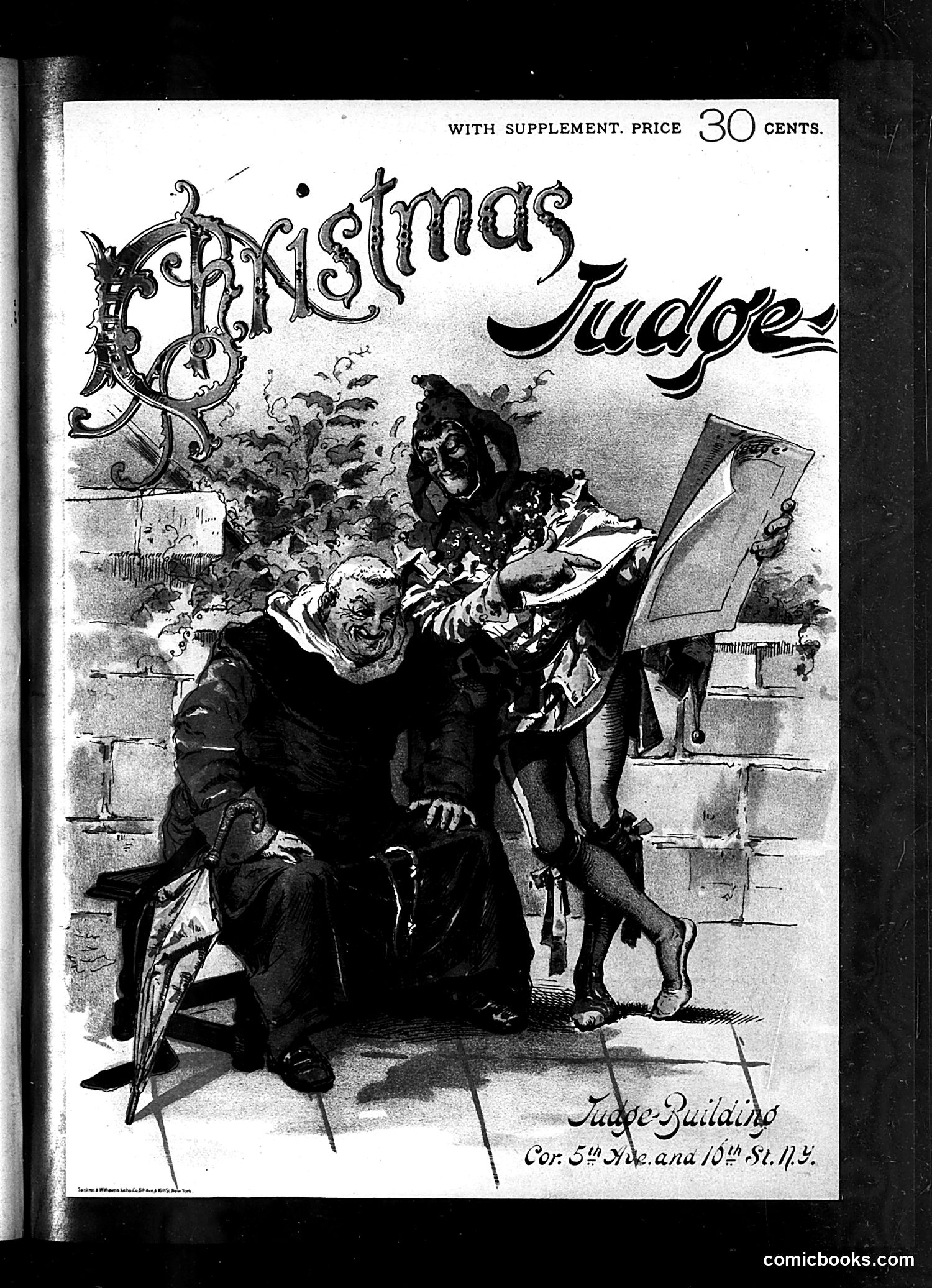
This is a cover from *Judge* magazine (price 30 cents with supplement) titled "Christmas Judge." The illustration depicts a grotesque, demonic figure—appearing to be a caricature—sitting in a chair while holding what looks like a gavel or judge's implement. The figure has exaggerated, menacing features typical of period political caricature. The artistic style and composition suggest this is satirizing a specific political or judicial figure of the era, though without additional context or clearer identifying details in the image itself, I cannot definitively name the target of the satire. The "Judge" title and gavel suggest mockery of legal authority or a particular judge or politician involved in a Christmas-season controversy. The demonic rendering indicates hostile, critical intent toward the subject.
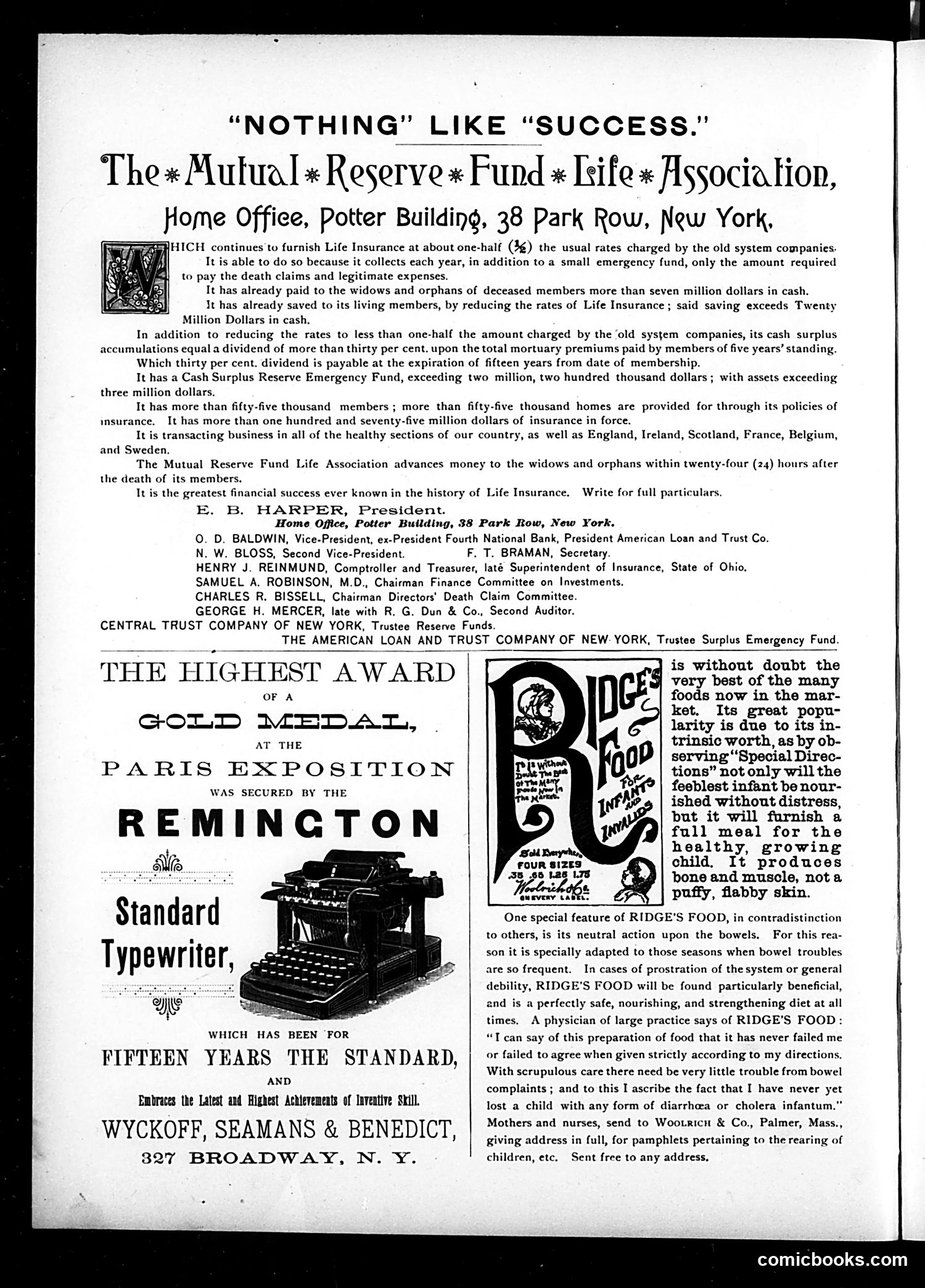
This page is **primarily advertising**, not satire or editorial content. The main advertisements are: 1. **Mutual Reserve Fund Life Association** (top) — promoting their life insurance success, claiming lower rates and faster widow/orphan payouts than competitors. 2. **Remington Standard Typewriter** (left) — emphasizing 15 years of market leadership and "latest and highest achievements of inventive skill." 3. **Ridge's Food** (right) — a patent medicine/infant food product claiming neutral bowel action and safety for children. The page contains no political cartoons or satirical commentary. It's a typical Judge magazine advertisement layout from the late 19th/early 20th century, mixing financial services, office equipment, and dubious health products targeted at affluent readers.
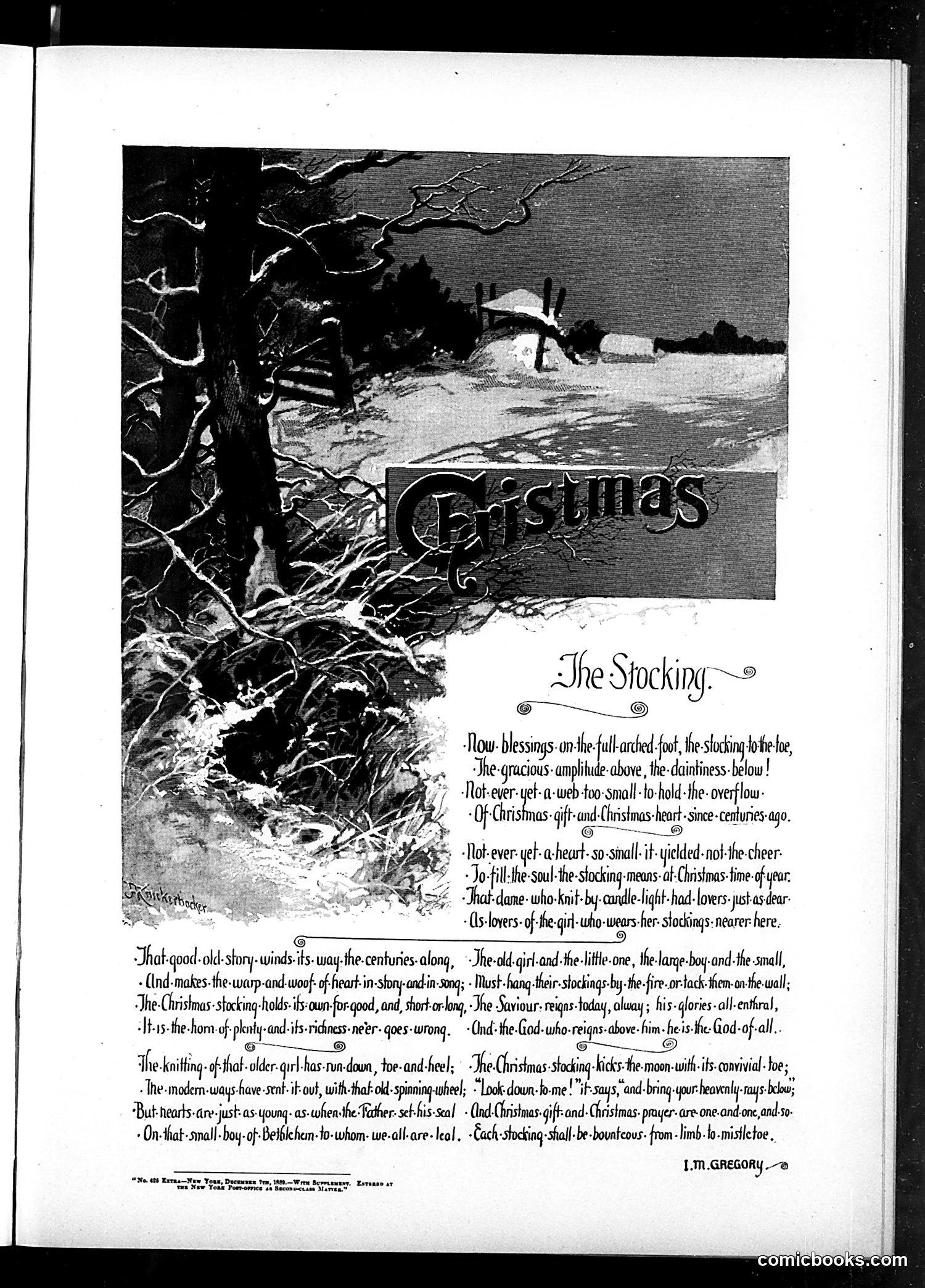
This is a sentimental Christmas poem with an accompanying illustration, not political satire. The image shows a snowy rural cottage scene, evoking nostalgia. The poem celebrates Christmas stockings as a timeless tradition connecting past and present generations. It romanticizes both historical hand-knitted stockings made "by-candle-light" and contemporary ones, arguing that despite modern changes ("the modern-ways have sent it out, with-that-of spinning wheel"), the heart of Christmas giving remains unchanged. The work emphasizes universal Christian values—that stockings represent generosity and divine blessing accessible to all social classes ("the old-girl and the little-one, the large-boy and the small"). It's devotional rather than satirical, presenting Christmas traditions as spiritually meaningful across centuries. The Judge magazine context suggests this appeared as wholesome holiday content rather than political commentary.
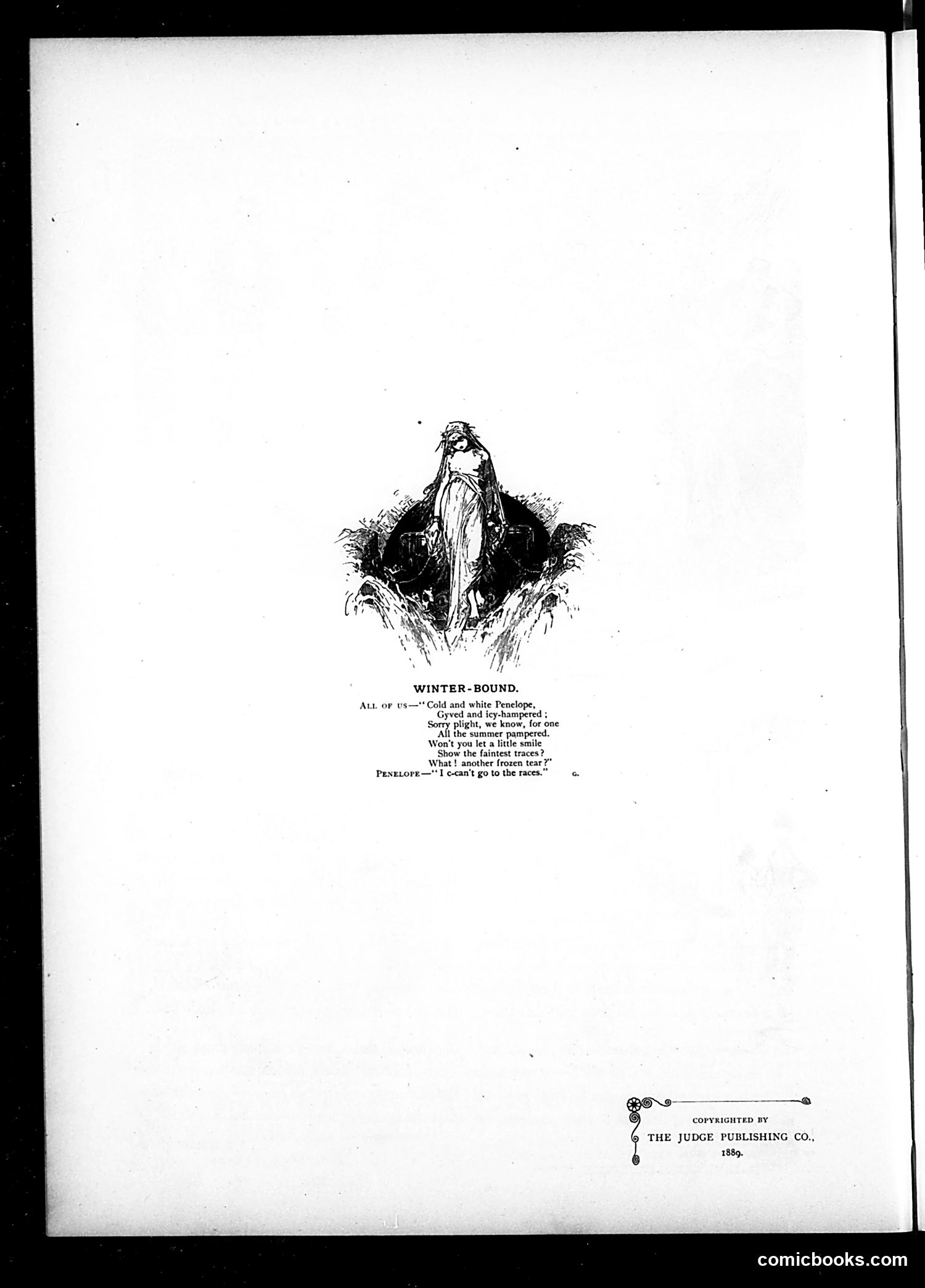
This cartoon depicts **Penelope**, a classical figure from Greek mythology (wife of Odysseus), personified here as a fashionable society woman. The satire targets the leisure class during winter. The joke hinges on contrast: Penelope is "cold and white," "icy-hampered," and normally "pampered" in summer. Someone tries to cheer her with a smile, but her tearful response reveals her actual concern—she "can't go to the races." The satire mocks wealthy women's priorities: despite winter hardship affecting ordinary people, Penelope's genuine distress stems solely from missing the horse races (a premier social event). Her classical allusion elevates what is essentially a complaint about social inconvenience. Judge magazine uses this to ridicule the self-centered frivolity of the privileged classes.
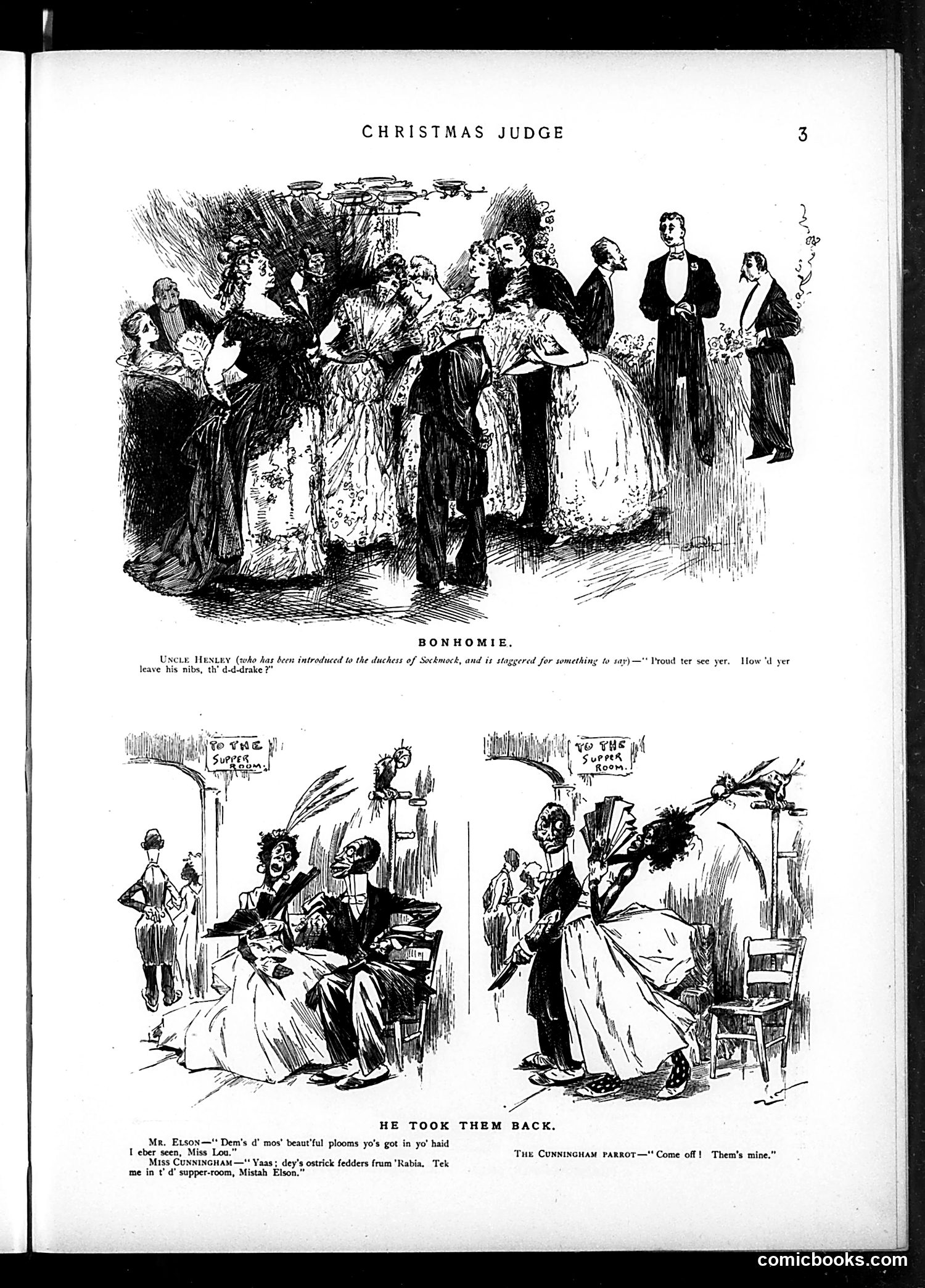
This page contains three related vignettes mocking nouveau riche behavior and social climbing at a fancy Christmas gathering. **"Bonhomie"** (top): An awkwardly introduced man ("Uncle Henry") stammers trying to impress a duchess, satirizing working-class discomfort with aristocratic society. **"He Took Them Back"** (bottom left): Mr. Elson compliments a woman's hat plumes, unaware they belong to Miss Cunningham—satirizing competitive materialism and the obsession with exotic fashion (ostrich feathers from Arabia were luxury items). **The Parrot** (bottom right): A parrot squawks "They're mine," exposing the woman's deception—the joke being that even a bird can shame her pretension. The overall mockery targets 1890s-era social ambition: people acquiring expensive possessions to seem refined while lacking actual breeding or wit. The dialect and caricature suggest class-based humor typical of Judge magazine's satirical approach.
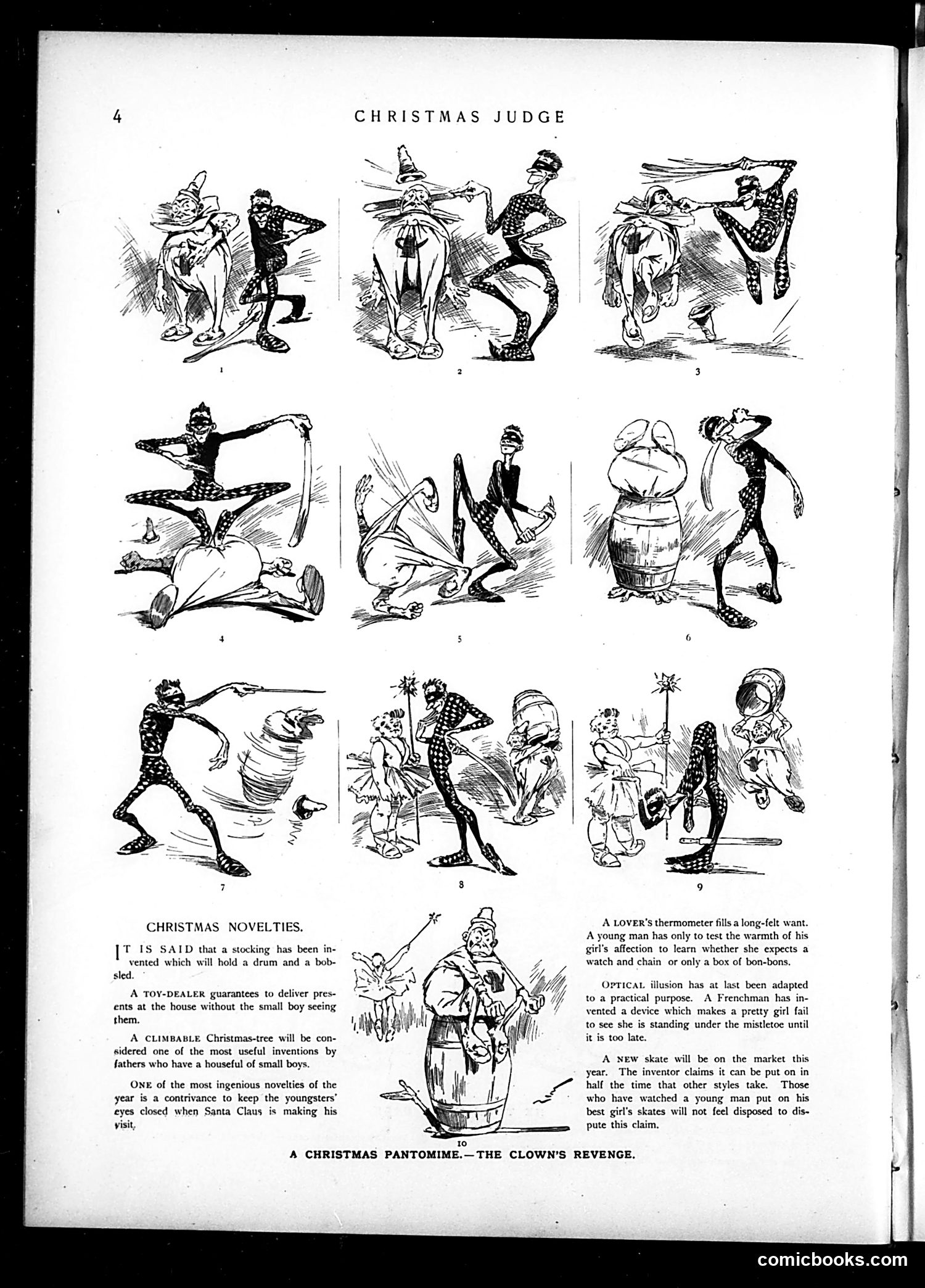
This page from *Judge* magazine combines humorous illustrated vignettes (panels 1-9) with satirical product descriptions mocking Christmas gift-giving anxieties. The top section presents absurd "novelties"—a stocking holding both drum and bobsled, a toy delivery system avoiding children's eyes, a climbable Christmas tree, and a device to keep kids from seeing Santa. These mock parental frustrations with noisy toys and holiday chaos. The right column's "novelties" target courtship rituals: a "lover's thermometer" to gauge female romantic interest through gift expectations (watch vs. candy), an optical illusion helping men trap women under mistletoe, and a quick-fastening skate allowing men to help dress their girlfriends—each reflecting period gender dynamics and dating conventions. Panel 10 shows "The Clown's Revenge," a pantomime scene, though its specific satirical meaning remains unclear from the image alone. Overall, the page satirizes both consumer culture's endless trivial "improvements" and Victorian courtship conventions through exaggerated, tongue-in-cheek product descriptions.
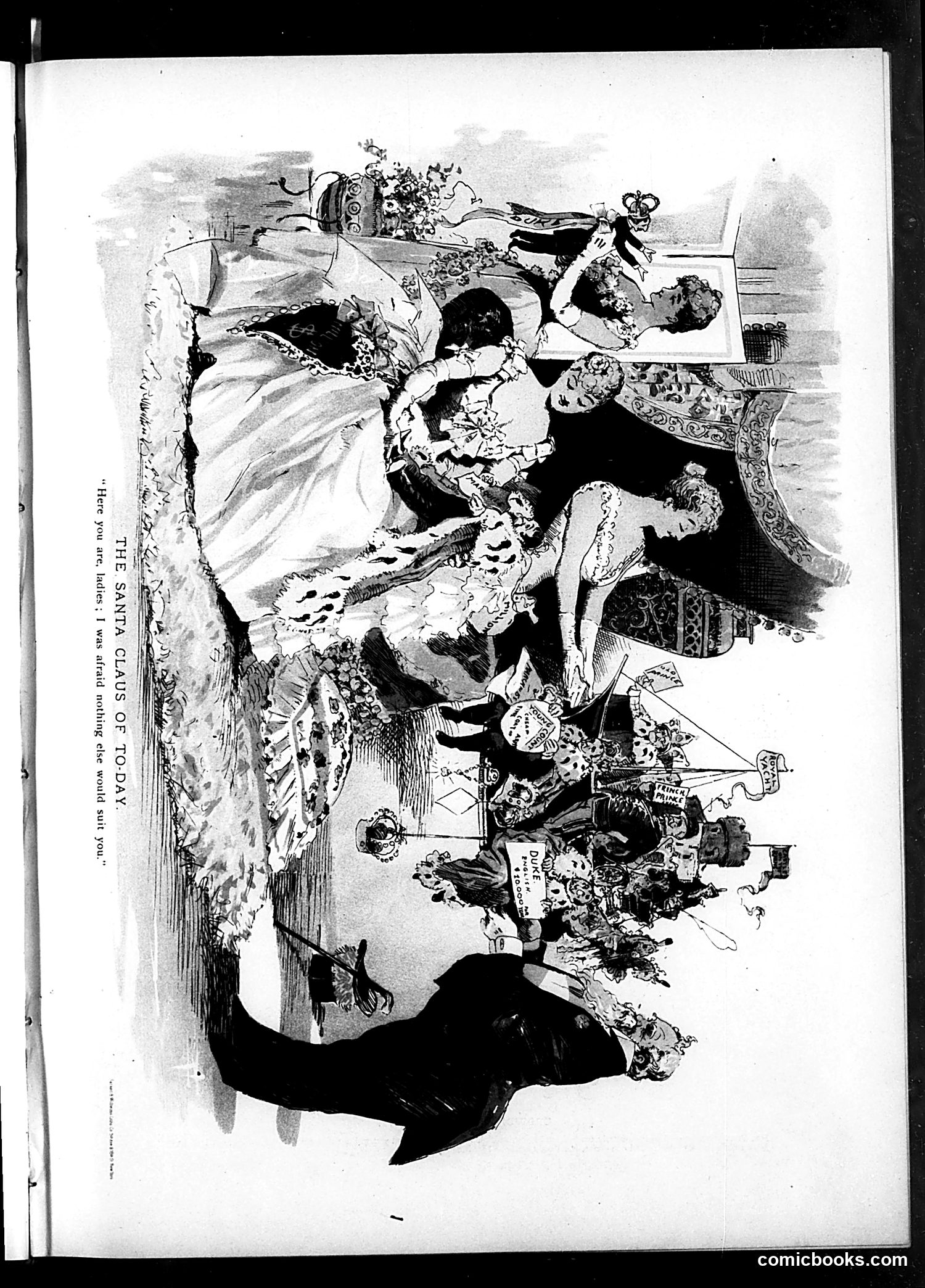
This satirical cartoon depicts Santa Claus distributing gifts to wealthy women, with the caption suggesting he's giving them whatever they desire. The joke appears to target the commercialization of Christmas and the materialism of wealthy society women during the Gilded Age or early 20th century. Santa's comment—"I was afraid nothing else would suit you"—implies these women are so demanding and extravagant that pleasing them is nearly impossible, even for Santa. The elaborate clothing and jewelry visible in the illustration emphasize their wealth and status. The satire critiques how modern Christmas had become less about spiritual values and more about conspicuous consumption and the endless desires of the privileged class. It's a commentary on how even magical gift-giving has succumbed to materialistic excess.
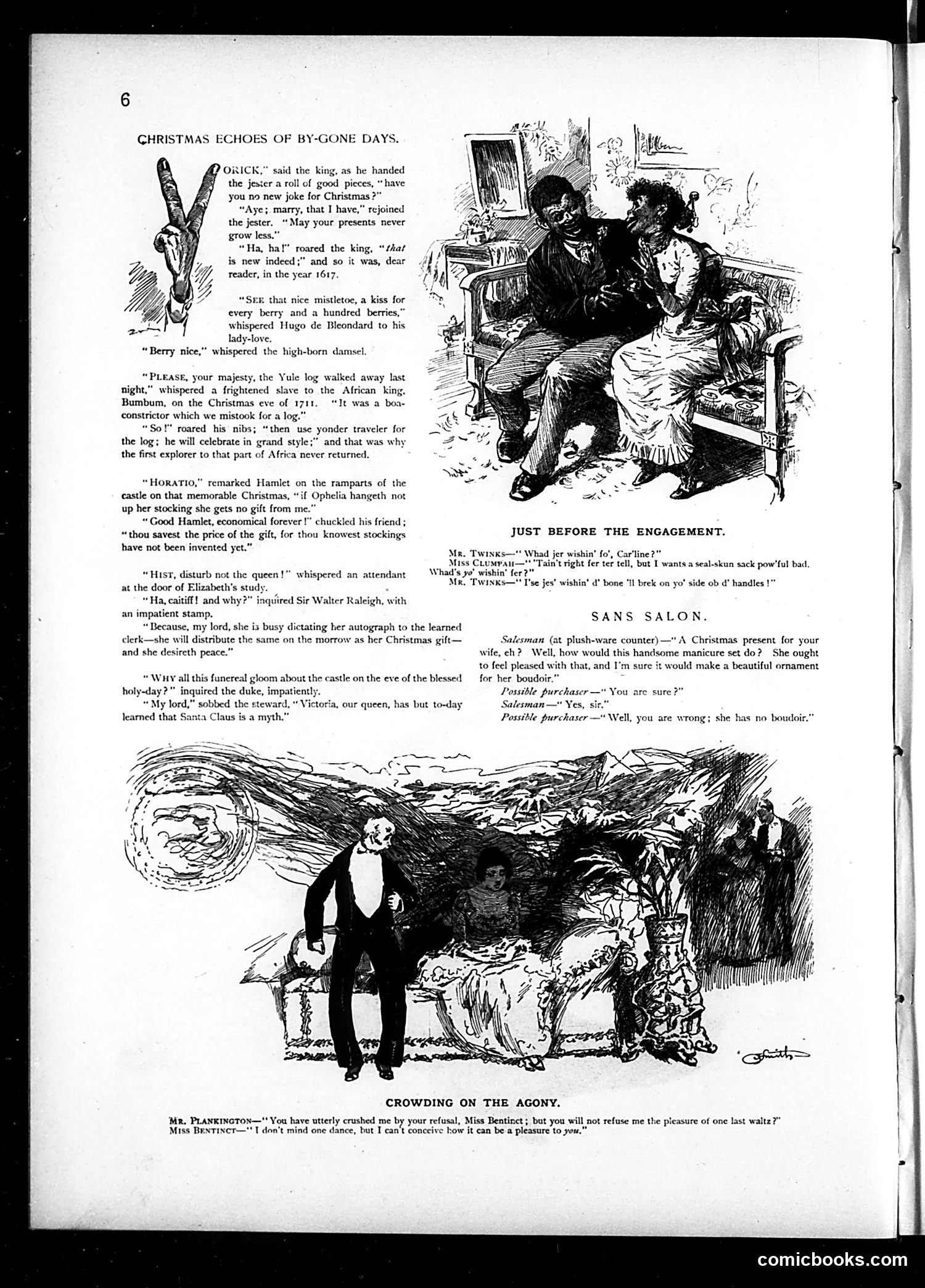
This page collects humorous historical vignettes parodying Christmas customs across different eras. Each sketch plays on anachronisms and period stereotypes: **Upper section**: Comedic scenes from 1617, 1711, and Shakespearean/Elizabethan times feature absurd Christmas situations—a jester's joke about presents never diminishing, a boa constrictor mistaken for a Yule log (leading to an explorer's demise), and Hamlet's penny-pinching about unstocking gifts. **"Sans Salon" section**: A shopkeeper tries selling a manicure set to a husband as a Christmas gift, assuming his wife has a "boudoir." The husband deflates this pretension, revealing his wife lacks such refined furnishings—mocking middle-class aspirations to upper-class aesthetics. **Bottom cartoon** ("Crowding on the Agony"): A rejected suitor insists on one final waltz despite the woman's refusal, extending awkward romantic suffering. The satire targets sentimental nostalgia for "bygone days" while mocking class pretensions and romantic persistence in contemporary society.
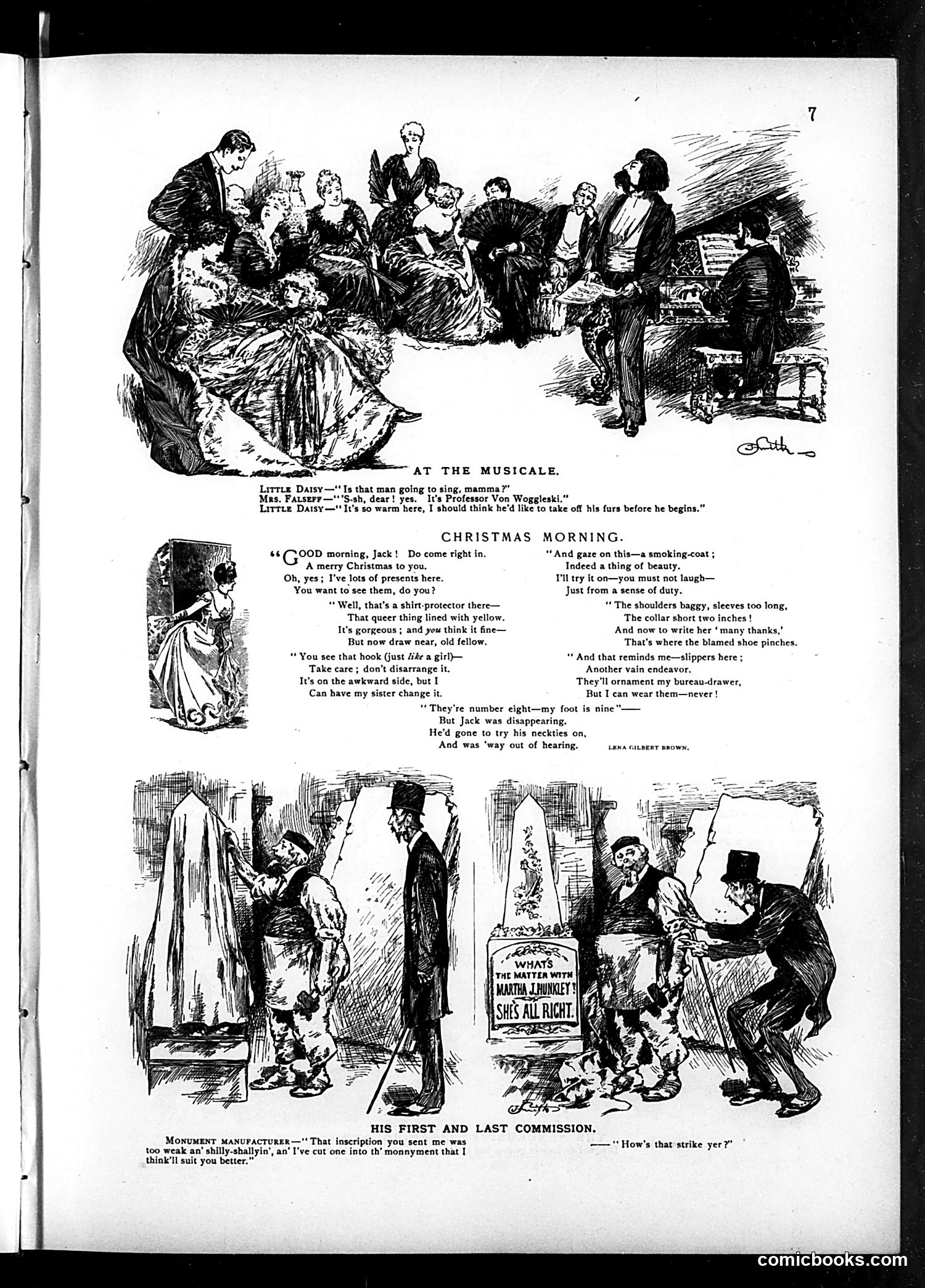
This page contains three satirical pieces typical of late 19th-century American humor: **"At the Musicale"** mocks pretentious concert culture and likely a specific performer ("Professor Von Woggleski"—appears to be a caricatured foreign musician). The child's innocent question about removing his furs before singing hints at the absurdity of affected sophistication. **"Christmas Morning"** satirizes gift-giving awkwardness. A man receives ill-fitting, impractical presents (oversized shirt-protector, baggy smoking coat, wrong-size slippers, uncomfortable neckties) and must pretend gratitude. The humor lies in the universal experience of receiving useless gifts from well-meaning but clueless relatives. **"His First and Last Commission"** jokes about a monument manufacturer's misunderstanding. The client complained his inscription was "weak" and "shilly-shallying" (wishy-washy), so the manufacturer created something crude and overly strong—the opposite of what was wanted. The punchline "How's that strike yer?" suggests the client will be equally dissatisfied. All three reflect common social frustrations: pretension, holiday obligation, and miscommunication.
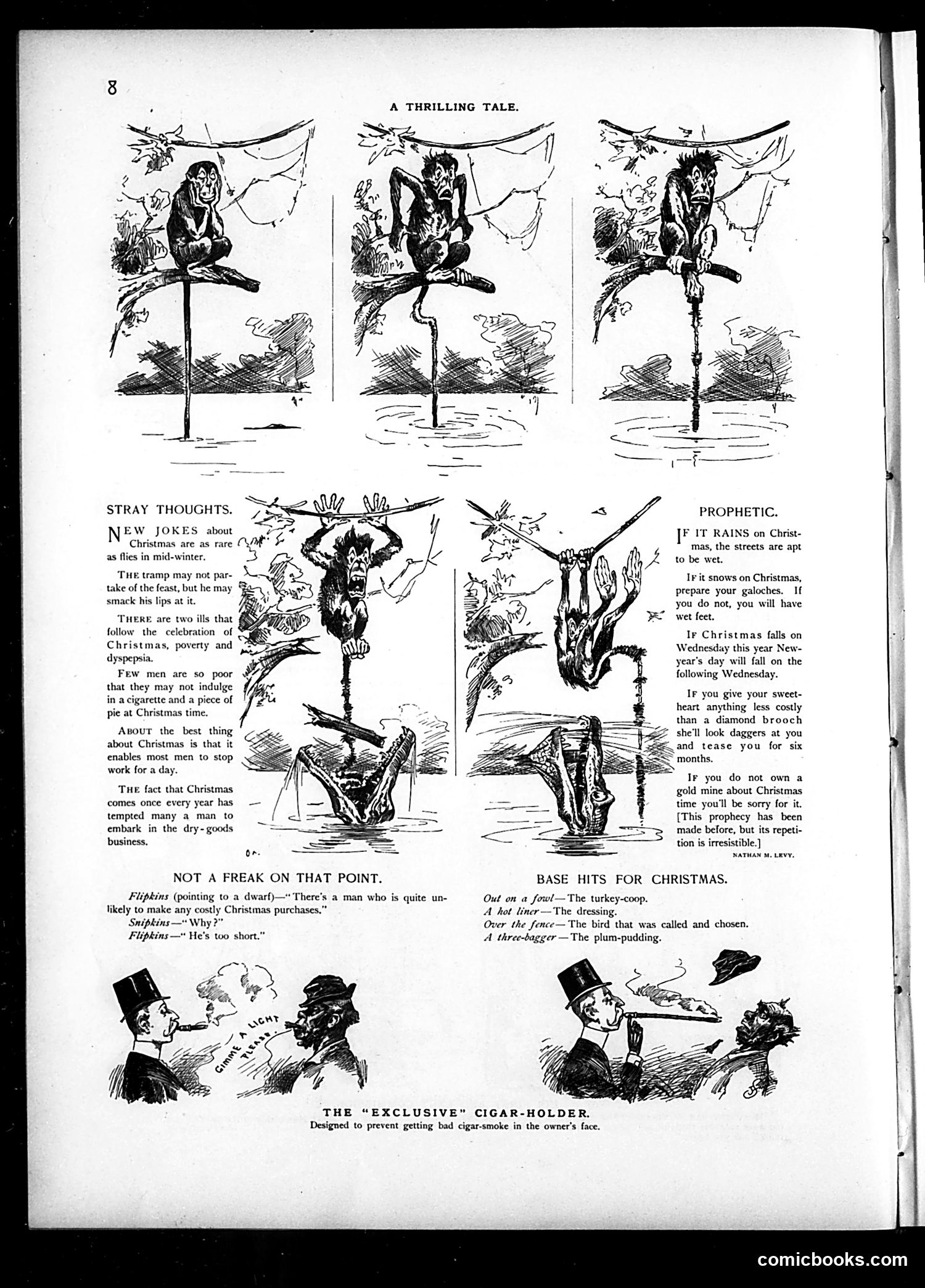
This is a humor compilation page from *Judge* magazine mixing Christmas-themed jokes with satirical commentary on contemporary life and consumer culture. **"A Thrilling Tale"** shows a figure on a pole appearing to levitate or defying gravity—likely mocking melodramatic serialized fiction popular at the time. **"Stray Thoughts"** and **"Prophetic"** sections offer dry, cynical observations: Christmas forces poor men to work harder, poverty and overeating plague the holiday, and materialism dominates (suggesting wealthy suitors give expensive gifts or face romantic consequences). The "prophecy" that if Christmas falls Wednesday, New Year's will too is deliberately obvious satire of fortune-telling. **"Not a Freak on That Point"** jokes that a dwarf won't spend money on Christmas—dark humor about wealth disparities. **"Base Hits for Christmas"** uses baseball terminology to describe Christmas food (turkey, dressing, plum pudding). **"The 'Exclusive' Cigar-Holder"** satirizes consumer products claiming to solve trivial problems—poking fun at marketing excess. Overall, the page satirizes consumerism, class inequality, and how Christmas commercialism corrupts the holiday's supposed meaning.
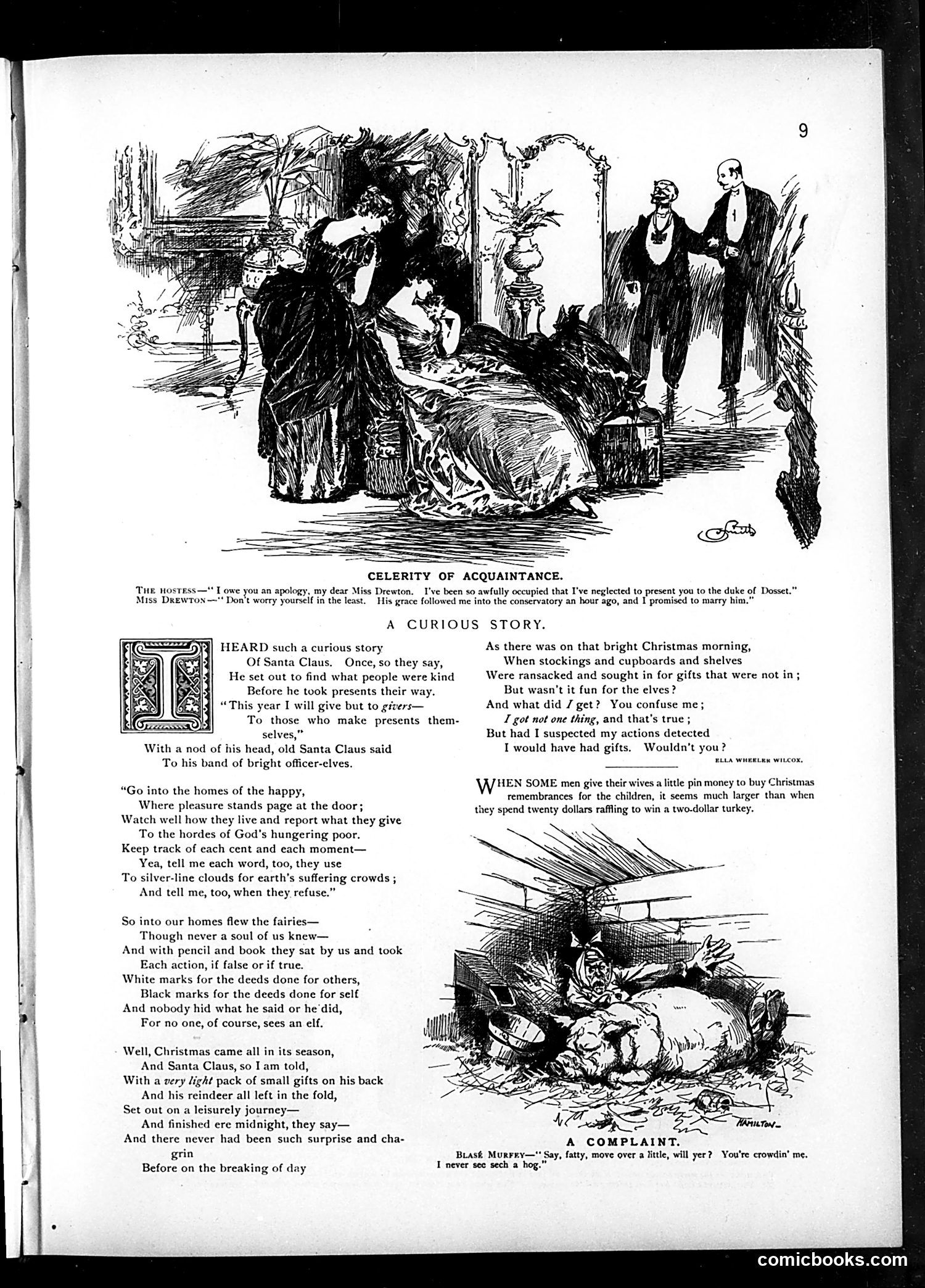
This page contains two Christmas-themed pieces satirizing American social hypocrisy and selfishness. **"Celerity of Acquaintance"** (top cartoon): A brief satire on social climbing. A hostess apologizes for not introducing Miss Drewton to a duke, but the young woman has already secured a marriage proposal from him within an hour—mocking how quickly social-climbing women pursue wealthy titled men. **"A Curious Story"** (main text): A morality fable where Santa's elves secretly monitor people's charitable giving throughout the year. The twist: those who gave generously receive small gifts on Christmas, while selfish people receive nothing—revealing their hypocrisy. A speaker admits receiving nothing because the elves detected their lack of generosity, questioning whether they would have given more if they'd known they were being watched. This critiques performative charity. **"A Complaint"** (bottom cartoon): Two pigs in a pen—likely representing greedy men quarreling over space, satirizing selfishness and competition for resources. The page's theme: American society's gap between claimed values and actual charitable behavior, particularly around Christmas.
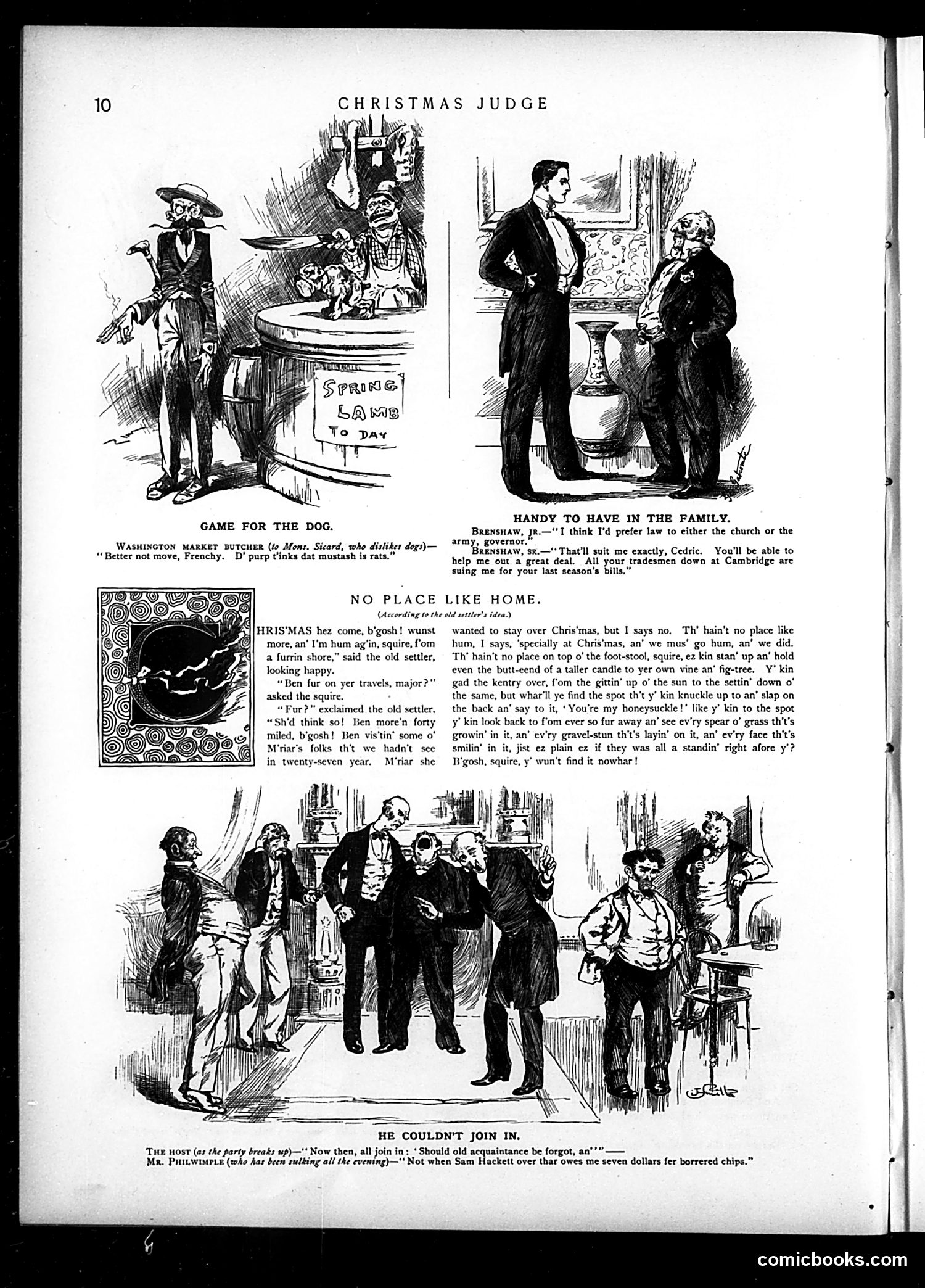
This page contains four separate satirical pieces: 1. **"Game for the Dog"**: A butcher warns a French visitor (identified by accent as "Frenchy") not to move, as the butcher's dog might mistake his mustache for rats—mocking both the Frenchman's distinctive facial hair and implying French people are rodent-like. 2. **"Handy to Have in the Family"**: A wealthy father approves his son pursuing law specifically because the son can help collect debts from tradesmen—satirizing both paternal cynicism and the upper class's use of legal connections for financial gain. 3. **"No Place Like Home"**: An old settler romanticizes returning home after travels, speaking in exaggerated rural dialect about the irreplaceability of home. The satire mocks nostalgic patriotism and sentimental rural ideology. 4. **"He Couldn't Join In"**: A man refuses to sing "Auld Lang Syne" because another guest owes him money from gambling—cynically suggesting financial grievance trumps holiday goodwill and camaraderie.
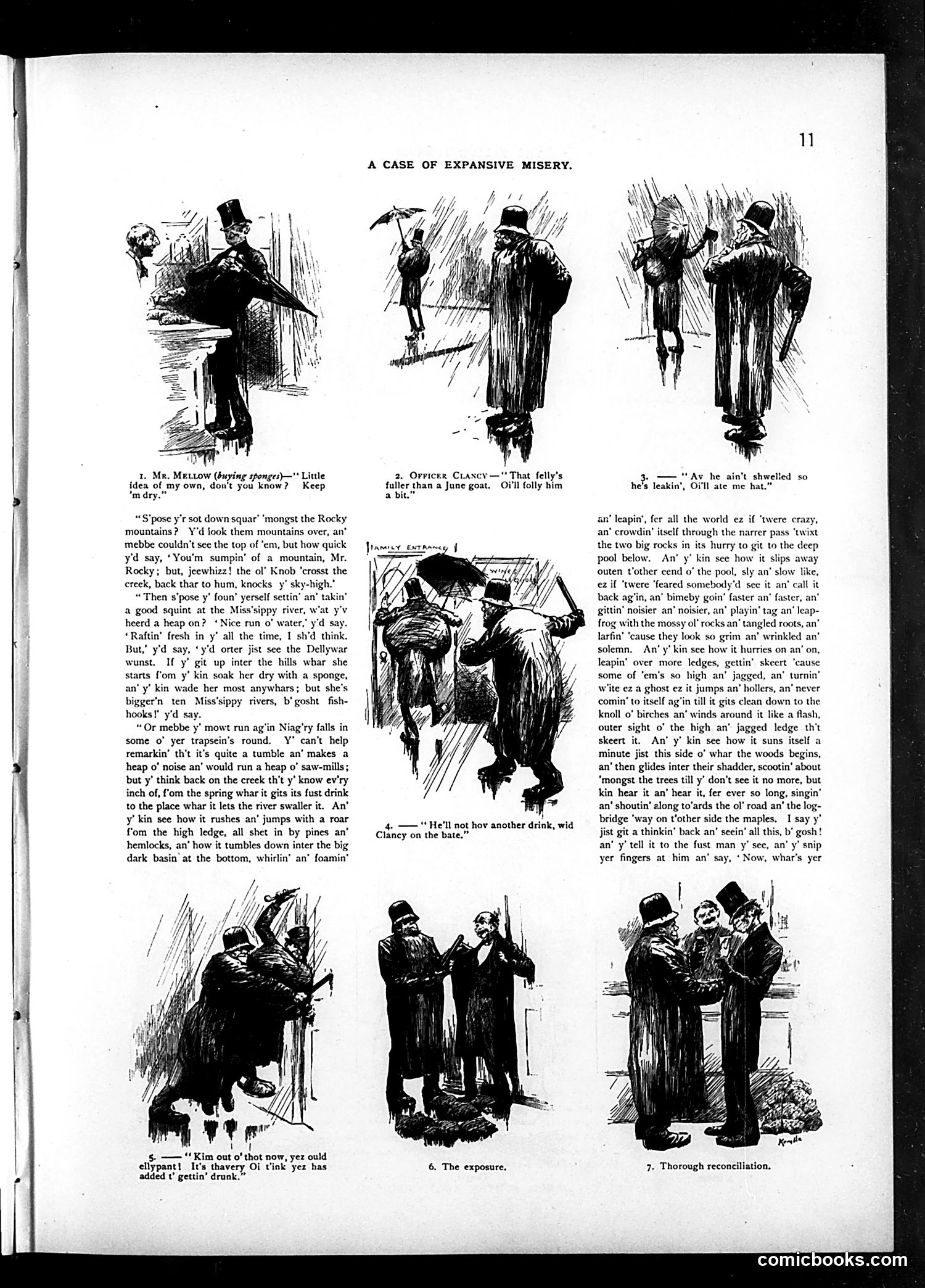
This page satirizes a common human tendency: nostalgia and local pride distorting perception. The main narrative (panels 1-3) features a rural character explaining how familiar things always seem superior to famous ones—a small creek back home seems grander than Niagara Falls or the Mississippi River. The accompanying sketches (panels 4-7) show Irish immigrant characters (indicated by dialect and Officer Clancy), depicting what appears to be a domestic dispute cycle: courtship, exposure of infidelity, reconciliation. The title "Expansive Misery" suggests the joke: just as the main character *expands* humble local sights into grand comparisons, these characters *expand* their emotional drama—quarreling passionately, then making up, only to repeat the cycle. The humor mixes rural Americana sentiment with Irish-immigrant caricature, typical of Judge magazine's comedy approach targeting multiple American populations.
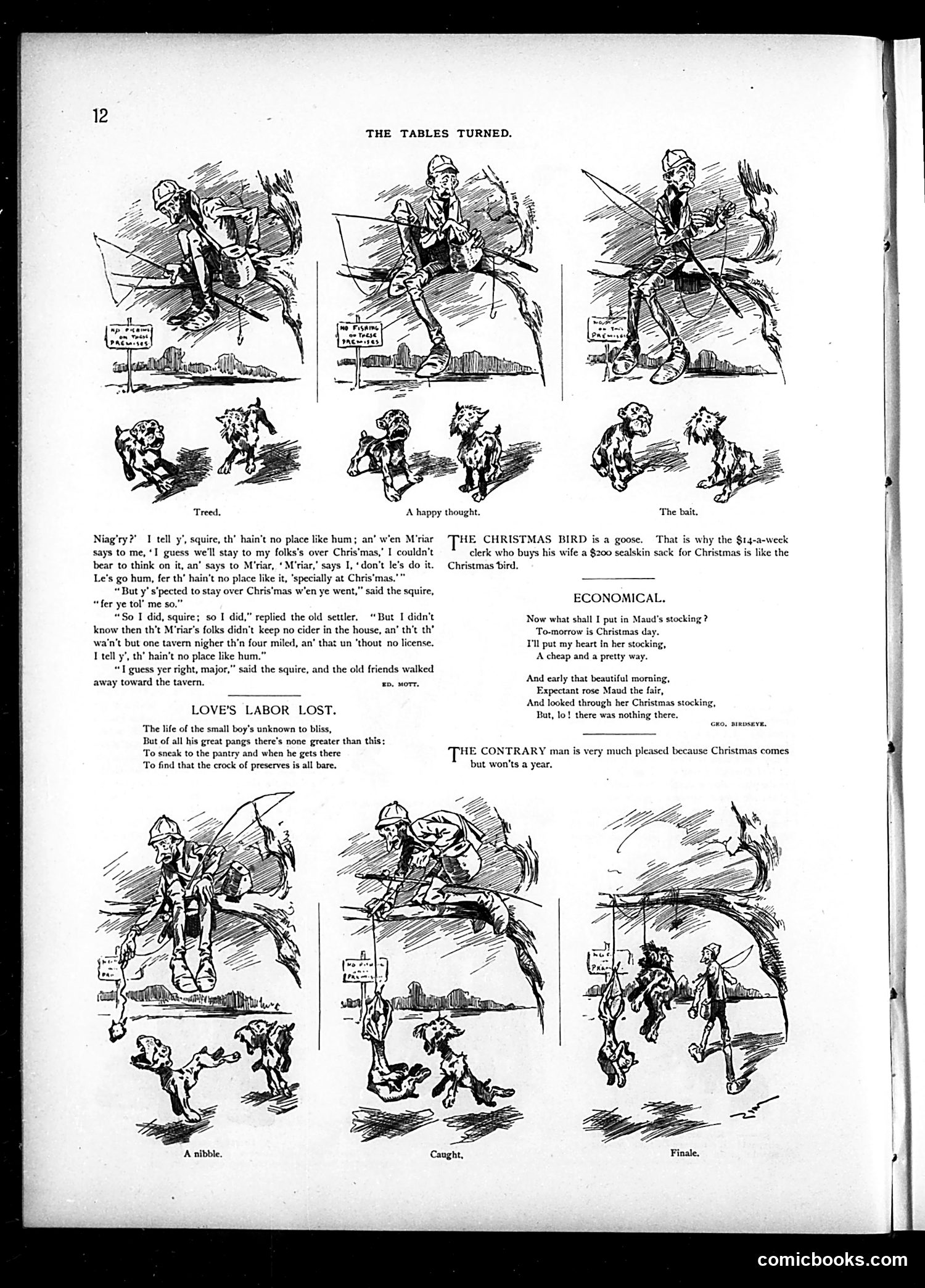
This page contains several Christmas-themed satirical pieces. The main comic strip "The Tables Turned" depicts a dialogue between a squire and an old settler about staying for Christmas. The settler initially agreed but now refuses, claiming he didn't know the settler's in-laws had no cider and no properly-licensed tavern nearby—revealing that holiday visits are endured primarily for drinking rather than family sentiment. The joke mocks rural American holiday customs and the gap between social expectations and actual motivations. The accompanying pieces—"Love's Labor Lost," "The Christmas Bird," "Economical," and "The Contrary Man"—offer brief satirical observations about Christmas gift-giving and consumerism, suggesting the holiday brings financial strain and disappointment rather than genuine joy. The tone is cynical about commercialized Christmas traditions.
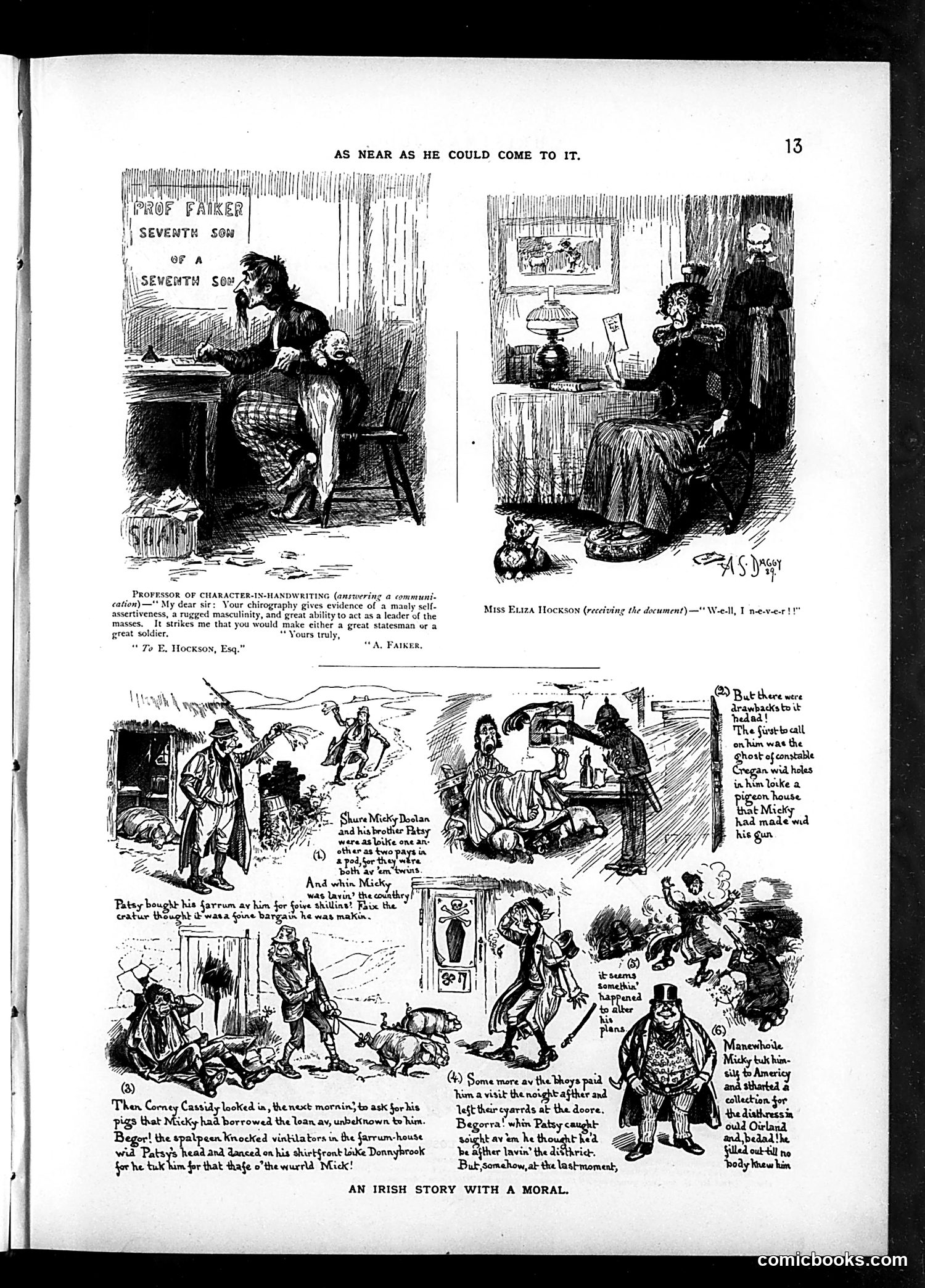
**Top Section:** Two cartoon panels satirizing character assessment through handwriting. A professor of "character-in-handwriting" (graphology) analyzes a correspondent's writing, declaring it shows "manly self-assertiveness" and leadership qualities—traits fitting either a "great statesman or soldier." The joke appears to mock the pseudoscience of handwriting analysis and its absurd pretensions to judge character. **Bottom Section:** "An Irish Story with a Moral" uses heavy Irish dialect and stereotypical characters (Micky, Patsy, Corney Cassidy) in a narrative about rural mischief. The story involves borrowed pigs, property damage, and confusion leading to physical altercations. This reflects period anti-Irish stereotyping common in American satire—depicting Irish immigrants/rural Irish as crude, dishonest, and prone to violence—presented as comic entertainment for contemporary readers. Both sections exemplify Judge's satirical approach: targeting pseudoscience above, ethnic caricature below.
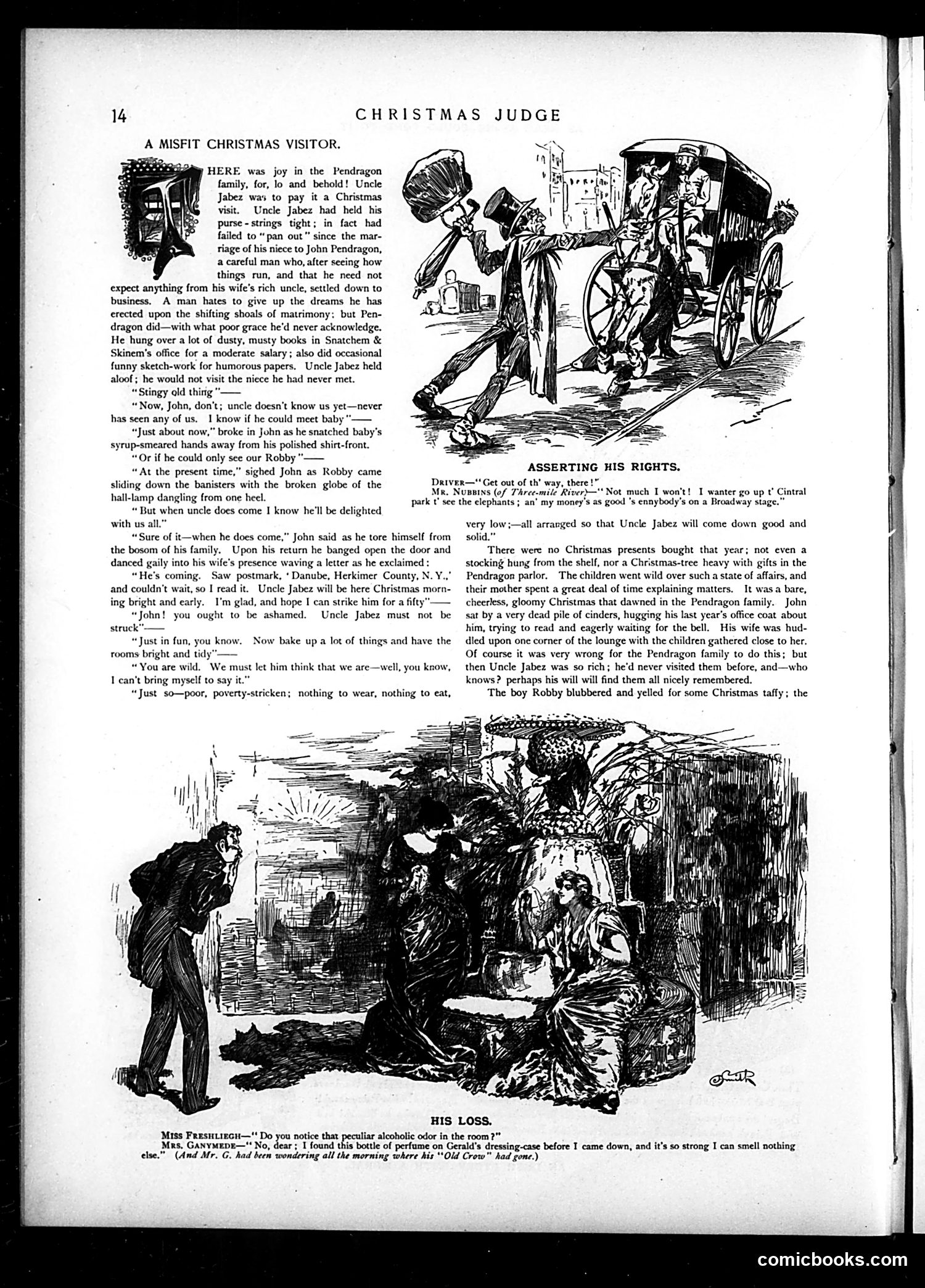
This story satirizes middle-class greed and pretense. John Pendragon, a struggling office worker and occasional cartoonist, has married into a family expecting inheritance from his wealthy but stingy Uncle Jabez. When Uncle Jabez finally announces a Christmas visit, the Pendragons stage an elaborate deception—deliberately impoverishing their home and denying their children presents to appear poor and sympathetic, hoping to manipulate him into financial generosity or a favorable will. The satire targets the hypocrisy of gold-digging relatives and the moral corruption money inspires. The accompanying illustrations show the family's desperation ("His Loss") and Uncle Jabez's arrival ("Asserting His Rights"), depicting the collision between their scheming hopes and reality. This reflects Gilded Age anxieties about wealth, inheritance, and family dysfunction among the aspiring middle class.
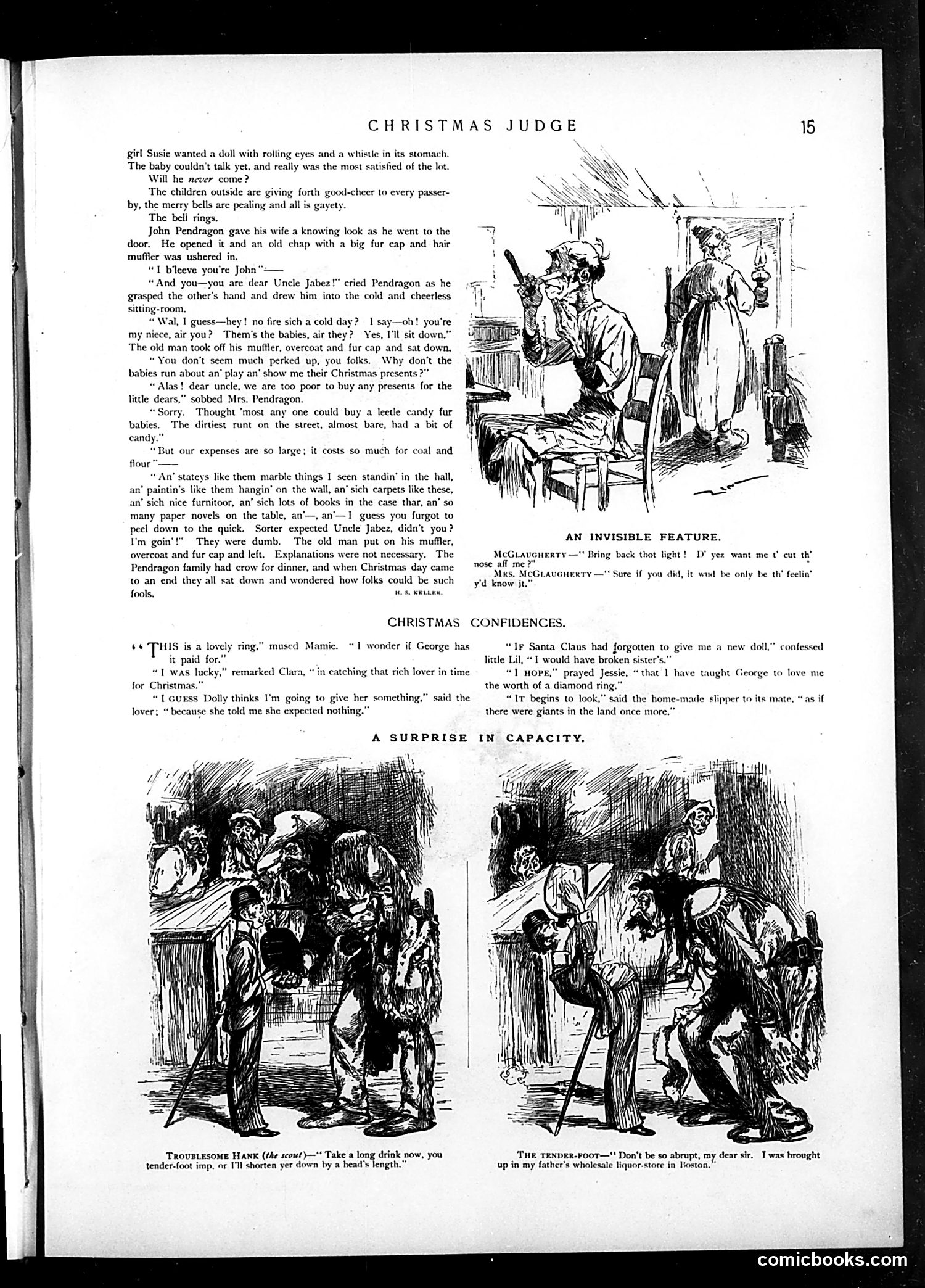
This page contains multiple satirical pieces about Christmas poverty and social pretense: **Main Story ("Christmas Judge"):** A poor family (the Pendragons) pretend to wealth when Uncle Jabez visits—maintaining expensive furnishings and decorations while claiming inability to buy children Christmas presents. The uncle sees through the hypocrisy, calls them out, and leaves in disgust. The satire targets middle-class families who prioritize appearances (marble statues, paintings, carpets, novels) over their children's basic needs. **"Christmas Confidences":** Brief cynical observations about gift-giving expectations and materialism among the wealthy. **"A Surprise in Capacity":** Two cartoon panels showing a rural scout ("Troublesome Hank") trying to get a tender-foot to drink whiskey, but the easterner reveals he was raised in his father's wholesale liquor business—implying he can outdrink the rustic. This satirizes stereotypes about city versus country sophistication. The overall theme: exposing hypocrisy and false pretenses during the Christmas season across different social classes.
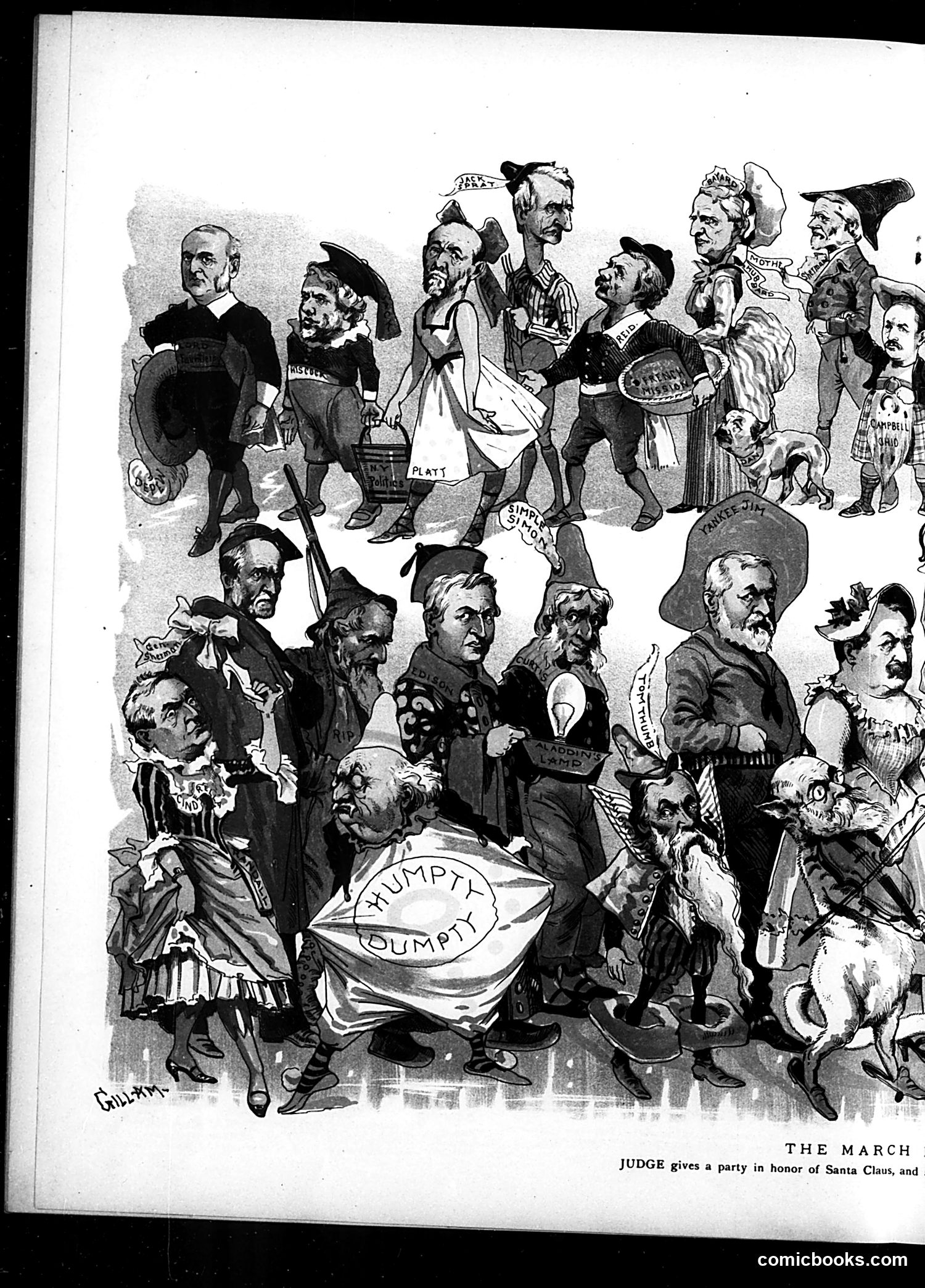
This is a satirical political cartoon from *Judge* magazine depicting a procession of exaggerated caricatured figures. The caption indicates it's ostensibly a "party in honor of Santa Claus," but the image satirizes contemporary political or social figures through grotesque caricature—a common *Judge* technique. The figures wear various costumes and hold symbols (banners reading "TRIUMPH DUMPTY" appear visible), suggesting they represent specific politicians or public figures of the era. The artistic style uses physical exaggeration and caricature typical of Gilded Age political satire. Without clearer identification of specific individuals or the magazine's publication date, the precise political targets remain unclear, though the festive "march" framing suggests mockery of a contemporary political parade or movement.
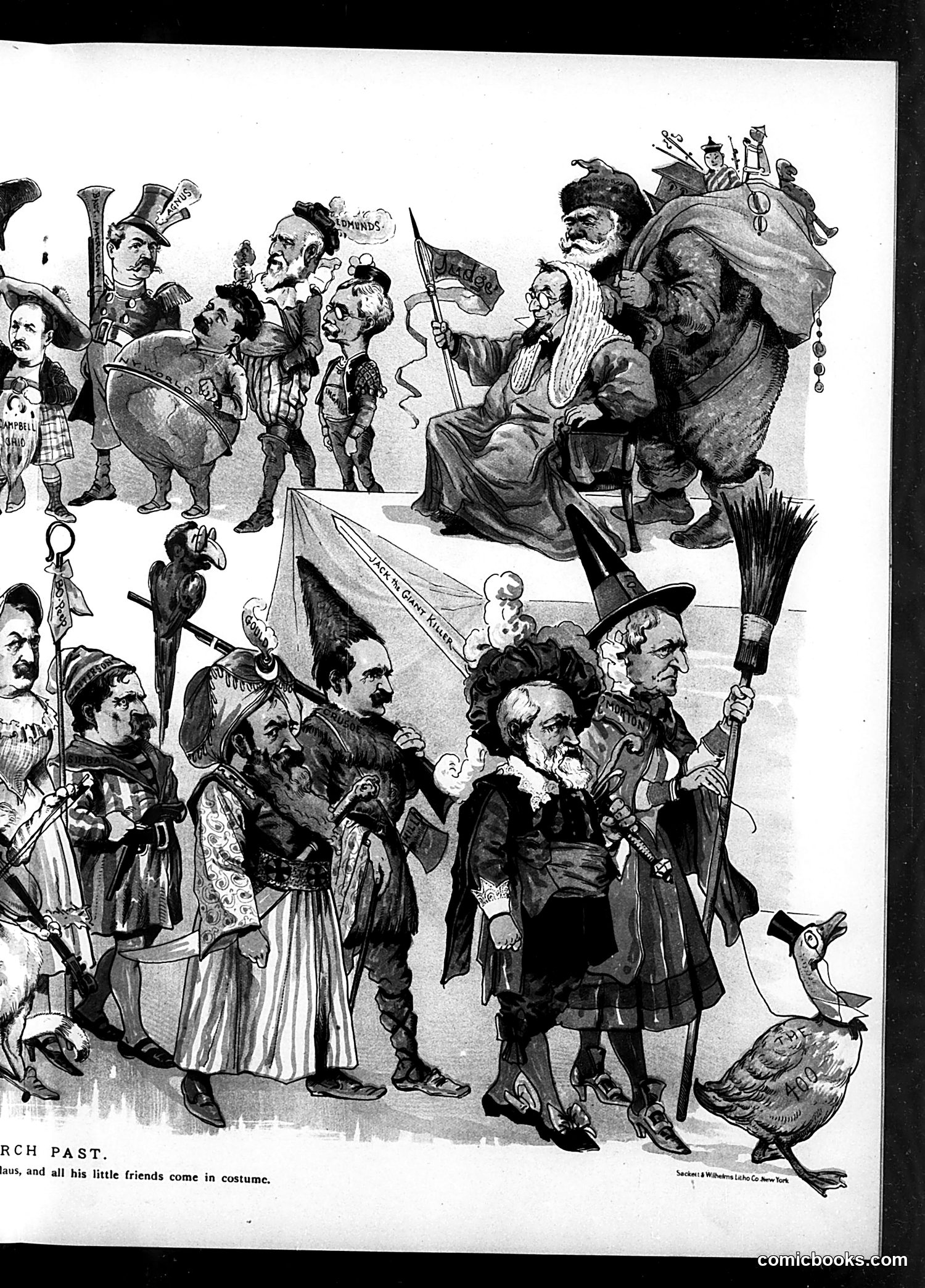
This appears to be a satirical cartoon titled "MARCH PAST" from *Judge* magazine, depicting a parade or procession of historical and political figures in costume or caricature. The characters are drawn with exaggerated features typical of late 19th-century political satire. The composition shows figures at different social levels—some on an elevated platform (possibly representing power or authority) and others marching below. The costumes and regalia suggest these are meant to represent political leaders, possibly European monarchs or statesmen, given the formal dress and heraldic elements visible. Without clearer context or visible labels identifying specific individuals, the exact targets of this satire remain unclear. The "March Past" title suggests commentary on political procession, pageantry, or perhaps the parading of outdated political systems. The overall tone appears mocking of pretension and formal hierarchy.
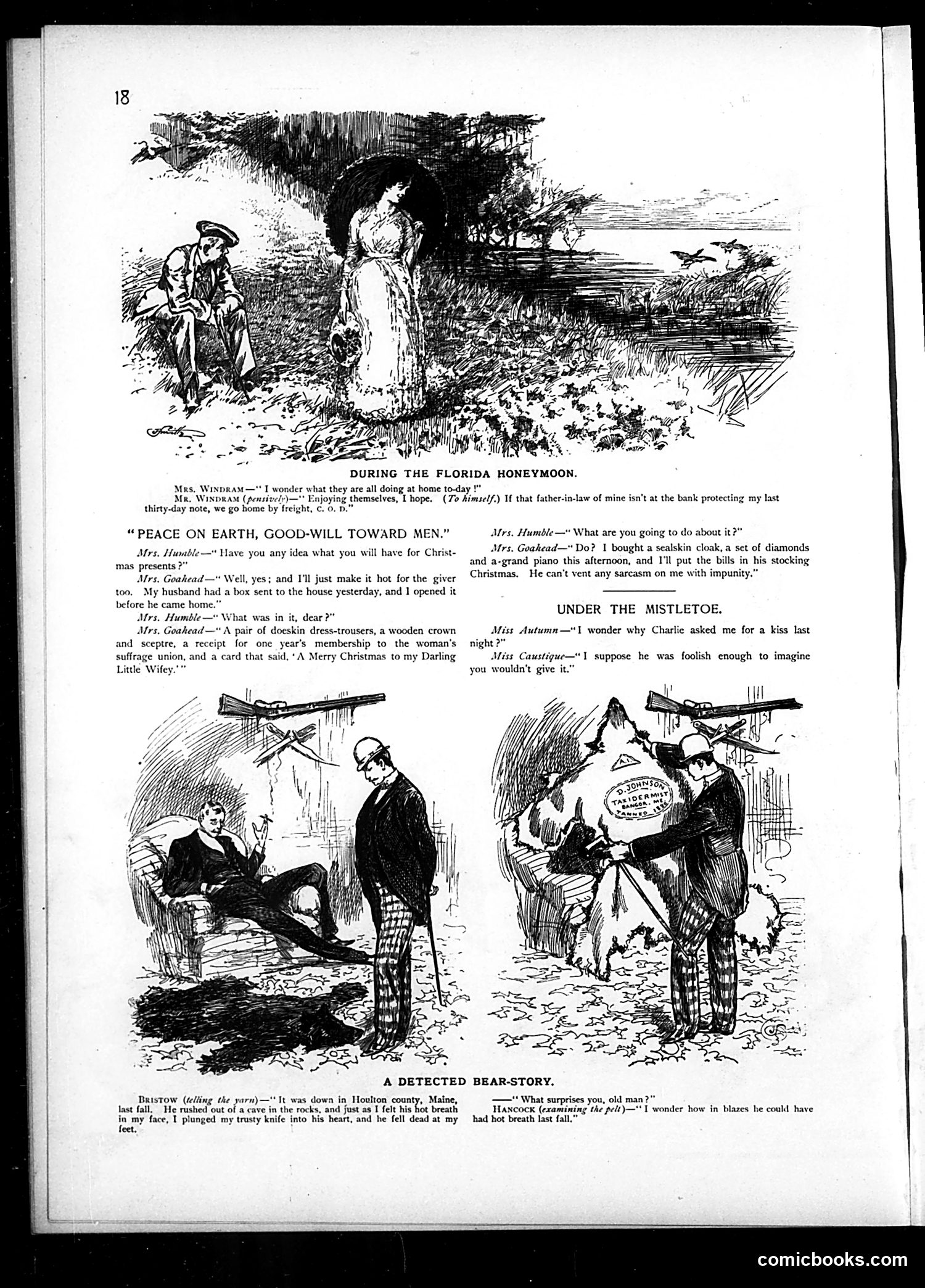
This page contains three satirical sketches about Christmas and courtship customs circa early 1900s: **"During the Florida Honeymoon"** mocks newlyweds' financial anxieties—the husband worries about debts while honeymooning. **"Peace on Earth, Good-Will Toward Men"** satirizes domestic conflict through gift-giving. A husband gives his wife modest, somewhat insulting gifts (including a suffrage union membership, suggesting mockery of women's rights). She retaliates by purchasing expensive items (sealskin, diamonds, piano) and deliberately hiding bills in his stocking—inverting traditional gender roles in spending and marital power dynamics. **"Under the Mistletoe"** is a brief joke about romantic expectations around holiday traditions. **"A Detected Bear-Story"** exposes a tall tale: a hunter claims to have killed a bear in Maine autumn, but his companion reveals the lie—bears don't have "hot breath" in fall, as they're hibernating. It mocks exaggerated hunting stories. The overall theme critiques materialism, marital discord, and masculine bravado during the holiday season.
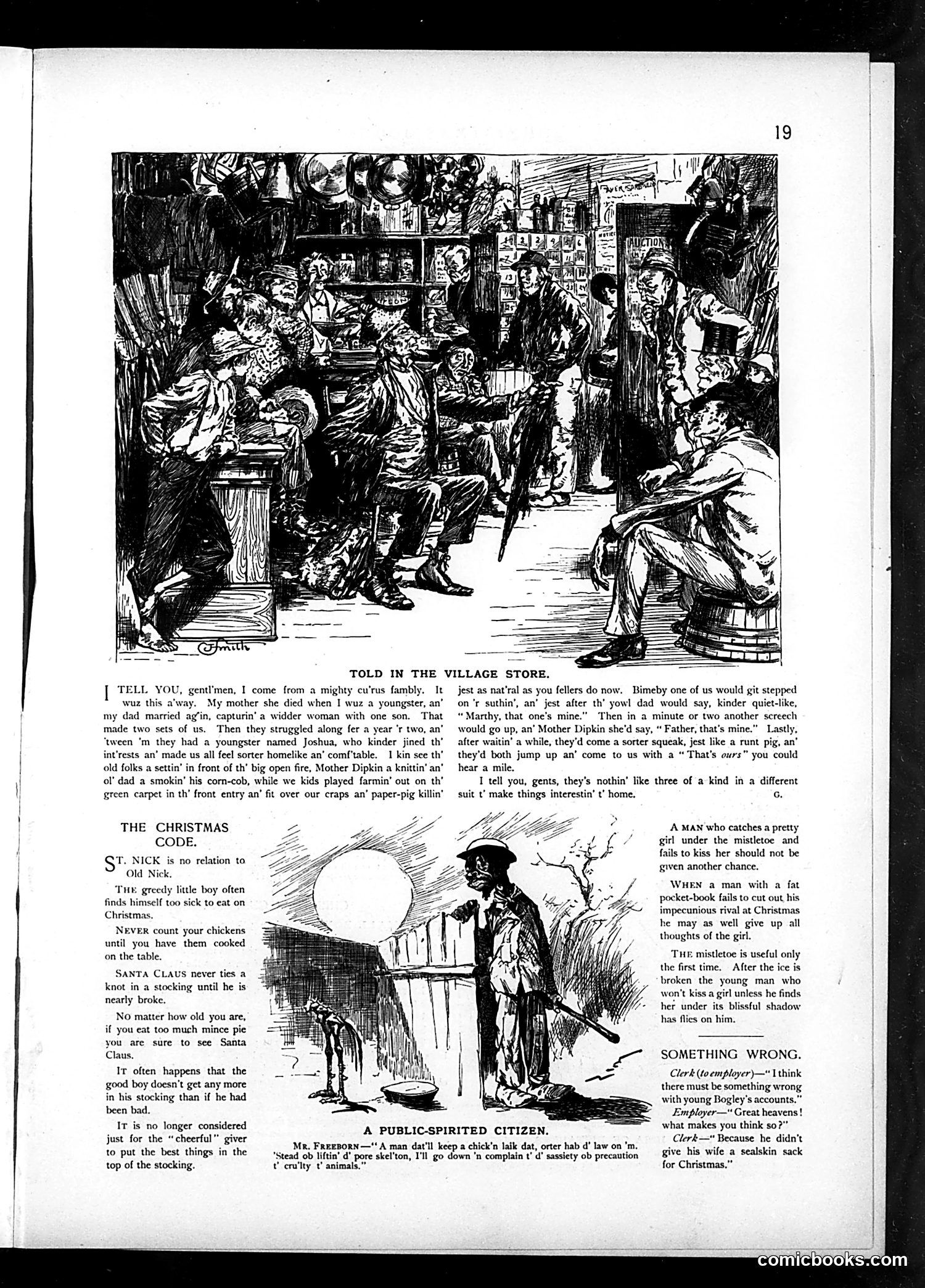
This page contains three distinct satirical pieces: **"Told in the Village Store"** (main illustration): A humorous anecdote in rural dialect about a blended family with multiple children, told as entertainment in a general store. The joke centers on the children fighting over territory and possessions—a domestic comedy reflecting late-19th-century rural life. **"The Christmas Code"** (left column): A satirical list of supposed "rules" for Christmas behavior, mocking bourgeois hypocrisy. It jokes that good behavior goes unrewarded, that greed causes illness, and that Santa isn't actually generous—poking fun at both commercialized Christmas and middle-class pretense. **"A Public-Spirited Citizen"** and **"Something Wrong"** (right): Brief satirical vignettes. The first mocks self-righteous busybodies who complain about animal cruelty. The second suggests a clerk's suspicion about an employee's honesty is confirmed when the employee didn't buy his wife an expensive sealskin coat—satire on conspicuous consumption as a moral indicator. The page ridicules class pretense, rural simplicity, and Christmas commercialism.
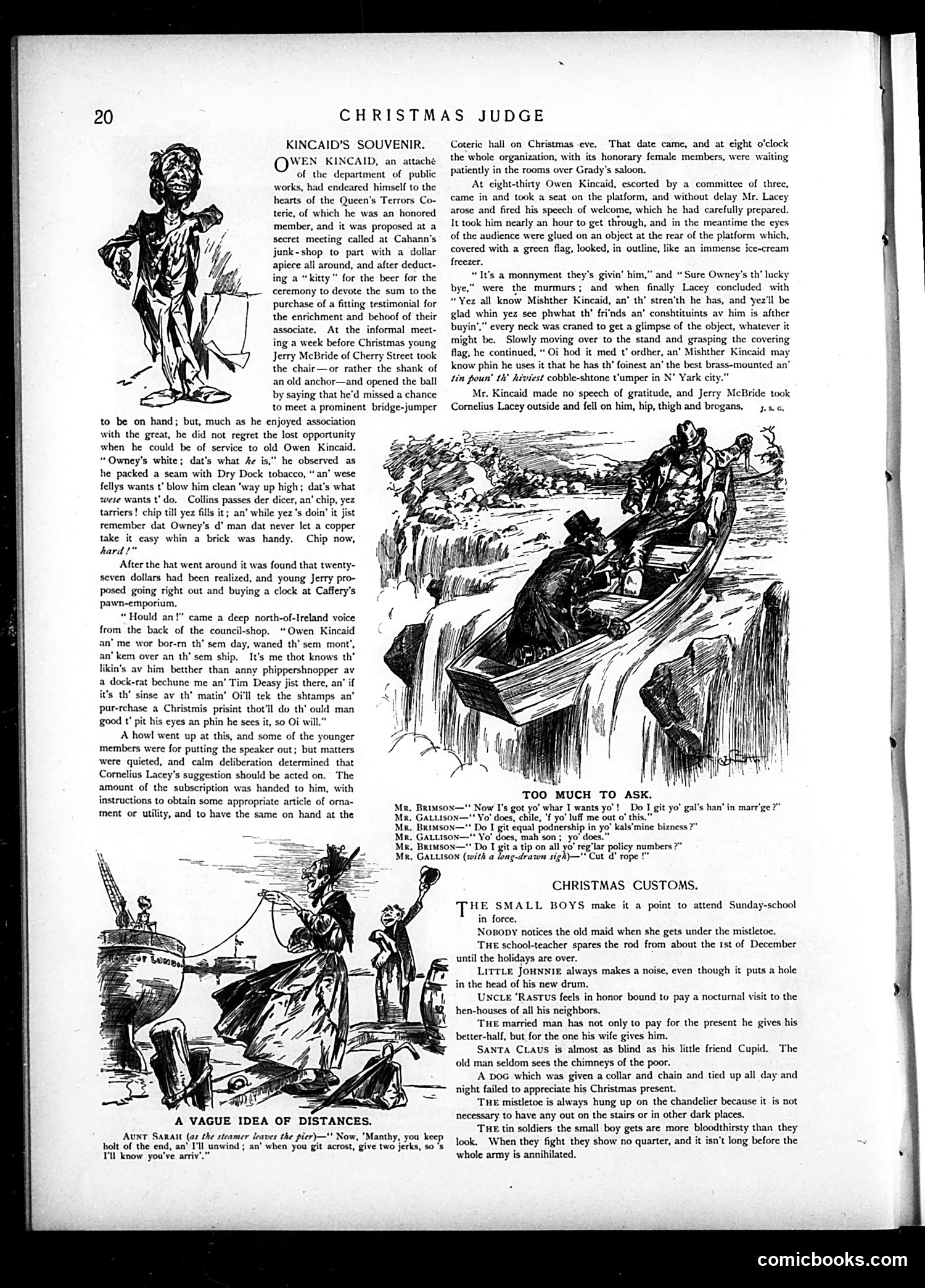
This page satirizes Irish-American working-class culture in New York, specifically dock workers and laborers. "Owen Kincaid," an attaché in the public works department, is being honored by the "Queen's Terrors Coterie"—a group of Irish immigrants meeting at a junk shop to collect money for a gift. The satire targets several things: the heavy Irish dialect rendered phonetically ("Owney," "phippershnopper"), the working-class setting (dock rats, tarriers), and the absurd reverence shown to a minor bureaucrat. The humor lies in their grand ceremony—an hour-long speech by Cornelius Lacey to unveil a mysterious gift (hidden under a green flag, humorously resembling an ice-cream freezer)—for what's presumably a mundane object. The accompanying cartoon "A Vague Idea of Distances" jokes about Irish immigrants' confusion about American geography and communication. The "Christmas Customs" section below offers satirical commentary on working-class and immigrant holiday behaviors.
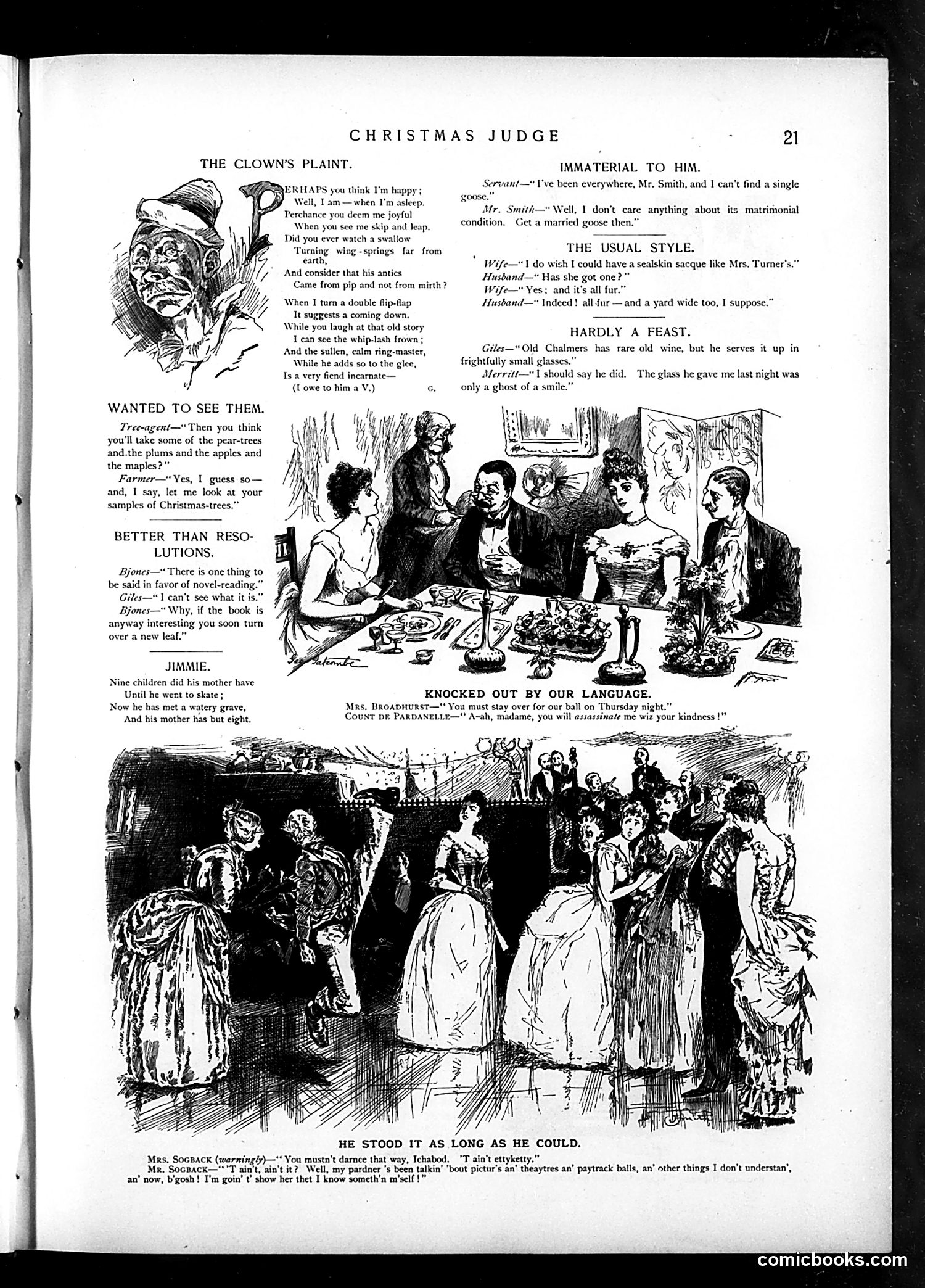
This page collects brief humorous sketches typical of Judge magazine's social satire: **"The Clown's Plaint"** mocks the assumption that performers are always happy—a clown describes the melancholy behind theatrical entertainment, suggesting performance masks inner suffering. **"Immaterial to Him"** jokes on marital indifference: when a servant can't find a goose for dinner, Mr. Smith dismissively suggests getting "a married goose" instead, implying married life lacks vitality. **"Hardly a Feast"** satirizes stingy hospitality—serving rare wine in tiny glasses to appear generous while being miserly. **"Jimmie"** presents a dark joke about a child's death by skating accident, reducing tragedy to macabre wordplay. **"Knocked Out by Our Language"** mocks foreigners' awkward English; a French count uses "assassinate" instead of "overwhelm," creating unintended violent imagery. **"He Stood It as Long as He Could"** portrays a working-class man (Ichabod) fed up with his partner discussing culture and entertainment—he asserts his own knowledge by dancing badly, satirizing class anxiety and masculine defensiveness.
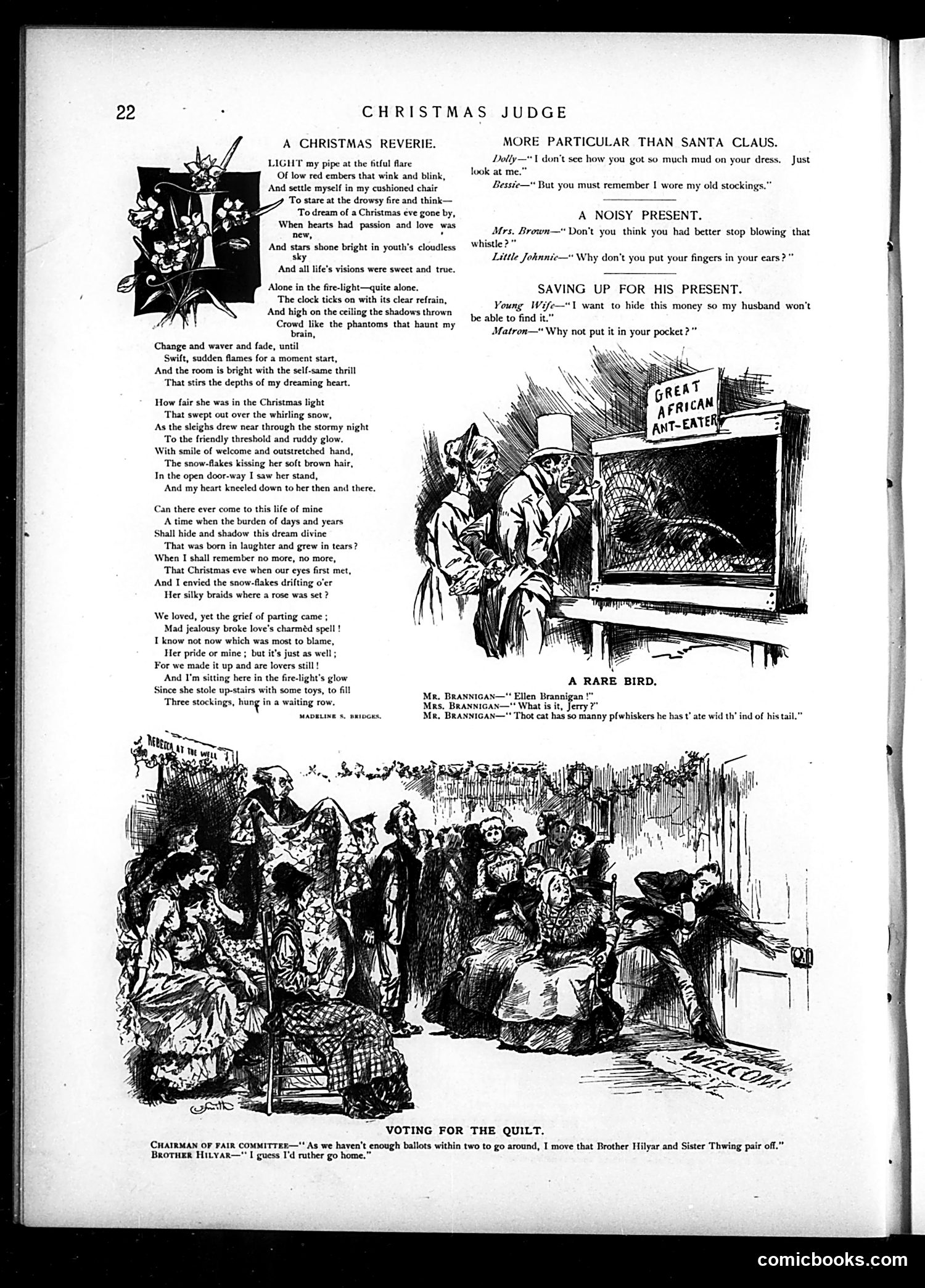
This page from *Judge* magazine contains sentimental and humorous Christmas-themed content typical of the era. **"A Christmas Reverie"** is a nostalgic poem about a man recalling a Christmas Eve when he met his beloved, describing lost love, jealousy, and reconciliation. The narrative ends domestically—he's now married, waiting for his wife to fill stockings upstairs. The cartoon vignettes below are brief domestic humor sketches: - **"More Particular Than Santa Claus"**: A child's muddy dress excuse - **"A Noisy Present"**: A child blowing a whistle, mocking adult complaints - **"Saving Up for His Present"**: A wife hiding money from her husband - **"A Rare Bird"**: Ethnic humor about an Irish character's malapropism regarding a cat's whiskers - **"Voting for the Quilt"**: A church fair committee chairman's procedural joke; Brother Hilyar prefers going home to pairing off with Sister Thwing for the vote The humor relies on domestic situations, class observations, and period stereotypes rather than sharp political satire.
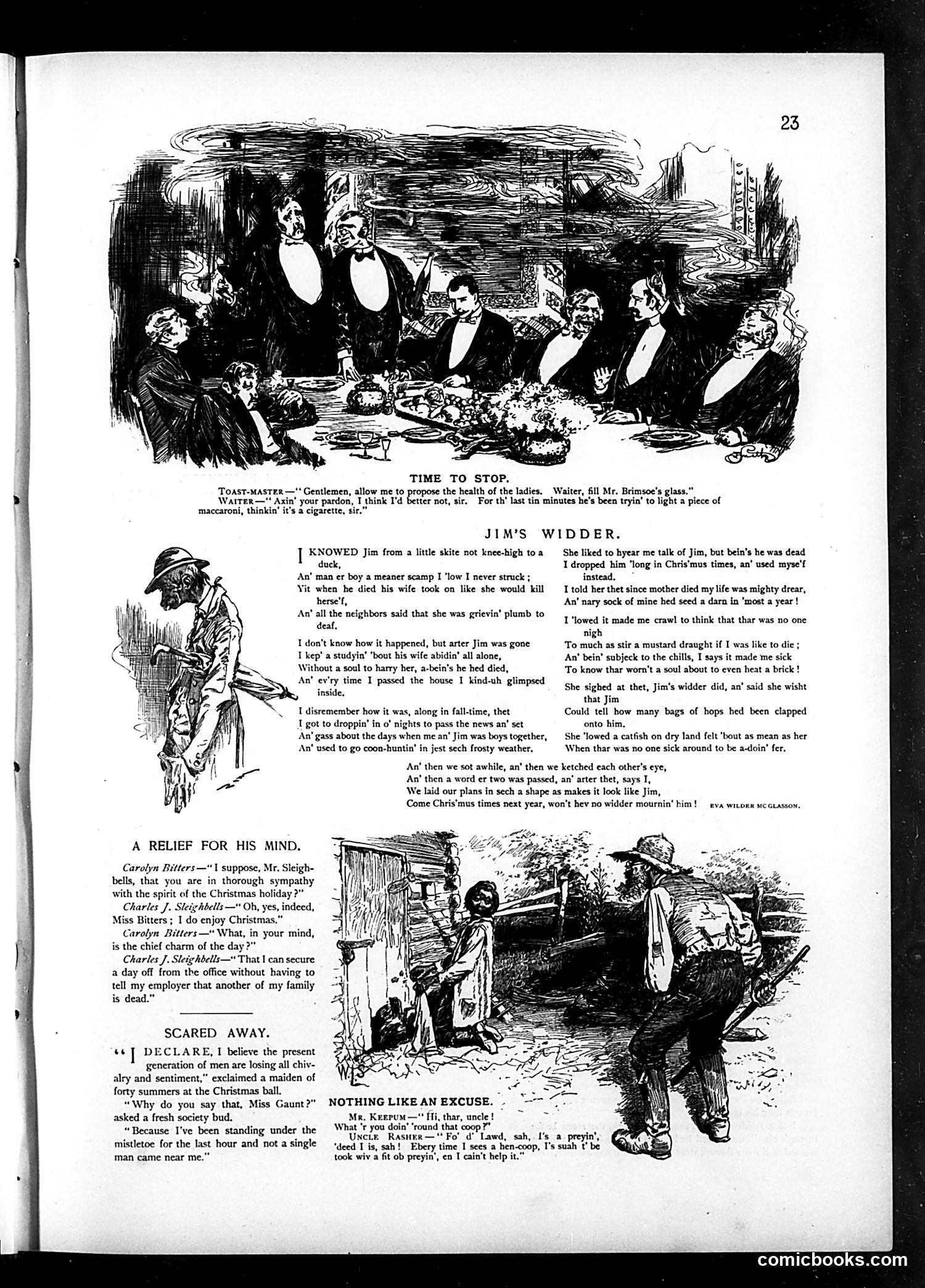
This page contains multiple brief satirical pieces typical of Judge's holiday content: **"Time to Stop"** mocks a drunk dinner guest who's so intoxicated he tries lighting pasta as a cigarette. **"Jim's Widder"** is a sentimental rural dialect poem about a widower who consoles Jim's grieving widow, eventually proposing marriage by Christmas—satirizing melodramatic sentimentality. **"A Relief for His Mind"** jokes that a character's favorite thing about Christmas is getting a day off work without needing to fabricate a family death excuse—dark humor about workplace dishonesty. **"Scared Away"** mocks a middle-aged woman complaining no men approached her under the mistletoe, implying her age makes her unappealing. **"Nothing Like an Excuse"** features racist dialect humor: an enslaved or formerly enslaved man claims he's "praying" near a chicken coop, when obviously he's stealing—playing on period stereotypes. These pieces showcase Judge's mix of sentimental storytelling, workplace satire, and period-typical racist caricature.
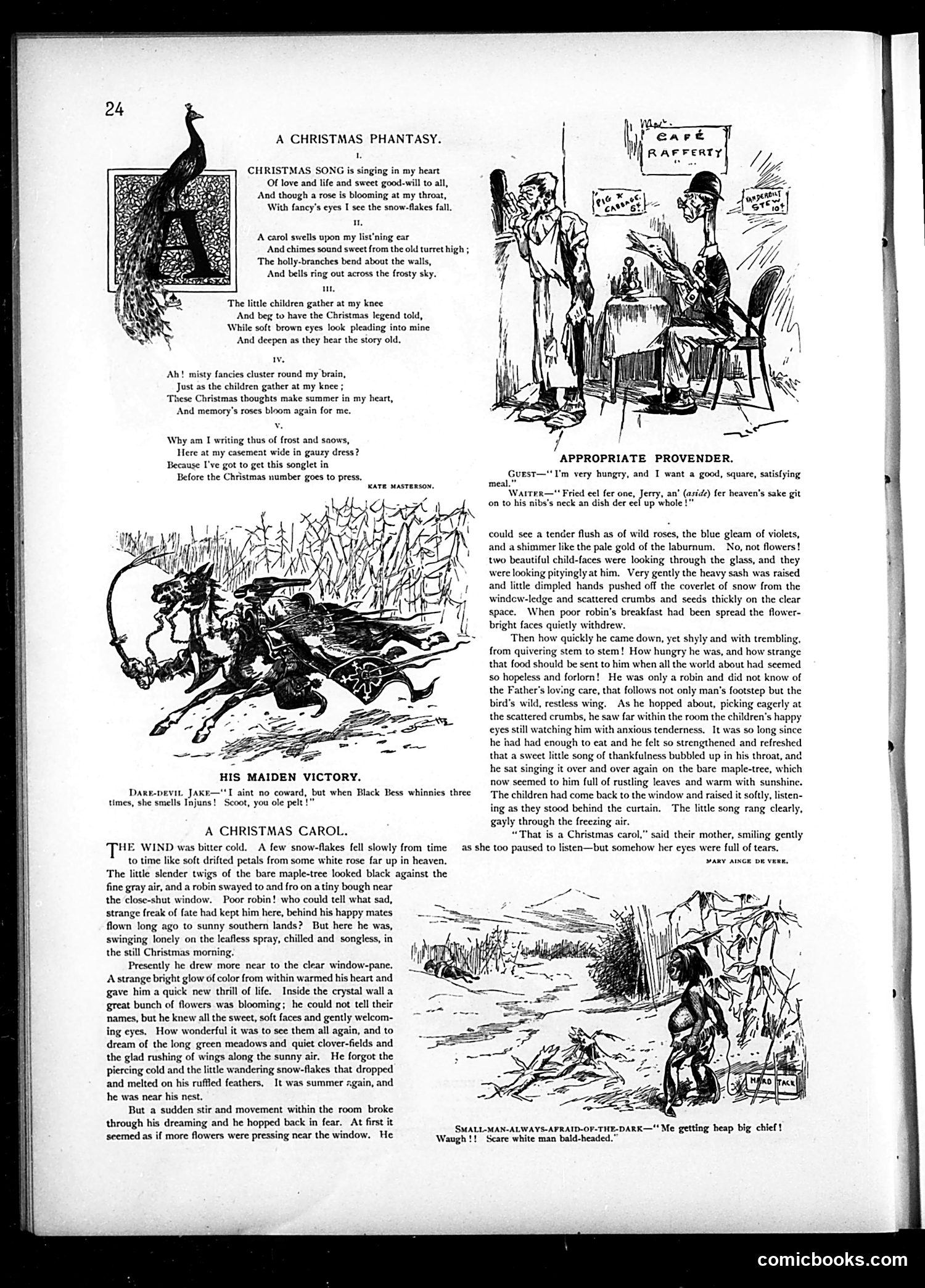
This page contains three separate pieces: **"A Christmas Phantasy"** (poem by Kate Masterson): A sentimental Christmas poem about nostalgic memories and holiday feelings. The final stanza is meta-humor—the author admits she's writing about frost and snow while sitting in summer dress simply because the poem needs to meet the Christmas issue deadline. **"His Maiden Victory"** (cartoon): A crude Western sketch showing a character named "Dare-Devil Jake" claiming he's not a coward, but his horse "Black Bess" detects Native Americans nearby, suggesting Jake is actually afraid despite his bravado. This reflects period stereotypes and the popular "dime novel" Western genre. **"A Christmas Carol"** and **"Appropriate Provender"** (story and cartoon): A sentimental Christmas tale about a cold robin finding comfort at a window where children feed it, juxtaposed with a crude joke about a waiter's contempt for a customer ordering eel—he plans to serve it whole to the "boss" upstairs rather than properly prepare it. The page mixes sentimental Christmas content with working-class humor and period stereotypes typical of Judge's satirical approach.
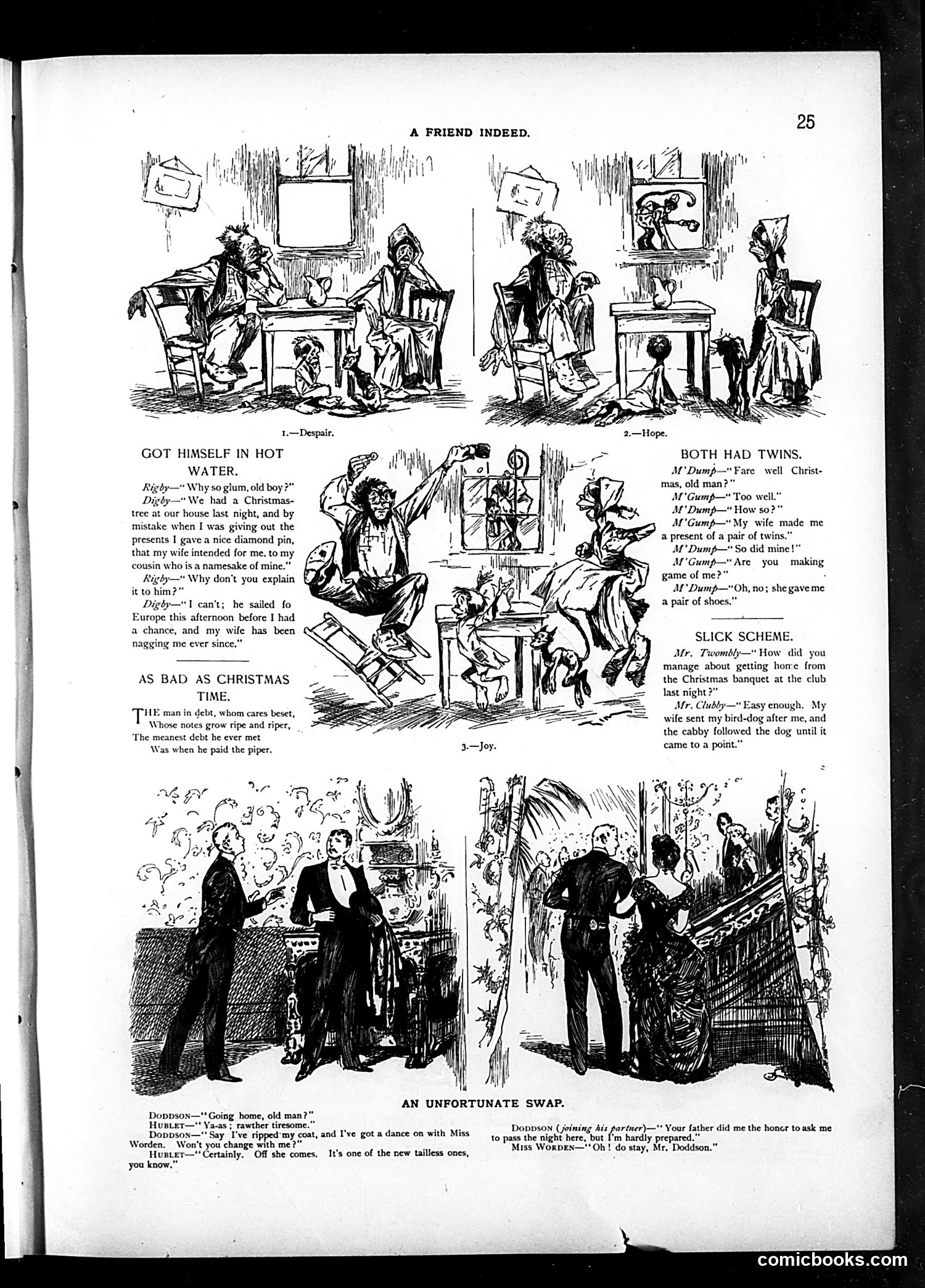
This page contains six brief humorous sketches satirizing Victorian-era middle-class social mishaps: **"Got Himself in Hot Water"**: A man accidentally gives his wife's intended diamond pin gift to a cousin with the same name, who immediately sails to Europe. The joke mocks marital discord and the impossibility of correcting the mistake. **"As Bad as Christmas Time"**: A poem about debt collectors, comparing the burden of paying debts to "paying the piper"—a common expression meaning facing consequences. **"Both Had Twins"** and **"Joy"**: Husband exchanges about unwanted gifts disguised as twins—wives gave husbands children (twins) while husbands gave wives shoes. Darkly satirizes marriage frustrations. **"Slick Scheme"**: A man avoids walking home drunk from a club dinner by having his wife send the bird-dog to follow him; the cab driver follows the dog to the hunting point—mocking both inebriation and marital manipulation. **"An Unfortunate Swap"**: A man unprepared for an overnight stay attempts to borrow a tailcoat, receiving a "new tailless one" instead—wordplay on fashion and social embarrassment. All mock Victorian domesticity and class pretensions.
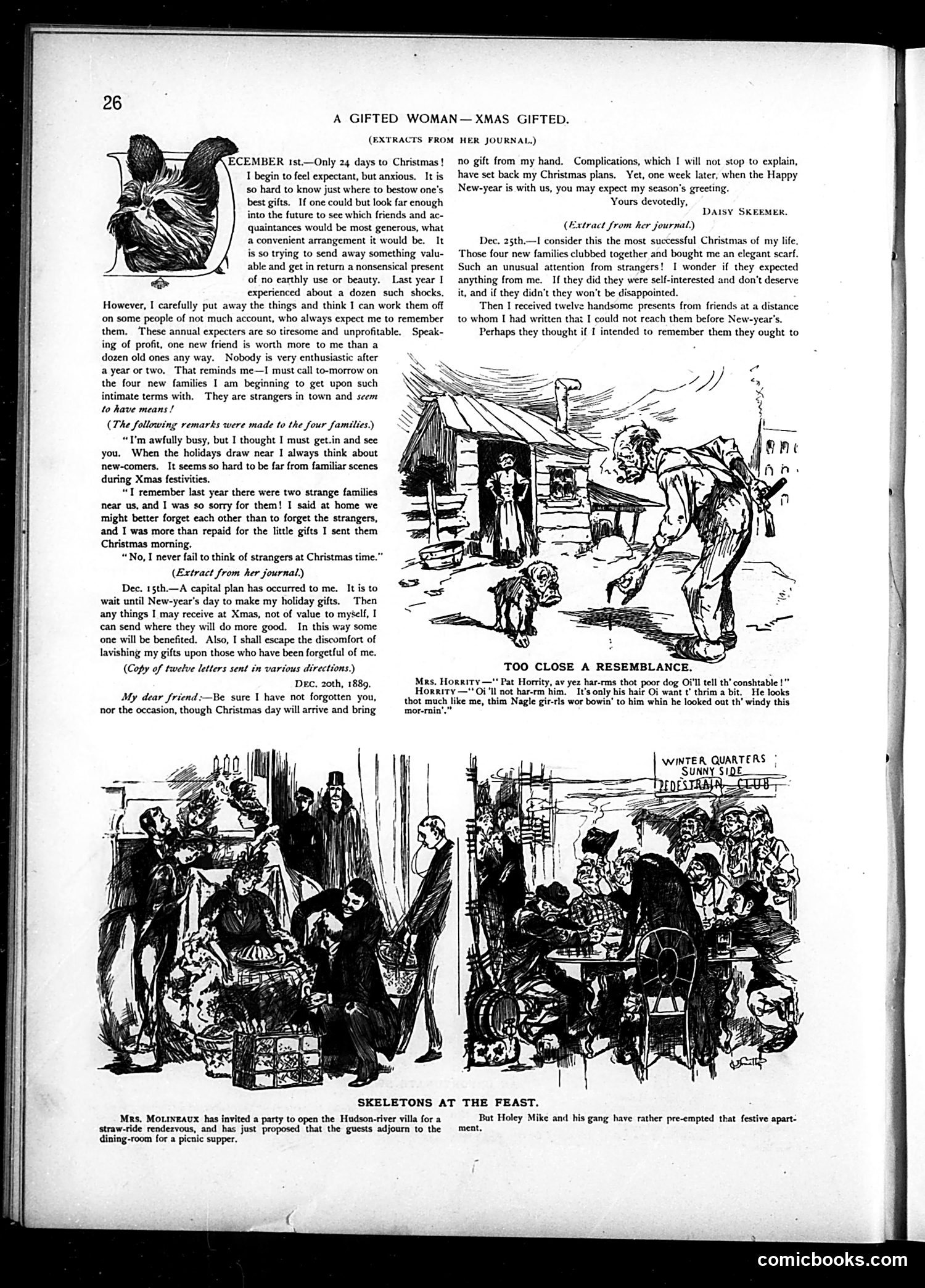
This satirical piece mocks the hypocrisy of upper-class charitable gift-giving. The protagonist, Daisy Skeemer, presents herself as generous to poor strangers at Christmas, yet her private journal reveals her true motivation: she strategically gives gifts only to wealthy "new families" with "means," calculating that they'll reciprocate with valuable gifts. She plans to regift unwanted presents to "people of not much account" and delays gifts to distant friends until New Year's, hoping guilt will prompt them to send her presents first. The satire exposes how ostensible Christmas charity among the privileged class is actually transactional self-interest disguised as benevolence. The other cartoons on the page ("Too Close a Resemblance" and "Skeletons at the Feast") continue mocking social pretense—ethnic humor and uncomfortable holiday gatherings respectively.
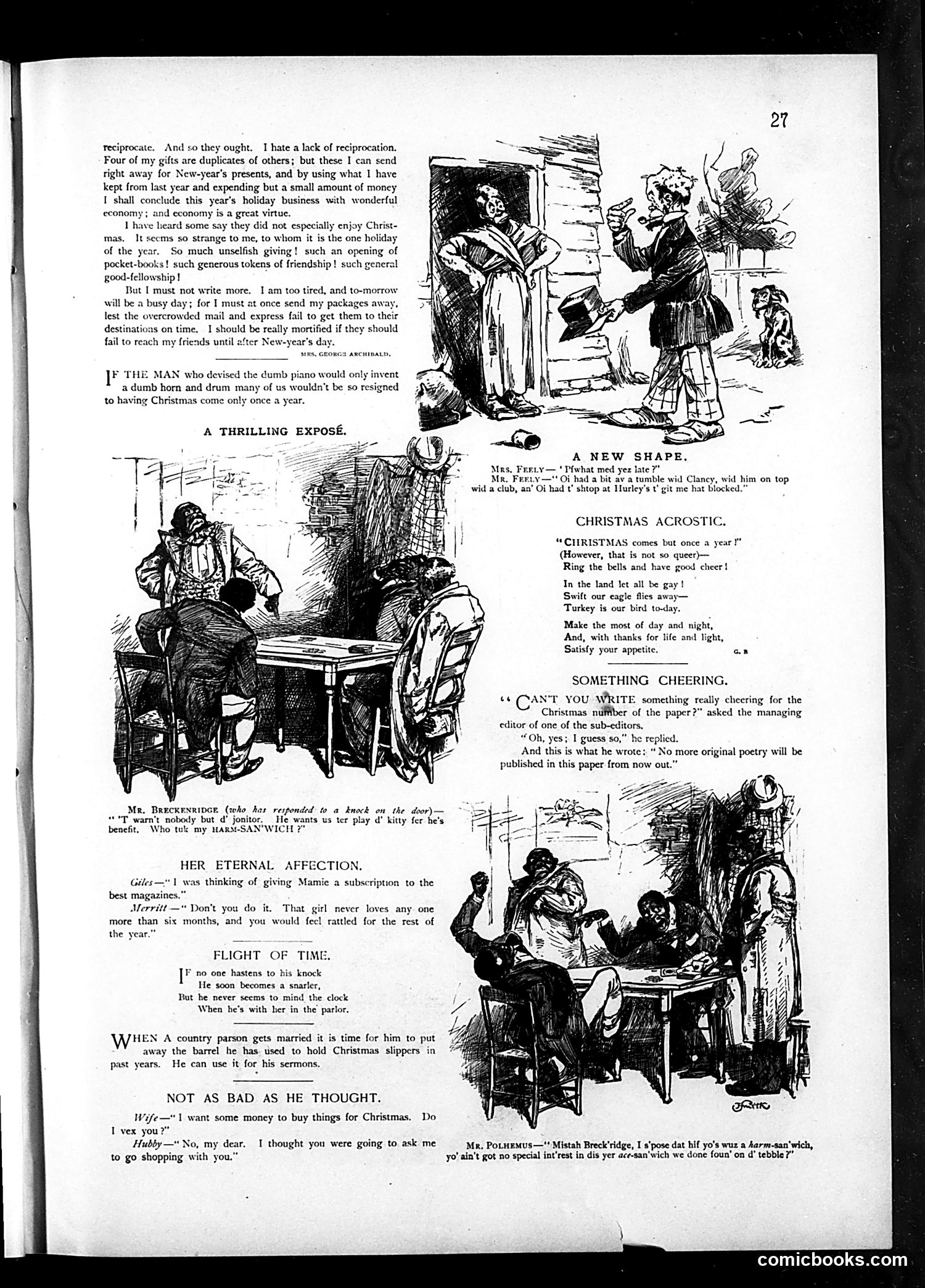
This page from Judge magazine contains several satirical pieces about Christmas customs and domestic life, circa early 1900s. **Main content includes:** - A lengthy editorial-style piece about Christmas gift-giving, critiquing the obligation and expense of reciprocal presents while praising the "economy" of reusing duplicates - A joke about an inventor of the "dumb piano"—satirizing annoying musical instruments that plague households during the holidays - Dialect humor featuring working-class Irish characters (recognizable by phonetic spelling like "Oi" and "d'"), common in period humor - Marital comedy sketches portraying husbands reluctant about Christmas spending and wives' "eternal affection" lasting only six months - A parson joke about repurposing a barrel formerly used for Christmas slippers **The satire targets:** middle-class gift-giving anxiety, domestic tensions over spending, unwanted musical performances, and class-based ethnic humor typical of the era. The overall tone mocks commercialized Christmas while paradoxically celebrating its obligatory social rituals.
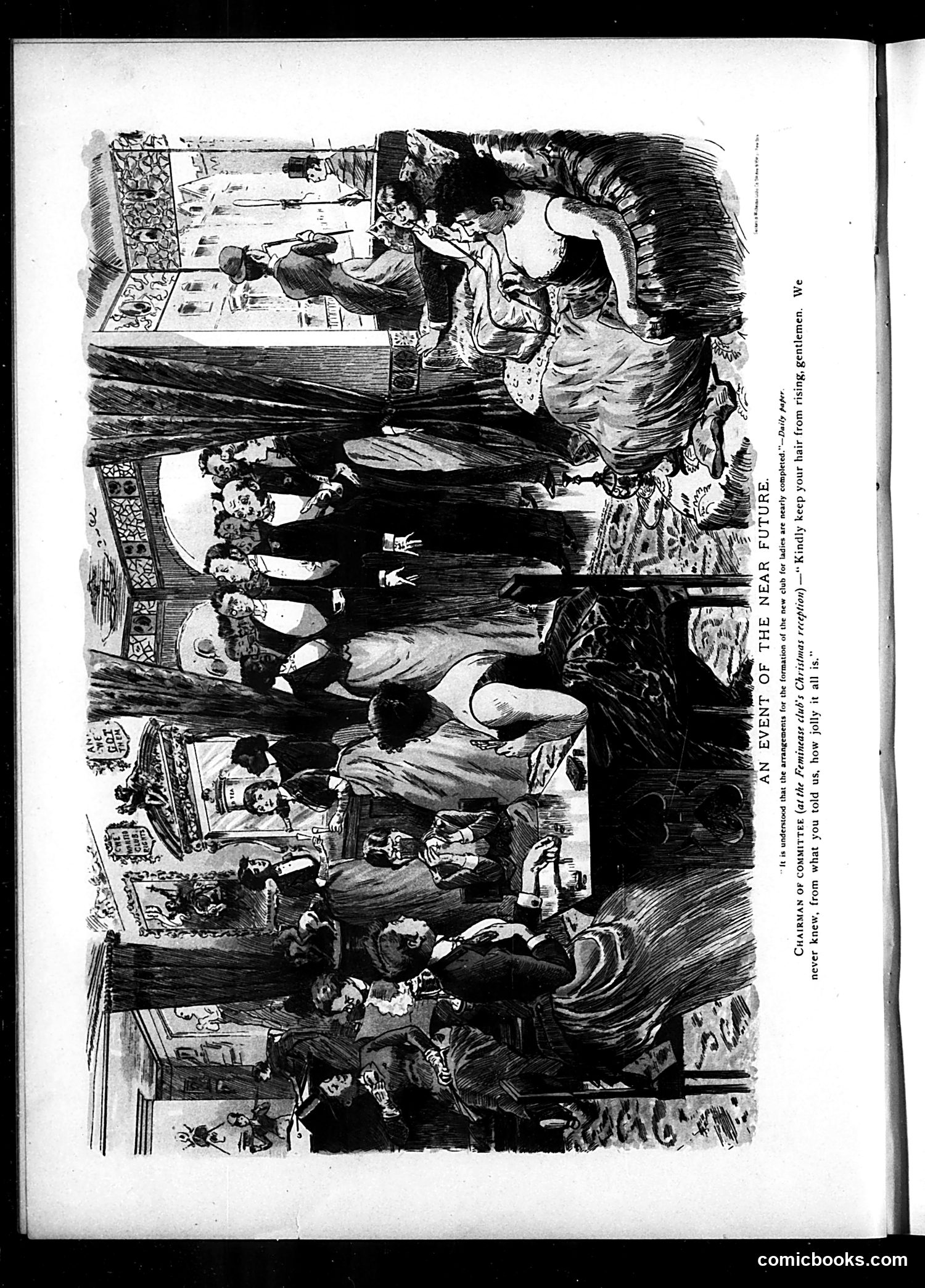
I can see this is a page from *Judge* magazine with an illustration titled "AN EVENT OF THE NEAR FUTURE" (visible on the right margin). The image appears to be rotated 90 degrees, showing what looks like a social or political scene with multiple figures in period dress gathered indoors—possibly a parlor or formal setting. However, the OCR text is almost entirely corrupted characters and is unreadable. Without legible text explaining the satire's specific target, I cannot reliably identify which political or social figures are caricatured, what event is being referenced, or what the cartoon's satirical point is meant to be. The illustration style and composition suggest social or political commentary typical of *Judge* magazine, but I cannot responsibly identify specific figures or explain the intended satire without clear textual support.
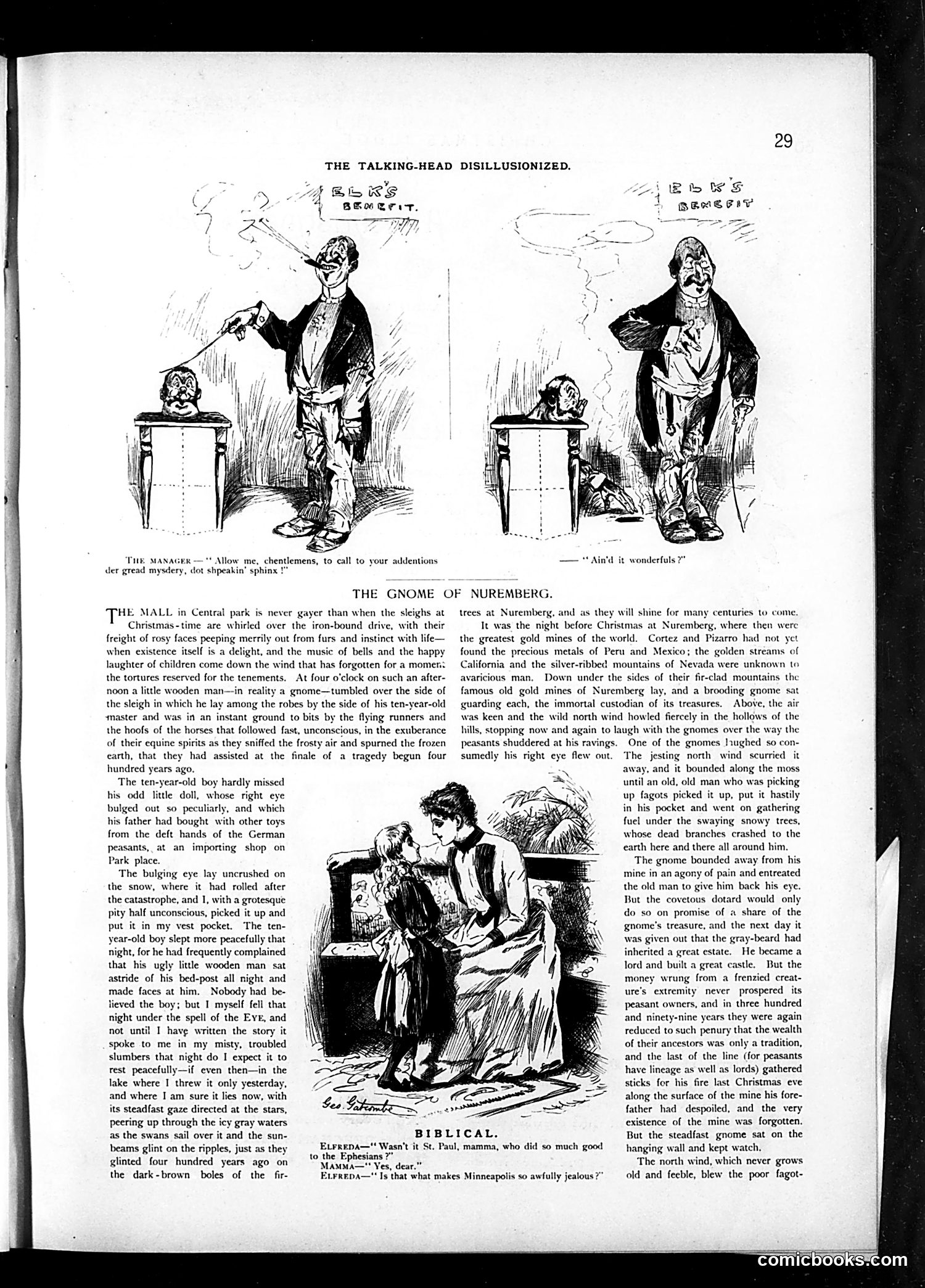
**"The Talking-Head Disillusionized"** (top): This mocks a circus or sideshow "manager" with a heavy German accent who presents a supposed "speaking sphinx" as a great mystery. The reveal shows it's just a severed head—the joke being that the manager's theatrical hype completely misrepresents a macabre, disappointing attraction. It satirizes fraudulent entertainment and immigrant carnival operators. **"The Gnome of Nuremberg"** (main story): A gothic fairy tale about a wooden doll from Germany that falls from a child's sleigh and is destroyed. The narrative links it to a supernatural gnome guarding Nuremberg's legendary gold mines centuries earlier, whose eye was knocked loose and eventually embedded in the doll. It's a whimsical, darkly romantic tale playing on German folklore and nostalgia—typical of Judge's literary content mixing humor with sentimental storytelling. **"Biblical"** (bottom): A brief joke where "Ephesians" is confused with Minneapolis, mocking the city's jealousy of St. Paul's prominence.
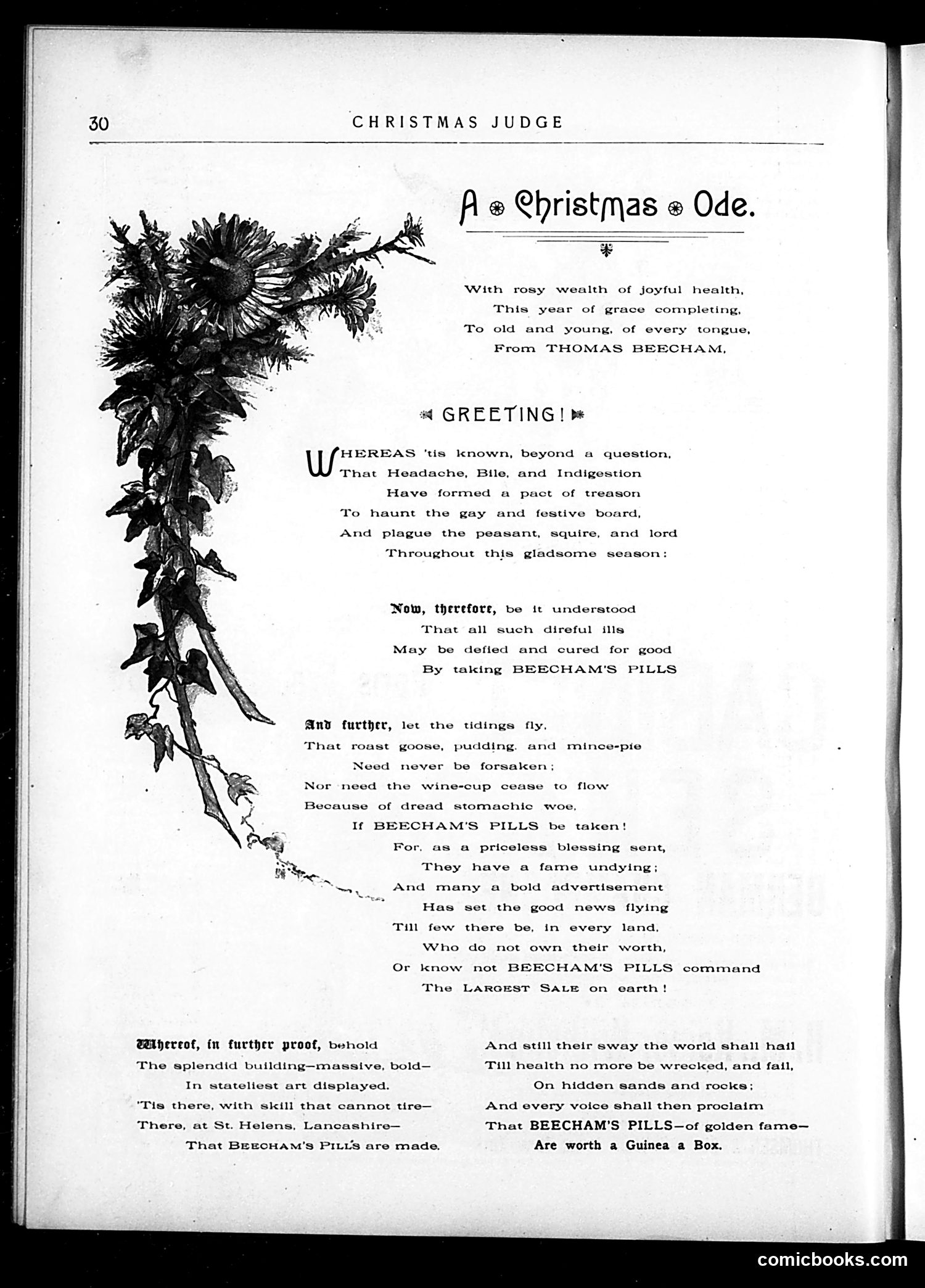
This page is a Christmas-themed advertisement disguised as poetry, not political satire. Thomas Beecham's Pills—a real patent medicine of the Victorian era—are promoted through an elaborate ode mocking the digestive ailments that plagued holiday feasting. The "joke" targets common Christmas indulgences: rich foods like roast goose, pudding, and mince pie, plus wine, which caused indigestion, headache, and bile complaints. Beecham's Pills promised relief, allowing celebrants to overeat without consequence. The satire is gentle: the poem ironically presents digestive illness as a "pact of treason" threatening festive cheer, then positions the pills as salvation. The final boast about "largest sale on earth" and the factory at St. Helens, Lancashire, emphasizes the product's commercial dominance. This reflects Judge magazine's willingness to publish pharmaceutical advertisements alongside editorial content—common practice when patent medicines saturated American and British markets.
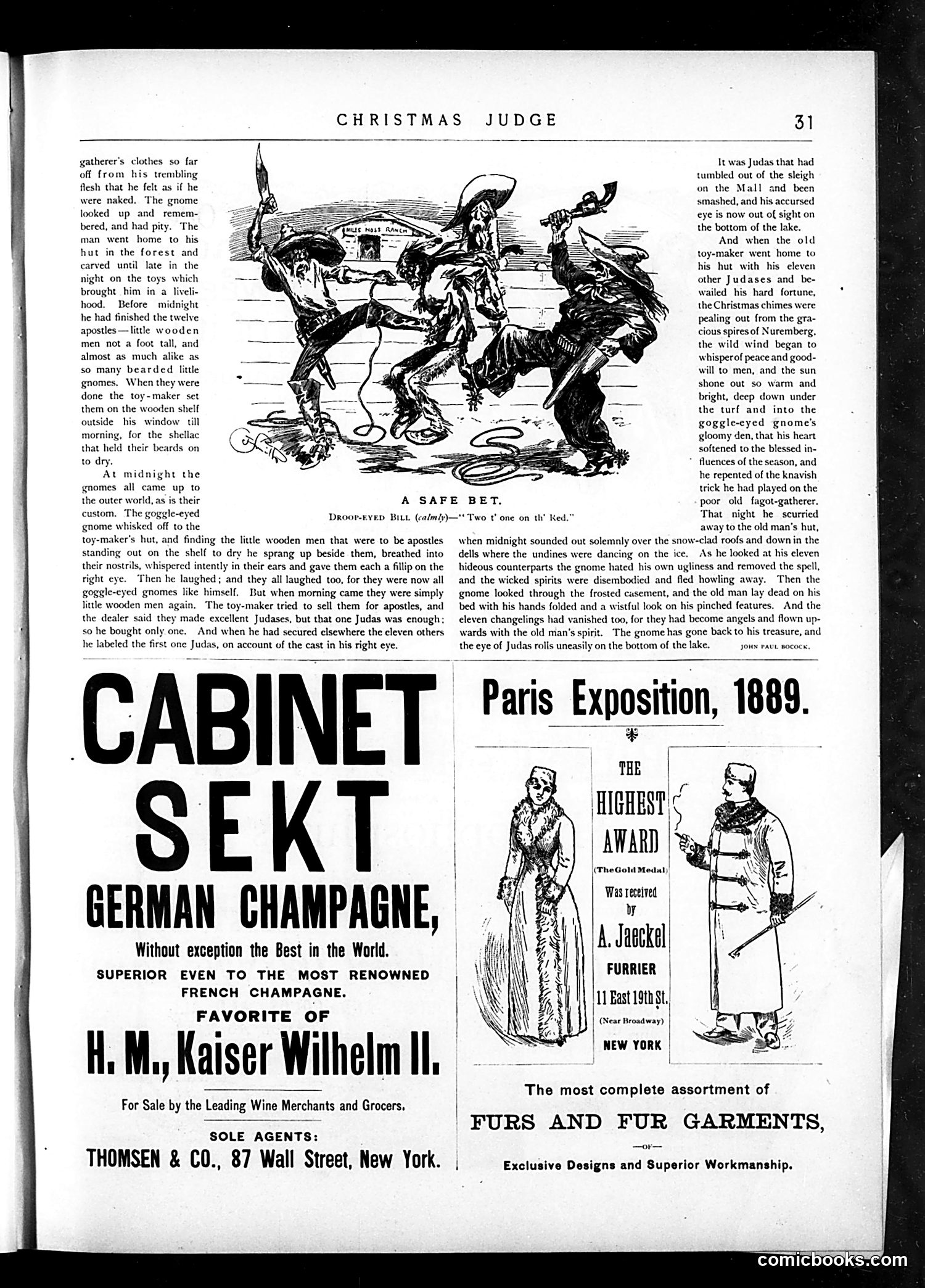
This Judge page (31) contains a Christmas story titled "A Safe Bet" by John Paul Socock, illustrated with a sketch of what appears to be gnomes or magical figures in winter clothing. The narrative is a European fairy tale about a toy-maker, a gnome, and wooden apostle figures—specifically a Judas figure with a distinctive eye cast. The page is primarily **advertising**, not political satire. Below the story are three advertisements: Cabinet Sekt German Champagne (favored by Kaiser Wilhelm II), and a fur garment business by A. Jaeckel in New York that won a gold medal at the 1889 Paris Exposition. The only potentially satirical element is the champagne ad's emphasis on German superiority over French champagne while noting the Kaiser's preference—reflecting contemporary Franco-German tensions. The fur advertisement uses period fashion illustrations typical of commercial copy from this era.
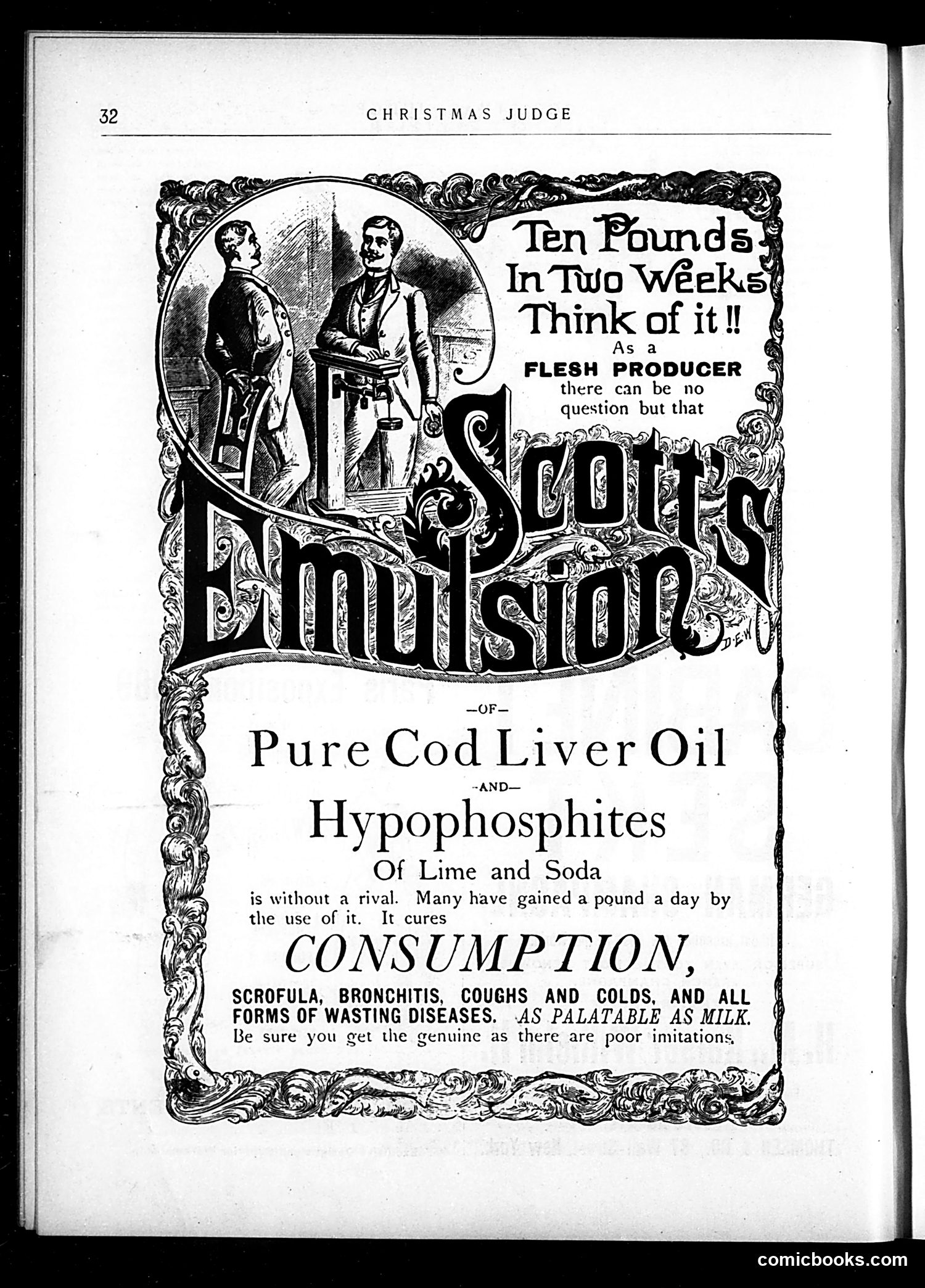
This is a **full-page advertisement**, not a political cartoon. It promotes "Scott's Emulsion" of cod liver oil and hypophosphites as a cure-all medicine. The ad claims the product is a "flesh producer" that helps users gain a pound daily and cures consumption (tuberculosis), scrofula, bronchitis, coughs, colds, and "wasting diseases." It promises the medicine tastes "as palatable as milk." The vignette shows two well-dressed men, likely representing a doctor and patient or satisfied customer. The ornate decorative border was typical period design. This reflects 19th-century patent medicine advertising—before FDA regulations. Such ads made sweeping curative claims with minimal evidence. The warning about "poor imitations" suggests the product competed with counterfeits, a common problem in unregulated markets.
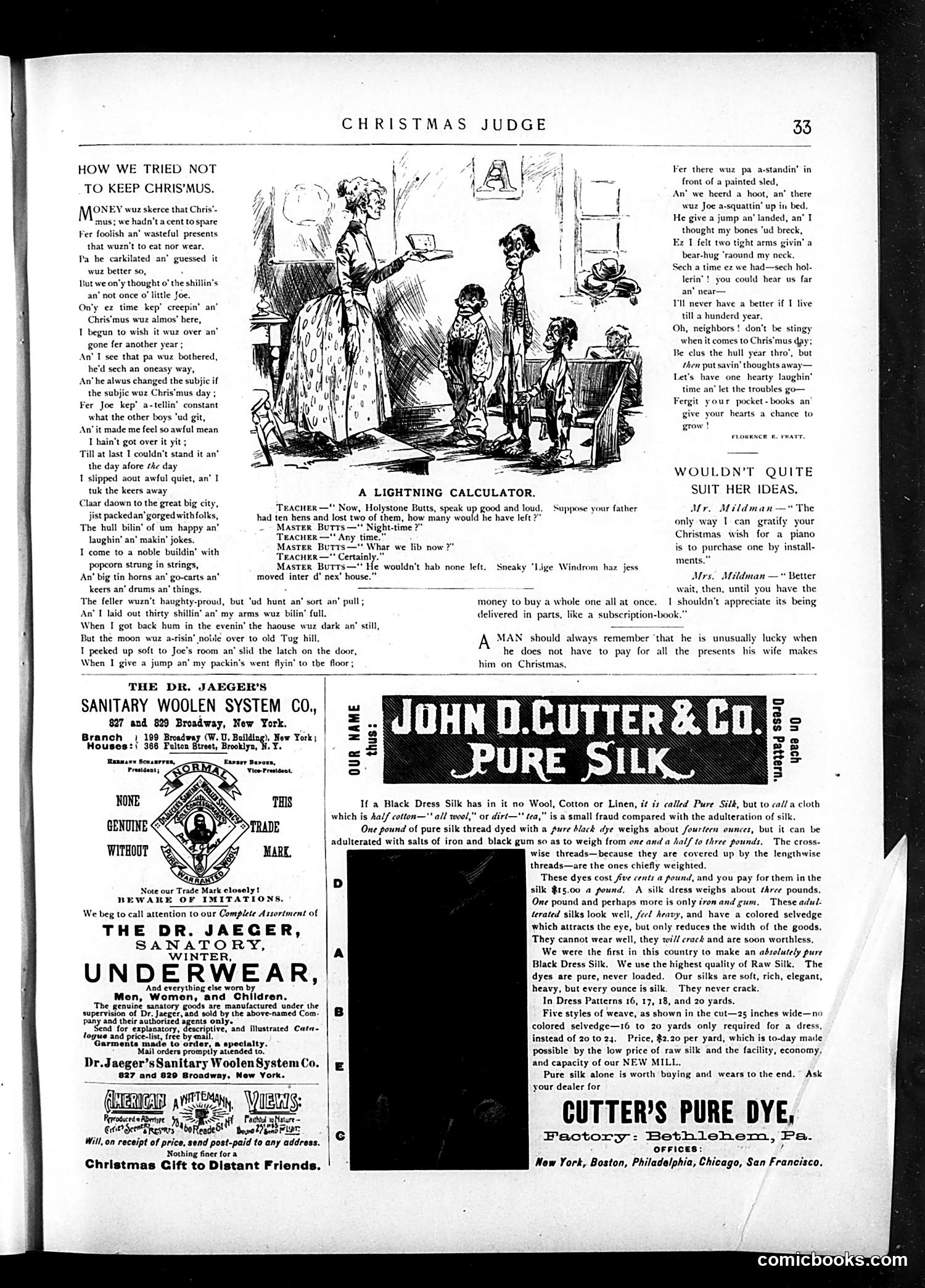
This sentimental story-poem depicts a poor family attempting to skip Christmas due to lack of money. The father and mother reluctantly decide against buying presents, but their young son Joe keeps mentioning what other boys will receive. Guilt-stricken, the mother secretly takes money to the city and purchases toys and a sled. The twist: when she returns home, she discovers the father has done the same thing—he's already bought Joe a sled. The family's joy at giving—despite their poverty—becomes the moral point: don't let frugality override generosity during Christmas, especially for children. The page also includes a school joke about a boy misunderstanding a math problem, and advertisements for silk fabric and woolen underwear—typical magazine filler. The overall message reflects Victorian-era sentiment about Christmas charity overcoming economic hardship.
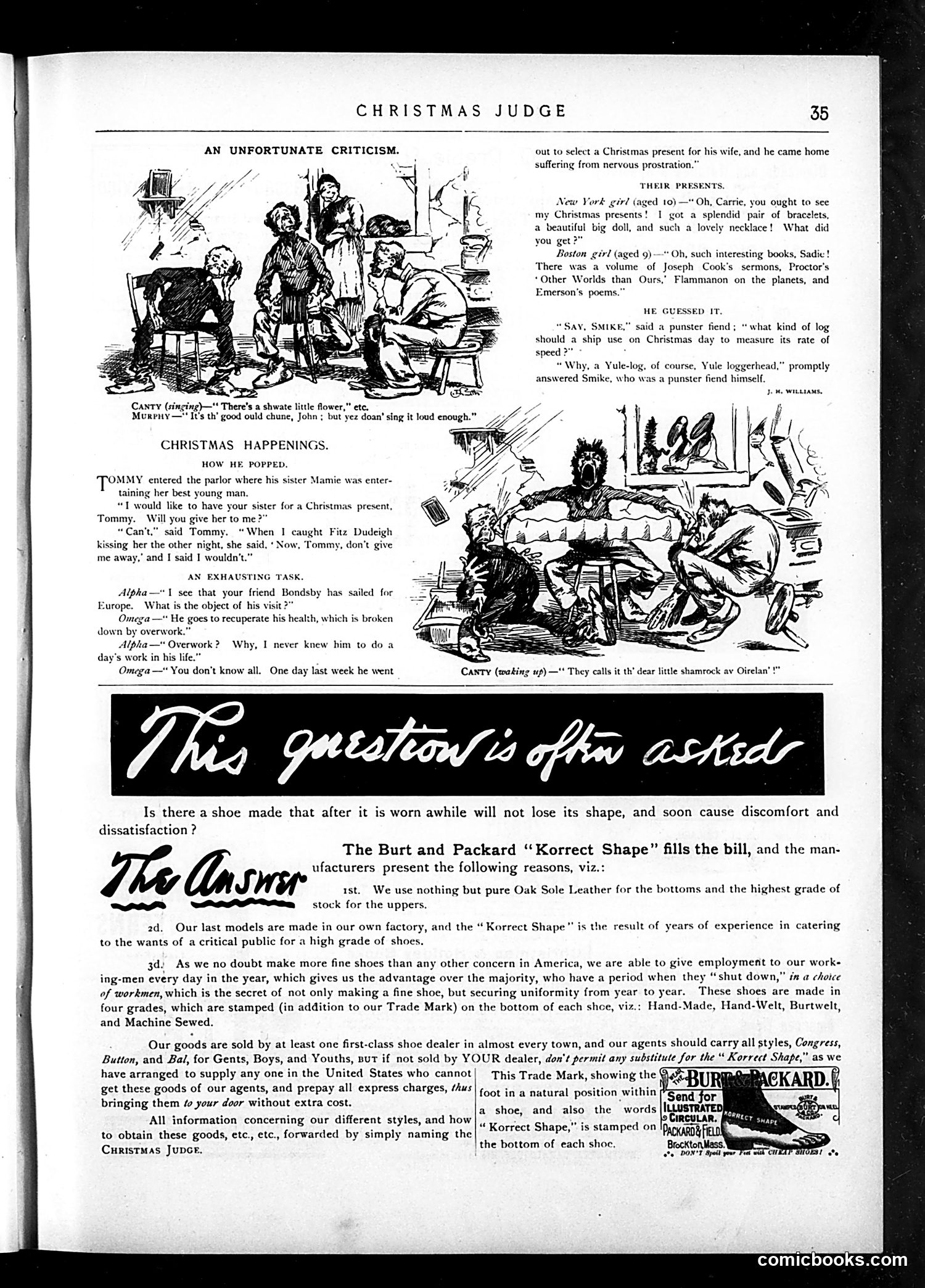
This page contains three distinct sections: **Top cartoons ("An Unfortunate Criticism" and "Christmas Happenings"):** These are light holiday humor pieces. The first contrasts a superficial New York girl bragging about jewelry and dolls with a pretentious Boston girl listing intellectual books (Joseph Cook sermons, Flammarion astronomy texts, Emerson poetry)—satirizing Boston's self-regard for cultural superiority. The other vignettes are simple puns and domestic jokes typical of the era's family humor magazines. **Bottom section:** This is a full-page advertisement for Burt and Packard shoes, touting their "Korrect Shape" design. The ad emphasizes American manufacturing quality, hand-craftsmanship, employment practices, and availability through dealers nationwide—typical late-19th-century marketing that appeals to patriotic consumers and craftsmen pride. The page is primarily commercial, with humor used as the magazine's editorial wrapper around advertising revenue.
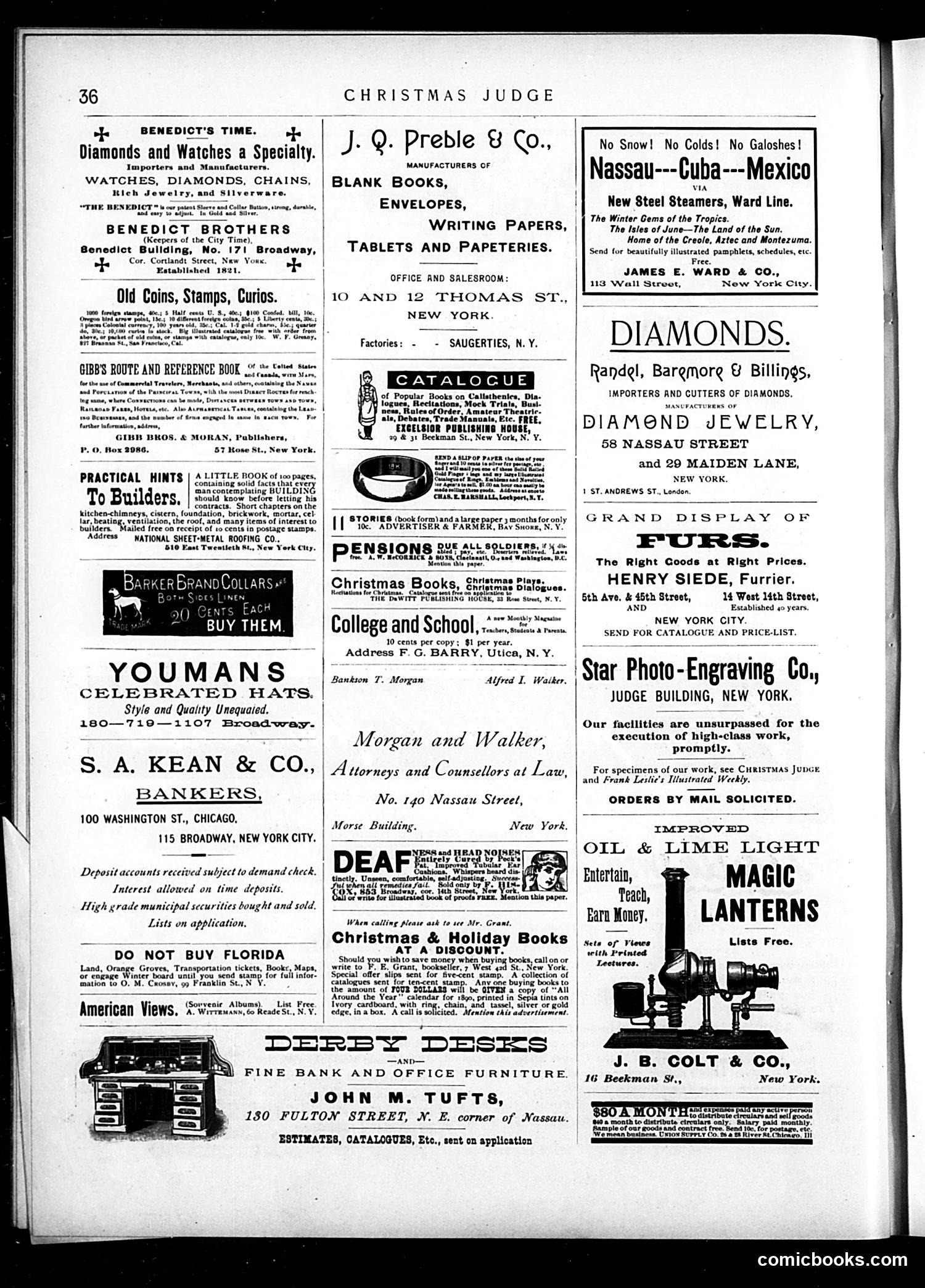
This page is primarily **advertising**, not editorial or satirical content from Judge magazine. The page contains dozens of commercial advertisements for New York City businesses circa the 1880s: jewelry dealers (Benedict Brothers, Randel Barmore & Billings), bankers (S.A. Kean & Co.), printers and stationers (J.Q. Preble & Co.), lawyers (Morgan and Walker), furniture makers (John M. Tufts), and vacation services (Ward Line steamers to Nassau/Cuba/Mexico). A few advertisements include small illustrations—notably a Derby desk with drawers and an oil/lime magic lantern device—but these are product showcases, not political cartoons or satire. The note "DO NOT BUY FLORIDA" warns against fraudulent land schemes, a practical consumer advisory rather than satire. This appears to be a **back-of-the-magazine classified advertising section**, typical of periodicals from this era. No satirical commentary or cartoon content is present on this page.
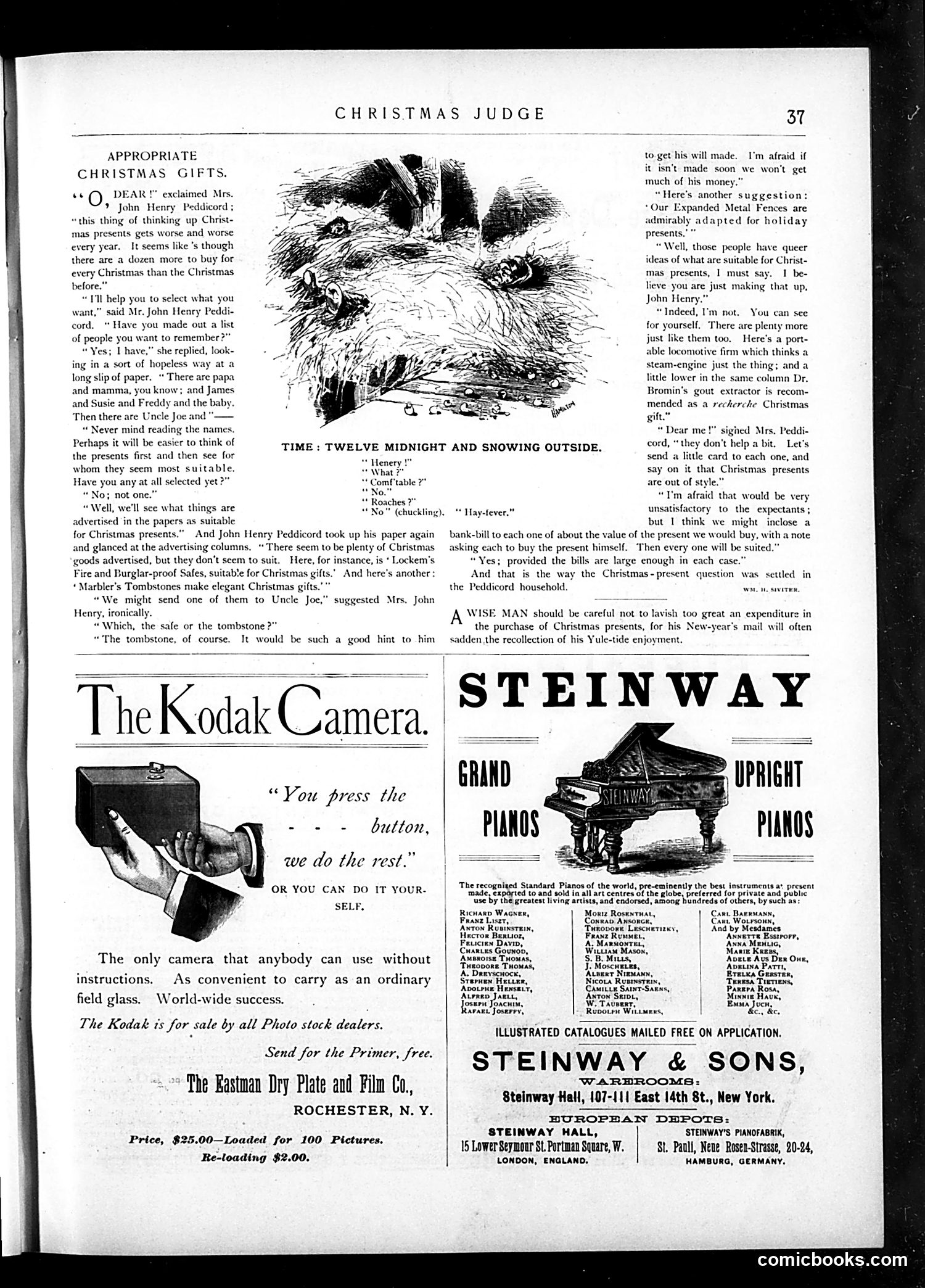
This page satirizes the difficulty of selecting Christmas gifts. Mr. and Mrs. Peddicord discuss gift-giving challenges, then humorously browse newspaper advertisements. The joke is that the ads featured—for safes, tombstones, and industrial metal fences—are absurdly unsuitable as presents. Mrs. Peddicord jokes that a tombstone would be a perfect hint to Uncle Joe to make his will. The couple ultimately decides to send cash instead, noting that tangible gifts often disappoint recipients. The satire mocks both overly practical (or morbid) gift suggestions and the commercialism of Christmas advertising. The moral conclusion warns against lavish gift-giving, as unpaid debts and disappointed expectations often follow the holidays. The page also contains period advertisements for Kodak cameras and Steinway pianos—themselves presented as luxury gift options.
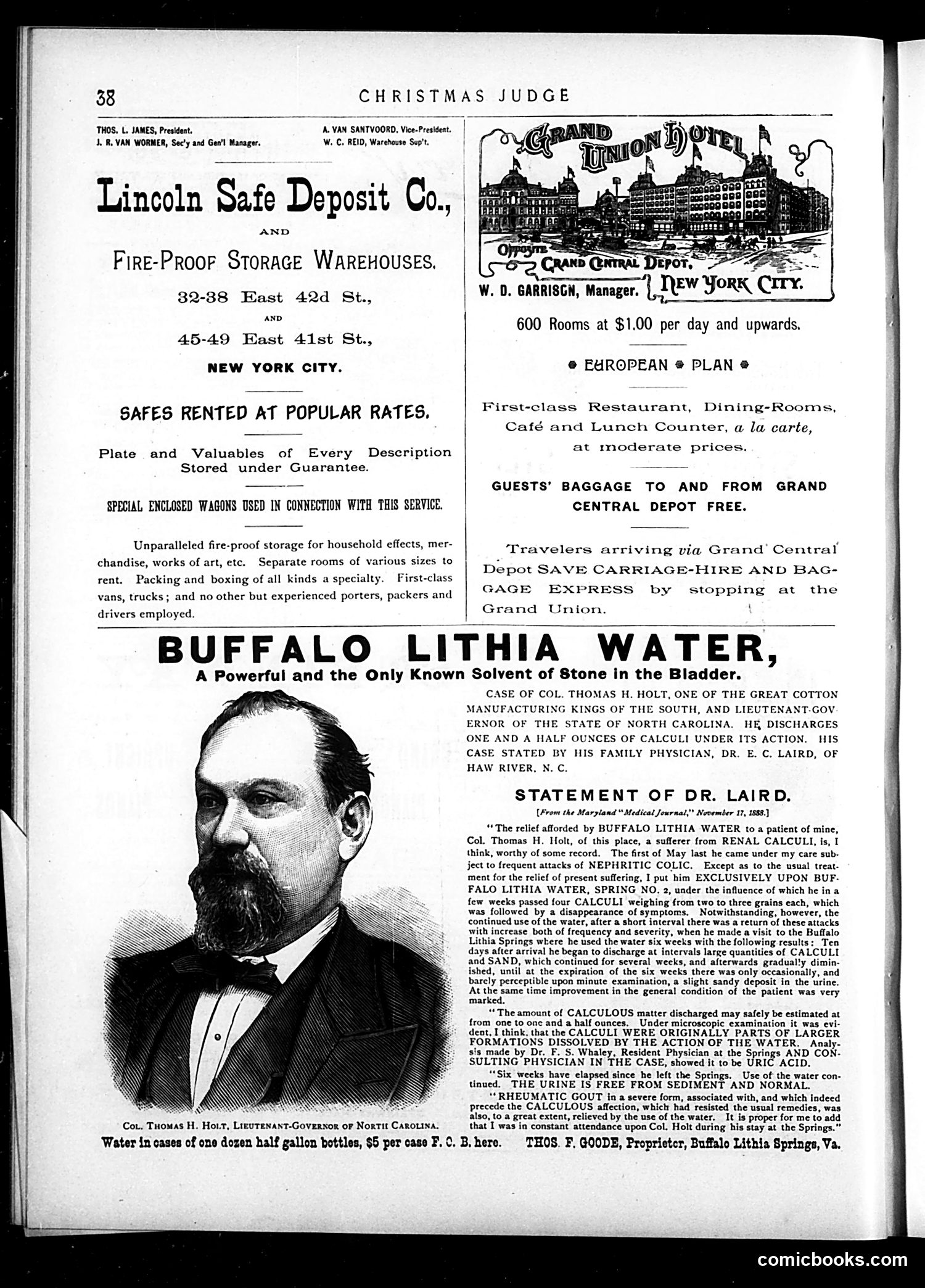
This page is primarily **advertising**, not political satire. It contains three distinct ads: 1. **Lincoln Safe Deposit Co.** - a fire-proof storage warehouse in New York City offering vault rental services for valuables and household items. 2. **Grand Union Hotel** - a New York City hotel advertising 600 rooms at budget rates with European-plan dining. 3. **Buffalo Lithia Water** - a patent medicine claiming to dissolve kidney stones. It features a portrait of Col. Thomas H. Holt (identified as a North Carolina cotton manufacturer and lieutenant governor) and includes a testimonial from his physician, Dr. E.C. Laird, describing how the water allegedly cured Holt's severe kidney stone condition by dissolving calculi. The Buffalo Lithia ad represents the era's common medical quackery—unproven "cure-all" mineral waters marketed with physician testimonials. There is no cartoon or satire visible; this appears to be a standard Judge magazine advertising page from the late 1880s.
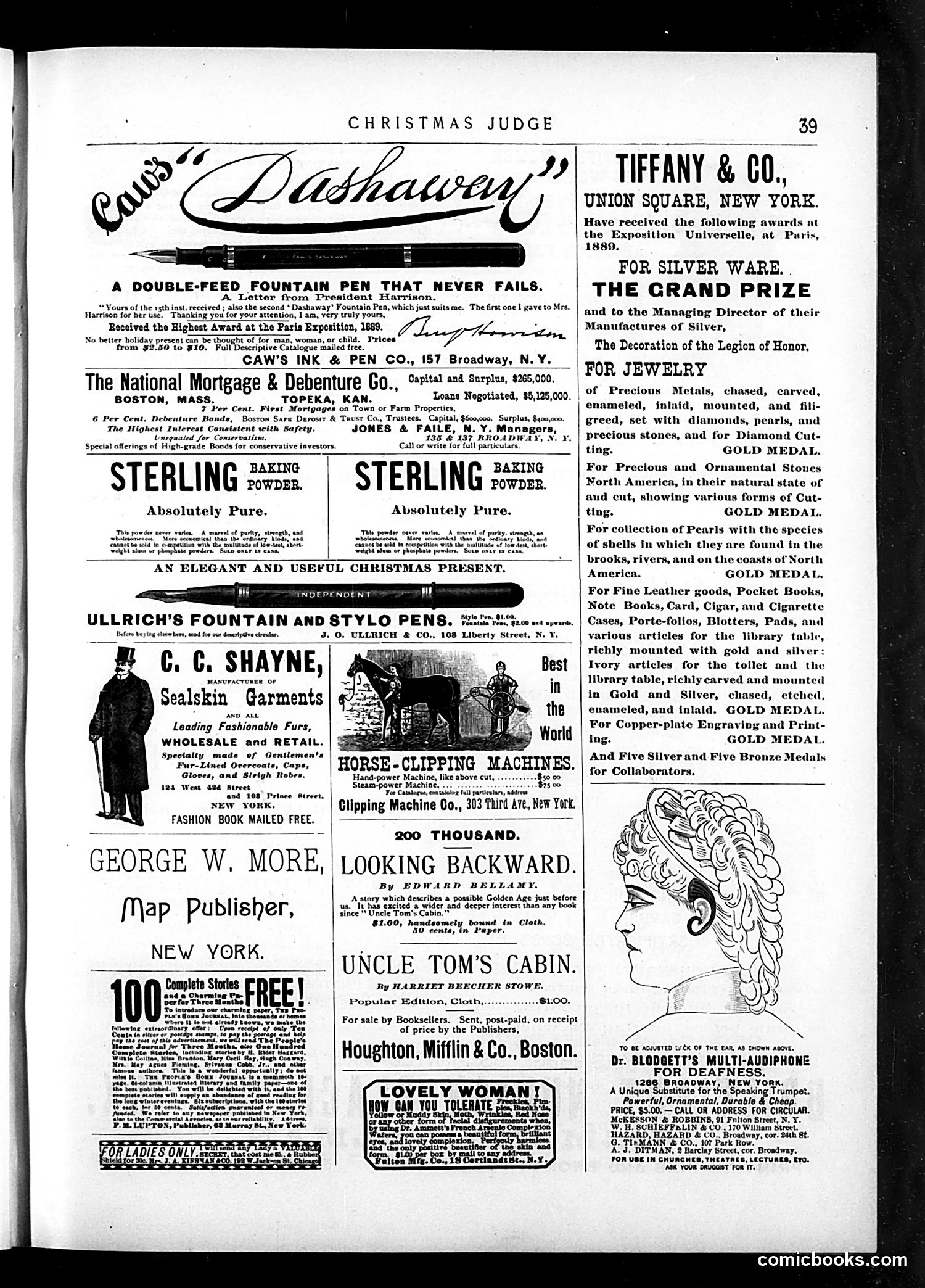
This is primarily a **Christmas advertisement page** from Judge magazine, not a political cartoon page. The dominant content comprises luxury goods advertisements targeting wealthy consumers: Tiffany & Co. jewelry and silverware (which won a Grand Prize at the 1889 Paris Exposition), fountain pens, sealskin garments, and financial products. The page includes book advertisements for *Looking Backward* by Edward Bellamy (a utopian socialist novel that caused significant cultural debate in the 1880s-90s) and *Uncle Tom's Cabin* by Harriet Beecher Stowe. The juxtaposition of Bellamy's futuristic vision with Stowe's abolitionist classic appears incidental to advertising purposes rather than intentional satire. A small profile illustration appears on the right side, possibly advertising a hearing device, but its specific reference is unclear. The page reflects Judge's role as a magazine for affluent audiences, using advertisements to define desirable consumption and status.
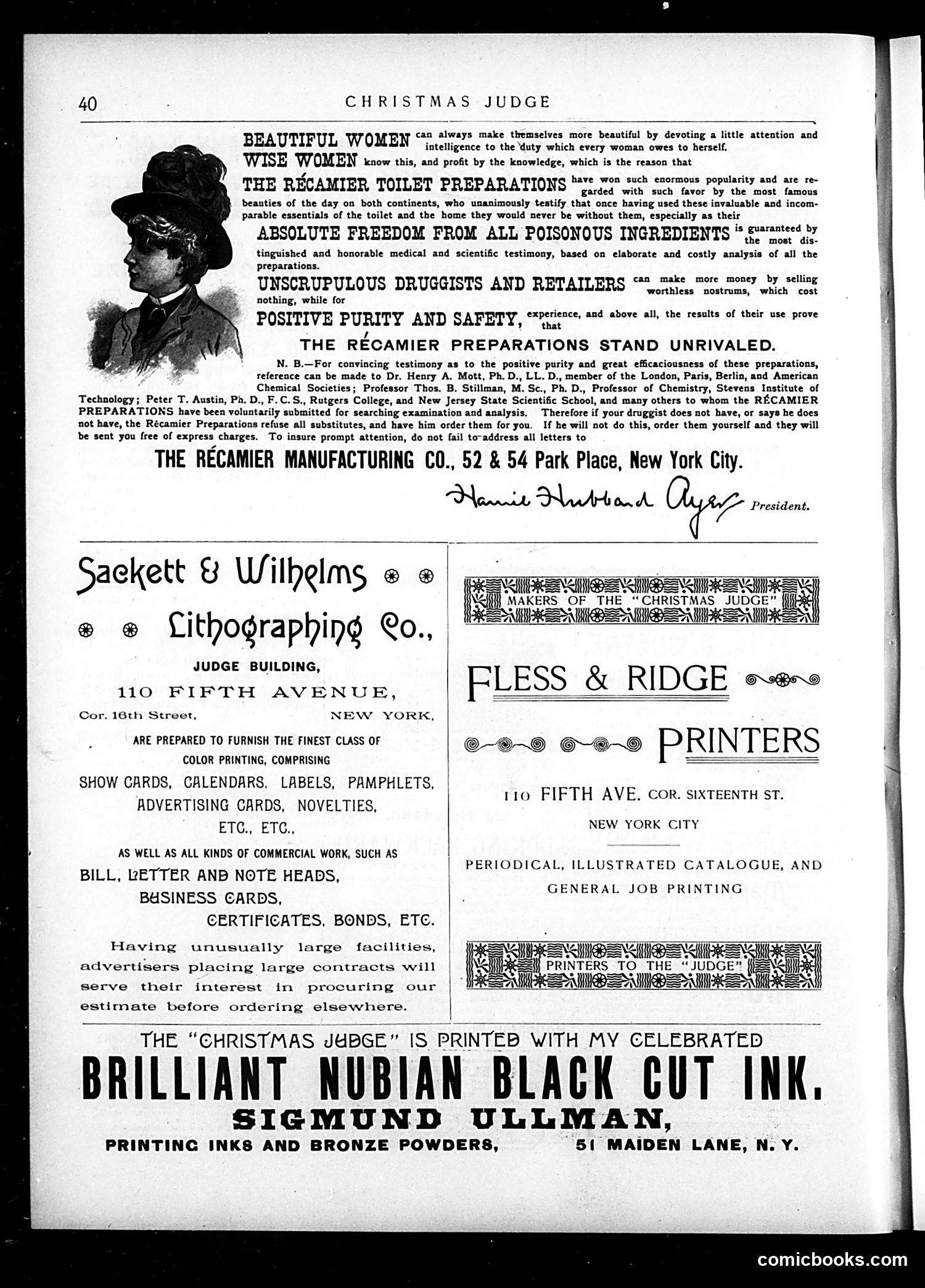
This is primarily an **advertising page**, not a satirical cartoon. The page features a full-page advertisement for Récamier Toilet Preparations—cosmetics and beauty products marketed to women. The ad uses typical late 19th/early 20th-century marketing tactics: it appeals to women's desire for beauty while emphasizing "purity" and "safety." Notably, it claims the products contain "absolute freedom from all poisonous ingredients" and cites scientific testimonies from chemists—a selling point suggesting competitors' products were actually dangerous (many beauty products of the era contained toxic substances like lead and mercury). The ad also warns against "unscrupulous druggists" selling worthless substitutes, encouraging consumers to order directly if their druggist won't stock the brand. The remainder of the page contains printer and lithographer advertisements, typical of magazine back matter from this period.
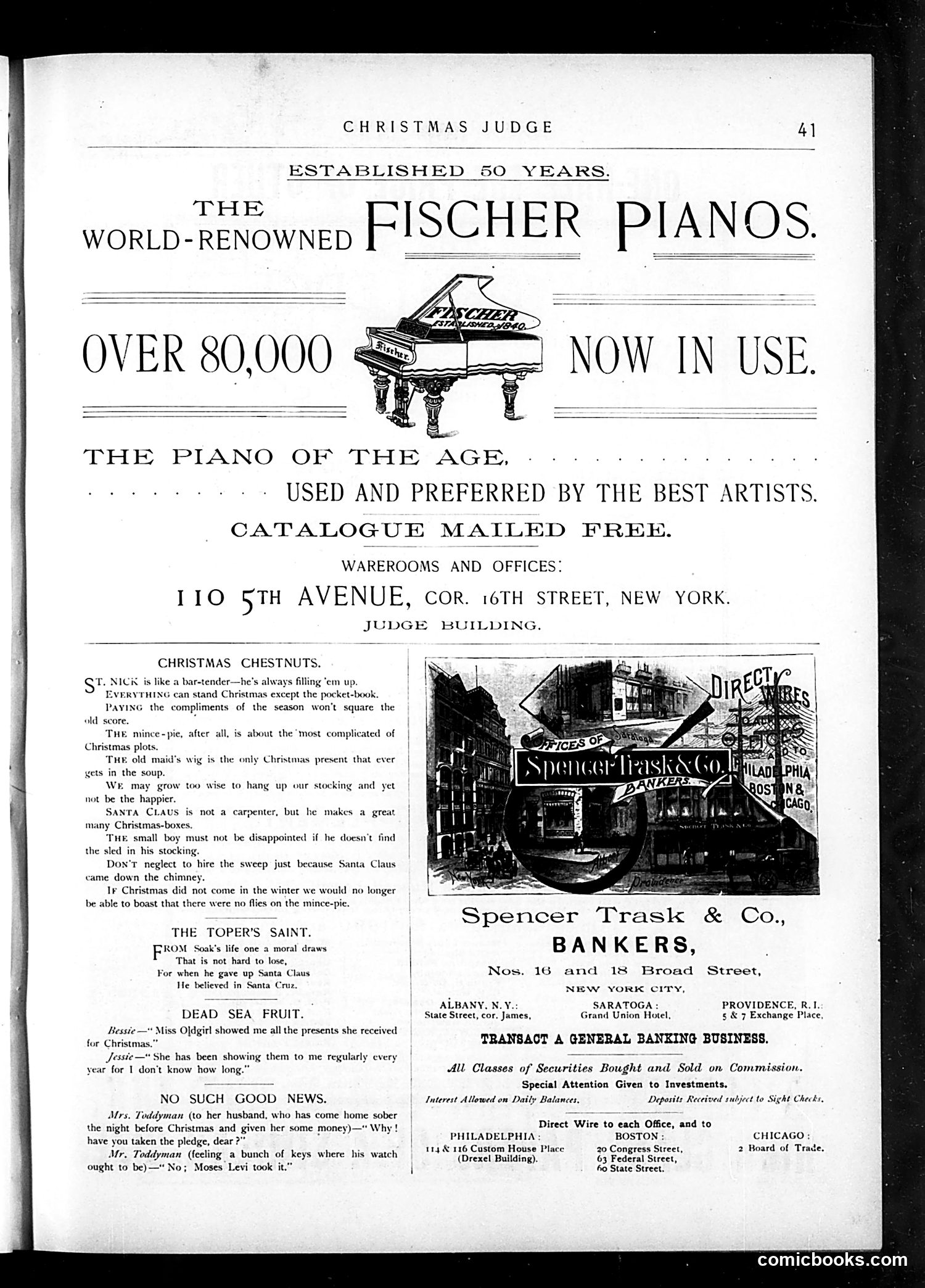
This is primarily an **advertising and humor page** rather than a political cartoon. The page contains: **Advertisements:** Fischer Pianos (established 50 years, over 80,000 in use) and Spencer Trask & Co. Bankers dominate the layout. **"Christmas Chestnuts"** section: A collection of mild holiday jokes playing on familiar tropes—St. Nick always "filling 'em up" (drinking), Christmas expenses straining wallets, Santa's delayed deliveries, etc. These are puns and observational humor rather than satire. **Notable jokes include ethnic/class humor:** "Moses Levi" (a Jewish moneylender reference) stealing a watch, and "Santa Cruz" (wordplay suggesting a drunk man's faith in alcohol). The content reflects late 19th-century middle-class anxieties about Christmas consumerism, domestic drinking, and working-class financial struggles, presented through gentle ribaldry typical of Judge magazine's approach.
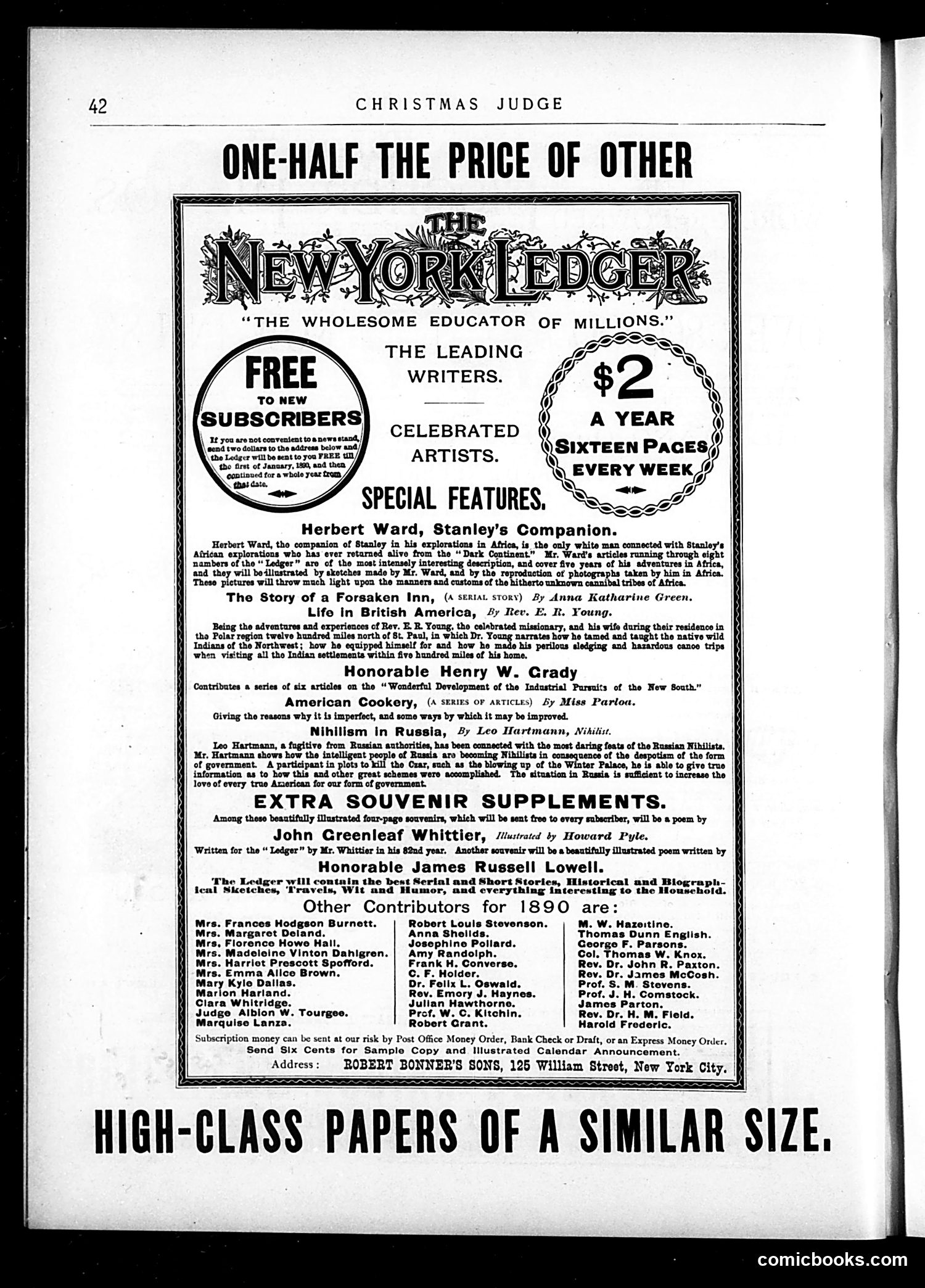
This is primarily an **advertisement for The New York Ledger magazine**, not a political cartoon. It's a full-page promotional piece from Judge magazine advertising a competitor publication. The page promotes The Ledger's 1890 content, emphasizing prestigious contributors: explorers (Herbert Ward of Stanley's African expeditions), literary figures (John Greenleaf Whittier, James Russell Lowell), and social commentators. Notable is an article on **Russian Nihilism by Leo Hartmann**, described as someone connected with Nihilist attacks including bombing the Winter Palace—likely referencing 1880s Russian revolutionary violence. The inclusion emphasizes how such content contrasts favorably with "our form of government," appealing to American readers' anti-radical sentiments. The headline "One-Half the Price of Other" emphasizes The Ledger's competitive pricing ($2/year versus competitors). This appears designed to attract Judge readers to a rival publication—somewhat ironic advertising placement within a competing satirical magazine.
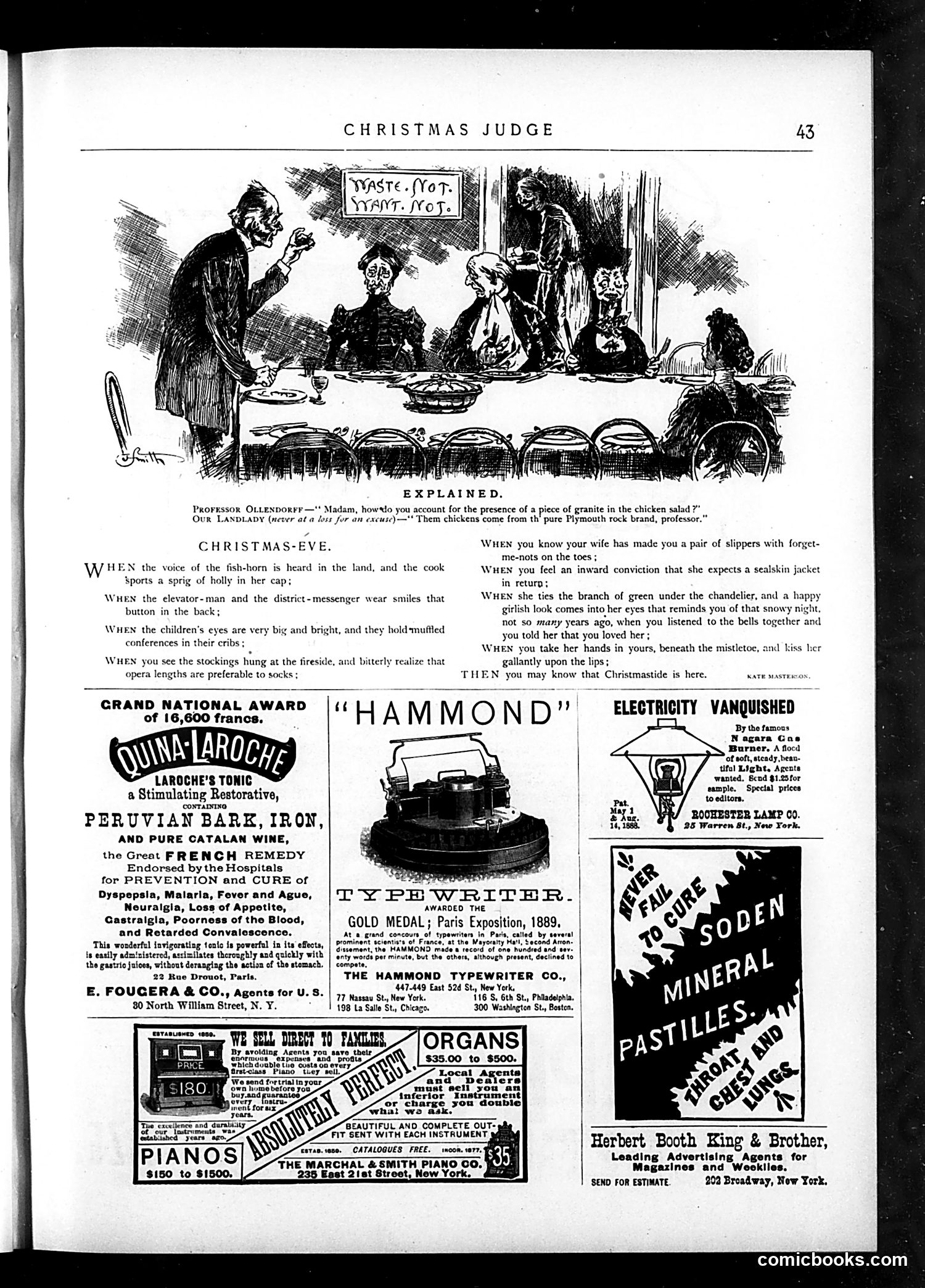
## Main Cartoon The top illustration depicts a dinner scene where a guest complains to "Professor Ollendorff" about finding granite in the chicken salad. The landlady responds that the chickens came from "pure Plymouth rock brand"—a pun conflating Plymouth Rock (the Pilgrims' landing site, suggesting quality/Americana) with actual rock. This is a classic joke structure: the landlady's excuse is absurdly literal, revealing either her stupidity or her willingness to serve substandard food. ## "Christmas-Eve" Prose Poem Below the cartoon, the text sentimentally catalogs signs that Christmas approaches: servants smiling, children excited, stockings hung. It then shifts to romantic domesticity—wives making homemade slippers, mistletoe kisses—suggesting Christmas rekindles marital affection and nostalgia. This contrasts sharply with the harsh joke above, offering readers sentimental holiday sentiment alongside satirical commentary on household life and class dynamics. The page is primarily advertisements for period remedies, typewriters, and pianos below.
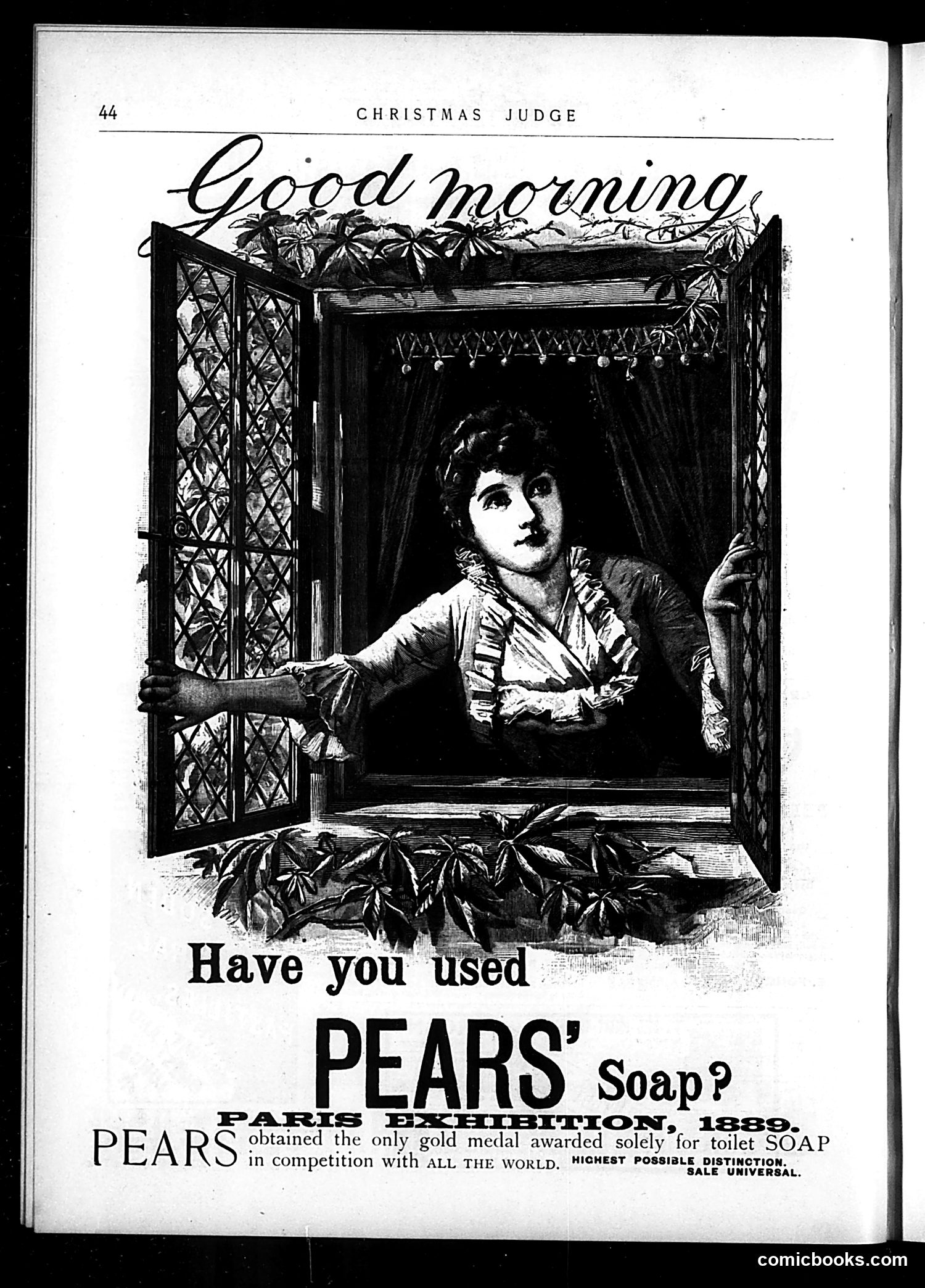
This page is primarily a **Pears' Soap advertisement**, not political satire. It features a romanticized illustration of a young woman at an open window decorated with holiday greenery, gazing upward wistfully. The "Good morning" greeting and Christmas framing create a sentimental, aspirational mood. The ad emphasizes Pears' claimed achievement: winning "the only gold medal awarded solely for toilet soap" at the 1889 Paris Exhibition. The text stresses "highest possible distinction" and "sale universal," positioning the product as internationally validated and widely available. This represents late-Victorian marketing strategy—using emotional imagery and prestigious awards to establish brand prestige. For modern readers, it's notable as an early example of advertising using sentiment and competitive claims rather than product features alone.
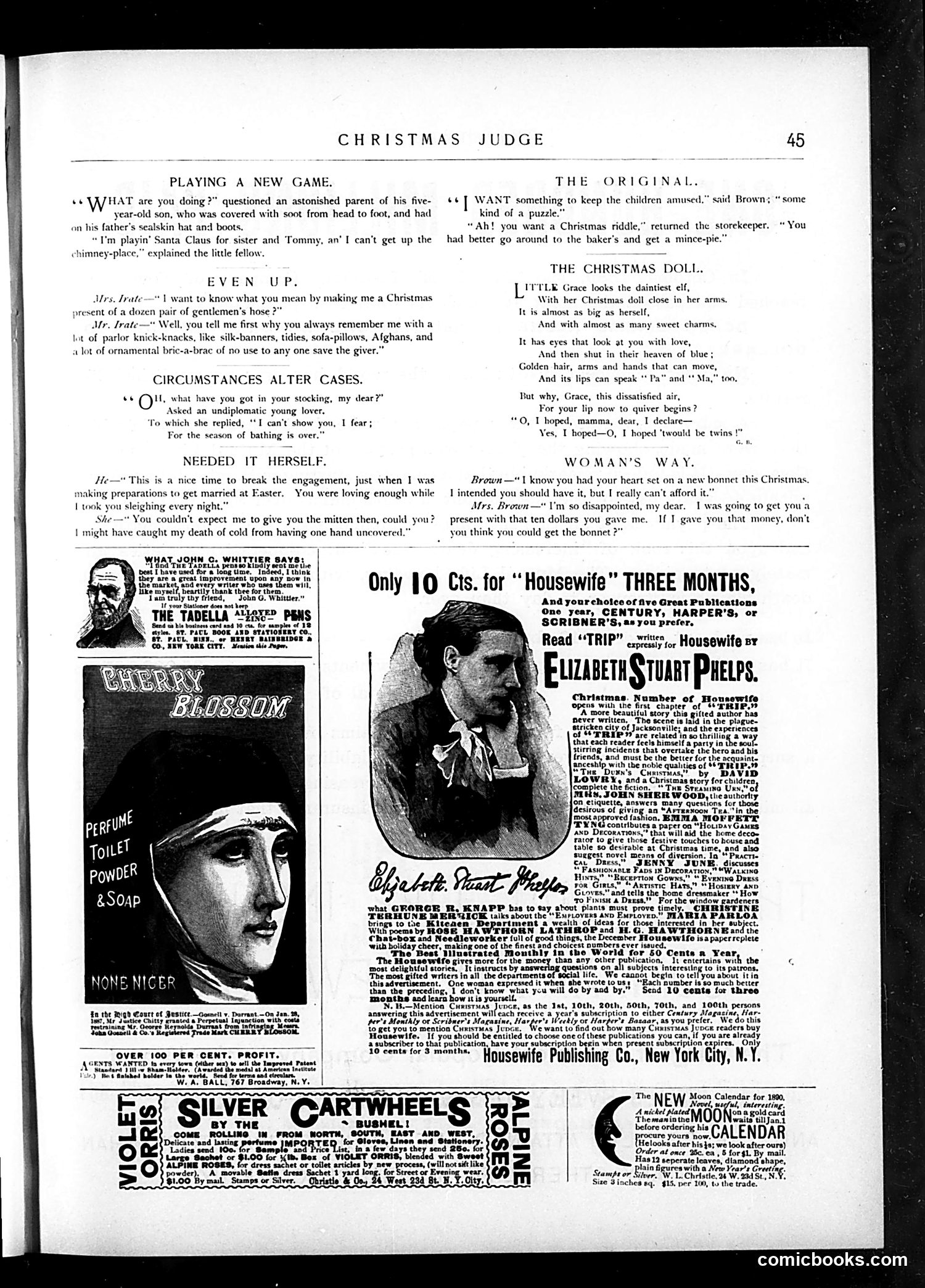
This Christmas-themed page from Judge magazine (circa 1880s) contains short humorous sketches satirizing Victorian domestic life and gender relations. **"Playing a New Game"** shows a child covered in soot, wearing his father's oversized clothes, attempting to play Santa by going down the chimney—humor based on childhood mischief and literal interpretation of Christmas traditions. **The marital disputes** ("Even Up," "Circumstances Alter Cases," "Woman's Way") mock predictable husband-wife gift-giving dynamics: wives give impractical decorative items; husbands give practical hosiery. One sketch jokes that a woman won't show her stocking contents because "bathing season is over"—a veiled reference to removing stockings for bathing, playing on Victorian prudishness. Another depicts a woman disappointed she received a doll instead of twins as a Christmas gift, satirizing women's limited agency in family planning. **"The Christmas Doll"** is sentimental poetry celebrating a child's gift. The page is otherwise dominated by period advertisements for perfume, pens, and other products—typical magazine filler of the era.
This page is **not satire or a cartoon**—it's a full-page advertisement for the Mutual Life Insurance Company of New York, appearing in *Judge* magazine's Christmas issue (likely 1889). The ad celebrates the company's milestone: by October 1889, it had paid $100 million in death claims alone since its 1843 founding—allegedly within 46 years of starting "without a dollar." The text emphasizes financial stability: the company holds $130 million in reserves plus $8 million surplus despite rising death claims, suggesting it will outlast competitors who typically collapse under increasing mortality costs. The phrase "the Mutual sells insurance that insures" is the key selling point—implying reliability and actual protection. **Context for modern readers**: Life insurance was relatively new; the ad promotes Mutual Life as exceptionally solvent and trustworthy during an era when insurance companies frequently failed. This was genuine corporate marketing, not satirical commentary.
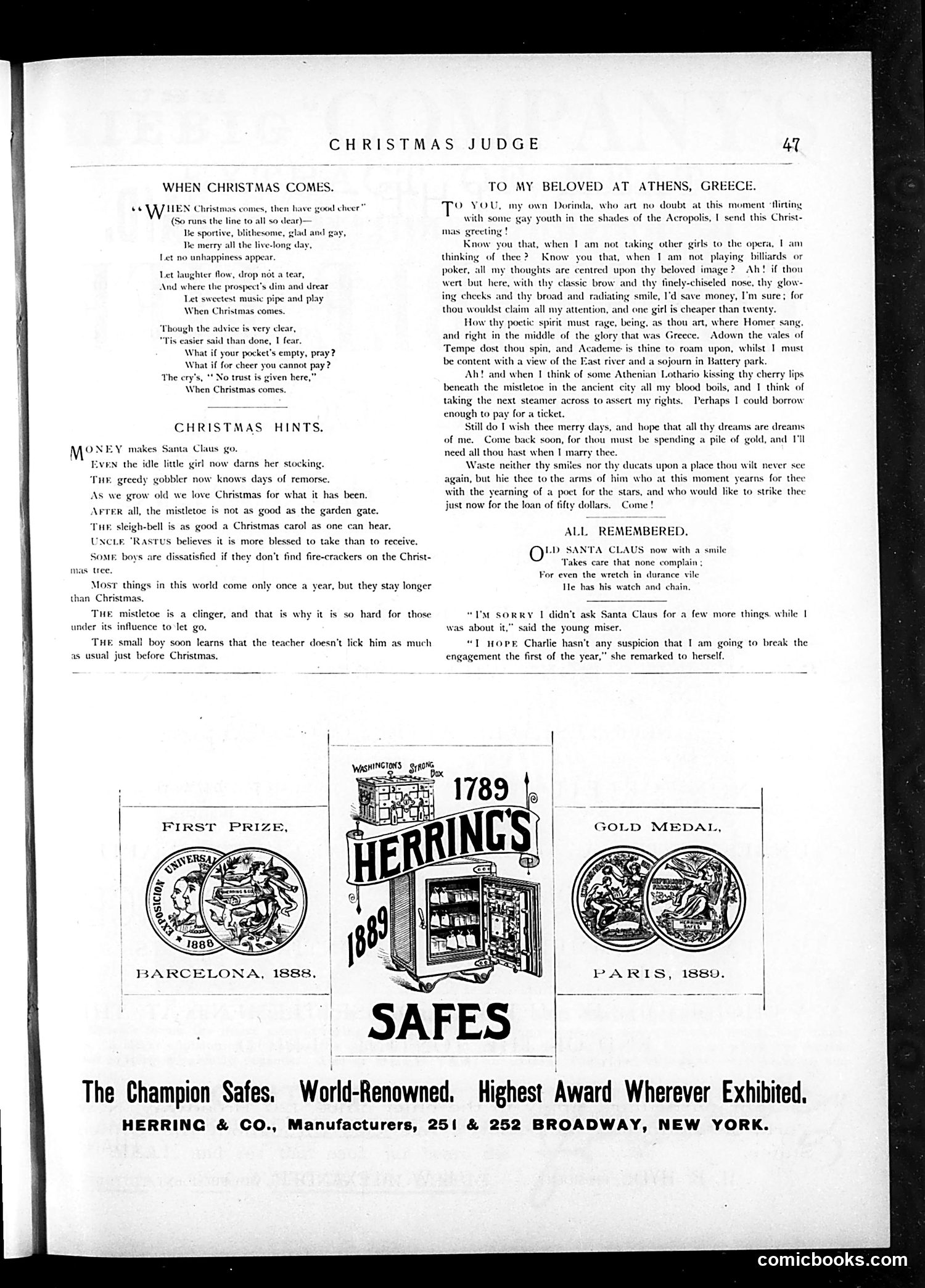
This page contains Christmas-themed humor and commentary typical of late 19th-century American satire. The content includes: **"When Christmas Comes"** — A poem contrasting the cheerful ideal of Christmas with harsh economic reality. It mocks the gap between sentiment ("have good cheer") and working-class hardship ("What if your pocket's empty, pray?"). The refrain "No trust is given here" critiques merchants' refusal to extend credit to the poor during the holidays. **"Christmas Hints"** — Brief satirical observations, including a reference to "Uncle Rastus" (a racist stereotypical caricature of Black Americans), typical of the era's offensive humor. **"To My Beloved at Athens, Greece"** — A comedic love letter from a broke suitor trying to keep his girlfriend in Greece, joking about his inability to afford her return or his romantic rivals. **The Herring Safes Advertisement** — This occupies the lower half, unrelated to the editorial content. The overall theme reflects Judge's satirical critique of class disparities and commercialism surrounding Christmas.
This is an advertisement, not a satirical cartoon. The Equitable Life Assurance Society is promoting their new life insurance policy form in Judge magazine's Christmas issue. The ad highlights innovative features for the era: the policy functions like a simple bank draft with no hidden conditions, becomes incontestable after two years, and offers policyholders unrestricted travel and occupation rights after one year. It emphasizes immediate payability and "tontine profits" (a pooled investment structure where surviving policyholders shared accumulated funds). The advertisement lists H.B. Hyde as President and J.W. Alexander as Vice-President, with the main office at 120 Broadway, New York. This represents Equitable's attempt to modernize and simplify life insurance offerings—a significant competitive advantage when policies typically contained restrictive clauses. The placement in Judge suggests this was a prestigious, high-profile promotion targeting the magazine's educated readership.
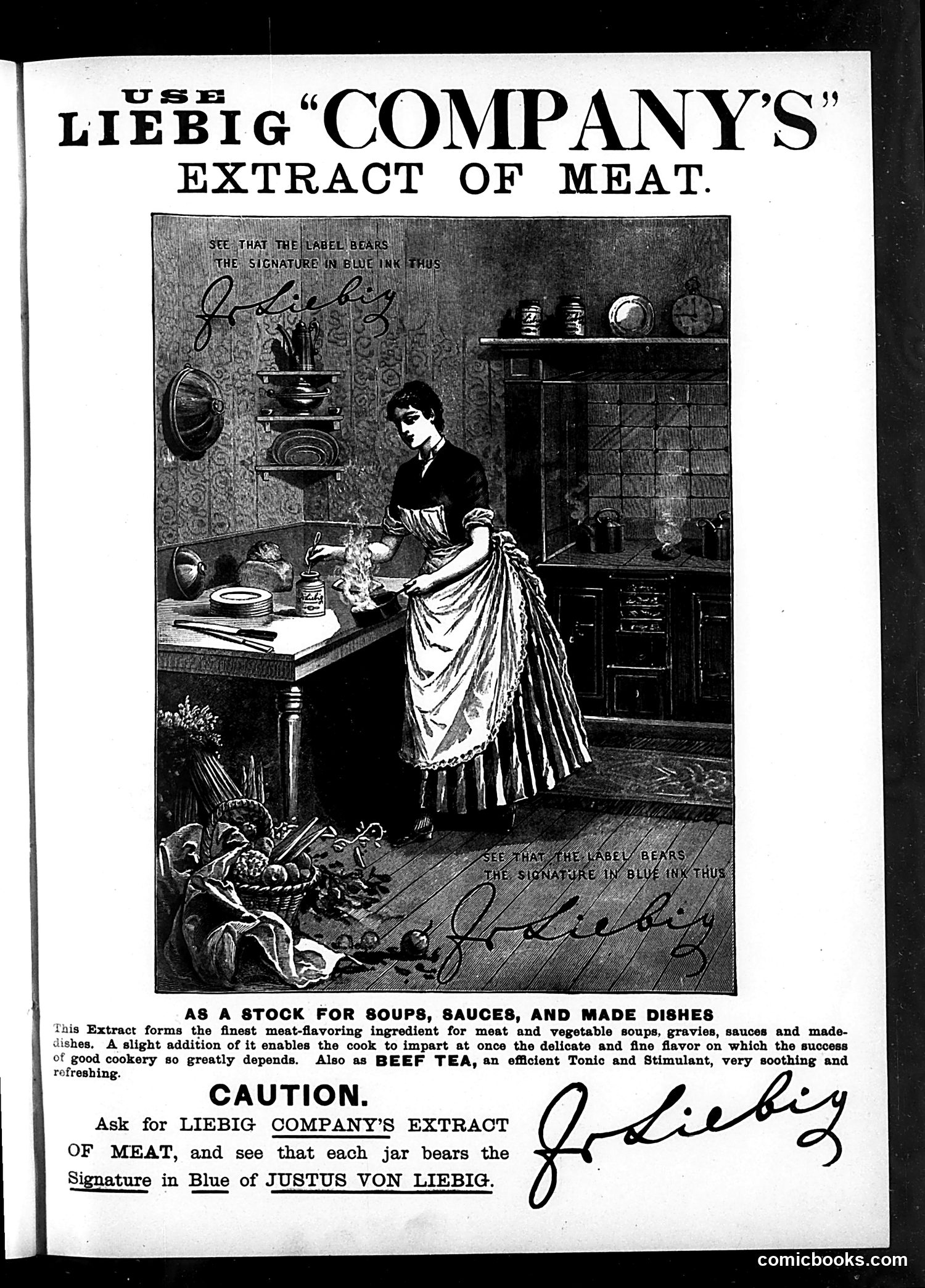
This is primarily a **product advertisement**, not political satire. It promotes Liebig Company's meat extract—a popular 19th-century concentrated broth product used as a cooking ingredient and tonic. The image shows a well-dressed woman in a Victorian kitchen preparing food, emphasizing that the extract enables elegant home cooking. The repeated warning about verifying **Justus von Liebig's signature in blue ink** indicates this was a heavily counterfeited product, making authenticity a major selling point. The "caution" section targets consumers concerned about fake versions flooding the market. Liebig's was a legitimate German innovation that became a global brand, but its popularity spawned numerous inferior imitations. The advertisement reassures buyers they could trust the genuine article by checking the signature—a practical consumer-protection message dressed in respectable domestic imagery.
This appears to be a **title page or advertisement** for "The Celebrated Schmertz Pianos," not a political cartoon. The page features Art Deco-style typography with the brand name displayed diagonally across a silhouetted profile of a person's head. The text claims Schmertz pianos are "the most popular and preferred by the leading artists." This is a commercial advertisement using the prestige of professional musicians to market the product. The artistic, modernist design and appeal to "leading artists" suggests this targets an upscale audience. Without additional context about the Schmertz company or when this appeared in Judge magazine, I cannot identify specific satirical intent or social commentary beyond standard early-20th-century advertising claims.

I can see this is a page from *Judge* magazine (as indicated by the comicbooks.com watermark), but the image is almost entirely black or extremely underexposed, making it impossible to discern any cartoon artwork, illustrations, text, or satirical content with confidence. I can barely make out what appears to be a vertical white stripe on the left edge and possibly some faint patterns suggesting there may be decorative borders or ornamental elements typical of period publications, but no readable text or identifiable figures are visible. To provide the historical analysis you've requested, I would need a clearer image where the actual cartoon content and accompanying text are legible.