
A complete issue · 18 pages · 1889
Judge — December 7, 1889
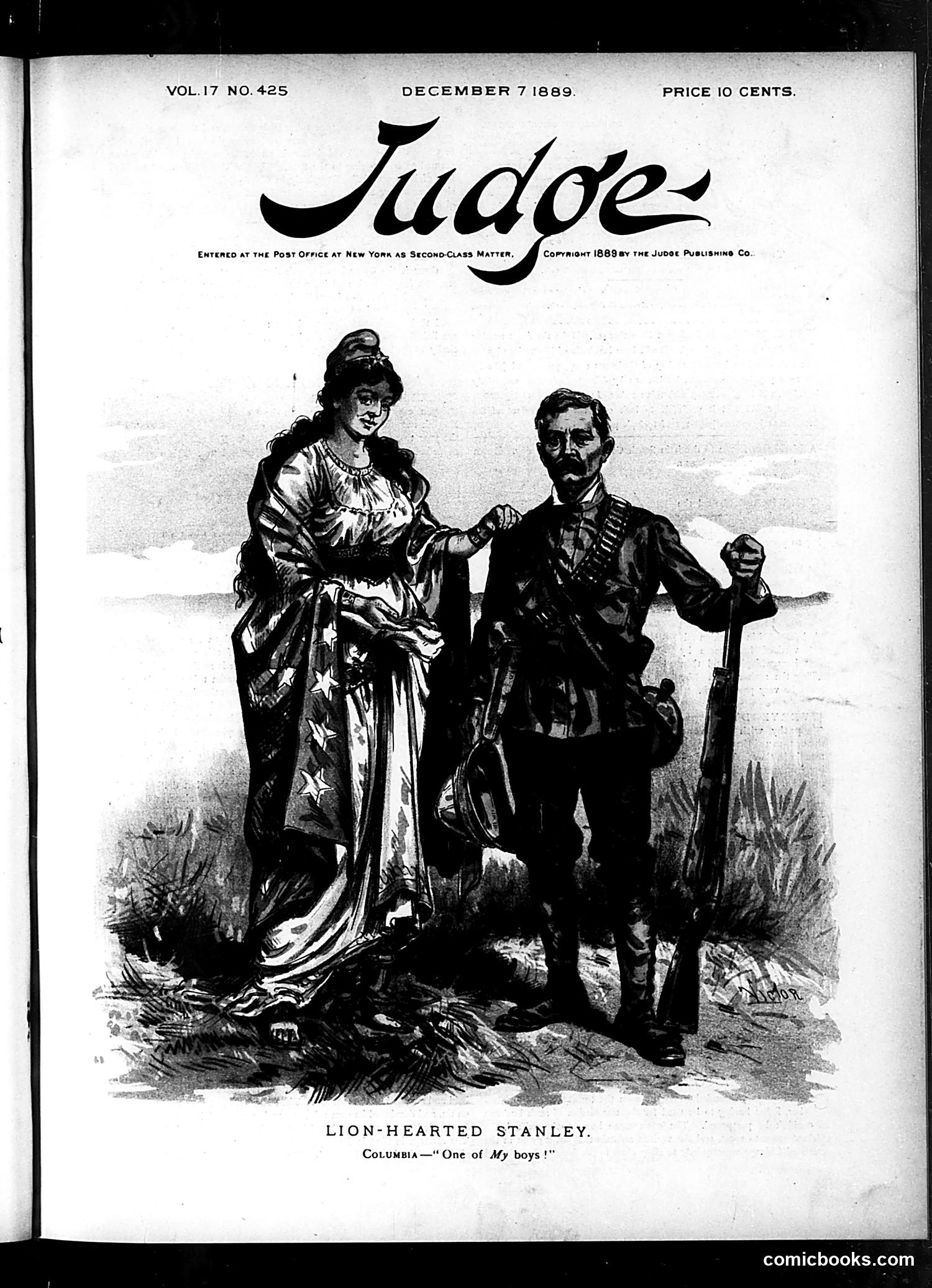
This *Judge* cover from December 7, 1889 depicts Henry Morton Stanley, the famous explorer, with a woman identified as "Columbia" (the personification of America). The caption quotes Columbia saying "One of My boys!"—suggesting Stanley as an American hero. The satire likely celebrates Stanley's recent African explorations and his role in establishing Belgian colonial control in the Congo. By 1889, Stanley had become a celebrated figure in American popular culture, portrayed here as a conquering adventurer whom America could claim pride in. The "lion-hearted" epithet references both his courage and his imperial ambitions. The image romanticizes colonial expansion—a perspective typical of late-19th-century American satire, before widespread critique of imperialism.
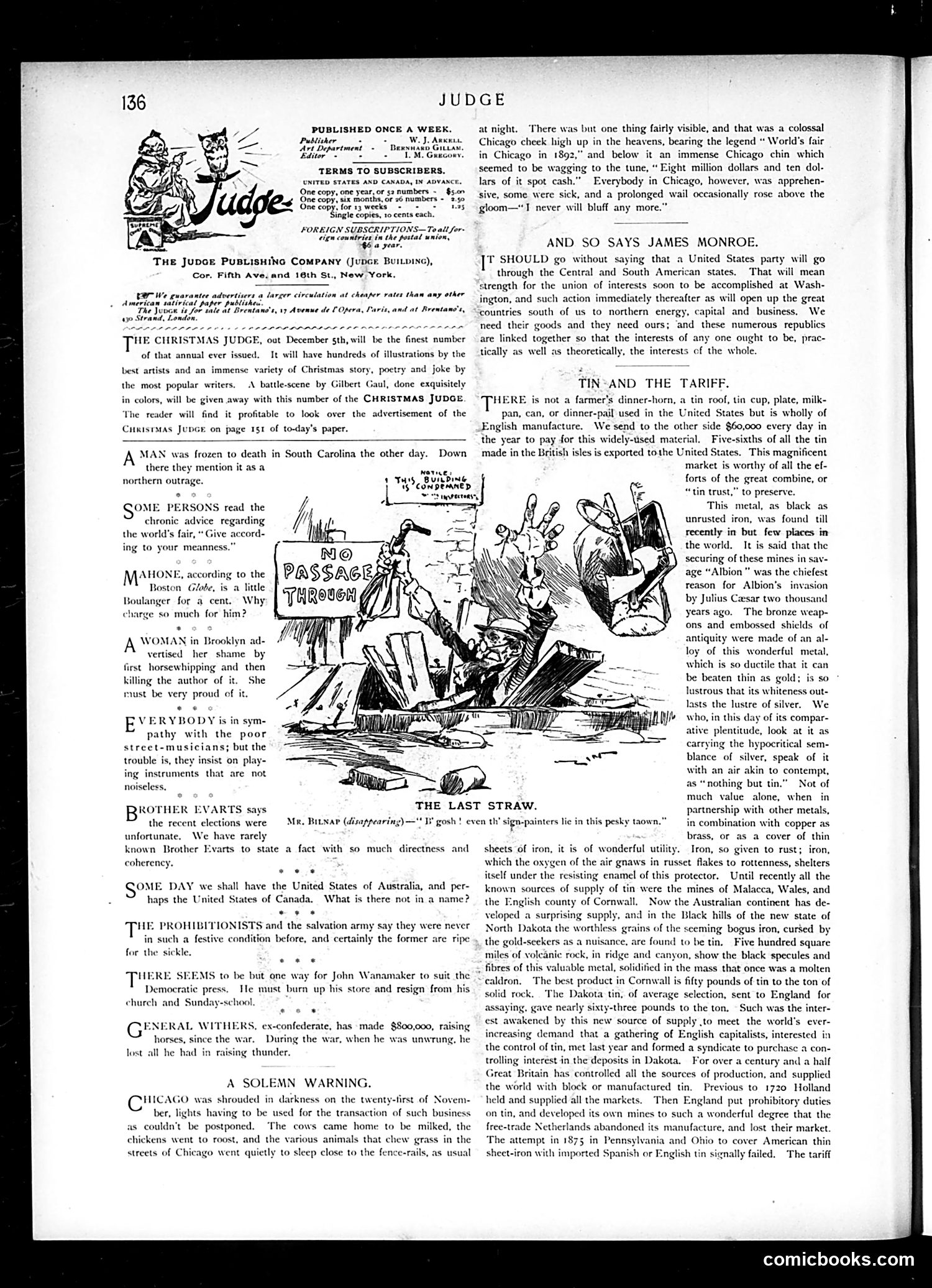
**Main Cartoon: "Passage Through"** This political cartoon depicts immigration/passage debate, likely from the 1890s-1900s era. A figure labeled "PASSAGE THROUGH" shows immigrants or cargo being transported, with crowded conditions and chaos. The reference to "passage" suggests debate over U.S. trade routes or immigrant transit rights. **"The Last Straw" Cartoon** Features Mr. Bulnap (appearing disheveled) with sign-painters, satirizing someone's tolerance wearing thin—a visual pun on "last straw." **Articles** The page contains essays on tin tariffs, tin mining in Australia/Dakota, and Britain's tin monopoly control—reflecting late-19th century trade debates and American industrial protectionism concerns. The overall page mixes political satire with economic commentary typical of Judge's editorial stance on tariffs and international trade.
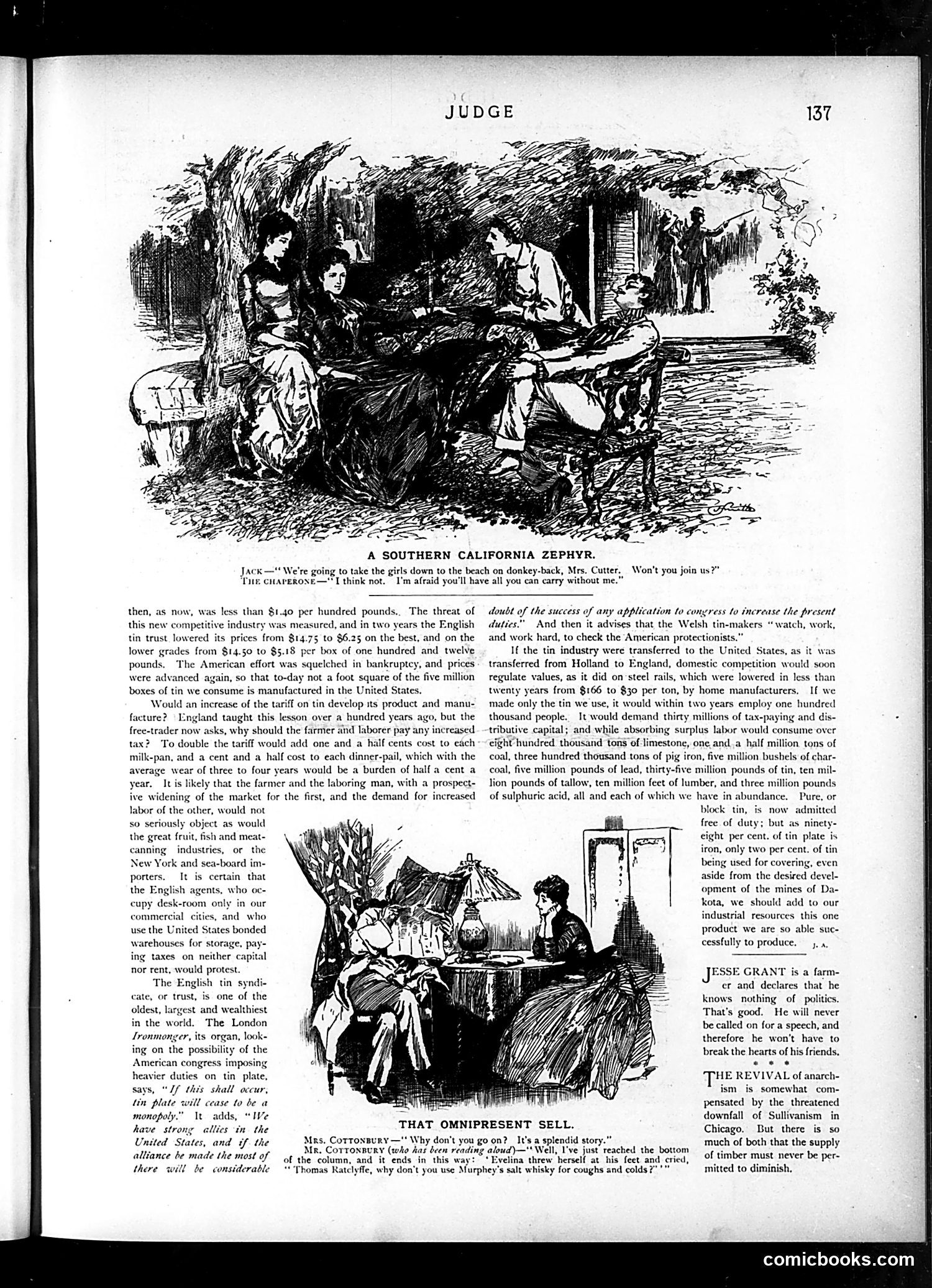
## Top Cartoon: "A Southern California Zephyr" A humorous domestic scene showing Jack inviting Mrs. Cutter on a beach donkey-back ride with young women. The chaperone's witty refusal—"I think not. I'm afraid you'll have all you can carry without me"—is a joke about her substantial weight, implying she would be too heavy a burden for the donkey. This represents typical Victorian-era humor about women's bodies and propriety. ## Main Article: Tin Tariff Debate The lengthy text discusses American tin-plate manufacturing versus English tin trusts. Judge argues that protective tariffs would boost domestic production, employ hundreds of thousands, and stimulate related industries (coal, lumber, limestone). The article criticizes English syndicates using American bonded warehouses tax-free while lobbying Congress against protective duties. This reflects late-19th-century protectionist vs. free-trade political divisions. ## Bottom Cartoon: "That Omnipresent Sell" A domestic reading scene where Mr. Cottonsbury interrupts his wife's story—the narrative climax is interrupted by an advertisement for "Murphy" (likely a product). The joke satirizes how commercial advertising infiltrates even intimate moments.
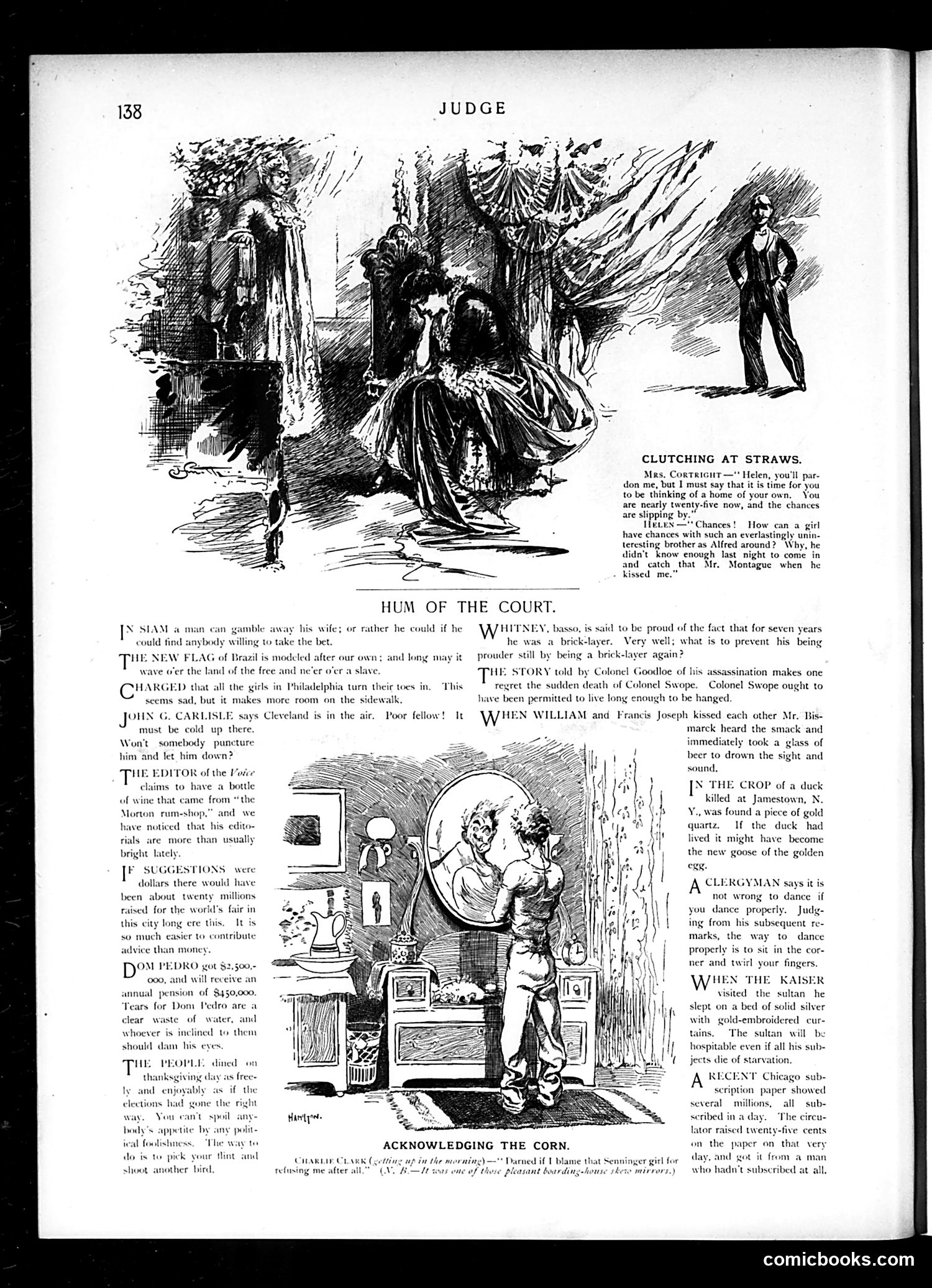
This page from *Judge* contains several brief satirical items typical of the publication's format. The top cartoon, "Clutching at Straws," depicts a mother pressuring her adult daughter about marriage prospects. The daughter blames her unmarried brother Alfred for scaring away suitors by failing to escort a man (Mr. Montague) from her room after he kissed her—implying impropriety that damages her reputation. The satire targets Victorian social conventions around courtship and female respectability. The remaining text items are short quips on contemporary topics: Siam's marriage laws, Brazil's flag, Colonel Swope's assassination, John Carlisle (likely the Kentucky politician), and various anecdotes about money, food, and social behavior. The "Acknowledging the Corn" caption references a girl named Senninger who refuses a suitor despite his morning apology. The page reflects *Judge's* style of mixing visual and textual satire aimed at urban, educated readers familiar with contemporary politicians, social scandals, and cultural debates.
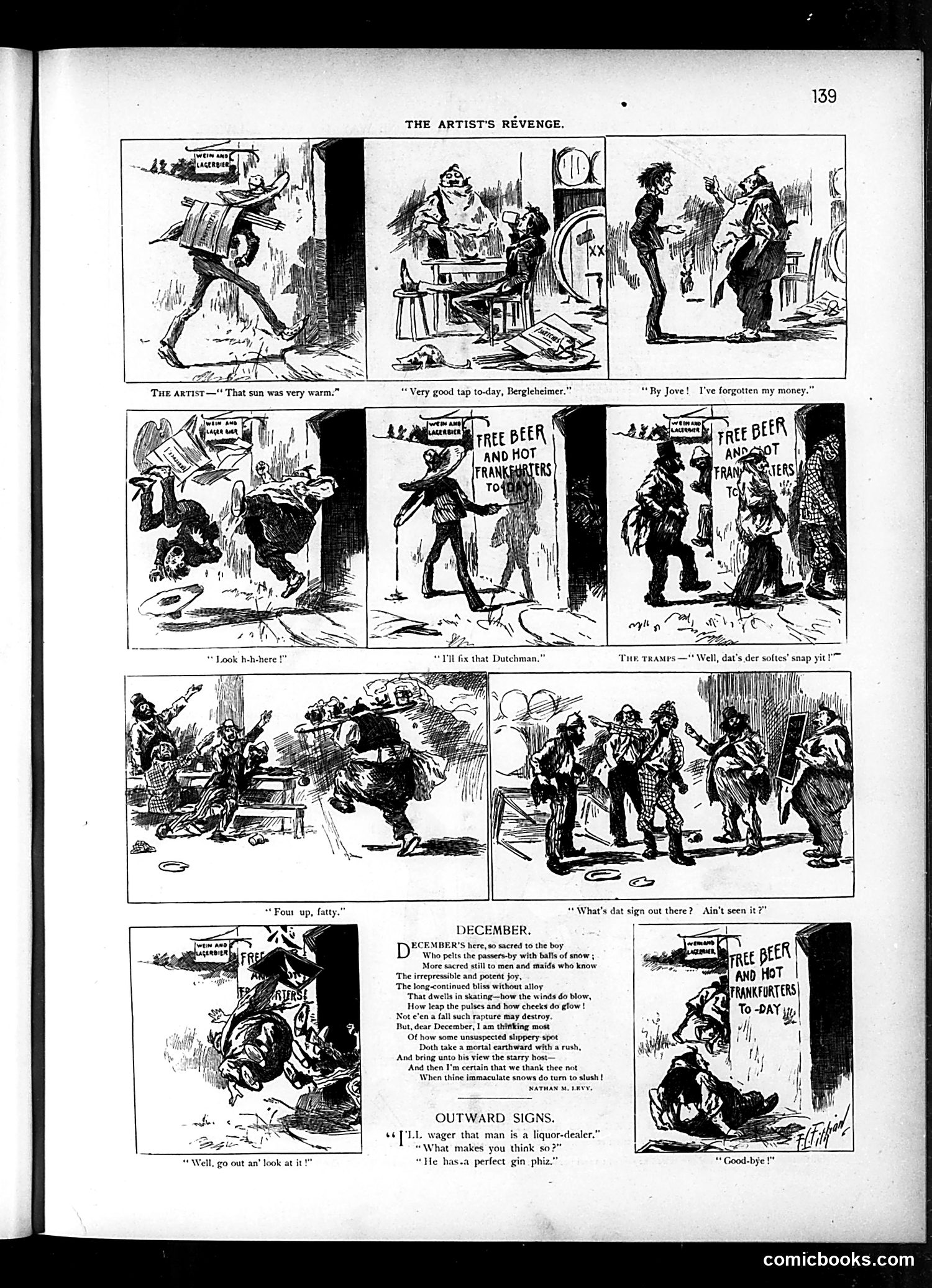
This is a multi-panel satirical comic depicting an artist's escalating conflict with a wealthy patron (likely named Bergscheimer, based on dialogue). The narrative arc shows: the artist delivering work in cold weather ("that sun was very warm"), receiving poor payment ("I've forgotten my money"), then seeking revenge by advertising "Free Beer and Hot Frankfurters" to lure homeless tramps to the patron's establishment. The joke is the artist's clever retaliation—he floods the rich man's property with rowdy vagrants, disrupting his business and dignity. The final panels show the chaos and confusion this causes. Below, a December poem celebrates winter pleasures (skating, snow) while wryly noting slippery ice hazards. The "Outward Signs" section jokes about identifying a liquor dealer by his "gin phiz" (bloated face from drinking). The satire reflects class tensions and the struggle between working artists and wealthy exploiters.
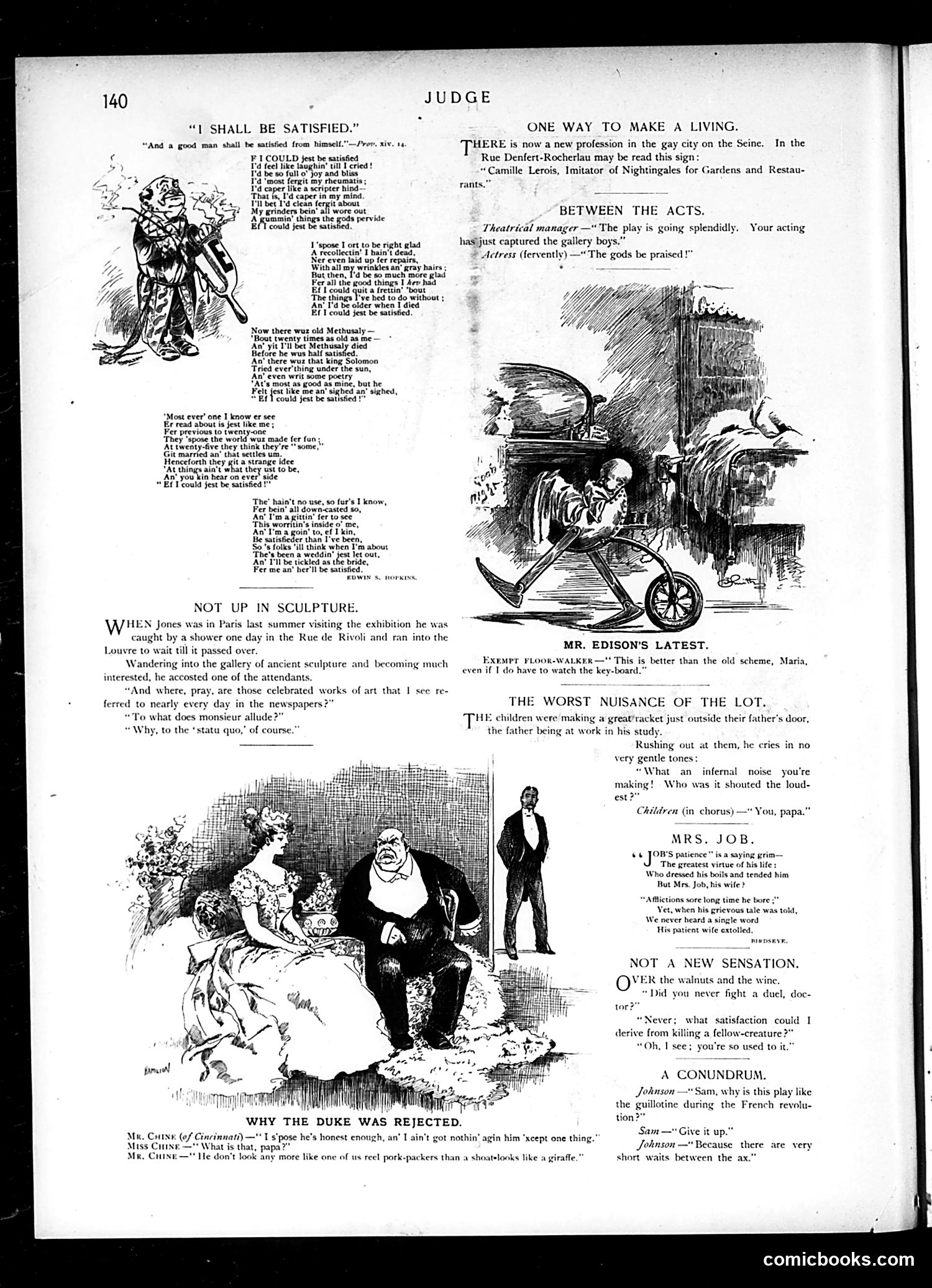
This page contains multiple short humorous pieces typical of 1890s satirical journalism: **Main Content:** - A lengthy poem about human dissatisfaction, using biblical references (Methuselah, Solomon, Job) to argue that people perpetually want more than they have - "Not Up in Sculpture": A pun-based joke where an American tourist in Paris asks about the "statu quo" (status quo), mishearing it as a sculpture title—mocking American ignorance of French language and culture - "Why the Duke Was Rejected": A Cincinnati pork-packer rejects a nobleman as a son-in-law, suggesting aristocrats lack the substance of American industrialists - Various brief comedic sketches about Parisian professions, theater, and domestic life **Satire Targets:** The page satirizes American materialism and discontent, European pretension, gender dynamics (particularly in the "Mrs. Job" piece about unrecognized female labor), and class consciousness. The artwork throughout features typical period caricature styles. The humor relies heavily on wordplay, class commentary, and gentle domestic observations rather than political content.
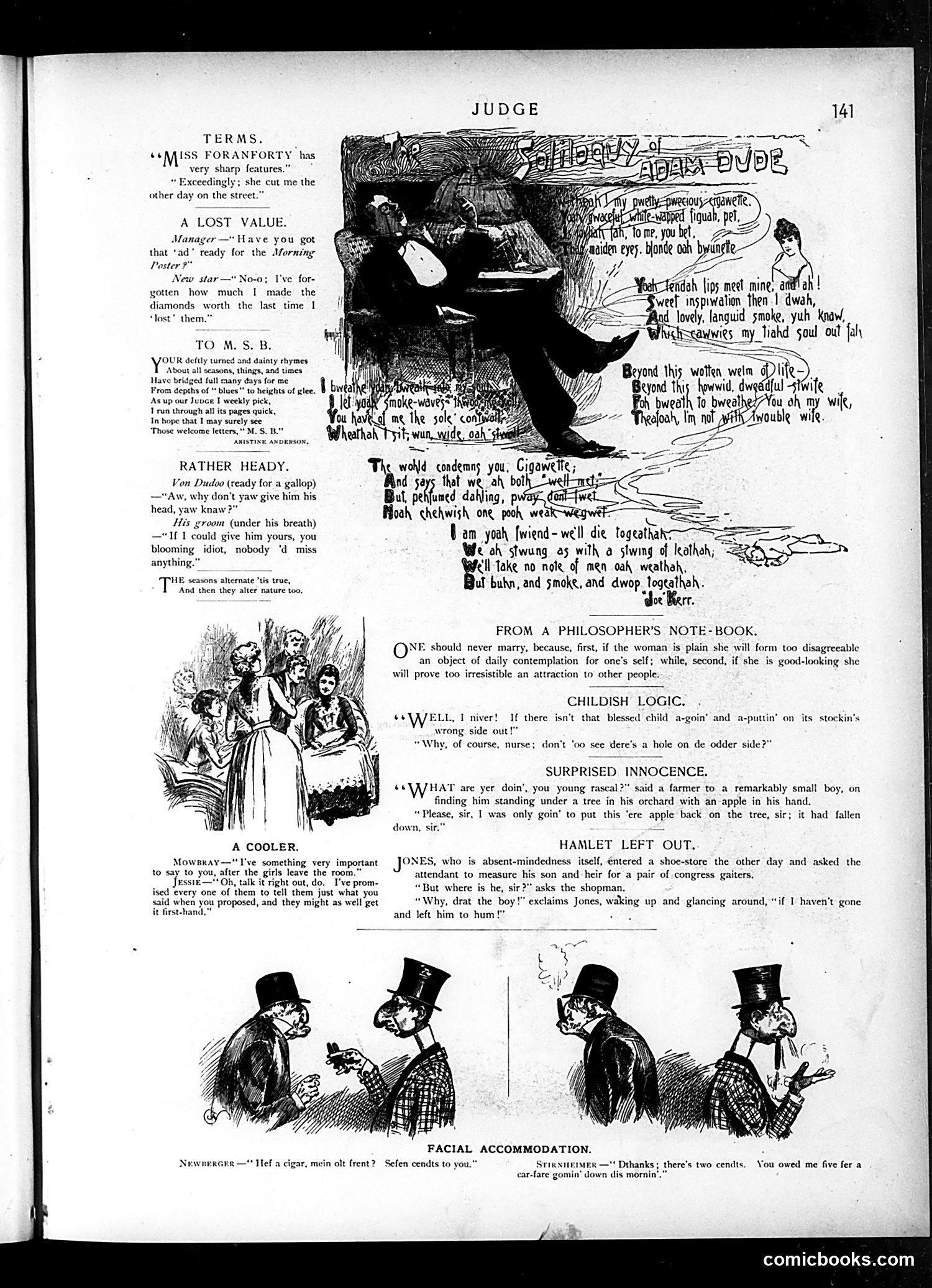
This page from *Judge* contains miscellaneous satirical humor pieces typical of the publication. The main items include: **"A Lost Value"**: Mocks theatrical advertising by depicting a manager and performer discussing inflated diamond valuations—satirizing how theater productions artificially boost props' worth for publicity. **"Rather Heady"**: A groom's aside joke about his employer's drunkenness, suggesting the rider is too intoxicated to control his horse properly. **"A Cooler"**: Humorously depicts a woman (Jessie) so gossipy that her suitor must propose knowing she'll immediately broadcast his exact words to everyone. **"Childish Logic" and "Surprised Innocence"**: Short anecdotes poking fun at literal-minded children and naive characters. **"Hamlet Left Out"**: An absent-minded man enters a shoe store asking to measure his son—then realizes he's left the boy behind entirely. **"Facial Accommodation"**: Two ethnic caricatures (using period dialect) negotiate a cigar sale while settling a debt. The page relies on slapstick situations, character types, and observational humor rather than specific political commentary.
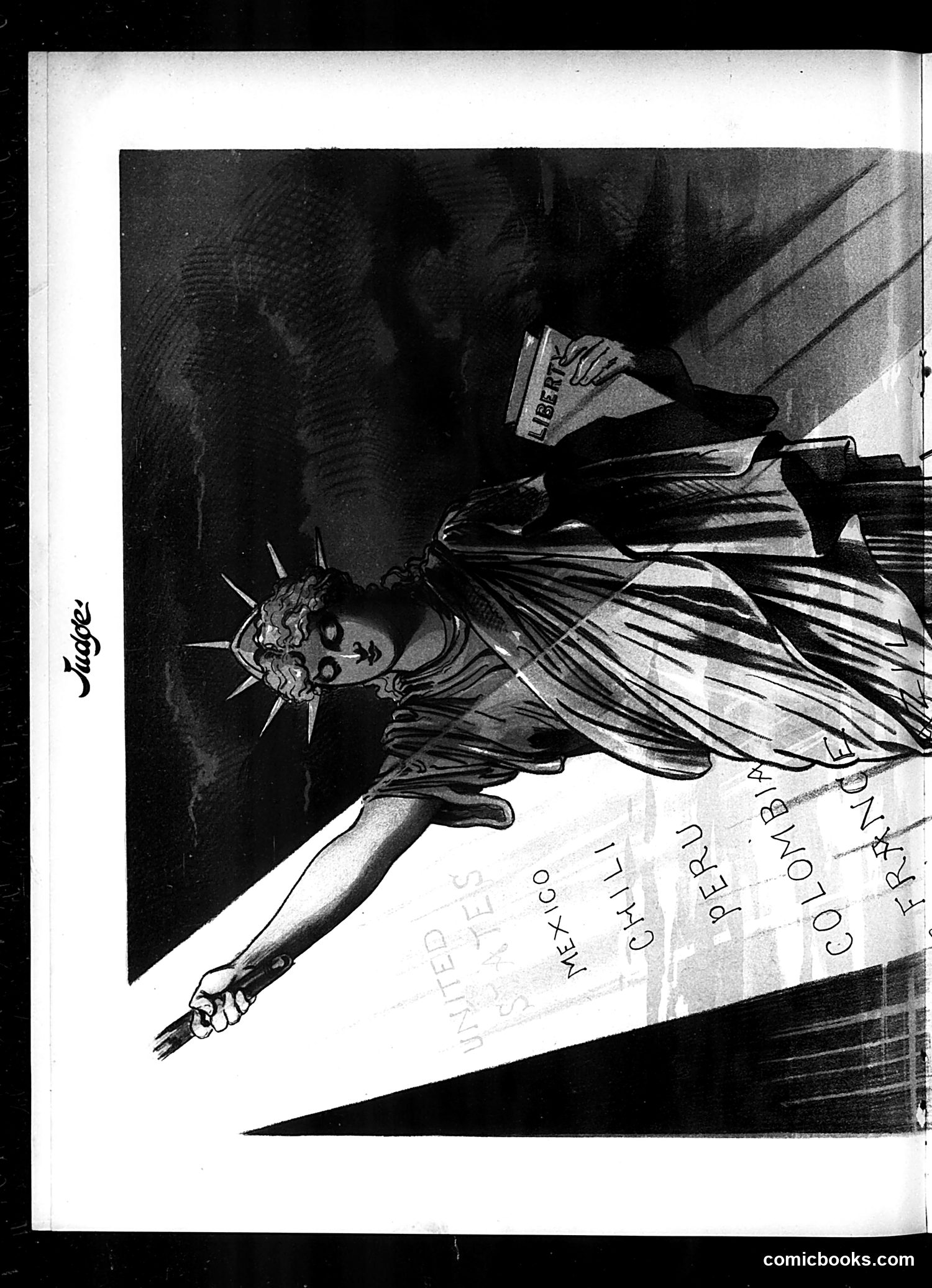
This page features a caricatured female figure wearing a spiked crown and flowing robes, holding what appears to be a torch or staff. The styling and iconography strongly suggest this is **Lady Liberty** (the Statue of Liberty personified). The figure holds a document labeled "UNITED STATES" with partial text visible including references to "COLONY" and "FOREIGN." The satire appears to critique American foreign policy or colonial ambitions, suggesting that Lady Liberty—traditionally symbolizing American freedom and independence—has been compromised or corrupted by involvement in colonial ventures abroad. The juxtaposition of this sacred American symbol with colonialism critiques what the cartoonist saw as a contradiction to founding American ideals. The specific historical context and date remain unclear from visible text alone.
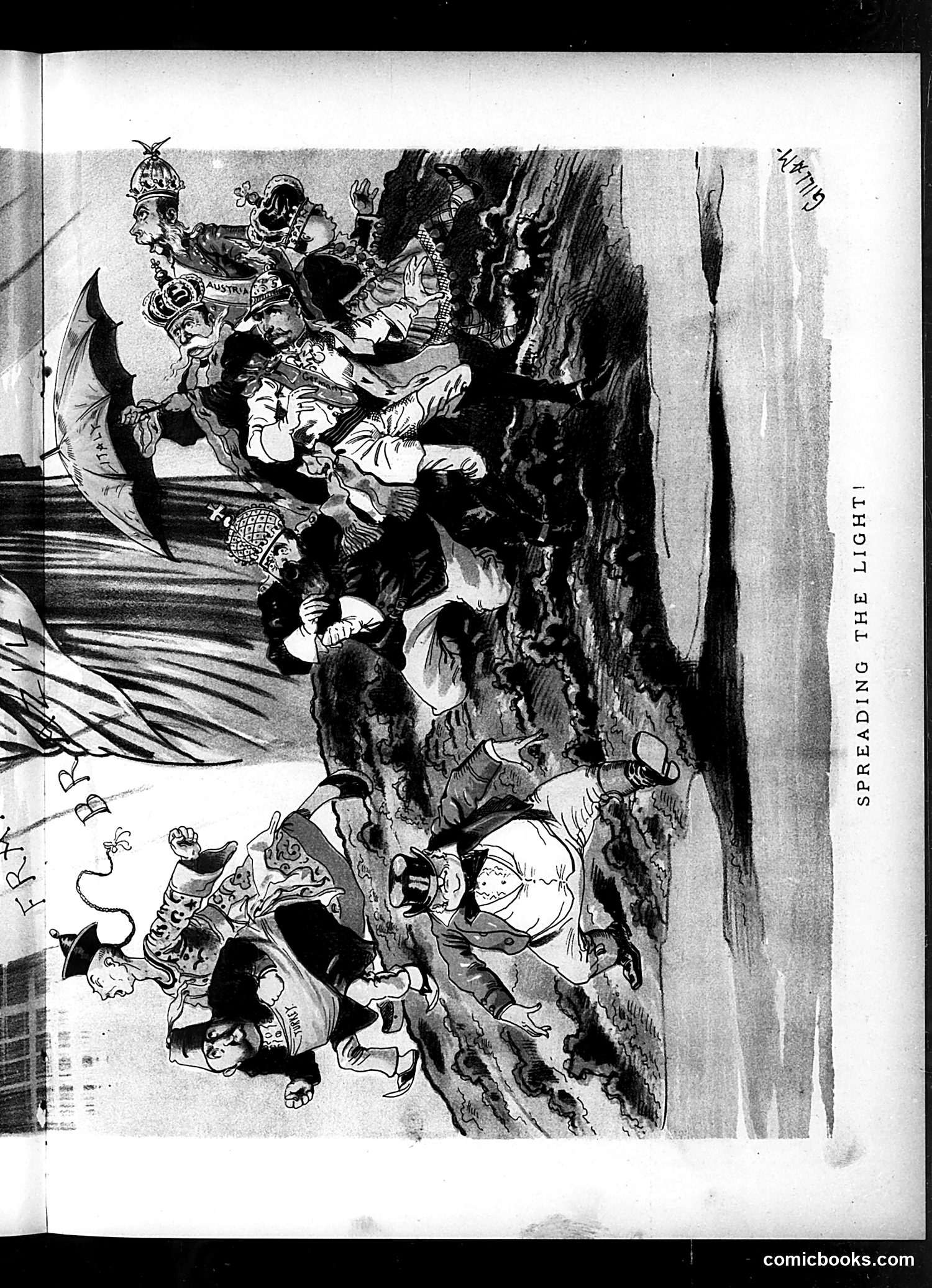
This Judge cartoon satirizes European imperial powers "spreading civilization" to colonial territories. The image depicts militaristic figures (identifiable by crowns and military dress, likely representing Austria and other European powers) descending upon indigenous peoples below in a violent, chaotic scene. The title's irony is clear: rather than enlightenment, these nations bring destruction and domination. The cartoon critiques the rhetoric of European imperialism—the claim that colonization brought "progress" and "light" to non-European peoples. Instead, the artwork shows armed aggression, chaos, and subjugation. This reflects Judge magazine's occasional anti-imperialist stance, mocking the self-righteous justifications European powers used to rationalize colonial conquest during the late 19th/early 20th century.
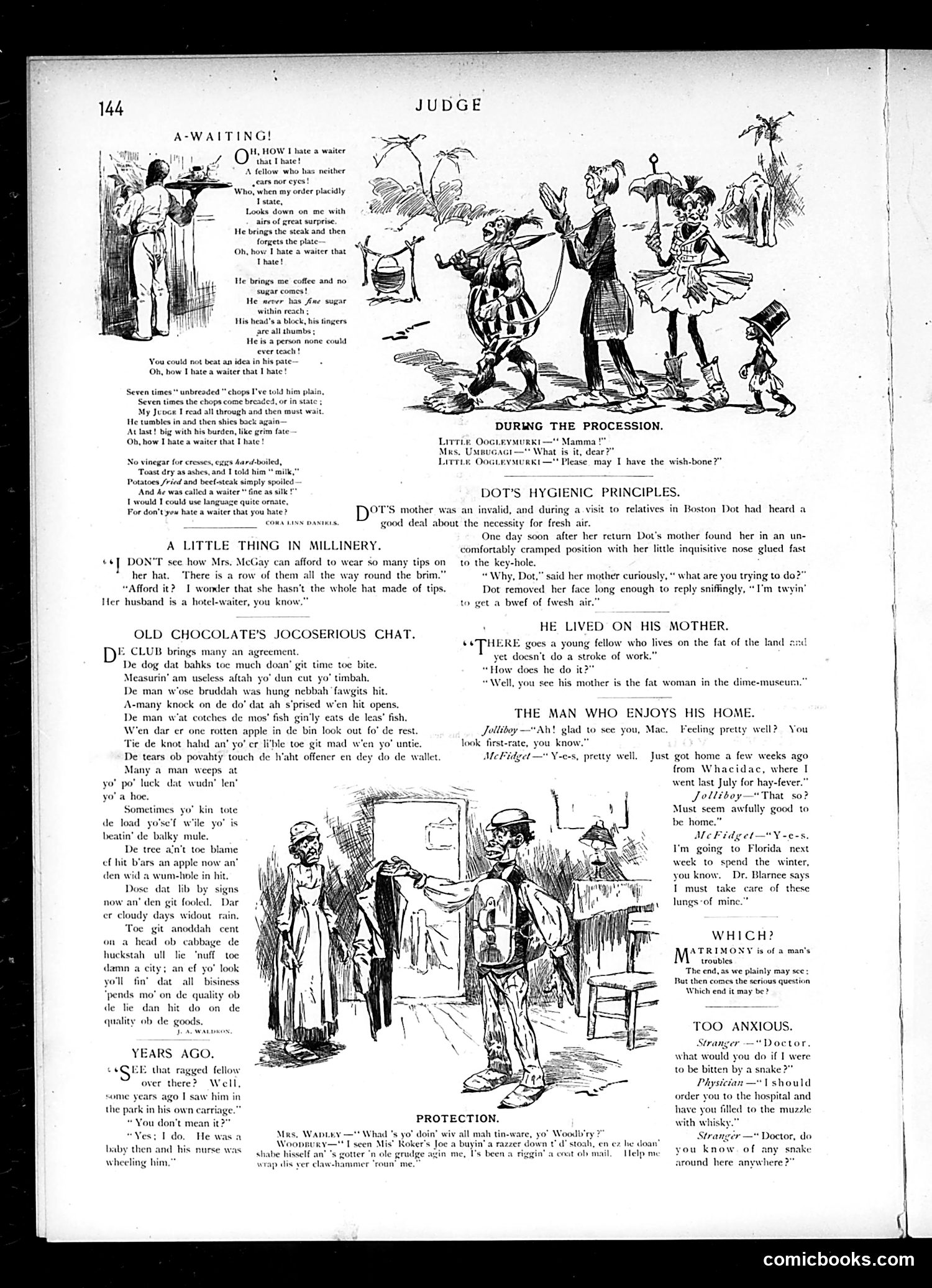
This page contains multiple brief humorous sketches typical of Judge magazine's satirical style: **"A-Waiting!"** mocks incompetent restaurant waiters—a common service complaint. The poem catalogs specific failures (forgetting plates, bringing breaded chops when unbreaded ordered), reflecting early 20th-century dining frustrations. **"A Little Thing in Millinery"** jokes about a hotel waiter's wife affording an expensive hat made entirely of tips—satirizing both working-class pretension and the service industry's reliance on gratuities. **"Old Chocolate's Jocoserous Chat"** presents African American dialect humor (common but offensive by modern standards), offering folksy wisdom about human nature and rural life. **"During the Procession"** shows children observing a parade, with dialogue about wish-bones, while a sideshow barker advertises attractions. **"Dot's Hygienic Principles"** ridicules a child cramped in a stuffy position, illustrating parental health concerns of the era. The remaining sketches offer domestic comedy about contentment, anxiety over snakes, and neighborhood gossip—typical Judge fare satirizing middle-class American life and social pretensions.
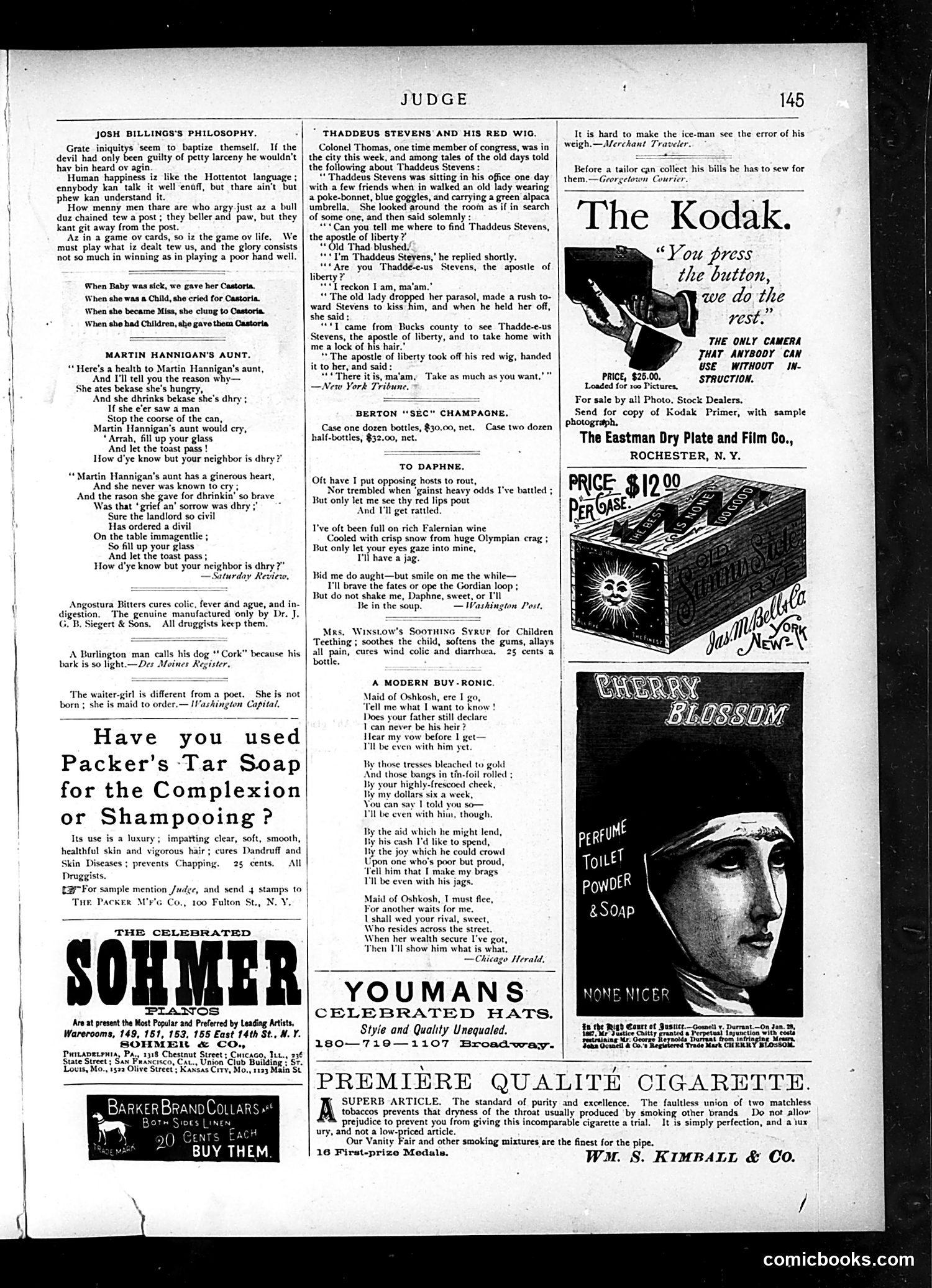
This page from *Judge* magazine contains several satirical pieces and advertisements typical of the era. The main cartoon, "Thaddeus Stevens and His Red Wig," mocks the Republican congressman and Radical Republican leader Thaddeus Stevens through an anecdote about a woman from his Pennsylvania district who visits him seeking a lock of his hair as a souvenir. The joke turns on Stevens removing his red wig and giving it to her instead—implying his wig is fake or that he's bald, a common personal insult of the period. Stevens was a prominent but controversial figure, and his appearance (including his clubfoot and distinctive features) made him a target for satire. The page also features humorous "philosophy" by Josh Billings (a popular 19th-century humorist), comic poems, and numerous period advertisements for products like Castoria (a children's laxative), Kodak cameras, and Sohmer pianos. The satire relies on physical mockery and wordplay typical of *Judge*'s approach to political figures.
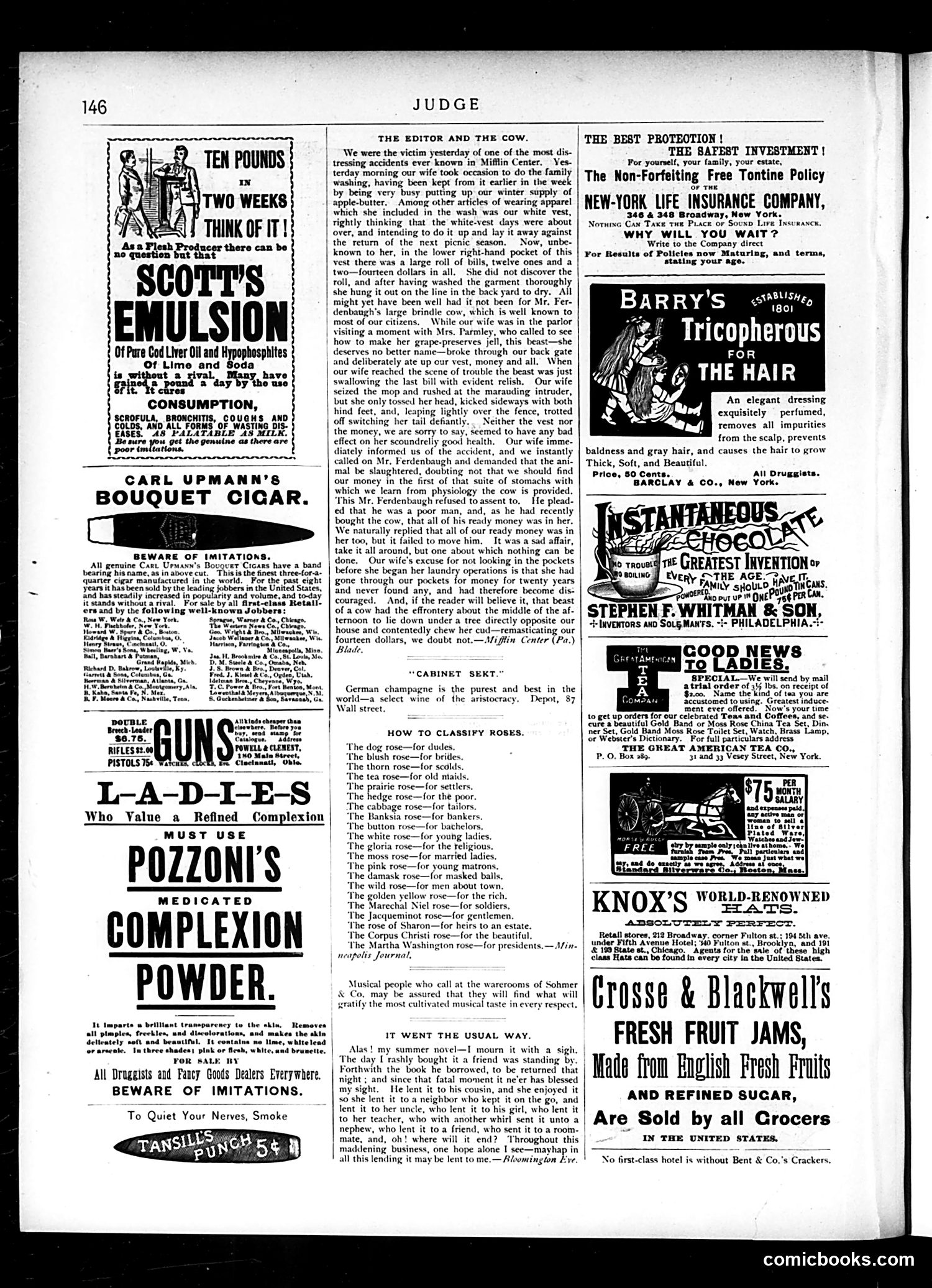
This page is predominantly **advertisements** interspersed with one humorous anecdote titled "The Editor and the Cow." ## The Main Narrative "The Editor and the Cow" is a comedic domestic mishap story: A Judge editor's wife washes his white vest containing fourteen dollars, hangs it to dry, and Mr. Ferdenbaugh's stray cow eats the vest—money and all. When the editor demands the cow be slaughtered to recover his cash, Ferdenbaugh refuses, claiming all *his* ready money is also now inside the cow. The editor humorously concedes the situation is hopeless. ## The Satire The piece gently mocks both parties' predicament and the absurdity of wealth literally being "inside" the cow—a play on the expression that livestock represents a farmer's capital. It's a lighthearted rural anecdote rather than political commentary. ## Advertisements The page features patent medicines (Scott's Emulsion for consumption), cigars, firearms, and cosmetics typical of late 19th-century Judge advertising—products now viewed skeptically or regulated.
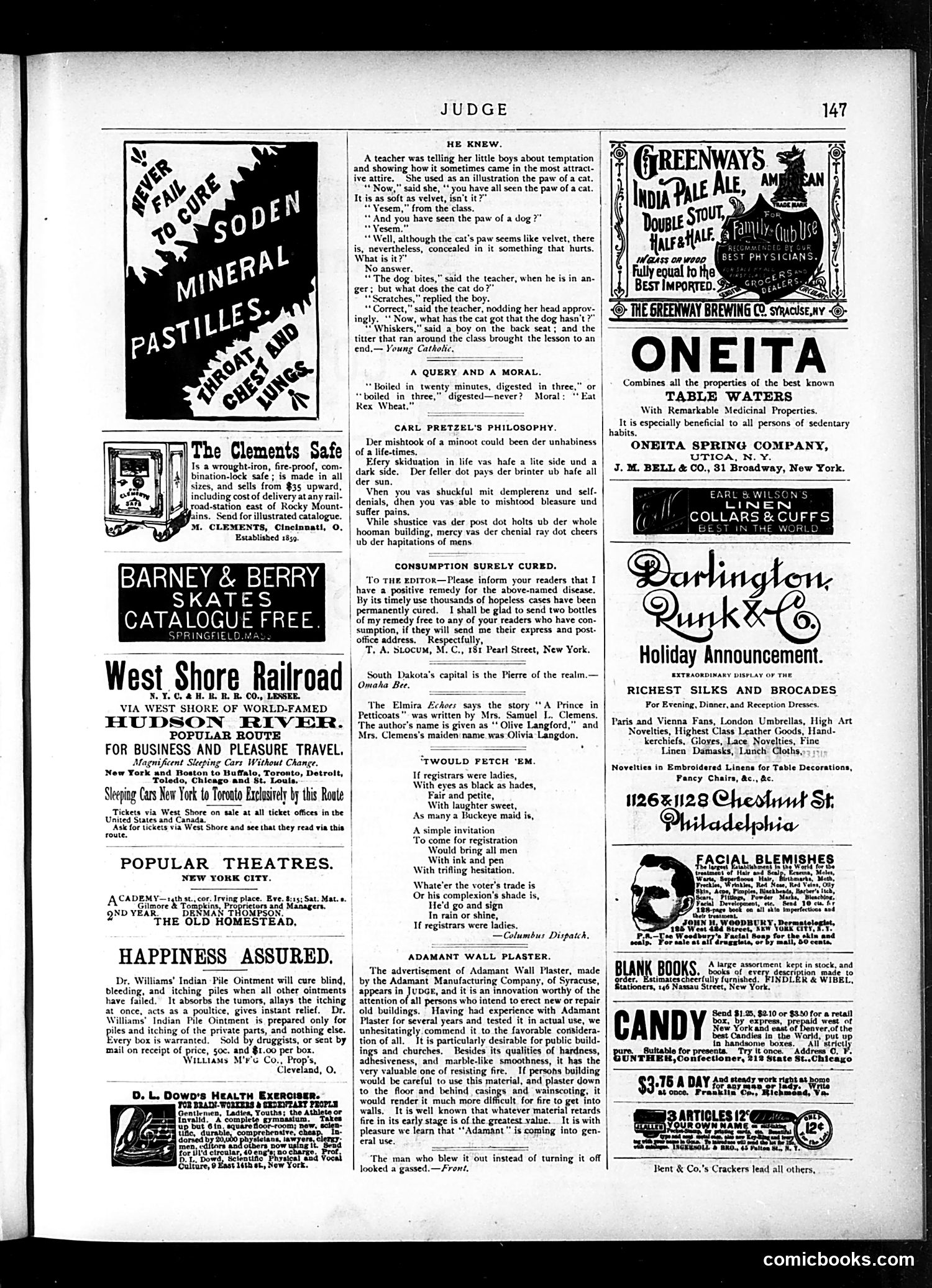
This page is primarily **advertising and filler content** rather than political satire. The main elements include: **Editorial Content:** - "He Knew": A classroom anecdote where a teacher illustrates temptation using animal paws; a student humorously deflates the lesson by answering "whiskers" to what distinguishes cats from dogs. - "Carl Pretzel's Philosophy": Dialect humor featuring broken English attributed to a German character offering homespun wisdom about life's choices and mercy. **Advertisements:** Numerous product ads (safes, skates, railroads, theaters, patent medicines for piles and health exercises) typical of late-19th-century magazines. The page contains **no clear political cartoon** or sustained satirical commentary on current events. The humor is mild, domestic, and moralistic—characteristic of Judge's family-friendly content alongside its more pointed political work elsewhere in the magazine. The "Carl Pretzel" piece appears to trade on ethnic German-American stereotypes common to the era.
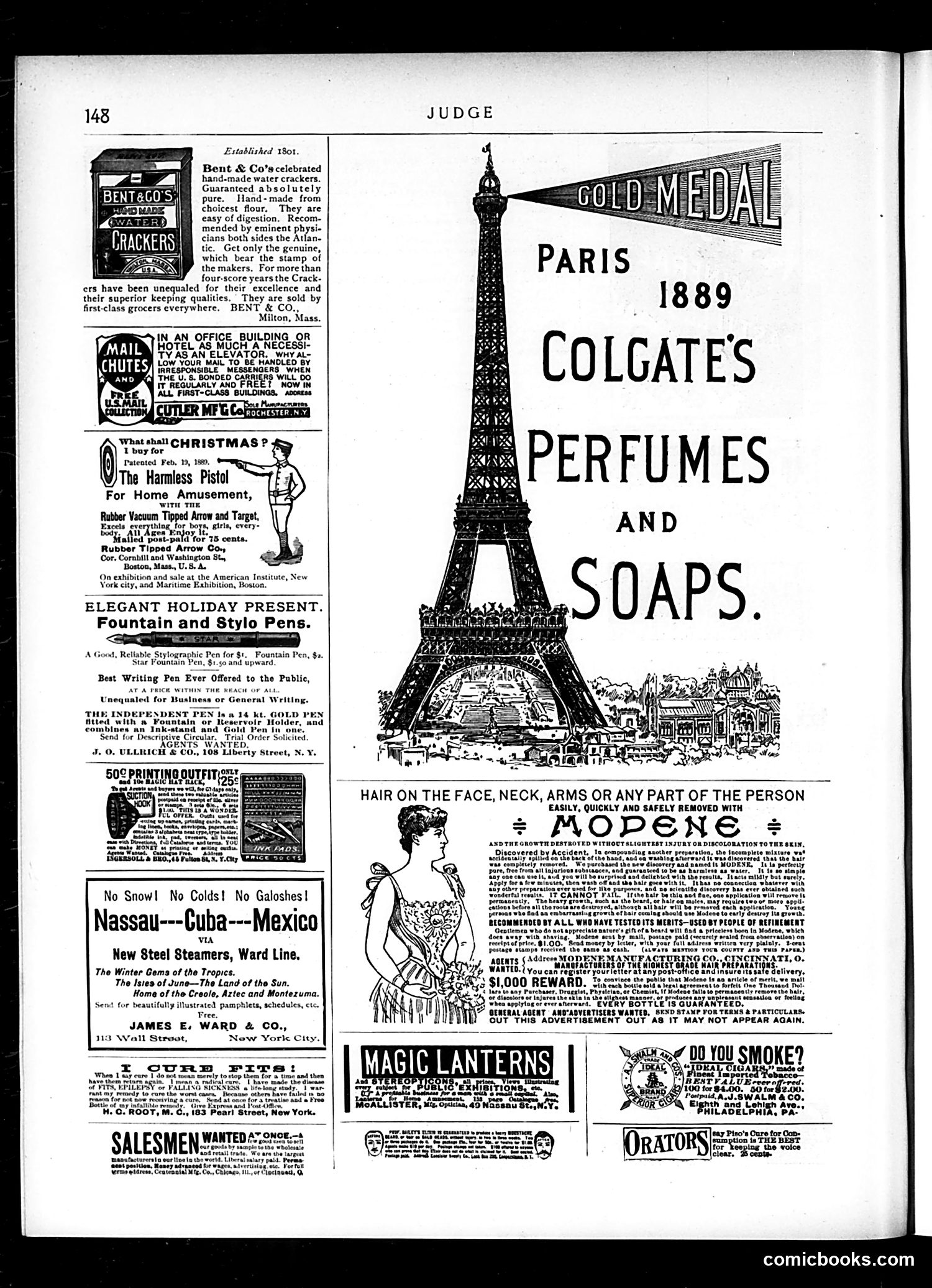
This page is primarily **advertising**, not political satire. It's a collection of late 19th-century commercial advertisements interspersed with what appears to be a magazine masthead or section header. The dominant visual is a large advertisement for **Colgate's Perfumes and Soaps**, featuring the Eiffel Tower (Paris 1889 Exposition), emphasizing imported luxury goods. Below this is an advertisement for **Modene**, a hair removal product marketed to women, using a classical profile illustration. Other advertisements include crackers, toy pistols, fountain pens, Caribbean cruise lines, and various patent medicines—typical of Judge's revenue model. There is **no political cartoon visible** on this page. The content reflects the consumer culture and commercial interests of 1890s America, with heavy emphasis on grooming products, luxury imports, and novelty items marketed to middle-class readers.
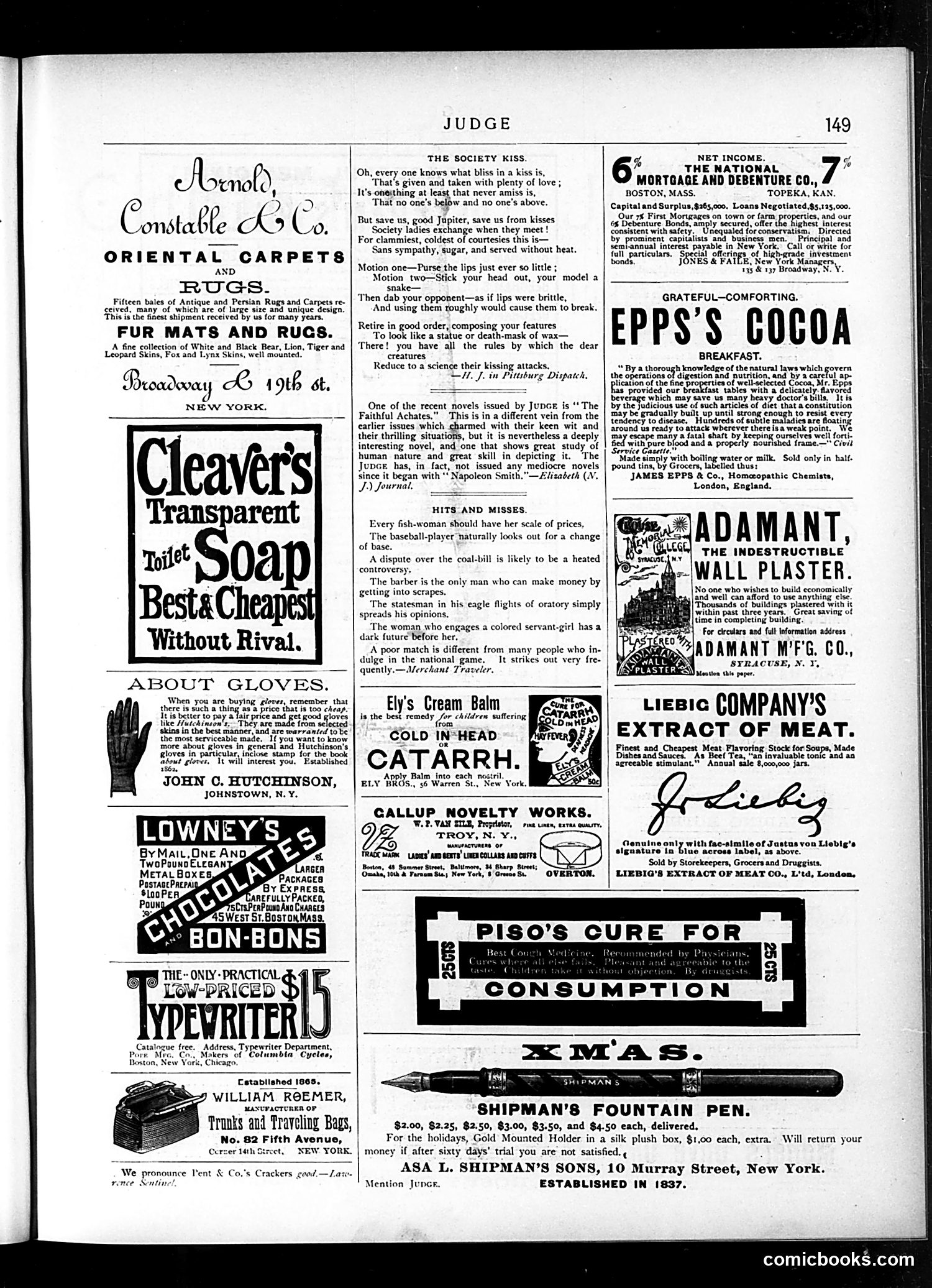
This page is primarily **advertising** with some light satirical content. The main pieces are: **"The Society Kiss"** (center): A satirical poem mocking the affectation of high-society women's greeting rituals. It describes their kiss as purely performative—lips pursed, heads extended like "snakes," mechanical and emotionless—contrasting sharply with genuine affectionate kisses. The satire targets the artificiality and coldness of upper-class social conventions. **"Hits and Misses"** (lower center): Brief wordplay jokes, mostly puns on occupations (barbers, statemen, servants) with no deeper political meaning. The remainder comprises period advertisements for Oriental carpets, gloves, soap, typewriters, travel goods, cocoa, wall plaster, and other commercial products—typical of Judge's revenue model. No identifiable caricatures or political figures appear on this page.
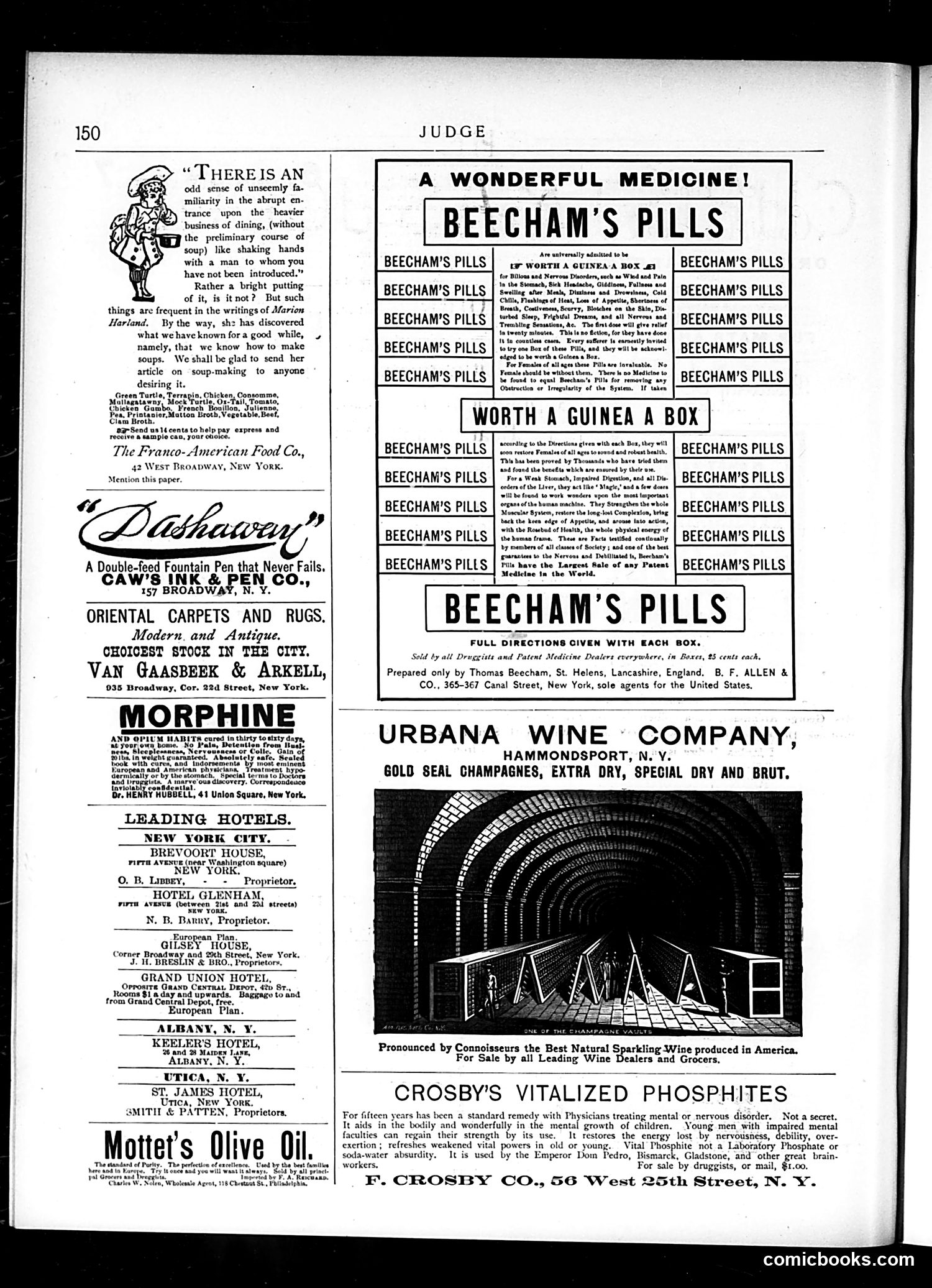
This page is primarily **advertising**, not satirical content. The bulk of the page consists of patent medicine and product advertisements typical of late 19th/early 20th-century American publications. The small editorial content at top left discusses Marion Harland's writing on soup-making etiquette—comparing the abruptness of starting dinner without soup to shaking hands with an unintroduced stranger. This is gentle social commentary, not political satire. The advertisements reveal period concerns: **Beecham's Pills** (a "wonderful medicine" claiming to cure digestive issues and "female irregularities"), morphine addiction treatments, olive oil tonics, and **Crosby's Vitalized Phosphites** for "mental or nervous disorder." These reflect an era when patent medicines made expansive, unregulated health claims. The wine and hotel advertisements suggest this magazine targeted middle-to-upper-class urban readers in New York. **No significant political satire or identifiable caricatures appear on this page.**
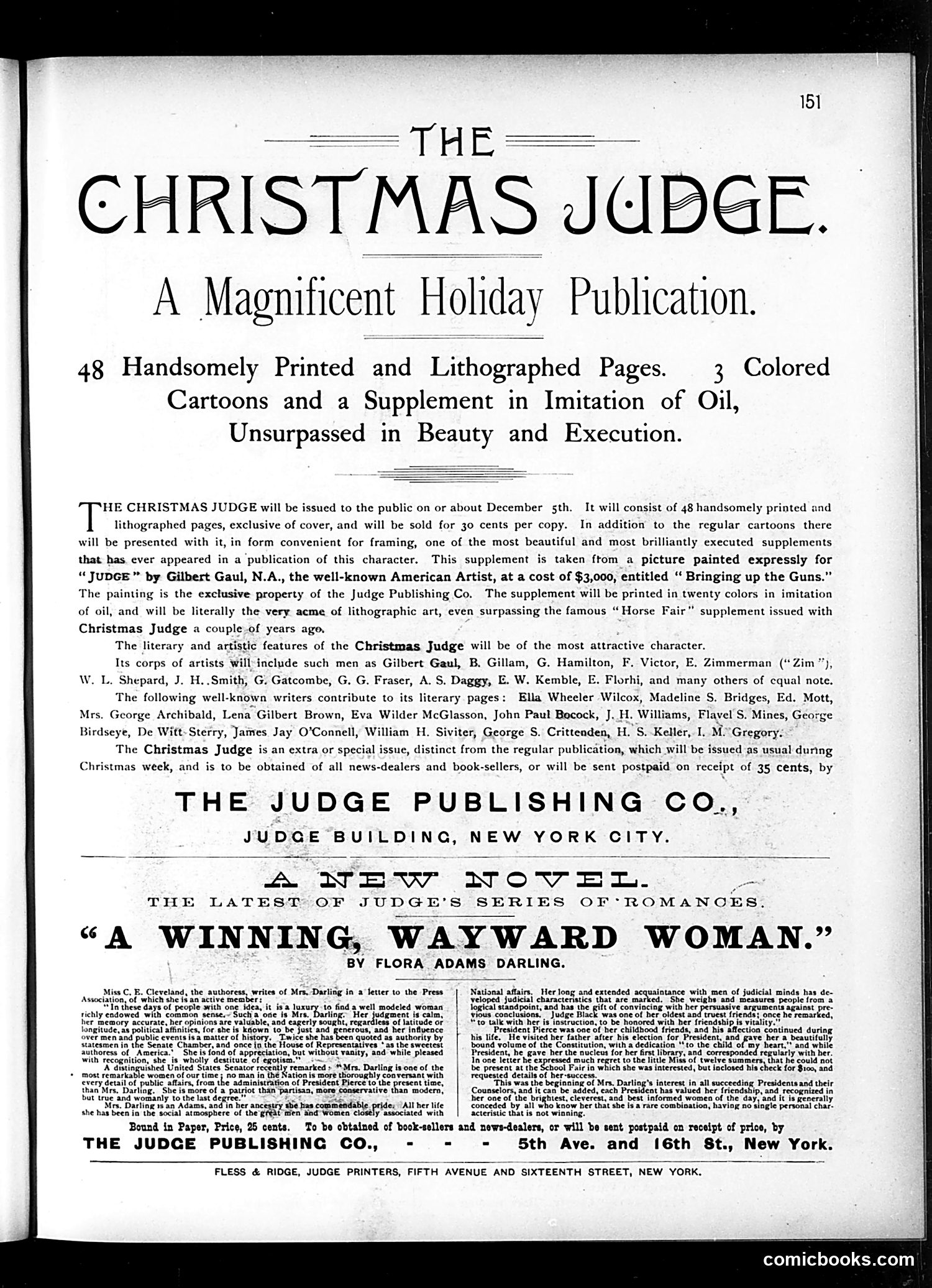
This is primarily a title page and advertisement for a special December holiday edition of *Judge* magazine, a prominent American satirical publication. The page announces a 48-page illustrated Christmas issue selling for 30 cents, featuring three colored political cartoons and an oil-painting supplement by artist Gilbert Gaul titled "Bringing up the Guns." The text lists notable illustrators (B. Gillam, E.W. Kemble) and writers (Ella Wheeler Wilcox) contributing to the issue. The lower section advertises a serialized novel, "A Winning, Wayward Woman" by Flora Adams Darling, describing the author's reputation for good judgment and her acquaintance with political figures including President Pierce and Judge Black. This represents *Judge*'s commercial publishing strategy during the Gilded Age—packaging topical satire with literary content as premium holiday merchandise.
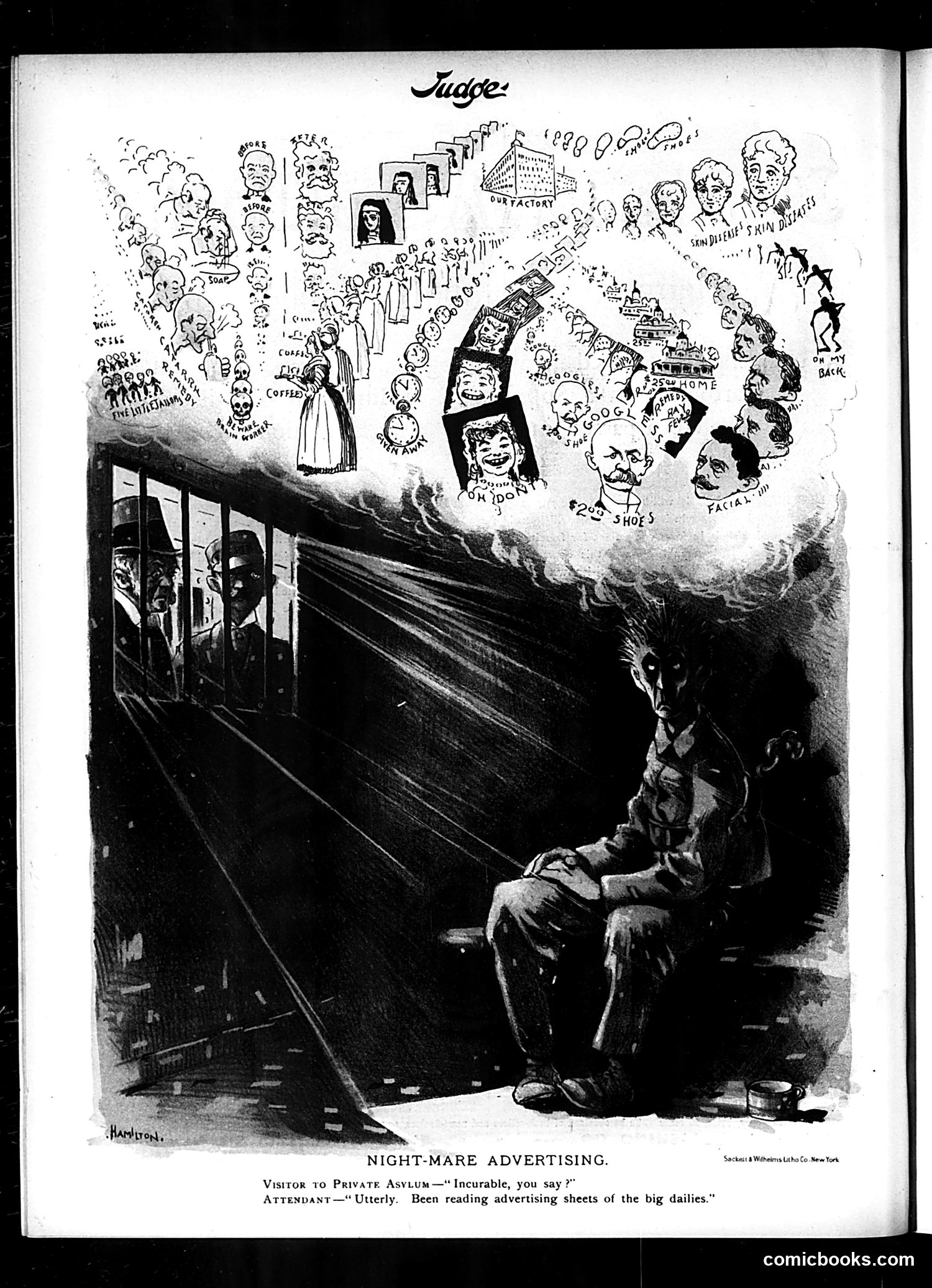
This cartoon satirizes the mental health impact of newspaper advertising. A visitor to a private asylum questions an attendant about a patient's condition. The attendant replies that the patient has become "incurable" from reading advertising sheets in major daily newspapers. The cartoon depicts the patient's nightmarish vision above—a chaotic cloud filled with exaggerated faces, product names, and promotional imagery from various advertisements. This visual cacophony represents how aggressive, overwhelming advertising drives people to madness. The satire targets the proliferation of aggressive commercial advertising in late 19th/early 20th-century newspapers, suggesting that constant exposure to manipulative marketing and sensationalism is literally driving readers insane. It's a critique of both corporate advertising excess and newspapers' willingness to saturate their pages with such content.