
Judge, 1889-12-07 · page 3 of 18
Judge — December 7, 1889 — page 3: what you’re looking at
What you’re looking at
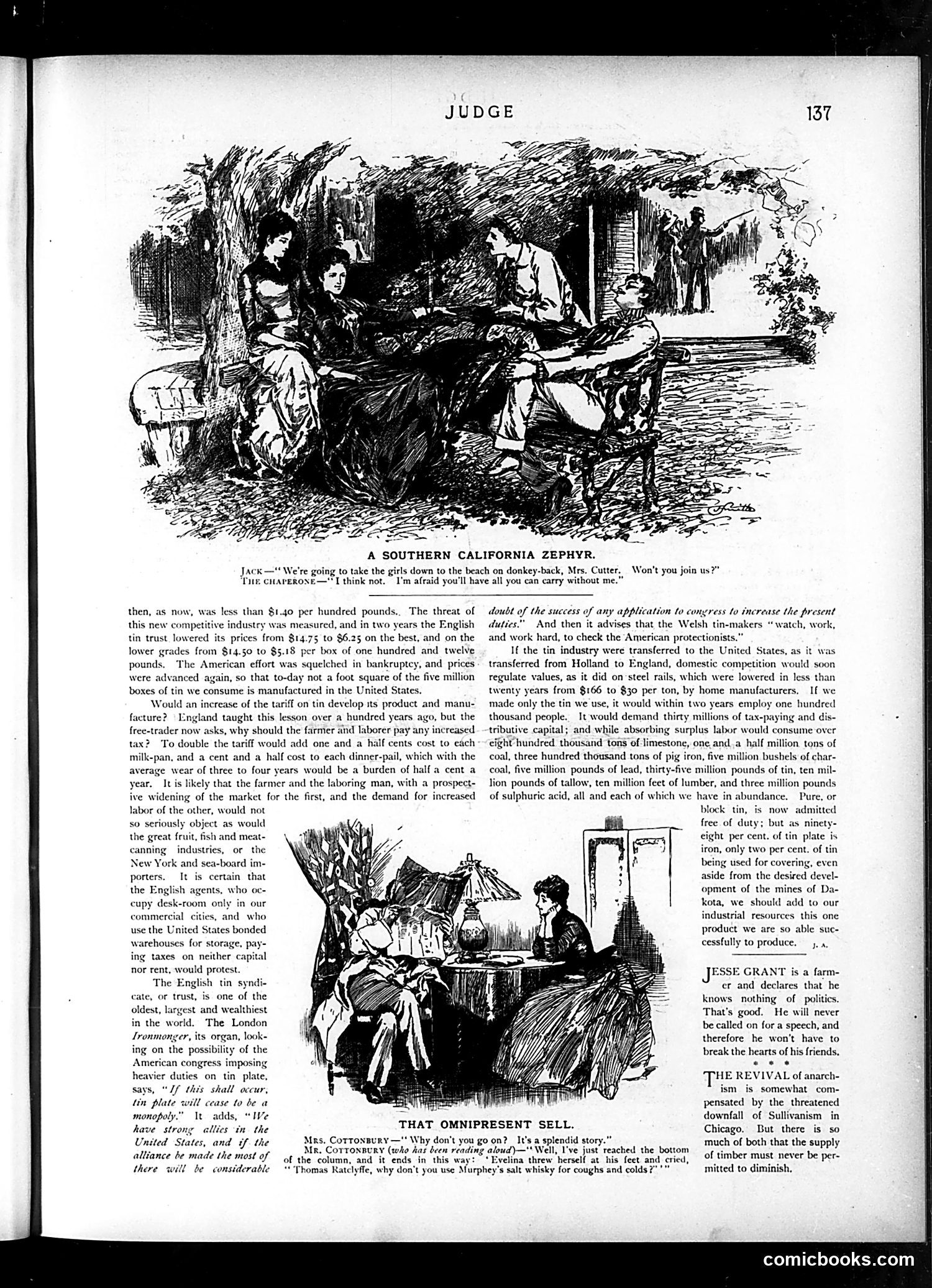
## Top Cartoon: "A Southern California Zephyr" A humorous domestic scene showing Jack inviting Mrs. Cutter on a beach donkey-back ride with young women. The chaperone's witty refusal—"I think not. I'm afraid you'll have all you can carry without me"—is a joke about her substantial weight, implying she would be too heavy a burden for the donkey. This represents typical Victorian-era humor about women's bodies and propriety. ## Main Article: Tin Tariff Debate The lengthy text discusses American tin-plate manufacturing versus English tin trusts. Judge argues that protective tariffs would boost domestic production, employ hundreds of thousands, and stimulate related industries (coal, lumber, limestone). The article criticizes English syndicates using American bonded warehouses tax-free while lobbying Congress against protective duties. This reflects late-19th-century protectionist vs. free-trade political divisions. ## Bottom Cartoon: "That Omnipresent Sell" A domestic reading scene where Mr. Cottonsbury interrupts his wife's story—the narrative climax is interrupted by an advertisement for "Murphy" (likely a product). The joke satirizes how commercial advertising infiltrates even intimate moments.
📄 Transcribed text from this page (OCR, searchable)
Machine-transcribed from the original scan — historical spelling and the odd misread are preserved.
A SOUTHERN CALIFORNIA ZEPHYR. Jack —" We're going to take the girls down to the beach on donkey-back, Mrs. Cutter, I'm afraid you'll have all you can carry THe CHAPERONE—"'T think not. Won't you join us?” ithout me.” then, as now, was less than $1.40 per hundred pounds., The threat of this new competitive industry was measured, and in two years the English tin trust lowered its prices from $14.75 to $6.25 on the best, and on the lower grades from $14.50 to $5.18 per box of one hundred and twelve pounds, The American effort was squelched in bankruptcy, and prices were advanced again, so that to-day not a foot square of the five million boxes of tin we consume is manufactured in the United States. Would an increase of the tariff on tin develop sts product and manu- facture? England taught this lesson over a hundred y 0, but the free-trader now asks, why should the farmer and laborer pay any increased x? To double the tariff would add one and a half cents cost to each milk-pan, and a cent and a half cost to each dinner-pail, which with the average wear of three to four years would be a burden of half a cent a year. It is likely that the farmer and the laboring man, with a prospect- ive widening of the market for the first, and the demand for increased labor of the other, would not so seriously object as would the great fruit, fish and meat- canning industries, or the New York and sea-board im- porters. It is certain that the English agents, who oc- cupy desk-room only in our commercial cities, and who use the United States bonded warehouses for storage, pay- ing taxes on neither capital nor rent, would protest. The English tin syndi- cate, or trust, is one of the oldest, largest and wealthiest in the world. The London Tronmonger, its organ, look= ing on the possibility of the American congress imposing heavier duties on tin plate, Uf this shall occur, tin plate will cease to be a monopoly.” It adds, “We have strong allies in the United States, and if, the alliance be made the most of : the column, and it ends in this way: there will be considerable THAT OMNIPRESENT SELL. Mrs, Corroxsury—"‘ Why don't you go on?_ It's a splendid story.” Mr. Cortonsury (who kas been reading aloud)—** Well, \'ve just reached the bottom ‘Evelina threw ‘herself at his feet and cried, Thomas Ratelyffe, why don't you use Murphey doubt of the success of any application to congress to increase the present duties.” And then it advises that the Welsh tin-makers “watch, work, and work hard, to check the American protectionists. If the tin industry were transferred to the United States, as it was transferred from Holland to England, domestic competition would soon regulate values, as it did on steel rails, which were lowered in less than twenty years from $166 to $30 per ton, by home manufacturers, If we made only the tin we use, it would within two years employ one hundred thousand people. It would demand thirty millions of tax-paying and tributive capital; and while absorbing surplus labor would consume over eight hundred thousand tons of-limestone, one anda half million tons of coal, three hundred thousand tons of pig iron, five million bushels of char- coal, five million pounds of lead, thirty-five million pounds of tin, ten mil- lion pounds of tallow, ten million feet of lumber, and three million pounds of sulphuric acid, all and each of which we have in abundance. Pure, or block tin, is now admitted free of duty; but as ninety- eight per cent. of tin plate is iron, only two per cent. of tin being used for covering, even aside from the desired devel- opment of the mines of Da- kota, we should add to our industrial resources this one product we are so able suc- cessfully to produce. 5, 4, SE GRANT is a farm- er and declares that he knows nothing of | politics. That's good. He will never be called on for a speech, and therefore he won't have to break the hearts of his friends. 'HE REVIVAL of anarch- ism is somewhat com- pensated by the threatened downfall of Sullivanism in Chicago, But there is so much of both that the supply of timber must never be per- salt whisky for coughs and colds?” '”” mitted to diminish, comicbooks.com