
Judge, 1889-12-07 · page 2 of 18
Judge — December 7, 1889 — page 2: what you’re looking at
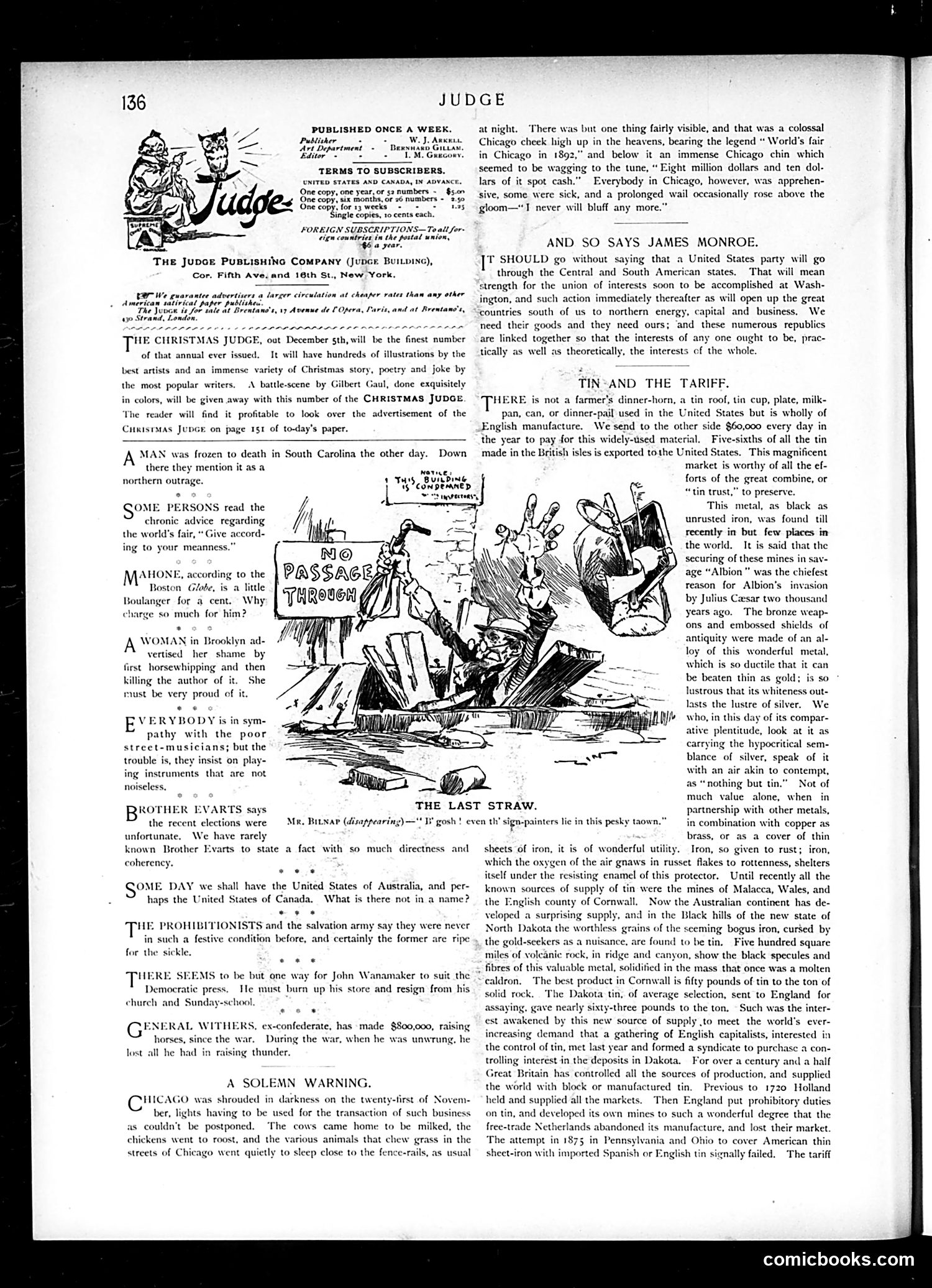
What you’re looking at
**Main Cartoon: "Passage Through"** This political cartoon depicts immigration/passage debate, likely from the 1890s-1900s era. A figure labeled "PASSAGE THROUGH" shows immigrants or cargo being transported, with crowded conditions and chaos. The reference to "passage" suggests debate over U.S. trade routes or immigrant transit rights. **"The Last Straw" Cartoon** Features Mr. Bulnap (appearing disheveled) with sign-painters, satirizing someone's tolerance wearing thin—a visual pun on "last straw." **Articles** The page contains essays on tin tariffs, tin mining in Australia/Dakota, and Britain's tin monopoly control—reflecting late-19th century trade debates and American industrial protectionism concerns. The overall page mixes political satire with economic commentary typical of Judge's editorial stance on tariffs and international trade.
📄 Transcribed text from this page (OCR, searchable)
Machine-transcribed from the original scan — historical spelling and the odd misread are preserved.
JUD PUBLISHED ONCE A WEEK. Publisher + + WJ. Amn. ‘Art Department ~~ Dexnash Gitras, Editor * 1. M. Guxcony. TERMS TO SUBSCRIBERS. UNITED STATES AXD CANADA, IN ADVANCE. One copy, one year, or s2 numbers = $5.07 ‘One copy, six months, or 26 numbers - "2.50 One copy, for 13 weeks 135 ingle copies, 10 cents each. FOREIGN SUBSCRIPTIONS—To alt for- cign countries in the postal union, Uudge- $6 a year. THE JuDGE PuBLiIsHING COMPANY (JuDGE Buitpinc), Fifth Ave. and 16th St., New York, Cor. vantee advertisers a larger circulatio irical paper publishes is The Juvcn is for tale at Brentano's, 17 Avenue de COpera, Paris, and at Brentano's, 490 Strand, London cheaper rates tha THE CHRISTMAS JU oat December sth, will be the finest number of that annual ever issued. It will have hundreds of illustrations by the best artists and an immense variety of Christmas story, poetry and joke by the most popular writers. in colors, will be given away with this number of the CHRISTMAS JUDGE. A\ battle-scene by Gilbert Gaul, done exquisitely ‘The reader will find it profitable to look over the advertisement of the Cumisestas Jupce on page 151 of to-day's paper. MAN was frozen to death in South Carolina the other day. there they mention it as a northern outrage. Down nove, 1 TH BUILDING 4 tS CONDEMNED OME PE chronic the world’s ing to your MAHONE, according to the Boston Globe, is a little Boulanger for a cent. Why arge so much for him? A WOMAN in Brooklyn ad- vertised her shame by first horsewhipping and then killing the author of it. She raust be very proud of it. . VERYBODY is in sym- pathy with the poor street-musicians; but the trouble is, they insist on play ing instruments that are not myPecteRs, RSONS read the advice regarding meanne! noiseless, BROTHER EVARTS says the recent elections were unfortunate. We have rarely known Brother coherency. a fact with so much directness and OME DAY we shall have the United States of Australia, and per- haps the United States of Canada. What is there not in a name? HE PROHIBITIONISTS and the salvation army say they were never in such a festive mn before, and certainly the former are for the sickle, condi pe HERE SEEMS to be but one way for John W: Democratic press. church and Sunda amaker to suit the He must burn up his store and resign from his school. ERAL WITHERS, ex- horses, since the war, lost all he had in. rai onfederate, has made $800,000, raising During the ing thunder. ‘ar, when he was unwrung, he A SOLEMN WARNING. HICAGO was shrouded in darkness on the twenty-first of Novem- ber, lights having to be used for the transaction of such business as couldn't be postponed. The cows came home t chickens went to roost, and the various streets of Chicago went quiet be milked, the nimals that chew grass in the y to sleep close to the fence-rails, as usual | he. THE LAST STRAW. Mr. Binnar (disappearing) —"' Is gosh ! even th’ sign-painters lie in this pesky taown,”” GE at night. There was but one thing fairly visible, and that was a colossal Chicago cheek high up in the heavens, bearing the legend “ World's fair in Chicago in 1892,” and below it an immense Chicago chin which seemed to be wagging to the tune, “Eight million dollars and ten dol- lars of it spot cash.” Everybody in Chicago, however, was apprehen- sive, some were sick, and a prolonged wail occasionally rose above the gloom—"I never will bluff any more.” AND SO SAYS JAMES MONROE. [™ SHOULD go without saying that a United States party will go through the Central and South American states, That will mean strength for the union of interests soon to be accomplished at Wash- ington, and such action immediately thereafter as will open up the great countries south of us to northern energy, capital and business. We need their goods and they need ours; ‘and these numerous republics are linked together so that the interests of any one ought to be, prac- tically as well as theoretically, the interests of the whole. TIN-AND THE TARIFF. HERE is not a farmer's dinner-horn, pan, can, or dinner-pail used in the United States but is wholly of English manufacture. We send to the other side $60,000 every day in the year to pay for this widely-used material, Five-sixths of all the tin made in the British isles is exported tothe United States. This magnificent market is worthy of all the ef- forts of the great combine, or “tin trust,” to preserve. This metal, as black as unrusted iron, was found till recently in but few places in the world, It is said that the securing of these mines in sav- age “Albion” was the chiefest reason for Albion's by Julius Caesar two thousand years ago. The bronze weap- ons and embossed shields of antiquity were made of an al- loy of this wonderful metal, which is so ductile that it can be beaten thin as gold lustrous that its whiteness out- lasts the lustre of silver. We who, in this day of its compar- ative plentitude, look at it as carrying the hypocritical sem- blance of silver, speak of it with an air akin to contempt, as “nothing but tin.” Not of much value alone, when in partnership with other metals, in combination with copper as brass, or as a cover of thin sheets of iron, it is of wonderful utility. Iron, so given to rust; iron, which the oxygen of the air gnaws in russet flakes to rottenness, shelters itself under the resisting enamel of this protector. Until recently all the known sources of supply of tin were the mines of Malacca, Wales, and the English county of Cornwall, Now the Australian continent has de- veloped a surprising supply, and in the Black hills of the new state of orth Dakota the worthless grains of the sceming bogus iron, cursed by the gold-seekers as a nuisance, are found to be tin, Five hundred square miles of voleanic rock, in ridge and canyon, show the black specules and fibres of this valuable metal, soliditied in the mass that once was a molten caldron. The best product in Cornwall is fifty pounds of tin to the ton of solid rock. ‘The Dakota tin, of average selection, sent to England for assaying, gave nearly sixty-three pounds to the ton, Such was the inter- est awakened by this new source of supply to meet the world’s ever- increasing demand that a gathering of English cap the control of tin, met last year and formed a syndic trolling interest in the deposits in Dakota. Great Britain has controlled all the sources of production, and supplied the world with block or manufactured tin. Previous to 1720 Holland held and supplied all the markets. Then England put prohibitory duties on tin, and developed its own mines to such a wonderful degree that the free-trade Netherlands abandoned i ‘The attempt in 1875 in Pennsyl sheet-iron with imported Spanish or tin roof, tin cup, plate, milk- invasion so sts, interested ir © to purchase a con- For over a century and a half 's manufacture, and lost their market. ania and Ohio to cover American tl English tin signally failed. in The tariff comicbooks.com