
A complete issue · 16 pages · 1885
Judge — September 19, 1885
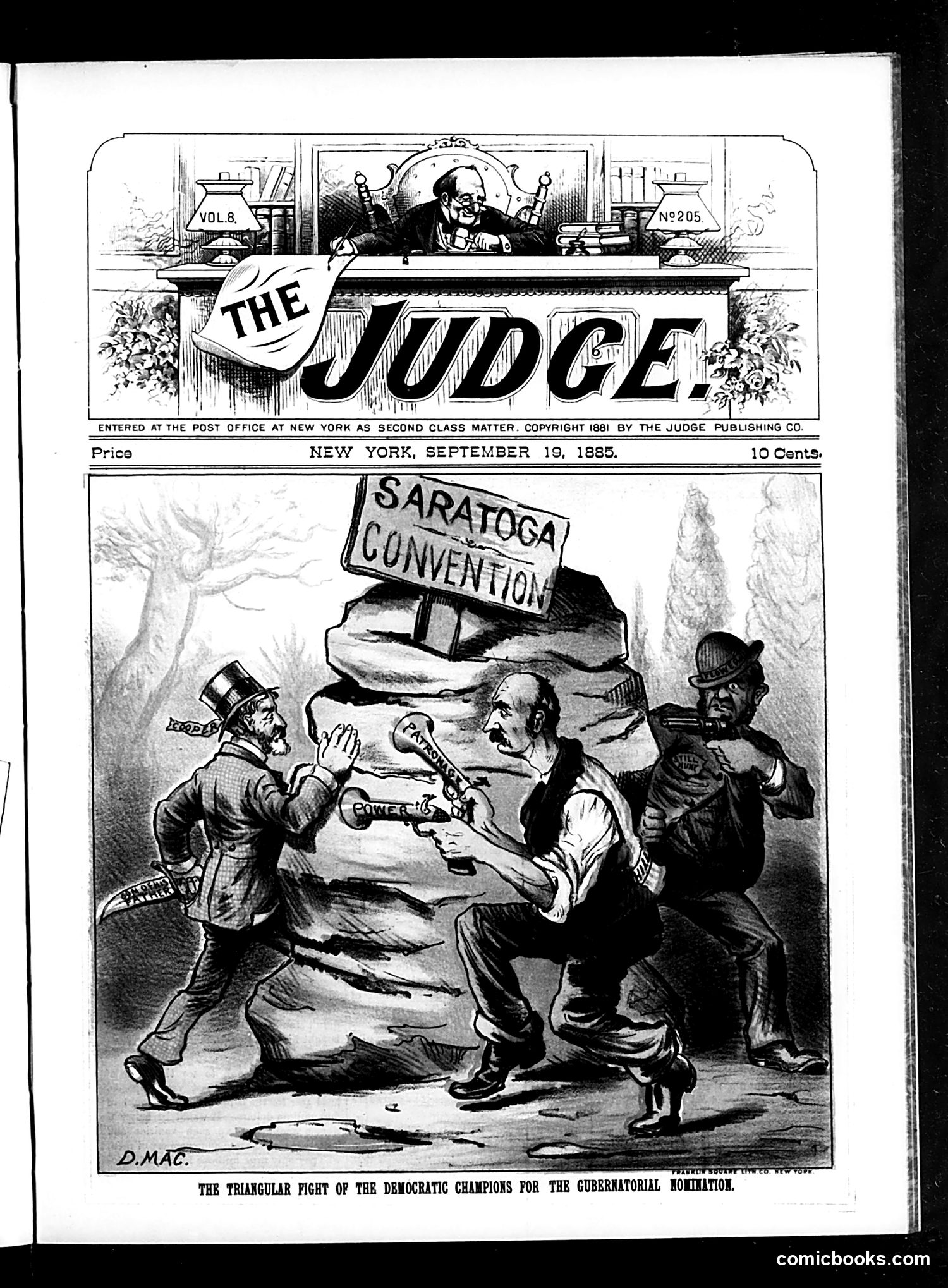
This 1885 *Judge* cartoon satirizes infighting among Democratic candidates competing for New York's gubernatorial nomination at the Saratoga Convention. Three men, labeled with "POWER," struggle over a large stone marked "SARATOGA CONVENTION" while a sign overhead identifies it as such. The "triangular fight" metaphor depicts the brutal internal struggle for the party's nomination. The cartoon suggests Democratic leaders were more focused on defeating each other than presenting a unified front. This reflects genuine 1880s Democratic Party divisions over patronage, ideology, and regional interests—a common satirical target for *Judge*, which frequently mocked political infighting and weakness.
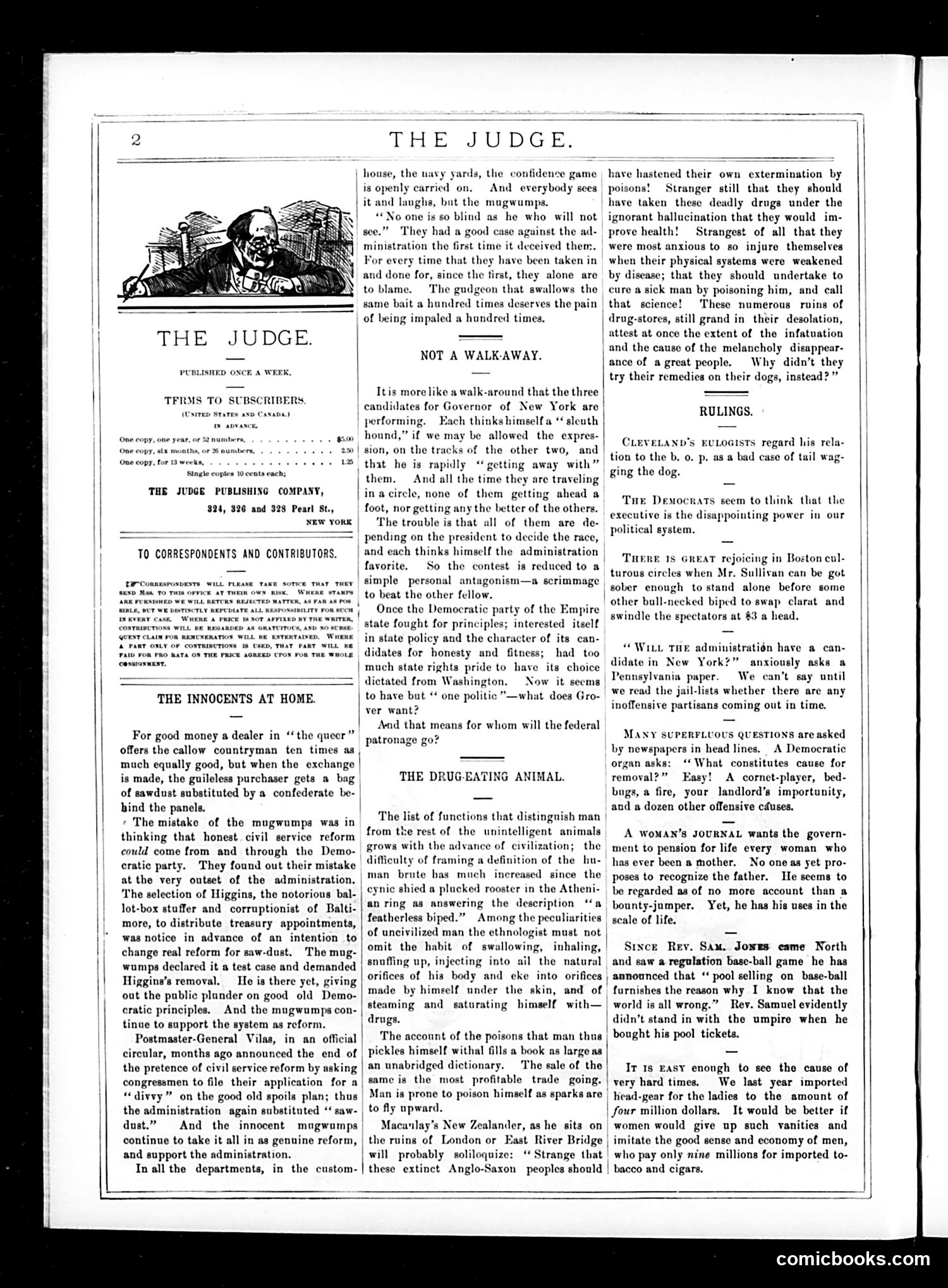
This page from *Judge* satirizes the **Mugwumps**—Republicans who defected to support Democrat Grover Cleveland's 1884 presidential campaign, believing he would enact genuine civil service reform. The main article, "The Innocents at Home," mocks the Mugwumps as gullible dupes. Cleveland's administration appointed known corrupt figures like Baltimore ballot-stuffer Higgins to distribute patronage jobs, directly contradicting reform promises. Yet the Mugwumps continued supporting Cleveland anyway—compared to a fish repeatedly swallowing the same baited hook. The secondary article critiques New York's three gubernatorial candidates as circular competitors dependent on Cleveland's federal patronage to win, reducing the race to personal antagonism rather than principle. The satire's core point: the Mugwumps were naive reformers fooled by a corrupt Democratic machine, their idealism exploited for votes while genuine reform died.
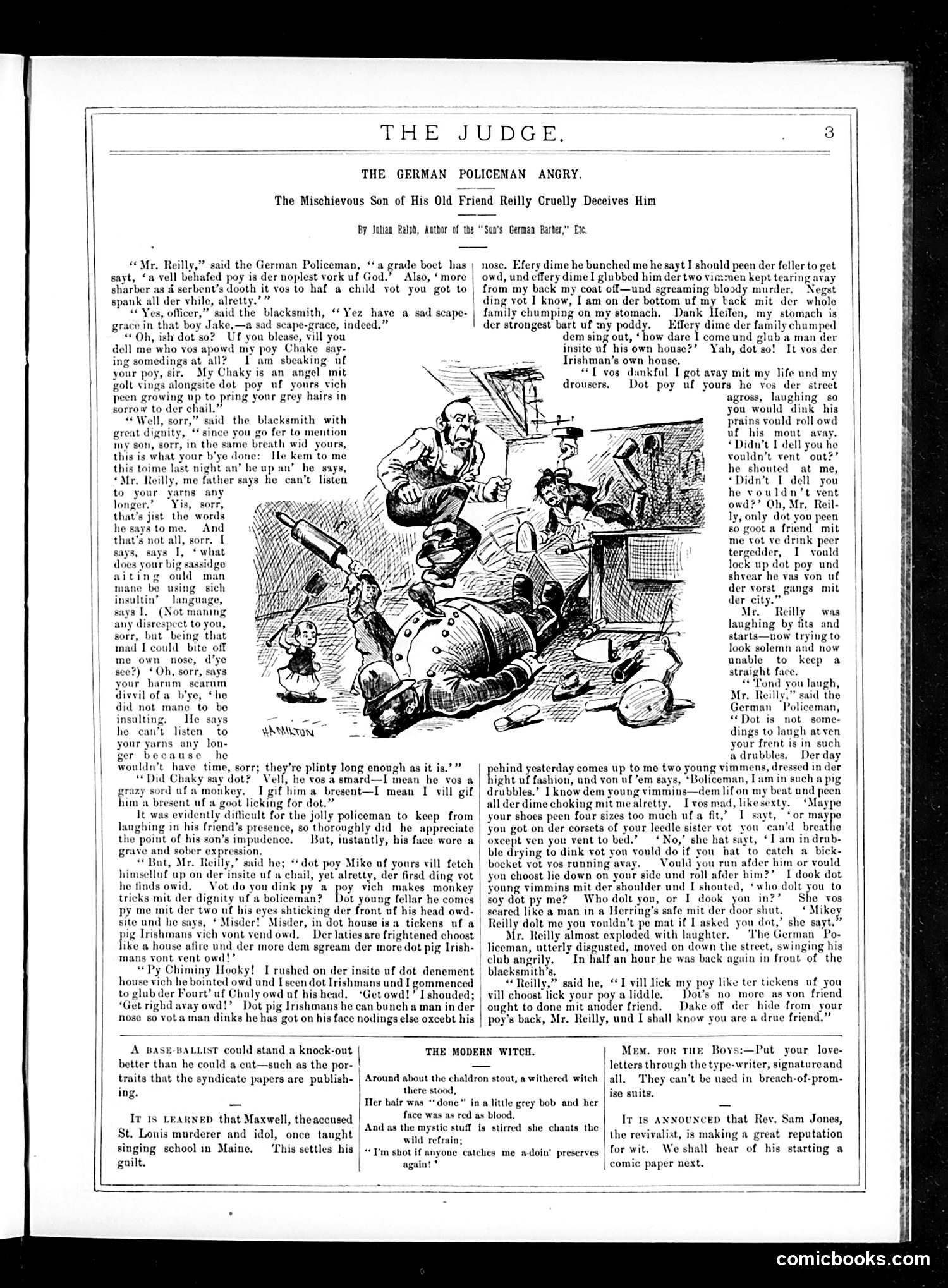
This satirical story by Julian Ralph mocks German immigrants and their accented English through a dispute between an Irish blacksmith named Reilly and a German policeman. The humor relies on ethnic stereotyping: the German officer's thick accent ("vell behafed poy," "serbent's dooth") contrasts with the Irish character's dialect. The plot involves their sons playing pranks—Reilly's boy insults the policeman's storytelling; the German's son spreads false rumors about Irish neighbors causing chaos. The satire targets both groups: the sanctimonious German policeman who lectures Reilly about child discipline while his own son misbehaves, and the reckless Irish tenants (including a pig farmer) who create mayhem. The cartoon depicts the violent melee that ensues when the policeman tries to intervene. This reflects late 19th/early 20th-century *Judge* magazine's frequent mockery of immigrant communities through exaggerated dialects and stereotypical behavior.
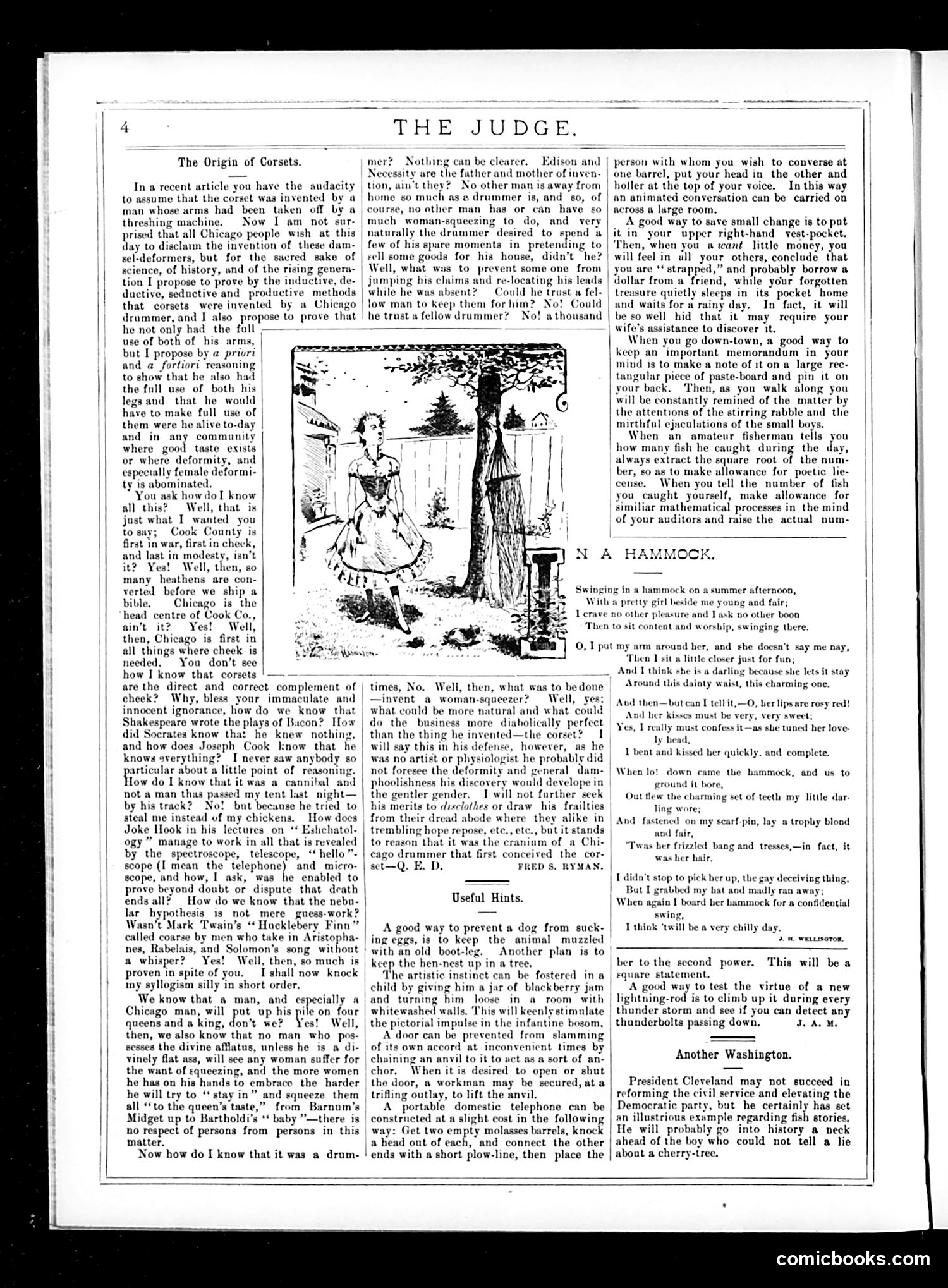
This page from *Judge* magazine contains a satirical letter defending the corset's invention against a previous article's claim. The writer humorously argues that a Chicago traveling salesman ("drummer") invented the corset—not out of malice, but from desperation to keep his female relatives from being "stolen" by rival salesmen while he traveled for work. The satire mocks both Chicago's reputation for aggressive commercialism and the absurd logic used to defend corsets as necessary "restraints" on women. The letter uses deliberately convoluted reasoning (invoking Socrates, Shakespeare, and Mark Twain) to satirize how people rationalize restricting women's bodies. The accompanying illustration shows a woman in a corset near a tree—a visual joke reinforcing the argument's ridiculousness. The piece critiques how society justified female corseting through pseudo-logical male reasoning, presenting the corset not as fashion but as a tool of male control disguised as protection.
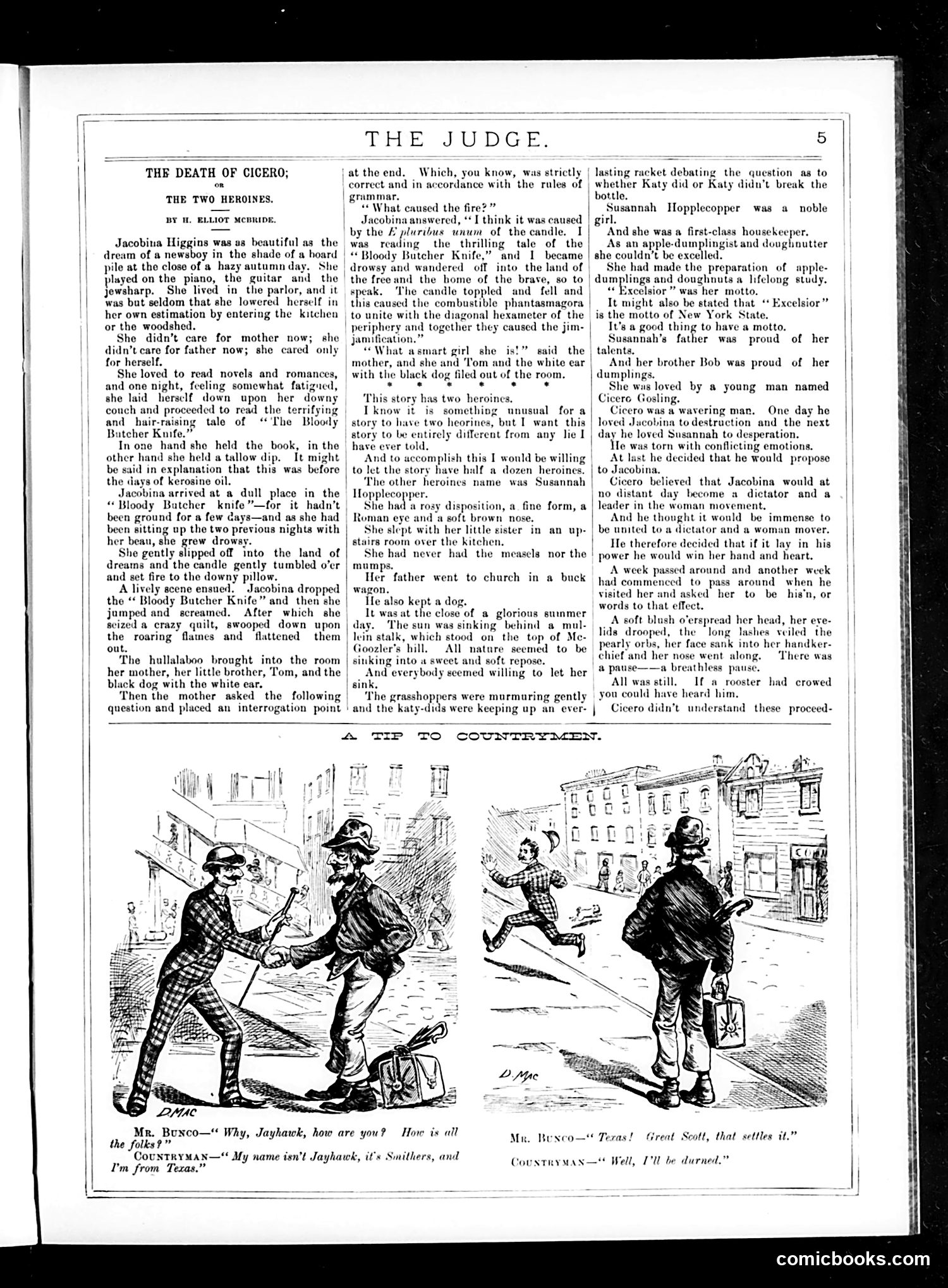
This is a satirical short story (not primarily a political cartoon) published in *Judge* magazine. The piece gently mocks Victorian literary conventions and female stereotypes of the era. **The satire targets:** - Flowery, overwrought romantic fiction ("the thrilling tale of 'The Bloody Butcher Knife'") - Jacobina Higgins, who represents the vapid, novel-obsessed "parlor girl" of genteel society—vain, disconnected from domestic reality, focused only on herself - Susannah Hopplecopper, the counterpoint: a devoted homemaker whose entire identity revolves around apple dumplings and "excelsior" (progress), yet somehow destined to become a "dictator" and "woman mover" **The joke:** The story ironically presents two supposedly heroic women—one frivolous and self-absorbed, the other defined solely by domestic competence—while commenting on confused expectations about women's roles in contemporary society. The absurdist grammar ("pluribus unum of the candle") adds comedic deadpan humor.
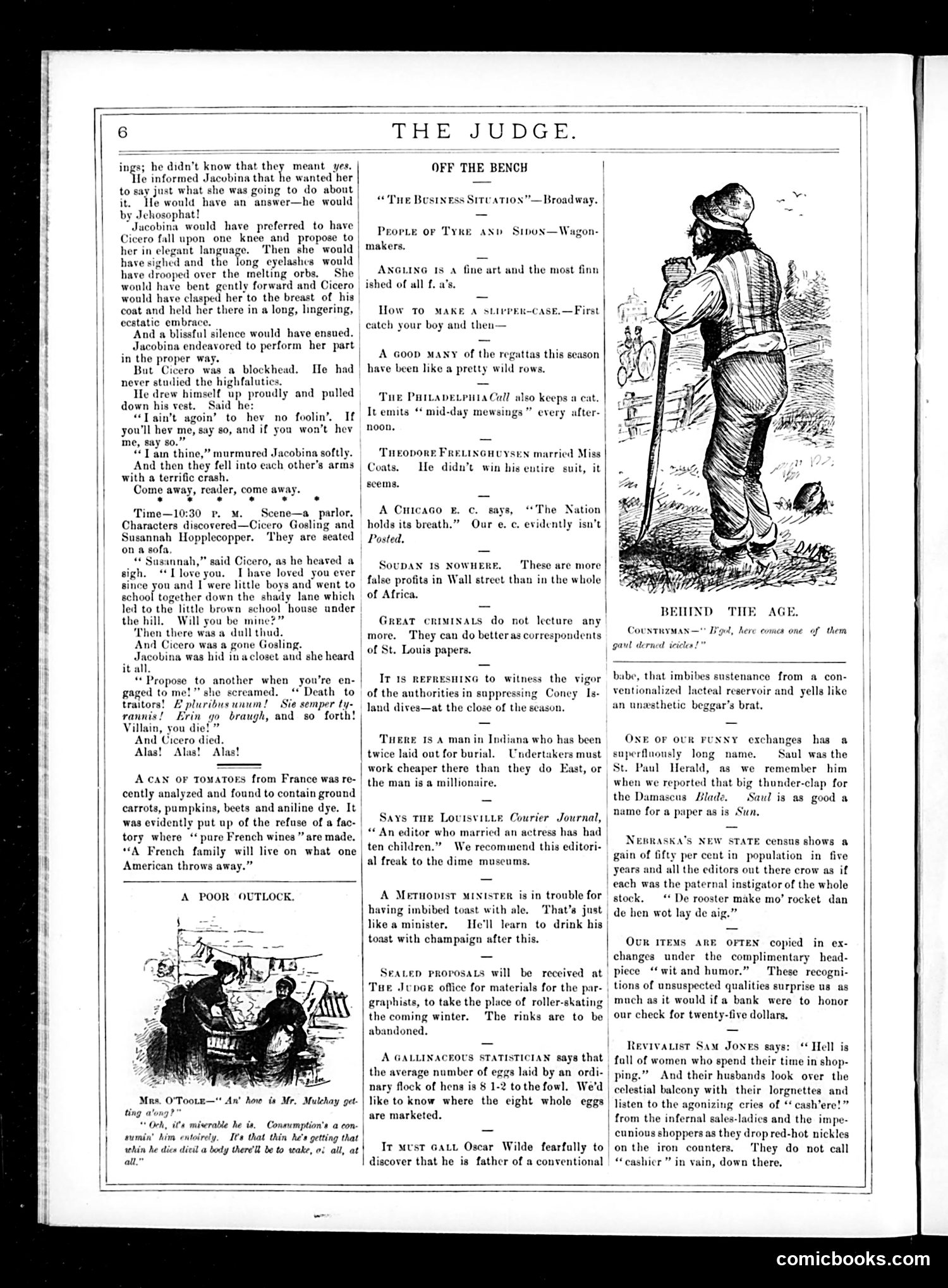
This page contains humor columns and brief satirical items typical of Judge's "filler" content. The main narrative describes a clumsy romantic proposal between characters named Cicero and Jacobina—satirizing overwrought Victorian courtship rituals. Cicero bumbles the romantic moment with crude directness ("If you'll hev me, say so"), disappointing Jacobina's expectations for elegant language and swooning. The "Off the Bench" section offers topical jabs: mocking French food adulteration, Wall Street profiteering, newspaper editorial absurdity (an editor with ten children by an actress), and ministerial hypocrisy (a Methodist minister drinking ale). The items mock contemporary social pretensions, commercial fraud, and religious inconsistency—standard Judge fare criticizing Gilded Age excess and humbug. The illustrations appear to be generic comic vignettes unrelated to specific political figures—focusing on social rather than political satire.
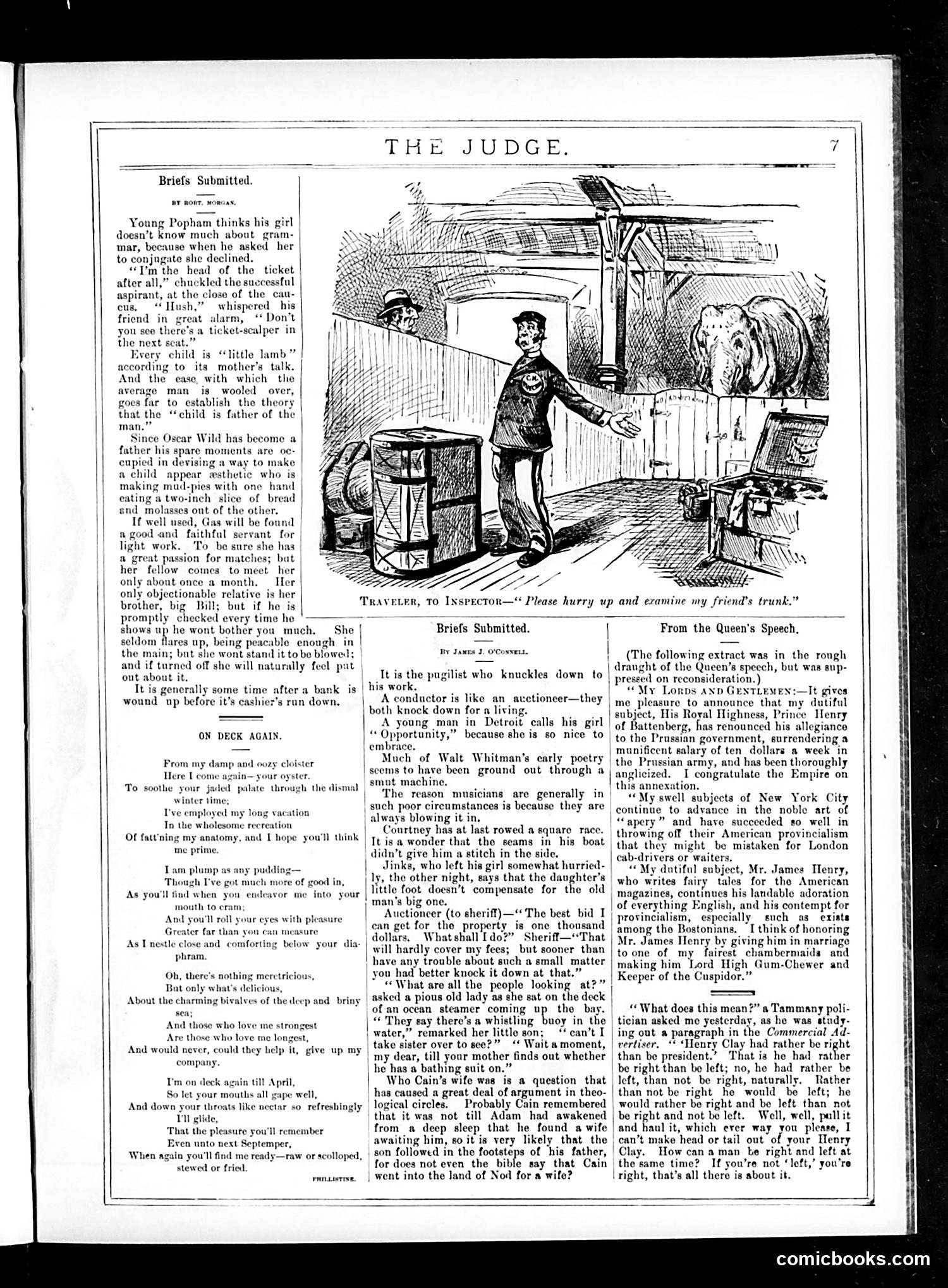
This page contains brief humorous anecdotes and a single cartoon satirizing petty bureaucracy. **The Cartoon:** A traveler asks an inspector to "examine my friend's trunk," depicting the tedious customs inspection process—a recurring annoyance for travelers. **"Briefs Submitted":** Short jokes on contemporary topics: - Young romance and grammar education - Oscar Wilde becoming a father (relevant: Wilde was a prominent public figure in the 1880s-90s) - Gas lighting as domestic servants - Oysters as seasonal delicacies (the poem celebrates their return "on deck again till April") - Puns on professions (pugilists, conductors, musicians, auctioneers) - References to local figures like rower Courtney **The Satire:** These pieces mock everyday American life—romantic mishaps, pretentious aestheticism (Wilde reference), domestic inconveniences, and social pretension. The humor is gentle wordplay rather than sharp political commentary, typical of Judge's lighter content alongside weightier satire elsewhere.
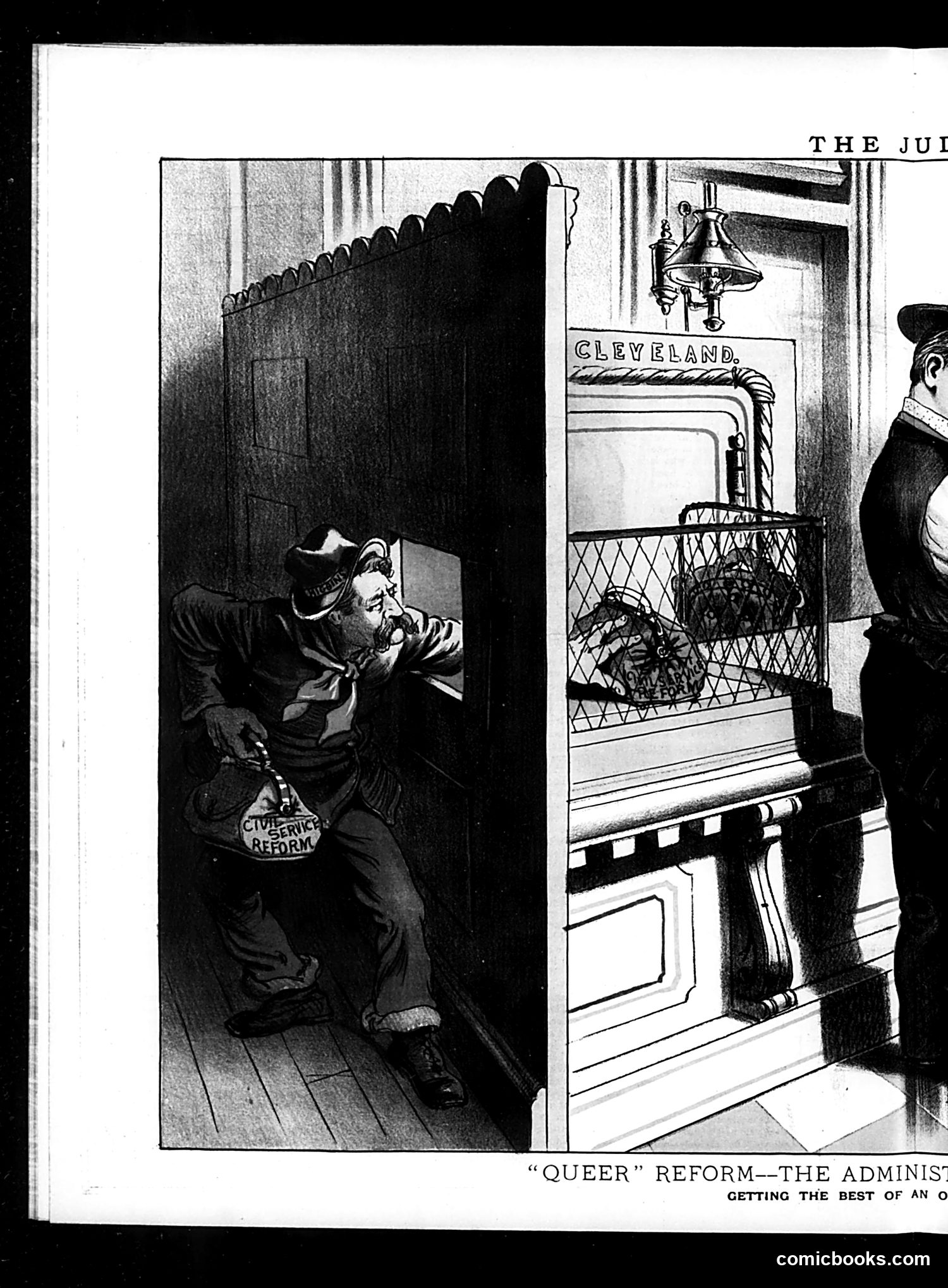
This political cartoon from *Judge* magazine satirizes Cleveland's administration's approach to civil service reform. The image shows a figure labeled "Civil Service Reform" crouching uncomfortably in a dark closet or confined space, while well-dressed officials stand outside near a Cleveland-branded fireplace. The title "Queer Reform—The Administration Getting the Best of an O[utcome]" suggests the cartoon mocks the administration's hollow commitment to reform—they publicly champion civil service reform while keeping it hidden away or marginalized in practice. The cramped, dark positioning of the "Reform" figure implies the administration pays only lip service to the cause while conducting business as usual. This appears to be critical commentary on President Grover Cleveland's actual reform efforts versus his rhetoric.
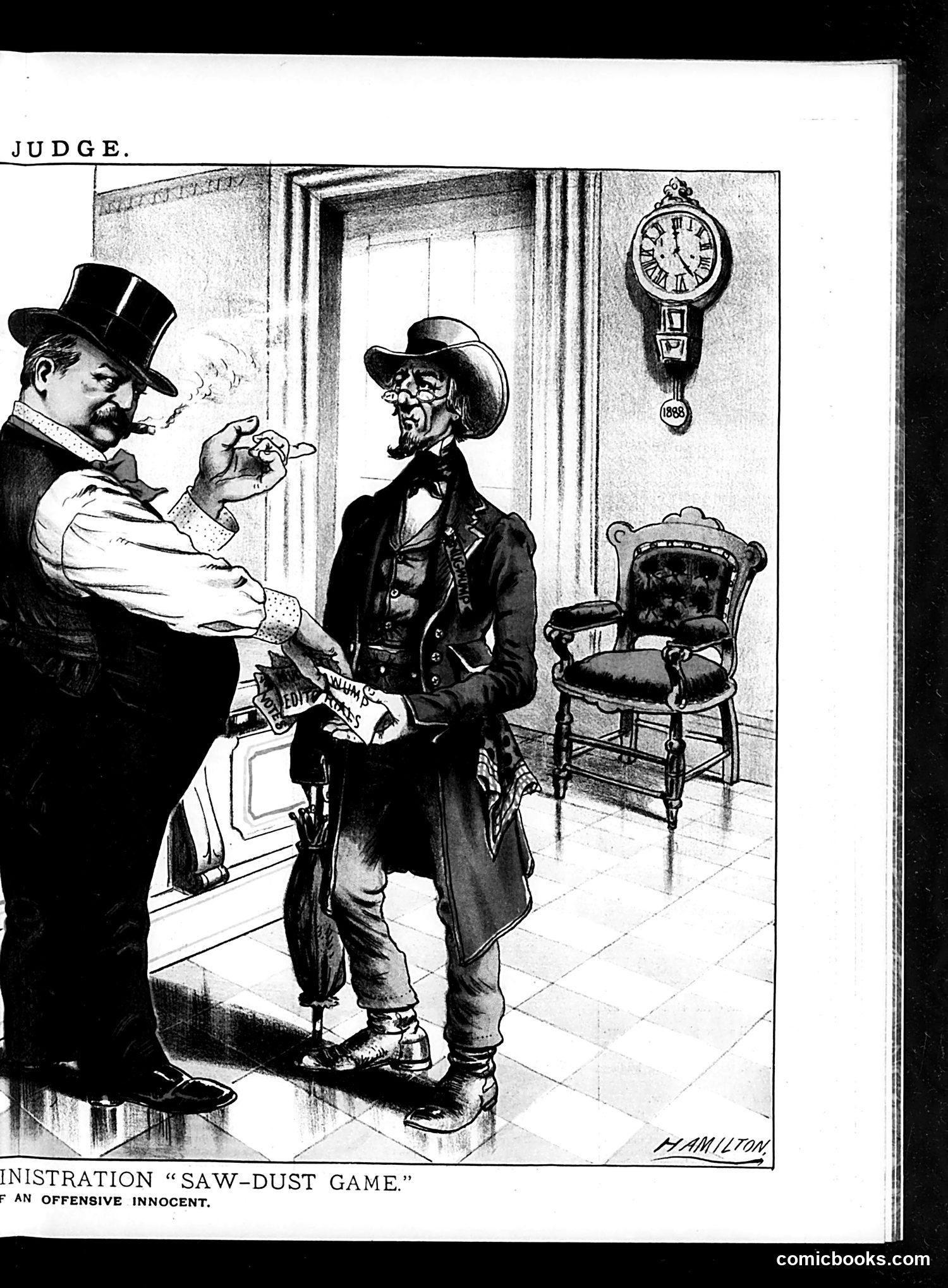
This cartoon satirizes an administrative official (left, in top hat) attempting to deceive a cowboy figure (center) through what's labeled a "saw-dust game"—a confidence trick involving deception. The judge figure on the wall suggests judicial authority is being manipulated. The "saw-dust game" appears to reference fraudulent practices within government administration, where officials use sleight-of-hand tactics to conceal wrongdoing while claiming innocence ("an offensive innocent"). The cowboy's skeptical expression suggests he sees through the deception. Though the specific administration and date aren't visible here, the cartoon critiques governmental corruption and the use of smoke-and-mirrors tactics to mislead the public. The signature reads "HAMILTON."
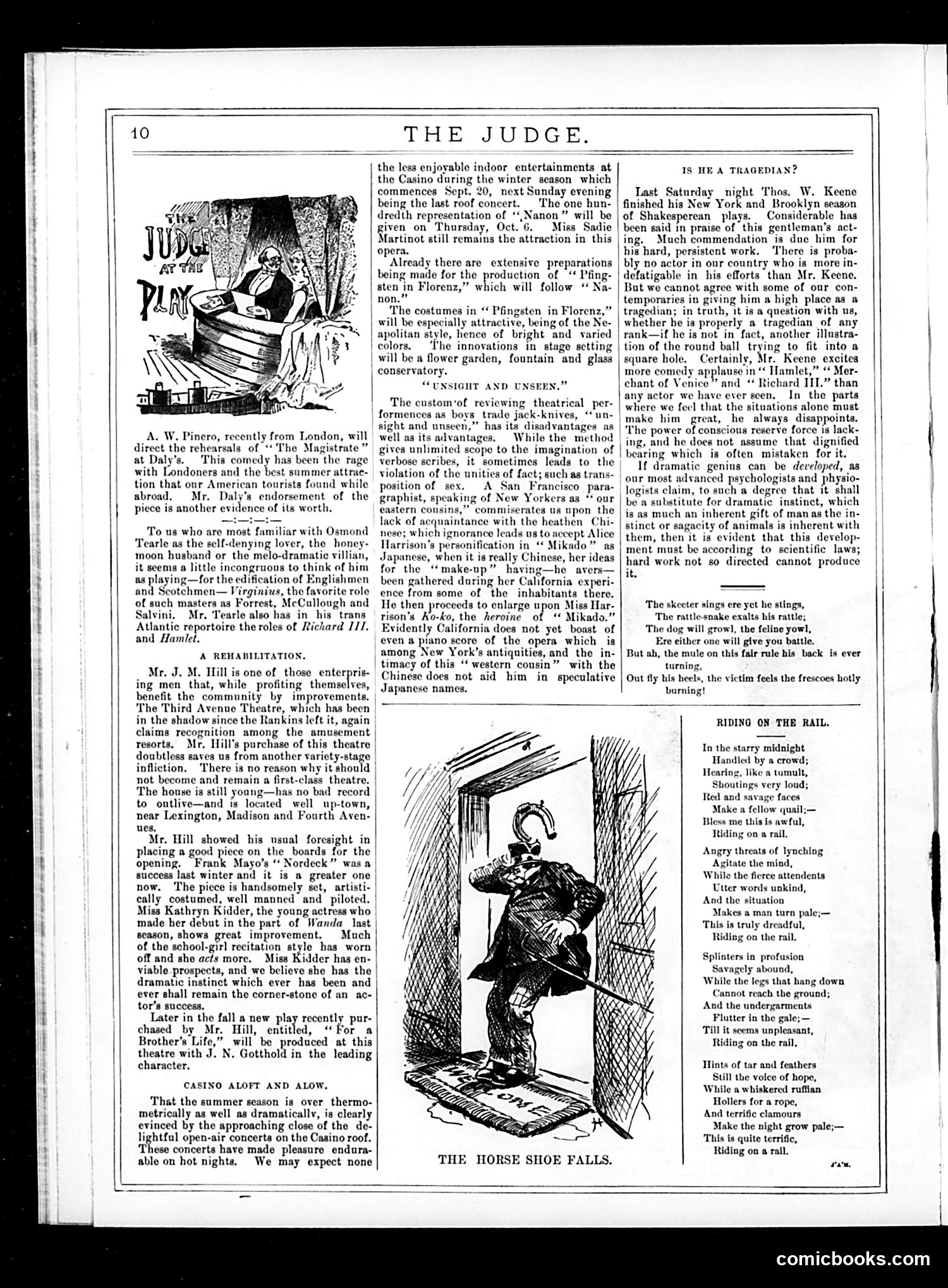
This page from *Judge* magazine contains theater reviews and commentary rather than political cartoons. The content discusses several theatrical productions and personalities of the period: **Main subjects covered:** - A.W. Pinero directing rehearsals of "The Magistrate" at Daly's Theatre - Actor Osmond Tearle taking on the role of Virginius - J.M. Hill's rehabilitation of the Third Avenue Theatre - Productions at the Casino, including "Nanon" and upcoming "Pfingsten in Florenz" - Critical commentary on theatrical reviewing practices **The illustrations** show a figure in period dress (likely theatrical) and a poem titled "Riding on the Rail" about a dangerous nighttime incident. The satirical tone typical of *Judge* appears in the critique of theater reviewers who write about performances "unsight and unseen" (without actually attending), and observations about theatrical casting and acting quality. This represents cultural commentary on 1880s New York theater rather than political satire.
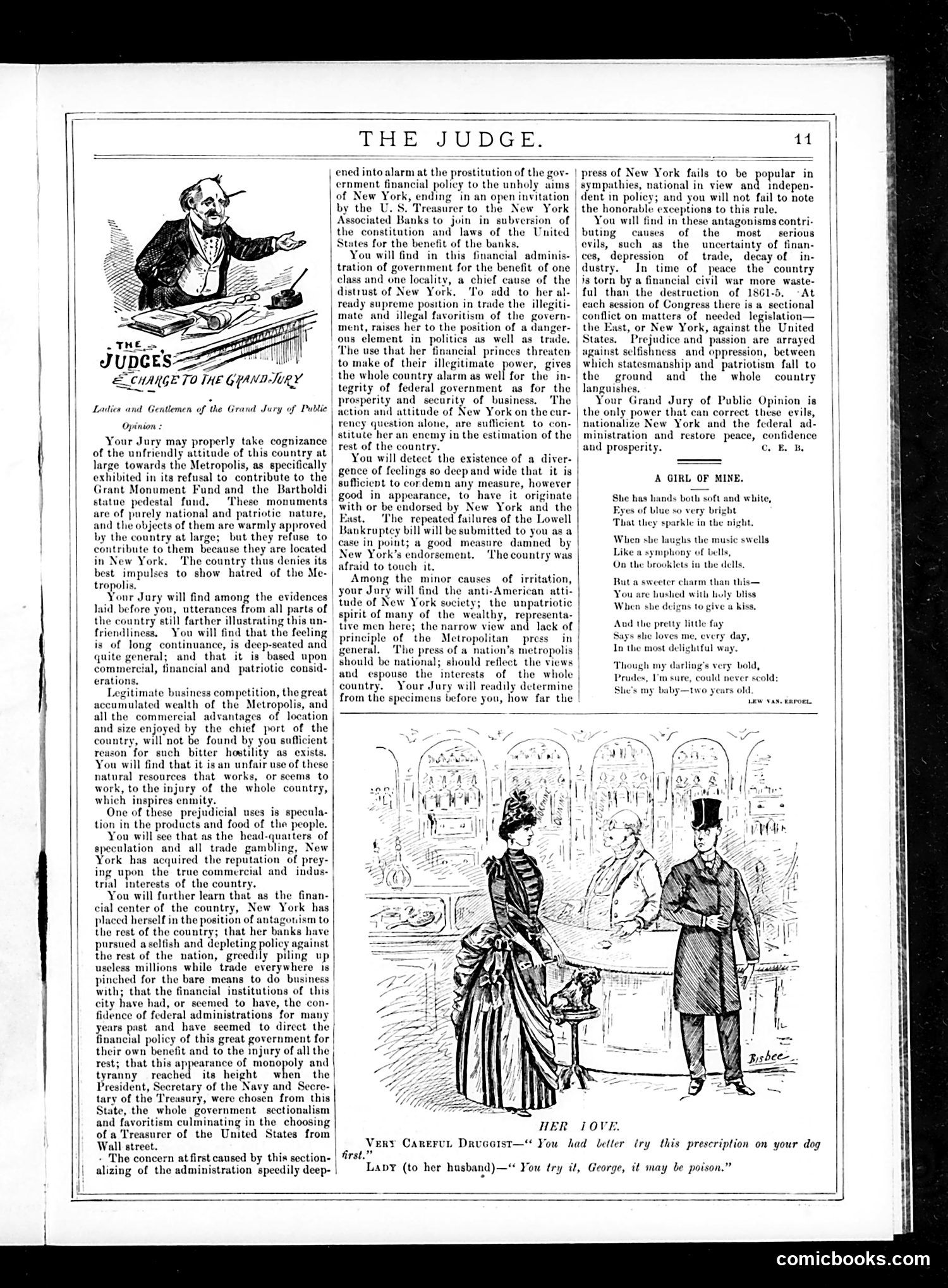
This editorial cartoon satirizes widespread American resentment of **New York City's financial and political dominance**. The "Judge" (depicted as a stern authority figure) addresses the "Grand Jury of Public Opinion," charging them to recognize New York's unfair advantages. The satire targets: - **Financial monopoly**: New York banks' control over national economic policy - **Speculation**: The city's reputation for commodity and trade gambling harming farmers and producers - **Political favoritism**: Accusations that Treasury Secretaries from Wall Street directed federal policy to benefit NYC banks over the nation - **Regional resentment**: The country's anger at funding monuments (Grant Monument, Bartholdi statue pedestal) located in New York while the city itself accumulates wealth through "illegitimate" federal favoritism The accompanying cartoon "Her Love" (bottom) shows a woman warning her husband about a love letter—likely a satirical jab at romantic or deceptive relationships, possibly paralleling the "seduction" of government by Wall Street interests. The piece reflects real 1880s-90s anti-Wall Street sentiment and regional tensions over financial power concentration.
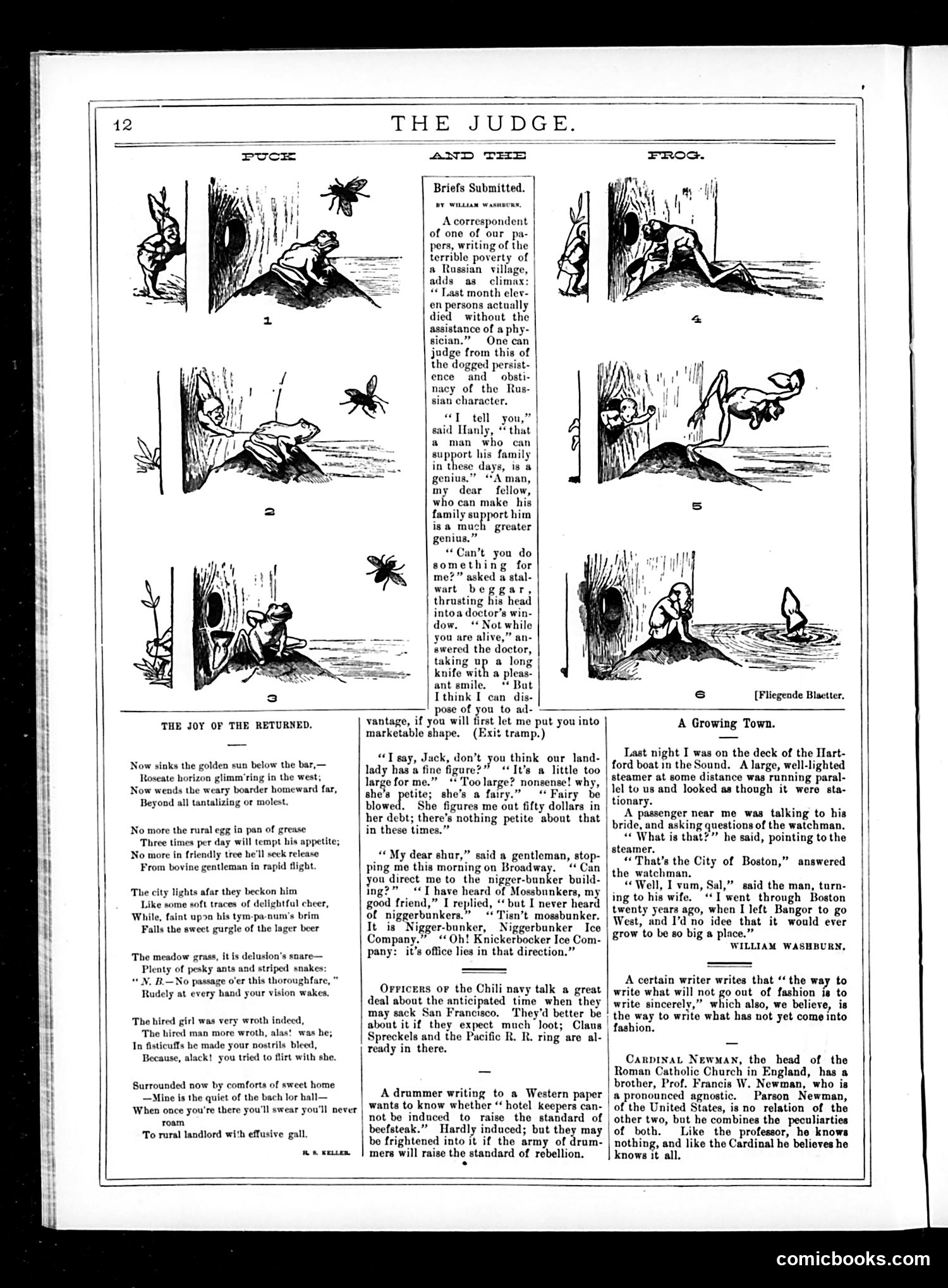
This page contains several brief satirical pieces typical of Judge magazine's humor. **"Briefs Submitted"** mocks Russian character through anecdotes about poverty and stubbornness. It includes jokes about supporting families during hard economic times and a darkly comic exchange between a beggar and doctor. **"The Joy of the Returned"** is a poem celebrating city life over rural boarding-house existence—mocking the discomforts of country living (greasy eggs, insects, aggressive hired help) while praising urban pleasures like beer and bachelor independence. **"A Growing Town"** humorously depicts a rustic tourist amazed that Boston—a city he visited decades ago—is now large enough to have a steamship named after it, suggesting rapid American urban growth. The cartoons (numbered 1-6) appear to illustrate "Puck and the Frog," though their specific narrative is unclear from this page alone. Other brief items mock landlady complaints and naval ambitions regarding San Francisco.
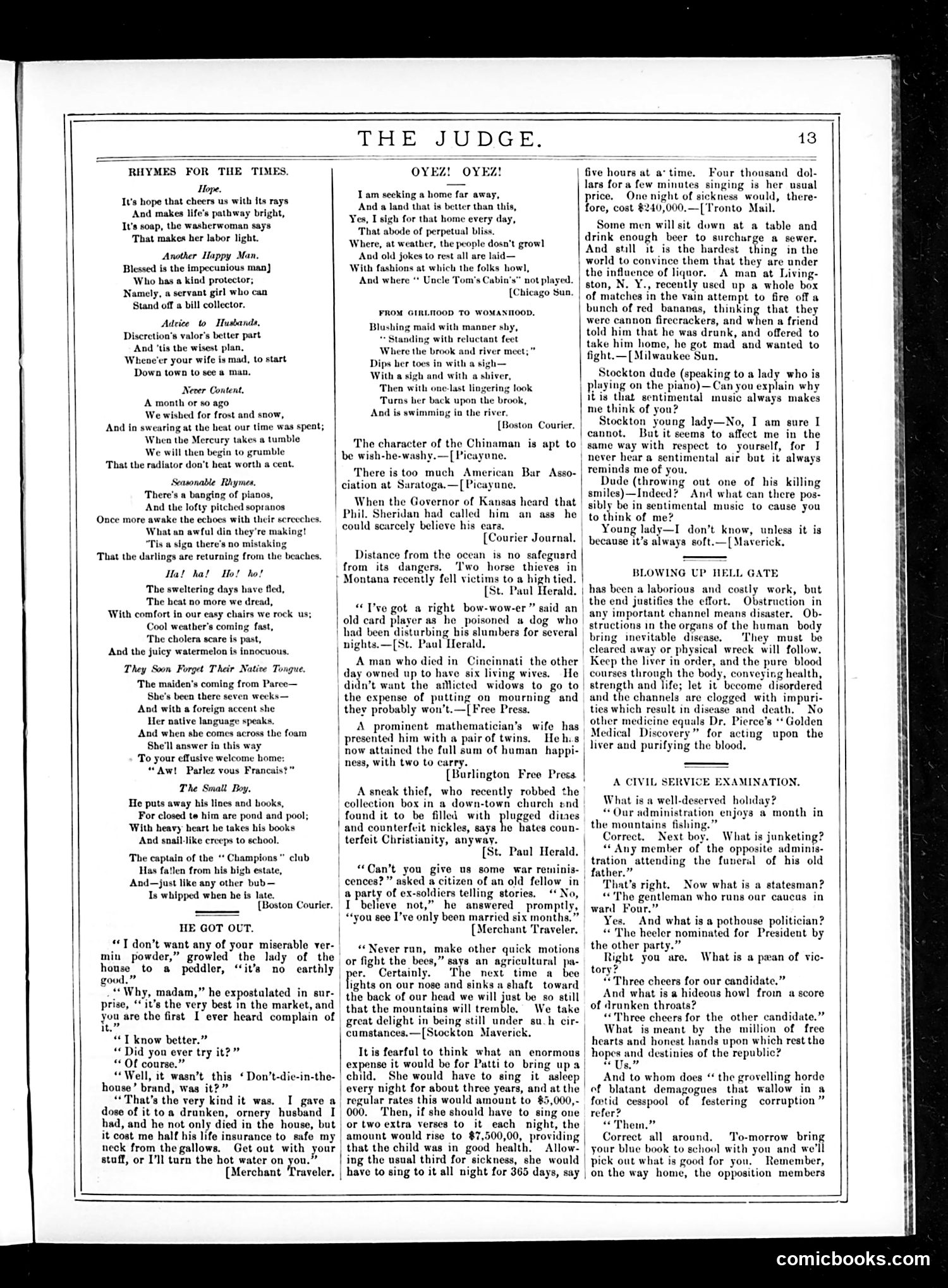
This is a satirical magazine page mixing humor, social commentary, and light verse typical of late 19th-century American humor journalism. **Key Content:** The "Rhymes for the Times" section offers gentle mockery of American life: complaints about weather (wanting snow, then complaining about heat), servants avoiding bill collectors, returning vacationers speaking affected French, and schoolboys dreading the end of summer. **Notable Satire:** "He Got Out" depicts a widow who murdered her abusive drunk husband using vermin poison—then avoided execution. The joke's dark humor plays on contemporary frustrations with domestic abuse and imperfect justice. The brief quips mock Chinese immigrants ("wish-he-washy"), excessive bar association formality, and other period concerns. **Overall Tone:** This represents Judge's formula: mixing domestic comedy, ethnic stereotypes (common then), and occasionally darker social critique—all aimed at educated, middle-class readers. The humor assumes familiarity with contemporary scandals and social anxieties but remains fundamentally conservative, never challenging fundamental power structures. The page lacks prominent political cartoons, focusing instead on verse and anecdotes.
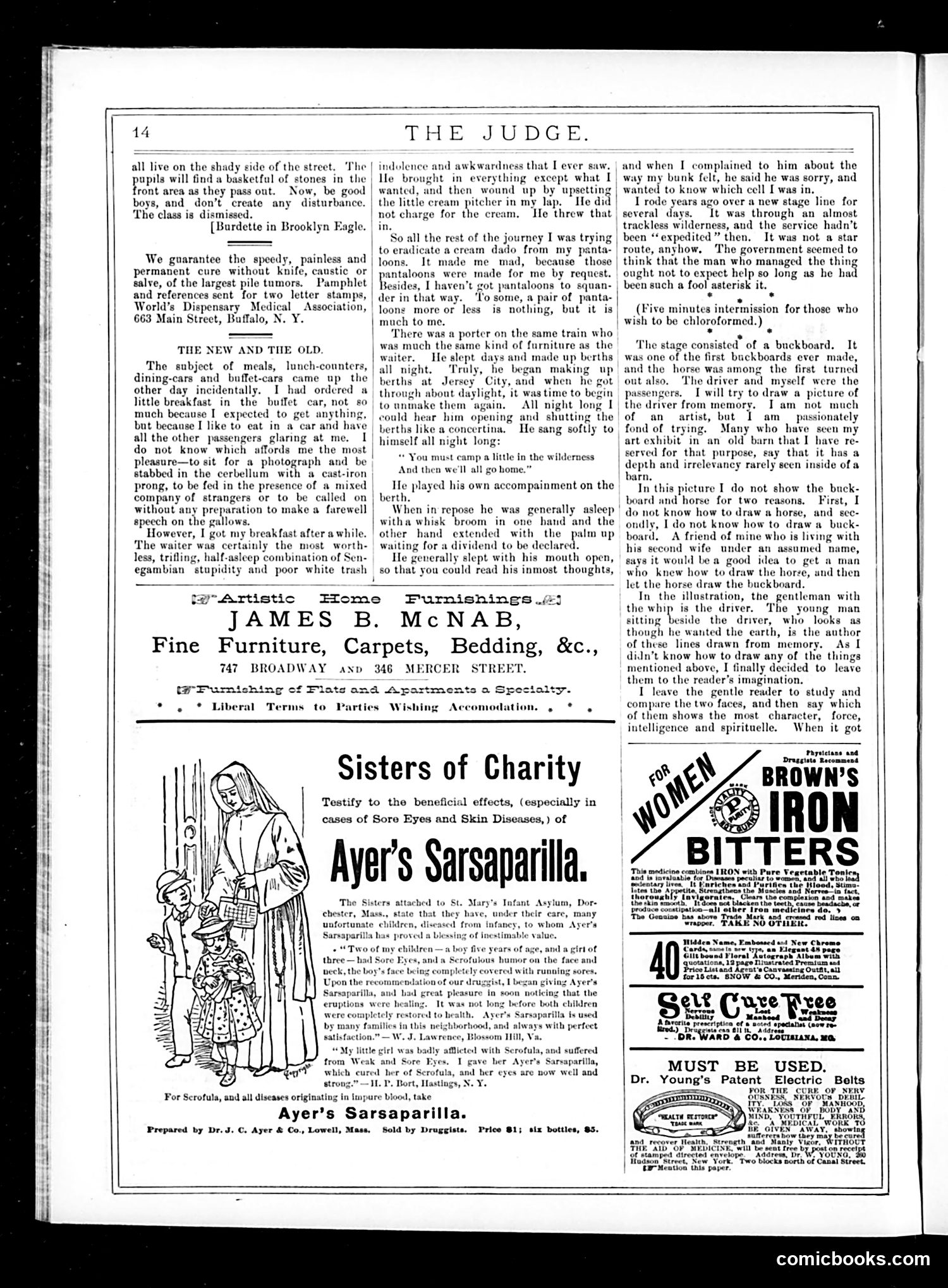
This page is primarily **advertising and serialized fiction** rather than political satire or cartoon commentary. The main text is a humorous essay titled "The New and the Old" by Burdette (from Brooklyn Eagle), satirizing **railroad travel in the late 19th century**. It mocks incompetent service workers—specifically a slovenly waiter and lazy porter—through exaggerated, unflattering racial and class stereotypes typical of the era. The author complains about ruined clothes and poor service with comedic hyperbole. The page is dominated by **period advertisements** for furniture (James B. McNab), patent medicines (Ayer's Sarsaparilla, Browns Iron Bitters, Dr. Young's Electric Belts), and other products. These ads use testimonials and medical claims common to the era. The single cartoon visible depicts **Sisters of Charity** endorsing Ayer's Sarsaparilla as a cure for skin diseases and sore eyes—a typical product endorsement advertisement rather than political satire. **No identifiable political figures or events** are referenced on this page.
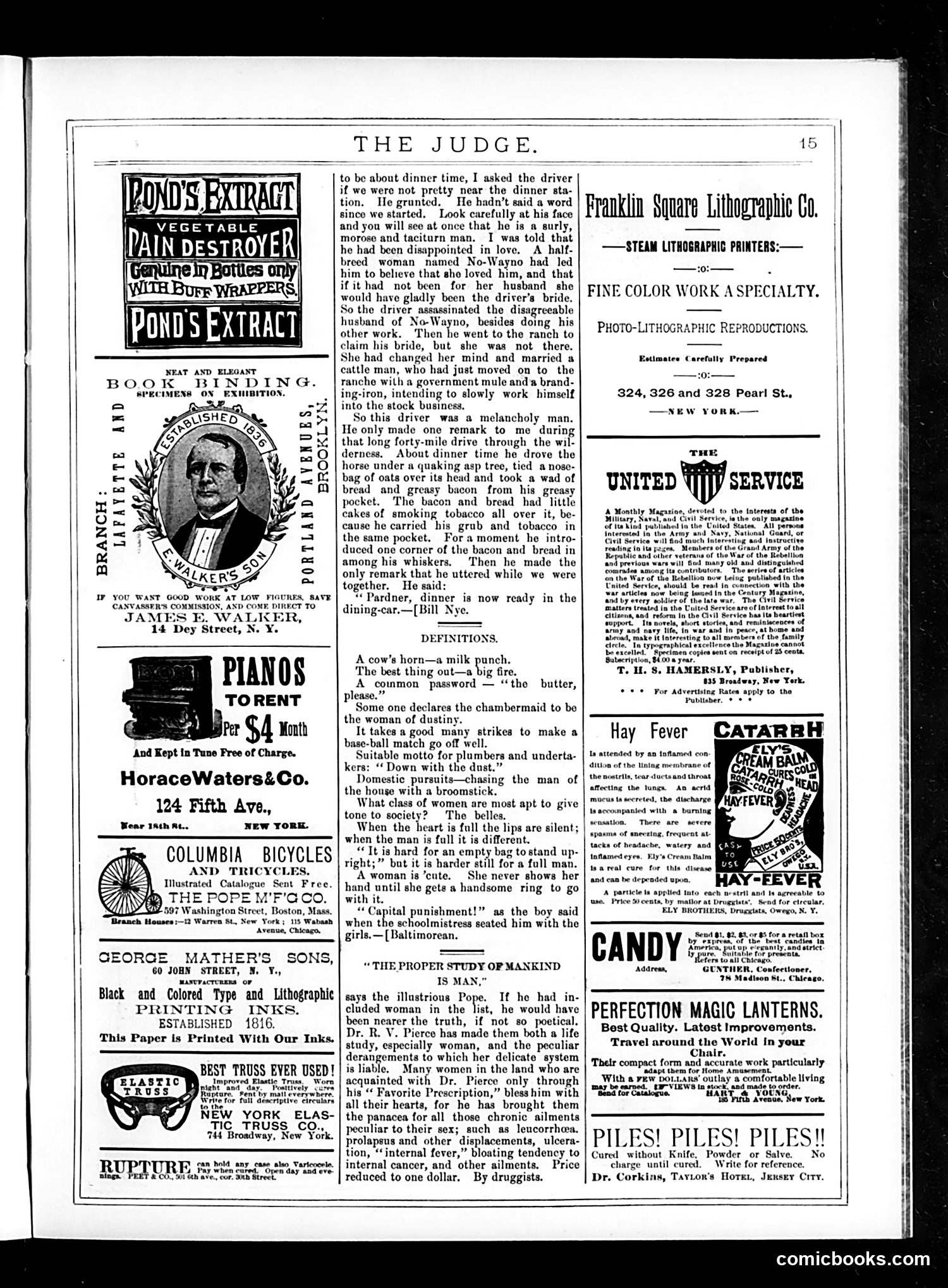
This page is primarily **advertisements and humorous content** rather than political satire. The main narrative is a story by **Bill Nye** (a popular humorist of the era) describing a melancholy stagecoach driver in the American West. **The Story's Context:** Nye recounts a 40-mile wilderness journey with a taciturn driver who had murdered a rival in a love triangle involving a "half-breed woman named No-Wayno." The driver's romantic rejection left him perpetually morose. The humor lies in Nye's deadpan observation of this melodramatic frontier tragedy—the driver's only utterance being an absurd non-sequitur about dinner being "ready in the dining-car" while eating tobacco-covered bacon under a tree. **The Satire:** Nye mocks Western frontier conventions: the violent jealousy, exotic love interests, and the juxtaposition of crude wilderness reality with civilized language ("dining-car"). The page also includes a "Definitions" section offering punny wordplay typical of Judge magazine's lighter humor. The surrounding **advertisements** (pianos, bicycles, medical devices, printing services) represent typical late-19th-century commercial concerns.
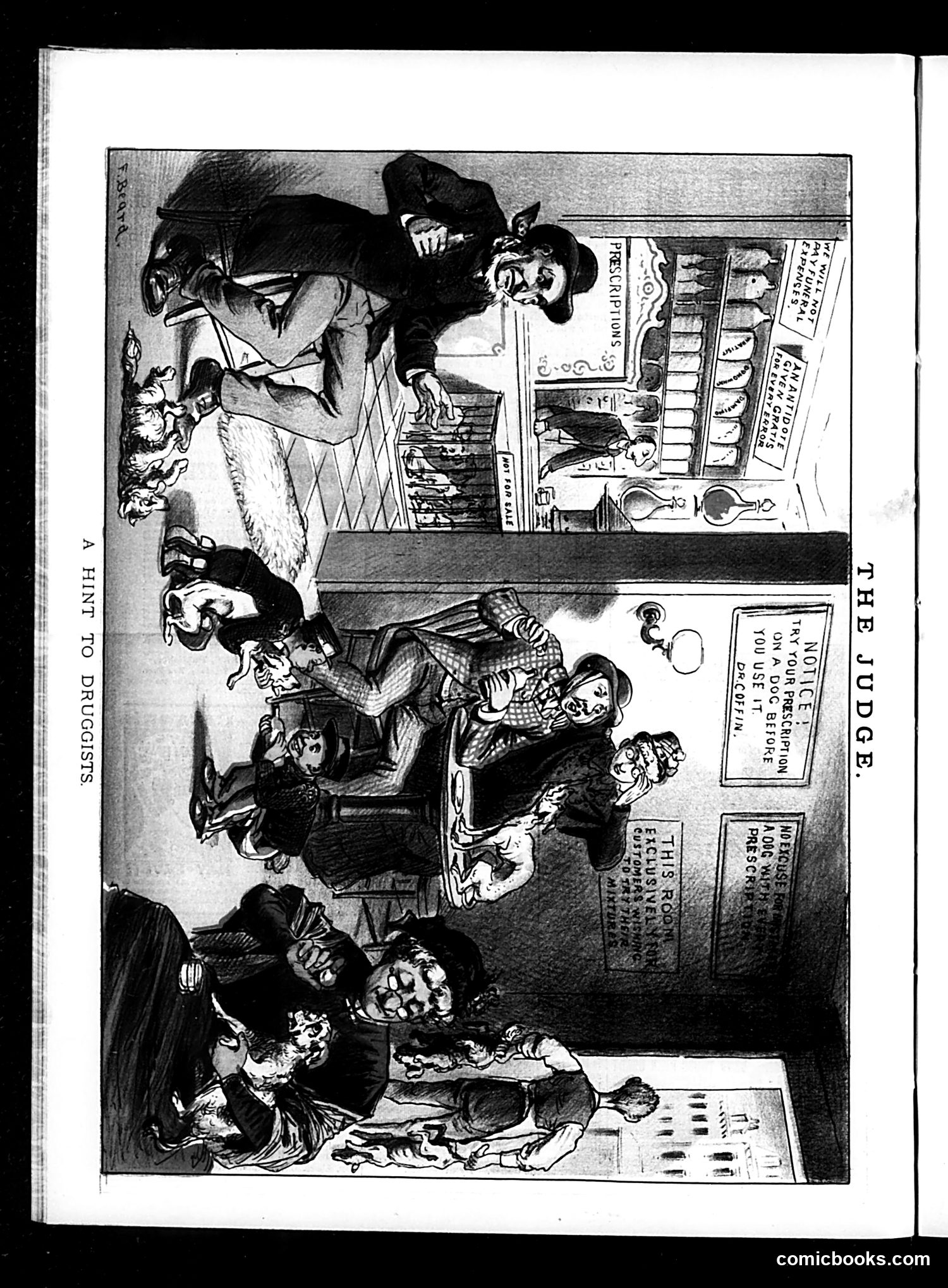
This satirical cartoon warns pharmacists to test prescriptions before dispensing them to patients. The image shows a chaotic drugstore scene where multiple figures—appearing to be a doctor, pharmacist, and customers—react with alarm to a medication's effects. The title "A Hint to Druggists" and the text "Try Your Prescription on a Doc Before You Use It" suggest the cartoon is criticizing either incompetent physicians who write dangerous prescriptions or pharmacists who fill them without verification. The character labeled "Dr. Coffin" (a dark pun on "death") emphasizes the potentially fatal consequences of filling untested or incorrectly written prescriptions. This reflects late-19th/early-20th-century concerns about medical and pharmaceutical safety before modern drug regulation existed.