
A complete issue · 16 pages · 1884
Judge — September 27, 1884
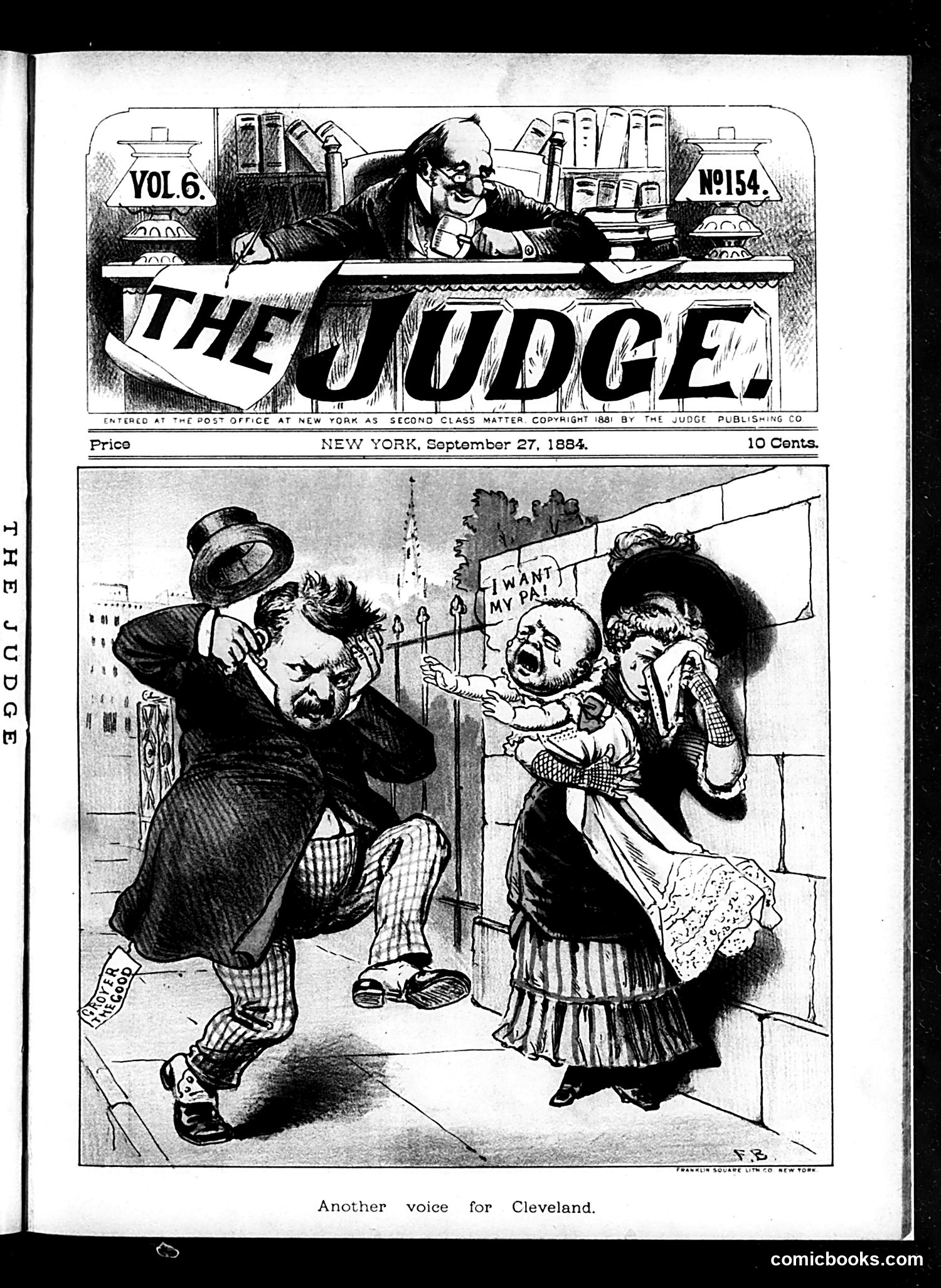
This is a political cartoon titled "Another voice for Cleveland," likely referencing Grover Cleveland's 1884 presidential campaign. The cartoon depicts a domestic scene where a man physically mistreats a woman holding a child, with a sign reading "I WANT MY PAL" visible in the background. The satire appears to attack Cleveland by associating him with domestic violence or moral corruption. This likely references contemporary scandals or criticisms leveled against Cleveland during his campaign. The "voice" reference suggests an endorsement or supporter—here portrayed as a disreputable figure—backing Cleveland. The caricatured style and exaggerated features were typical of 19th-century satirical political cartooning, used to delegitimize candidates through association with social vices.
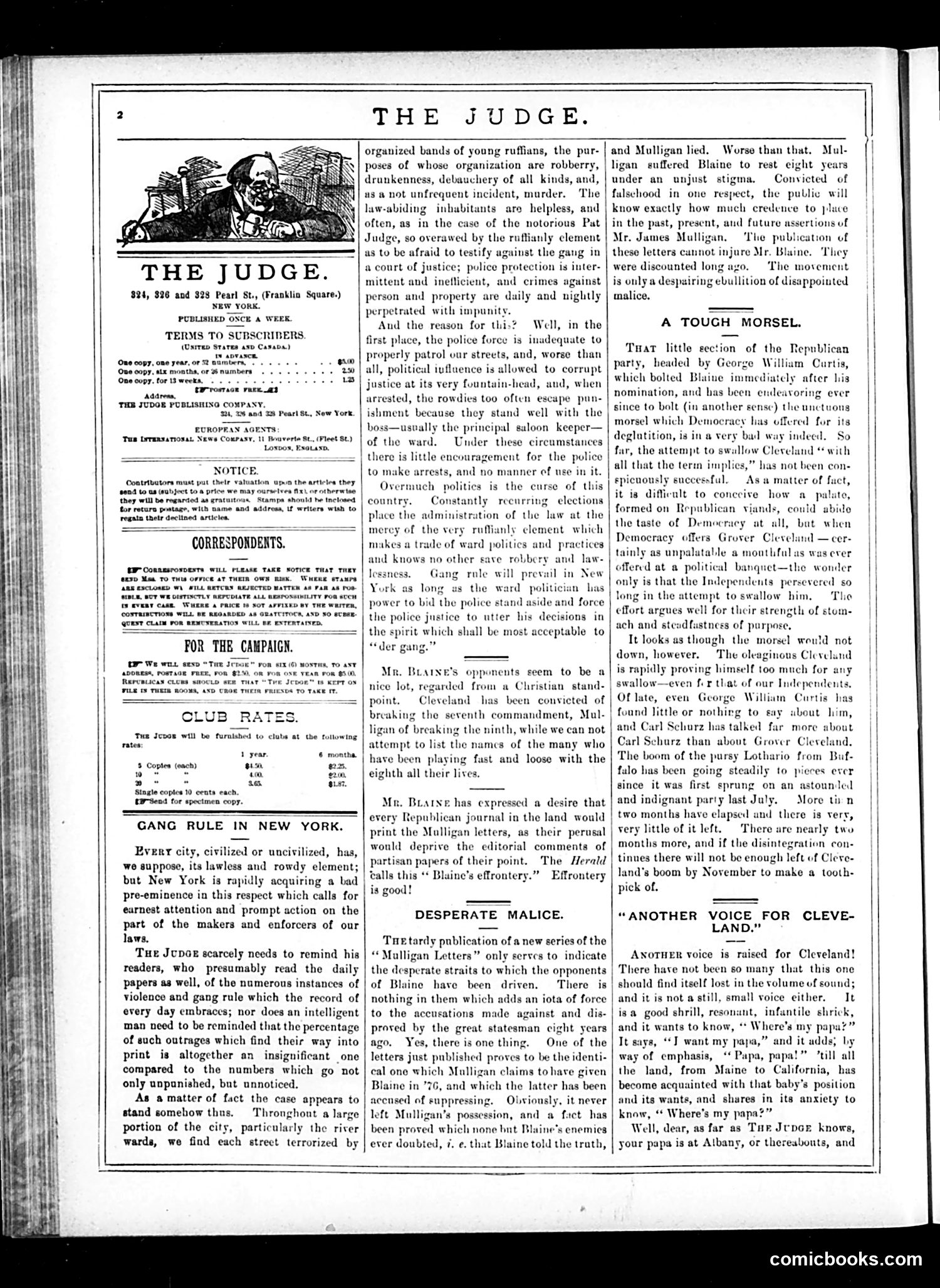
This page from *Judge* (a major American satirical weekly) addresses **gang violence in New York City**. The editorial argues that organized criminal gangs operate with impunity due to police inadequacy and **political corruption**—specifically, ward bosses (typically saloon keepers) protecting criminals who serve their political interests. The piece references a real case: **"Pat Judge,"** apparently a notorious gang leader whose victims were too intimidated to testify against him in court. The satire's target is the systemic problem: elected officials' control over law enforcement allows criminals to escape punishment through political patronage rather than justice. The editorial's solution is implicit: remove politics from policing. Without naming specific politicians, it condemns how ward politics enables gang rule—a common Progressive Era critique of machine politics in major cities. The page also contains subscription information and notices for contributors.
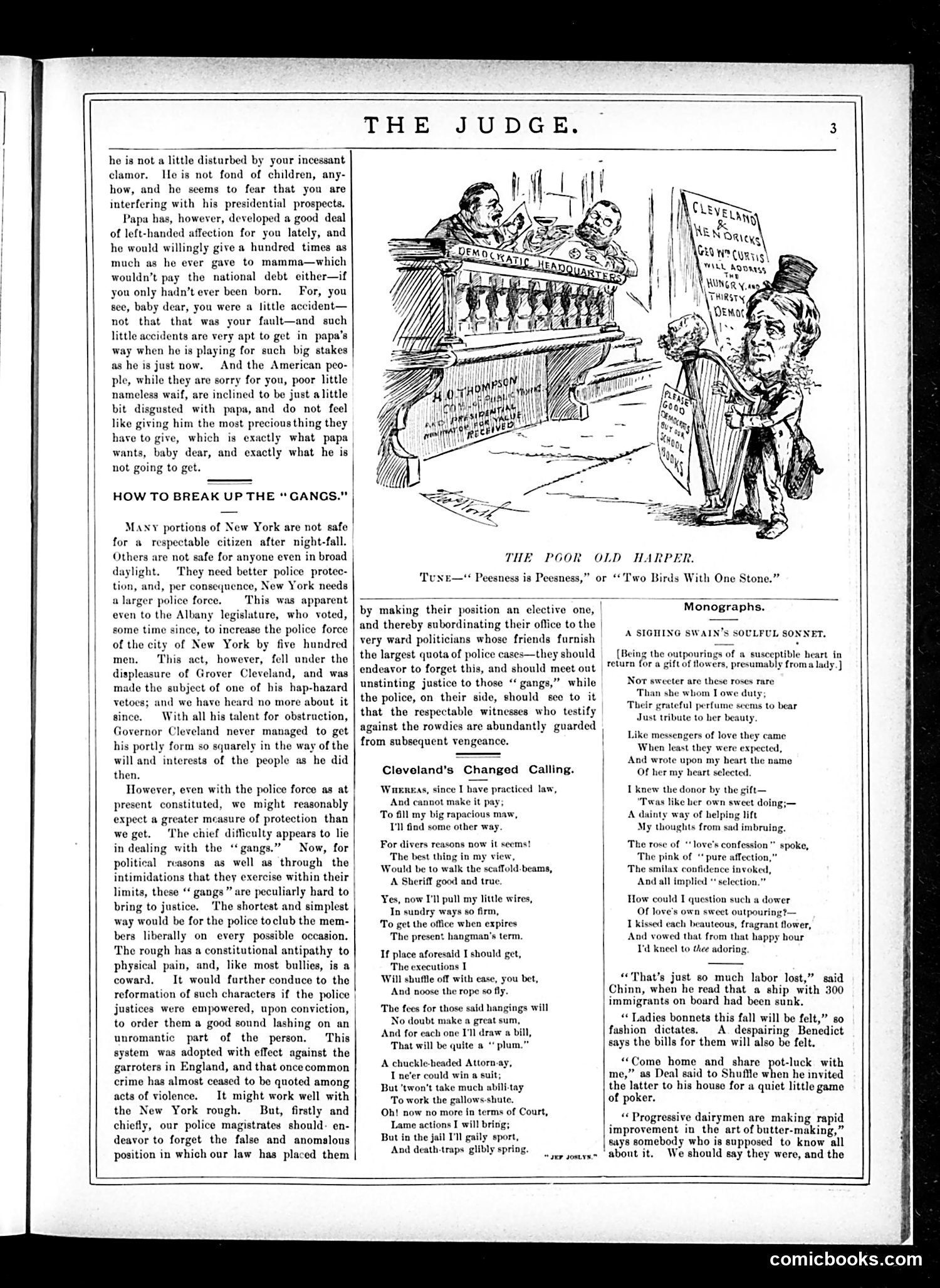
This page contains political satire targeting President **Grover Cleveland**. The main cartoon depicts Cleveland as "The Poor Old Harper" (a destitute figure), criticizing his veto of a bill to increase New York City's police force by 500 men. The text argues Cleveland obstructed the will of the people for political reasons, hamstringing efforts to combat street gangs and crime. The accompanying articles propose tough policing solutions—club gang members and impose floggings—while attacking Cleveland's political obstruction. A secondary piece titled "Cleveland's Changed Calling" sarcastically suggests Cleveland, unable to make his law practice pay, has turned to politics as an alternative income source. The satire portrays Cleveland as an obstacle to public safety and characterizes his political interference as self-interested obstruction rather than principled governance. The imagery and tone are decidedly hostile to the President.
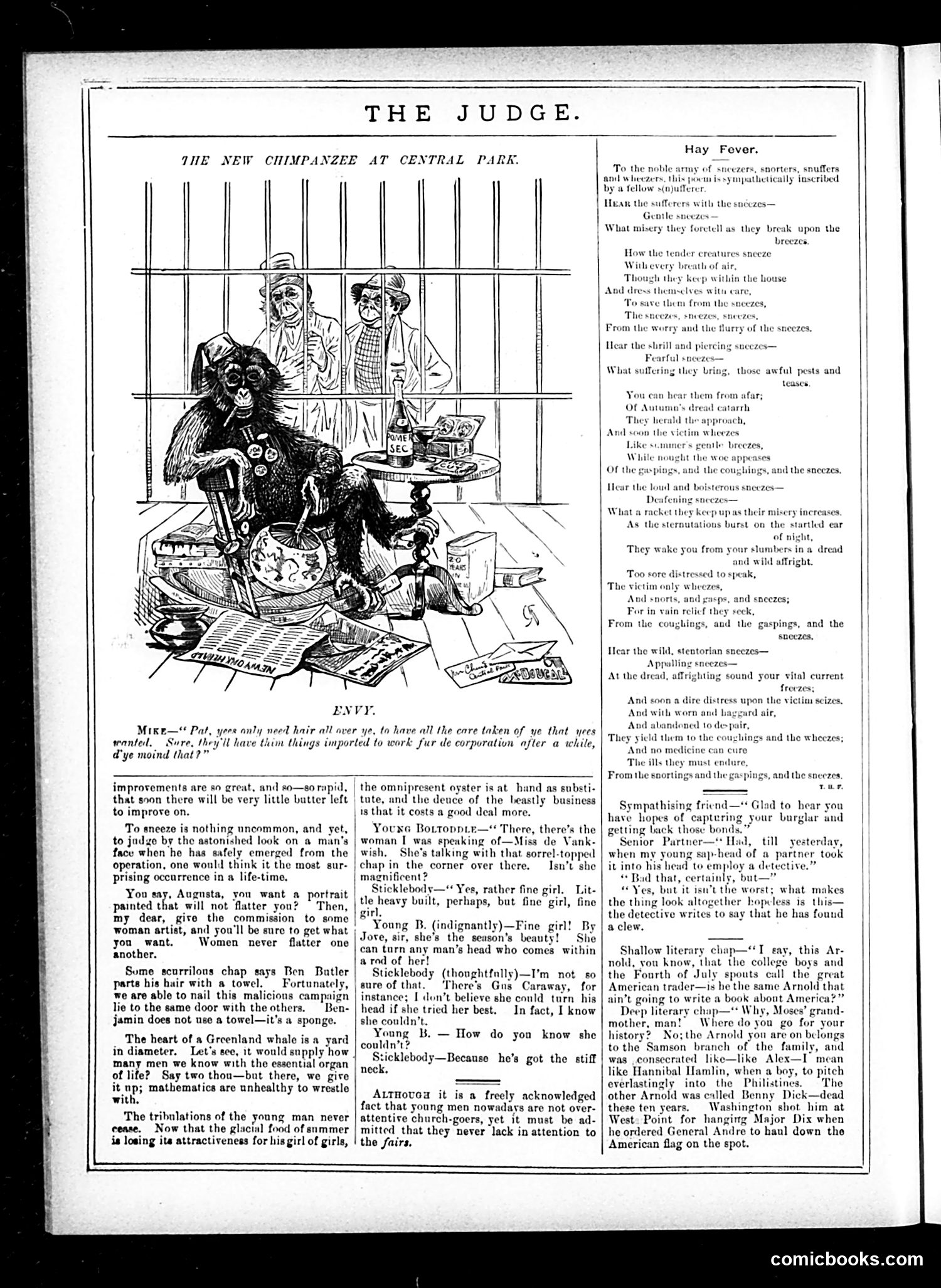
This page satirizes the public's fascination with a newly arrived chimpanzee at Central Park Zoo. The main cartoon shows the chimp being treated with more careful attention and amenities than poor immigrant laborers receive—a pointed commentary on class inequality in Gilded Age New York. The dialogue between working-class characters ("Mike" and "Pat") emphasizes the absurdity: they joke that the corporation will eventually import exotic creatures to replace human workers for dangerous jobs, suggesting anxiety about immigrant labor displacement and industrial exploitation. The satirical text snippets mock various contemporary social pretensions—vain women, young men obsessed with romance, and the fashionable concern with hay fever among the wealthy elite. The humor works on multiple levels: mocking both the public's zoo-going enthusiasm and broader anxieties about immigration, labor, and class in 1880s America. The chimp becomes a mirror reflecting society's own priorities and prejudices.
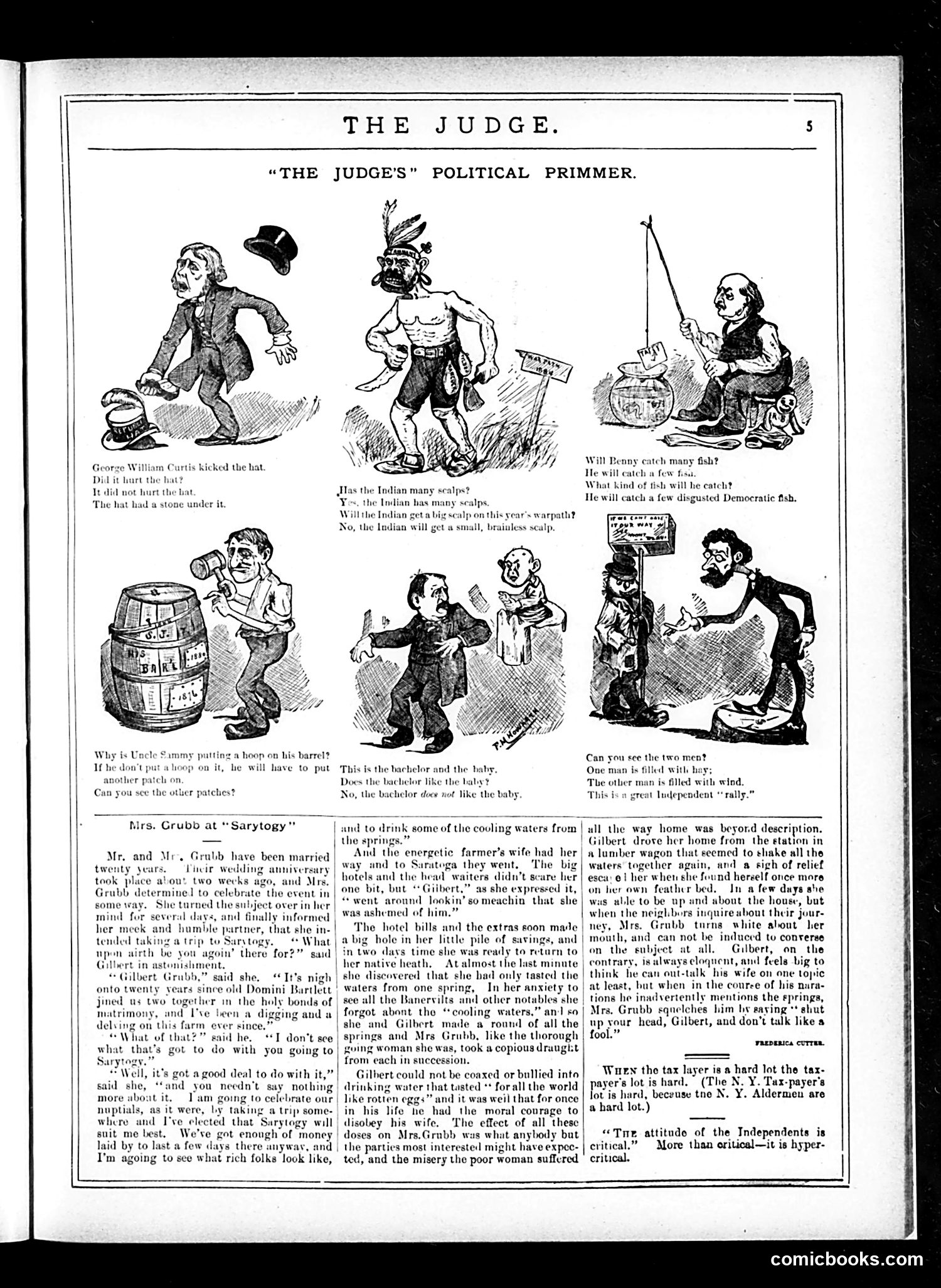
This page presents a mock educational primer using crude political cartoons and caricatures to ridicule American politics and public figures of the era. The "lessons" use absurdist humor to critique contemporary political issues. The illustrations appear to mock various political figures and movements: one caricature seems to reference Native American policy ("the Indian"), another depicts what's labeled a "Democratic fish," and others show figures filled with "hay" and "wind"—suggesting empty rhetoric. The "Independent rally" panel mocks independent political movements as insubstantial. The accompanying story about Mrs. Grubb's Saratoga Springs trip is pure domestic humor with no apparent political content, likely included as filler. Without identifying specific historical figures or dates from the text alone, the cartoons clearly use crude visual satire and ethnic caricature typical of late-19th-century American political magazines to mock Democrats, Republicans, and independent movements through exaggerated, dehumanizing depictions.
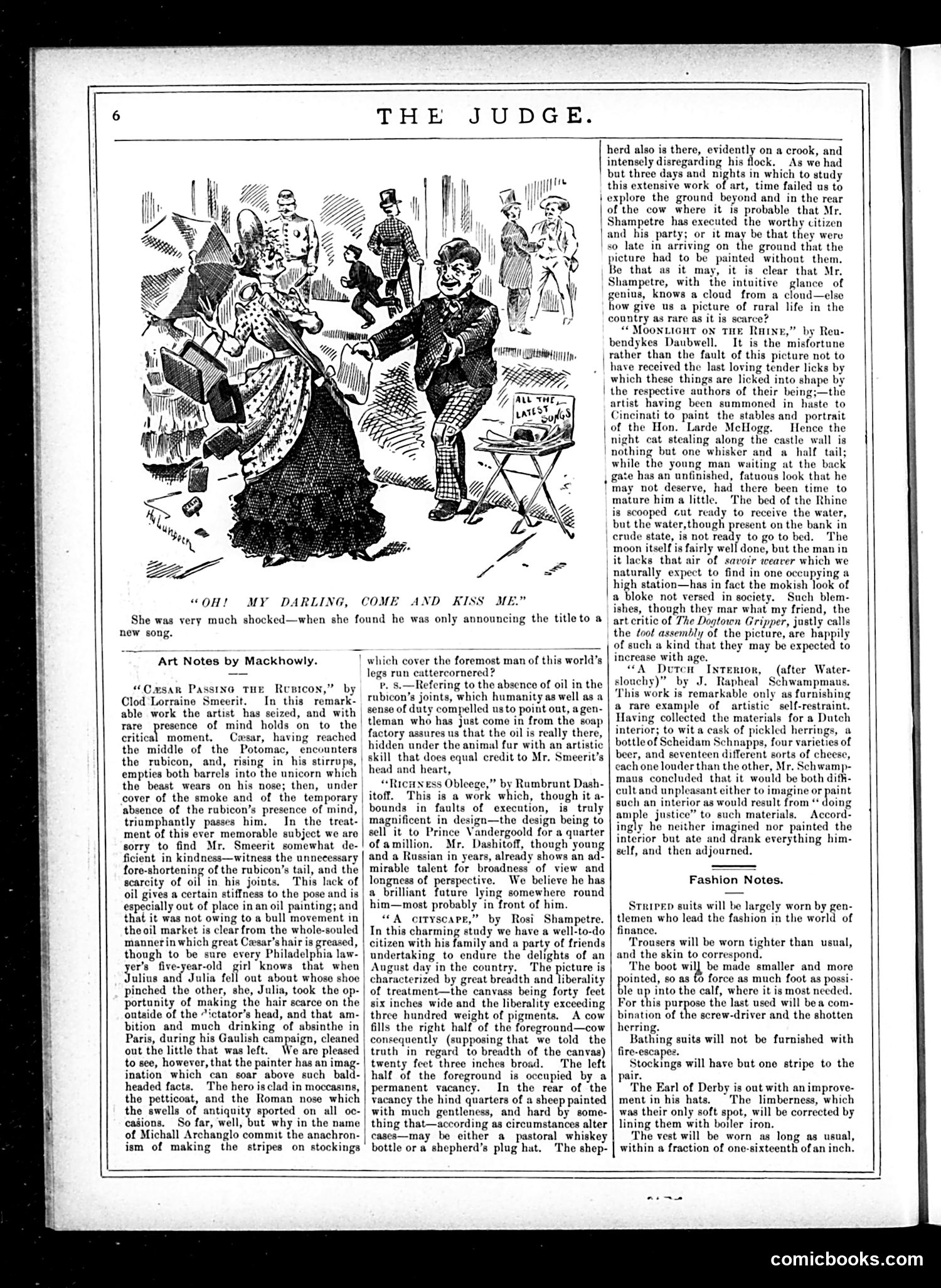
This page from *Judge* magazine contains satirical art criticism mocking pretentious paintings and absurd artistic choices. **The Main Cartoon** shows a woman shocked to discover a man is merely singing the song title "Oh! My Darling, Come and Kiss Me"—she'd mistaken his romantic gesture for an actual advance. It's a simple joke about misread intentions. **"Art Notes by Mackhowly"** is the page's centerpiece: a scathing parody of overwrought art criticism. The critic reviews fictional paintings with deliberately ridiculous descriptions—praising a work for artistic merit while pointing out logical absurdities (Caesar wearing moccasins and petticoats, a Rubicon river with oil-joint problems, a cow taking up half a 40-foot canvas). **The satire targets** both bad artists who produce technically flawed or conceptually nonsensical work, and pompous critics who praise them anyway. The critic's flowery language disguises obvious problems, mocking how serious criticism obscures rather than clarifies artistic merit. The page also includes brief "Fashion Notes" about clothing trends—likely practical content balanced against the satire.
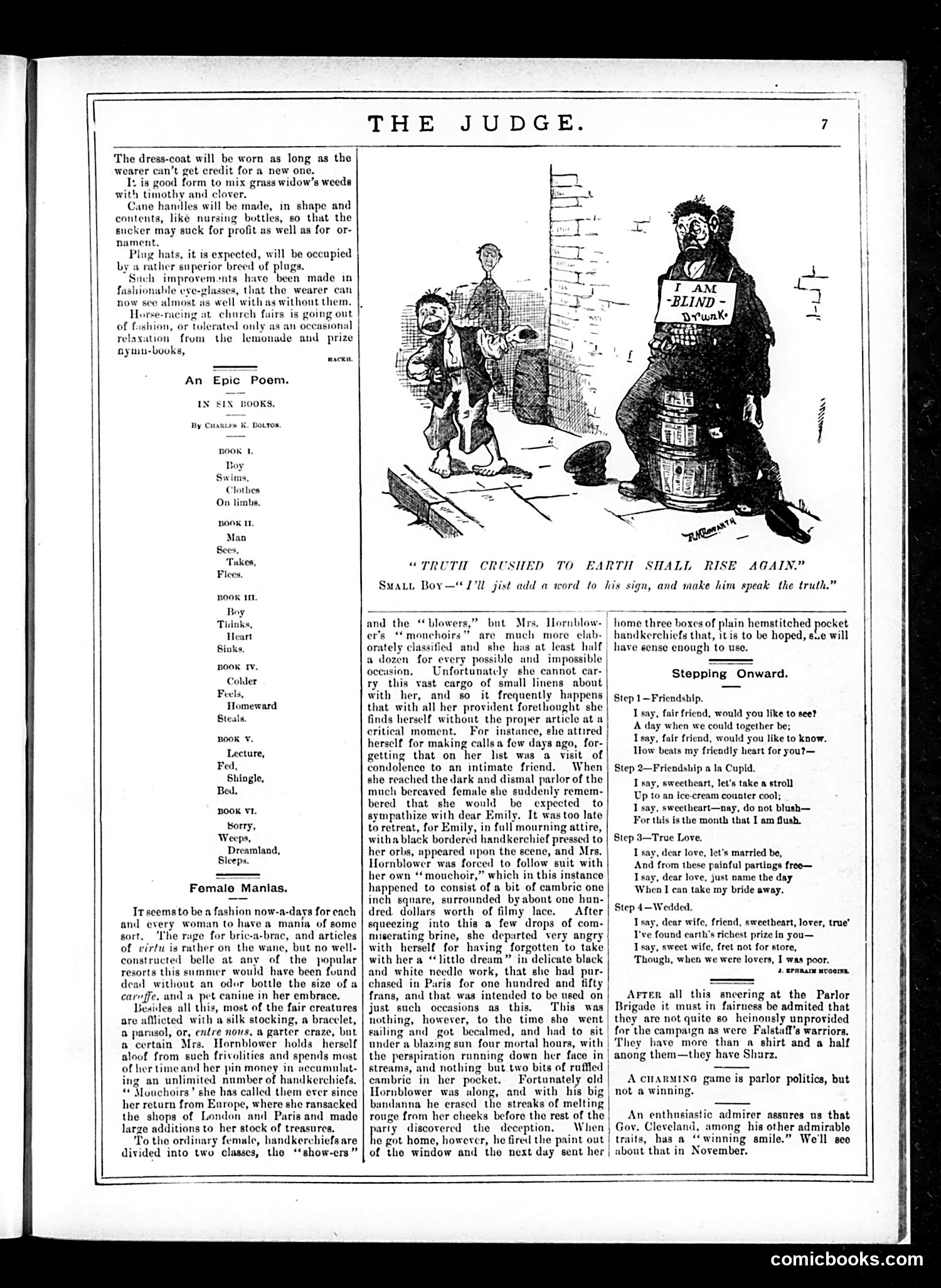
This page contains satirical commentary on 1880s American fashion and social manners. The main cartoon depicts a figure labeled "I AM BLIND" holding a sign reading "TRUTH CRUSHED TO EARTH SHALL RISE AGAIN," while a small boy suggests adding words to make him "speak the truth." This appears to be political satire—likely criticizing either a public figure or political movement for dishonesty, using the classical phrase about truth's resilience ironically. The surrounding text mocks contemporary fashion trends (dress coats, plug hats, grass widow's fashion) and society obsessions. "Female Manias" satirizes wealthy women's excessive collecting habits, specifically chronicling Mrs. Hornblower's absurd accumulation of expensive decorative handkerchiefs—a pointed jab at frivolous consumerism among the privileged classes. The "Epic Poem" parodies pretentious literature through reductive simplicity, further lampooning contemporary cultural pretensions.
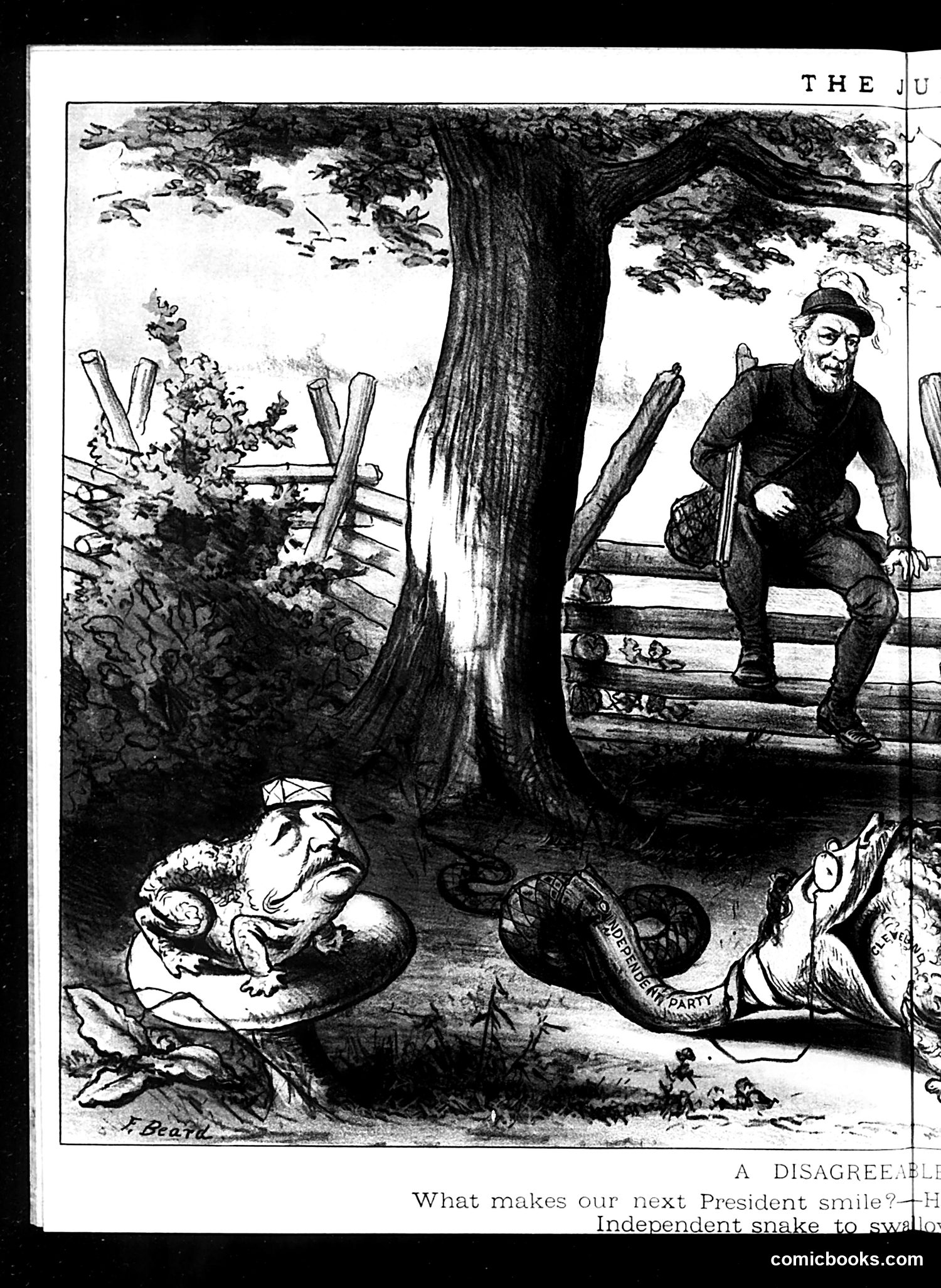
This appears to be a political cartoon from *Judge* magazine satirizing a presidential election candidate. The visible text references "our next President" and "Independent snake to swallo[w]" (text cuts off). The cartoon depicts a man in a bowler hat standing on a fence, observing caricatured figures below—one appearing gnome-like or grotesque. The "Independent snake" reference suggests commentary on third-party or "independent" political movements of the era, likely portraying such candidates as dangerous or absurd threats. The artist (signed "Beard") uses the snake as metaphor for treachery or poison within politics. Without the complete text or publication date visible, I cannot identify the specific candidate or election referenced, though the style suggests late 19th or early 20th-century American politics.
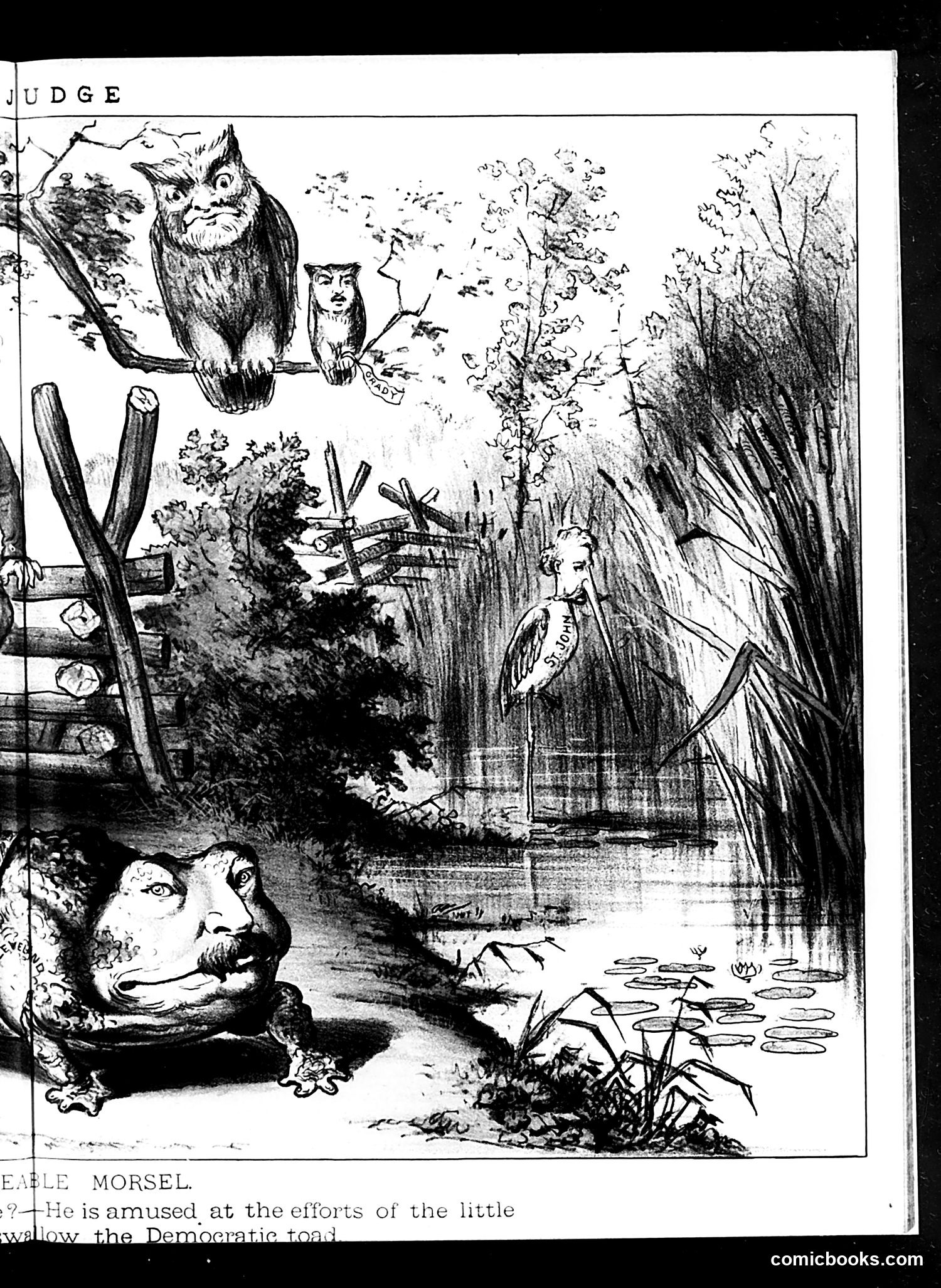
This Judge magazine cartoon depicts a large eagle (representing American power or the Republican establishment) perched above, observing a scene below. A bearded man's head (likely representing Democratic leadership) appears in the lower left, while a crane or wading bird stands in water to the right. The caption indicates the eagle finds amusement in "the efforts of the little...low the Democratic toad" (the OCR appears corrupted, but references Democratic efforts). The satire portrays Republicans as viewing Democratic political attempts as futile or contemptible—comparing Democratic efforts to a toad's struggles, something beneath serious consideration. The "able morsel" suggests the Democrats are small prey to be consumed by superior Republican power. This reflects late 19th/early 20th-century partisan mockery typical of Judge magazine.
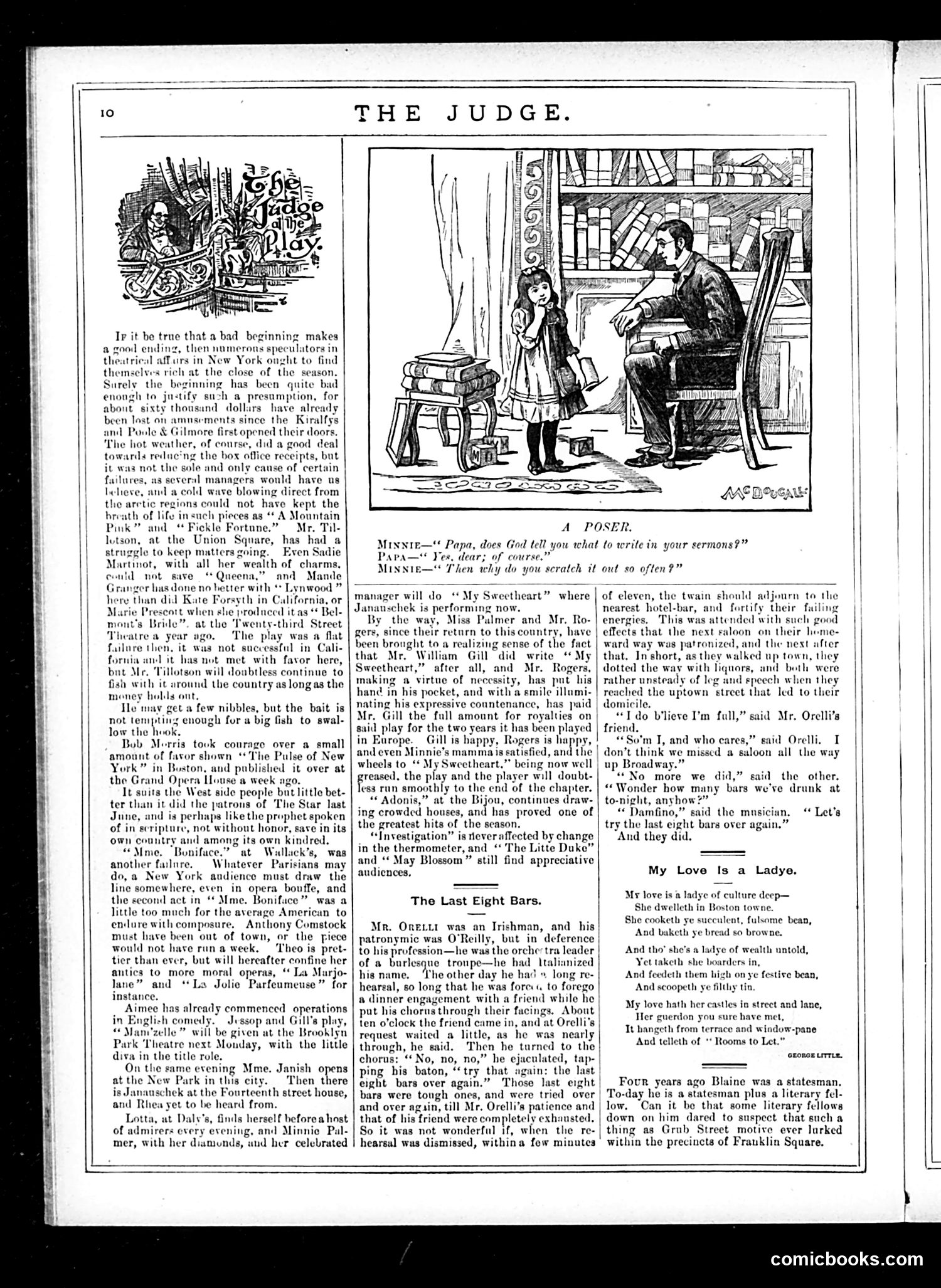
This single-panel cartoon depicts a young girl (Minnie) visiting a clergyman in his study, asking innocent but awkward questions about his sermon-writing process. The joke plays on the double meaning of "scratch" — she's asking why he physically scratches out text so often if he's divinely inspired. The cartoon satirizes clergy and religious hypocrisy by suggesting ministers don't receive divine guidance but rather labor over their sermons like any writer. The child's naive questioning exposes the gap between religious pretense and practical reality. The accompanying text discusses theatrical failures and productions, unrelated to the cartoon itself. This appears to be Judge's typical format: mixing social/political satire cartoons with entertainment industry gossip and commentary on contemporary New York theater.
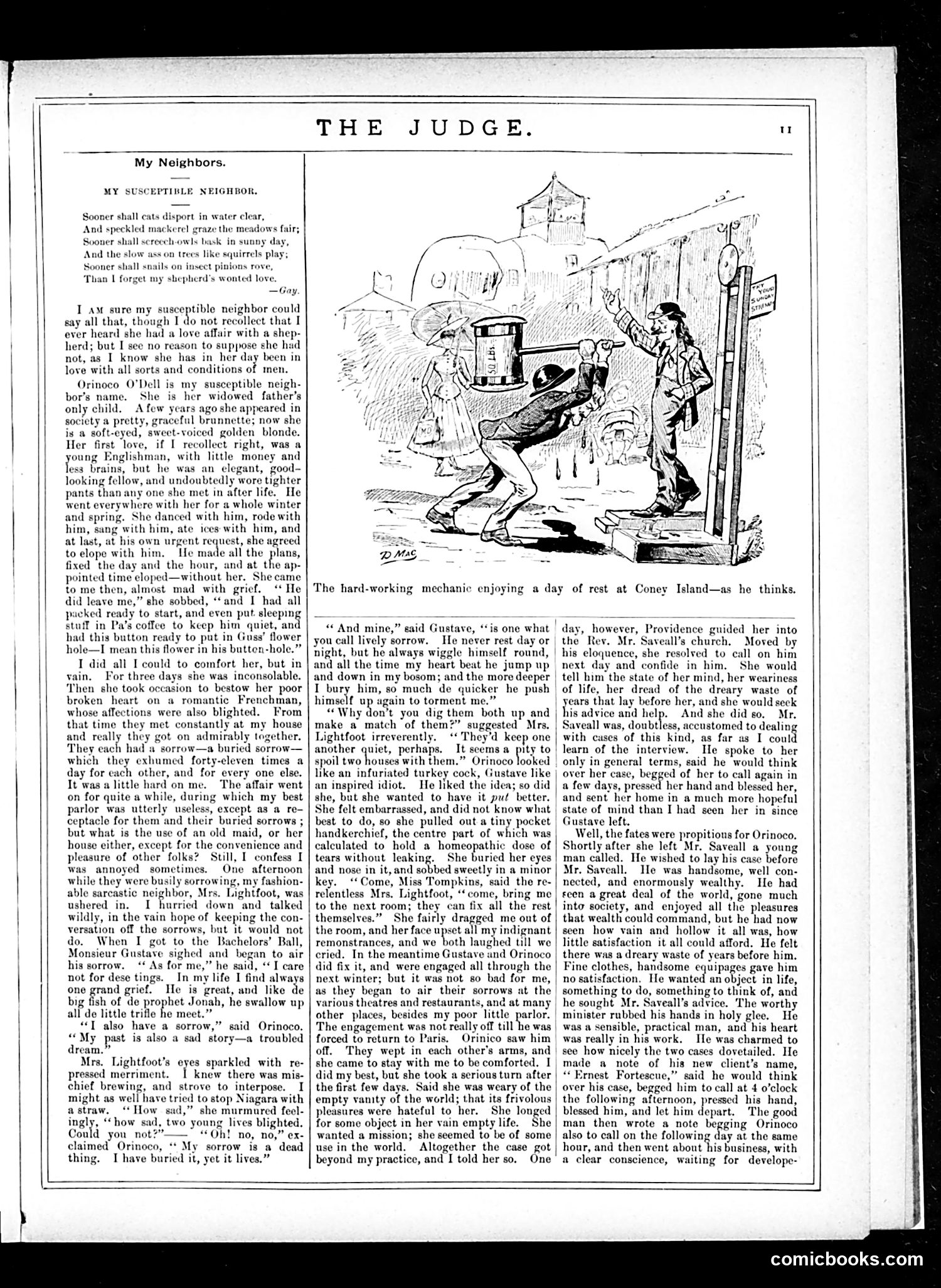
This satirical piece mocks the romantic melodrama and emotional excess of the period through the character Orinoco O'Dell, the narrator's "susceptible neighbor." **The satire targets:** - Women's tendency toward theatrical romanticism and serial infatuation - The self-pitying sentimentality of romantic suitors (particularly foreign ones—a Frenchman named Monsieur Gustave) - The social burden placed on unmarried women to provide emotional labor and house space for others' romantic crises **Key joke:** Orinoco has cycled through multiple love affairs, each time displaying exaggerated grief. The illustrated scene shows a working-class mechanic enjoying a rest day—presumably representing a more grounded, practical contrast to the overwrought emotional lives being satirized in the text. The title "My Neighbors" suggests Judge is mocking recognizable social types of the era—susceptible women and their dramatic romantic entanglements. The narrator's long-suffering patience with their use of her home and time emphasizes the inconvenience these emotional displays cause practical people.
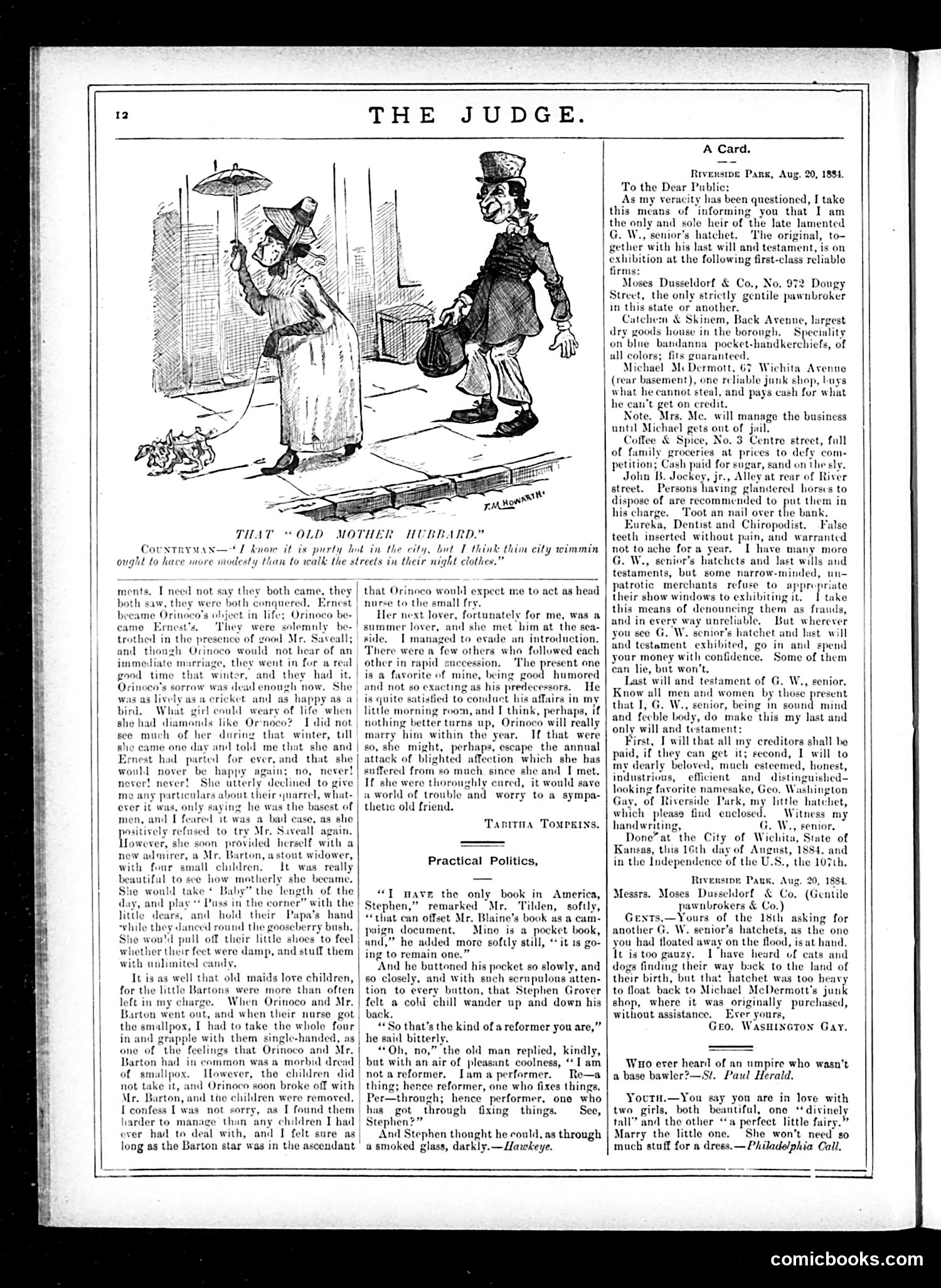
This satirical cartoon mocks rural/country attitudes toward urban fashion. The countryman criticizes city women for wearing nightgowns in public, considering it immodest. The joke targets provincial prudishness—what he perceives as "night clothes" are likely ordinary day dresses of the 1884 era, revealing his ignorance of contemporary urban fashion standards. The accompanying story "Practical Politics" features a dialogue (likely between Samuel Tilden and Stephen Grover Cleveland, prominent Democratic figures of the period) satirizing political hypocrisy. Tilden claims his "pocket book" can counter Blaine's campaign document, then pointedly buttons his pocket—suggesting he won't spend money on politics despite reform rhetoric. The punchline mocks reformers as mere "performers" rather than agents of actual change, exposing the gap between political posturing and genuine action.
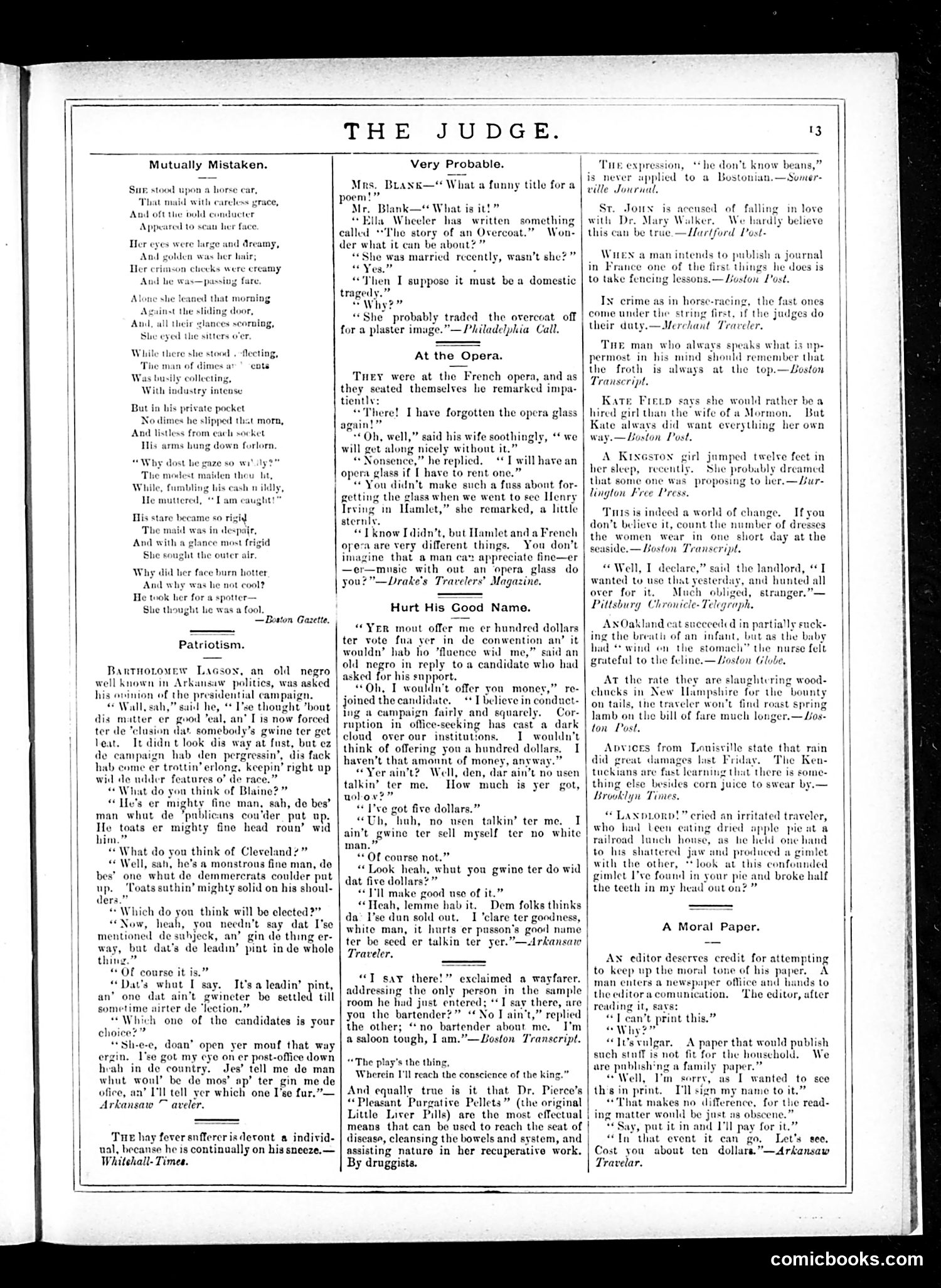
This page from *Judge* (a 19th-century American satirical weekly) contains several short humorous pieces: **"Mutually Mistaken"** is a poem about a streetcar conductor and a female passenger who misread each other's intentions—he thinks she's flirting, she thinks he's collecting fares dishonestly. **"Patriotism"** satirizes a Black Arkansas politician (rendered in dialect) who expresses indifference between presidential candidates Blaine and Cleveland, revealing his true motivation: securing a post office job. The satire targets political corruption and self-interest masquerading as civic engagement. **"Very Probable"** jokes that poet Ella Wheeler Wilcox's recent poem about an overcoat must be a "domestic tragedy"—implying wives trade husbands' belongings. **"At the Opera"** depicts marital discord over a forgotten opera glass, with the husband's inconsistent priorities mocked. **"Hurt His Good Name"** presents a politician's hollow anti-corruption rhetoric exposed when offering bribes. The page reflects period attitudes toward race, gender, and political hypocrisy through light satirical commentary.
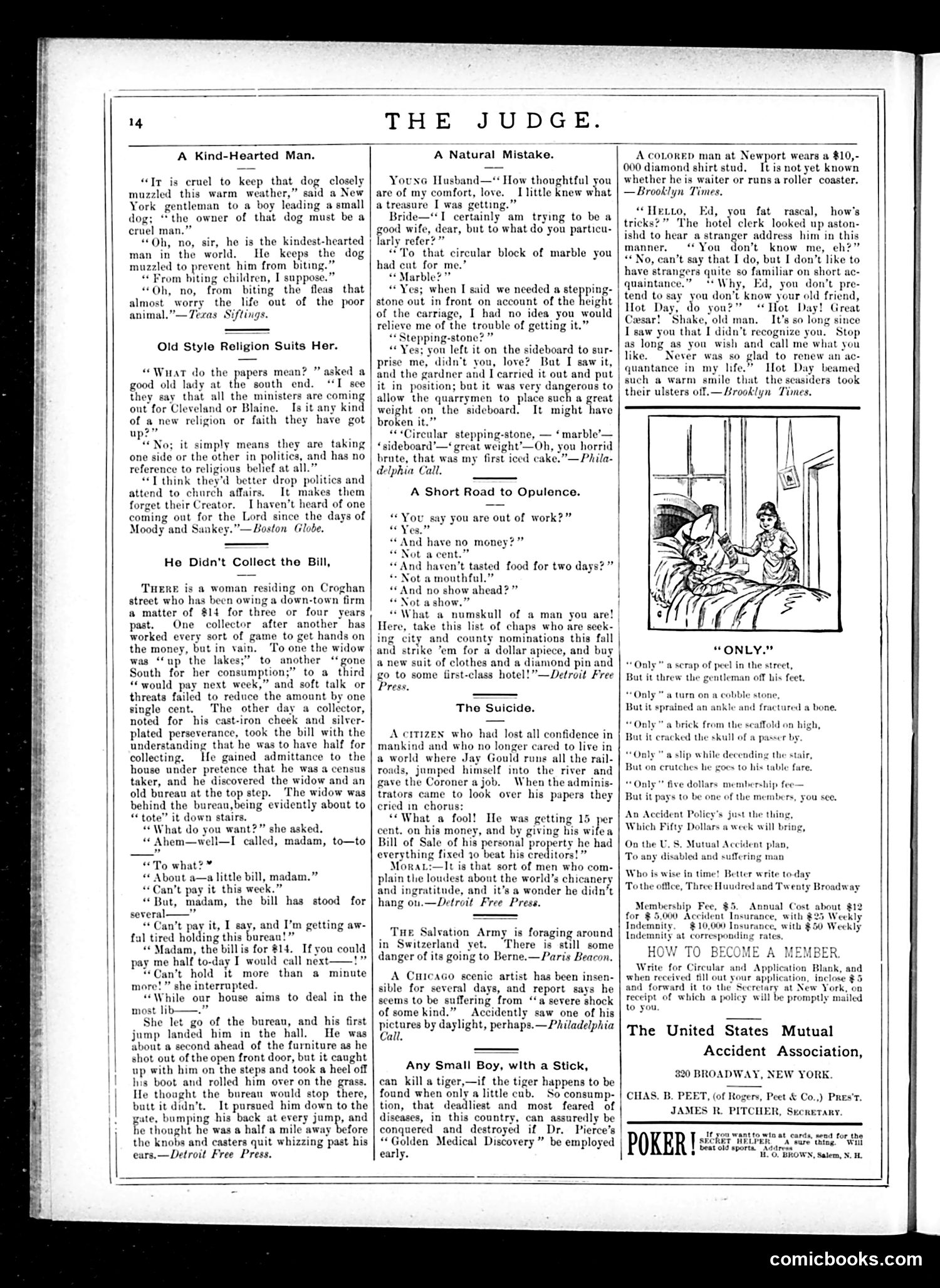
This page from *Judge* magazine contains several short humorous anecdotes rather than political cartoons. The pieces satirize everyday social situations: **"A Kind-Hearted Man"** jokes about a dog owner's claim that muzzling prevents the dog from biting fish—absurd reasoning masking actual dangerousness. **"Old Style Religion Suits Her"** mocks an elderly woman who confuses political endorsements (for Cleveland or Blaine—19th-century presidential candidates) with religious declarations, satirizing both her naïveté and ministers' political involvement. **"He Didn't Collect the Bill"** describes a debt collector's humiliating failure when a widow, caught moving furniture to avoid him, drops a bureau on him in her escape—slapstick commentary on aggressive collection tactics. **"A Natural Mistake"** plays on newlywed miscommunication: the bride mistakes her husband's request for a stepping-stone as a decorative marble gift, creating domestic confusion. These are character-driven humor pieces typical of the era, emphasizing wit over visual satire.
This page is primarily **advertising**, with brief humorous snippets interspersed. The main content consists of patent medicine ads (Catarrh cream, "Men's Agitat Molem" for male vigor, breakfast cocoa) and business advertisements typical of late 19th-century publications. The few satirical pieces are short anecdotes poking fun at everyday situations: a wife criticizing her husband's nose-drinking, a Mexican man's courtesy, a child expecting Coney Island as reward for good behavior, and a farmer resisting political pressure to replace his longtime representative. The most substantial satirical exchange features a **Politician trying to convince a Farmer (Mr. Granger)** to run for legislature by arguing for "rotation in office." The Farmer's shrewd response—comparing it to crop rotation but noting he wouldn't plant skunk cabbage in last year's potato field—satirizes the politician's euphemistic argument for term limits as mere self-serving rhetoric. The humor targets political opportunism and rural common sense outwitting urban political maneuvering.
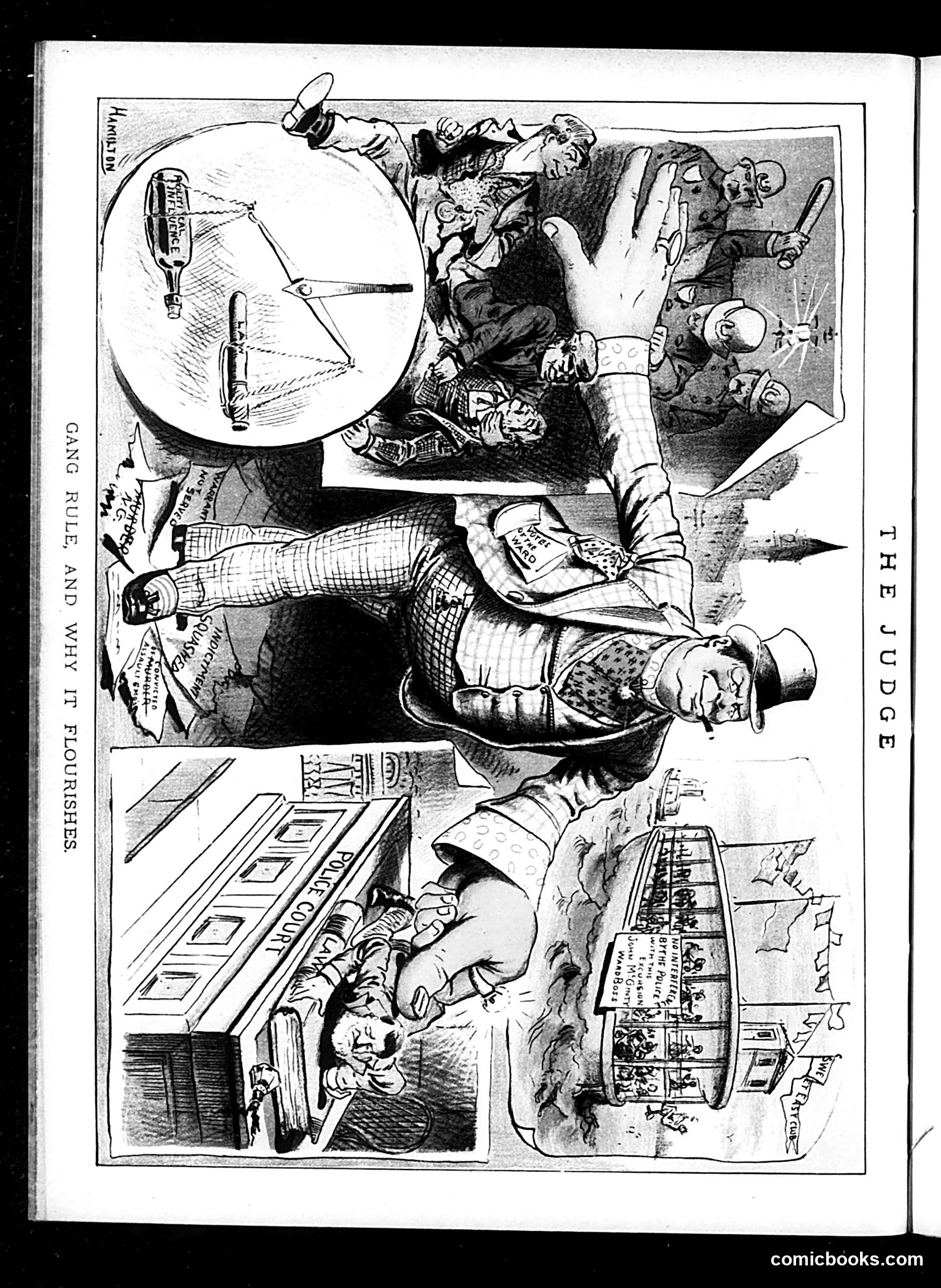
This page appears to be a title or cover from *Judge* magazine featuring a satirical cartoon titled "The Judge" (visible on right margin). The main image depicts a large hand labeled "Gang Rule and What It Flourishes" holding or manipulating various figures representing different social groups and politicians. The composition suggests commentary on organized crime's ("gang rule") influence over American institutions and public life. The circular diagram in the upper left appears to illustrate some kind of system or network of relationships, though specific details are difficult to discern. The overall message criticizes how criminal elements control or manipulate society's structures and the people within them. Without clearer date context or caption text, the specific political moment referenced remains unclear, though the theme reflects early 20th-century concerns about urban corruption and organized crime's reach.