
Judge, 1884-09-27 · page 6 of 16
Judge — September 27, 1884 — page 6: what you’re looking at
What you’re looking at
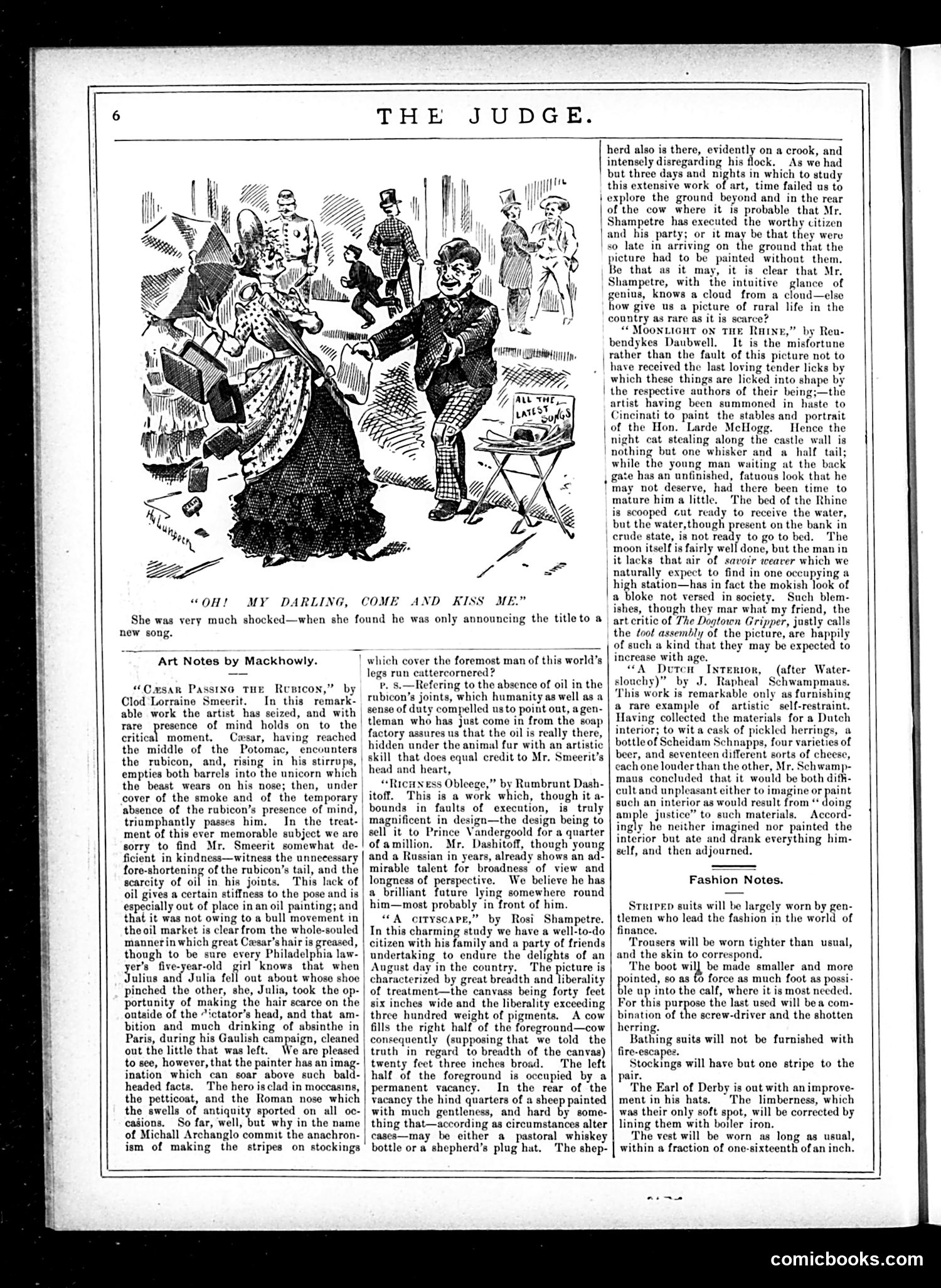
This page from *Judge* magazine contains satirical art criticism mocking pretentious paintings and absurd artistic choices. **The Main Cartoon** shows a woman shocked to discover a man is merely singing the song title "Oh! My Darling, Come and Kiss Me"—she'd mistaken his romantic gesture for an actual advance. It's a simple joke about misread intentions. **"Art Notes by Mackhowly"** is the page's centerpiece: a scathing parody of overwrought art criticism. The critic reviews fictional paintings with deliberately ridiculous descriptions—praising a work for artistic merit while pointing out logical absurdities (Caesar wearing moccasins and petticoats, a Rubicon river with oil-joint problems, a cow taking up half a 40-foot canvas). **The satire targets** both bad artists who produce technically flawed or conceptually nonsensical work, and pompous critics who praise them anyway. The critic's flowery language disguises obvious problems, mocking how serious criticism obscures rather than clarifies artistic merit. The page also includes brief "Fashion Notes" about clothing trends—likely practical content balanced against the satire.
📄 Transcribed text from this page (OCR, searchable)
Machine-transcribed from the original scan — historical spelling and the odd misread are preserved.
THE JUDGE. “OH! MY DARLING, COME AND KISS ME.” She was very much shocked—when she found he was only announcing the title to a new song. “Art Notes by Mackhowly. “Csar Passing THe Rvpicon Clod Lorraine Smeerit. In this remark- able work the artist has seized, and with rare presence of mind holds on to the critical moment. Cwsar, having reached the middle of the tomac, encounters the rubicon, and, rising in his stirrups, empties both barrels into the unicorn which the beast wears on his nose; then, under cover of the smoke and of the temporary absence of the rubicon’s presence of mind, triumphantly passes him. In the treat- ment of this ever memorable subject we aro sorry to find Mr. Smeerit somewhat de- ficient in kindness—witness the unnecessary fore-shortening of the rubicon’s tail, and the scarcity of oil in his joints. This lack of oil gives a certain stiffness to the pose and is, especially out of place in an oil painting; and that it was not owing to a bull movement in theoil market is clearfrom the whole-souled mannerin which great Cwsar’s hair is greased, thongh to be sure every Philadelphia law- er’s five-year-old girl knows that when ulius and Julia fell out about whose shoe pinched the other, she, Julia, took the op- | portunity of making the hair scarce on the outside of the “ictator’s head, and that am- bition and much drinking of absinthe in Paris, during his Gaulish campaign, cleaned out the little that was left. We are pleased to see, however, that the painter has an imag | Id- ination which can soar above such bal headed facts. The hero is clad in moccasins, the petticoat, and the Roman nose which the swells of antiquity sported on all oc- caiions. So far, well, but why in the name of Michall Archanglo commit the anachron- ism of making the stripes on stockings | which cover the foremost man of this world’s legs run cattercornered? p. S.—Refering to the absence of oil in the rubicon’s joints, which humanity as well as a sense of duty compelled us to point out, agen- tleman who has just come in from the soap factory assures us that the oil is really there, hidden under the animal fur with an artistic | skill that does equal credit to Mr. Smeerit’s head and heart, “TicHNess Obleege,” by Rumbrunt Dash- itoff. is is a work which, though it bounds in faults of execution, is truly magnificent in design—the design being to sell it to Prince Vandergoold for a quarter of amillion. Mr. Dashitoff, though young and a Russian in years, already shows an ad- mirable talent for broadness of view and longness of perspective. We believe he has a brilliant fature lying somewhere round him—most probably in front of him. “A cityscape,” by Rosi Shampetre. In this charming study we have a well-to-do citizen with his family and a party of friends undertaking to endure the delights of an August day in the country. The pistons is characterized by great breadth and liberality of treatment—the canvass being forty feet six inches wide and the liberality exceeding three hundred weight of pigments. A cow fills the right half of the foreground—cow consequently (supposing that we told the truth in regard to breadth of the canvas) twenty feet three inches broad. The left half of the foreground is occupied by a permanent vacancy. In the rear of the vacancy the hind quarters of a sheep painted with much gentleness, and hard by some- | thing that—according as circumstances alter cases—may be either a pastoral whiskey bottle or a shepherd’s plug hat. ‘The shep- | of the Hon. Larde McHogg. ‘night cat stealing along the castle wall is herd also is there, evidently on a crook, and intensely disregarding his flock. As we had but three days and nights in which to study this extensive work of art, time failed us to explore the ground beyond and in the rear of the cow where it is probable that Mr. Shampetre has executed the worthy citizen and his party; or it may be that they were so late in arriving on the ground that the pictare had to be painted without them. 3e that as it may, it is clear that Mr. Shampetre, with the intuitive glance of genius, knows a cloud from a cloud—else how give us a picture of rural life in the country as rare as it is scarce? “MOONLIGHT oN THE Rune,” by Reu- bendykes Daubwell. It is the misfortune rather than the fault of this picture not to have received the last loving tender licks by which these things are licked into shape by | the respective authors of their being;—the artist having been summoned in haste to Cincinati to paint the stables and portrait Hence the nothing but one whisker and a half tail; while the young man waiting at the back gate has an unfinished, fatuous look that he may not deserve, had there been time to mature him a little. The bed of the Rhine is scooped cut ready to receive the water, but the water,though present on the bank in crude state, is not aay to go to bed. The moon itself is fairly well done, but the man in it lacks that air of savoir weaver which we naturally expect to find in one occupying a | high station—has in fact the mokish look of a bloke not versed in society. Such blem- ishes, though they mar what my friend, the art critic of The Dogtown Gripper, justly calls the foot assembly of the picture, are happily of such a kind that they may be expected to increase with age. “A Deten Interior, (after Water- slouchy)” by J. Rapheal Schwampmaus. ‘This work is remarkable only as furnishing a rare example of artistic’ self-restraint. Having collected the materials for a Dutch interior; to wit a cask of pickled herrings, a bottle of Scheidam Schnapps, four varieties of beer, and seventeen different sorts of cheese, cach one louder than the other, Mr. Schwamp- maus concluded that it would be both diff- cult and unpleasant either to imagine or paint such an interior as would result from “ doing ample justice” to such materials. Accord- ingly he neither imagined nor painted the interior but ate and drank everything him- self, and then adjourned. Fashion Notes. Strivep suits will be largely worn by gen- tlemen who lead the fashion in the world of finance. ‘Trousers will be worn tighter than usual, and the skin to correspond. ‘The boot wil] be made smaller and more ointed, so as to force as much foot as possi- ble up into the calf, where it is most needed. For this purpose the last used will bea com- bination of the screw-driver and the shotten herring. Bathing suits will not be furnished with fire-escapes. Stockings will have but one stripe to the pair. ‘The Earl of Derby is out with animprove- ment in his hats. “The limberness, which was their only soft spot, will be corrected by lining them with boiler iron. The vest will be worn as long as usual, within a fraction of one-sixteenth ofan inch. comicbooks.com