
Judge, 1884-09-27 · page 11 of 16
Judge — September 27, 1884 — page 11: what you’re looking at
What you’re looking at
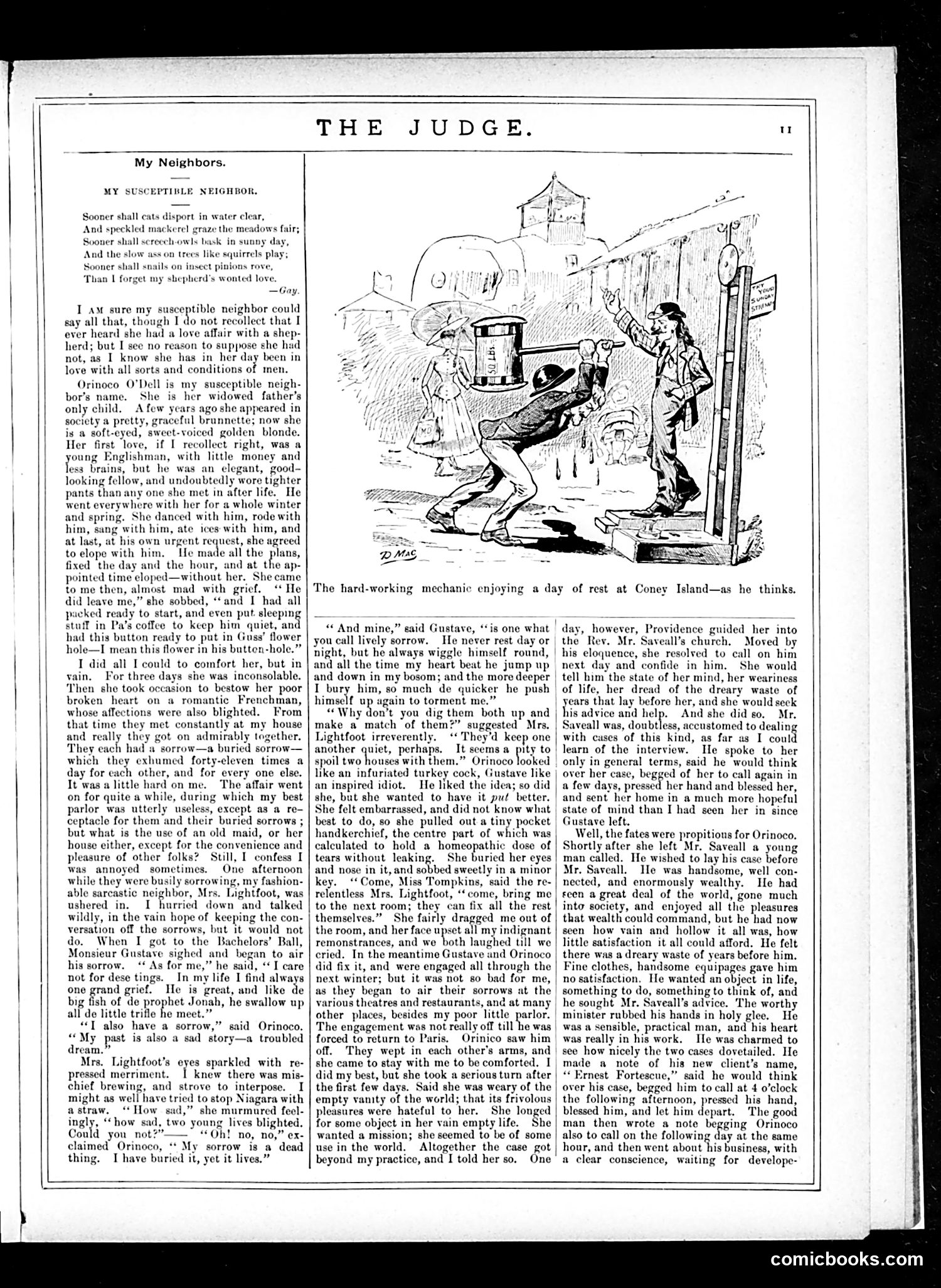
This satirical piece mocks the romantic melodrama and emotional excess of the period through the character Orinoco O'Dell, the narrator's "susceptible neighbor." **The satire targets:** - Women's tendency toward theatrical romanticism and serial infatuation - The self-pitying sentimentality of romantic suitors (particularly foreign ones—a Frenchman named Monsieur Gustave) - The social burden placed on unmarried women to provide emotional labor and house space for others' romantic crises **Key joke:** Orinoco has cycled through multiple love affairs, each time displaying exaggerated grief. The illustrated scene shows a working-class mechanic enjoying a rest day—presumably representing a more grounded, practical contrast to the overwrought emotional lives being satirized in the text. The title "My Neighbors" suggests Judge is mocking recognizable social types of the era—susceptible women and their dramatic romantic entanglements. The narrator's long-suffering patience with their use of her home and time emphasizes the inconvenience these emotional displays cause practical people.
📄 Transcribed text from this page (OCR, searchable)
Machine-transcribed from the original scan — historical spelling and the odd misread are preserved.
My Neighbors. MY SUSCEPTIBLE NEIGHBOR. Sooner shall cats disport in water clear, And speckled mack Sooner shall sereceh-owls in sunny day And the slow ass on trees like squirrels pl Sooner shall snails ‘Than | f e the meadows fal insect pinions rov my shepherd's wonted ve —Gay. I ax sure my susceptible neighbor could say all that, though I do not recollect that I ever heard she had a love affair with a shep- herd; but I sec no reason to suppose she had not, as I know she has in her day been in love with all sorts and conditions of men. Orinoco O'Dell is my susceptible neigh- bor’s name. She is her widowed father’s only child. A few years ago she appeared in society a pretty, graceful brunnette; now she is a soft-eyed, sweet-voiced golden blonde. Her first love, if I recollect right, was a y nglishman, with little money and <3 brains, but he was an elegant, good- looking fellow, and undoubtedly wore tighter pants than any one she met in after life. He went everywhere with her for a whole winter and spring. She danced with him, rode with him, sang with him, ate ices with him, and at last, at his own urgent request, she agreed to elope with him. He cade 1 the pane, fixed the day and the hour, and at the ap- pointed time eloped—without her. She came to me then, almost mad with grief. ‘ He did leave me,” she sobbed, ‘and I had all packed ready to start, and even put sleeping stuff in Pa’s coffee to keep him quiet, and had this button ready to put in Guss’ flower hole—I mean this flower in his butten-hole.” I did all I could to comfort her, but in vain. For three days she was inconsolable. Then she took occasion to bestow her poor broken heart on a romantic Frenchman, whose affections were also blighted. From that time they met constantly at my house and really they got on admiri together. They each had a sorrow—a buried sorrow— which they exhumed forty-eleven times a day for cach other, and for every one else. It was a little hard on me. The affair went on for quite a while, during which my best parlor was utterly useless, except asa re- ceptacle for them and their buried sorrows ; but w is the use of an old maid, or her house either, except for the convenience and pleasure of other folks? Still, I confess I was annoyed sometimes. One afternoon while they were busily sorrowing, my fashion- able sarcastic neighbor, Mrs. Lightfoot, was ushered in. I hurried down and _ talked wildly, in the vain hope of keeping the con- versation off the sorrows, but it would not do. When I got to the Bachelors’ Ball, Monsieur Gustave sighed and began to air his sorrow. ‘‘ As for me,” he said, “I care not for dese tings. _In my life I find always one grand grief. He is great, and like de big fish of de prophet Jonah, he swallow up all de little trifle he meet.” “T also have a sorrow,” said Orinoco. “My past is also a sad story—a troubled dream.” Mrs. Lightfoot’s eyes sparkled with re- pressed merriment. I knew there was mis- chief brewing, and strove to interpose. I might as well have tried to stop Niagara with astraw. ‘How sad,” she murmured feel- ingly, “how sad, two young lives blighted, Could you not??—" “Oh! no, no,” ex- claimed Orinoco, ‘* My sorrow is a dead thing. I have buried it, yet it lives.” The hard-working mechanic enjoying a “And mine,” said Gustave, ‘is one what you call lively sorrow. He never rest day or night, but he always wiggle himself round, and all the time my heart beat he jump up and down in my bosom; and the more deeper I bury him, so much de quicker he push himself up again to torment me.” “Why don't you dig them both up and make a match of them?” suggested Mrs. Lightfoot irreverently, ‘They'd keep one another quiet, perhaps. It seems a pity spoil two houses with them.” Orinoco looked like an infuriated turkey an inspired idiot. He liked the idea; so did she, but she wanted to hi it put better. She felt embarrassed, and did not know what best to do, so she pulled out a tiny pocket handkerchief, the centre part of which was calculated to hold a homeopathic dose of tears without leaking. She buried her eyes and nose in it, and sobbed sweetly in a minor key. “Come, Miss Tompkins, ‘said the re- relentless Mrs. Lightfoot, ‘come, bring me to the next room; they can fix all the rest themselves.” She fairly dragged me out of the room, and her face upset all my indignant remonstrances, and we both laughed tll we cried, In the meantime Gustave and Orinoco did fix it, and were engaged all through the next winter; but it was not so bad for me, as they began to air their sorrows at the various theatres and restaurants, and at many other places, besides my poor little parlor. The engagement was not really off till he was forced to return to Paris. Orinico saw him off. They wept in each other's arms, and she came to stay with me to be comforted. I did my best, but she took a serious turn after the first few days. Said she was weary of the empty vanity of the world; that its frivolous pleasiires were hateful to her. She longed for some object in her vain empty life. She wanted a mission; she seemed to be of some use in the world. Altogether the case got beyond my practice, and I told her so, One pity to | cock, (iustave like | of rest at Coney Island—as he thinks, » however, Rev. Mr. da the his eloquence, she res Providence guided her into Saveall’s church, Moved by aved to call on him next day and confide in him. She would tell him the state of her mind, her weariness of life, her dread of the dreary waste of years that lay before her, and she would seck | his advice and help. And she did so, Mr. | Saveall was, doubtless, accustomed to dealin with cases of this kind, as far as I coul learn of the interview. Ile spoke to her only in general terms, said he would think over her case, begged of her to call again in a few days, pressed her hand and blessed her, and sent her home in a much more hopeful state of mind than I had seen her in since Gustave left. Well, the fates were propitious for Orinoco. Shortly after she left Mr. Saveall a young man called. He wished to lay his case before Mr. Saveall. He was handsome, well con- nected, and enormously wealthy. He had feen a great deal of the world, gone much into society, and enjoyed all the pleasures that wealth could command, but he had now seen how vain and hollow it all was, how little satisfaction it all could afford. He felt | there was a dreary waste of years before him, Fine clothes, handsome equipages gave him no satisfaction. He wanted an object in life, something to do, something to think of, and he sought Mr. Saveall’s advice. The worthy minister rubbed his hands in holy glee. He was a sensible, practical man, and his heart was really in his work. Ile was charmed to see how nicely the two cases dovetailed. He made a note of his new client’s name, “Ernest Fortescue,” said he would think over his case, begged him to call at 4 o’clock the following afternoon, pressed his hand, blessed him, and let him depart. The good man then wrote a note begging Orinoco also to call on the following day at the same | hour, and then went about his business, with a clear conscience, waiting for develope- comicbooks.com