
Judge, 1884-09-27 · page 10 of 16
Judge — September 27, 1884 — page 10: what you’re looking at
What you’re looking at
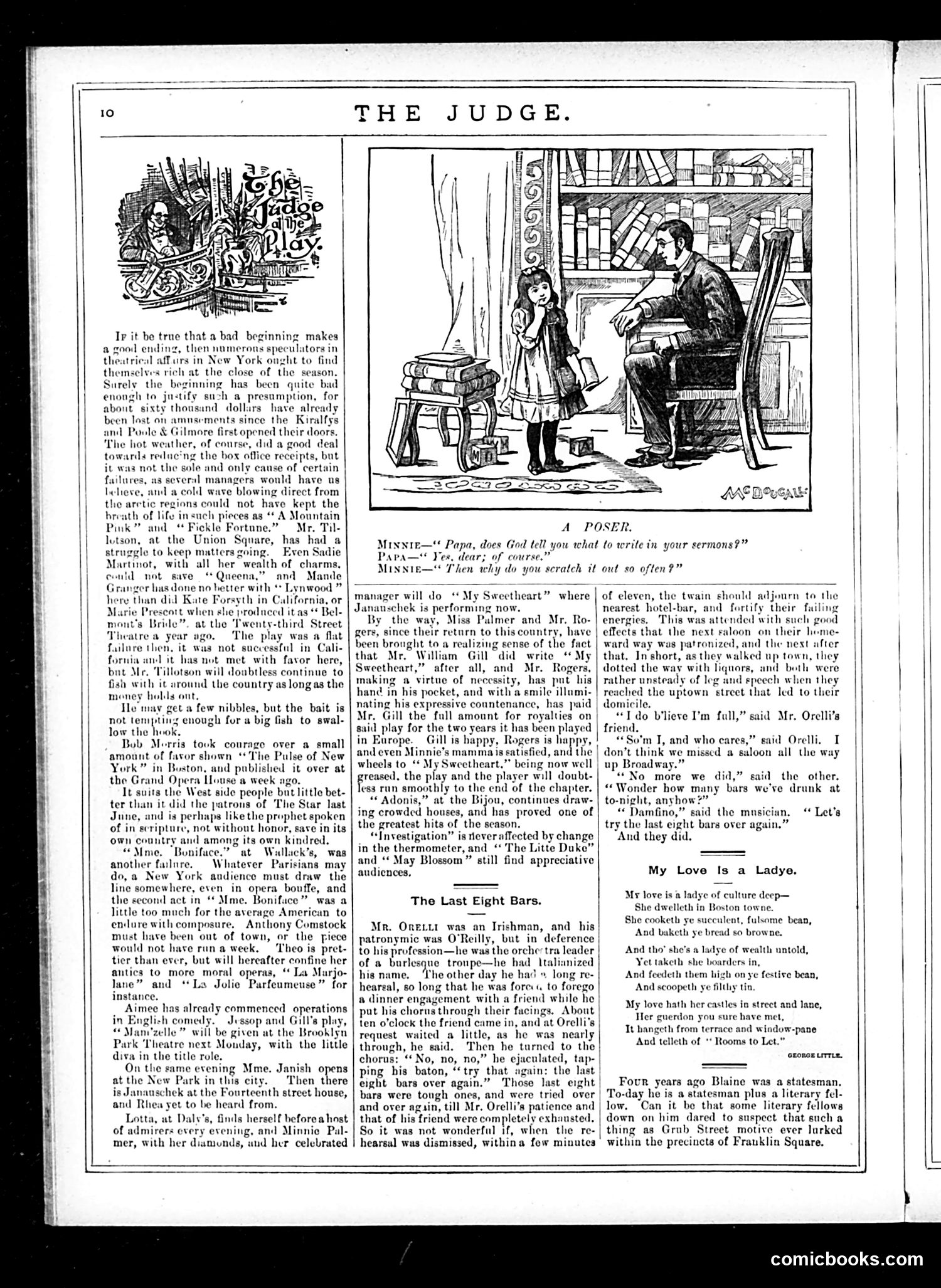
This single-panel cartoon depicts a young girl (Minnie) visiting a clergyman in his study, asking innocent but awkward questions about his sermon-writing process. The joke plays on the double meaning of "scratch" — she's asking why he physically scratches out text so often if he's divinely inspired. The cartoon satirizes clergy and religious hypocrisy by suggesting ministers don't receive divine guidance but rather labor over their sermons like any writer. The child's naive questioning exposes the gap between religious pretense and practical reality. The accompanying text discusses theatrical failures and productions, unrelated to the cartoon itself. This appears to be Judge's typical format: mixing social/political satire cartoons with entertainment industry gossip and commentary on contemporary New York theater.
📄 Transcribed text from this page (OCR, searchable)
Machine-transcribed from the original scan — historical spelling and the odd misread are preserved.
THE JUDGE. Tr it be true that a bad beginning makes a goal ending, then numerons speculators in theatrical affurs in New York ought to find themselves rich at the close of the on. Surely the beginning has been quite bad enongh to justify such a presumption, for about sixty thousand dollirs have already been lost on amngements since the Kiralfys and Poole & Gilmore first opened their doors. The hot weather, of course, did a good deal towards reducing the box office receipts, but it waz not the sole and only cause of certain failures, a3 several managers would have us eheve, and a cold e blowing direct from the arctic regions could not have kept the breath of life insuch pieces as A Mountain Pink”? and “Fi Fortune.” Mr. Til- lotson, at the Union Square, has had a struggle to keep matters going. Even Sadie Martinot, with all her wealth of charms, vid not save‘ Queer and Mande ger hus done no better with ** Lynwood ” ere Unan did Kate Forsyth in California, or Marie Prescott when she produced it as ** Bel- vs Bride”. at the ‘Twenty-third Street catre a year ago. ‘The play was a flat failure then, it was not successful in Cali- fornia al it has net met with favor here, but Mr. ‘Tillotson will doubtless continue to fish with it around the country as long as the money holds ont. Tle may get a few nibbles, but the bait is not lemptins enough for a big fish to swal- low the heok, Bob Morris tovk courage over a small amount of favor shown ** The Pulse of New York” in Boston, and published it over at the Grand Opera House a week ago. It suits the West side people but little bet- ter than it did the patrons of The Star last June, and is perhaps like the prophet spoken of in scripture, not without honor, save in its own country and among its own kindred. “Mme. Boniface.” at Wallack’s, was another failure. Whatever Parisians may do, a New York audience must draw the line somewhere, even in opera bouffe, and the second act in * Mme. Bonifuce” was a little too much for the average American to endure with composure. Anthony Comstock must have been out of town, or the piece would not have run a week. | ‘Theo is pret- tier than ever, but will hereafter confine her antics to more moral operas, “ La Marjo- lane” and ‘Ls Jolie Parfeumeuse” for instance. Aimec has already commenced operations in English comedy. Jessop and Gill's p “ Manvzelle” will be given at the Brookly Park Theatre next Monday, with the little diva in the title role. On the same evening Mme. Janish opens at the N rk in this city. Then there i chek at the Fourteenth street house, and Rhea yet to be heard from. Lotta, ut Daly's, finds herself beforea host of admirers every evening, and Minnie Pal- mer, with her diamonds, aud her celebrated Para— Yes, dear; of cours Minsie—* Phen why do you scratch it r will do “My Sweetheart” where chek is performing now. y the way, Miss Palmer and Mr. Ro- gers, since their return to thiscountry, have | been brought to a realizing sense of the fact that Mr. William Gill did write ‘ My Sweetheart,” after all, and Mr. Rogers, king a virtue of necessity, has put his hand in his pocket, and with a smile illumi- | nating his expressive countenance, has paid Mr. Gill the full amount for royalties on said play for the two years it has been play in Europe. Gill is happy, Rogers is happy, and even Minnie’s mammais satisfied, and the | wheels to “ My Sweetheart.” being now well eased, the play and the player will doubt- ess run smoothly to the end of the chapter. * Adonis,” at the Bijou, continues draw- ing crowded houses, and has proved one of the greatest hits of the season, “Investigation” is never affected by change in the thermometer, and ‘* The Litte Duke” and ** May Blossom” still find appreciative audiences, The Last Eight Bars. Mr. Oneitt was an Irishman, and his | patronymic was O'Reilly, but in deference | to his profession—he was the orche leader | of a burlesque troupe—he had ltalianized his name. ‘The other day he had » long re- heareal, so long that he was fore: « to forego a dinner engagement with a friend while he put his chorus through their facings. About ten o'clock the friend came in, and at Orelli’s | request waited a little, as he was nearly through, he said. Then he turned to the} chorus: “No, no, no,” he ejaculated, tap- ping his baton, ‘try that again: the last | eight bars over again.” ‘Those last eight | bars were tongh ones, and were tried over | and over again, till Mr. Orelli’s patience and that of his friend were completely exhausted, So it was not wonderful if, when the re- hearsul was dismissed, withina few minutes A POSER. Minnre— Papa, does God tell you what to write in your sermons?” out so often?” | of eleven, the twain shonld adjourn to the | nearest hotel-bar, and fortify their failing energies. This was attended with such good effects that the next saloon on their heme- | ward way was patronized, and the nest after that, In short, as they walked up town, they | dotted the way with liquors, and beth were rather unsteady of leg and speech when they reached the uptown street that led to their domicile. “Tdo b'lieve I’m full,” said Mr. Orelli’s friend. "m I, and who cares,” said Orelli. I don’t think we missed a saloon all the way up Broadway.” “*No more we did,” said the other. | “Wonder how many bars we've drunk at to-night, anyhow?” “ Damfino,” said the musician, try the last eight bars over again.” And they did. “Let's My Love Is a Ladye. Mr love is a ladye of culture deep— She dwelleth in Boston towne. She cooketh ye succulent, fulsome bean, And baketh ye bread so browne, And tho’ she’s a ladye of wealth untold, Yet taketh she boarders i And feedeth them high on ye festive bean, And scoopeth ye filthy tin. My love hath her castles in street and lane, Her guerdon you sure have met, It hangeth from terrace and window-pane And telleth of ** Rooms to Let.” OronoRurtis. Four years ago Blaine was a statesman. To-day he is a statesman plus a literary fel- low. ‘Can it bo that some literary fellows down on him dared to suspect that such a thing as Grub Street motive ever lurked within the precincts of Frauklin Square. —$—$————————I comicbooks.com