
Judge, 1884-09-27 · page 3 of 16
Judge — September 27, 1884 — page 3: what you’re looking at
What you’re looking at
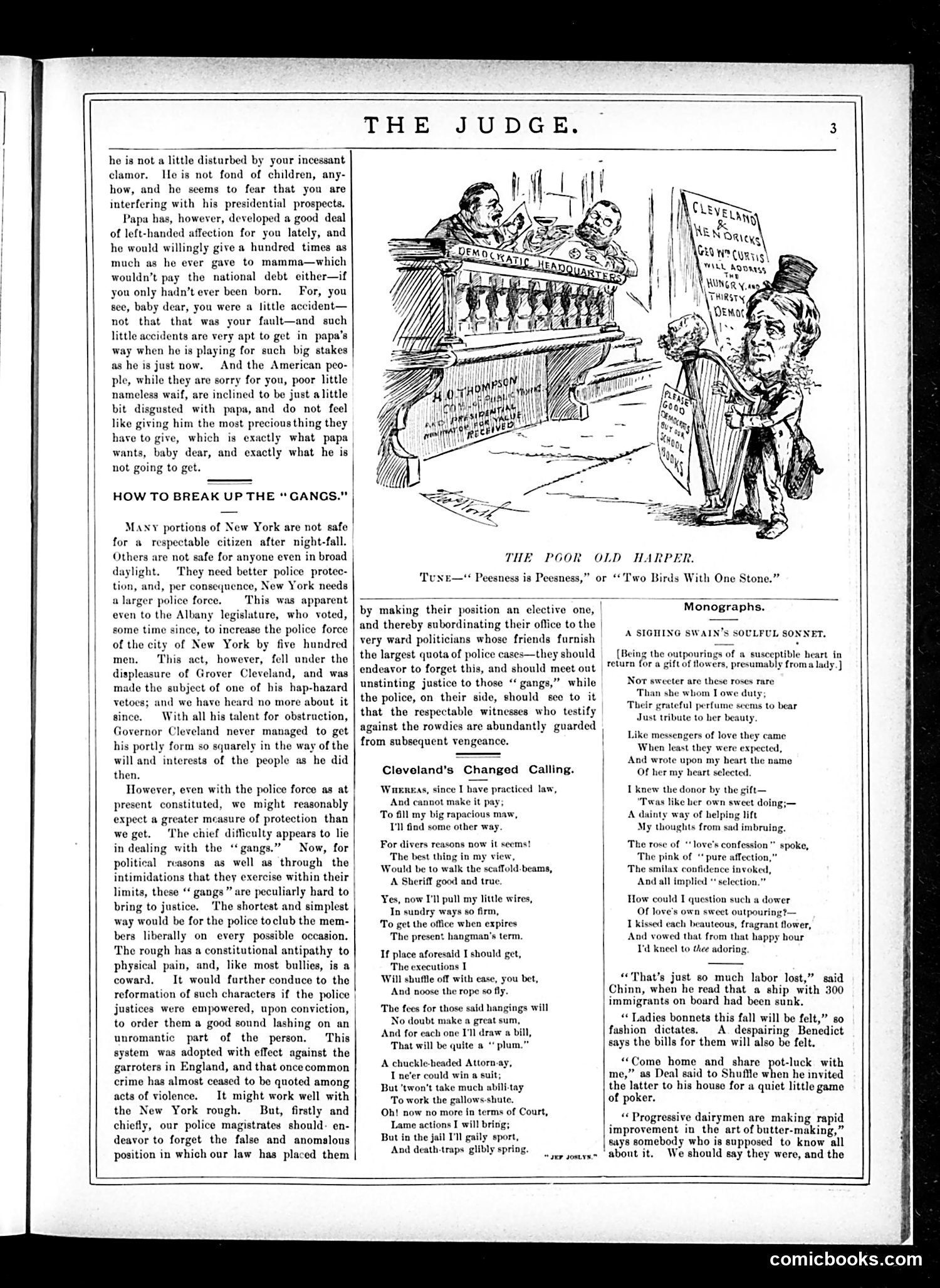
This page contains political satire targeting President **Grover Cleveland**. The main cartoon depicts Cleveland as "The Poor Old Harper" (a destitute figure), criticizing his veto of a bill to increase New York City's police force by 500 men. The text argues Cleveland obstructed the will of the people for political reasons, hamstringing efforts to combat street gangs and crime. The accompanying articles propose tough policing solutions—club gang members and impose floggings—while attacking Cleveland's political obstruction. A secondary piece titled "Cleveland's Changed Calling" sarcastically suggests Cleveland, unable to make his law practice pay, has turned to politics as an alternative income source. The satire portrays Cleveland as an obstacle to public safety and characterizes his political interference as self-interested obstruction rather than principled governance. The imagery and tone are decidedly hostile to the President.
📄 Transcribed text from this page (OCR, searchable)
Machine-transcribed from the original scan — historical spelling and the odd misread are preserved.
THE JUDGE. he is not a little disturbed by your incessant clamor. Ile is not fond of children, any- how, and he seems to fear that you are interfering with his presidential prospects. Papa has, however, developed a good deal of left-handed affection for you lately, and he would willingly give a hundred times as much as he ever gave to. mamma—which wouldn’t pay the national debt either—if you only hadn’t ever been born. For, you see, baby dear, you were a little ident— not that that was your fault—and such little accidents are very apt to get in papa’s way when he is playing for such big stakes as he is just now. And the American pco- ple, while they are sorry for you, poor little nameless waif, are inclined to be just alittle bit disgusted with papa, and do not feel like giving him the most precious thing they have to give, which is exactly what papa | wants, baby dear, and exactly what he is not going to get. HOW TO BREAK UP THE “GANGS.” Many portions of New York are not safe for a respectable citizen after night-fall. Others are not safe for anyone even in broad | daylight. ‘They need better police protec- tion, and, per consequence, New York needs alarger police force. This was apparent even to the Albany legislature, who voted, some time since, to increase the police force of the city of New York by five hundred men. This act, however, fell under the displeasure of Grover Cleveland, and was made the subject of one of his hap-hazard vetoes; and we have heard no more about it since. With all his talent for obstruction, Governor Cleveland never managed to get his portly form so squarely in the way of the will and interests of the people as he did then. However, even with the police force as at | present constituted, we might reasonably expect a greater measure of protection than we get. ‘The chief difficulty appears to lie in dealing with the ‘‘gangs.” Now, for political reasons as well as through the intimidations that they exercise within their | limits, these “ gangs” are peculiarly hard to bring to justice. ‘The shortest and simplest | way would be for the police toclub the mem- bers liberally on every possible occasion. The rough has a constitutional antipathy to physical pain, and, like most bullies, is a coward, It would further conduce to the reformation of such characters if the police | justices were empowered, upon conviction, | to order them a good sound lashing on an unromantic part of the person. This system was adopted with effect against the garroters in England, and that oncecommon crime has almost ceased to be quoted among acts of violence. It might work well with the New York rough. But, firstly and chiefly, our police magistrates should: en- deavor to forget the false and anomalous position in which our law has placed them THE POOR ‘E—‘* Peesness is Peesness,” or OLD C29 WH CRTs) WALL a + MODAN HARPER, ‘o Birds With One Stone.” by making their position an elective one, | and thereby subordinating their office to the very ward politicians whose friends furnish the largest quota of police cases—they should endeavor to forget this, and should meet out unstinting justice to those “ gangs,” while the police, on their side, should see to it that the respectable witnesses who testify against the rowdies are abundantly guarded from subsequent vengeance. Cleveland’s Changed Calling. Warneas, since Ib And cannot make it pay; To fill my big rapacious maw, I'll find some other way. For divers reasons now it seems! The best thing in my view, Would be to walk the scaffold-beams, A Sheriff good and true. Yes, now I'll pull my little wires, In sundry ways so firm, ‘To get the office when expires ‘The present hangman's term. If place aforesaid I should get, ‘The executions I Will shufile off with case, you bet, And noose the rope 80 fly. ‘The fees for those said hangings will No doubt make a great sum, And for each one I'll draw a bill, ‘That will be quite a “ plum.” A chuckle-headed Attorn-ay, I ne'er could win a suit; But ‘twon't take much abili-tay To work the gallows-shute. Oh! now no more in terms of Court, Lame actions I will bring; But in the jail IN gaily sport, And death-traps glibly spring. ger ost” Monographs. A SIGHING SWAIN’S SOULFUL SONNET. (Being the outpourings of a susceptible heart in return for a gift of flowers, presumably froma lady. } Nor sweeter are these roses rare ‘Than she whom T owe duty Their grateful perfume seems to bear Just tribute to her beauty. Like messengers of love the When least they were expected, And wrote upon my heart the name Of her my heart selected. I knew the donor by the gift— ‘Twas like her own sweet doing;— A dainty way of helping lift My thoughts from sad imbruing. ne rose of “love's confession” spoke, ‘The pink of “ pure affection,” The smilax confidence invoked, And all implied “selection.” How could I question such a dower Of love's own sweet outpouring?— T kissed each beauteous, fragrant flower, And vowed that from that happy hour I'd kneel to thee adoring “That’s just so much labor lost,” said | Chinn, when he read that a ship with 300 | immigrants on board had been sunk. “Ladies bonnets this fall will be felt,” so fashion dictates. A despairing Benedict says the bills for them will also be felt. “Come home and share pot-luck with me,” as Deal said to Shuffle when he invited the latter to his house for a quiet little game of poker. ‘Progressive dairymen are making rapid | improvement in the art of butter-making,” | says somebody who is supposed to know all ‘about it. We should say they were, and the comicbooks.com