
A complete issue · 16 pages · 1882
Judge — May 6, 1882
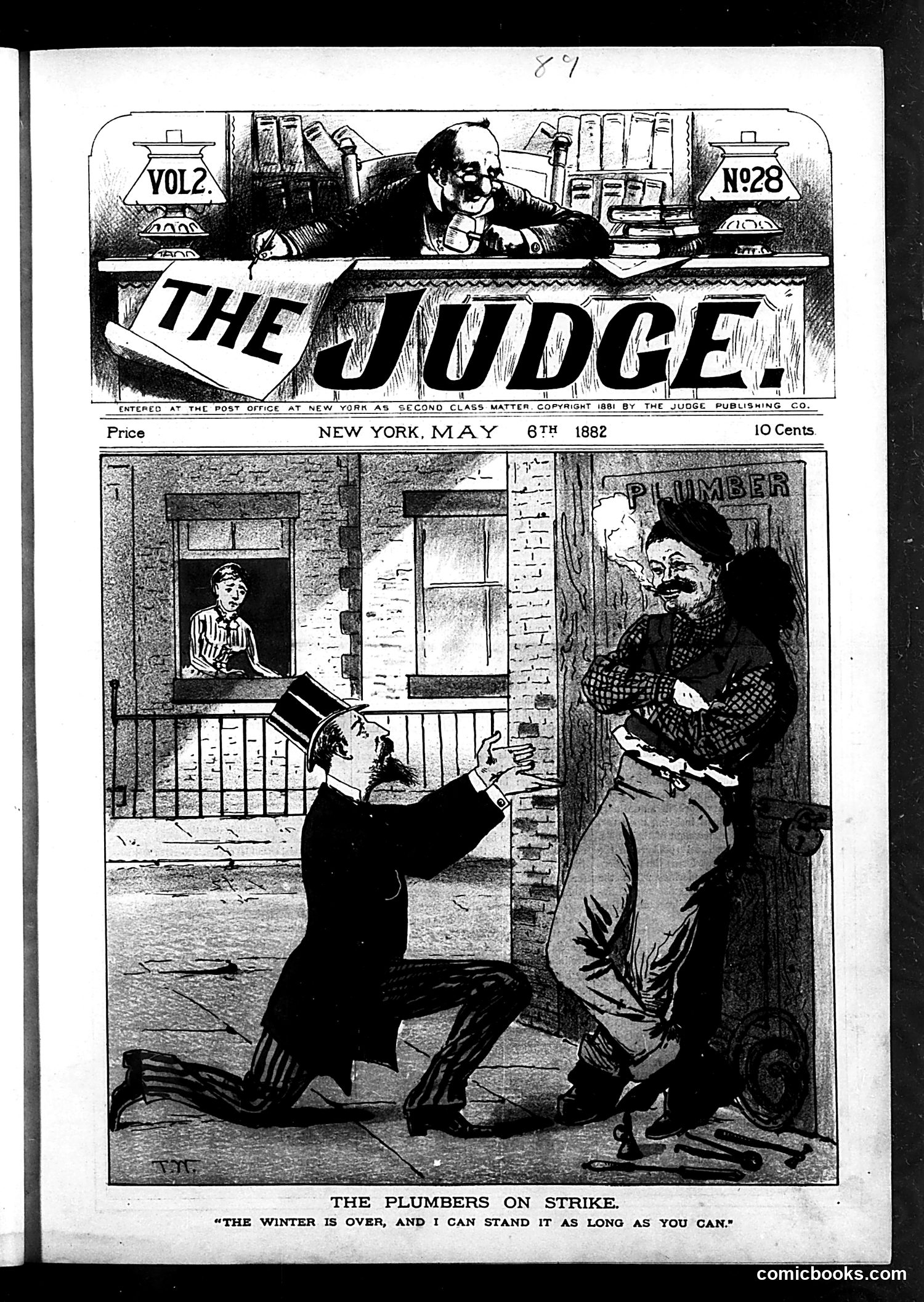
This May 1882 cartoon satirizes a plumbers' labor strike. The main illustration shows a well-dressed man on his knees, pleading with a burly plumber labeled "PLUMBER." The gentleman holds an empty wallet, suggesting financial desperation. A woman watches from a window above, implying domestic crisis. The caption reads: "The winter is over, and I can stand it as long as you can"—the gentleman's bluff assertion to the striking plumber that he can endure the work stoppage indefinitely. However, his posture and empty wallet contradict this boast, making the satire clear: homeowners are actually suffering badly from the strike and desperate for the plumbers to return. The cartoon mocks the striking workers by depicting the employer as pitiful rather than the workers as sympathetic—Judge magazine's typical pro-business stance during labor disputes of the Gilded Age.
This page from Judge contains two satirical articles attacking contemporary public figures and social problems circa the 1870s-80s. **"The Mighty Plumbers"** mocks plumbers' wage demands and their practice of accepting partial home payment for services—treating this as symptomatic of larger economic grievances alongside National Banks and railroads. **"Clear the Stage"** is the main satire, using moving day as metaphor to demand prominent politicians and figures vacate public life. It names James G. Blaine (Maine politician), Henry Ward Beecher (preacher), Ulysses S. Grant, Roscoe Conkling, Henry Bergh (animal welfare activist), and Samuel Tilden (associated with Tammany Hall corruption). The piece sarcastically imagines these figures reluctantly leaving office, suggesting they cling to power and positions despite their scandals or ineffectiveness. The "Castle Garden" reference alludes to corruption at this immigrant processing center. The satire reflects Gilded Age frustrations with entrenched political corruption and powerful individuals resisting reform.
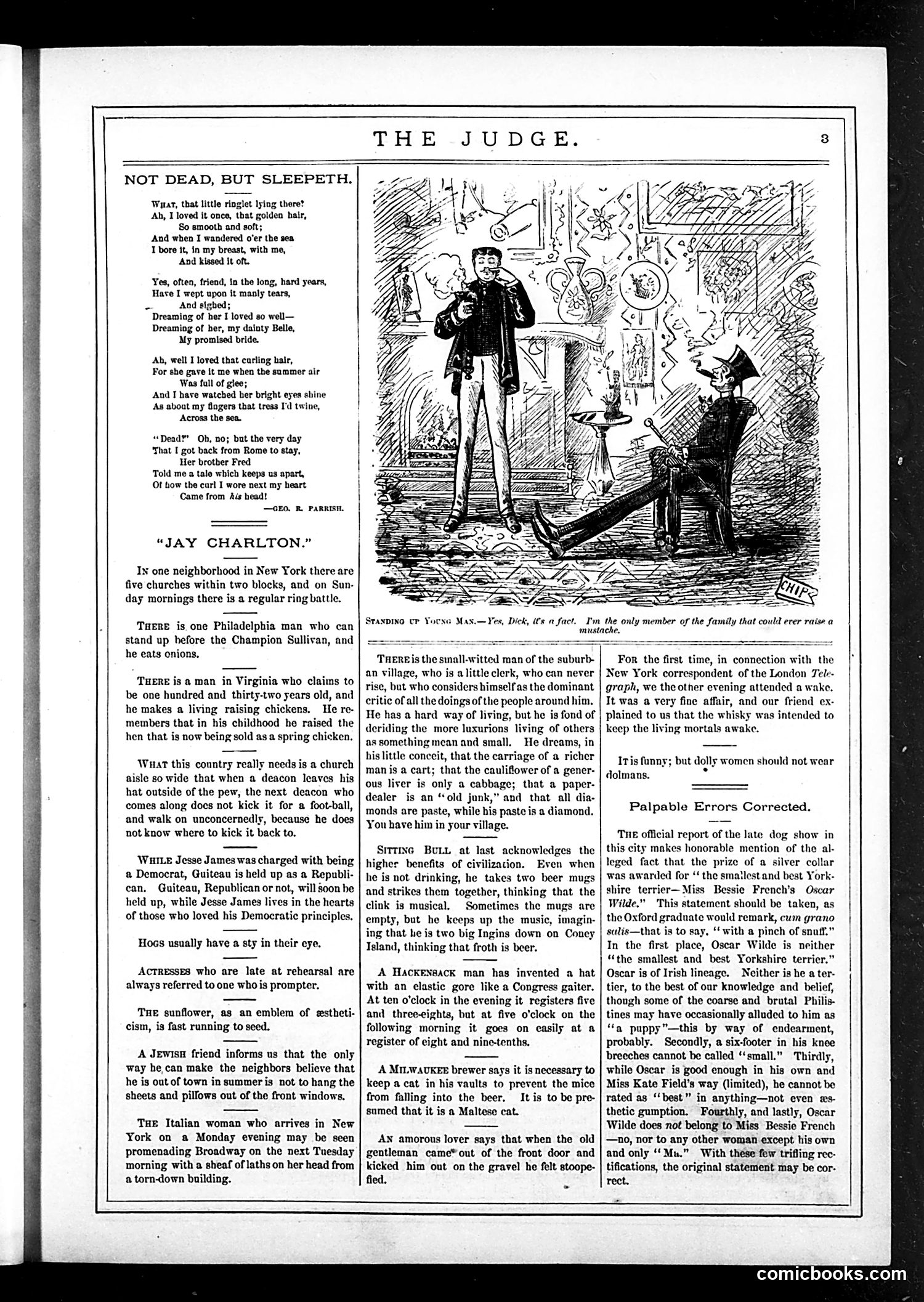
The main cartoon depicts a tall, thin man standing on stilts in a cluttered workshop, addressing a seated figure. The caption reads: "Standing of Young Man—Yes, Dick, it's a fact. I'm the only member of the family that could ever raise a mustache." **The satire:** This is a visual joke about masculine vanity and family pride. The absurdly tall man (literally elevated on stilts) boasts about his unique ability to grow facial hair, presenting it as a significant family distinction. The exaggerated posture—literally above others—mocks how men inflate trivial personal achievements into matters of importance. The surrounding text consists of brief social observations typical of Judge's satirical format: commentary on New York church rivalries, various character types (the small-minded suburban clerk, the philosophizing drunk), and humorous anecdotes about immigrants and urban life. These are disconnected vignettes poking fun at contemporary American social pretensions and behaviors, requiring no specific historical event knowledge to understand their general mockery of human folly.
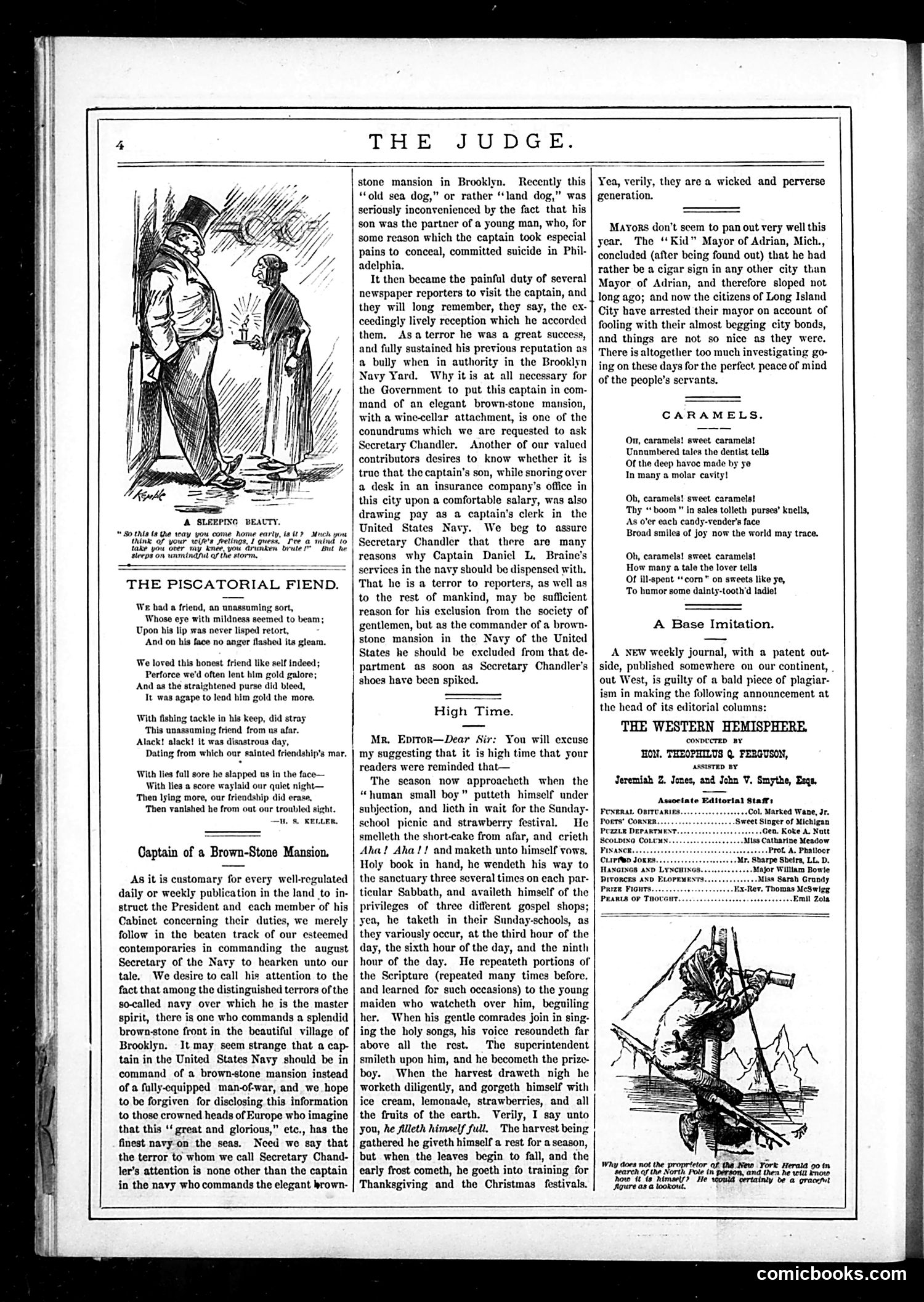
This satirical piece attacks **Captain Daniel L. Braine** of the U.S. Navy, who apparently commanded a Brooklyn mansion rather than a warship. The article mocks the absurdity through mock-serious language directed at **Secretary of the Navy William E. Chandler**, urging him to remove Braine. The satire centers on several scandals: Braine's son was business partner to a man who committed suicide in Philadelphia; Braine allegedly bullied newspaper reporters investigating this; and the son apparently drew Navy pay as a clerk while working in an insurance office. The cartoon illustrates the core hypocrisy: a U.S. Navy officer commanding a fashionable townhouse instead of naval vessels. This represents government corruption and nepotism—a Navy captain maintaining elite civilian status while drawing military salary, embodying the kind of political favoritism *Judge* regularly lampooned.
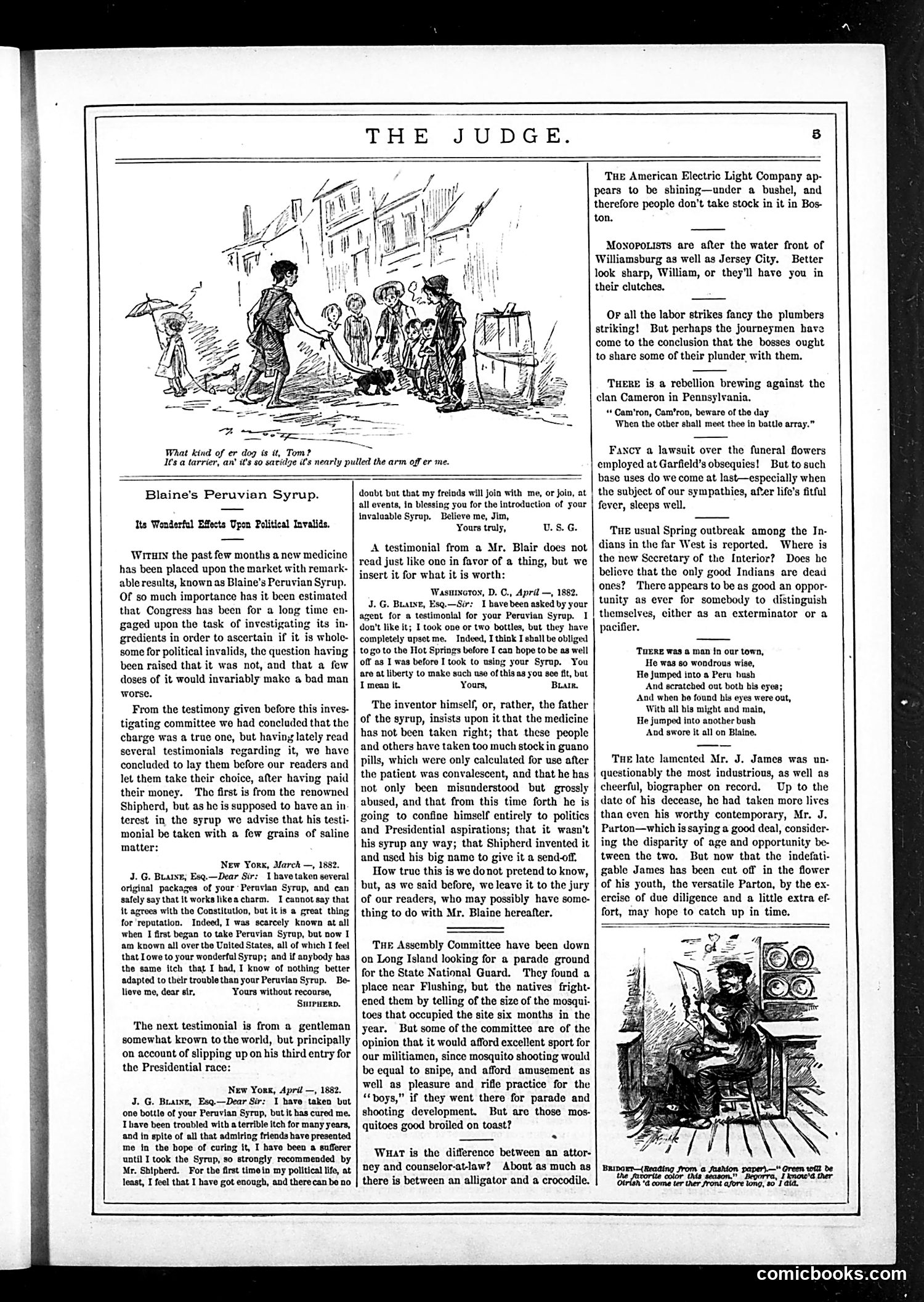
This satirical piece mocks James G. Blaine, the Republican politician, using a fake "medicine" as metaphor for his political career. The testimonials are from recognizable figures: Shepherd (likely Henry Ward Beecher), "Jim" (appears to reference Blaine's previous failed presidential runs), and Blair (likely Secretary of State James G. Blair), each offering deliberately contradictory "reviews." The joke: Blaine's reputation is the "illness" being treated. Some claim the syrup restored their prominence (like Blaine's 1884 presidential bid), while others report it made them worse. The cartoon above shows children being drugged—suggesting the "medicine" is actually poison masked as cure. The satire attacks Blaine's political ambitions and character, implying he's an unreliable quack whose remedy for political failure is worse than the disease itself. The false endorsements parody actual patent medicine advertising prevalent in 1880s America.
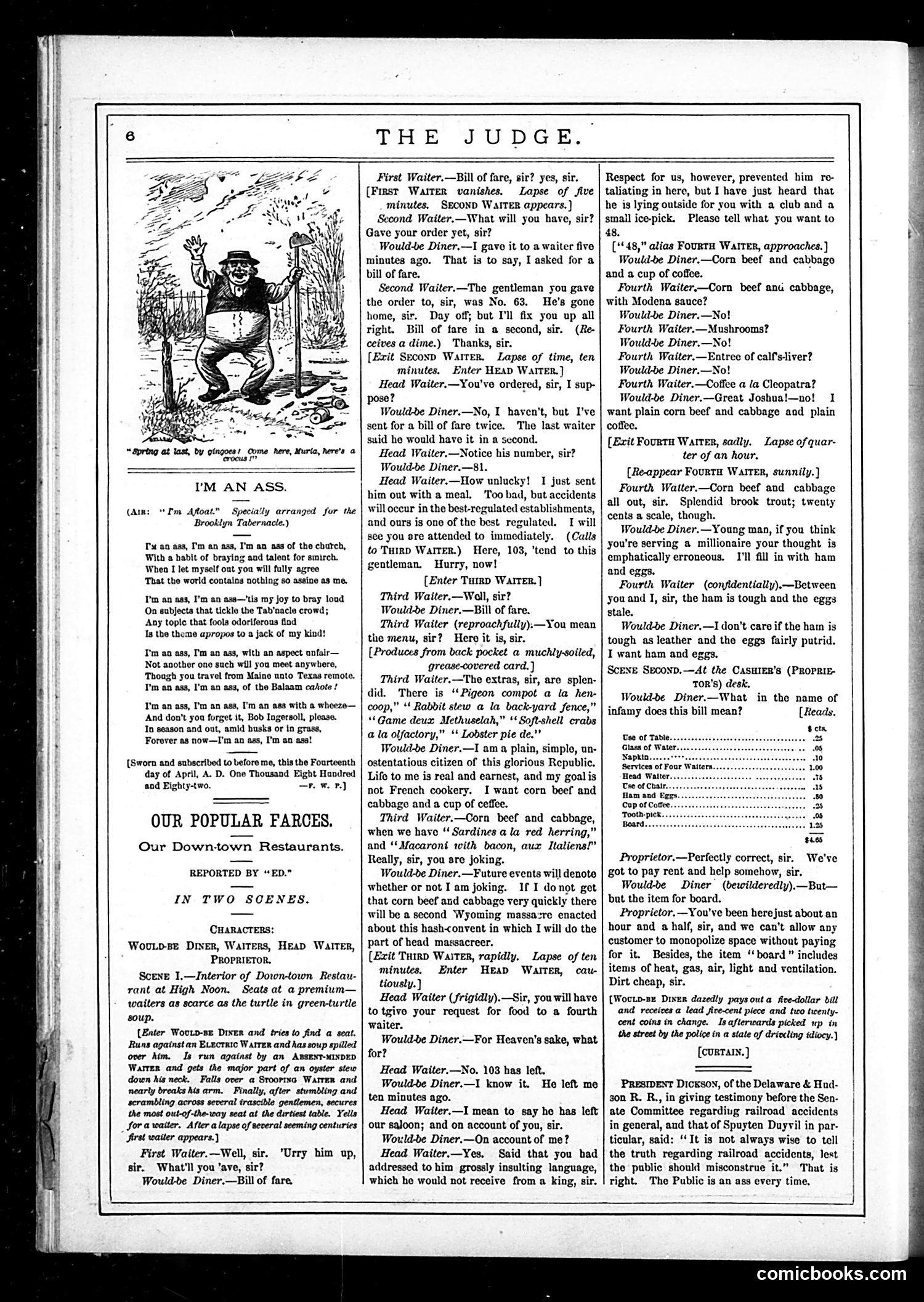
## "I'm an Ass" This appears to be a satirical attack on a specific preacher or public figure associated with the Brooklyn Tabernacle (a prominent evangelical church). The poem mocks someone who uses inflammatory rhetoric to entertain his congregation—braying loudly on controversial topics that appeal to crowds' prejudices. The reference to "Bob Ingersoll" (likely Robert Ingersoll, a famous agnostic lecturer) suggests the target is a preacher who attacks atheism or similar topics for crowd approval. The cartoon depicts a donkey-headed figure, literalizing the "ass" metaphor. ## "Our Popular Farces: Downtown Restaurants" This two-scene sketch satirizes the chaos and incompetence of New York restaurant service. A diner repeatedly gets lost between different waiters (numbered 63, 81, 103), each claiming ignorance of previous orders, with one conveniently sent out on a meal. The humor lies in depicting the restaurant industry's systematic dysfunction despite pretense of being "well-regulated."
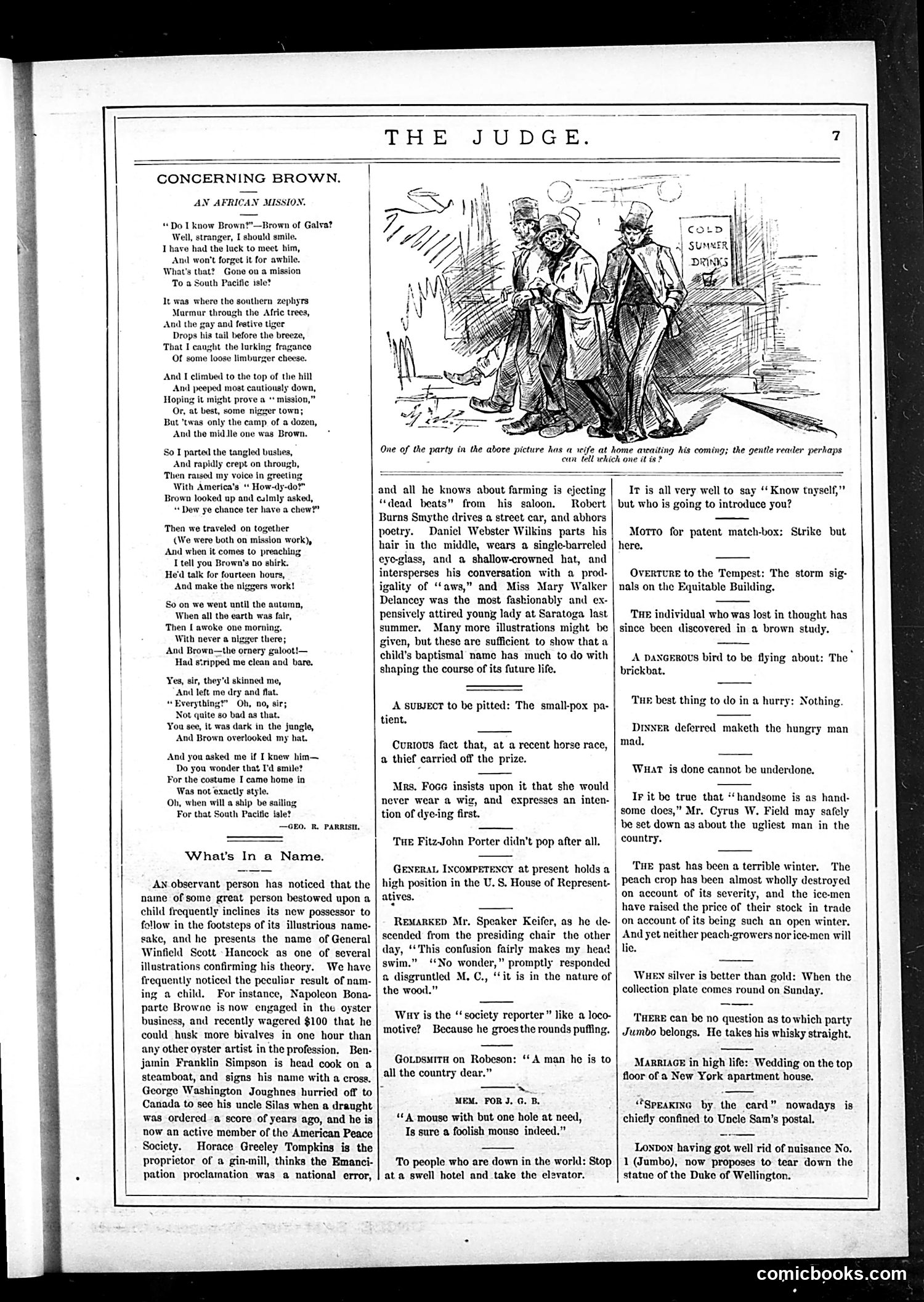
This page contains two main pieces of satire from Judge magazine: **"Concerning Brown"** is a humorous poem (by Geo. R. Parrish) mocking missionary work in Africa. The narrator encounters "Brown," a fellow missionary in the South Pacific who preaches extensively to local people but ultimately robs the narrator blind—leaving him only his hat. The satire targets both the incompetence and moral hypocrisy of some missionaries, portraying Brown as a charlatan who exploits the missionary enterprise for personal gain. **"What's In a Name"** satirizes the then-popular belief that naming children after famous historical figures (like General Winfield Scott Hancock or Benjamin Franklin) would influence their character. Judge ridicules this notion by listing ironically inappropriate namesakes: Napoleon Bonaparte Browne works in oysters, George Washington Joughnes became a railroad worker—contradicting their illustrious names' implications. The page also includes scattered one-liners mocking contemporary figures and absurdities, typical of Judge's satirical style. The overall tone is lighthearted social commentary rather than serious political critique.
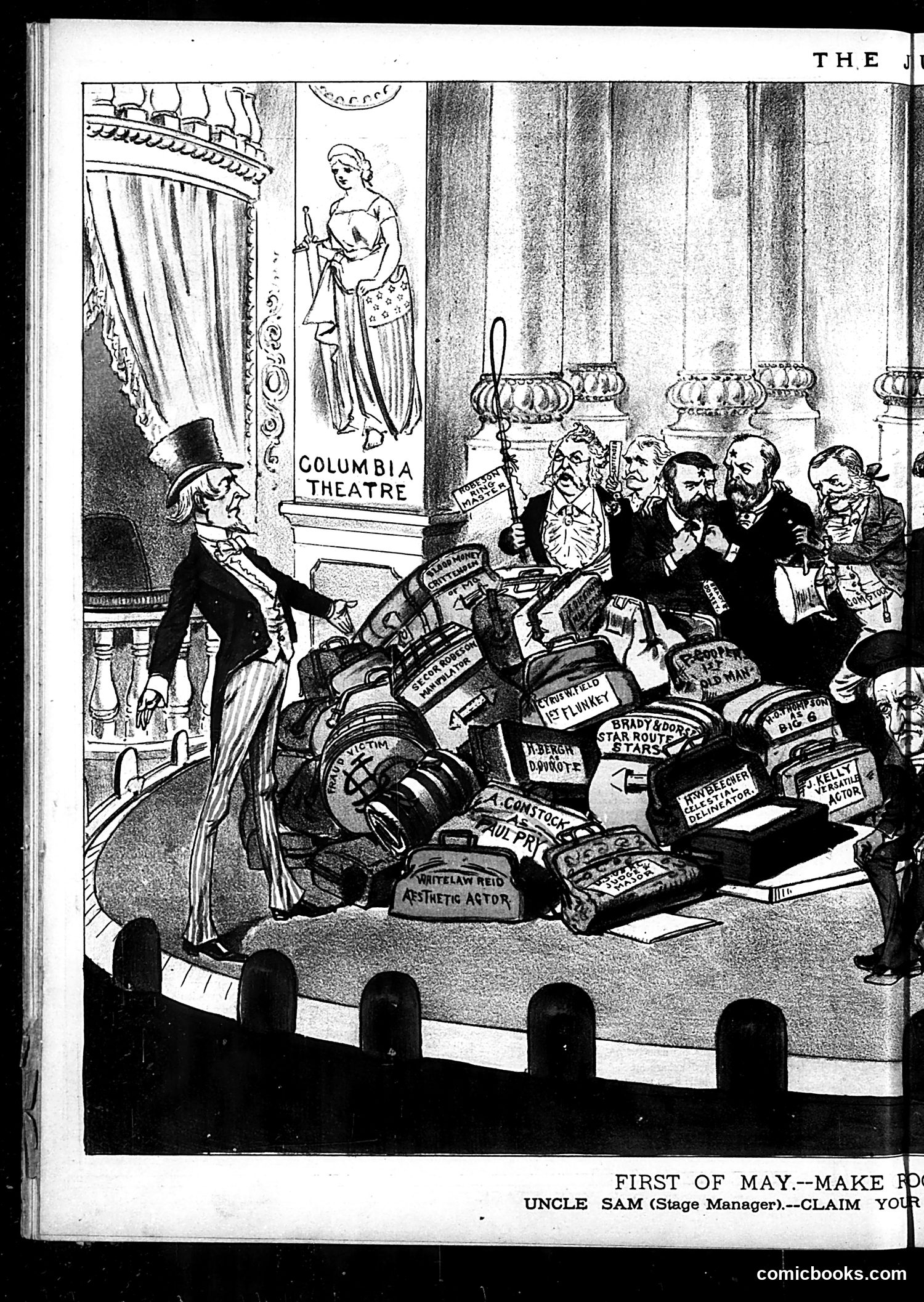
This is a political cartoon from Judge magazine showing Uncle Sam as a stage manager at the Columbia Theatre, confronted by several men holding large barrels labeled with names of theatrical actors and performers (including "Whitelaw Reid," "Star Route," and others). The men appear to be demanding or claiming something from Uncle Sam. The cartoon satirizes theatrical politics or patronage—likely depicting actors or performers attempting to claim roles, positions, or compensation from the government (represented by Uncle Sam). The "First of May" reference suggests this relates to traditional hiring/employment changes on that date. The barrels appear to represent accumulated demands or claims. The specific actors named are unclear without additional historical context, but the satire targets the scramble for government favor or theatrical appointments during this period.
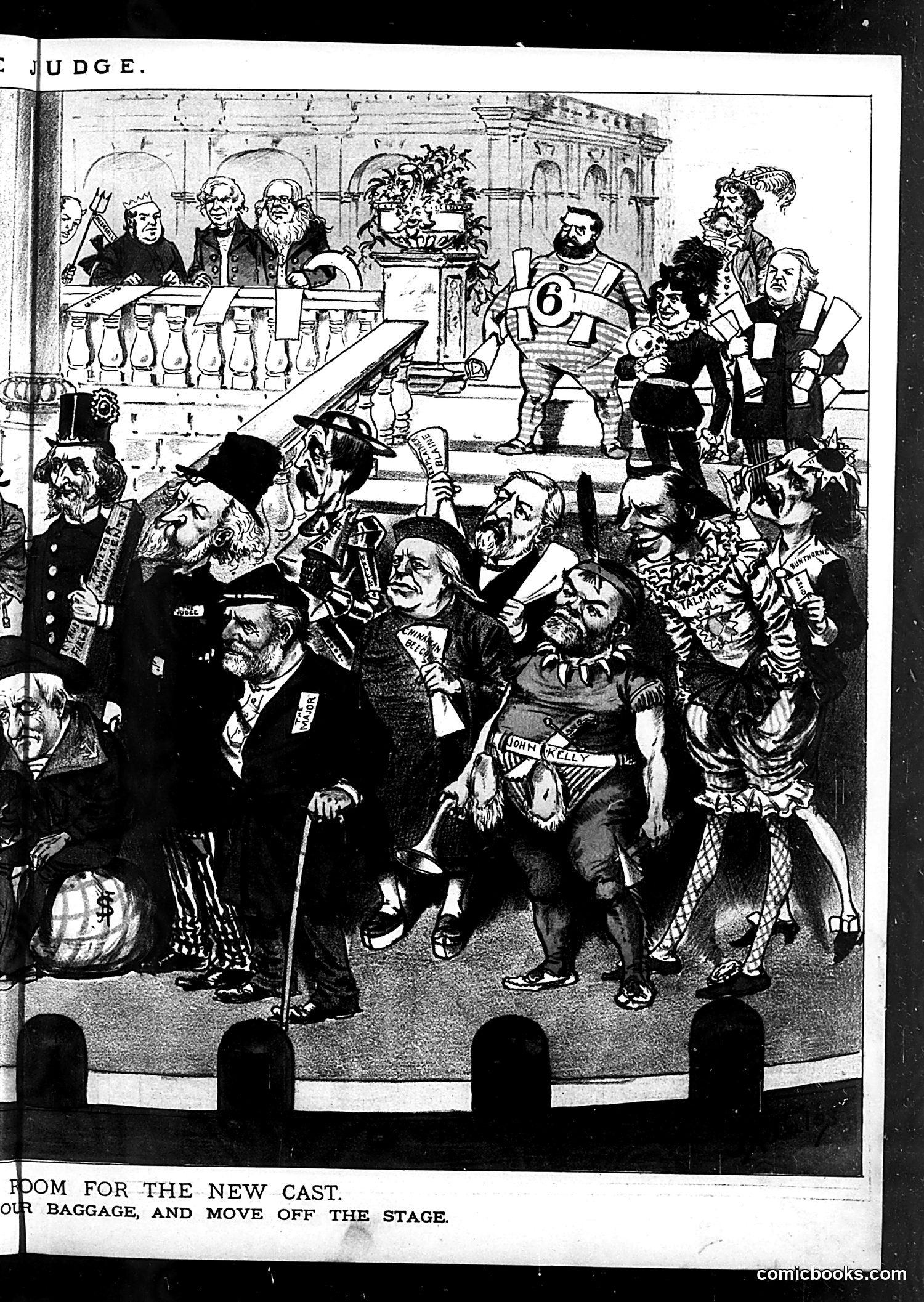
This Judge cartoon satirizes theatrical politics, depicting a crowded courtroom or stage where military and political figures jostle for position. The caption reads "Room for the New Cast—Our Baggage, and Move Off the Stage," suggesting commentary on government turnover or political reshuffling. The setting appears to be a formal judicial or legislative proceeding (note "JUDGE" at top), with caricatured figures in military uniforms and formal dress competing for prominence. A figure marked with "6" stands centrally, though his specific identity isn't clear from the image alone. The satire likely critiques either: - The chaos of replacing government officials - Military figures competing for political power - General political congestion and ego-driven maneuvering Without clearer identification of specific figures or a visible date, the exact historical moment remains unclear, though the style and content suggest late 19th or early 20th-century American politics.
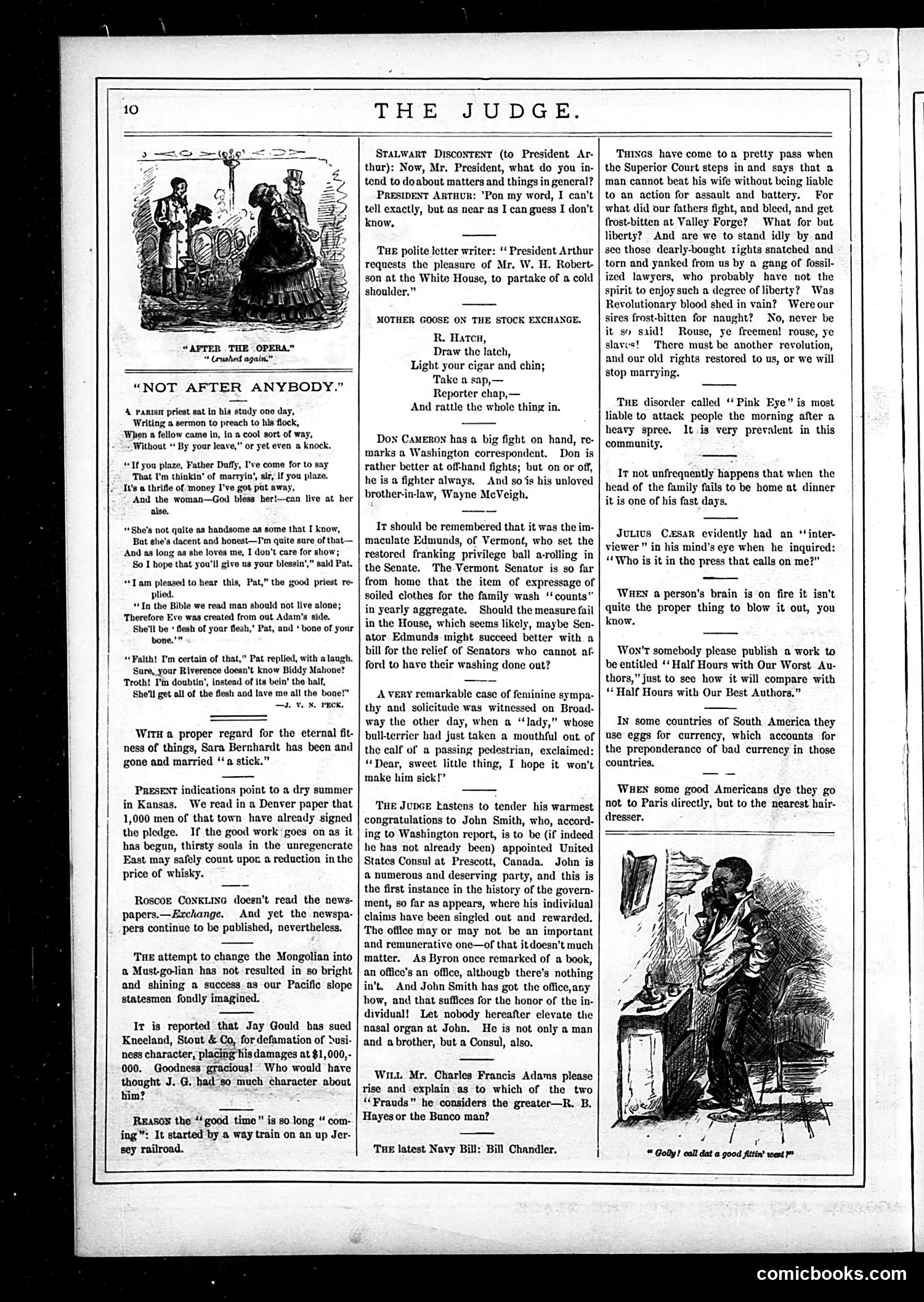
This page contains several brief satirical items mocking prominent figures and political issues of the era (appears to be 1880s based on references): **Main targets:** - **President Arthur**: Mocked for indecision and vagueness about governing policy - **W.H. Robertson**: Subject of a cold-shoulder joke (likely a patronage appointment dispute) - **Senator Edmunds (Vermont)**: Satirized for abusing the congressional franking privilege to mail dirty laundry home at public expense - **Don Cameron and Wayne McVeigh**: Criticized as quarrelsome - **Jay Gould**: Ridiculed for suing over defamation while having little "character" **Social commentary includes**: Sara Bernhardt's marriage ("a stick"), Kansas temperance pledges, and Chinese exclusion policy ("Must-go-lian"). The cartoons and brief humor pieces reflect Judge's role as a satirical publication critiquing government corruption, patronage politics, and the wealthy elite's questionable ethics during the Gilded Age.
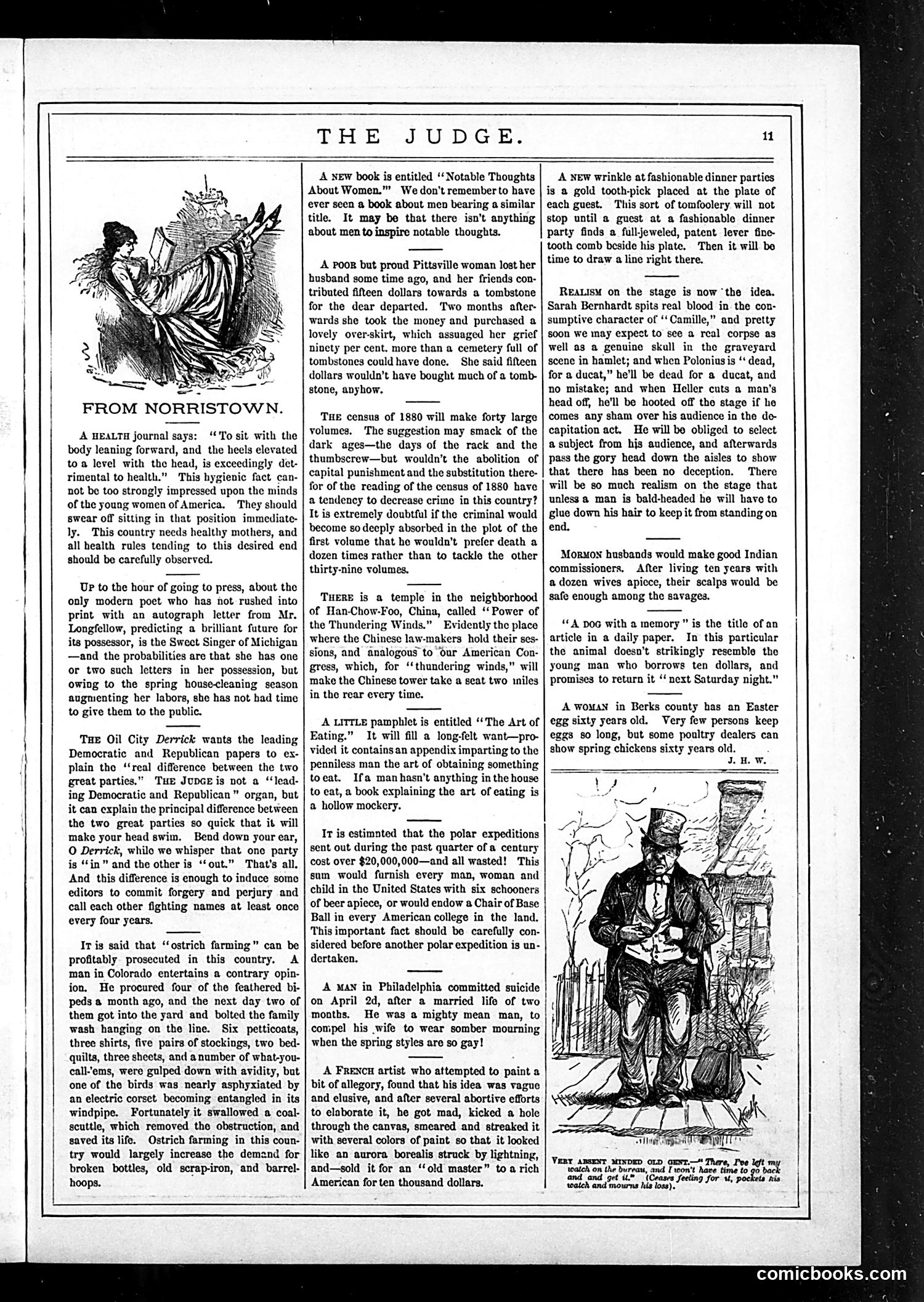
This page from *Judge* magazine contains several short satirical pieces mocking contemporary American life and politics circa 1880. **Key satire targets:** 1. **Women's health/fashion**: The opening piece ridicules young women sitting in supposedly unhealthy postures, sarcastically suggesting they need reform for the nation's future mothers. 2. **Literary pretension**: A jab at poets rushing to publish autograph letters praising Longfellow, with a sarcastic aside about Michigan's "Sweet Singer" (likely Julia Moore, a notoriously bad poet). 3. **Political hypocrisy**: Judge explains the "real difference" between Democrats and Republicans as merely being "in" versus "out" of power—suggesting both parties are equally self-serving and willing to commit fraud against each other. 4. **Ostrich farming absurdity**: A humorous anecdote about ostriches eating laundry and nearly choking on a corset, mocking the get-rich-quick farming scheme fad. The accompanying illustration (bottom right) appears to show a Victorian-era figure, likely related to one of these satirical pieces, though the specific reference is unclear from the image alone.
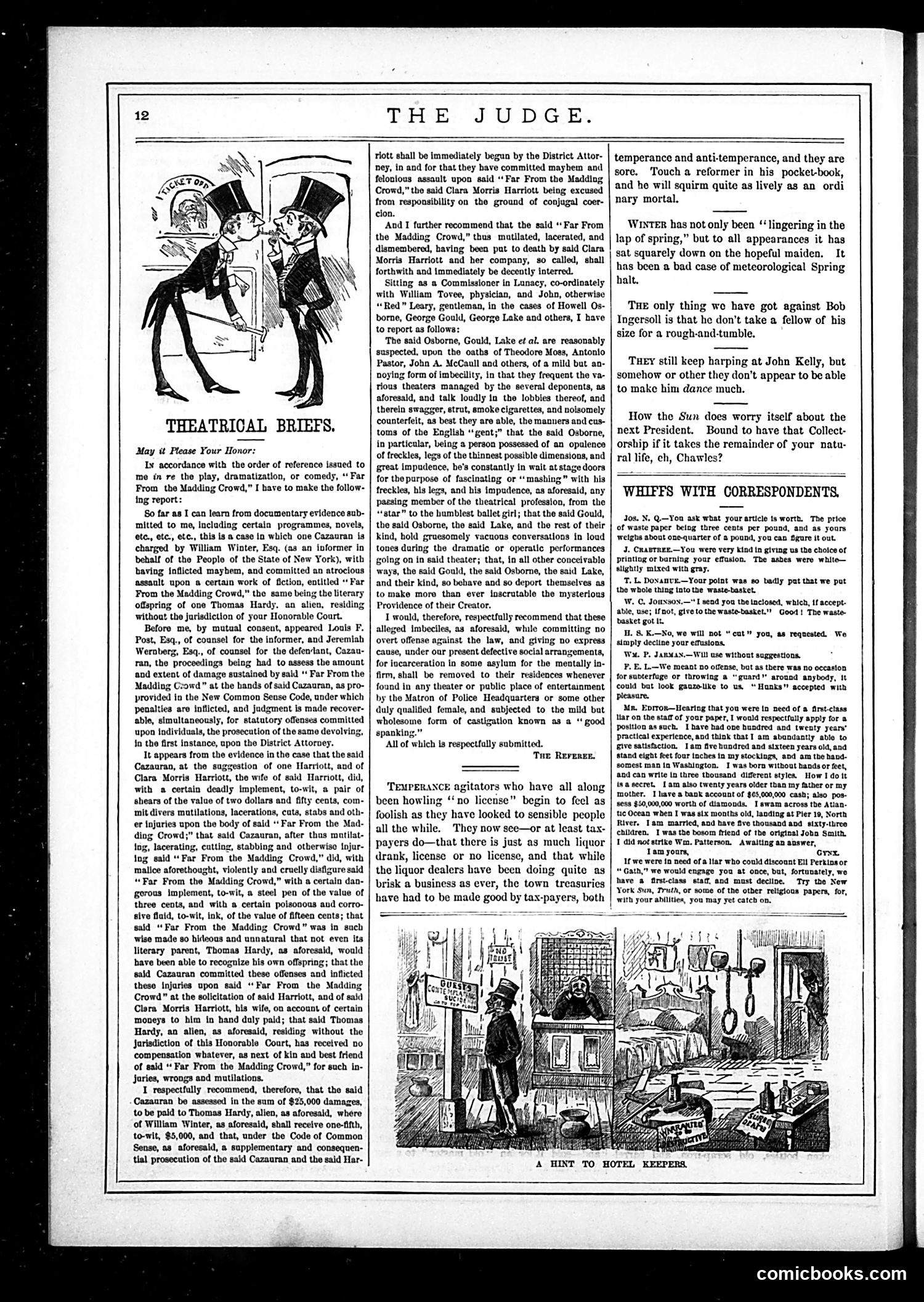
This Judge satirical "court case" mocks a theatrical adaptation of Thomas Hardy's novel. The complainant is William Winter (a real theater critic), who charges adapter Cazauran with "mayhem" and "assault" on Hardy's literary work—using absurdly legal language to describe dramatization. The joke targets both the adapter's allegedly poor stage version and Winter's overwrought critical outrage. The verdict recommends $25,000 damages to Hardy (the author, an "alien" outside U.S. jurisdiction), with Winter receiving $5,000—satirizing how critics position themselves as literary guardians while seeking personal benefit. The bottom illustration, "A Hint to Hotel Keepers," appears unrelated—a separate satirical cartoon about hotel management.
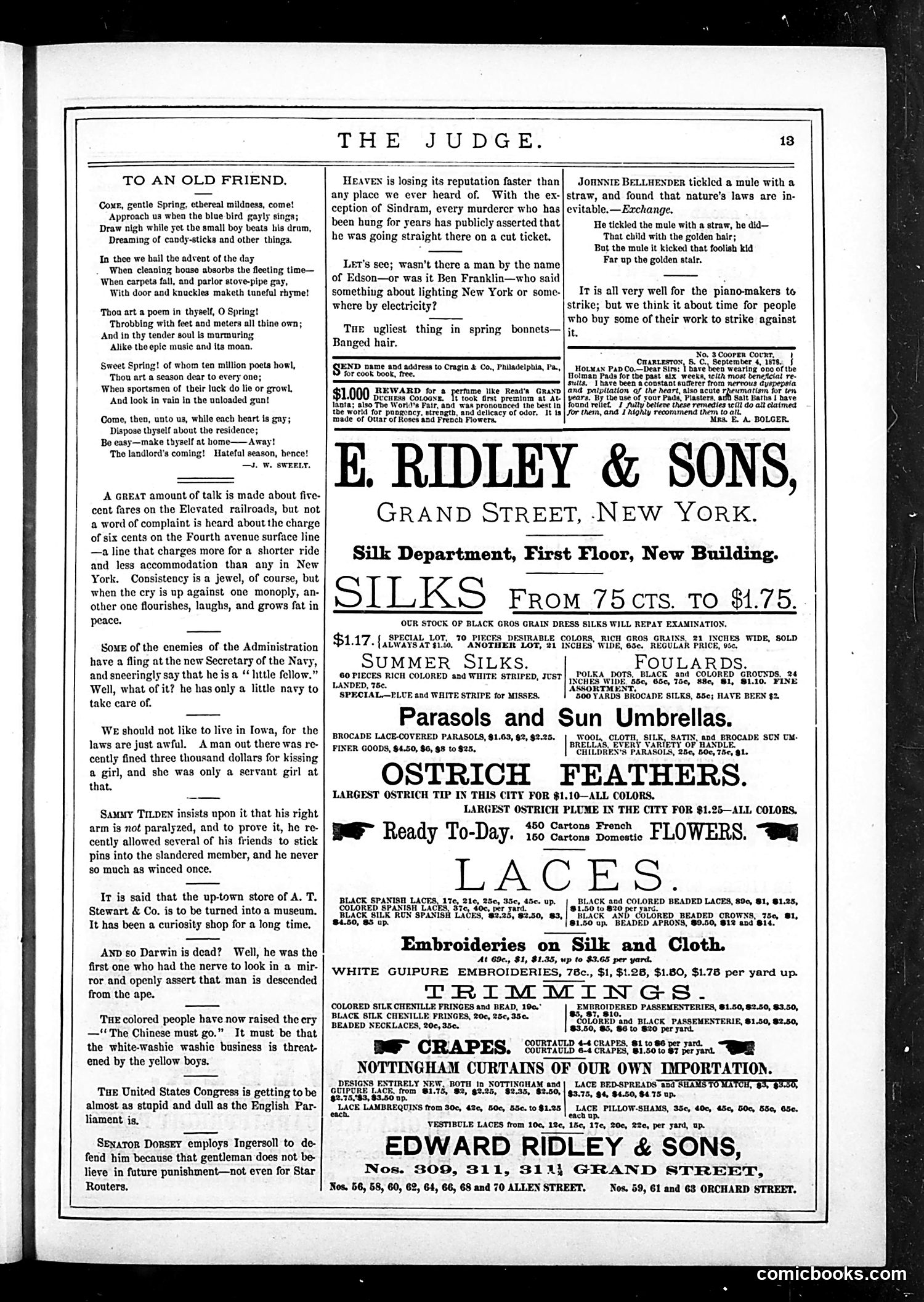
This page is primarily **advertising and light satirical commentary** rather than political cartoons. The content includes: **Satirical pieces** (left column): Short, witty jabs at contemporary issues—five-cent trolley fares, Secretary of Navy criticism, Iowa's strict kissing law ($3,000 fine), Samuel Tilden's paralysis rumors, and a joke about murdered criminals claiming deathbed conversions to heaven. **The "Johnnie Bellhender" item**: A dark humor anecdote about a child tickling a mule with a straw, resulting in the mule kicking the child "far up the golden stair"—a euphemism for death. **Darwin reference**: Mocking those who criticized Darwin's evolution theory as suggesting humans descended from apes. **The bulk of the page**: Large advertisements for E. Ridley & Sons (silks, laces, parasols, ostrich feathers) on Grand Street, New York. The satire targets 1880s-era monopolies, political figures, social absurdities, and religious hypocrisy—typical Judge magazine fare—but lacks sustained narrative cartooning on this particular page.
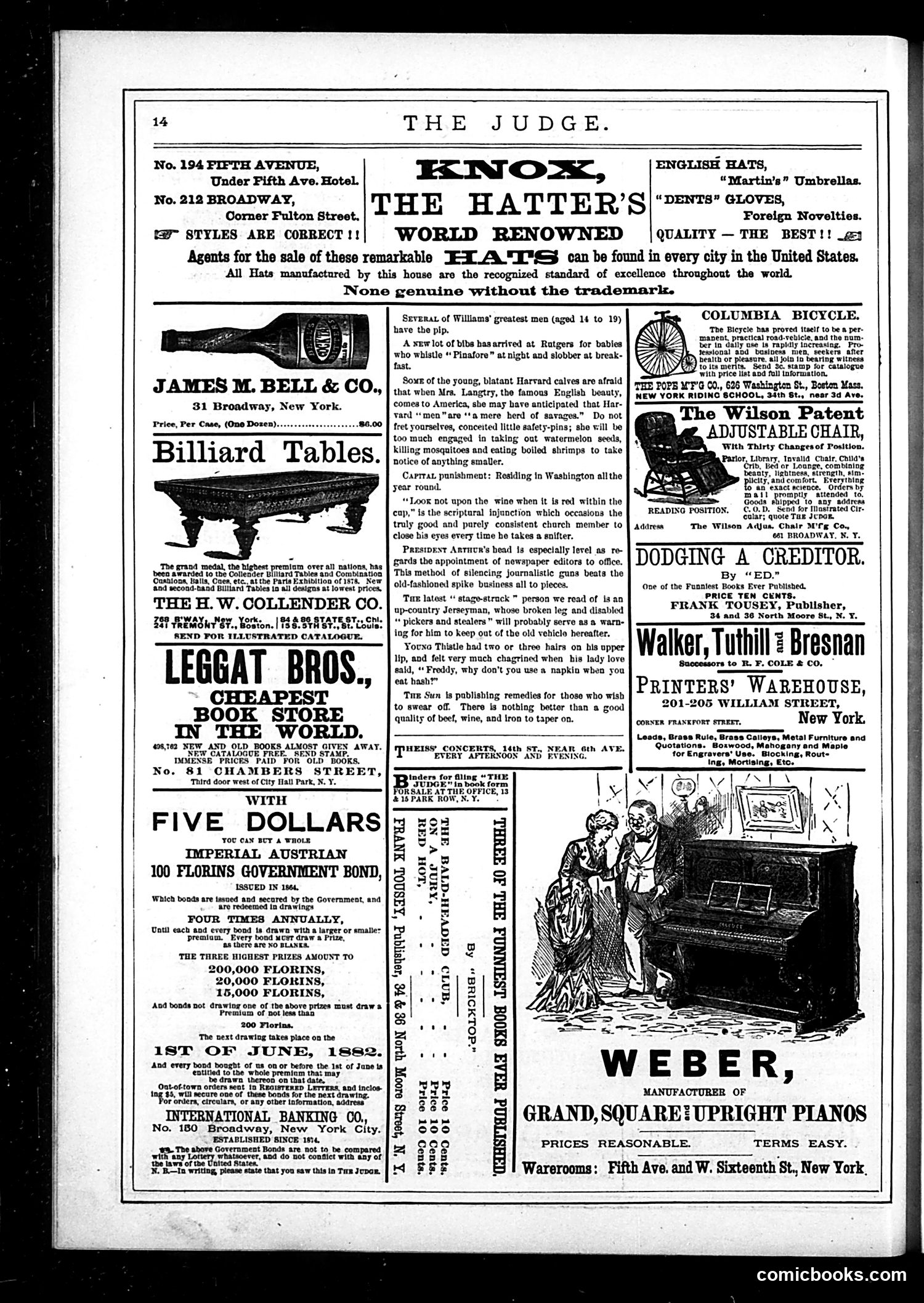
This is primarily an **advertising page** with scattered satirical commentary rather than a unified cartoon. The main visual is an illustration (bottom right) accompanying a caption about "THERE IF THE FUNNIEST BONES IN PARLIAMENT"—likely a joke about British politicians, showing figures at what appears to be a piano or organ. The page's satirical content consists of brief, disconnected jabs at various targets: Harvard students ("young, blatant Harvard calves" worried about impressing actress Lillie Langtry); church hypocrisy (clergy ignoring temperance teachings); and President Arthur's appointment of newspaper editors to silence critical journalism. The humor relies on period-specific references (Lillie Langtry's American tour, Gilbert & Sullivan's *HMS Pinafore*) now requiring historical context. Most of the page promotes pianos, billiard tables, bonds, and books—the advertisements that funded Judge's publication.
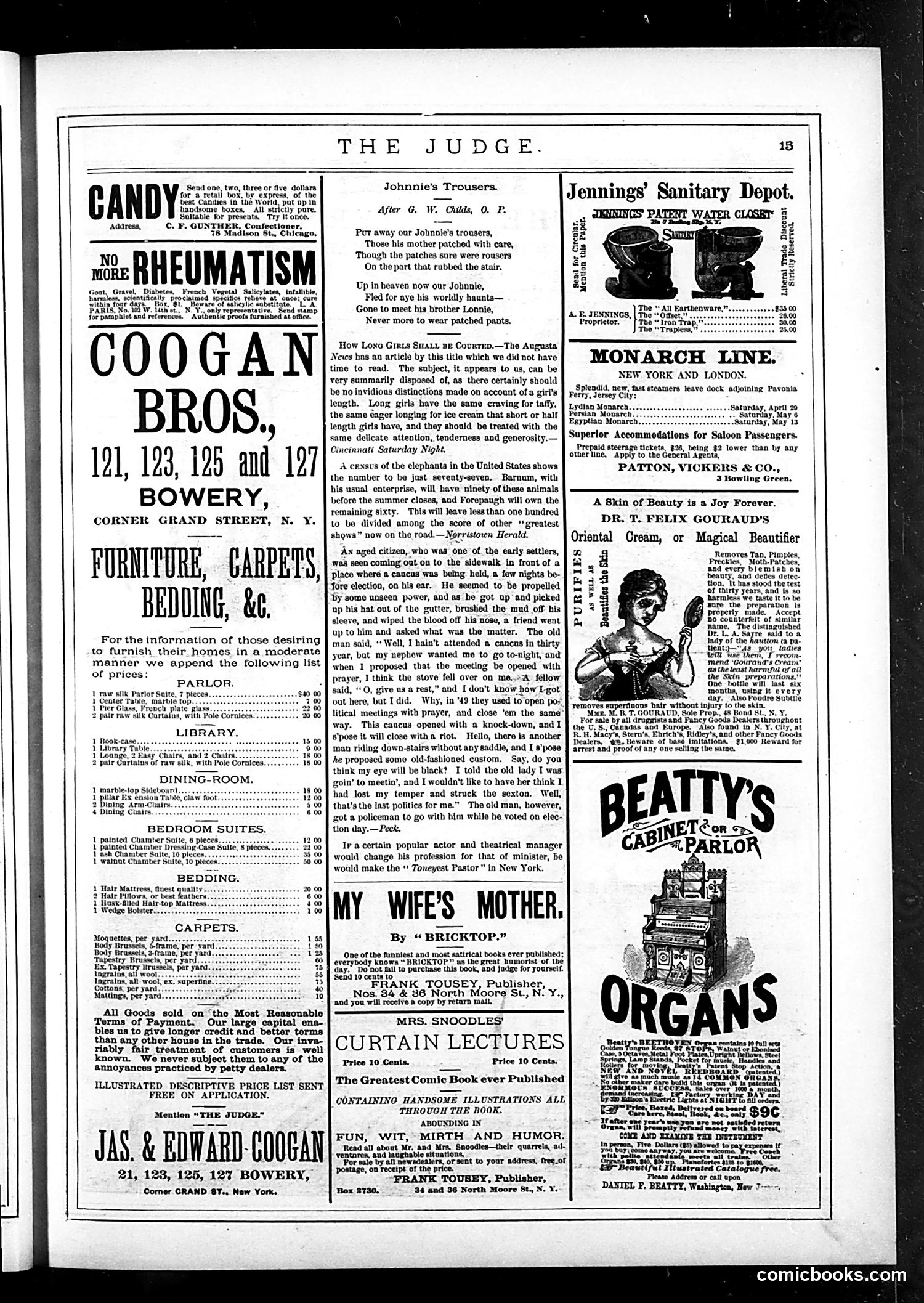
This page is primarily **advertising and filler content**, not political satire. It consists mostly of commercial notices for furniture dealers (Coogan Bros.), candy makers (Gunther), and patent medicines (rheumatism cure). The only substantive editorial content includes: 1. **"Johnnie's Trousers"** — a sentimental poem about a deceased child, parodying popular 19th-century mourning verse 2. **Short humorous items** about long girls needing taffy, elephant census statistics (likely poking fun at P.T. Barnum's showmanship), and an anecdote about an elderly voter being physically ejected from a political caucus meeting These brief pieces reflect typical *Judge* humor: social commentary on courtship customs, show business rivalry, and rough political behavior. The electoral violence reference suggests the post-Civil War era's contentious campaign practices. The page demonstrates *Judge*'s business model: selling advertising space to support satirical content.
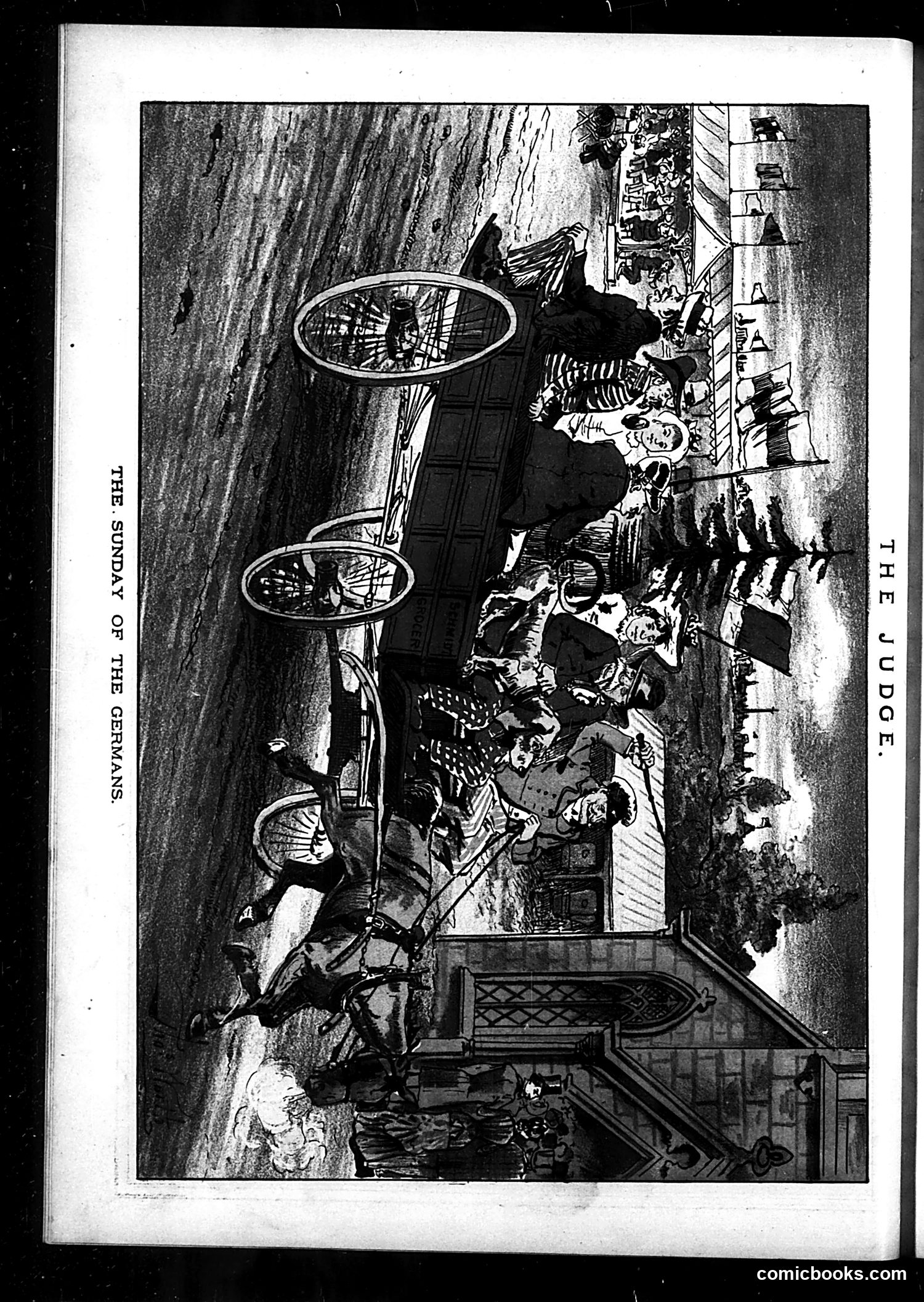
This is a satirical illustration titled "The Sunday of the Germans" from *Judge* magazine. The cartoon depicts a crowded German beer garden or public gathering scene, rendered in black and white with detailed cross-hatching. The image appears to satirize German-American cultural practices and social customs, likely referencing the substantial German immigrant population in America and their distinctive leisure activities. The composition emphasizes the boisterous, convivial atmosphere typical of such establishments—people eating, drinking, and socializing. Without a clear date visible, the cartoon's specific historical context remains uncertain, though the style suggests late 19th or early 20th century. The satire targets recognizable cultural stereotypes about German recreation and social habits that contemporary American readers would have found familiar or amusing.