
A complete issue · 22 pages · 1881
Judge — December 31, 1881
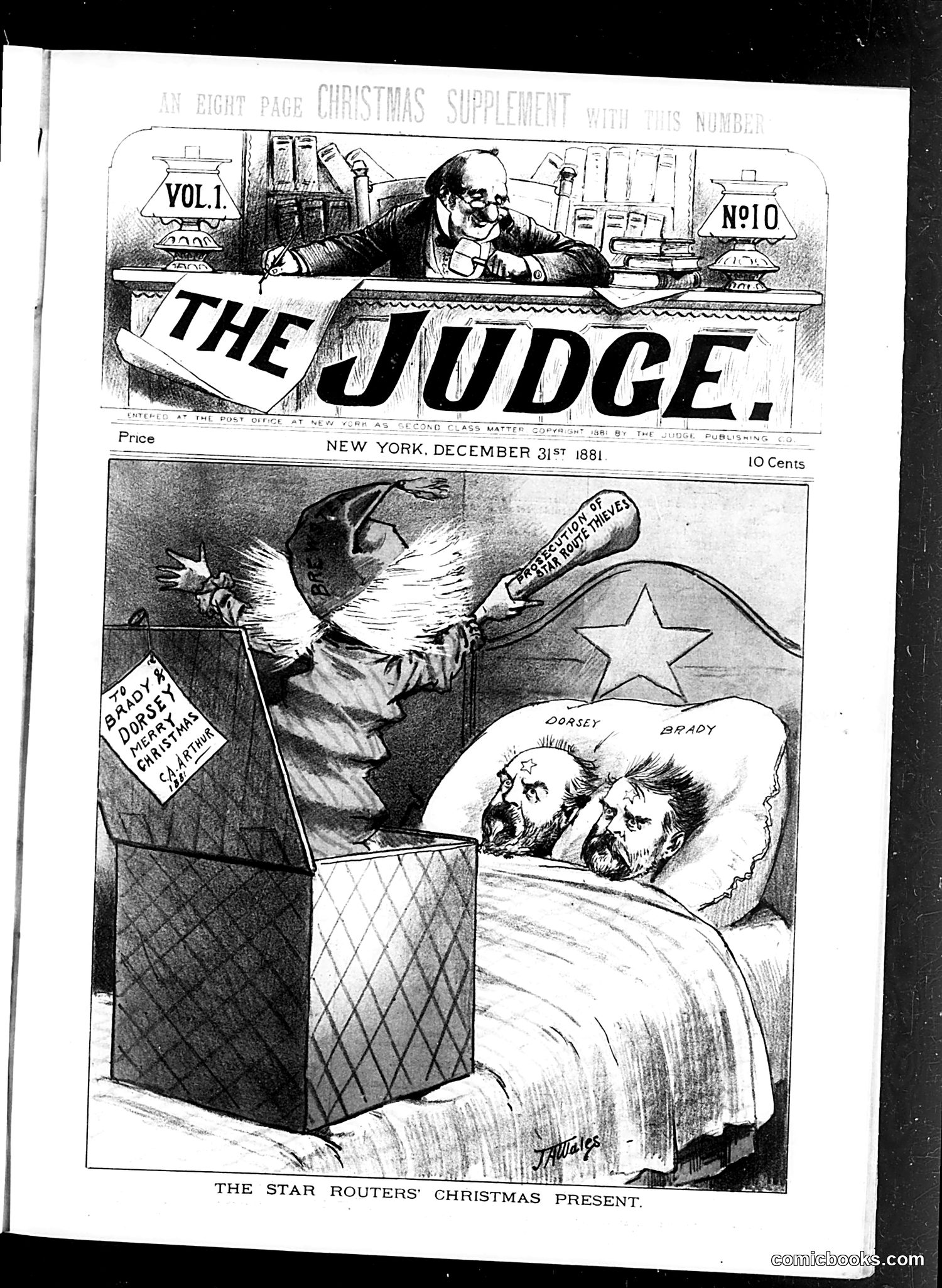
This political cartoon satirizes the "Star Route" scandal, a major corruption case of the early 1880s involving postal contractors who defrauded the U.S. government. The illustration shows Santa delivering a gift containing what appears to be two bearded men (likely implicated contractors) to figures labeled "Dorsey" and "Brady"—prominent defendants in the scandal. The "present" is darkly comic: rather than gifts, corrupt officials receive exposure and consequences. The club labeled "PROSECUTION NEVER FAILS" and the star (referencing the "Star Routes") reinforce the satirical message that wrongdoers will face justice. The cartoon mocks the scandal's high-profile nature and celebrates anticipated prosecutions of those involved in the postal fraud scheme.
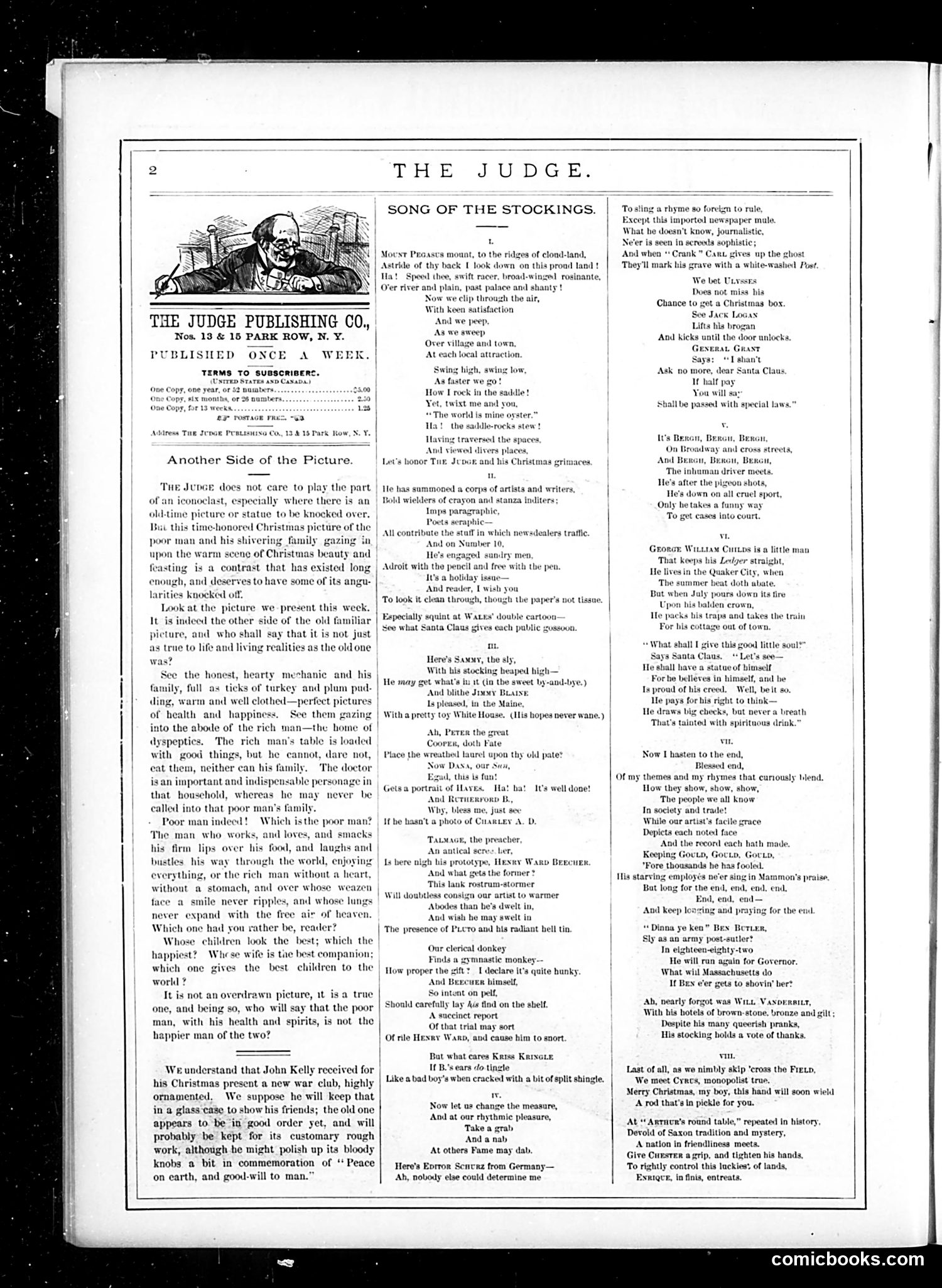
This page presents a sentimental critique of the traditional "poor family gazing at rich family's Christmas" tableau. Judge inverts the stereotype: the mechanic and his family are depicted as healthy, happy, well-fed, and content, while the wealthy man is sickly, dyspeptic, and miserable despite his material abundance. The satire argues that genuine happiness derives from honest labor and family warmth, not wealth—a populist message common to Gilded Age humor. The accompanying "Song of the Stockings" is festive verse celebrating Christmas, with references to contemporary political figures (likely including mentions of local politicians receiving satirical commentary). A brief note about John Kelly receiving a "war club" appears to reference a specific scandal or violent incident, though the exact context is unclear without additional historical documentation. The page is primarily editorial/literary content rather than visual cartooning.
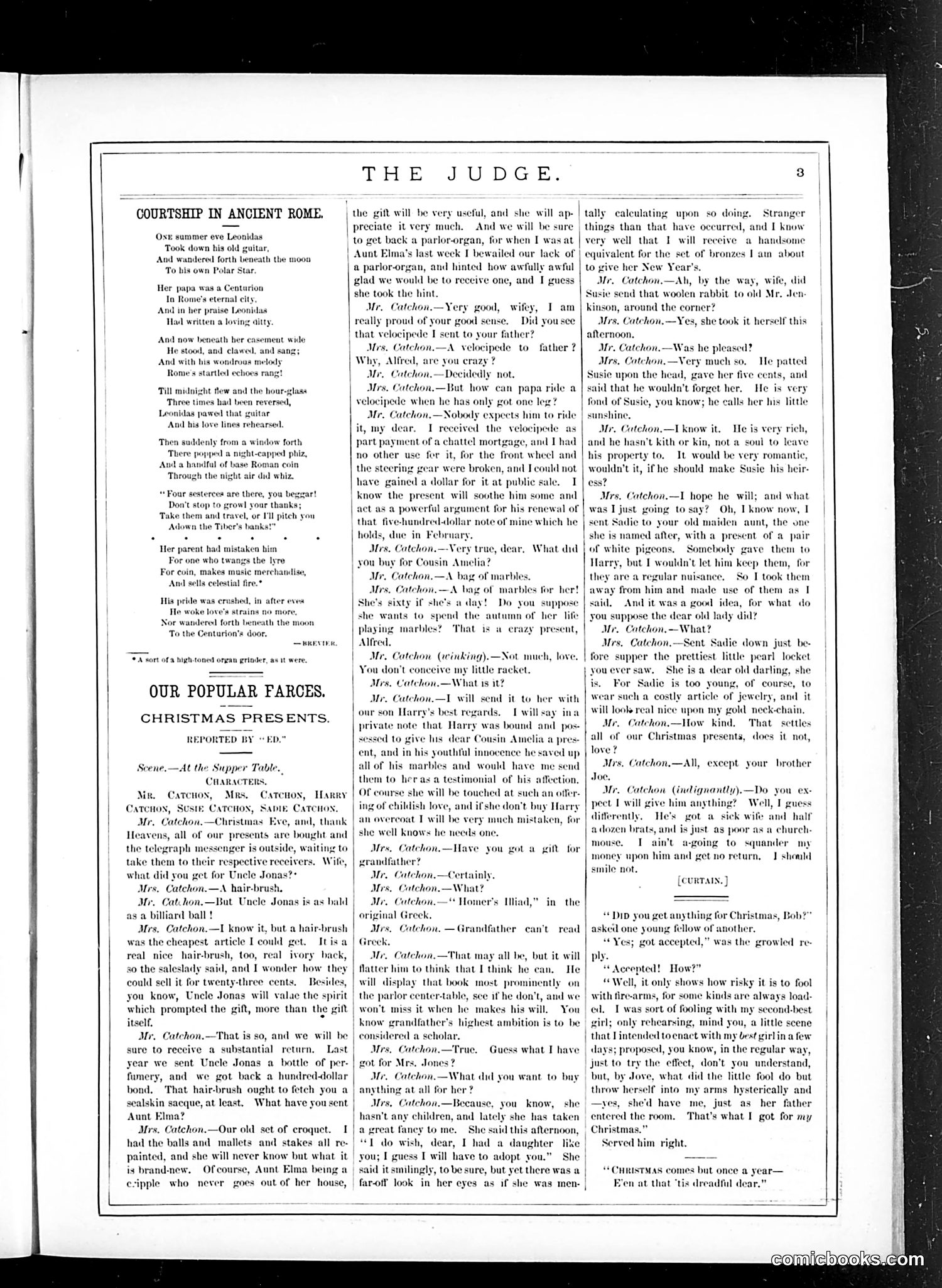
This page contains two unrelated pieces of Victorian-era satire: **"Courtship in Ancient Rome"** is a humorous narrative poem mocking sentimental romantic literature. It depicts Leonidas serenading his beloved with a guitar beneath her window, only to be pelted with coins by her father (a Roman centurion) who mistakes him for a street musician. The joke ridicules both overwrought romantic gestures and the misunderstanding that destroys them—poking fun at the melodramatic courtship tales popular in contemporary fiction. **"Christmas Presents"** is a domestic farce satirizing gift-giving hypocrisy among the middle class. The Catchon family strategically gives cheap, unwanted items (a hairbrush to a bald uncle, a broken velocipede) expecting lavish returns—revealing how "generosity" is actually calculated investment. The satire exposes the transactional nature hidden beneath polite gift-giving customs of the era. Both pieces mock human vanity and pretense through exaggerated scenarios.
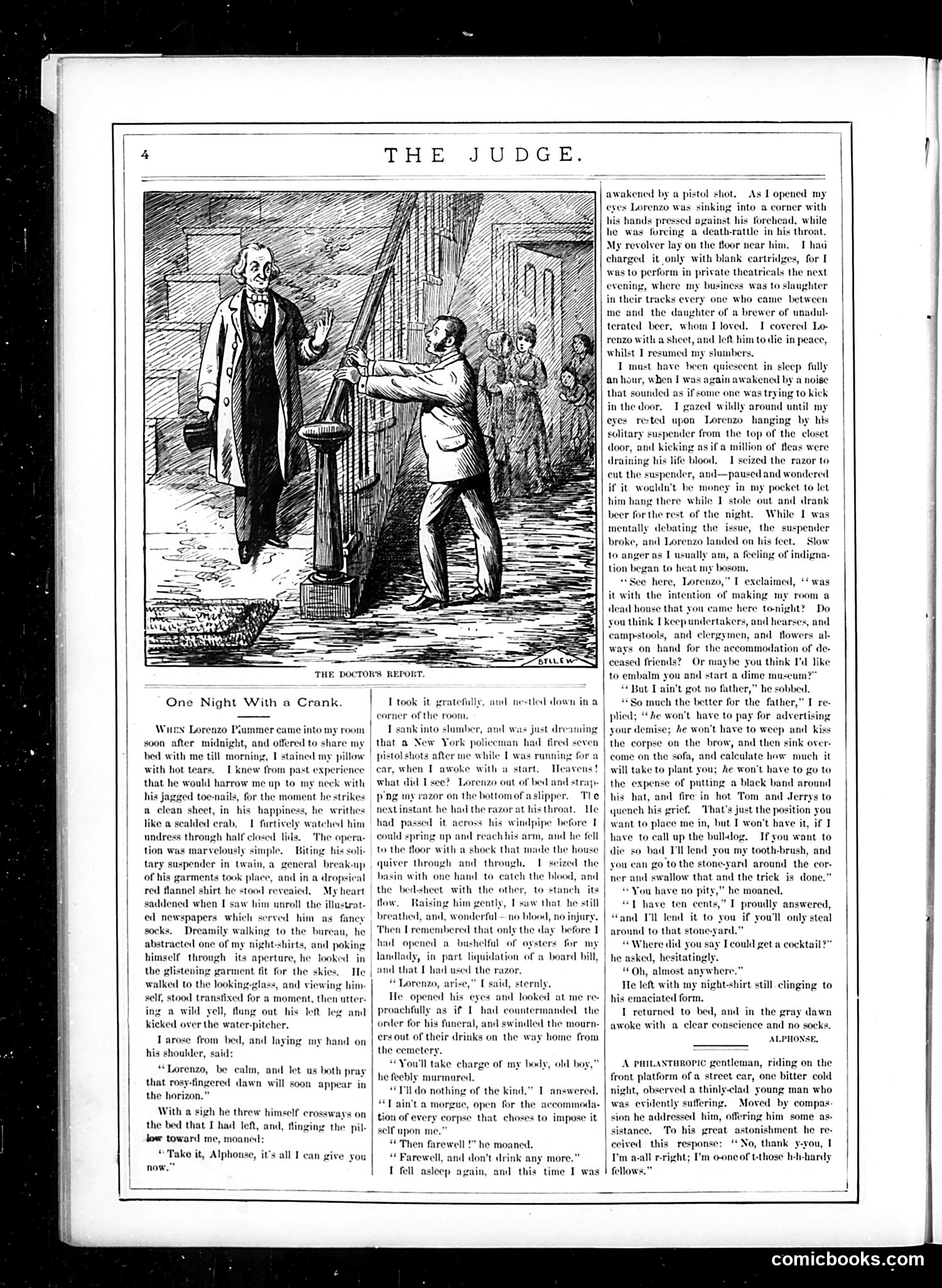
This is a humorous short story with accompanying illustration rather than a political cartoon. The narrative satirizes the disruptive houseguest archetype—specifically a character named Lorenzo Plummer who is apparently a chronic troublemaker and deadbeat. The joke targets social parasites: Lorenzo repeatedly causes mayhem (breaking furniture, kicking water pitchers, staging fake suicide attempts) while evading consequences. The narrator gradually realizes Lorenzo's chaos is deliberate manipulation—he'd swindled mourners at funerals and now imposes on the narrator's hospitality with escalating pranks and fake crises. The humor lies in the narrator's growing exasperation and the absurdist situations: contemplating whether to let Lorenzo hang himself, keeping blank cartridges in his revolver for theatrical purposes. The illustration shows a disheveled Lorenzo confronting the narrator indignantly. This exemplifies Judge's social satire about freeloaders and moral degenerates disrupting respectable households—common targets of late 19th-century American humor.
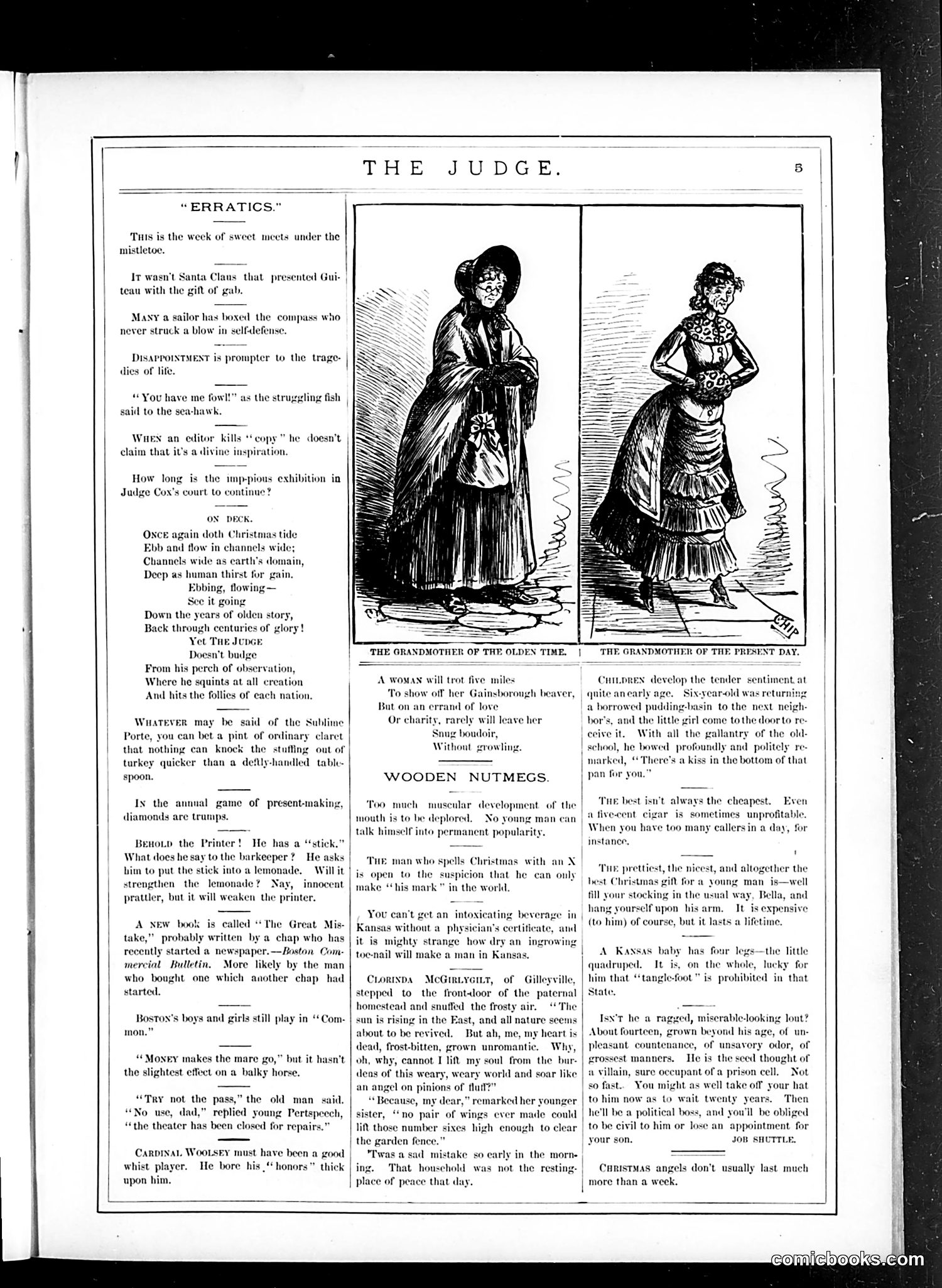
This page from *Judge* contains miscellaneous satirical commentary rather than a single political cartoon. The two illustrations compare "The Grandmother of the Olden Time" with "The Grandmother of the Present Day"—a social satire contrasting Victorian-era propriety with modern women's fashion and behavior. The "Erratics" column offers brief, cynical observations on contemporary American life: editorial hypocrisy, legal proceedings, Christmas commercialism, and human folly. References to "Judge Cox's court" suggest ongoing legal scandal, though the specific case isn't identified here. "Wooden Nutmegs" discusses social absurdities: physical development standards for men, Christmas spelling conventions, alcohol prohibition in Kansas, and Kansas babies' unusual anatomy ("four legs"). The final item mocks young women's marriage prospects, implying an expensive but lifetime commitment. The humor relies on period-specific social anxieties—changing gender roles, prohibition, and modernization—rather than immediately recognizable political figures.
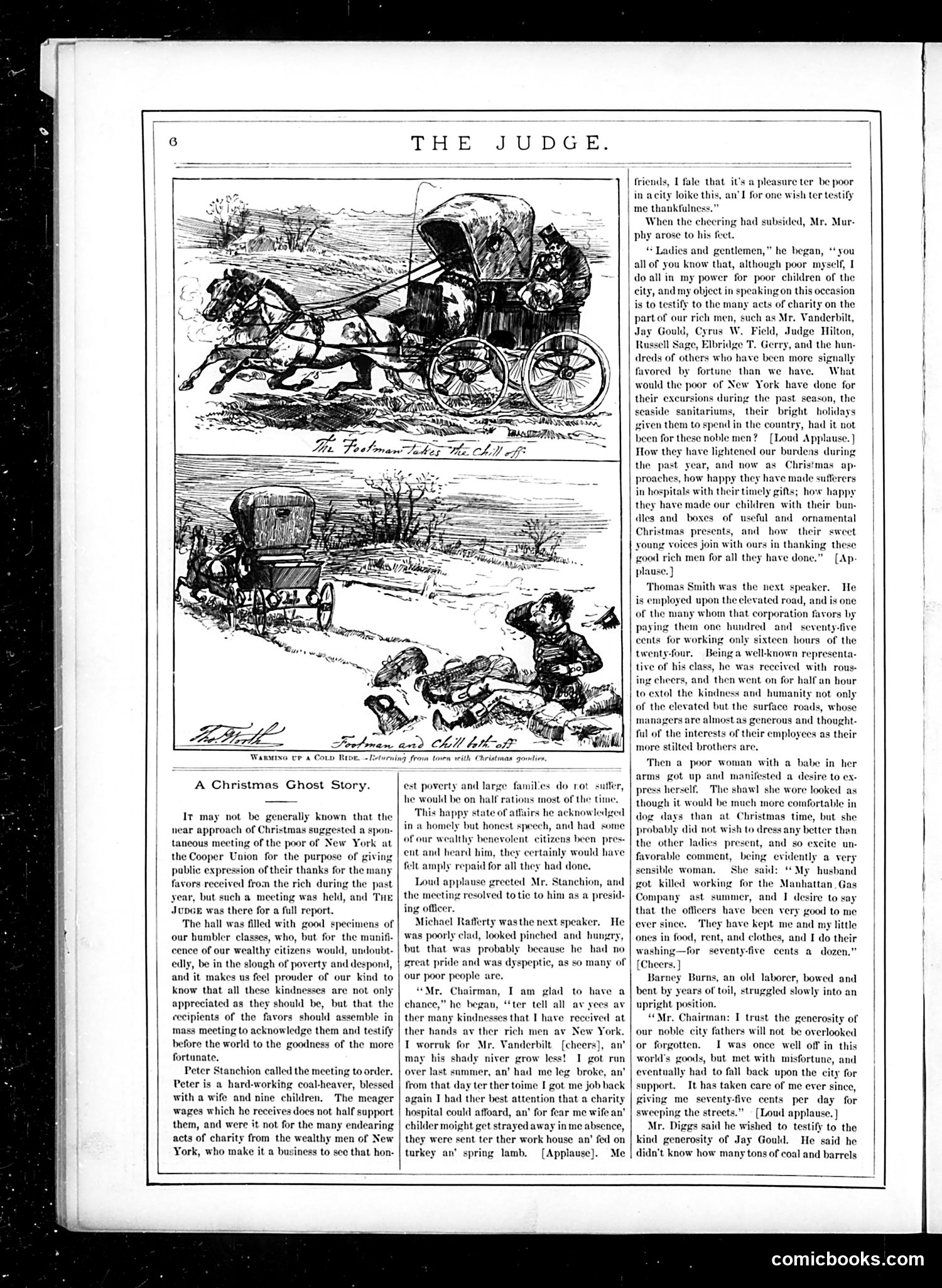
This page satirizes the performative charity of Gilded Age wealthy industrialists. The text describes a supposed meeting where poor New York workers publicly thank the rich—including Vanderbilt, Jay Gould, and Russell Sage—for "kindnesses" like charity hospital care and brief country excursions. The satire is biting: workers like Michael Rafferty describe being maimed (run over by a wagon) then having their families sent to the workhouse while recovering, yet frame this as generosity. The title "Christmas Ghost Story" suggests this gratitude is phantom-like—unreal or forced. Judge mocks both the wealthy men's self-congratulation and the implication that minimal, inadequate relief merits such public thanksgiving. The cartoon illustrations showing poor families and workers reinforce the gap between the rhetoric of benevolence and actual working-class conditions. This is social criticism dressed as reporting.
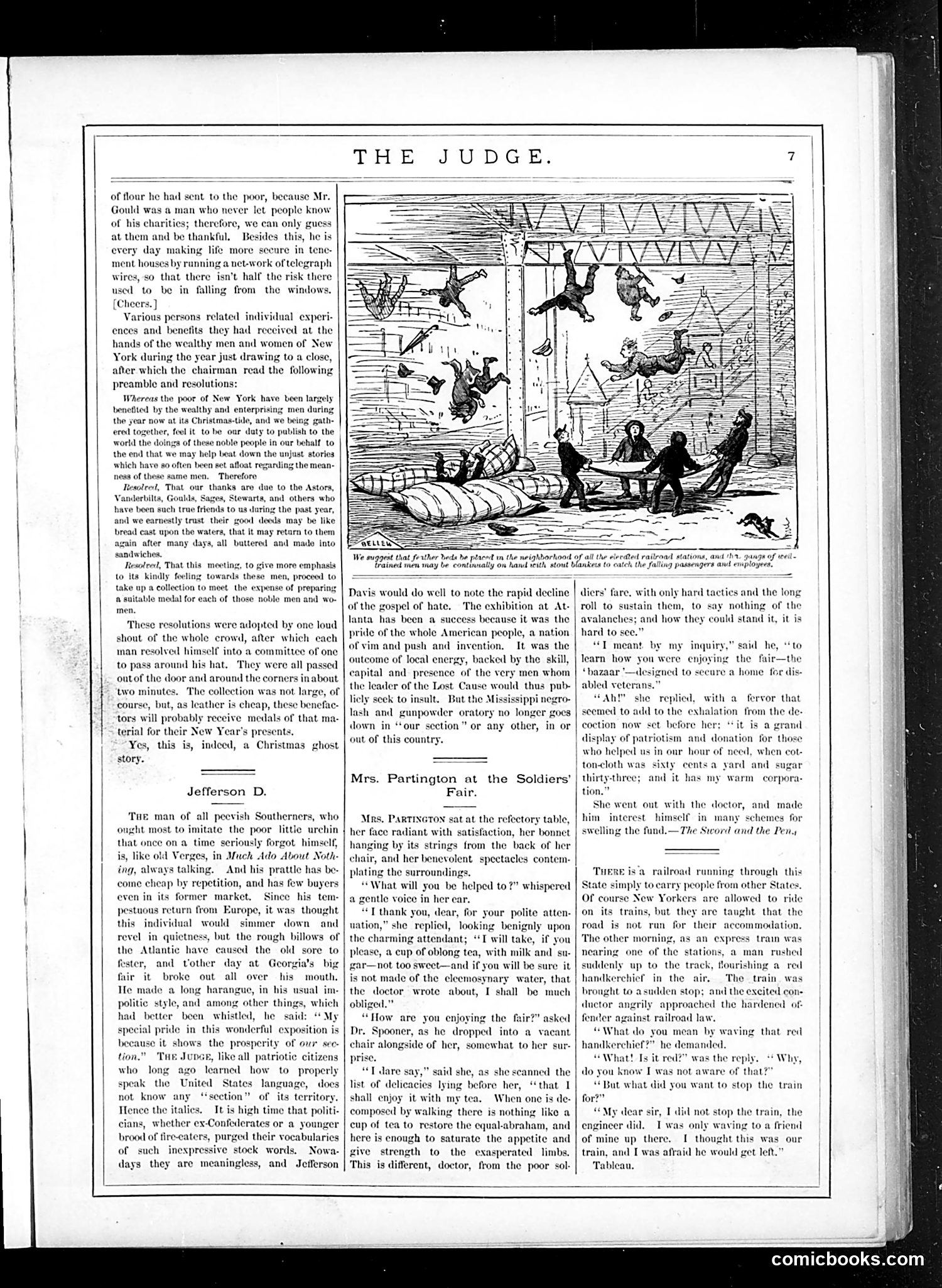
This page contains two satirical pieces targeting wealthy philanthropists and former Confederate leader Jefferson Davis. **Upper cartoon/article**: Mocks New York's wealthy elite (Astors, Vanderbilts, Goulds, Stewarts) for self-serving charity. The satire shows poor people passing resolutions thanking the rich, then collecting money for medals—but receiving cheap leather ones instead. Judge ridicules how wealthy industrialists publicize their charitable acts to counter "unjust stories" about their meanness, suggesting their philanthropy serves reputation-building rather than genuine generosity. **"Jefferson D." section**: Attacks former Confederate President Jefferson Davis for continuing to use divisive language about "our section" when discussing the South at Georgia's fair. Judge argues such sectional rhetoric is outdated and harmful—that all Americans should speak as unified citizens, not as representatives of regional interests. The piece suggests Davis exemplifies bitter ex-Confederates who haven't abandoned hostility toward the Union. Both pieces reflect post-Reconstruction tensions: skepticism of capitalist elites' motives and anxiety about lingering Southern resentment.
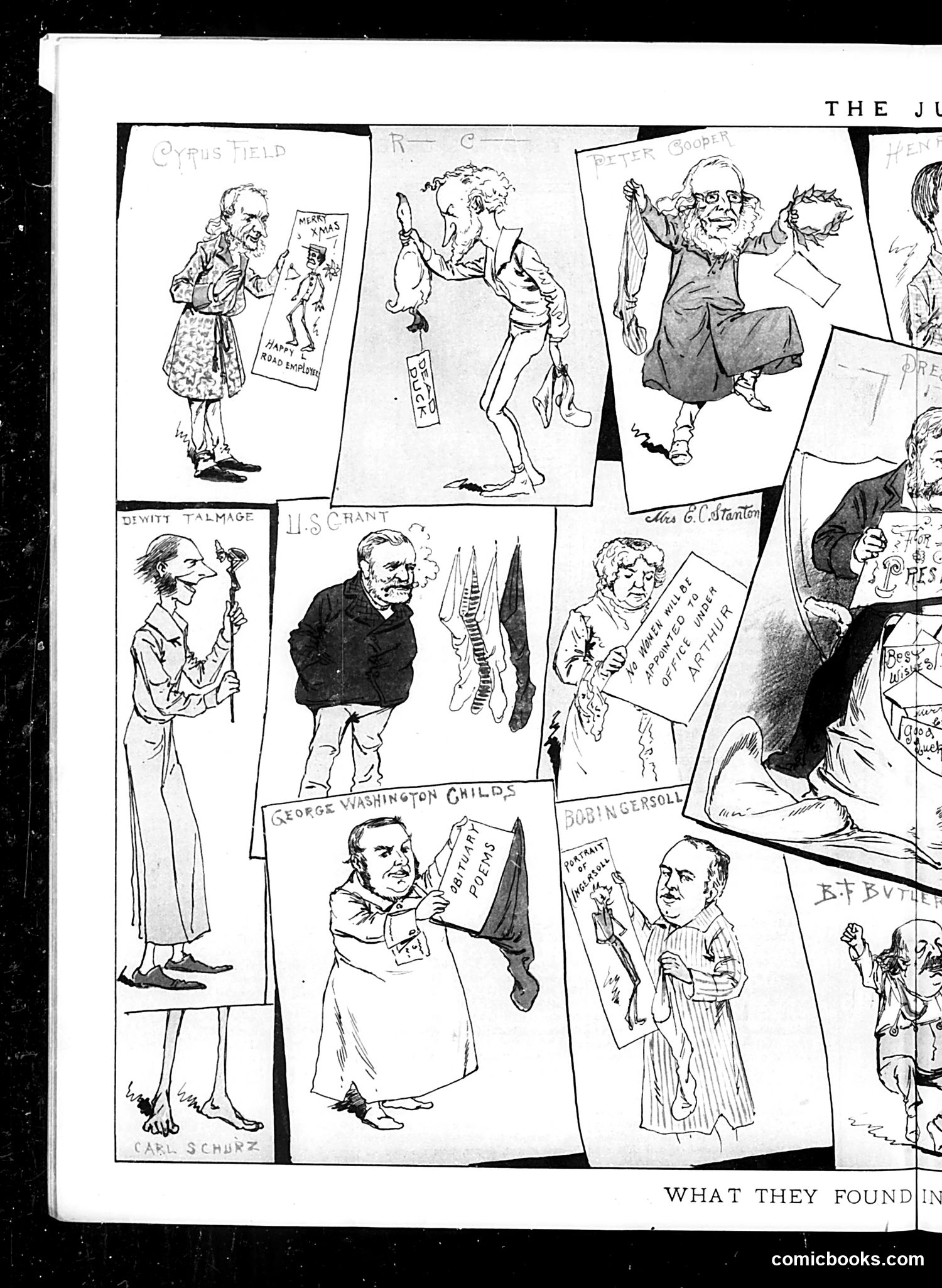
This page presents a satirical comic strip titled "What They Found In..." showing caricatured public figures examining various "discoveries" or criticisms. **Identifiable figures** include: - **Cyrus Field** (telegraph pioneer) - **DeWitt Talmage** (prominent minister) - **U.S. Grant** (former president) - **Peter Cooper** (industrialist/philanthropist) - **George Washington Childs** (newspaper publisher) - **Carl Schurz** (politician/reformer) - **Chauncey Depew** (railroad executive/politician) Each panel shows these men holding papers or examining objects with satirical labels—appearing to criticize or mock their public reputations, business practices, or political positions. The cartoons likely comment on scandals, failures, or hypocrisy associated with these prominent figures during the Gilded Age. Without clearer text visibility, specific referenced incidents remain unclear.
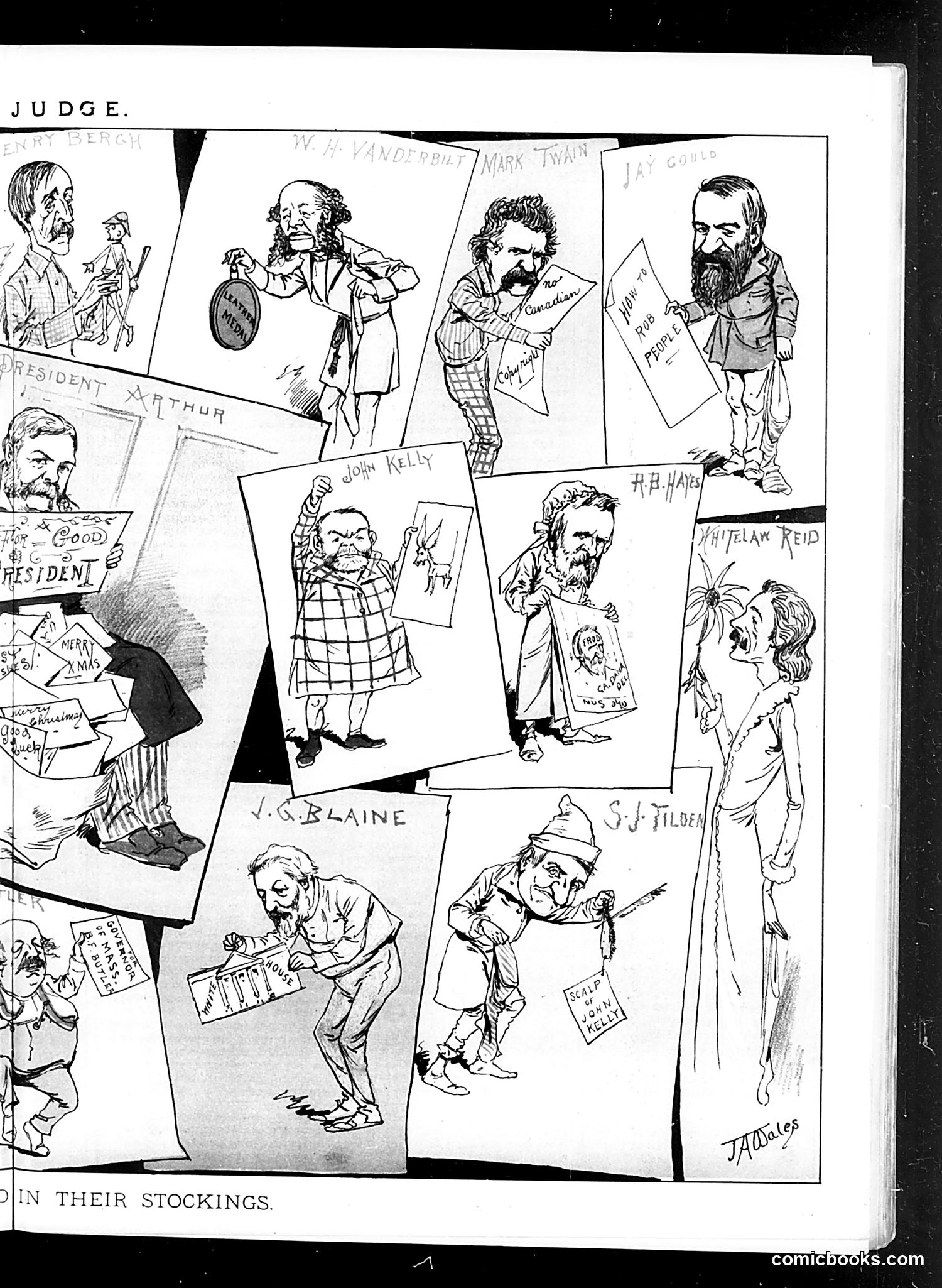
This Judge magazine page satirizes prominent public figures as Christmas gifts or stocking-stuffers. The visible names include Mark Twain, W.H. Vanderbilt, Jay Gould, John Kelly, H.H. Hays, Whitelaw Reid, and S.J. Tilden—prominent late 19th-century businessmen, politicians, and writers. The cartoon's joke appears to mock these figures as commodities or prizes people might desire. The caricatured portraits emphasize unflattering physical features typical of Judge's satirical style. The "stocking" reference suggests these men represent both desirable and undesirable "gifts" for the coming year, likely commenting on their public prominence, scandals, or controversial roles in American politics and business during the Gilded Age. The crude, exaggerated drawing style reinforces the satirical intent to ridicule these figures.
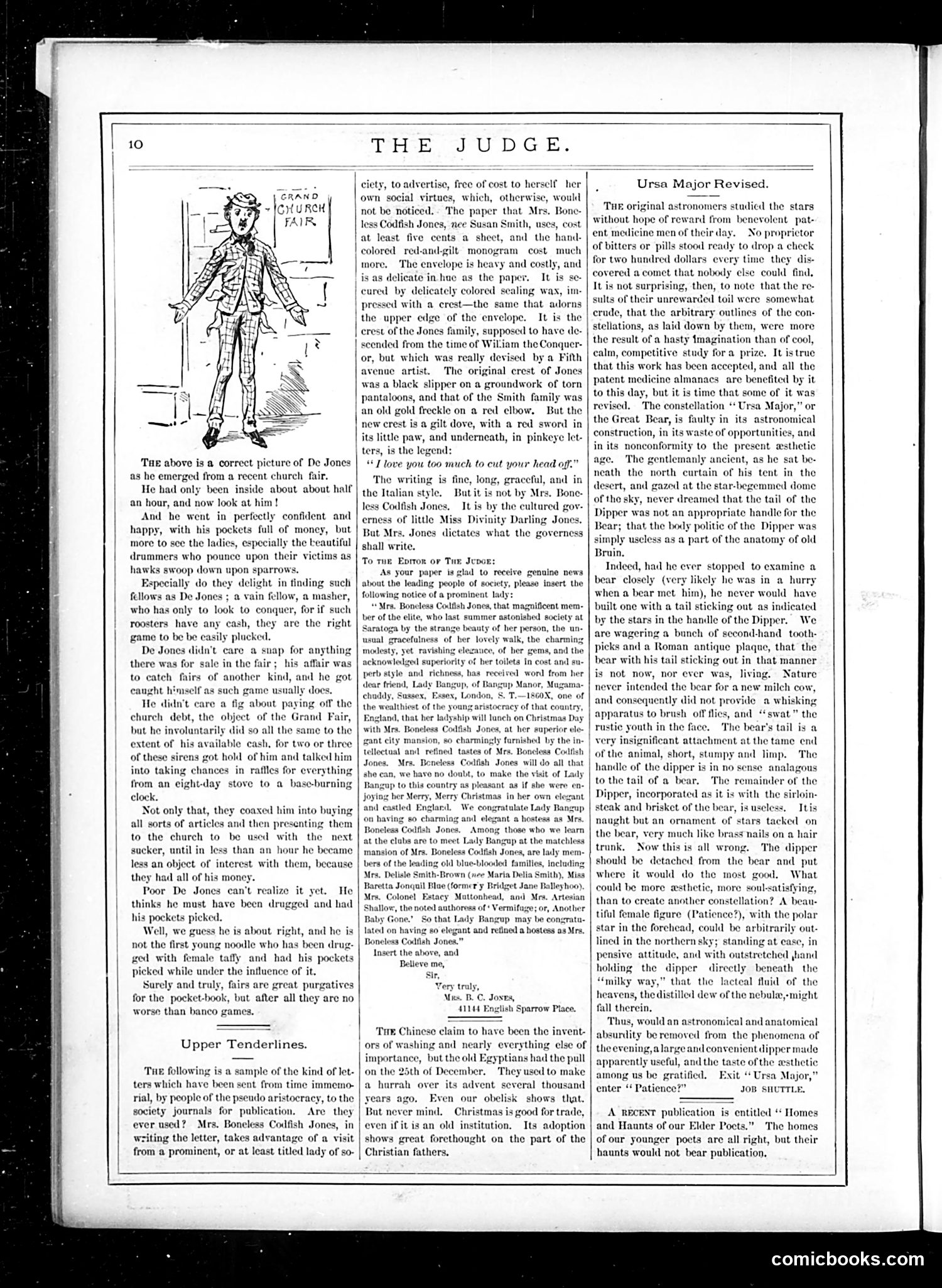
This page contains two satirical pieces from Judge magazine: **"De Jones at the Church Fair"** (left illustration): A cartoon mocking a vain, wealthy man ("a masher") who enters a charity church fair with money but leaves penniless. The satire targets both his vanity and the aggressive fundraising tactics of women volunteers ("sirens") who manipulate him into buying raffle tickets and donating items. The joke: he thought he was being clever and seductive, but was actually fleeced for the church's benefit. **"Upper Tenderlines"** (right text): A letter-writing satire about "Mrs. Boneless Codfish Jones" (née Susan Smith), a socially-climbing woman who writes to society journals using expensive stationery and an invented family crest to advertise her gentility. The satire mocks nouveau riche pretension—she fabricates aristocratic credentials while her actual family origins were humble. The crest joke reveals her fakery: the Jones family's "real" crest was a black slipper on torn pants. Both pieces satirize social climbing and vanity among the aspiring wealthy.
This page from Judge magazine (circa 1880) is primarily a **satirical commentary column** titled "The Judge," not a single cartoon. It consists of humorous brief anecdotes and observations mocking contemporary society. Key satirical points include: - **Drinking competitions**: Mocking German-American beer culture and the implausibility of extreme consumption claims - **Czar Alexander III**: Satirizing Russian imperial excess—criticizing extravagant champagne consumption at his father's funeral - **St. Francis Xavier comment**: Dark humor about religious figures and outdated religious relevance - **Southern "chivalry"**: Post-Civil War mockery—noting the South lost its aristocratic pretense when slavery ended ("lost all their Pomp—and Dinah, too") - **Chinese culture**: Stereotyping Chinese youth as peaceable because they lack American dime novels about Indian-killing The page also lists humorous fake book titles parodying popular literature. The overall tone is irreverent commentary on class, ethnicity, and post-Civil War American society.
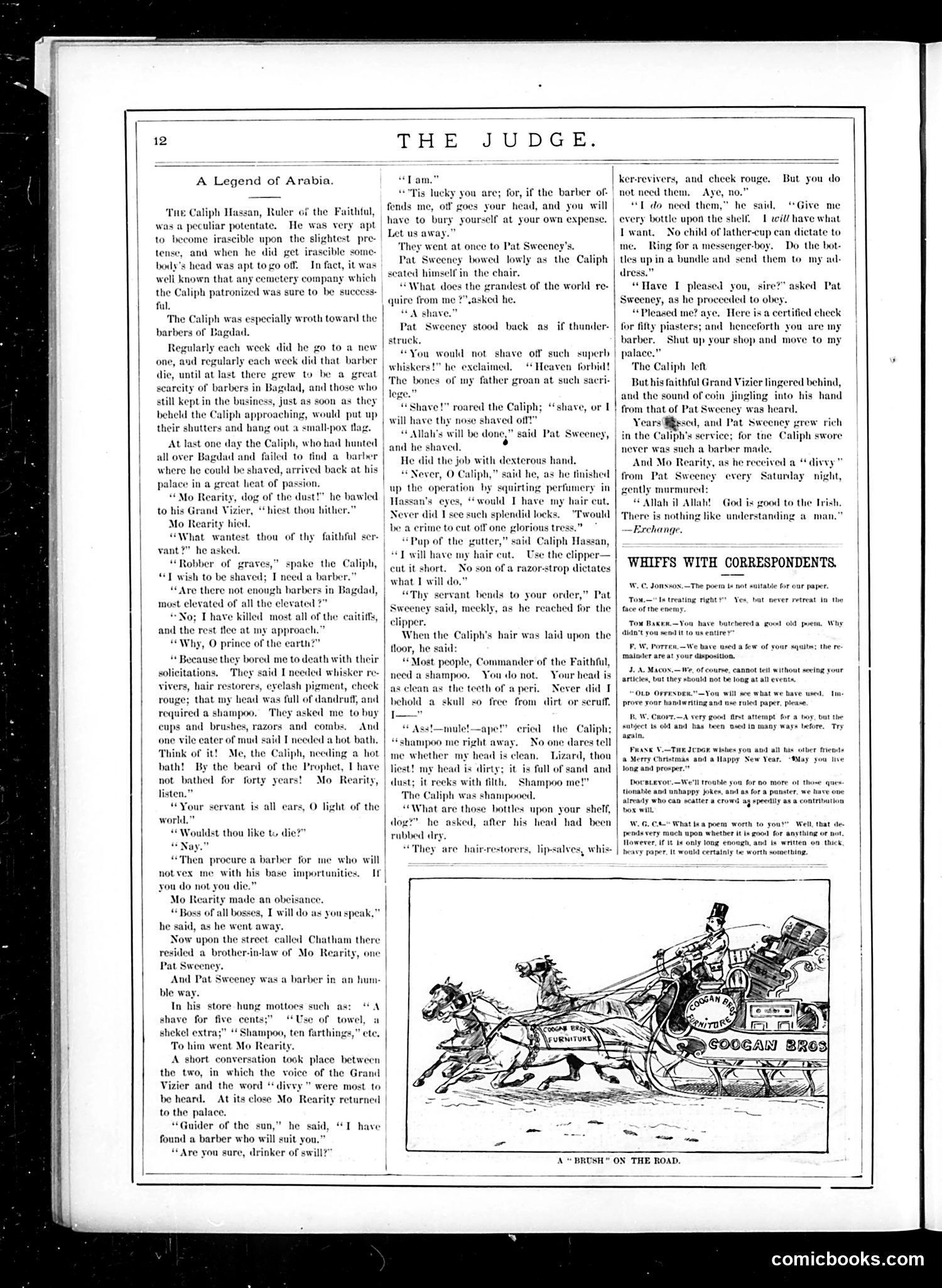
This story is a **Victorian-era satirical joke** mocking Irish immigrant barbers and labor negotiations in America, disguised as an exotic Arabian tale. The Caliph represents a wealthy, demanding American client. **Pat Sweeney** (clearly Irish from the name) is a struggling barber who must deal with an unreasonable customer making increasingly absurd demands—shaving, hair-cutting, then shampooing. The satire targets **working-class service providers** of the era: Pat's shop displays humorous price signs ("Use of towel, a shekel extra"), reflecting actual nickel-and-dime charges immigrants charged. The joke is that Pat negotiates a "divvy" (payment) with the Caliph's servant before accepting work—suggesting immigrant barbers haggled aggressively over meager fees. The punchline hinges on class anxiety: even a powerful ruler cannot intimidate a practical working-man into unpaid labor. Pat does the job competently but without deference, embodying the stereotype of the shrewd Irish laborer refusing to be exploited. The accompanying illustration shows a separate, unrelated advertisement for a "Brougham" carriage.
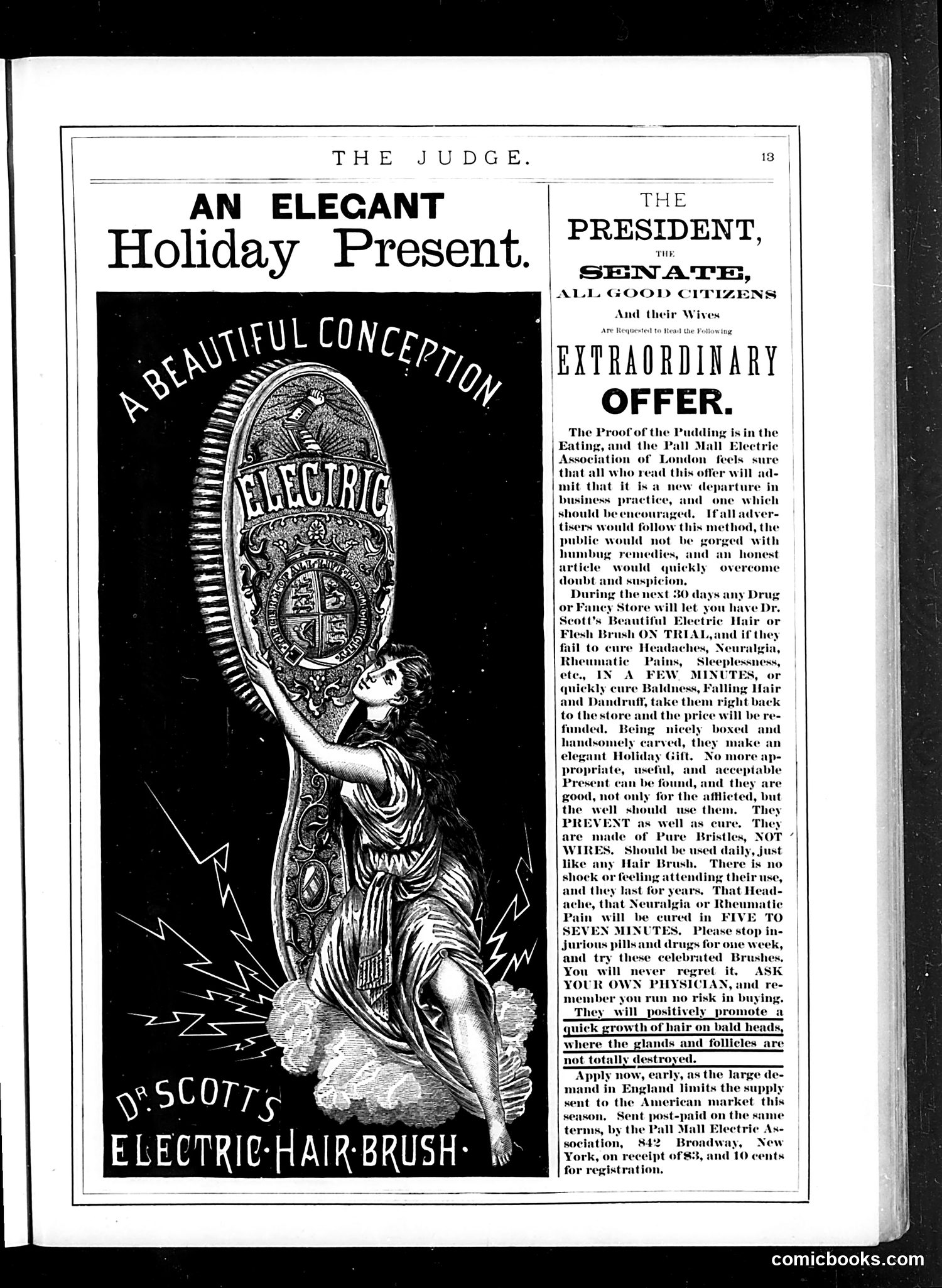
This page from *Judge* magazine is primarily **advertising disguised as editorial content**. The left side features a dramatic advertisement for "Dr. Scott's Electric Hair Brush"—a Victorian-era medical device claiming to cure headaches, neuralgia, baldness, and various ailments through electrical stimulation. The right column presents a mock "extraordinary offer" supposedly from "the President, the Senate, [and] all good citizens," sarcastically endorsing this quack remedy. The satire lies in the juxtaposition: *Judge* is ridiculing the absurd medical claims and fraudulent advertising practices of the era by presenting the brush's promotion as if it were an official government endorsement—thereby mocking both the product and the gullible public that bought such snake oil. The cartoon's message: American consumers were being duped by pseudoscientific health gadgets, and legitimate institutions were complicit through their silence or credibility-lending. This reflects *Judge's* role as social commentary on consumer fraud and medical charlatanism in the late 19th century.
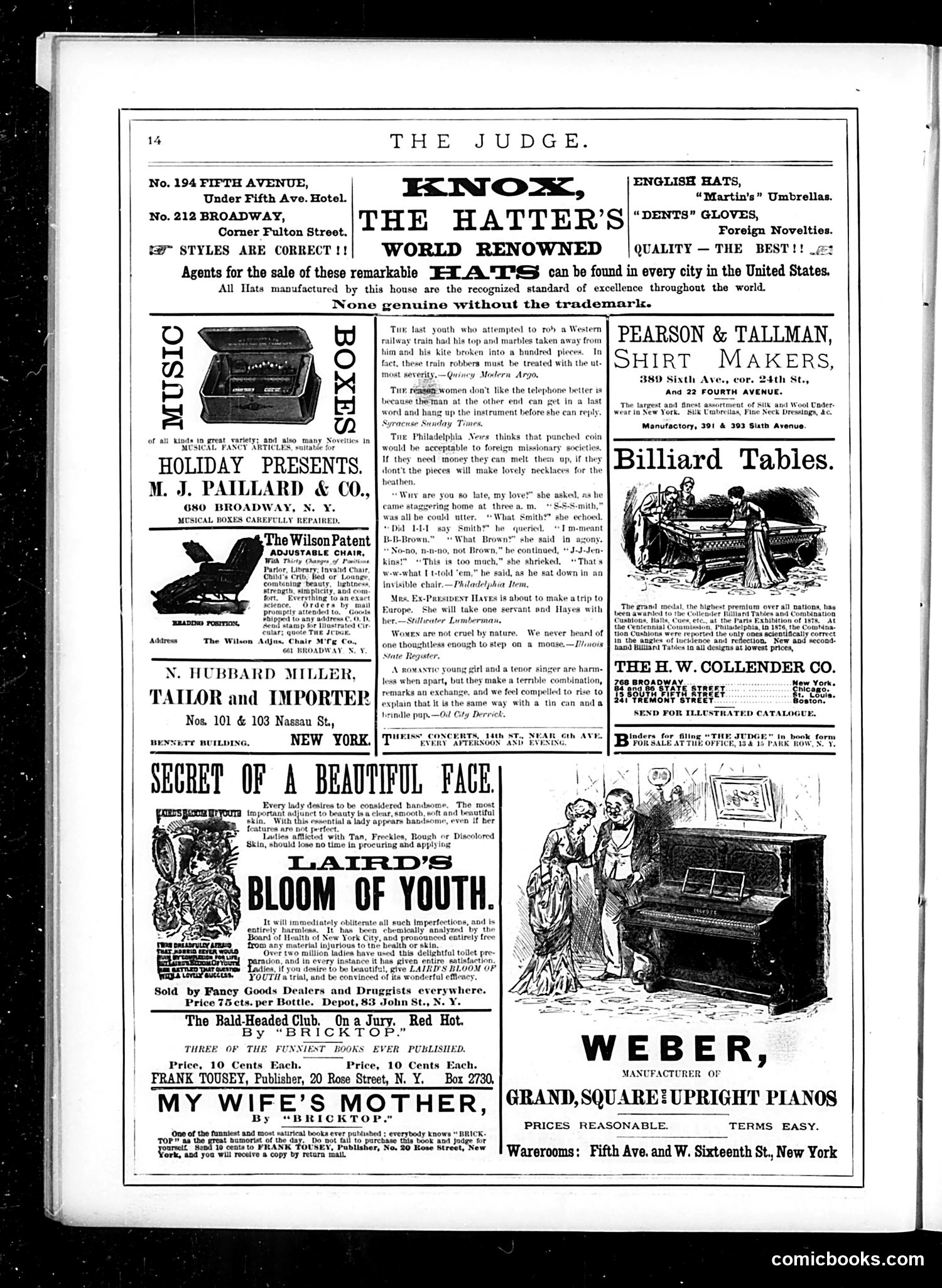
This is primarily an **advertising page** from Judge magazine, with minimal editorial content. The page features various commercial advertisements for late 19th-century products and services: hats (Knox brand), clothing (Pearson & Tallman shirts), billiard tables, pianos (Weber), beauty products (Laird's Bloom of Youth), and novelty books. The only cartoon appears to be a small illustration accompanying the billiard table advertisement, showing figures examining or playing at a table—typical product promotion imagery. The one substantive text item is a brief anecdote about a train conductor and a Western railway train, illustrating how "the man at the other end can't get in a lost nail" by hanging up an instrument before she can reply. This appears to be generic humor filler, not political satire. **No identifiable political figures or social commentary** are present on this page. It represents Judge functioning primarily as a **vehicle for paid advertising** rather than satirical journalism.
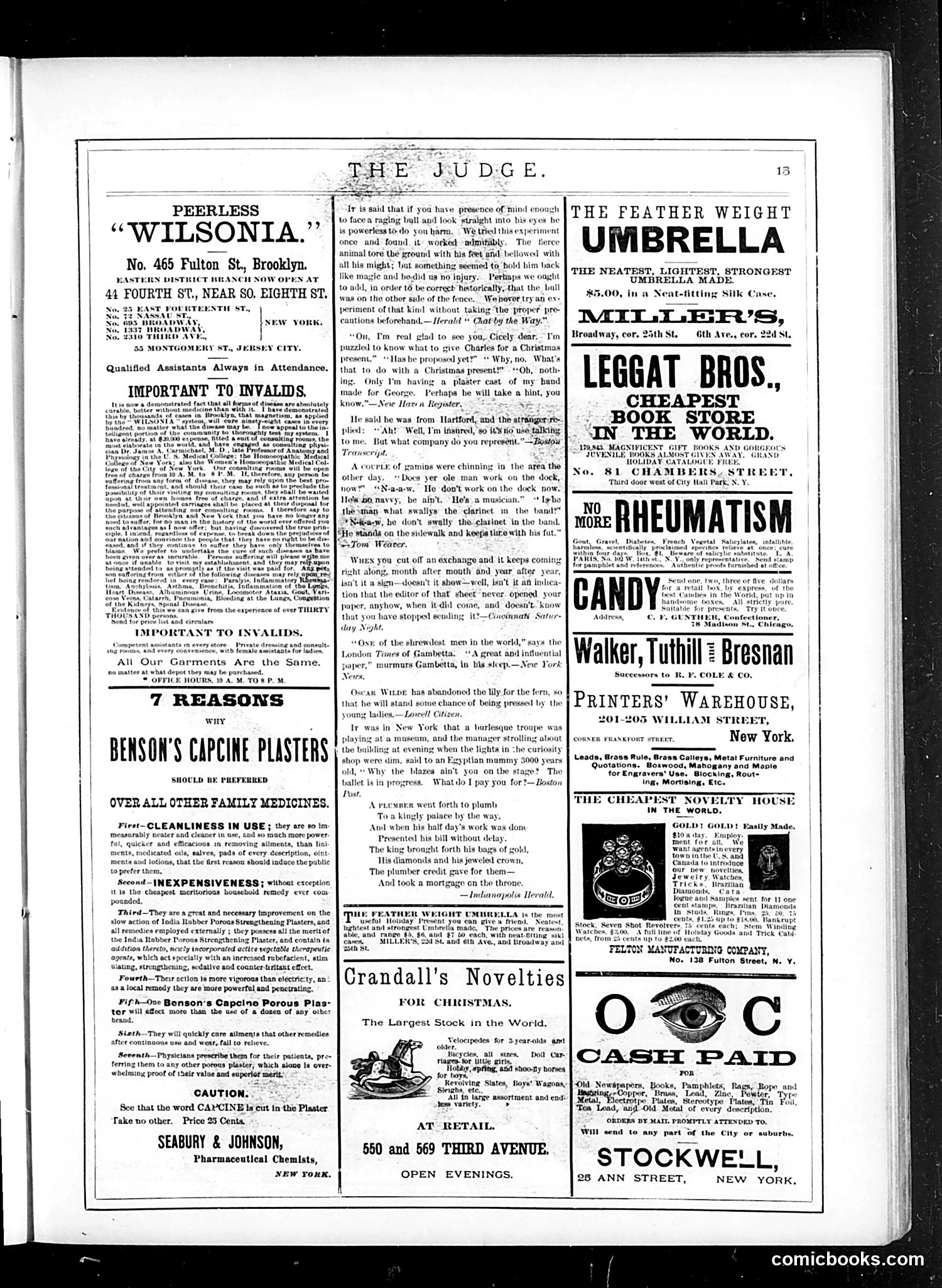
This appears to be primarily an **advertising page** from Judge magazine, with multiple commercial advertisements for products like the Wilsonia device, Benson's Caffeine Plasters, umbrellas, and bookstores. **The satirical content** consists of brief humorous anecdotes scattered among ads: - A joke about a man "cured" by a raging bull that couldn't hurt him (poking fun at dubious health claims) - A conversation about a Christmas gift involving a plaster cast - A story about mistaking a dock worker for a musician who "swallows" a clarinet while standing on the sidewalk (nonsensical humor, likely mocking working-class speech or absurd situations) - A comment about Oscar Wilde abandoning lilies for ferns (referencing Wilde's association with aestheticism and the "decadent" movement) **The overall point** appears to be typical Judge magazine satire: mocking bogus medical remedies, social pretension, and contemporary public figures through short, punchy jokes—though nothing here suggests serious political content.
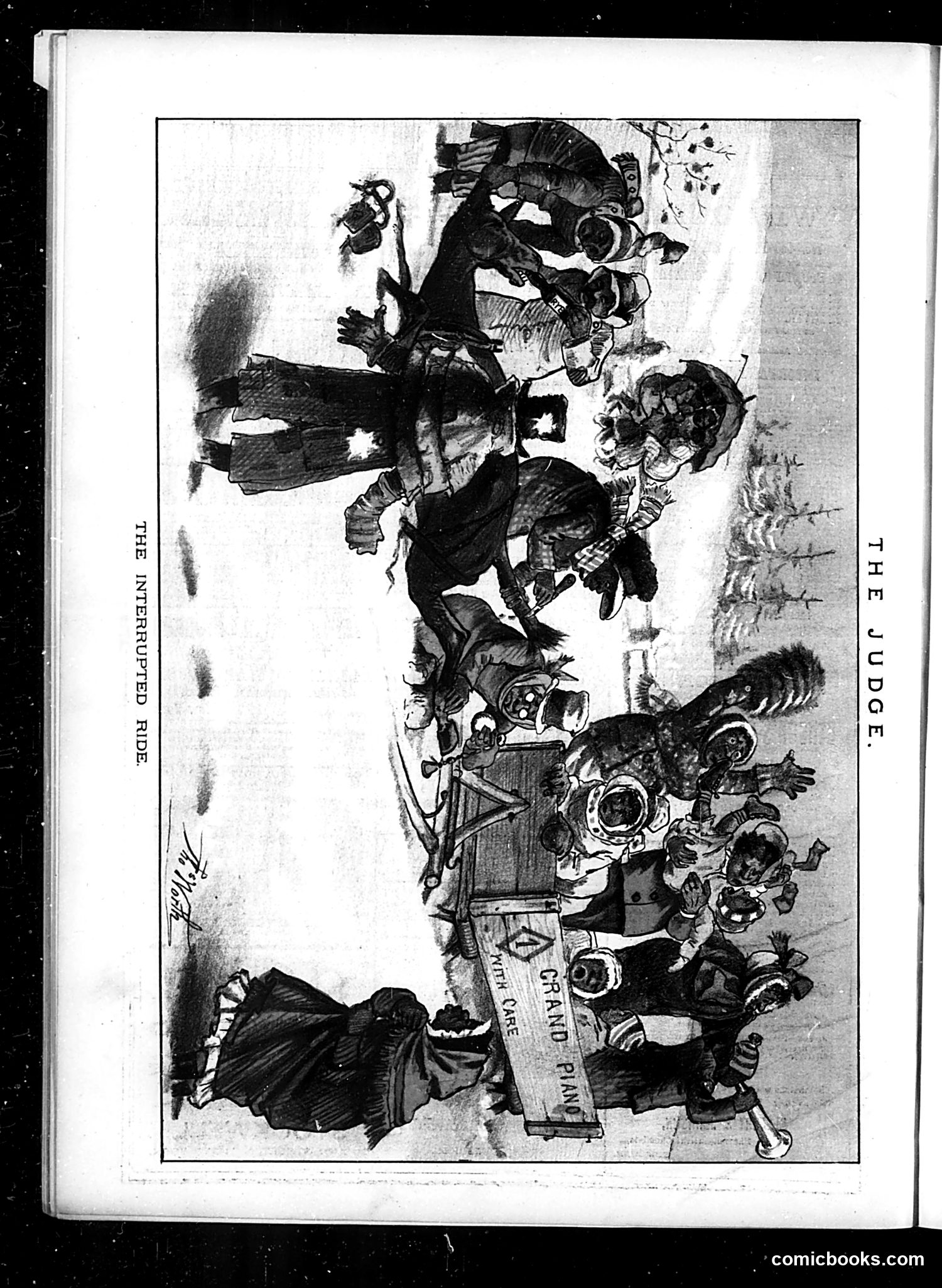
This satirical cartoon depicts what appears to be a chaotic scene with multiple figures interrupting a ride or journey. The title "The Interrupted Ride" suggests disruption of some planned event or progress. The image shows figures in period dress (likely late 19th century based on Judge magazine's era) in apparent conflict or commotion. A banner or sign reading "GRAND PIANO" is visible, though its exact significance remains unclear from the image alone. Without additional context about the specific historical moment this appeared, I cannot definitively identify the political figures or events being satirized. The cartoon's point likely mocked a contemporary political situation involving obstruction or interference with something important, but the specific reference eludes confirmation from the visual elements alone.
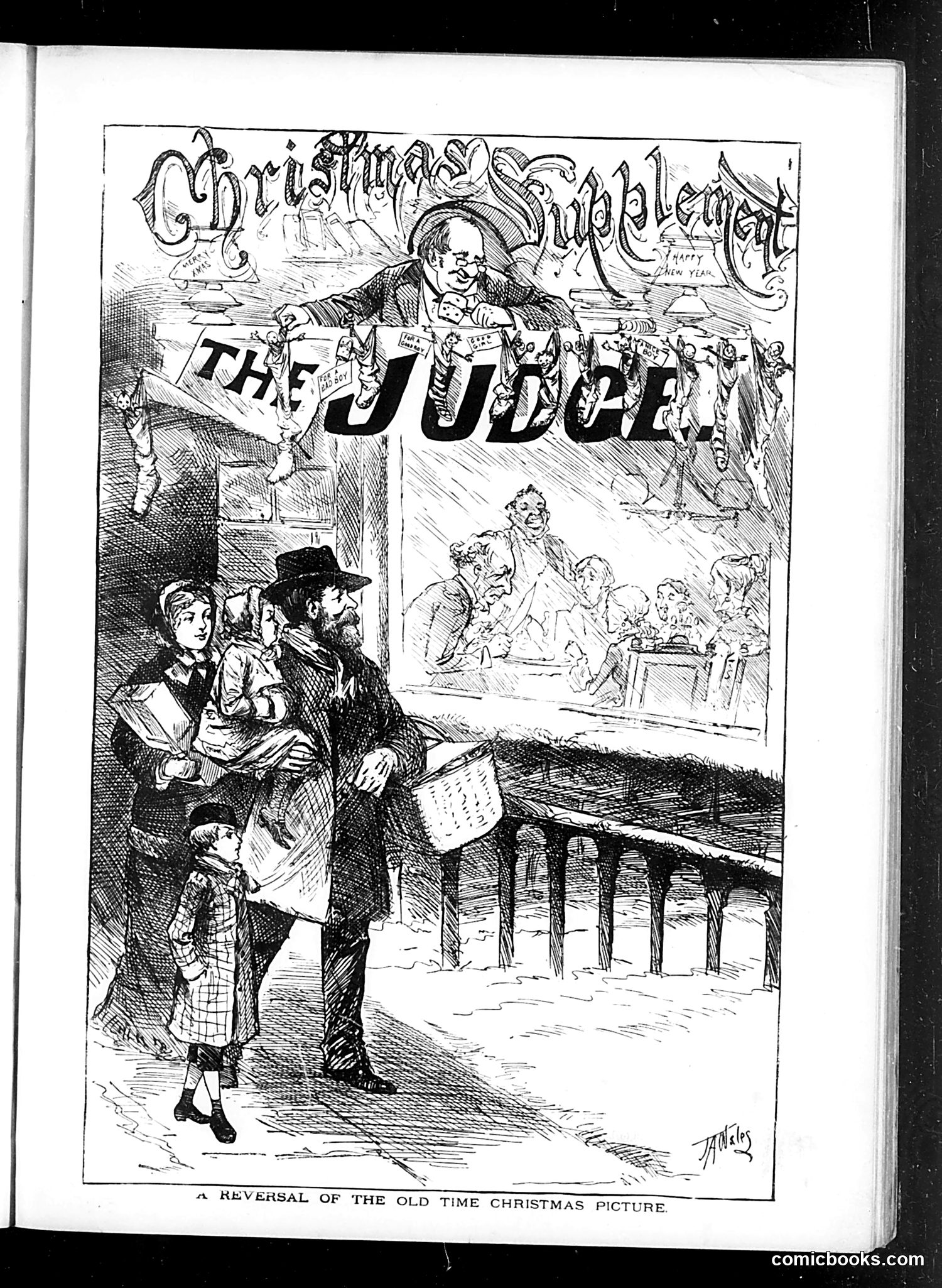
This political cartoon satirizes poverty and inequality during the Christmas season. The title "A Reversal of the Old Time Christmas Picture" inverts the traditional heartwarming Christmas imagery. The scene depicts a well-dressed man with children gazing into a courthouse or institutional building where a judge presides over proceedings—likely an eviction or debt case. This reverses the sentimental Victorian Christmas trope of families peering into warm, festive homes. The cartoon critiques how poor families faced legal hardship during holidays rather than experiencing traditional Christmas joy. The ornate title at top reads "Christmas Supplanted / The Judge," suggesting the judicial system has replaced yuletide goodwill. The satire targets the social indifference of wealthy institutions toward struggling families during what should be a season of compassion.
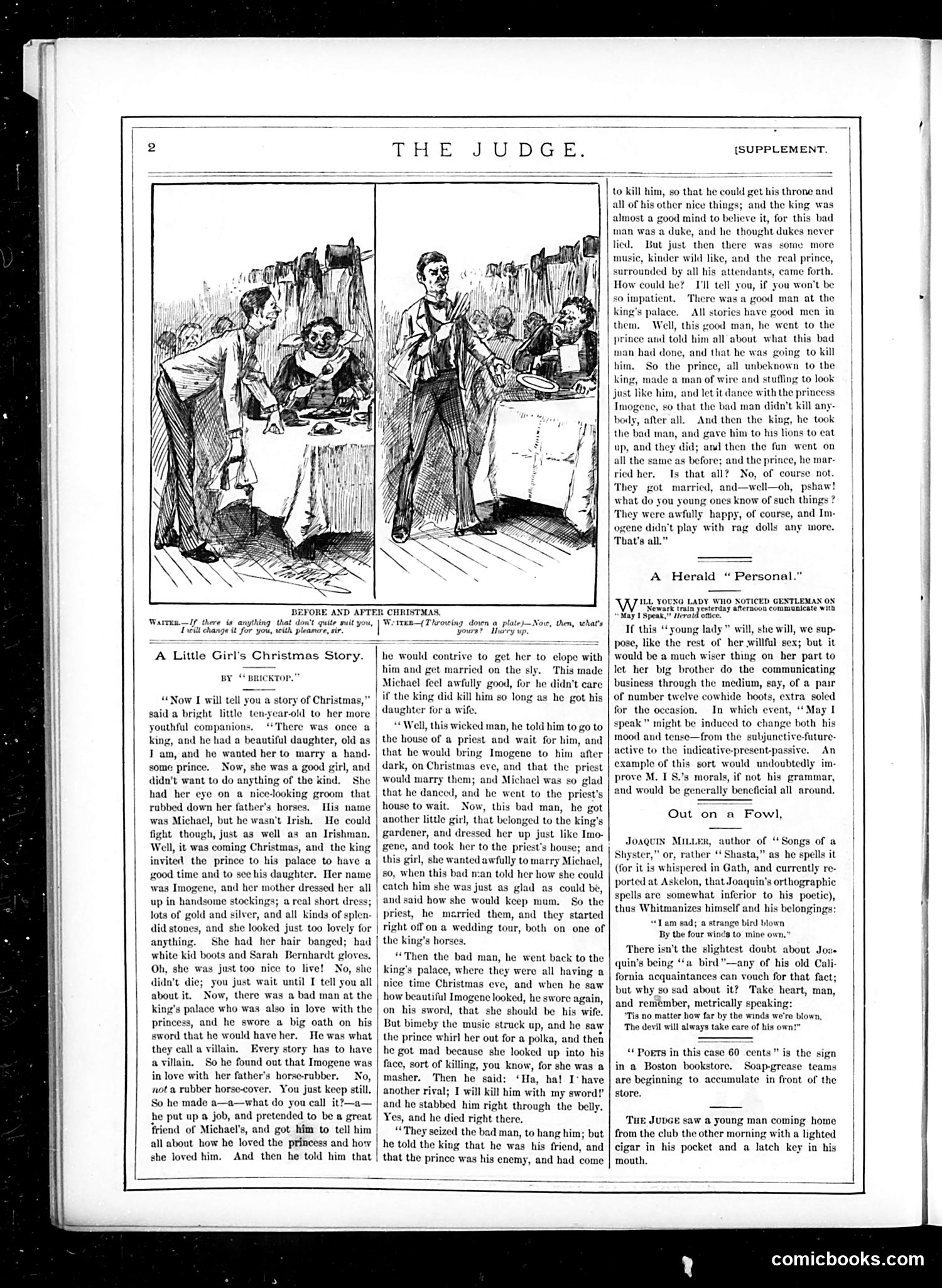
This page contains two separate pieces: a single-panel cartoon at top and a children's story below. **The Cartoon ("Before and After Christmas"):** A shopkeeper (Warren) offers to exchange merchandise for a dissatisfied customer. The humor is straightforward—it's about holiday retail complaints and exchange policies, likely commenting on consumer expectations around Christmas shopping. **"A Little Girl's Christmas Story":** A young girl tells her friends a fairy tale featuring a king, princess Imogene, and a love triangle. The plot involves a villain who sabotages a marriage between the princess and a commoner (Michael the groom) by arranging her elopement with someone else instead. When the villain later attacks the prince out of jealousy, he's caught but claims the prince was actually his enemy—creating moral ambiguity about guilt. The story appears to be gentle moral fiction for children, common to Judge magazine's family sections. It lacks obvious political satire, instead offering a coming-of-age narrative about romance, deception, and the complexity of judging character—fitting the magazine's title.
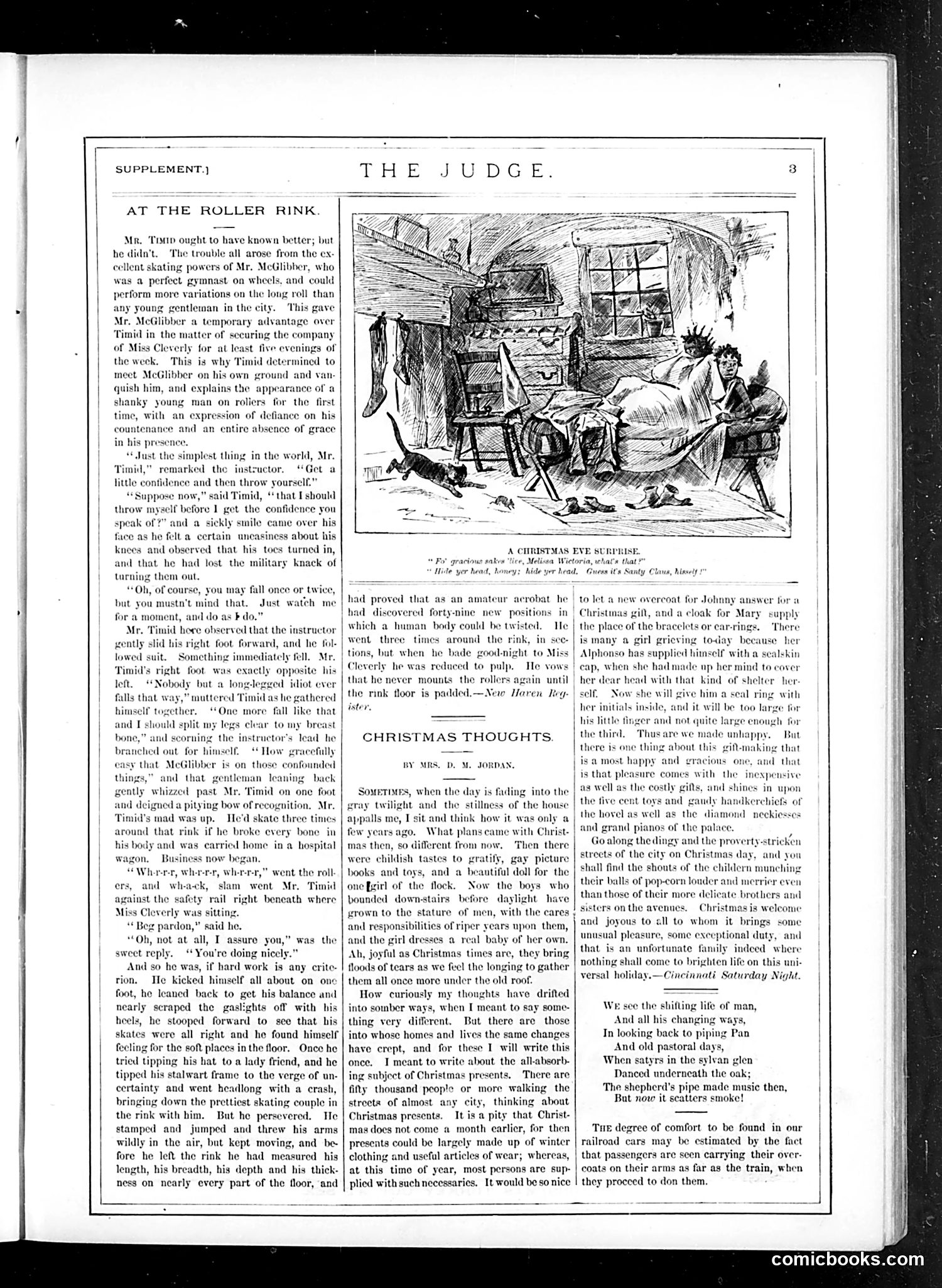
This humorous piece satirizes male rivalry over romantic attention in the late 19th century. Mr. Timid, an awkward suitor, attempts to outcompete the graceful Mr. McGlibber—who has monopolized Miss Cleverly's company through superior roller-skating ability—by learning to skate himself. The joke relies on Timid's physical incompetence: despite a skating instructor's advice, he repeatedly falls, crashes into safety rails, collides with other couples, and generally causes chaos on the rink. His desperate determination to impress Miss Cleverly through athletic prowess fails spectacularly; he leaves the rink having "measured his length, breadth, depth and thickness" across the floor. The satire mocks both male competitive vanity and the era's courtship rituals where gentlemen's accomplishments determined romantic access to eligible women. Timid's humiliation reveals the absurdity of such status-seeking displays.
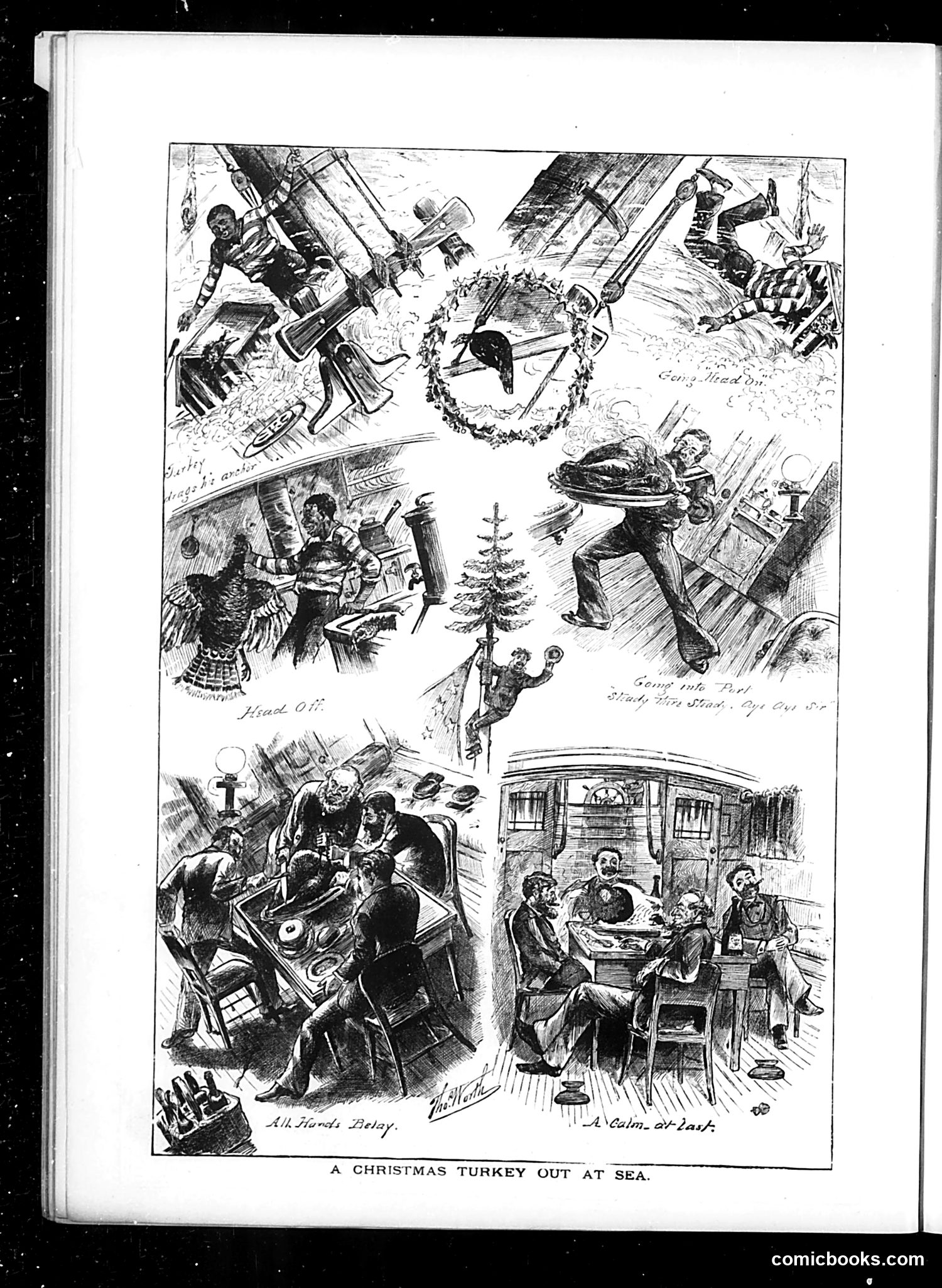
This is a multi-panel satirical cartoon depicting Christmas celebrations aboard a ship. The title suggests the humor revolves around attempting to enjoy traditional holiday festivities—particularly eating turkey—while at sea under challenging conditions. The panels show sailors engaged in various Christmas activities: decorating with wreaths, attempting to cook or serve food, and socializing in cramped quarters. The satire appears to mock the contrast between idealized Christmas traditions on land versus the awkward, uncomfortable reality of celebrating holidays aboard ship—with rough seas, confined spaces, and the inherent difficulties of maritime life. The OCR text is largely corrupted, so specific scene captions remain unclear. However, the visual joke centers on the incongruity of maintaining festive cheer amid naval conditions.
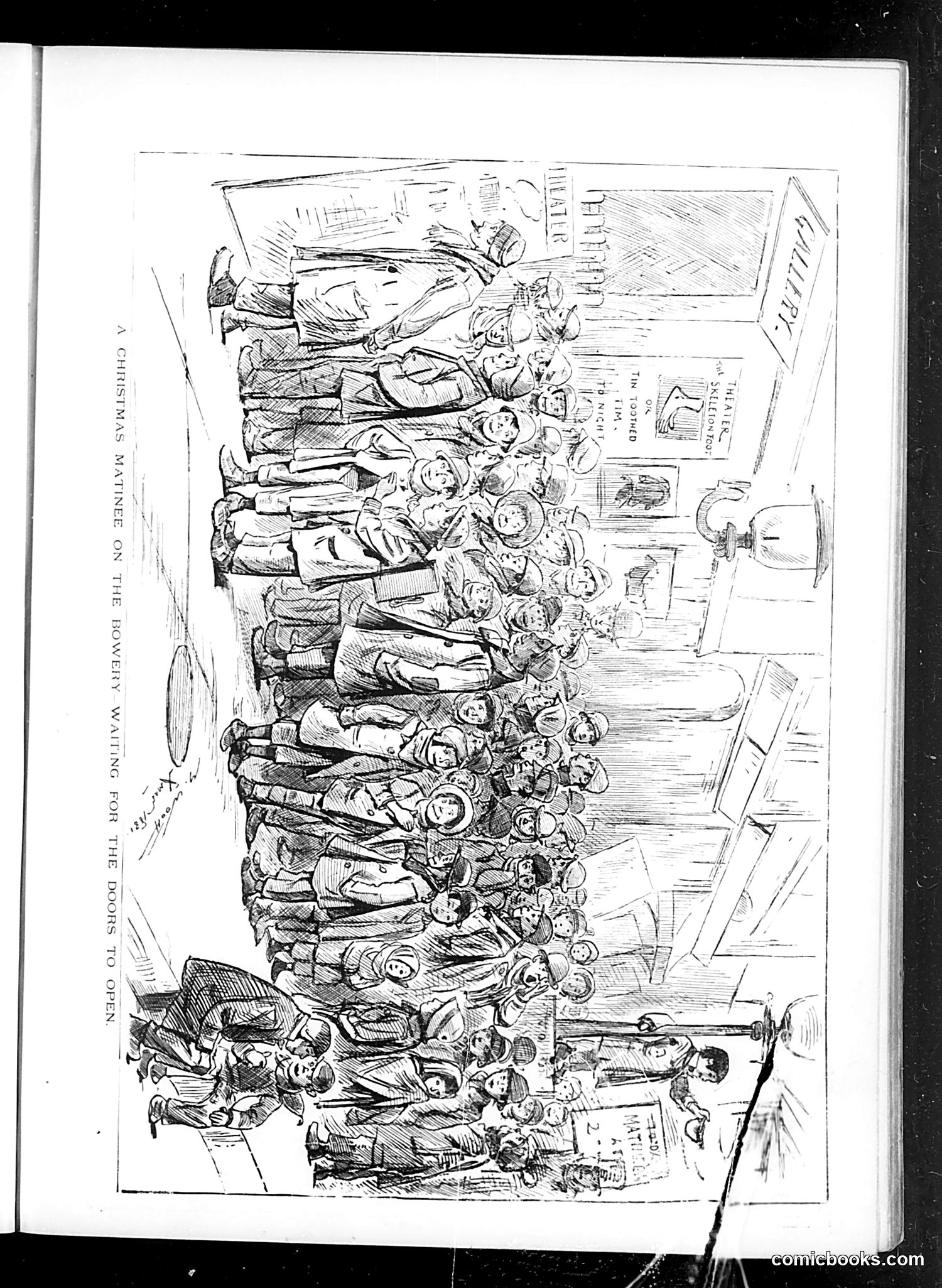
I can see this is a satirical engraving from Judge magazine showing a large crowd of people arranged in a vertical composition, oriented sideways on the page. The text on the left reads "A CRUSH AMONG MOTHERS ON THE BOWERY WAITING FOR THE DOORS TO OPEN." The cartoon appears to satirize crowded, chaotic scenes of working-class women (likely mothers) gathering on the Bowery—a notoriously crowded, poor neighborhood in New York City—waiting to enter somewhere, presumably for some benefit, sale, or public event. The densely packed, somewhat frenzied arrangement of figures emphasizes the crush and desperation of the crowd. This likely comments on urban poverty, consumerism, or social conditions affecting poor families in late 19th-century New York. The OCR text is too corrupted to provide additional context.
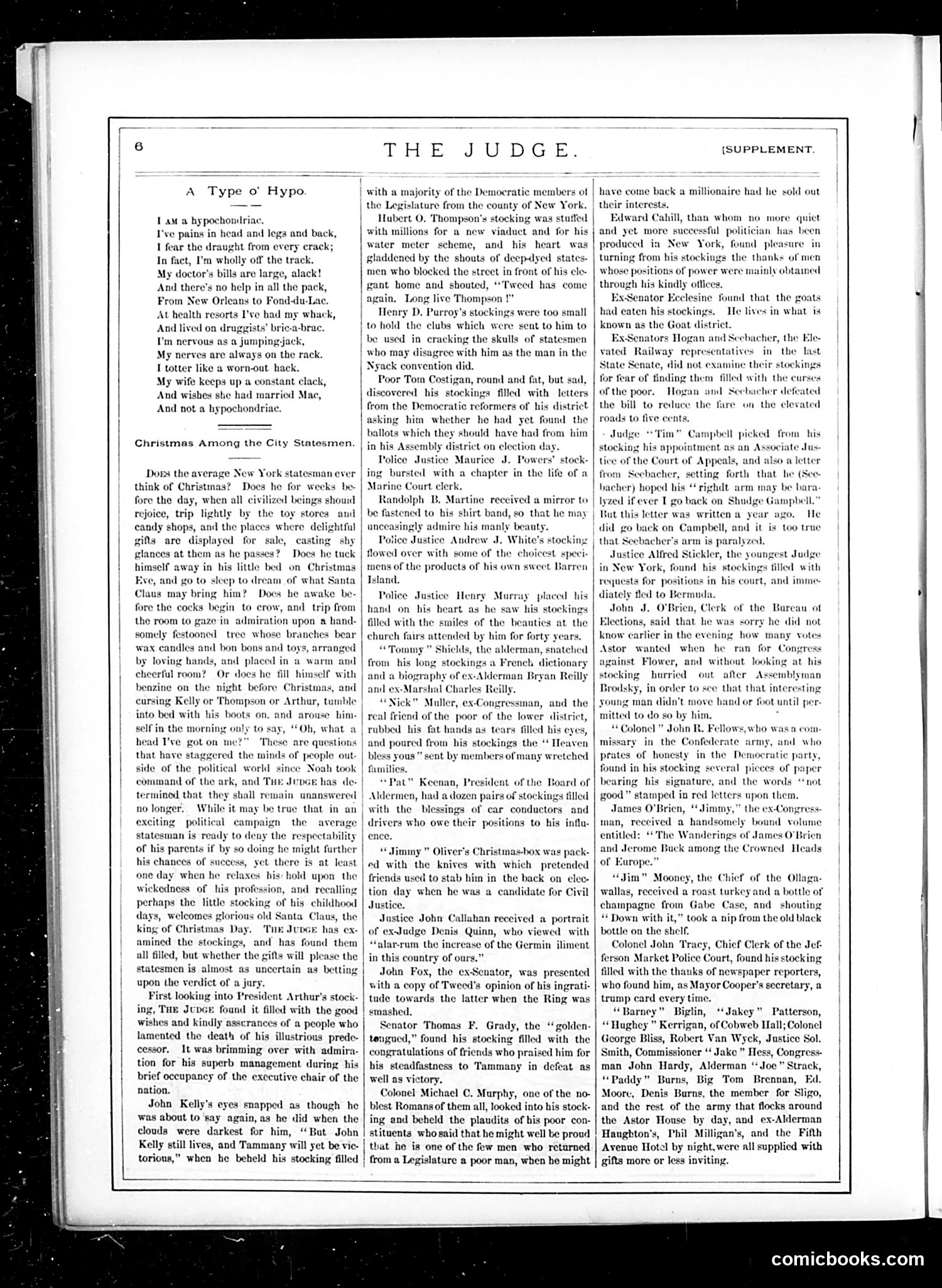
This is satirical commentary on New York political figures and their Christmas stockings, serving as moral critique disguised as holiday humor. **The Figures:** - **President Arthur**: receives good wishes and admiration (sincere, respectable gift) - **John Kelly** (Tammany Hall boss): receives Democratic legislators—mocking his political machine control - **Hubert O. Thompson**: gets millions for infrastructure schemes (viaduct, water meter), satirizing corruption and self-dealing - **Henry D. Purroy**: receives clubs for "cracking skulls," implying violent political suppression - **Tom Costigan**: gets letters from reformers questioning his integrity **The Satire:** Rather than genuine Christmas joy, these politicians receive gifts reflecting their actual values and corruptions. The piece asks whether they experience real Christmas sentiment or remain consumed by political scheming and graft. It's a moral indictment wrapped in holiday packaging—suggesting New York's political establishment is fundamentally corrupt and incapable of genuine human decency.