
Judge, 1881-12-31 · page 3 of 22
Judge — December 31, 1881 — page 3: what you’re looking at
What you’re looking at
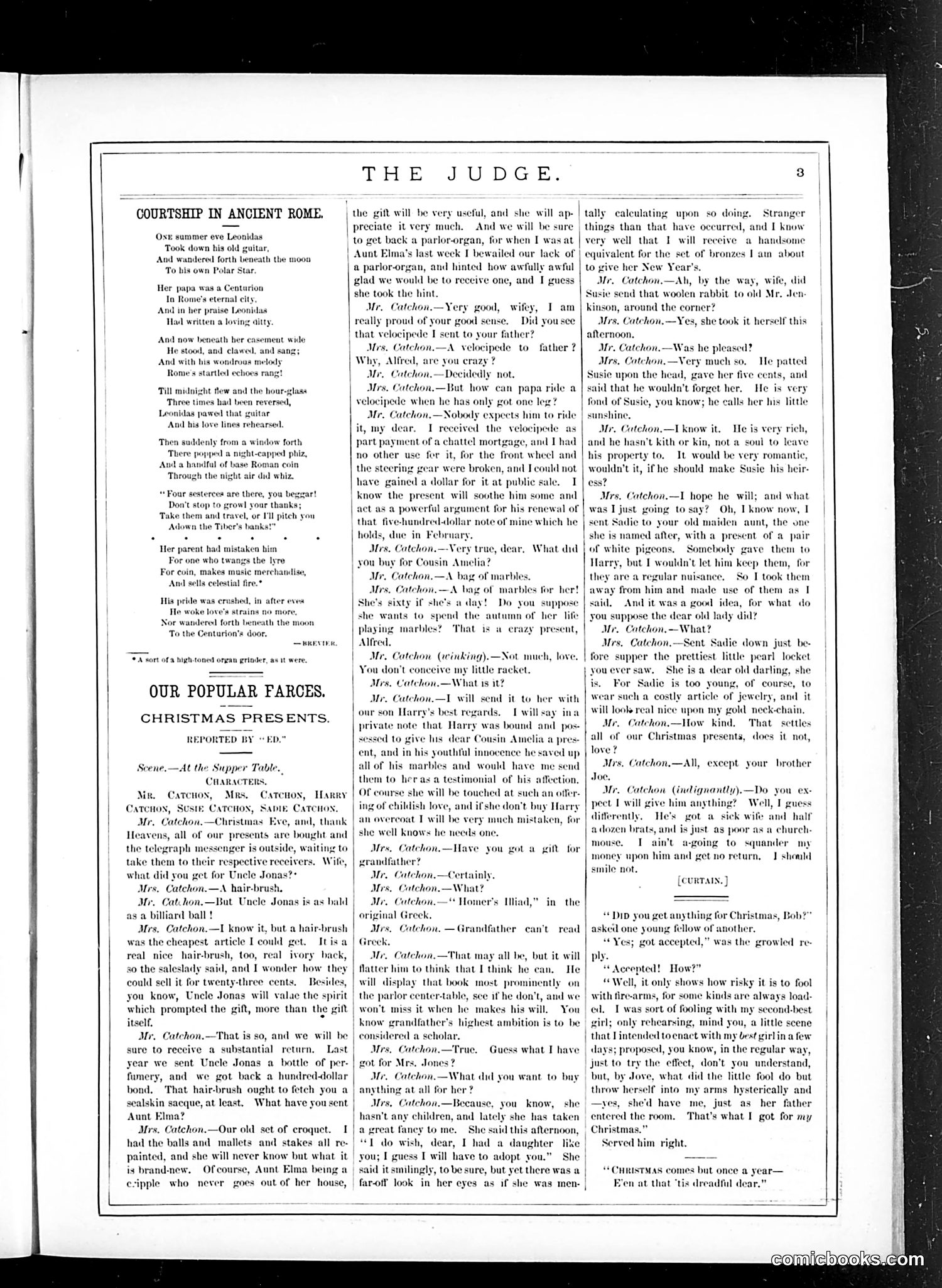
This page contains two unrelated pieces of Victorian-era satire: **"Courtship in Ancient Rome"** is a humorous narrative poem mocking sentimental romantic literature. It depicts Leonidas serenading his beloved with a guitar beneath her window, only to be pelted with coins by her father (a Roman centurion) who mistakes him for a street musician. The joke ridicules both overwrought romantic gestures and the misunderstanding that destroys them—poking fun at the melodramatic courtship tales popular in contemporary fiction. **"Christmas Presents"** is a domestic farce satirizing gift-giving hypocrisy among the middle class. The Catchon family strategically gives cheap, unwanted items (a hairbrush to a bald uncle, a broken velocipede) expecting lavish returns—revealing how "generosity" is actually calculated investment. The satire exposes the transactional nature hidden beneath polite gift-giving customs of the era. Both pieces mock human vanity and pretense through exaggerated scenarios.
📄 Transcribed text from this page (OCR, searchable)
Machine-transcribed from the original scan — historical spelling and the odd misread are preserved.
COURTSHIP IN ANCIENT ROME. Oxe summer eve Leonidas Took down his old guitar, And wandered forth beneath the To bis own Polar Star. Her papa was a ( In Rome's eternal city And in her praise Leonidas 1 written a loving aitty nturion nd claw And with his wondrous melody Rome's startled ech and sang; 3 rang Till midnight flew and the hour-glass ‘Three times had been reversed, Leonidas pawell that guitar And his love lines rehears Then suddenly from a window forth There popped a night-capped phiz, And a handful of base Roman coin. Through the night air did whiz, Don't stop to y Take them and travel, of Il piteh yon Adown the Tiber's banks!” Her parent had mistaken bitn For one who twangs the lyre For vin, makes music merchanise, ‘Anil sells celestial fire ur sest His pride was crushed, in He woke love's strains no more, Nor wandered forth ti the Centarion’s er eve ath the moon r. KEN IER, A sort of a high-toned onan grinder, as it were, OUR POPULAR FARCES. CHRISTMAS PRESENTS. REPORTED BY “ED” Scene. —At the Supper Table. CHaracTens. rk. Catcnox, Mrs, Catcuosx, Harry CatcHox, SUSIE CaTCHOS, Sale Catetos. Mr, Catchon,—Christmas Eve, and, thank Heavens, all of our presents are bought and the telegraph messenger is outside, waiting to take them to their respective receivers. Wife, what did you get for Uncle Jonas?* Mrs, Catchon.—A hair-brush, Mr, Catchon.—But Unele Jonas is as as a billiard ball Mrs, Catchon.—I know it, but a hair was the cheapest article I could gi real hair-brush, too, real ive so the saleslady said, and I wonder how they could sell it for twenty-three cents. Bes you know, Uncle Jonas will valae the spirit which prompted the gift, more than the gift itself. . Mr, Catchon.—That is so, and we will be sure to receive a substantial return, Last year we sent Uncle Jonas a bottle of per- fumery, and we got back a hundred-dollar bond. That hair-brush ought to fetch you a sealskin sacque, at least, What have you sent Aunt Elma? Mrs, Catchon.—Our old set of croquet. I had the balls and mallets and stakes all re- painted, and she will never know but what it is brand-new. Ofcourse, Aunt Elma being pple who s out of her house, nice never go THE JUDGE. gift will be very useful, and she will ap- | preciate it very much, And we will be sure to get back a parlor-organ, for when I was at Aunt Elma’s last week I bewailed our lack of a parlor-organ, and hinted how awfully awful glad we would be to receive one, and I guess she took the hint. Mr, Catchon.—Yery goo, really proud of your good sense, that velocipede I sent to your father? Mrs. Catchon.—A velocipede to Why, Alfred, are you crazy ? Mr, Catchon,—Decidedly not. Mrs, Catchon.—But how can papa ride velocipede when he has only got one | Mr. Catchon.—Nobody it, my dear. I received part payment of a chattel mortg no other use for you see father ? a Xpects hin to ride the veloc it, for the front wheel and the steering gear were broken, and Icould not have gained a dollar for it at public sale. I know the present will soothe him some and act as a powerful argument for his renewal of that five-hundredlollar note of mine whieh he holds, due in February. Mrs, Catchon.— you buy 'y true, dear, What did for Cousin Amelia? Mr, Catchon.—A bag of marbles. Mrs. Catchon.—\ She's sixty if she's « sh playing marbles? Alfred, Mr, Catchon (winking).—> You don't conceive my litth Mrs, Catchon.—What 1s it? Mr, Catchon,—1 will se our son Ha Dest regards. 1 will say private note that Harry was bound and pos sessed to give lis dear Cousin Amelia a pres: ent, and in his youthful innocence he allof his marbles and would have me send them to heras a testimonial of his affection, urse she will be touched at such an of childish love, and if'she don't buy Harry an overcoat Twill be very much mistaken, fi she well knows he needs one, of marbles for he lay! wants to spend th That Do you suppose tumn of her Ti y present, t much, love, acket, 1 it to her with ved up Mrs, Catchon,—Mave you g grandfather? Mr. Catchon.—Certainly. Mrs, Catchon,—What? Mr. Catchon. riginal Greek. Mrs, Pek. Mr, Catchon,—That may all be, but it will flatter him to think that I think he can, He will display that book most prominently on the parlor center-table, won't miss it when he know grandfather's hi considered a schola Mrs, Catchon.—True. got for Mrs, Jones? Mr. Catchon.—What du anything at all for her? Mrs, Catchon.—Because, you know, she hasn't any children, and lately she has taken a great fancy to me, 1 do wish, de; if for “Homer's Hliad,” in the Catchon, — Grandfather can't read it he don't, and we makes his will, You hest ambition is to be Guess what I have you want to buy She said this afternoon, r, I had a daughter like you; I guess I will have to adopt you.” She id it sinilingly, to be sure, but yet there was a | farotf look in her eyes as if she was men- | y ina | | tally calculating upon so doing. things than that have and 1 kn very well that I will anudlsomy equivalent for the set of bronzes I ain about to give her New Year's. Mr. Catchon.—Ah, by the way, wife, did Susie send that woolen rabbit to old Mr. Jen- kinson, around the corner? Mrs, Catchon,—Yes, she took it herself this afternoon. Mr, Catchon.—Was he pleased? Mrs, Catchon.—Very much so. 11 Susie upon the head, gave her five cents, and id that he wouldn't forget her. He is very nul of Susie, you know; he calls her his little | sunshine. | Mr. Catchon.—I know it. He is very rich, nd he hasn't kith or kin, not a soul to le his property to, It. would be very romantic, wouldn't it, if he should make Susie his heir- 5? ess? Stranger urred receive Mrs. Catchon.—1 hope he will; and what was I just going to say? Oh, Lknow now, 1 sent Sadie to your old maiden aunt, the one amed afer, with a present of a pair | of white pigeons. Marry they are a regular nuisance, she is Somebody gave them to y, but I wouldn't let him keep them, for So I took them way from him and made use of them as I aid. And it was a good idea, for w you suppose the dear old lady did? Mr, Catchon,-—What? Mrs. Catchon.—Sent Sadie down just be- fore supper the prettiest litle pearl loc | youever saw. She is a dear old darling, she is. For Sadie is too of to wear such a costly article of jewelry, and it Will lools real nice upon my gold neck-chain, Mr, Catchon.—Mow kind. That all of our Christmas presents, does it not, love t Mrs, Catchon, Joe, do course, settles All, exeept your brother Mr. Catchon (indignantly).—Do you ex- pect I will give him anything? Well, I guess | ditterently, He's got’ a sick wife and half | adozen brats, and is just_as poor as a church mouse. [ain't a-going to squander my money upon him and get no return, J shemld smile not. (curtaiy.] “Dip you get anything for Christmas, Bob?” asked one young fellow of another. “Yes; got accepted,” was the growled re- ply. ** Accepted! How?” “Well, it only shows how risky it is to fool with firearms, for some kinds are always load- ed. I was sort of fooling with my second-best girl; only rehearsing, mind you, a little scene | that Lintended toenact with my best girlin afew days; proposed, you know, in the regular way, just to try the effect, don’t you understand, but, by Jove, what did the little fool do but throw herself into. my arms hysterically and 2, she'd have me, just as her father entered the room. That's what I got for my Christmas.” Served him right. “CHnustas comes but once a year— nat that ‘tis dreadful dear.”