
Judge, 1881-12-31 · page 7 of 22
Judge — December 31, 1881 — page 7: what you’re looking at
What you’re looking at
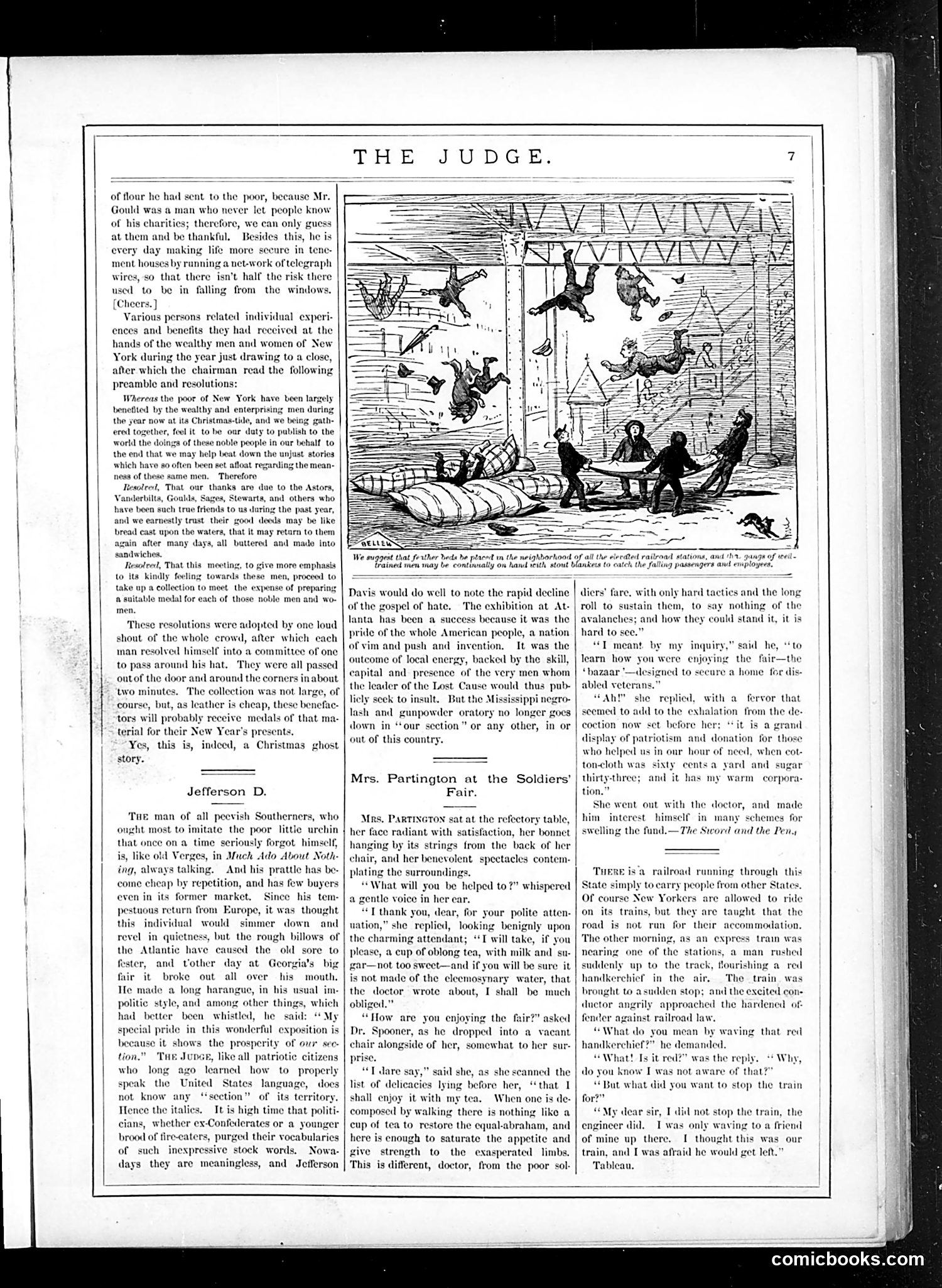
This page contains two satirical pieces targeting wealthy philanthropists and former Confederate leader Jefferson Davis. **Upper cartoon/article**: Mocks New York's wealthy elite (Astors, Vanderbilts, Goulds, Stewarts) for self-serving charity. The satire shows poor people passing resolutions thanking the rich, then collecting money for medals—but receiving cheap leather ones instead. Judge ridicules how wealthy industrialists publicize their charitable acts to counter "unjust stories" about their meanness, suggesting their philanthropy serves reputation-building rather than genuine generosity. **"Jefferson D." section**: Attacks former Confederate President Jefferson Davis for continuing to use divisive language about "our section" when discussing the South at Georgia's fair. Judge argues such sectional rhetoric is outdated and harmful—that all Americans should speak as unified citizens, not as representatives of regional interests. The piece suggests Davis exemplifies bitter ex-Confederates who haven't abandoned hostility toward the Union. Both pieces reflect post-Reconstruction tensions: skepticism of capitalist elites' motives and anxiety about lingering Southern resentment.
📄 Transcribed text from this page (OCR, searchable)
Machine-transcribed from the original scan — historical spelling and the odd misread are preserved.
of flour he had sent to the poor, because Mr. Gould was a man who never let people know of his ch: ; therefore, we ean only guess at them and be thankful. Besides this, he is every day making life more secure in tene- ment houses by running a network of telegraph wires, so that there isn't half the risk th used to be in falling from the windows (Cheers. ] Various persons related individual experi- ences and benefits they had received at the hands of the wealthy men and women of New York during the year just drawing to a close, after which the chairman read the following preamble and resolution: Whereas the poor of New York have bee benefited by the wealthy and enterprising the year now at its Christmas-tide, and we being gath- ered together, feel it to be our duty to publish to the world the doings of these noble people in our behalf to the end that we may help beat down the unjust stories which have so often been set afloat regarding the mean- reas of these same men, Therefore Resoleext, That our thanks are due to the Astors, Vanderbilts, Goulds, Sages, Stewarts, and others who have been such tre friends to us daring the past year, and we earnestly trust their good deeds may be like bread east upon the watera, that it may retarn to them again after many days, all buttered and made into sandwiches. Resolved, That this meeting, to give more emphasis to its kindly feeling towards these men, proceed to take up a collection to meet the expense of preparing a suitable medal for each of those noble men and wo- men. ‘These resolutions were adopted by one loud shout of the whole crowd, after which each man resolved himself into a committee of one to pass around his hat. They were all passed outof the door and around the corners inabout two minutes. ‘The collection was not large, of course, but, as leather is cheap, these benefac- tors will probably receive medals of that ma- terial for their New Year's presents. Yes, this is, indeed, a Chi story. stmas ghost Jefferson D. Tue man of all peevish Southerners, who wht most to imitate the poor littie urchin at once on a time seriously forgot himself, is, like old Verges, in Much Ado About Noth- ing, always talking. And his prattle has be- come cheap by repetition, and has few buyers even in its former market, Since his tem- pestuous return from Europe, it was thought this individual would simmer down and revel in quietness, but the rough billows of the Atlantic have caused the old sore to fester, and other day at Georgia’s big fair it broke out all over his mouth, He made a long ha in hi politic style, and among other thin; had better been whistled, he said: special pride in this wonderful exposition is because it shows the prosperity of our sec tion.” Tue June, like all patriotic citizens who long ago learned how to properly speak the United States language, does not know any ‘‘section” of its territory, Hence the italics, It is high time that politi- cians, whether ex-Confederates or a younger brood of fire-caters, purged their vocabularies of such inexpressive stock words. Nowa- days they are meaningless, and Jefferson usual im: which Sot NSS We suggest that feather bede he placed in the n trained men may be contu tally on hart Davis would do well to note the rapid decline of the gospel of hate, je of the whole American people, a nation of vim and push and invention, It was the outcome of local energy, backed by the skill, capital and presence of the very men whom the leader of the Lost Cause would thus pub- licly seek to insult. But the Mississippi negro- lash and gunpowder oratory no longer gocs down in “our section” or any other, in or out of this country. Mrs. Partington at the Soldiers’ Fair. Mrs. PARTINGTON sat at the refectory table, her face radiant with satisfaction, her bonnet hanging by its strings from the back of her chair, and her benevolent. spec plating the surroundings. “What will you be helped to?” whispered a gentle voice in her ear, “T thank you, dear, for your polite atten- uation,” she replied, looking benignly upon the charming attendant; “T will take, if you please, a cup of oblong tea, with milk and su- gar—not too swect—and if you will be sure it is not made of the eleemosynary water, that the doctor wrote about, I shall be mucl obliged.” “ffow are you enjoying the fair?” asked Dr. Spooner, as he dropped into a vacant chair alongside of her, somewhat to her sur- les contem- y," said she, as she scanned the list of delicacies lying before her, “that I shall enjoy it with my tea, When one is de- composed by walking there is nothing like a cup of tea to restore the equal-abraham, and here is enough to saturate the appetite and give strength to the exasperated limbs. This is different, doctor, from the poor sol- Nborhood of all the eieedted railroad stations, ith stout Blankets to catch te fa ‘The exhibition at At- | s been a success because it was the | display of p diers’ fare, with only hard tacties and the long roll to sustain them, to say nothing of the avalanches; and how they could stand it, it is hard to see. “T meant by my inquiry,” said he, “to learn how you were enjoying the fair—the “hazaar ae abled veterans. “Ah!” she replied, with a fervor that seemed to add to the exhalation from the de- coction now set before her: ‘it is a grand triotism and donation for those who helped us in our hour of need, when cot- ned to secure a home for dis- ton-cloth was sixty cents a yard and sugar thirty-three; and it has my warm corpora- tion.” She went out with the doctor, and made him interest himself in many schemes for swelling the fund.—The Sword and the Pens Tuene isa railroad running through this State simply to carry people from other States. Of course New Yorkers are allowed to ride on its trains, but they are taught that the road is not ran for their accommodation. The other morning, as an express. train was nearing one of the stations, a man rushed suddenly up to the track, fourishing a red handkerehief in the air, The train. was brought to asudden stop; and the excited con- ductor angrily approached the hardened of fender against railroad law, “What do you mean by waving that red handkerchief?” he demanded. “What! Is it red?” was the reply. “Why, do you know I was not aware of that?” “But what did you want to stop the train for? “My dear sir, I did not stop the train, the engincer did. a friend of mine up there. [ thought this was our train, and I was afraid he would get left.” Tableau, Twas only waving te comicbooks.com