
Judge, 1881-12-31 · page 6 of 22
Judge — December 31, 1881 — page 6: what you’re looking at
What you’re looking at
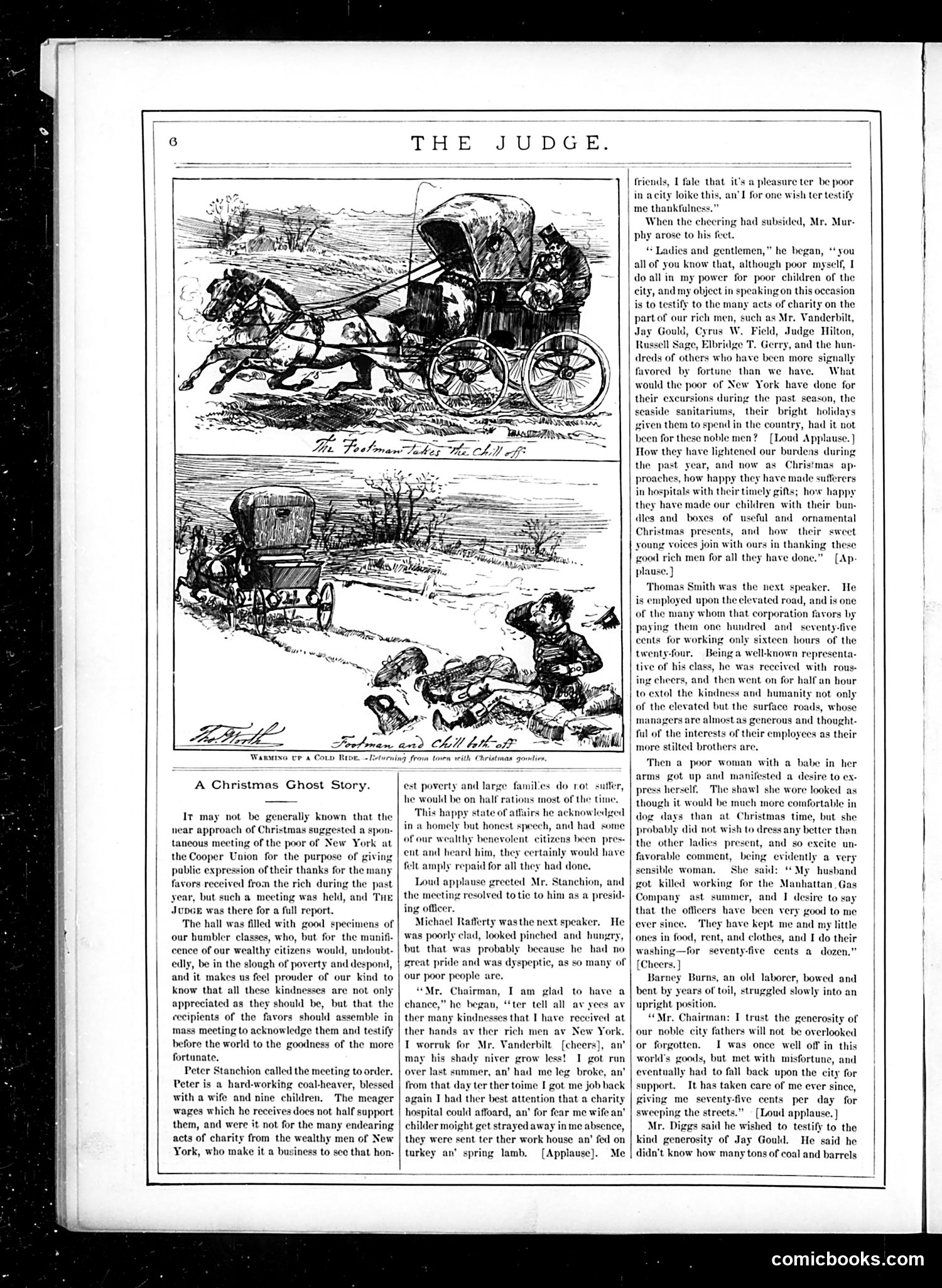
This page satirizes the performative charity of Gilded Age wealthy industrialists. The text describes a supposed meeting where poor New York workers publicly thank the rich—including Vanderbilt, Jay Gould, and Russell Sage—for "kindnesses" like charity hospital care and brief country excursions. The satire is biting: workers like Michael Rafferty describe being maimed (run over by a wagon) then having their families sent to the workhouse while recovering, yet frame this as generosity. The title "Christmas Ghost Story" suggests this gratitude is phantom-like—unreal or forced. Judge mocks both the wealthy men's self-congratulation and the implication that minimal, inadequate relief merits such public thanksgiving. The cartoon illustrations showing poor families and workers reinforce the gap between the rhetoric of benevolence and actual working-class conditions. This is social criticism dressed as reporting.
📄 Transcribed text from this page (OCR, searchable)
Machine-transcribed from the original scan — historical spelling and the odd misread are preserved.
A Christmas Ghost Story. It may not be generally known that the near approach of Christmas suggested a spon- taneous mecting of the poor of New York at the Cooper Union for the purpose of giving public expression of their thanks for the many favors received from the rich durin; year, but such a meeting was held, Jupce was there for a full report. The hall was filled with good specimens of our humbler classes, who, but for the manifi- cence of our wealthy citizens would, undoubt- edly, be in the slough of poverty and despond, and it makes us feel prouder of our kind to know that all these kindnesses are not only appreciated as they should be, but that the ‘ipients of the favors should assemble in mass meeting to acknowledge them and testify before the world to the goodness of the more fortunate. Peter Stanchion called the meeting to order. Peter is a hard-working coal-heaver, blessed with a wife and nine children. The meager wages which he receives does not half support them, and were it not for the many endearing acts of charity from the wealthy men of New York, who make it a business to sec that hon- est poverty and large families do rot sutter, he would be on half rations most of the t This happy state of affairs he acknowled in a homely but honest speech, and had of our wealthy benevolent citizens been pre ent and heard him, they nly would have felt amply repaid for all they had done. Loud applause greeted Mr. Stanchion, and the mecting resolved to tie to him as a pi ing officer. Michael Rafferty was the next speaker. was poorly clad, looked pinched and hungry but that was probably because he no great pride and was dyspeptic, as so many of our poor people are. me “Mr. Chairman, I am glad to have a chance,” he began, ‘ter tell all av yees av ther many kindnesses that I have received at ther hands av ther rich men av New York, I worruk for Mr. Vanderbilt [cheers], an’ may his shady niver grow less! I got run over last summer, an’ had me leg broke, an’ from that day ter ther toime I got me job back again I had ther best attention that a charity hospital could affoard, an’ for fear me wife an’ childer moight get strayed away in me absence, they were sent ter ther work house an’ fed on turkey an’ spring lamb. [Applause]. Me | in acity loike th friends, I fale that it's a pleasure ter be poor n' I for one wish ter testify me thankfuln When the cheering had subsided, Mr. Mur- phy arose to his feet. “Ladies and gentlemen,” he began, * you all of you know that, although poor myself, I do all in my power for poor children of the city, and my object in speaki 's occasion to testify to the many acts of charity on the partof our rich men, such as Mr. Vanderbilt, Jay Gould, Cyrus W. Field, Judge Hilton, Russell Sage, Elbridge T. ( and the hun- dreds of others who have been more signally favored by fortune than we have. What would the poor of New York have done for their excursions during the past season, the seasid nitariums, their bright holidays given them to spend in the country, had it not been for these noble men? (Loud Applause. } How they have lightened our burdens during the past year, and now as Christmas ap- proaches, how happy they have made sufferers in hospitals with the ely gifts; how happy they have made our children with their bun- 's and boxes of useful and ornamental Christmas presents, and how their sweet ices join with ours in thanking these od rich men for all they have done.” [Ap use. ] Thomas Smith was the next speaker. He is employed upon the elevated road, of the many whom that corporation favors by paying them one hundred and seventy cents for working only sixteen hours of the twenty-four, Being a well-known representa- tive of his class, he was received with rous- ing cheers, and then went on for half an hour to extol the kindness and hun of the elevated but the surface roads, whose managers are alm generous and thought- ful of the interests of their employees as their more stilted brothers are. nd is one Then a poor woman with a babe in her arms got up and manifested a desire to ex- press herself. The shawl she wore looked as though it would be much more comfortable in dog days than at Christmas time, but she probably did not wish to dress any better than the other ladies present, and so excite un- favorable comment, being evidently a very “My husband got killed working for the Manhattan. Gas Company ast summer, and I desire to say that the officers have been very good to me ever since. ‘They have kept me and my little ones in food, rent, and clothes, and I do their washing—for seventy-five cents a dozen.” ] 'y Burns, an old laborer, bowed and Years of toil, struggled slowly into an upright position. “Mr, Chairma: sensible woman, She s I trust the generosity of our noble city fathers will not_be overlooked or forgotten, 1 was once well off in this world's goods, but met with misfortune, and eventually had to fall back upon the city for support. It has taken care of me ever since, giving me seventy-five cents per day for sweeping the streets.” (Loud applause. } Mr. Diggs said he wished to testify to the kind generosity of Jay Gould. He said he didn't know how many tons of coal and barrels comicbooks.com