
Judge, 1881-12-31 · page 18 of 22
Judge — December 31, 1881 — page 18: what you’re looking at
What you’re looking at
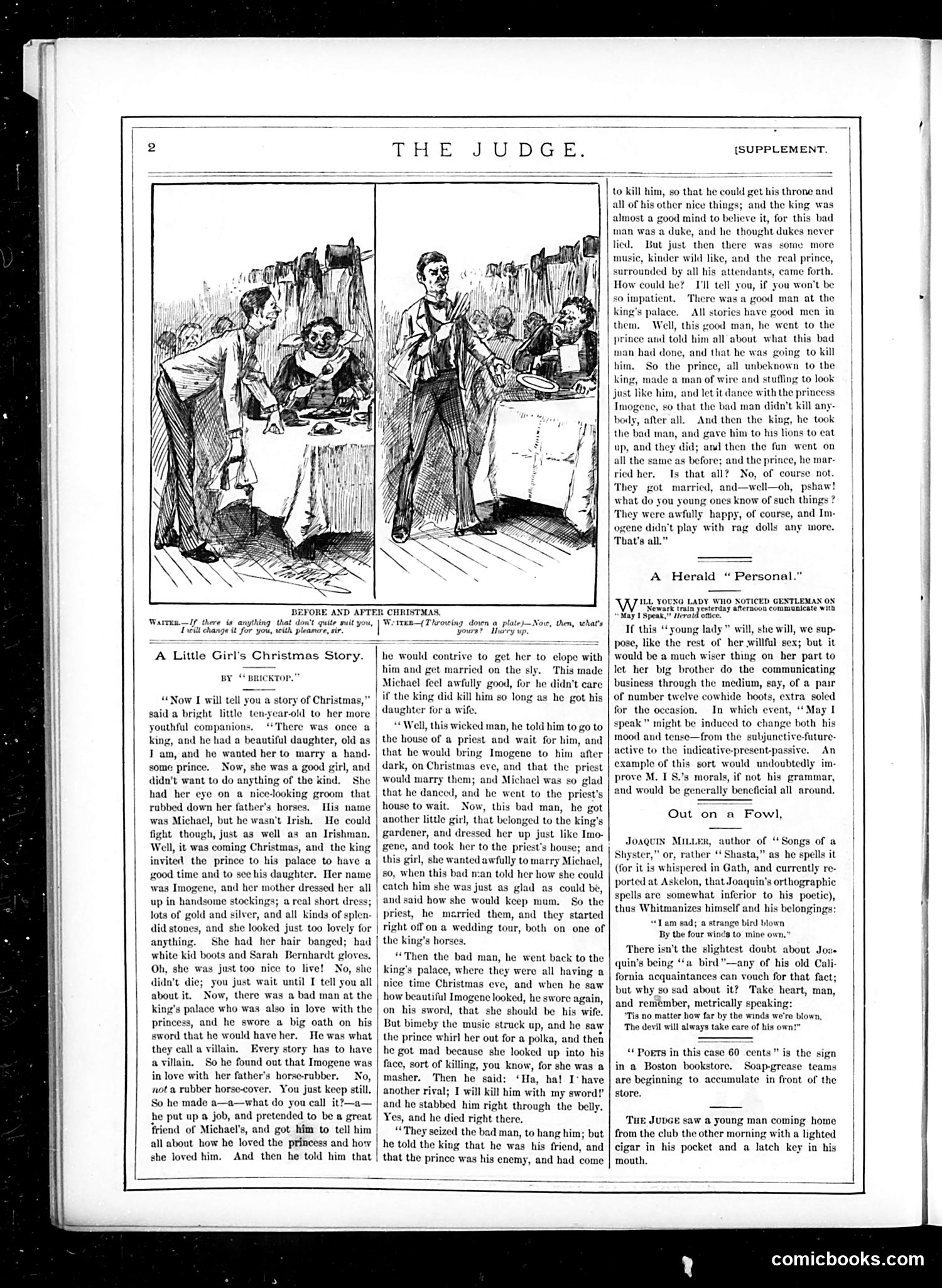
This page contains two separate pieces: a single-panel cartoon at top and a children's story below. **The Cartoon ("Before and After Christmas"):** A shopkeeper (Warren) offers to exchange merchandise for a dissatisfied customer. The humor is straightforward—it's about holiday retail complaints and exchange policies, likely commenting on consumer expectations around Christmas shopping. **"A Little Girl's Christmas Story":** A young girl tells her friends a fairy tale featuring a king, princess Imogene, and a love triangle. The plot involves a villain who sabotages a marriage between the princess and a commoner (Michael the groom) by arranging her elopement with someone else instead. When the villain later attacks the prince out of jealousy, he's caught but claims the prince was actually his enemy—creating moral ambiguity about guilt. The story appears to be gentle moral fiction for children, common to Judge magazine's family sections. It lacks obvious political satire, instead offering a coming-of-age narrative about romance, deception, and the complexity of judging character—fitting the magazine's title.
📄 Transcribed text from this page (OCR, searchable)
Machine-transcribed from the original scan — historical spelling and the odd misread are preserved.
BEFORE AND AFTER CHRISTMAS. Warren—/f there ia anything that don't quite suit you, Tet lange it for you, with pleasure, sir. A Little Girl's Christmas Story. By ‘ prickTor.” “Now I will tell you a said a bright little ten-year-old to her moi youthful companions, ‘There was once a king, and he had a beautiful daughter, old as I am, and he wanted her to marry a hand- some prince. Now, she was a good g' didn't want to do anything of the kind. She had her eye on a nice-looking groom tha rubbed down her father’s horses. His name was Michacl, but he wasn’t Irish. He could fight though, just as well as an Irishman. Well, it was coming Christmas, and the king invited the prince to his palace to have a good time and to see his daughter. Her name was Imogene, and her mother dressed her all up in handsome stockings; a real short dress; lots of gold and silver, and all kinds of splen- did stones, and she looked just too lovely for anything. She had her hair banged; had white kid boots and Sarah Bernhardt gloves. Oh, she was just too nice to live! No, she didn’t die; you just wait until [ tell you all about it. Now, there was a bad man at the king’s palace who was also in love with the princess, and he swore a big oath on his sword that he would have her, He was what they call a villain, Every story has to have a villain. So he found out that Imogene was in love with her father’s horse-rubber. No, not a rubber horse-cover. You just keep still. So he made a—a—what do you call it?—a— he put up a job, and pretended to be a great friend of Michael's, and got him to tell him all about how he loved the princess and how she loved him. And then he told him that ory of Christmas, | dau Wetrer(Throwing down a yours?) Harr; he would contrive to get her to elope with him and get married on the sly, This made Michael feel awfully good, for he didn't care if the king did kill him so long as he got his ter for a wife, “Well, this wicked man, he told him to go to the house of a priest and wait for him, and that he would bring Imogene to him after dark, on Christmas eve, and that the priest would marry them; and Michael was so glad that he danced, and he went to the priest's house to wait. Now, this bad man, he got another little girl, that belonged to the king's gardener, and dressed her up just like Imo- gene, and took her to the priest's house; this girl, she wanted awfully to marry Mi so, when this bad man told her how she could | catch him she was just as glad as could be, and said how she would keep mum. So the priest, he married them, and they started right off on a wedding tour, both on one of the king’s horses. “Then the bad man, he went back to the king's palace, where they were all having a nice time Christmas eve, and when he saw how beautiful Imogene looked, he swore again, on his sword, that she should be his wife. But bimeby the music struck up, and he saw the prince whirl her out for a polka, and then he got mad because she looked up into his face, sort of killing, you know, for she was a masher. Then he said: ‘Ha, ha! I‘ have another rival; I will kill him with my sword!’ and he stabbed him right through the belly. Yes, and he died right there. “They seized the bad man, to hang him; but he told the king that he was his friend, and that the prince was his enemy, and had come him, | king, made a man of wi! | the to kill him, so that he could get his throne and all of his other nice things; and the king was almost a good mind to believe it, for this bad man was a duke, and he thought dukes never lied. But just then there was some more music, kinder wild like, and the real prince, surrounded by all his attendants, came forth. How could he? I'll tell you, if you won't be so impatient. There was a good man at the king’s palace. All stories have good men in them. Well, this good man, he went to the prince and told him all about what this bad man had done, and that he was going to kill So the prince, all unbeknown to the and stuffing to look 1 let it dance with the princess the bad man didn’t kill any- And then the king, he took nd gave him to his lions to eat up, and they did; and then the fun went on all the same as before; and the prince, he mar- ried her. Is that all? No, of course not. They got married, and—well—oh, pshaw! what do you young ones know of such thin They were awfully happy, of course, and Im- ogene didn't play with rag dolls any more. That's all.” just like him, Tmogene, ¢o tha body, after all. ad man, A Herald “ Personal.” ILL YOUNG LADY WHO NOTICED GENTLEMAN ON emark aia yenerday aReraooa commusicae With yy I Speak,” Heraid ome. If this “young lady" will, she will, we sup- pose, like the rest of her willful sex; but it would be a much wiser thing on her part to let her big brother do the communicating business through the medium, say, of a pair of number twelve cowhide boots, extra soled for the occasion, In which event, ‘May I speak” might be induced to change both hi mood and tense—from the subjunctive-future- active to the indicative-present-passive. An example of this sort would undoubtedly im- prove M. I S.’s morals, if not his grammar, and would be generally beneficial all around. Out on a Fowl, Joagutn MILLER, author of “Songs of a nyster,”” or, 1: ” as he spells it (for it is whispered in Gath, and currently r ported at Askelon, that Joaquin’s orthographic spells are somewhat inferior to his poetic), thus Whitmanizes himself and his belongings: “Tam sad; a strange bird blown By the four winds to mine own.” doubt about Jo: quin’s being “a bird"—any of his old Cali- fornia acquaintances can vouch for that fact; but why so sad about it? Take heart, man, and remember, metrically speakin; “Tis no matter how far by the winds we're blown, The devil will always take care of his own! “ Poets in this case 60 cents” is the sign in a Boston bookstore. Soap-grease teams are beginning to accumulate in front of the store. Tue Juve saw a young man coming home from the club the other morning with a lighted cigar in his pocket and a latch key in his mouth. comicbooks.com