
A complete issue · 68 pages · 1923
Captain Billy's Whiz Bang #44
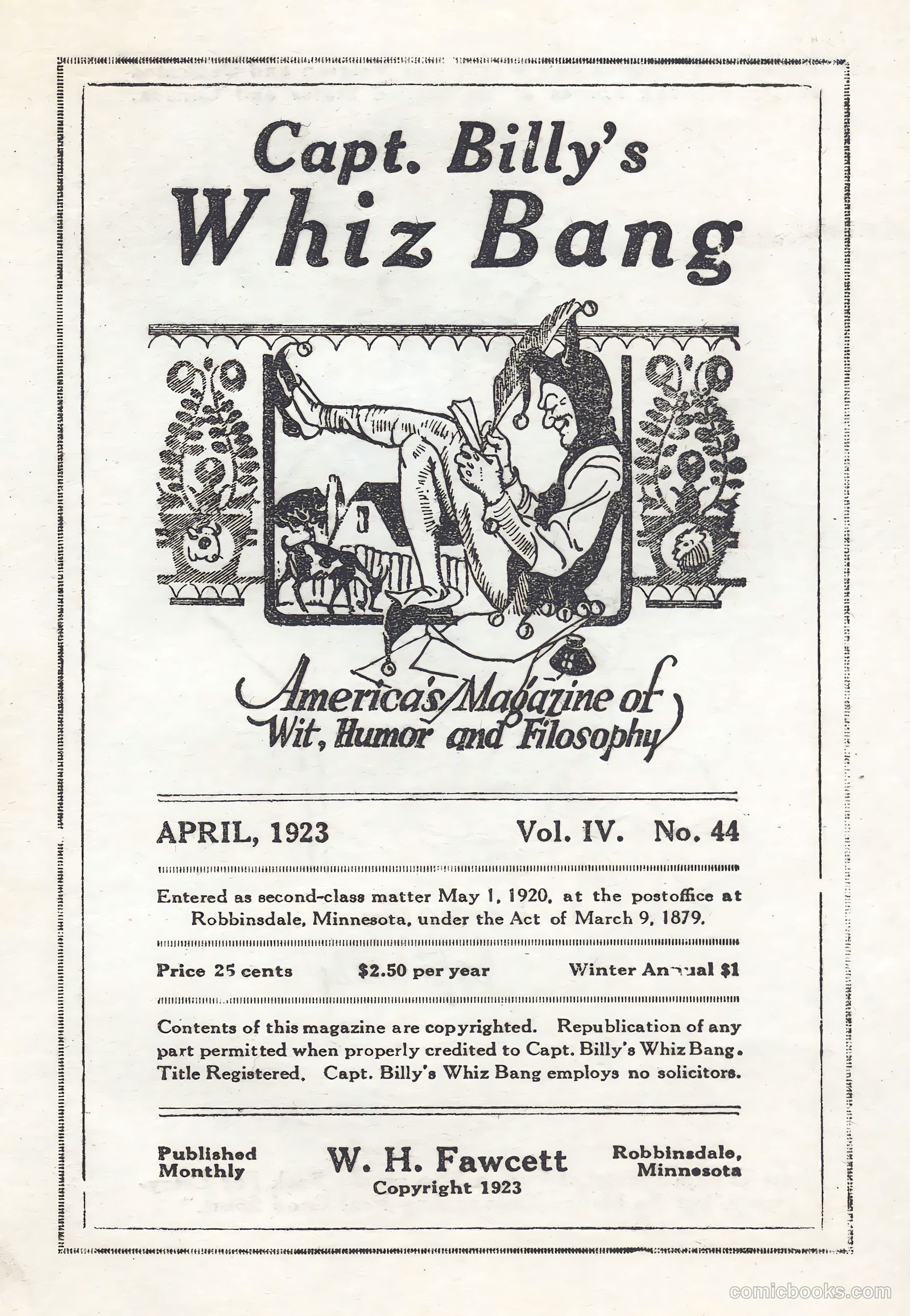
This is the title page for *Capt. Billy's Whiz Bang*, an American humor magazine published in Robbinsdale, Minnesota in April 1923. The central illustration shows what appears to be a chaotic domestic scene—a man in a chair with his feet up surrounded by children and household items, suggesting comedic domestic disorder. The illustration is typical of 1920s popular humor magazines that focused on domestic comedy and family situations. *Whiz Bang* was a widely-read publication of the era (priced at 25 cents per issue or $2.50 yearly) marketed as a magazine of "Wit, Humor and Philosophy." It targeted general audiences seeking light entertainment during the post-WWI period. The title page itself contains no specific political satire—it's primarily a cover identifying the publication's publisher W. H. Fawcett and establishing copyright information.
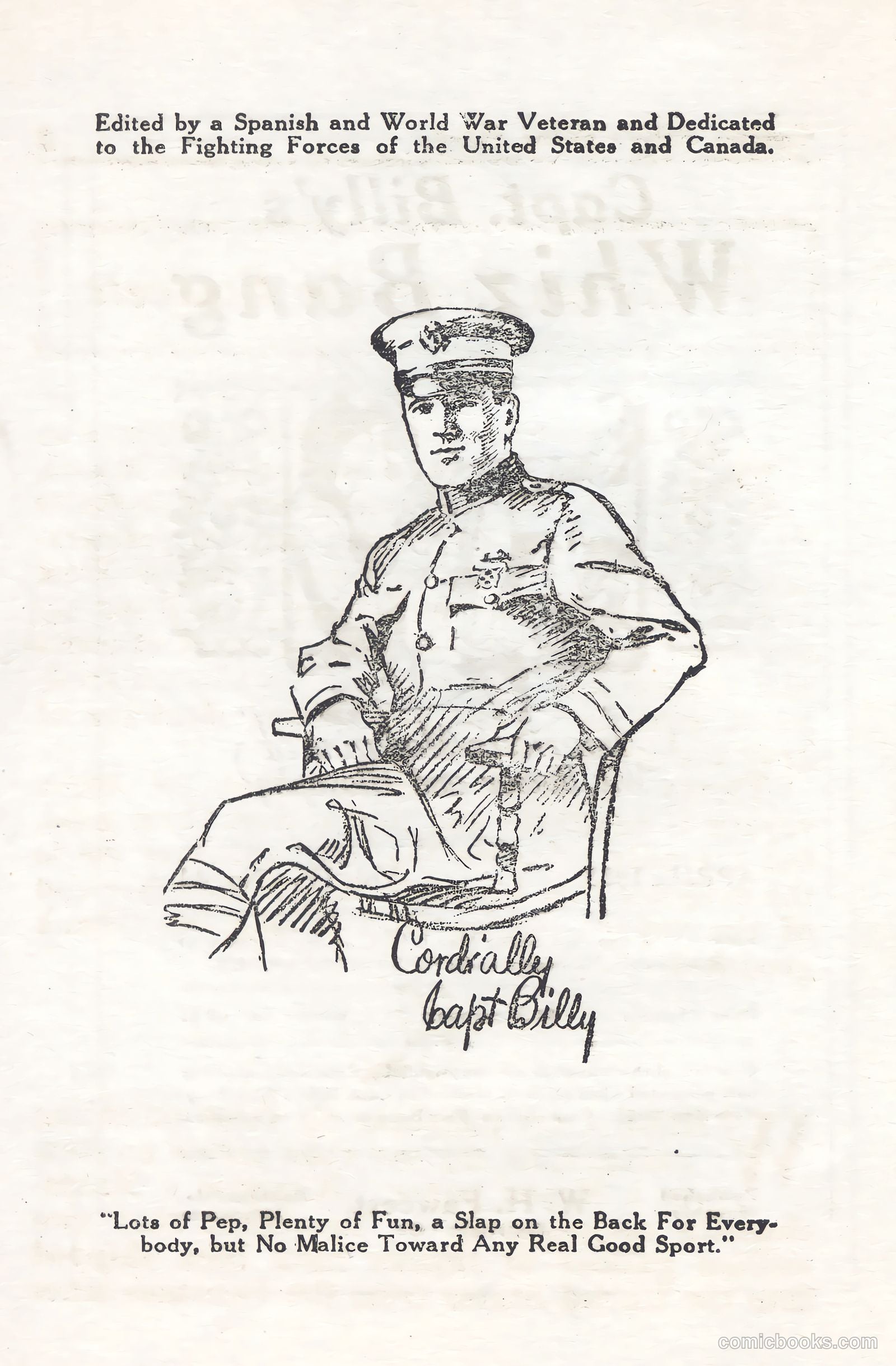
This is a title/dedication page for *Whiz-Bang*, a WWI-era satirical magazine. The central illustration depicts a military officer in uniform, signed "Cordially bapt Billy"—likely referring to Billy the editor, identified in the header as a Spanish-American and World War veteran. The magazine's motto emphasizes good-natured humor: "Lots of Pep, Plenty of Fun, a Slap on the Back For Everybody, but No Malice Toward Any Real Good Sport." This reflects the publication's intent to provide morale-boosting, lighthearted satire for American and Canadian servicemen during WWI. The uniform and military setting reinforce the magazine's dedication to fighting forces, positioning it as entertainment aimed at soldiers rather than civilians.
This is a humorous column by the magazine's editor, written from Miami. The first section satirizes ocean voyages—mocking the common belief that sea travel is healthy while describing the cramped, unpleasant reality of ship life (narrow aisles, greasy water, discomfort). The second section pivots to Prohibition-era smuggling. A Massachusetts congressman is quoted reporting that two million gallons of liquor have been shipped into the U.S. from the nearby Bahamas. This references the widespread bootlegging during Prohibition (1920-1933), when alcohol smuggling from Caribbean ports was rampant. The juxtaposition—placing this smuggling news amid casual travel commentary—suggests the casual, commonplace nature of illegal alcohol importation in that era. The column appears to satirize both naive assumptions about travel and the obvious scale of Prohibition's failure.
This page satirizes Prohibition-era anxieties through darkly comedic logic. The author argues that since Prohibition made America "dry," British rum runners now operate freely from Nassau, making everyone happy—until he extends this absurdly: those same Caribbean islands could easily become bases for enemy bombing raids during wartime. The joke's punch comes from the mock-serious invocation of General Pershing's recent statements about aircraft's military importance. The author warns New Yorkers that while they might tolerate gin bottles raining down, actual bombs would send them fleeing to Breezy Point Lodge. This satirizes American foreign policy anxieties post-WWI, weaponized prohibition enforcement concerns, and the emerging threat of aerial warfare—all wrapped in sardonic humor about the unintended consequences of Prohibition. The piece then transitions to the author's personal military memoir, relating these modern military concerns to his Philippines service under Major Robert Lee Bullard against the Moros.
This page is a memoir-style anecdote rather than a cartoon. The author describes witnessing military operations in the Philippines (Mindanao and Jolo islands) under commanders who would later become famous in World War I: General John J. Pershing and General Leonard Wood. The satire is subtle and self-aware. The author admits to name-dropping these future military luminaries primarily for personal gratification—boasting of having served under them. He acknowledges this impulse somewhat sheepishly as "inward pleasure" and "pride," asking readers to forgive his vanity. The joke is *about* the human tendency to inflate one's own importance through association with the famous. By explicitly confessing this motivation rather than simply praising his commanders, the author pokes fun at how people construct narratives of their own significance. The magazine's satirical tone comes through in this honest admission of a rather petty human motivation.
This page from *Captain Billy's Whiz Bang* (a 1920s-era humor magazine) contains two anecdotes: **First story**: A humorous domestic scene where the narrator's wife deflates his ego—when a flirtatious woman at a Savannah hotel flirts with him, his wife replies that she laughed at *him* when they first met, implying he was equally ridiculous-looking. **Second story**: The editor visits Cole L. Blease, twice-governor of South Carolina and noted criminal defense lawyer. The joke hinges on **Prohibition-era satire**: Blease quips that while he easily wins murder acquittals, freeing bootleggers (illegal alcohol producers/sellers) is actually *harder* in his state. This inverts expected difficulty, suggesting South Carolina's legal system punished alcohol violations more severely than homicide—social commentary on how Prohibition enforcement priorities exceeded justice for serious crimes. Both pieces use casual anecdote-humor typical of this magazine's irreverent tone.
This satirical piece contains multiple jokes about Prohibition-era America and Southern hospitality: **The Blease reference** appears to reference a political figure (likely Cole Blease, South Carolina governor), mocked for being "too late" to protect bootleggers—a jab at Prohibition's failure and widespread illegal alcohol production. **The dandelion joke** satirizes how Prohibition made people suddenly interested in plants' fermentation potential, revealing alcohol's grip on American culture. **The main satire targets Florida resort hotels**: their excessive courtesy masks predatory pricing schemes. The joke notes that con artists sold non-existent hotels to tourists, who believed their weekly receipts were property deeds—exposing both tourist gullibility and hotel dishonesty. **The final dig** at Southern "Dixie" economics suggests hotels must charge exorbitant rates during their brief 3-4 month tourist season to stay profitable, while even the rain financially victimizes visitors. Overall, the page mocks Prohibition's social effects, tourist exploitation, and Southern economic desperation.
This page from *Captain Billy's Whiz Bang* (a 1920s-era humor magazine) contains three satirical pieces: 1. **Southern Liquor Prices**: Mocks Prohibition-era pricing disparities. Scotch costs $60/case in the South versus $120 in the North, explaining Southern "hospitality"—hosts can afford to serve guests more cheaply. 2. **KKK Joke**: A racist "humor" piece featuring a stereotyped Black character making a dark joke about receiving KKK mail. The punchline relies on the threat of lynching—"reading it on the train" means fleeing quickly. This reflects how the KKK was resurgent and violent during the 1920s. 3. **Editor's Personal Misadventure**: The editor complains his wife published his photograph in the December issue while he managed the magazine, causing him embarrassment. This is self-deprecating humor about domestic life. The page reflects 1920s attitudes: casual racism, Prohibition bootlegging as normalized humor, and gender-based domestic comedy.
This page from the satirical magazine contains three humor items: 1. **Reader's Poem to Captain Billy**: A WWI veteran ("Twenty-ninth veteran—a former doughboy") sends humorous insults to the magazine's editor, Captain Billy, mocking his appearance and suggesting his photograph was made for his "red-headed wife." The joke plays on self-deprecating humor common to the era. 2. **Miami Bathing Suit Arrest**: A brief anecdote about police arresting a woman for wearing a one-piece bathing suit in Miami—satirizing the era's strict morality laws regarding women's swimming attire, which were genuinely enforced in the 1920s. 3. **Editorial Note**: Captain Billy welcomes submissions on any paper quality, joking that the magazine farm has "corn cobs" (waste material) available. This humorous invitation encourages reader participation, a key feature of *Whiz Bang's* interactive format. The page reflects 1920s popular humor: post-war irreverence, bathing suit controversies, and reader engagement.
This page from *Captain Billy's Whiz Bang* contains three short, unrelated humorous anecdotes typical of the magazine's format: 1. **Teacher/Vesuvius joke**: A child's innocent but irreverent comparison of a volcano to hell—humor from childish bluntness. 2. **Scandinavian/Cricket joke**: A visiting stranger mistakes a Saengerfest (German-Scandinavian singing society) for cricket sounds. The humor plays on ethnic stereotyping and miscommunication, with "Olaf" (stereotypically Scandinavian name) making an absurdly wrong explanation about how crickets "sing." 3. **Deacon Miller sketch**: A rural deacon visits a young lawyer's locked office displaying a "Return in 20 minutes" sign. The setup suggests the deacon will misinterpret why the office is locked (implying impropriety with the stenographer), though the punchline is cut off. These are typical period humor aimed at small-town American audiences, relying on ethnic caricature, rural naiveté, and mild innuendo—standard for 1920s-era magazines.
This page contains humorous rural American anecdotes, likely from the 1920s. The opening depicts an old mare refusing her owner's demand to return in 20 minutes—a joke about stubbornness and independence. The main content satirizes small-town life in Robbinsdale, Minnesota. It mocks fire chief John Bloberger, who allegedly considered resigning after hearing unfounded rumors of an assassination conspiracy against prominent Americans—poking fun at both gullibility and the Red Scare paranoia of the era. The second anecdote, introduced by Mayor Tom Howard, sets up a tall tale about a vain banker in Anoka with a glass eye. The banker's proposition to Patrick McCarthy—apparently contingent on McCarthy performing some feat—exemplifies the magazine's folksy humor style, where credulous characters and unlikely wagers drive the comedy. The page emphasizes small-town character types rather than national politics.
**First joke**: A banker offers Pat a loan if he can guess which of the banker's eyes is real (implying one is glass or artificial). Pat correctly identifies the right eye as real, then explains he knew because the left eye "looks far more sympathetic"—satirizing bankers as naturally unsympathetic and cold in their dealings. **Second joke**: A stranger asks Deacon Callahan where to find alcohol. The deacon points to the Baptist Church, then reveals it's "the only place you can't get it." This satirizes Prohibition-era hypocrisy: while churches preached temperance, alcohol was readily available nearly everywhere else in America. The joke implies even supposedly virtuous institutions were surrounded by widespread bootlegging and drinking. Both jokes target perceived character flaws in authority figures—bankers' callousness and religious leaders' ineffectiveness at enforcing moral standards.
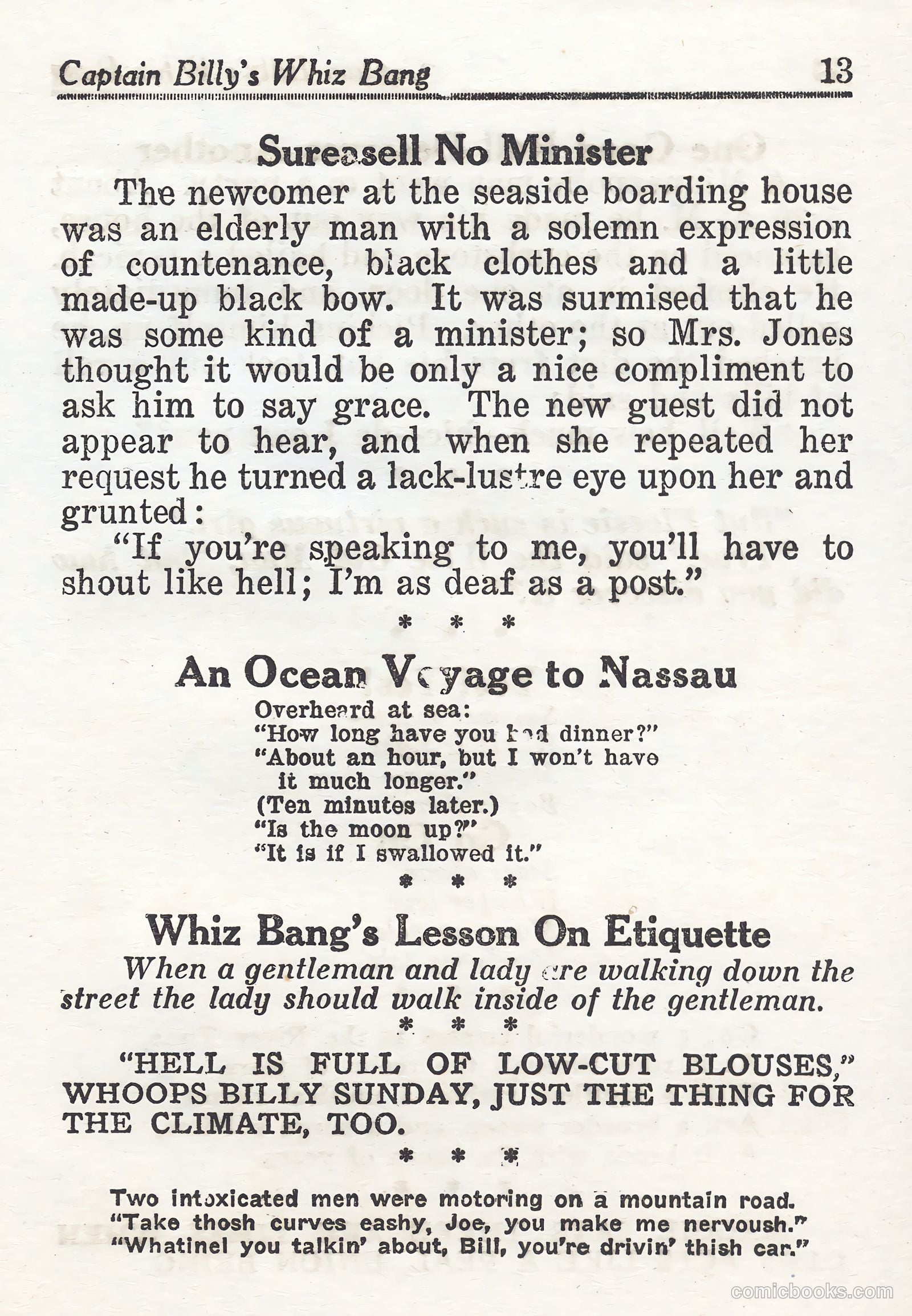
This page contains several short humorous anecdotes typical of 1920s American satirical magazines: **"Sureasell No Minister"** mocks assumptions about respectability. A boarding house keeper assumes an elderly man in formal black clothes is a clergyman worthy of saying grace, but he rudely refuses—revealing appearances deceive. **"Ocean Voyage to Nassau"** uses seasickness humor: a passenger won't have dinner "much longer" (implying vomiting), and later jokes about swallowing the moon, playing on nausea and disorientation at sea. **"Lesson on Etiquette"** presents conventional street-walking rules, then subverts them by quoting "Billy Sunday" (the famous evangelist-turned-moralist) making crude commentary about low-cut blouses and hell—satirizing his hypocritical moralizing about women's fashion. **Final anecdote** features two drunk drivers; the ironic punchline is that the passenger criticizes the driver's curves, unaware the *passenger* is actually driving—mocking drunk logic. These jokes rely on period-specific references (Billy Sunday's actual moralistic crusades, 1920s fashion anxieties) and rough, working-class humor typical of the era's bawdy magazines.
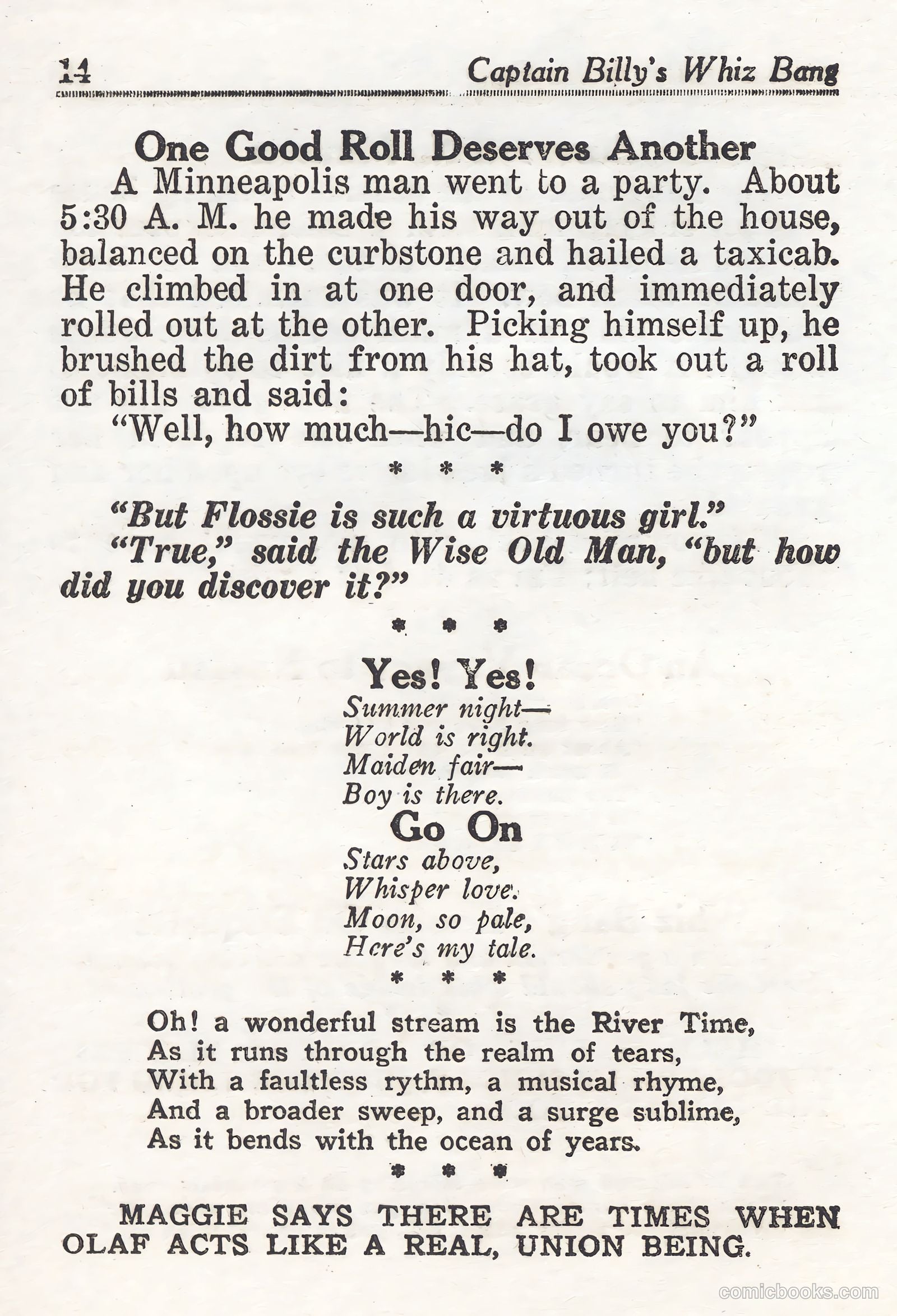
This page from *Captain Billy's Whiz Bang* (a 1920s-era humor magazine) contains three distinct jokes and a poetic section: **The Main Joke**: A drunk Minneapolis man falls out of a taxicab, then pays the driver anyway—humorously demonstrating intoxicated courtesy. **Secondary Jokes**: A dialogue mocking claims of female virtue (suggesting it's easily disproven), and a romantic poem about summer nights and young love. **The Poetry**: A sentimental piece personifying "River Time" flowing through human experience. **The Final Line**: References characters "Maggie" and "Olaf" (likely recurring comic strip characters in the magazine), with "union being" appearing to be a pun or joke whose exact meaning is unclear without more context—possibly wordplay on labor unions or simply meaning "real human being." The page reflects early-20th-century humor: drinking culture, skepticism about female propriety, and romantic sentimentality mixed with crude jokes. No specific political figures are caricatured here.
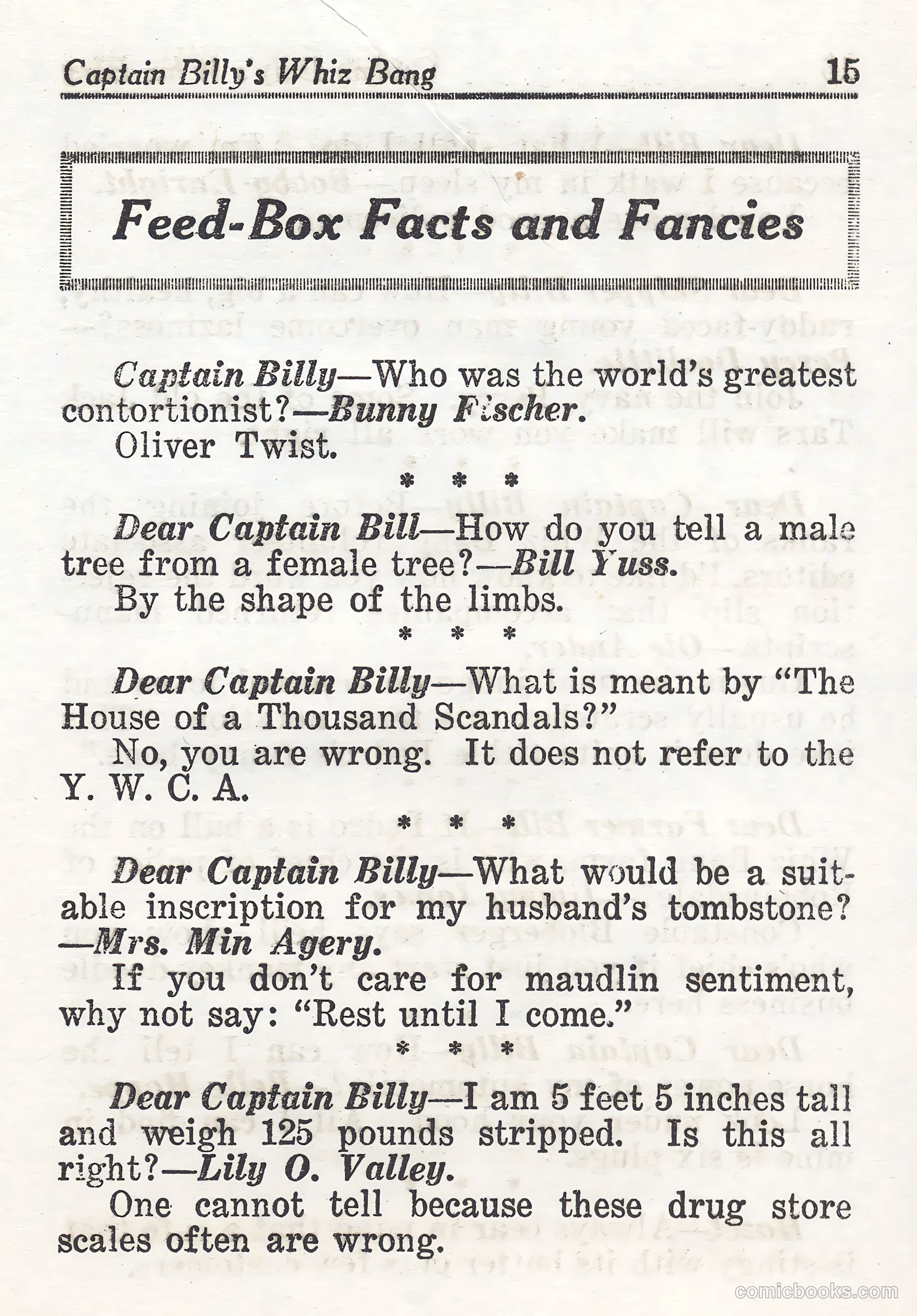
This is a humor advice column from *Captain Billy's Whiz Bang*, a popular American satirical magazine. The page contains jokes disguised as reader questions and answers—a common format of the era. The humor relies on puns and double meanings: "Oliver Twist" answers a contortionist question (twisting body), "shape of the limbs" distinguishes trees (gender innuendo), and "House of a Thousand Scandals" mocks the YWCA (Young Women's Christian Association), suggesting moral hypocrisy. The tombstone inscription joke ("Rest until I come") implies marital dissatisfaction. "Lily O. Valley" is a pun name (lilies in valleys), and the drug store scales joke references contemporary concerns about inaccurate weighing devices—a practical consumer issue of the time. The overall tone is irreverent, risqué without being explicit, and targets institutions (the YWCA, marriage, commerce) through innuendo and wordplay typical of 1920s-era humor magazines.
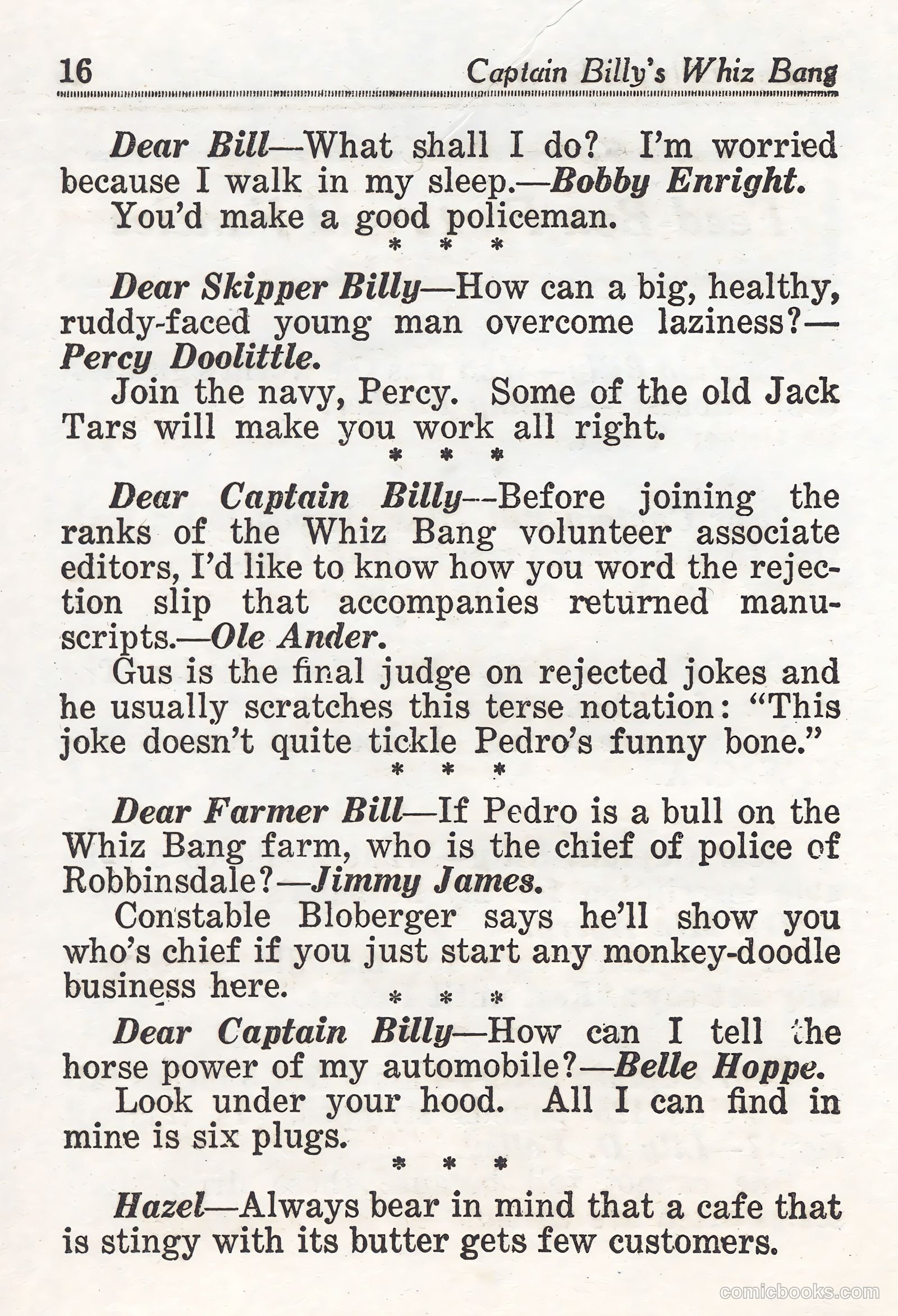
This is a humorous advice column from *Captain Billy's Whiz Bang*, a popular early-20th-century satirical magazine. The format features readers asking "Captain Billy" (the editor) absurd questions, which he answers with punny or irreverent one-liners. The jokes rely on wordplay and double meanings. For example, a sleepwalker would make "a good policeman" (playing on "walking the beat"). A lazy man should "join the navy" where Navy personnel will force him to work. The recurring character "Pedro" appears to be an in-house joke—a bull on the magazine's farm who symbolizes the editorial standard for acceptable humor. The final quip about automobile horsepower is a straightforward gag about the questioner's car having a weak engine. The closing advice about café butter is unrelated moralizing, typical of the magazine's casual, miscellaneous tone. This represents early 1900s American magazine humor: irreverent, pun-heavy, and reliant on shared knowledge of the publication's running jokes.
This is a humor magazine page containing several joke items with no visible cartoons. The content includes: **"April Fool Is With Us Again"**: A domestic joke about a child fooling his mother on April 1st by claiming there's a man in another room—a classic April Fools' prank. **"Almost Shocking"**: Dark humor about a death row prisoner offering his seat to a lady as he faces execution—gallows humor common to the era. **"The Vamp"**: A poem mocking seduction tactics and romantic deception, using period slang ("dope" meaning attractive/impressive). **Additional items**: Ethnic humor involving a Jewish employer and Yiddish speech patterns, and a rhyming poem about a secretive drinker hiding alcohol. The overall tone is irreverent 1920s-era popular humor mixing domestic situations, criminal justice, romance, and ethnic stereotypes typical of *Whiz Bang*'s satirical approach.
This page from the satirical magazine contains several brief jokes exploiting ethnic stereotypes common in 1920s American humor. The opening anecdote mocks a Swedish immigrant ("Ole Johnson") encountering cinema for the first time, using exaggerated dialect ("Ay vent in vun place where dey squirt pictures on de wall") to generate humor from his unfamiliarity with the technology and broken English. The "What Is So Rare as a Day In June?" section presents absurdist riddles with impossible or contradictory answers—a standard joke format of the era. The college joke relies on innuendo about dating and sexual necessity. The Hollywood item references Eddie Laemmle (likely a film industry figure) and makes light of sensationalist filmmaking focusing on women's bodies. The final line uses a pun—"Maggie...speaks in broken China"—playing on her Irish ethnicity while referencing the phrase "broken English," suggesting she speaks in broken Chinese instead, which doesn't logically follow. The humor throughout depends on ethnic caricature, dialect mockery, and wordplay typical of period comedy magazines.
This is a celebrity gossip column targeting Hollywood stars of the 1920s. The main story mocks actress Wanda Hawley for lying on her passport application—claiming to be a mere housewife named "Selma" rather than admitting her stardom. Federal investigators caught the deception and discovered her husband Burton had abandoned her. The column suggests her manager, J. Stewart Wilkinson, may be arranging overseas film work for her, implying possible impropriety. The brief items below report on other stars' personal troubles: Blanche Sweet's health issues, Gloria Swanson's impending divorce from Herbert K. Somborn, and Marshall Neilan's frequent unexplained absences. The final quip—comparing Marshall's marriage to Blanche to a failed vaccination—is cruel gossip suggesting the marriage won't last. The satire targets both celebrity hypocrisy and the invasive nature of 1920s Hollywood scandal-mongering.
This page from the satirical magazine *Captain Billy's Whiz Bang* is a gossip column mocking 1920s Hollywood figures and scandals. The column ridicules film directors and actors through anecdotes: one director effusively praises actress Pola Negri's talent until another (formerly a boxer) crudely reduces her to physical attractiveness. The "Four Roses" reference likely denotes whiskey passed around during this conversation, satirizing both the pretension and the drinking culture. Subsequent items mock actors John Bowers, Marguerite de la Motte, and others for romantic entanglements and infidelity. The Doris Eaton item sensationalizes her husband Joe Gorham's theft from "a trusting film star." The final item about director Billy Wellman and actress Helene Chadwick sarcastically suggests their marriage is so unstable that dinner guests must call ahead—they may be separated that day. The humor relies on readers' familiarity with these minor Hollywood personalities and scandalous behavior presented as entertainment.
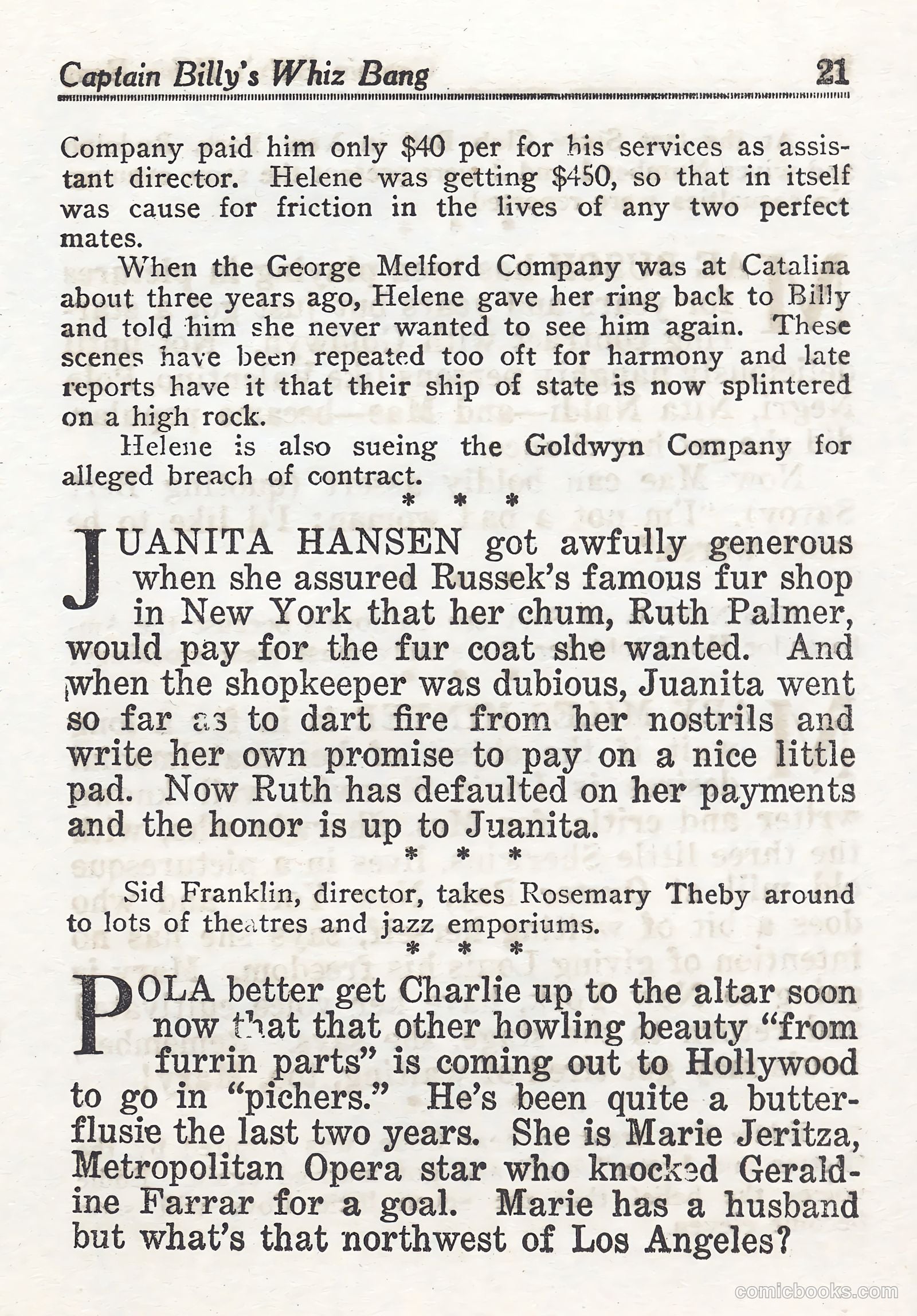
This is a satirical gossip column about early 1920s Hollywood scandals. The page reports on several entertainment-industry figures' romantic troubles: **Billy and Helene**: An unnamed couple (likely actors) whose relationship fractured due to pay disparity—he earned $40, she $450 as assistant director. She returned his ring and they've since separated. **Juanita Hansen and Ruth Palmer**: Hansen generously guaranteed a fur coat purchase for Palmer at a New York shop, even signing a promissory note. Palmer has now defaulted, leaving Hansen responsible. **Pola Negri and Charlie Chaplin**: The column warns Negri ("Pola") to marry Chaplin quickly before Marie Jeritza, a Metropolitan Opera star arriving from Europe, tempts him. Jeritza, who "knocked" rival Geraldine Farrar (both famous opera singers), apparently has a husband but that's "northwest of Los Angeles"—implying distance makes infidelity easier. The satire mocks Hollywood's transient relationships and suggests moral looseness among entertainment elites.
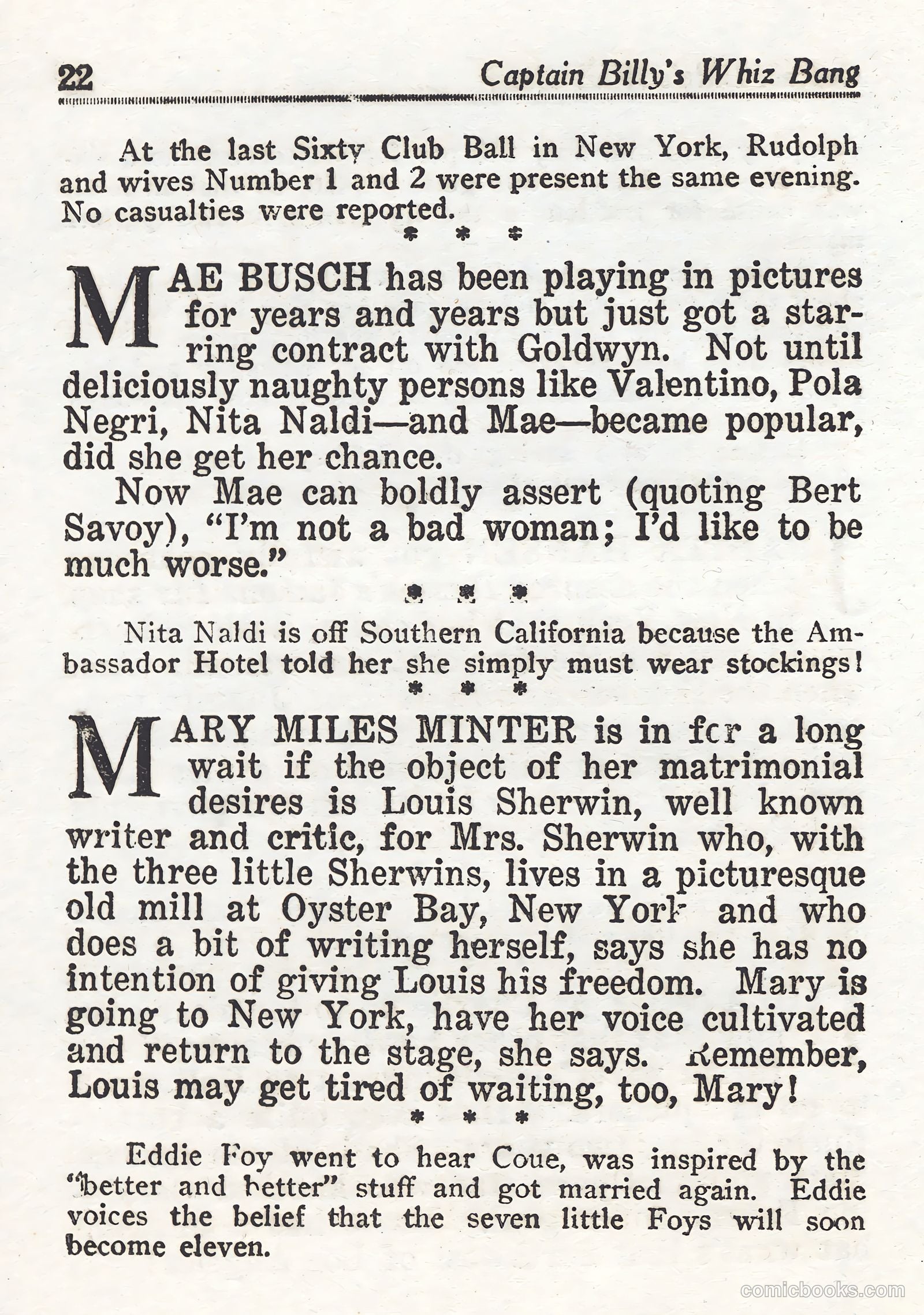
This page from the satirical magazine consists entirely of Hollywood gossip items with no visible cartoons. The humor targets 1920s film industry figures and scandals: **Mae Busch**: The joke mocks how actresses only achieved stardom after becoming known for "delicious" immorality—referencing Valentino and Pola Negri as sex symbols. Her quote about wanting to be "much worse" plays on this manufactured scandalous image. **Nita Naldi**: A jab at Hollywood's casual morality—she's apparently so indifferent to propriety that a hotel had to insist she wear stockings (considered essential modesty). **Mary Miles Minter**: Gossipy commentary on her pursuit of married writer Louis Sherwin, implying his wife won't divorce him and Mary's theatrical comeback is consolation. **Eddie Foy**: A joke about Émile Coué's popular "auto-suggestion" self-help movement ("every day in every way, better and better"). The gag: Foy got so inspired he married again, expecting his seven children to multiply to eleven—mocking both the fad and large families. The satire reflects 1920s attitudes toward celebrity, morality, and popular movements.
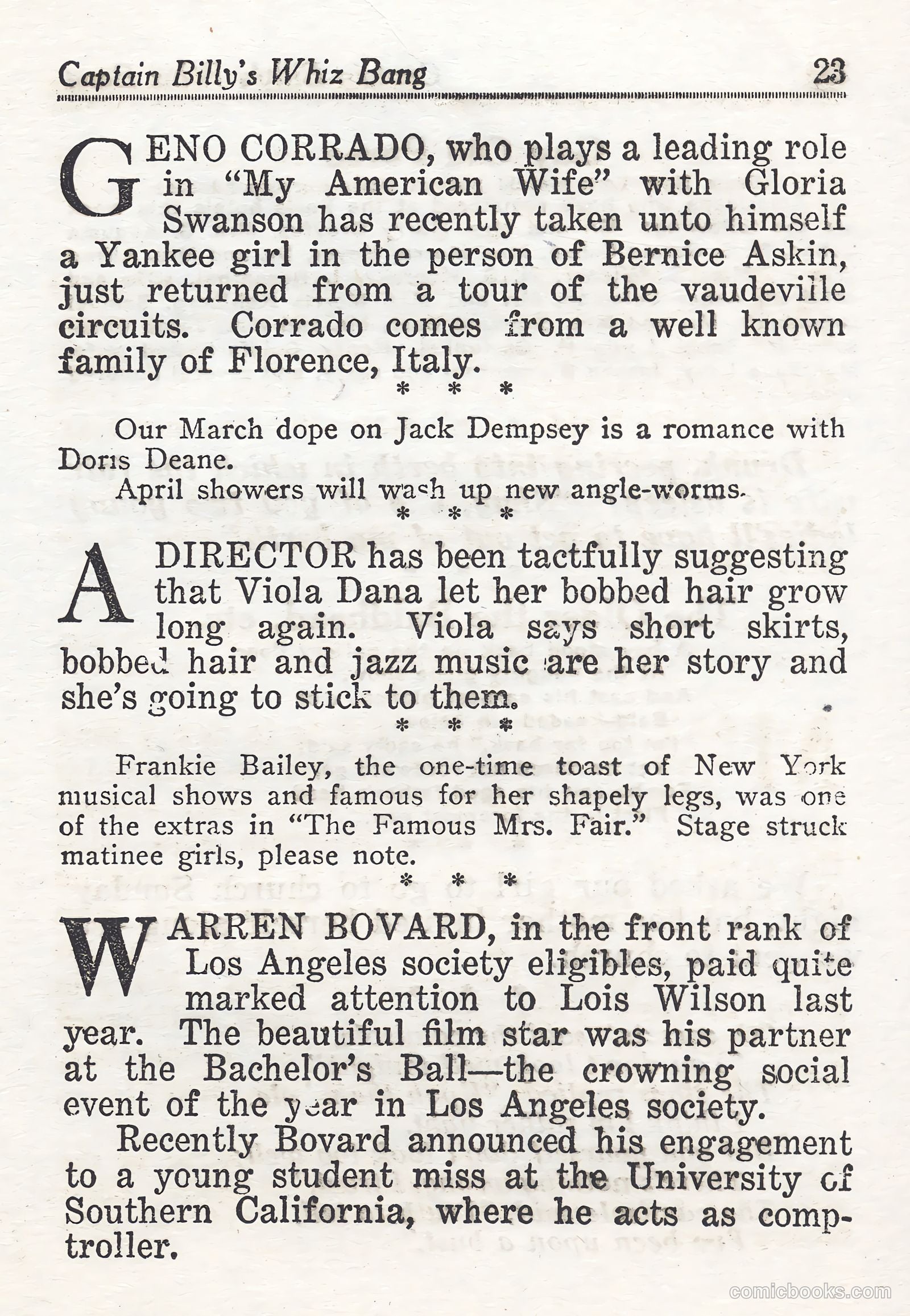
This is a gossip and entertainment column from an early 1920s satirical magazine. It contains brief items about film actors and society figures of the era—Geno Corrado (actor in Gloria Swanson films), Jack Dempsey (heavyweight boxer), Viola Dana (silent film star), and Lois Wilson (actress). The humor is gentle celebrity gossip rather than sharp satire. Items mock romantic entanglements, actresses' fashion choices (bobbed hair, short skirts), and social climbing. The Viola Dana item pokes fun at her defiant embrace of modern "flapper" style. The Warren Bovard item suggests his romantic attention shifted from film star Lois Wilson to a "young student miss"—implying he abandoned a glamorous match for an ordinary university girl. The overall tone treats Hollywood and Los Angeles high society as sources of amusing human-interest stories for readers.
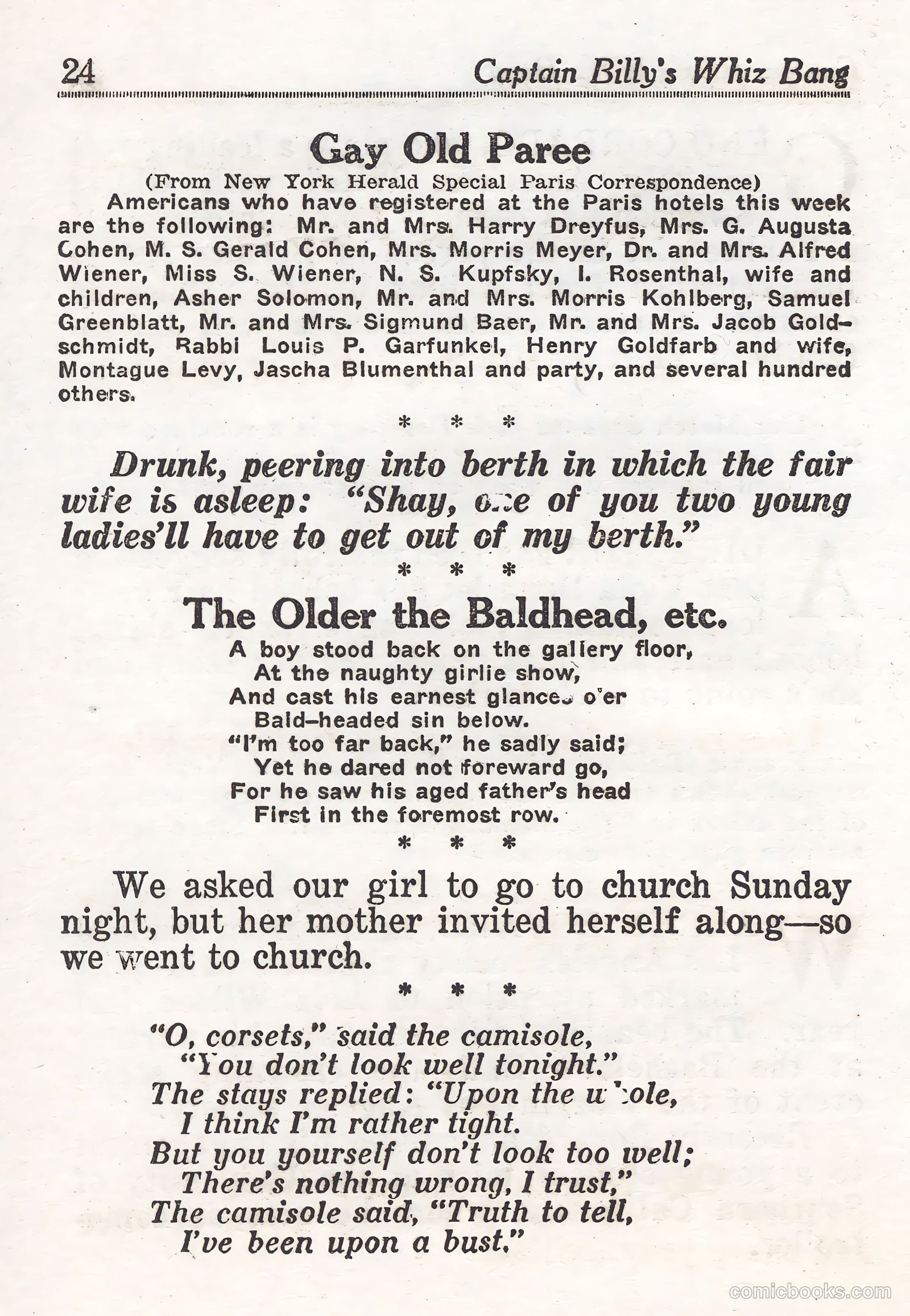
This page contains several humor items typical of 1920s American satire magazines: **"Gay Old Paree"** lists wealthy American tourists (predominantly Jewish names) registered in Paris hotels—likely satirizing both the postwar leisure travel of affluent Americans and ethnic stereotypes about Jewish wealth and tourism. **The drunk joke** plays on bawdy humor common to the era: a married man drunkenly mistakes his wife's sleeping berth for an empty one, addressing two "young ladies." **"The Older the Baldhead"** depicts generational awkwardness at a burlesque show—a young man embarrassed to be caught watching by his father in the audience. **The remaining items** are mild domestic humor: avoiding a date through maternal interference, and a punning dialogue between undergarments ("I've been upon a bust"). Overall, this represents typical early-20th-century men's magazine humor: ribald jokes, ethnic references presented as comedy, and mild social commentary targeting contemporary leisure culture and family dynamics.
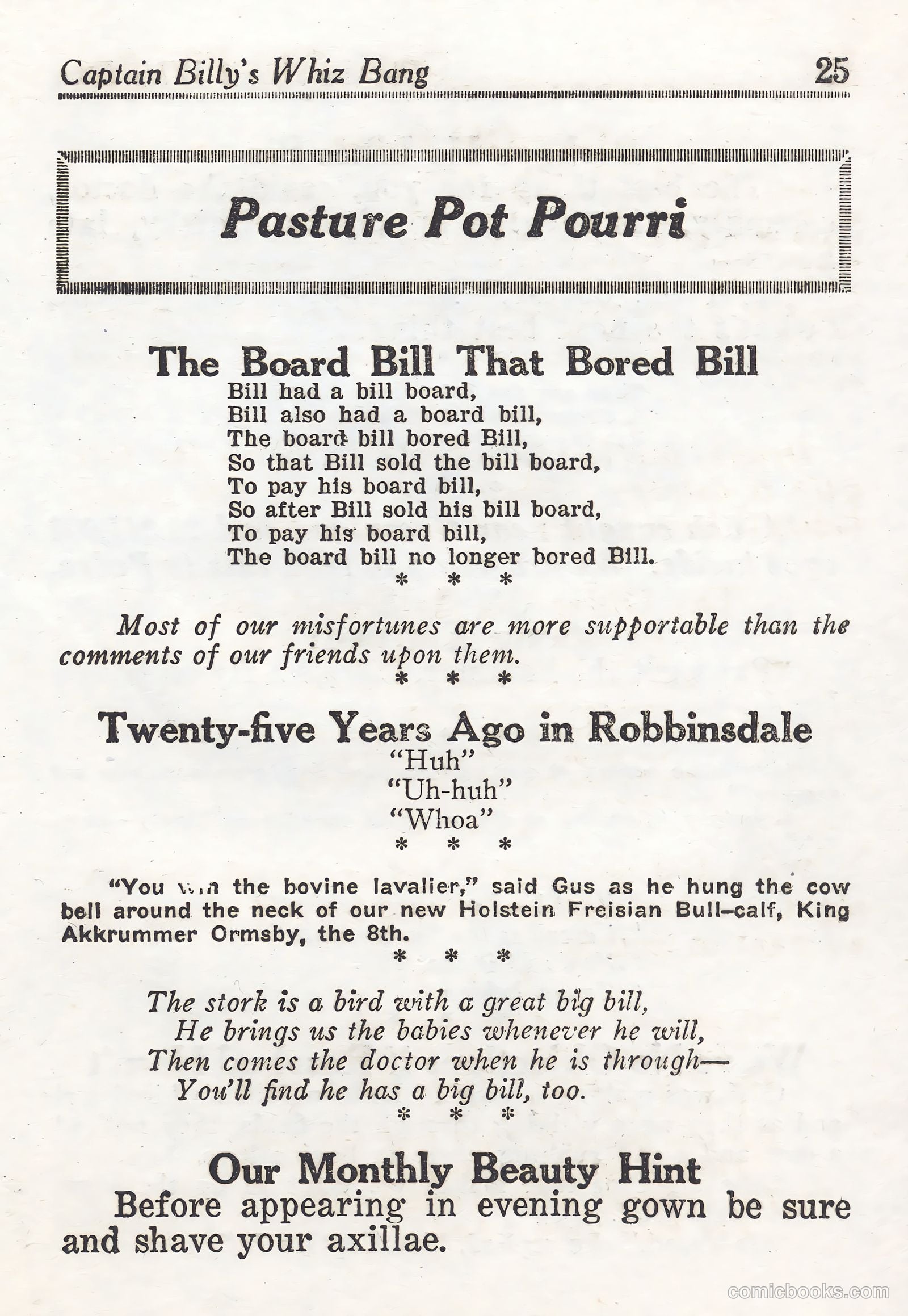
This page contains humorous short pieces typical of early 20th-century American satirical magazines. The content includes: **"The Board Bill That Bored Bill"**: A tongue-twister joke exploiting homophones ("bill board" vs. "board bill") to create wordplay humor—Bill solves his boredom by selling advertising space to pay his room-and-board expenses. **Philosophical quip**: A brief observation that friends' unwanted commentary about our troubles often feels worse than the troubles themselves. **"Twenty-five Years Ago in Robbinsdale"**: A nostalgic rural snippet featuring minimal dialogue ("Huh," "Uh-huh," "Whoa"), suggesting simple country life. **The cow-bell anecdote**: Gus names a prize Holstein bull calf with a grandiose pedigree name, jokingly calling him a "bovine cavalier." **Stork poem**: A mild joke about medical bills—the stork brings babies, but the doctor's bill follows. **Beauty hint**: A practical reminder for women to shave underarms before formal dress, reflecting contemporary grooming standards. No political satire or caricatures appear; this is general humor content.
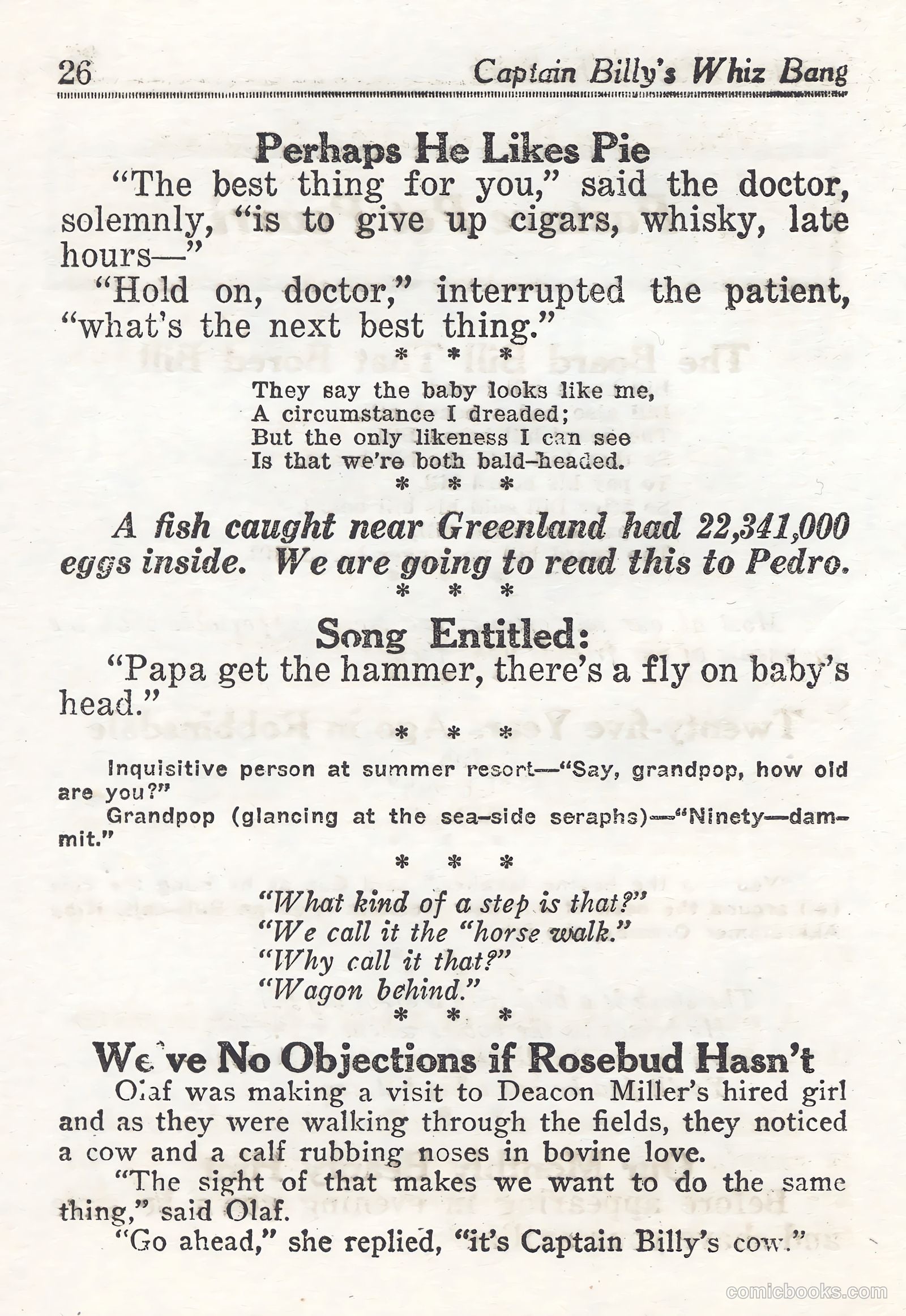
This page from *Captain Billy's Whiz Bang* (a 1920s humor magazine) contains a series of brief jokes and comic observations with no illustrated cartoons visible. The humor relies on era-typical comedic tropes: a patient dodging doctor's health advice by asking for the "next best thing" (implying vice is preferable); a father joking he and his bald baby share only baldness; crude jokes about babies and flies; an elderly man euphemistically deflecting his age ("Ninety—dammit") while viewing attractive women; a double-entendre about a dance step called the "horse walk" (because a "wagon" follows behind); and the final piece, a mild sexual innuendo where Olaf proposes kissing a girl after witnessing affectionate cattle—she consents because it's "Captain Billy's cow" (implying no consequences to using someone else's property). The humor is juvenile, pun-heavy, and targets working-class audiences with ribald but relatively innocent jokes.
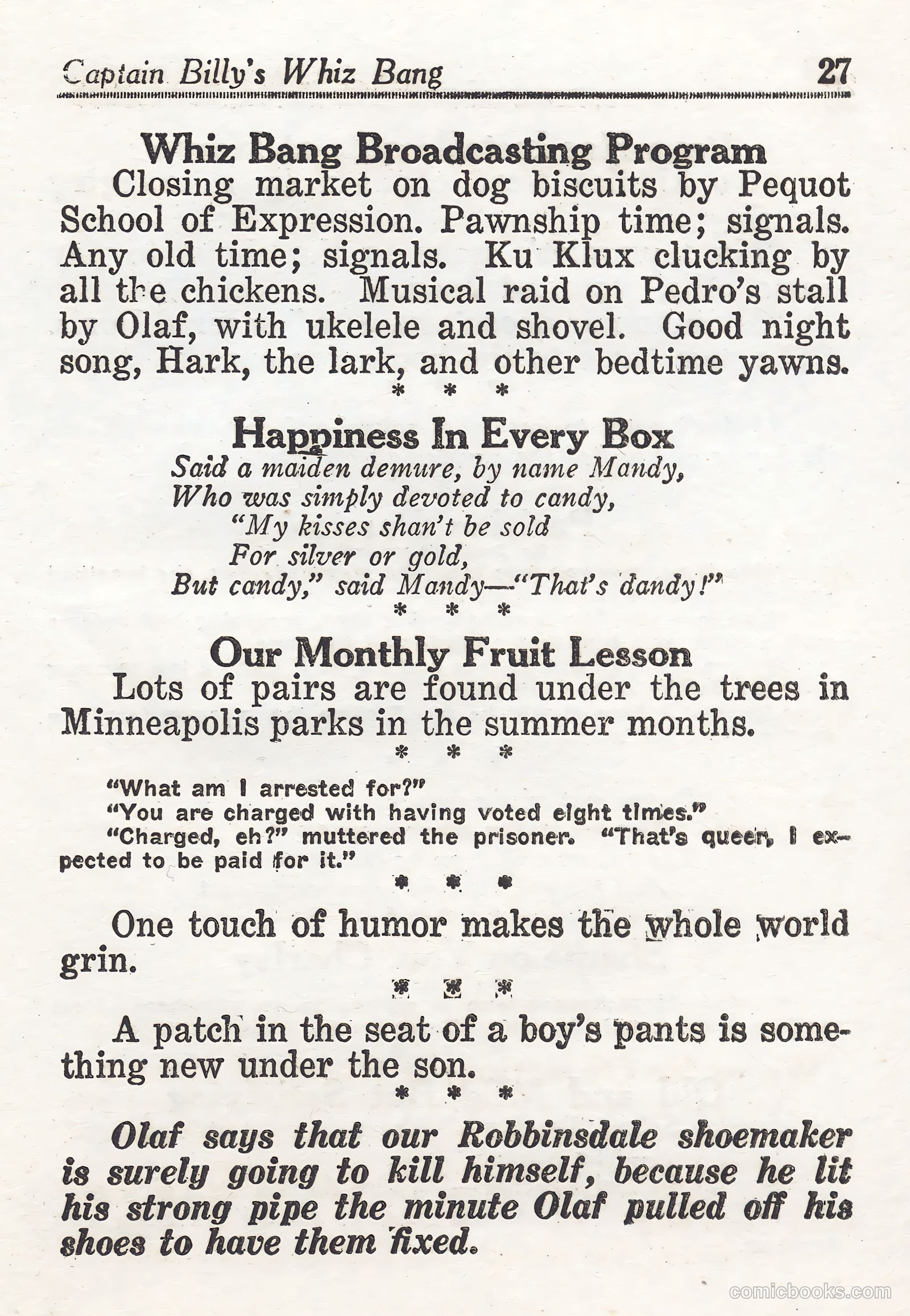
This page from the satirical magazine contains several brief jokes and quips typical of 1920s humor: The "Broadcasting Program" mockingly lists absurd radio content, including references to "Ku Klux clucking" (likely a joke about KKK visibility during that era). The voter fraud joke satirizes electoral corruption: a man arrested for voting eight times expects payment rather than punishment—suggesting bribing voters was an accepted practice. "Happiness in Every Box" is a flirtatious rhyming verse about a candy-obsessed woman named Mandy who'll trade kisses only for sweets. Other items poke fun at everyday annoyances: a boy's patched pants, and a shoemaker whose shoes smell so bad after removal that he can't light his pipe nearby. The humor is gentle, observational, and rooted in 1920s urban/rural American life and contemporary social issues like electoral corruption.
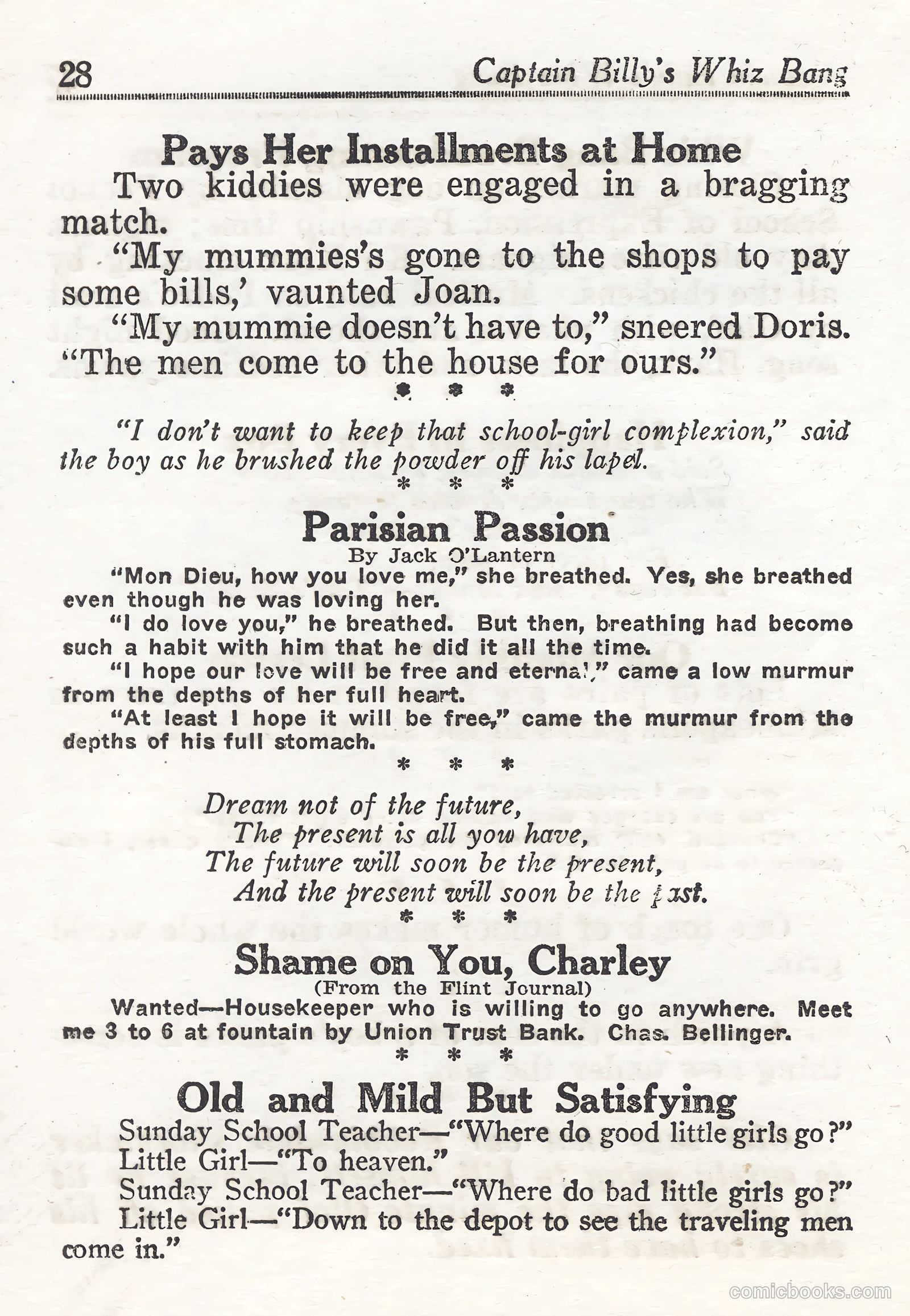
This page contains several short satirical pieces typical of 1920s humor magazines: **"Pays Her Installments at Home"** mocks class differences and credit systems. Joan brags her mother pays bills in shops (respectable), while Doris sneers that creditors come to *their* house—implying working-class debt collection and inability to afford cash purchases. **The powder joke** satirizes masculinity anxieties: a boy removes powder from his lapel to avoid appearing effeminate, reflecting period concerns about men maintaining conventional masculine appearance. **"Parisian Passion"** uses exaggerated French romanticism to mock lovers' pretense: she speaks of eternal love from her "heart"; he hopes it's "free" because he's thinking of his stomach—contrasting female romantic idealism with male self-interest and materialism. **The Sunday School joke** is risqué for its era: it implies "bad girls" meet traveling salesmen at train depots for illicit purposes, playing on period anxieties about unmarried women's morality and transient male workers. These pieces rely on period class consciousness, gender stereotypes, and dated moral concerns about women's respectability.
This is a humor/joke page from an early 20th-century satirical magazine. The content consists of brief comedic anecdotes and observations about relationships and social behavior, arranged without accompanying illustrations despite the page number suggesting visual content. The jokes play on marital infidelity, class dynamics, and gender relations typical of the era's "men's humor" magazines. A woman mistakenly calls her rent-paying boyfriend by another man's name, confusing holiday schedules. Another anecdote contrasts a French romantic with an American "Doughboy" soldier—likely referencing WWI-era cultural attitudes. The verses mock rural life and contain puns ("hephyr/dephyr"). Final quips suggest cynicism about female modesty and the dangers of flirtatiousness. The humor relies on period-specific assumptions about courtship, infidelity, and working-class morality that modern readers would find dated or offensive.
This is a humorous rural anecdote masquerading as society news from the Whiz Bang Farm. A prize bull calf named "King Akkrummer Ormsby the 8th" arrives at editor Fawcett's farm, but the existing herd leader Pedro rejects him, biting and bellowing that his "blueblooded pedigree" is fraudulent. After the new bull despairs over being an outcast, the farm's Swedish worker advises him to read "Coueflapposophy" by Dr. Coue—a play on Émile Coué's actual self-help philosophy of autosuggestion ("Every day, in every way, I'm getting better and better"). The satire mocks both rustic snobbery and the era's fad self-help movements by applying psychological theory to a despondent livestock problem.
This page from *Captain Billy's Whiz Bang* consists of satirical gossip-style items mocking small-town Minnesota life during Prohibition. The humor targets alcohol consumption disguised as propriety. The opening jokes reference reading matter that supposedly transforms a lazy man into an industrious one. Later items mock Prohibition evasion: Oscar Thormaldson's "delirium tremens" (alcohol withdrawal), Miss Altitude Highflier's arrest ("shot of snow"—cocaine), and most pointedly, Harvey Fawcett's "Bun Social" where "blended medicine" and "bevo" (a near-beer substitute) were served to prominent local figures including Congressman Andrew Volstead—who ironically sponsored the very Volstead Act that enacted Prohibition. The satire lies in the transparent pretense that these gatherings and substances weren't really about circumventing Prohibition laws.
This page contains humorous short quips and observations typical of 1920s satirical magazines. The "Ecstasy" section mocks flowery romantic prose through absurd food metaphors (clam chowder eyes, sausage mouth, flour-sack neck), deflating sentimentality with grotesque imagery. The aphorisms address relationships and gender dynamics. One verse contrasts old notions of male restraint ("man wants but little") with modern male greed ("wants as much as he can get / And wants it all the time"). A joke about a widow being "left" by her dead husband "every night in the week" uses double entendre to mock infidelity or promiscuity. The final section humorously requests editorial credit for reprinting quotations—itself presented as a satirical "remark" worthy of publication. No specific political figures or events are referenced; instead, this reflects general 1920s attitudes about changing male-female relations and consumer excess.
This page from *Captain Billy's Whiz Bang* (a humor magazine popular in the 1920s-30s) contains several brief satirical pieces and jokes: The opening story references "Gallagher and Shean," likely a famous vaudeville comedy duo, using their names for a domestic reconciliation joke where a child suggests her estranged parents role-play intimacy. "The Height of Indifference" is a humorous definition mocking emotional detachment in trivial situations. The Laertes quote satirizes human nature, suggesting informers and flatterers are more dangerous than animals. A fake Irving Berlin song title jokes about romantic regret. The final items mock editorial pretension (a lazy editor making advances to young female poets) and contain a double-negative joke about modesty and battleships, likely a risqué reference to naval displays or military masculinity. The tone throughout is lighthearted, bawdy humor typical of early 20th-century American comedy magazines.
This is an editorial column, not a cartoon. The author reflects on discovering Charlotte Temple's grave in Trinity Churchyard, New York—a historical figure (a young woman seduced by an English officer during the Revolution whose story became a famous 18th-century novel). The piece argues for compassion toward women whose sexual virtue has been compromised. The author notes that while society no longer literally marks "fallen women" with visible scarlet letters (referencing Hawthorne's novel), these women still bear invisible social stigma and judgment. The editorial's thesis—"The Bull is Mightier Than the Bullet"—appears to suggest that moral/social pressure ("the bull") is more destructive than physical violence ("the bullet"). It's a plea for society to be less harsh in condemning women whose lives have been damaged by seduction or sexual transgression, asserting that only divine judgment should apply.
This page contains three satirical commentaries from an early 1920s American humor magazine: 1. **The "Double Standard" Piece**: Critiques female hypocrisy. It argues that modern women demand equality with men, yet judge other women harshly for sexual indiscretions ("having a past"). The satire highlights the contradiction between feminist claims and conservative social judgment. 2. **The Germany/Oyster Joke**: Dark post-WWI humor. References Germany's war reparations debt while suggesting that at least oyster supplies will improve—trivializing serious economic consequences through absurdist contrast. 3. **The Water Wagon Joke**: A Prohibition-era gag. The "water wagon" (representing temperance) carries passengers who paradoxically carry "flagons" (alcohol containers). The joke mocks the failure of Prohibition enforcement, with drinkers making ironic pledges to abstain in 1923. All three pieces employ sarcasm and irony typical of Whiz Bang's satirical style, targeting post-war American social contradictions and the unpopular Prohibition law.
This page contains four separate humorous observations typical of 1920s satirical magazines. The first section (partially visible) describes Prohibition-era behavior—people avoiding saloons "like a bootlegger past an income tax collector" during Prohibition, instead frequenting other establishments. The remaining three pieces are brief satirical takes on contemporary social issues: 1. **Women's psychology**: A tongue-in-cheek claim that women are simple—they do what they want, listen to what interests them, and speak freely. 2. **Marriage costs**: A joke that while marriage is expensive, it's cheaper than courting. 3. **Gossip origins**: A jab at married men who tell their wives secrets "in the strictest confidence," only for wives to spread them publicly the next day. These pieces reflect 1920s attitudes toward gender roles, Prohibition, and marital dynamics—presented as witty observations rather than serious commentary.
This satirical magazine page contains three separate humor pieces: 1. **Twin Beds Complaint**: Mocks the modern fashion of twin beds in bedrooms, presented as impractical for couples. The joke relies on marital innuendo—beds too narrow for comfort but implying impediments to intimacy. 2. **Swiss Customs Joke**: The main satire targets post-WWI economic conditions. German currency (the mark) had collapsed in value, so women would cross into Germany, buy cheap lingerie, and smuggle it back into Switzerland. Swiss customs officials supposedly had to examine women so thoroughly (and repeatedly) that eight officials went blind from the duty—hence needing tin cups and guide dogs as beggars. It's crude sexual humor about customs inspections. 3. **Philosophy Fragment**: An unrelated closing piece about intellectual versus physical existence. The humor is bawdy and relies on readers understanding 1920s currency crisis and post-war European conditions.
This page from *Whiz Bang* (a 1920s humor magazine) contains brief satirical quips rather than visual cartoons. The humor targets: **"Monkey-gland treatment"** references a then-contemporary fad where wealthy men underwent dubious surgical procedures using monkey tissue, supposedly to restore youth/virility. The joke mocks ex-Kaiser Wilhelm II for denying this treatment—suggesting that's somehow *worse* than his actual WWI misdeeds. **Sheep gland tablets** similarly mock this medical craze, joking a man wasted money on fake supplements, then got swindled by a bootlegger (Prohibition-era illegal alcohol seller). **Income tax joke** satirizes the absurdity of new income tax laws: miscalculate and face jail; calculate correctly and remain so poor you'd enter a poorhouse anyway. The final aphorism warns against trusting deceptive people and dangerous animals—generic wisdom humor. The page exemplifies *Whiz Bang*'s style: topical satire on 1920s fads, politics, and social anxiety, delivered as quick one-liners rather than illustrated gags.
This page from the satirical magazine collects brief humorous anecdotes and quips targeting marriage and courtship—common topics in 1920s humor. The opening joke mocks a wealthy man's presumption: a recovering patient proposes to his young nurse, only to learn he'd face divorce complications with his current wife. The humor relies on his obliviousness and desperation. Subsequent jokes use wordplay and double meanings: a woman accepts the "Deacon" because she's lonely; gym-goers play on "bang" and "bust" as both kissing locations and violent strikes. Another quip references a domestic dispute ending in gunfire (played for laughs). The final jokes employ crude metaphors: one about a fat man requiring a "concave partner" for dancing (a body-shape insult), and cryptic observations about hidden poverty beneath fine clothing. Overall, the page reflects working-class, cynical humor about marriage as burdensome, women as transactional, and physical appearance as mockery-worthy—typical of the era's satirical publications.
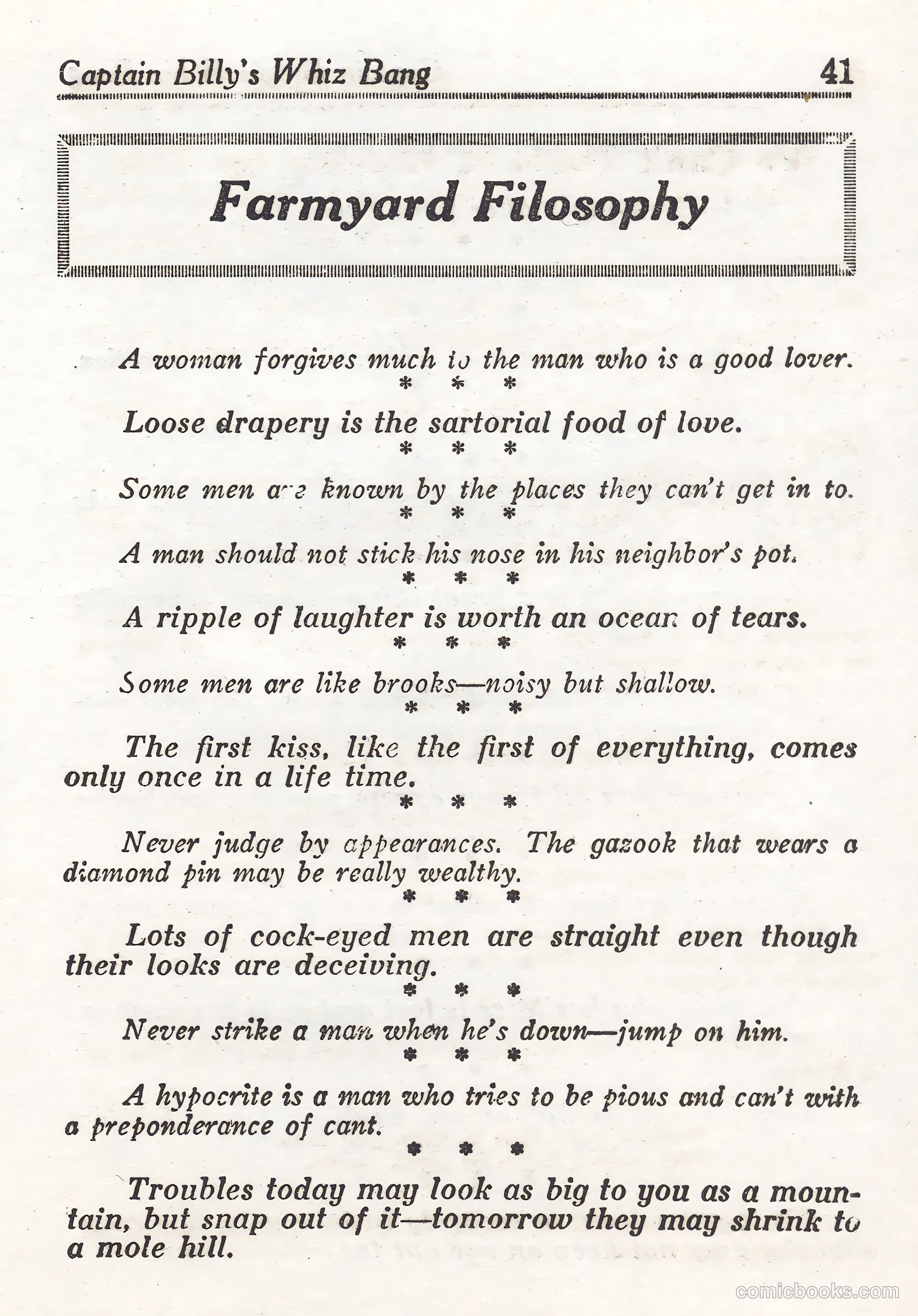
This page contains no cartoons—it's a collection of aphorisms labeled "Farmyard Philosophy," typical of *Whiz Bang*, a humor magazine known for bawdy, irreverent jokes targeting middle-class values. The sayings mix folk wisdom with crude satire. Several target romantic/sexual conduct ("loose drapery," "good lover"), while others mock social pretense ("never judge by appearances," the wealthy "gazook"). A few offer genuine advice ("a ripple of laughter is worth an ocean of tears"), but many deliberately contradict proper morality—notably "jump on him" when a man is down, inverting chivalric ideals. The tone is cynical, working-class irreverence aimed at deflating genteel Victorian/early-20th-century sensibilities. "Cock-eyed" and "gazook" (slang for an odd person) reflect period vernacular. Overall, this represents *Whiz Bang*'s signature blend of crude humor and anti-establishment attitude.
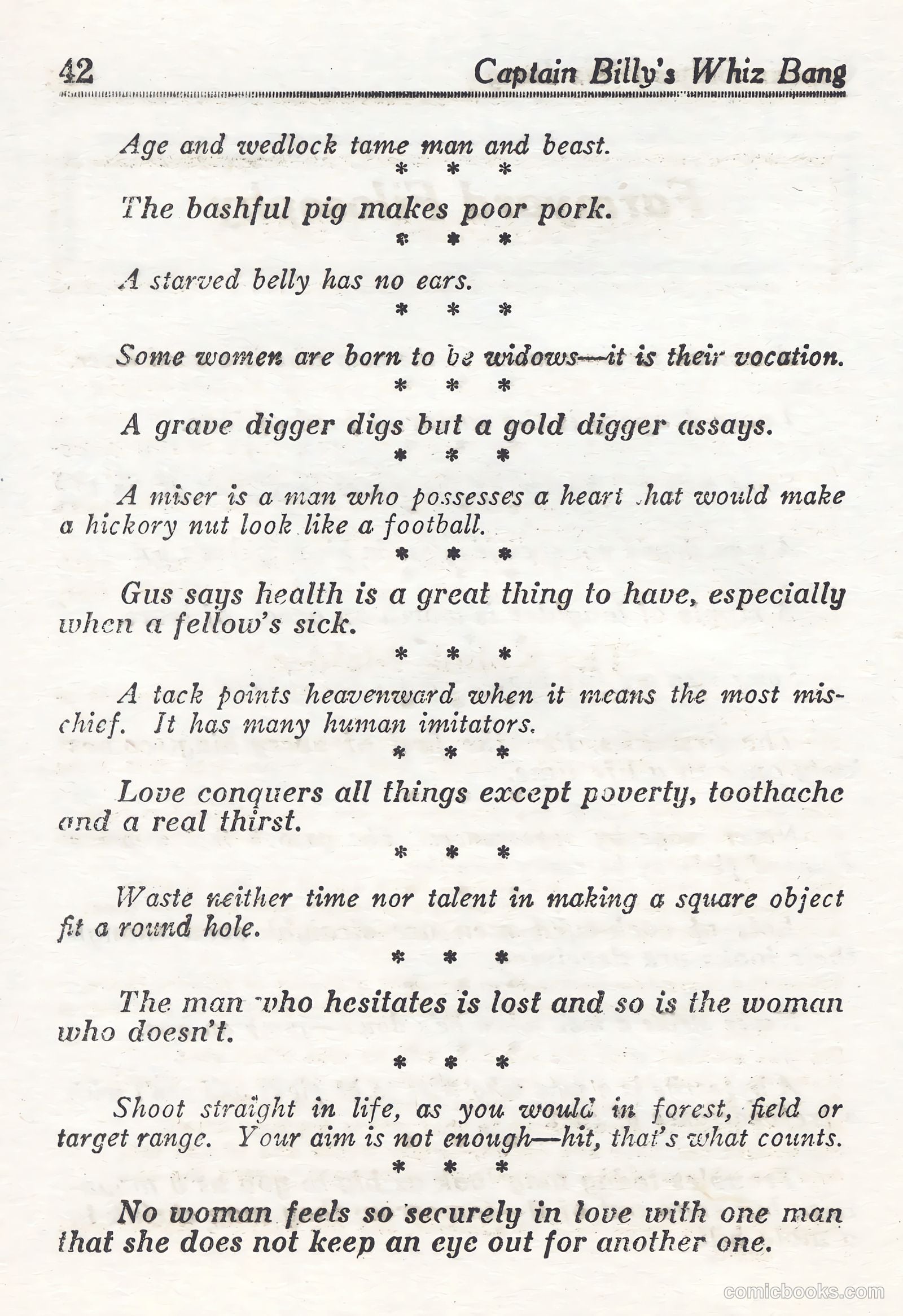
This page contains no cartoon imagery—it's purely text: a collection of aphorisms and satirical one-liners from *Captain Billy's Whiz Bang*, a popular American humor magazine (circa 1920s). The jokes target conventional wisdom and social hypocrisy through cynical reversals. Examples include jibes at marriage ("age and wedlock tame man and beast"), women's nature ("born to be widows," keeping "an eye out for another one"), and human folly (misers with shrunken hearts, tacks causing trouble like "human imitators"). One quip references "Gus," apparently a recurring character dispensing ironic advice. The tone is irreverent working-class humor—mocking pretense, exposing contradictions in romantic ideals, and offering blunt practical wisdom. The aphorisms assume a male perspective viewing women with amused skepticism typical of the era's popular satire.
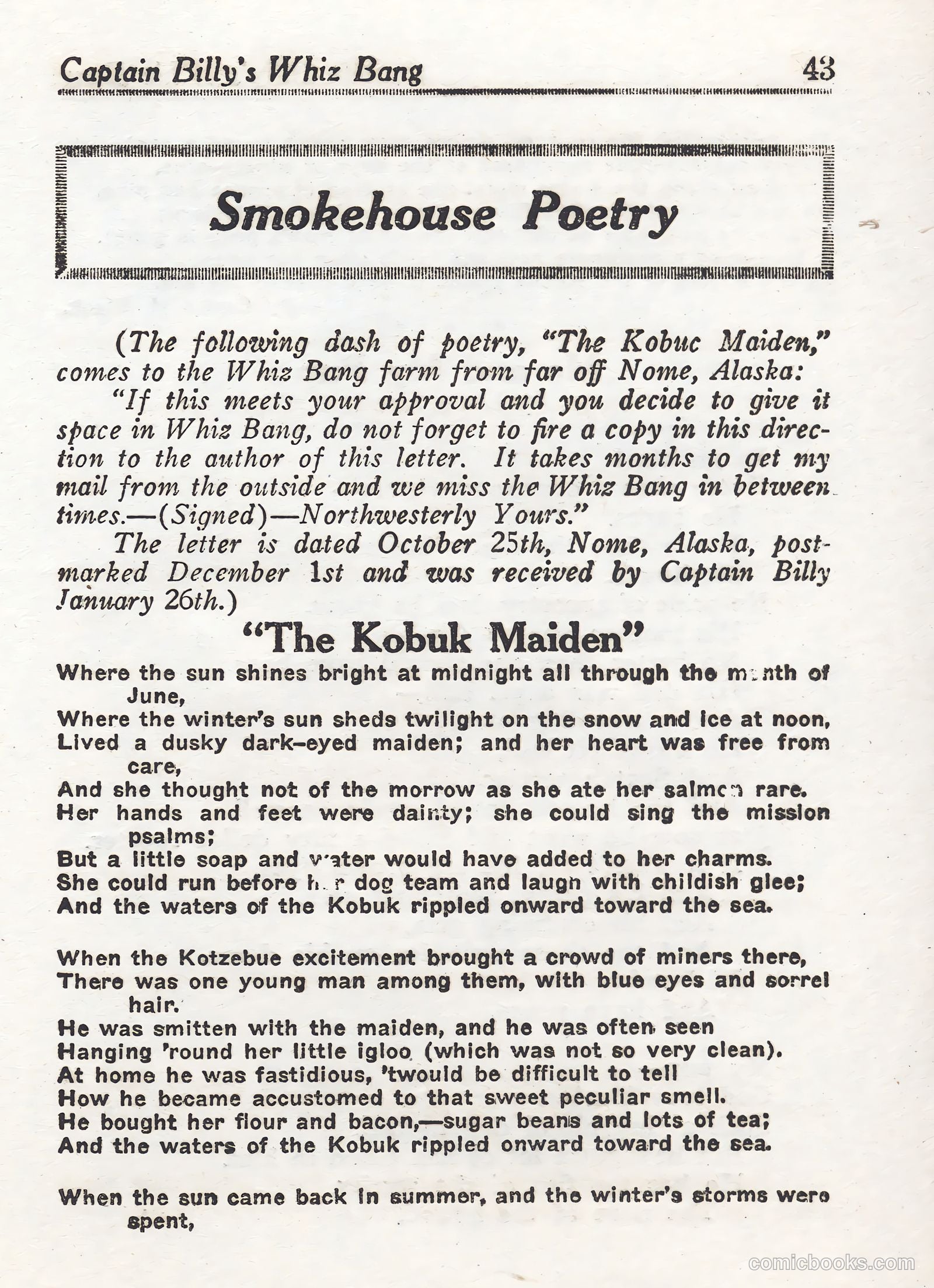
This page contains a poem titled "The Kobuk Maiden," submitted from Nome, Alaska to *Captain Billy's Whiz Bang*, a satirical magazine. The poem is humorously "smokehouse poetry"—crude, folksy verse about frontier life in Alaska during the gold rush era. The narrative depicts a Native Alaskan woman and a fastidious prospector who falls for her despite cultural and hygiene differences. The satire lies in the contrast: he's "fastidious" at home but becomes accustomed to her "sweet peculiar smell" and igloo's uncleanliness for love. The repeated refrain about the Kobuk River provides mock-poetic gravitas to an otherwise comedic tale of frontier romance and cultural clash. The framing note satirizes the remoteness of Alaska—mail takes months—and reader submission culture, poking gentle fun at both the author's earnest contribution and the magazine's willingness to publish amateur verse from distant subscribers.
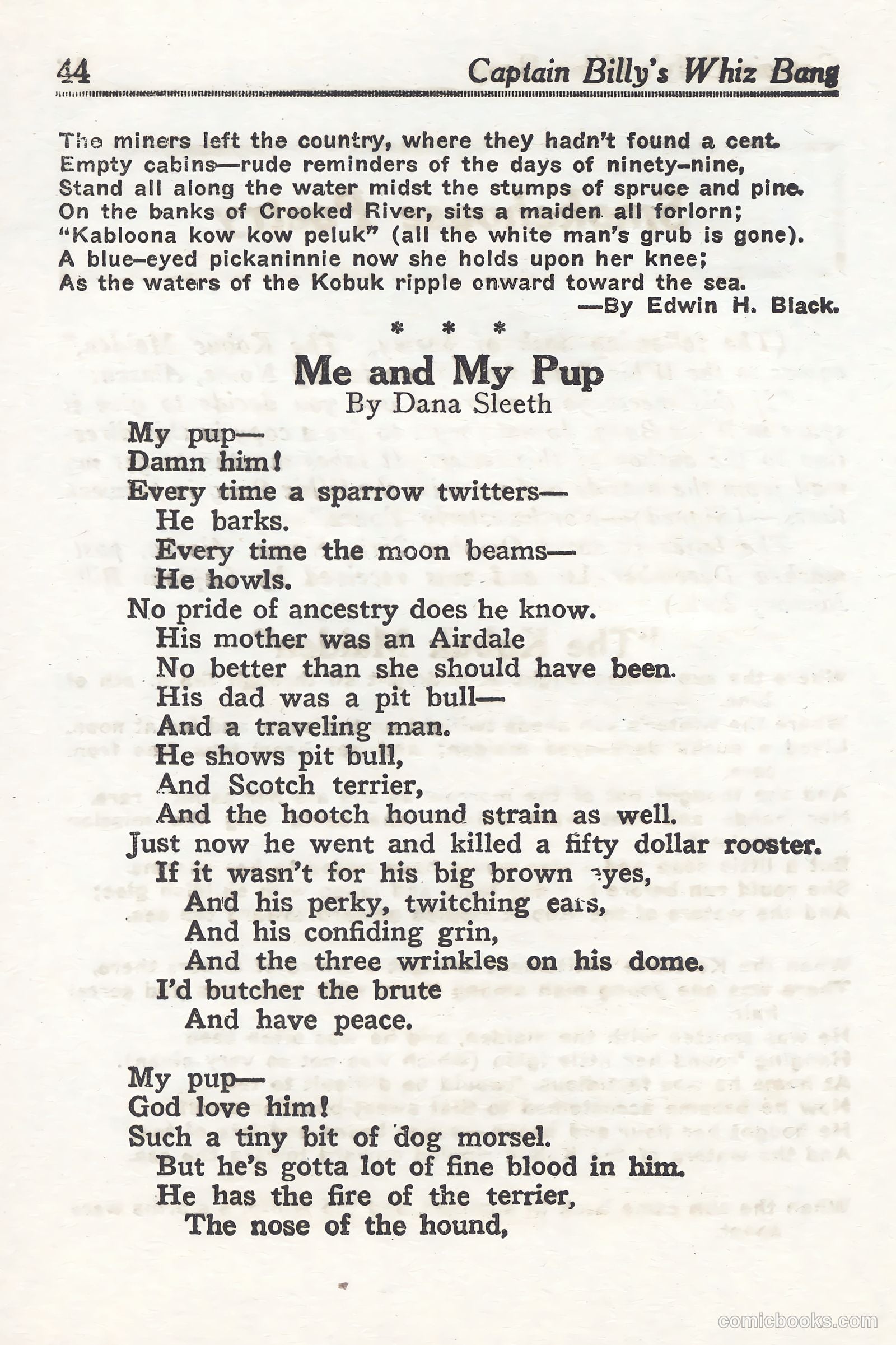
This page from *Captain Billy's Whiz Bang* (a humor magazine) contains two poems rather than cartoons. **Top poem** ("By Edwin H. Black"): Describes the aftermath of the Klondike Gold Rush (1890s). It depicts abandoned mining camps and a despondent Indigenous woman ("pickaninnie"—period terminology, now offensive) caring for a child by Crooked River/Kobuk River in Alaska, with the Inuit phrase translating to "all the white man's food is gone." The satire: prospectors left the region poor and depleted. **"Me and My Pup"** (Dana Sleeth): A comedic poem about an exasperating mixed-breed dog with dubious ancestry (pit bull, Airedale, Scotch terrier, "hootch hound"). The speaker alternates between cursing the dog's destructive behavior and admitting affection—killing a valuable rooster, constant barking and howling—yet finds him endearing. The humor lies in the narrator's conflicted exasperation: wanting to kill the pest while loving the beast.
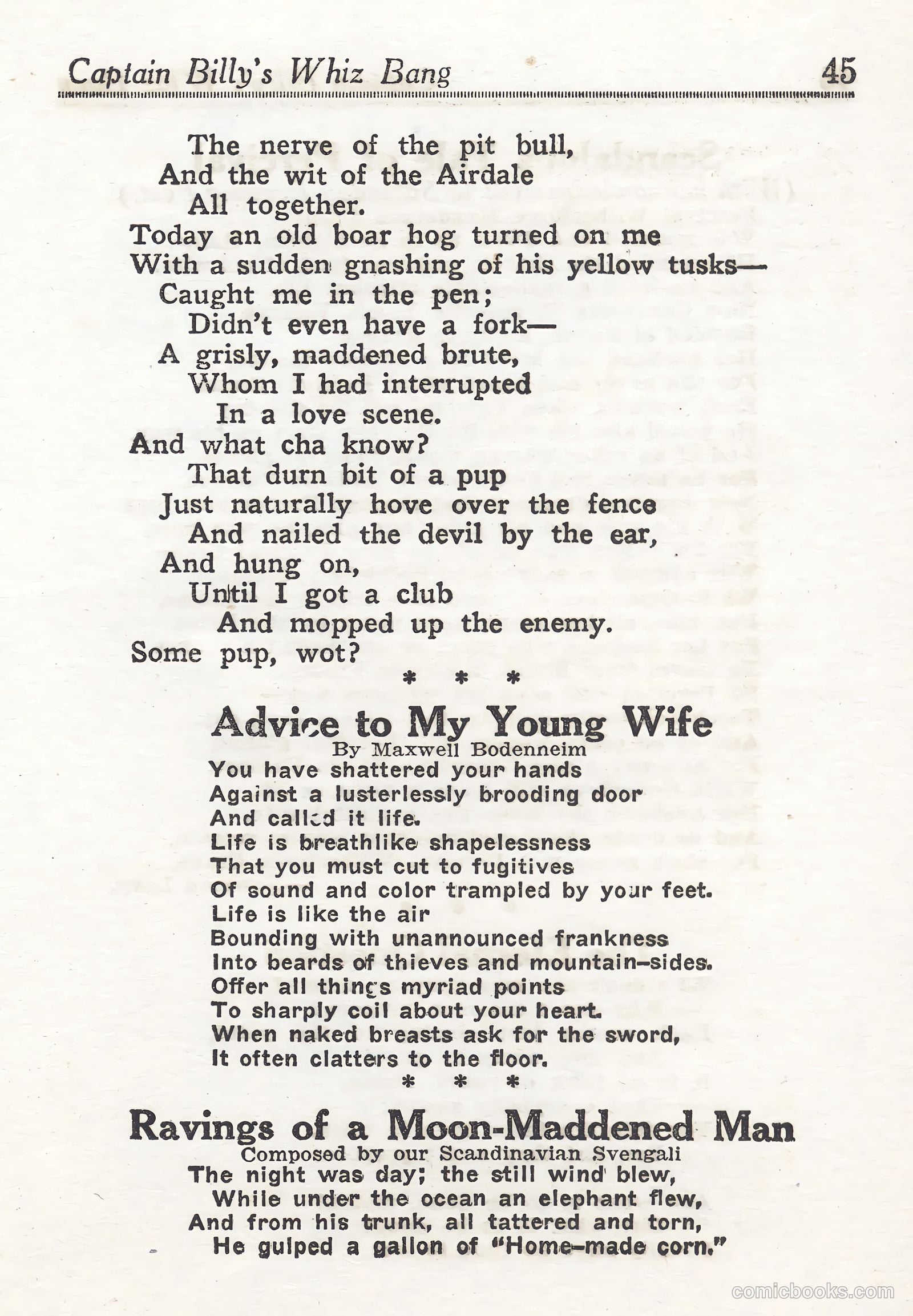
This page contains three humorous literary pieces typical of 1920s satirical magazines. The first piece celebrates a farm dog's courage during an attack by a boar hog, using colloquial rural language ("Some pup, wot?") for comedic effect. The second, credited to Maxwell Bodenheim (a real modernist poet known for experimental work), offers deliberately cryptic, high-minded "advice" to a young wife using abstract imagery about life's shapelessness. This appears to mock pretentious literary modernism—the grandiose philosophy contrasts absurdly with the mundane domestic setting. The third piece, attributed to a "Scandinavian Svengali," presents intentionally nonsensical surrealist imagery (night as day, flying elephants, prohibition-era "home-made corn" liquor). The title "Moon-Maddened Man" suggests madness, while the piece parodies both absurdist poetry and Scandinavian immigrant stereotypes popular in American humor of the era.
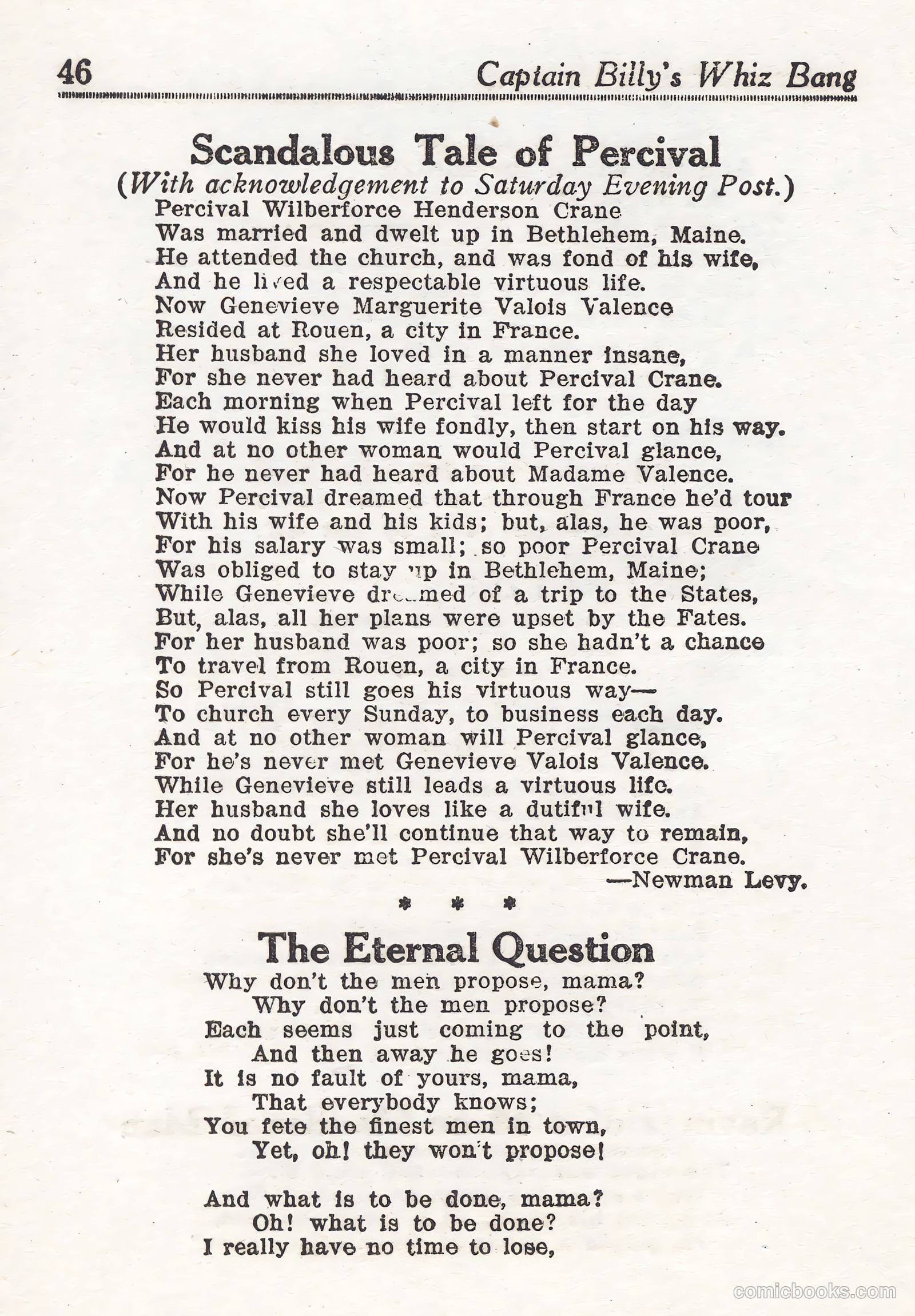
This page contains two satirical poems rather than visual cartoons: **"Scandalous Tale of Percival"** by Newman Levy mocks a virtuous man named Percival Crane from Bethlehem, Maine, who remains faithful to his wife despite dreaming of a French woman (Genevieve Valois Valence) he's never met. The satire ridicules naive idealization of unattainable women and the contrast between fantasy and modest reality. **"The Eternal Question"** humorously addresses why men don't propose to women. It playfully suggests women can't control men's reluctance despite their efforts—a commentary on dating frustrations and gender dynamics of the 1920s era. Both poems use humorous verse to satirize romantic expectations and courtship conventions of the period, typical of Whiz Bang's lighthearted social commentary.
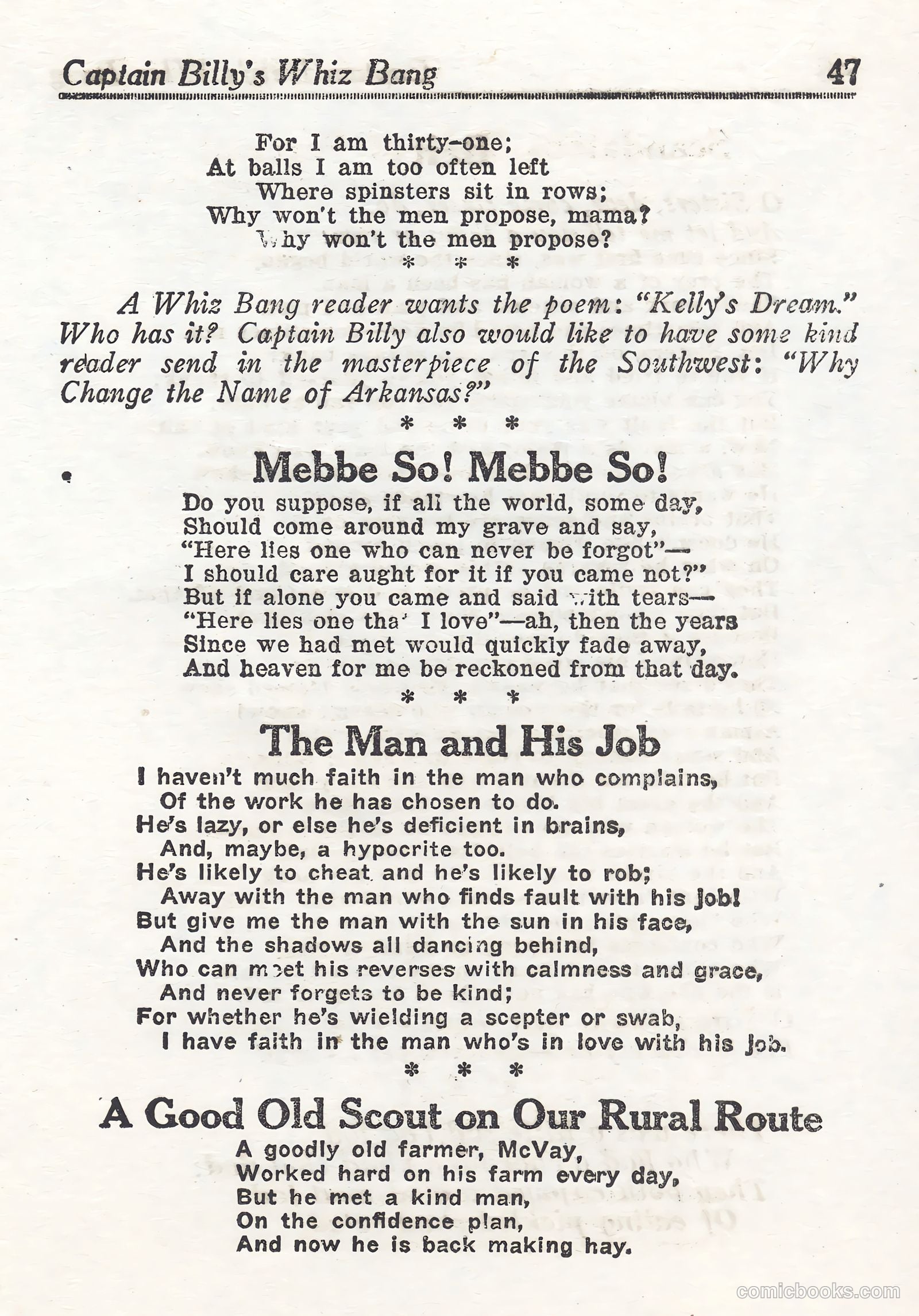
This page from the satirical magazine contains several poems and humorous pieces typical of early 20th-century American humor: **"Why Won't the Men Propose?"** mocks the social anxiety of unmarried women in their thirties, who were considered past marriageable age by contemporary standards. **"Mebee So! Mebbe So!"** is a sentimental poem about romantic love and mortality—asking whether posthumous fame matters if one's beloved doesn't mourn them. **"The Man and His Job"** offers moralistic advice: hardworking men who love their labor are virtuous, while complainers are lazy or dishonest. This reflects early 20th-century work-ethic ideology. **"A Good Old Scout on Our Rural Route"** uses gentle satire: a farmer named McVay was victimized by a confidence man (con artist) operating under the guise of kindness on the rural mail route. The page also solicits reader submissions for poems like "Kelly's Dream" and "Why Change the Name of Arkansas?"—suggesting community participation in the magazine.
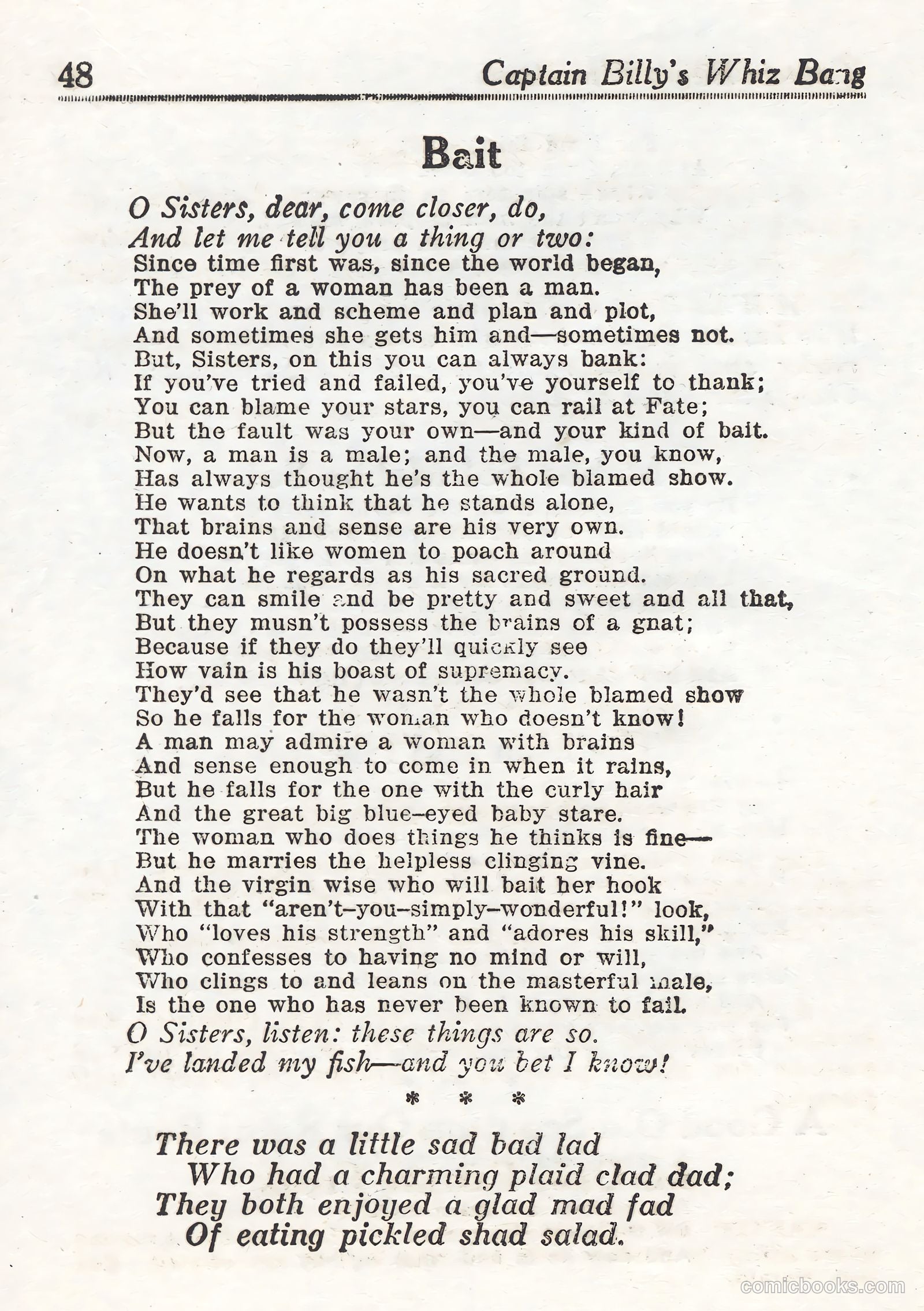
This poem from *Captain Billy's Whiz Bang* (a humor magazine popular in the 1920s) uses fishing metaphors to mock both male ego and female marital tactics. The speaker—a woman—advises her "sisters" that catching a husband requires strategic "bait." The satire targets male vanity: men believe themselves intellectually superior and resent women's intelligence, so they inevitably marry women who play dumb—feigning helplessness, admiration, and dependency. The poem cynically suggests this "virgin wise" strategy of faking ignorance ("no mind or will") is the surest path to marriage success. The joke cuts both ways: it ridicules men's fragile egos while simultaneously mocking women for manipulating through false helplessness rather than authenticity. The crude final quatrain about pickled shad serves as absurdist comic relief. The piece reflects 1920s anxieties about changing gender roles during the flapper era, when women's education and independence threatened traditional male authority.
This page collects short jokes and quips typical of *Captain Billy's Whiz Bang*, a popular American humor magazine. The humor relies on ethnic stereotypes, wordplay, and social commentary: **"Nights Too Chilly"** uses a Jewish dialect joke mocking both a father's accent and his confidence in arranging marriage without modern courtship. **"Somebody is Getting Nosey"** references women outperforming men at Northwestern University—contemporary anxiety about female educational advancement. **The three types of men** offers cynical relationship advice reflecting post-WWI disillusionment. **"Olaf"** and **"The Aggie College Yell"** target rural/agricultural students with crude humor about spitting tobacco and farm life. **The goat eating the magazine** is self-promotional wordplay—the publication's humor is intentionally lowbrow ("Bull"). **The final pun** ("little Cain") makes a biblical joke about walking sticks replacing canes after Cain's murder of Abel. The page exemplifies 1920s mainstream comedy: ethnic caricatures, sexual innuendo, and jokes about modernization alongside self-deprecating satire.
This gossip column from *Whiz Bang* (a satirical magazine) contains three Broadway/film industry items: 1. **George Melford's "You Can't Fool Your Wife"**: The joke is that the film features a "bootleggers' ball"—a reference to Prohibition-era illegal alcohol parties. The satire mocks Hollywood for staging such content during an era when alcohol was banned. 2. **Pauline Frederick's lawsuit**: The column gossips about actress Frederick's failed attempt to contest her father's will (he deliberately left her nothing). The satire is cruel, implying her three failed marriages and film career suggest she "deserves" disinheritance—with a pointed Biblical parallel: she once played Potiphar's wife, the seductress who "longed for the coat of many colors." 3. **Sessue Hayakawa's flop**: The brief mention mocks Japanese actor Hayakawa's failed stage play, using the casual slur "the Jap." The column's humor relies on schadenfreude, gossip, and ethnic stereotyping typical of 1920s entertainment journalism.
This satirical gossip column mocks 1920s Hollywood and theater figures. Key targets: **Hayakawa**: Sessue Hayakawa, a Japanese actor trapped by racist casting that confined him to "sinister yellow villain" roles despite his talent—commentary on racial stereotyping in early cinema. **Owen Moore**: An actor sued by a garage keeper for unpaid car maintenance, who denied ownership. The joke: forgetful, irresponsible celebrities. **"The Rear Car"**: Edward Rose's play that studios frantically bid over, with Goldwyn paying $17,500 before it flopped before reaching Broadway—mocking Hollywood's wasteful competition and poor judgment. **Nita Naldi**: An actress who adopted an Italian stage name despite being Irish-American ("Dooley"). The satire ridicules both her ethnic name-switching and the magazine's crude ethnic stereotyping ("Mama was a wop!"). The column uses gossip and mockery to expose Hollywood's racial prejudices, financial excess, and superficiality—typical 1920s tabloid satire.
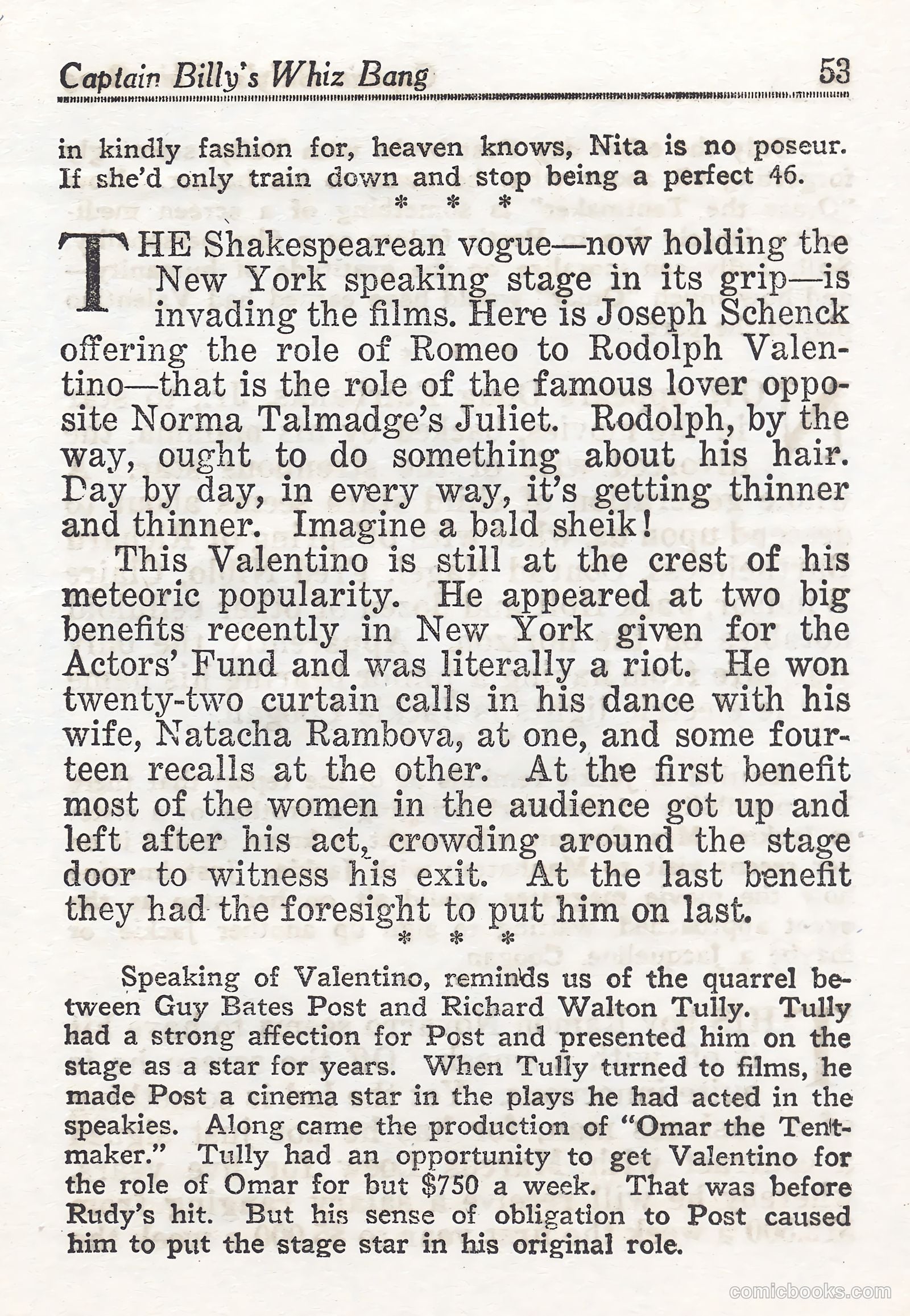
This page contains Hollywood gossip and satire from the early 1920s. The main target is **Rudolph Valentino**, the era's most famous male film star, whose popularity is mocked as excessive and feminizing. The column jokes that women abandoned their seats at benefit performances to crowd the stage door watching him exit—undignified behavior the writer finds ridiculous. The satire includes cutting remarks about Valentino's appearance (thinning hair, calling him a "bald sheik") and his extreme popularity at New York benefits, where he received 22 curtain calls. A secondary anecdote praises director **Richard Walton Tully** for loyalty: he cast his longtime protégé **Guy Bates Post** in "Omar the Tentmaker" rather than hiring the cheaper Valentino (at $750/week), despite Valentino later becoming a major star. The underlying joke: Hollywood's fickle fame and the absurdity of Valentino-mania among female audiences.
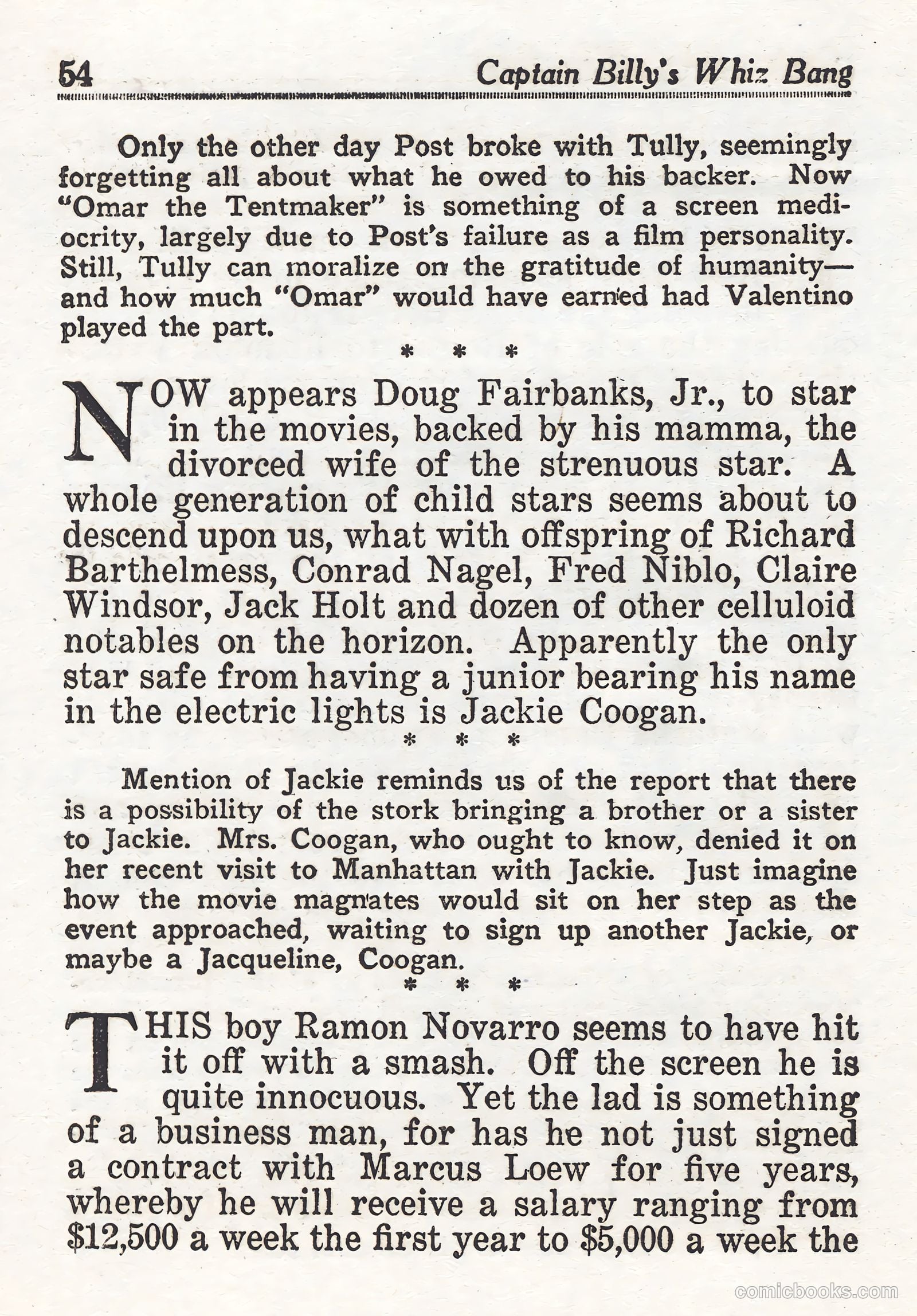
This satirical column mocks Hollywood's emerging star system and nepotism in early 1920s cinema. **Key targets:** - **Wiley Post & Frank Bully**: Post allegedly broke with his financial backer Bully over the film "Omar the Tentmaker," ungratefully ignoring what he owed him. - **Doug Fairbanks Jr.**: Criticized for being launched by his mother (Douglas Fairbanks Sr.'s ex-wife) rather than talent—exemplifying a wave of nepotistic "junior" stars whose famous fathers secured their opportunities. - **Jackie Coogan**: Noted as the *only* major star without a namesake junior waiting in the wings—a backhanded compliment suggesting studios would eagerly exploit his hypothetical children. - **Ramon Novarro**: Praised as a successful actor who shrewdly negotiated a lucrative five-year contract with Marcus Loew, demonstrating business acumen. The satire criticizes how Hollywood manufactures stars through family connections and star-power rather than merit, while praising those who leverage their positions into genuine financial advantage.
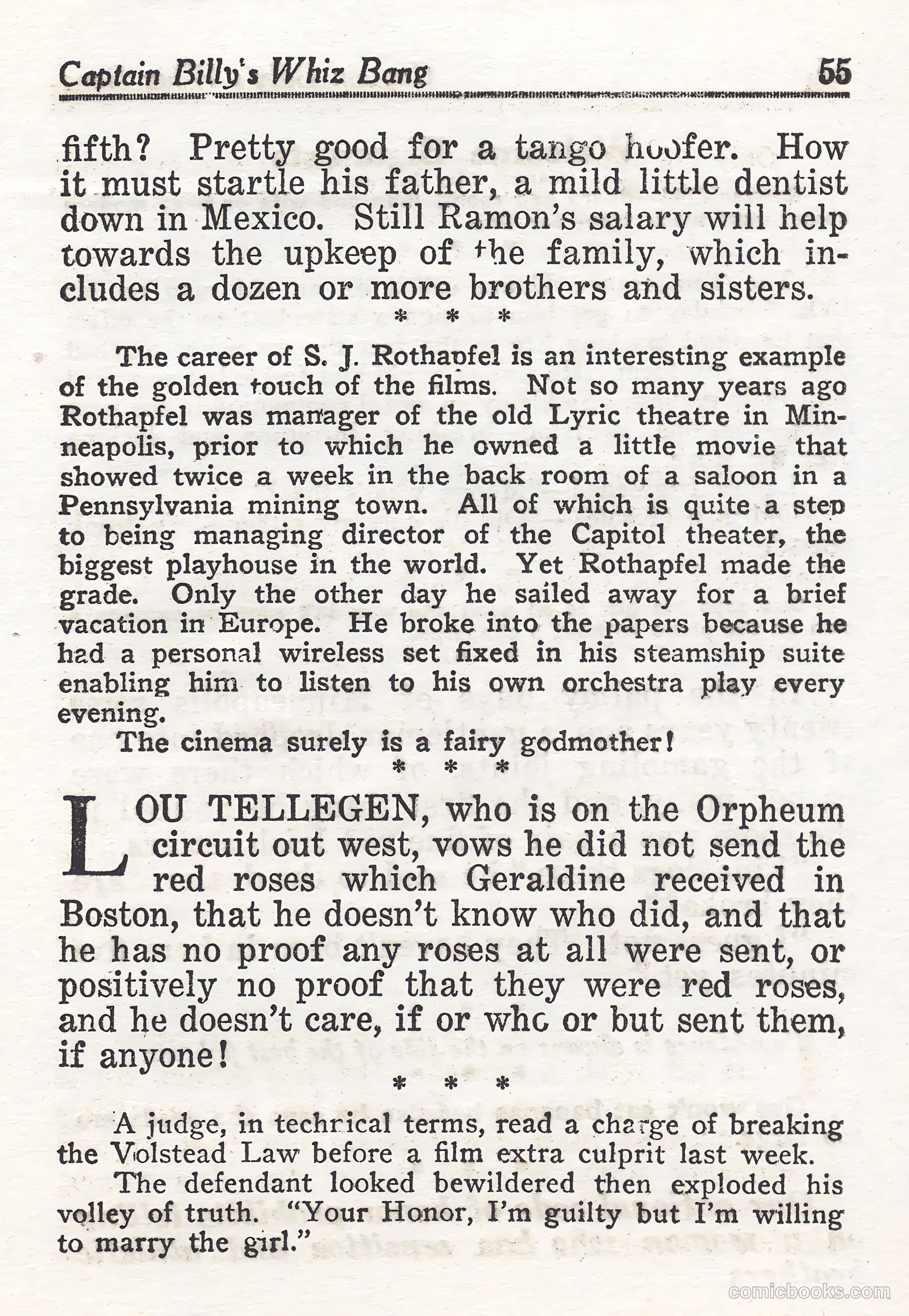
This page contains gossip-style commentary on film industry figures. The main satire targets the sudden wealth and absurd pretensions of cinema professionals: **S.J. Rothapfel** receives mockery for his rapid rise from managing a saloon's backroom movie theater to directing the Capitol Theater (claimed as "biggest playhouse in the world"). The joke peaks with him having a personal wireless radio installed on his steamship so he can listen to his own orchestra—an image of absurd luxury and self-regard. The text sarcastically calls cinema "a fairy godmother," suggesting undeserved magical advancement. **Lou Tellegen** (an actor) is portrayed denying he sent roses to "Geraldine" in Boston, with increasingly desperate and contradictory denials—suggesting gossip-column romance drama typical of silent-era celebrity scandal. The final item mocks a film extra charged under Prohibition law, whose response conflates legal guilt with a marriage proposal, implying the confused desperation of lower-tier film workers. The tone throughout is gossipy, slightly mocking of Hollywood's nouveau riche pretensions.
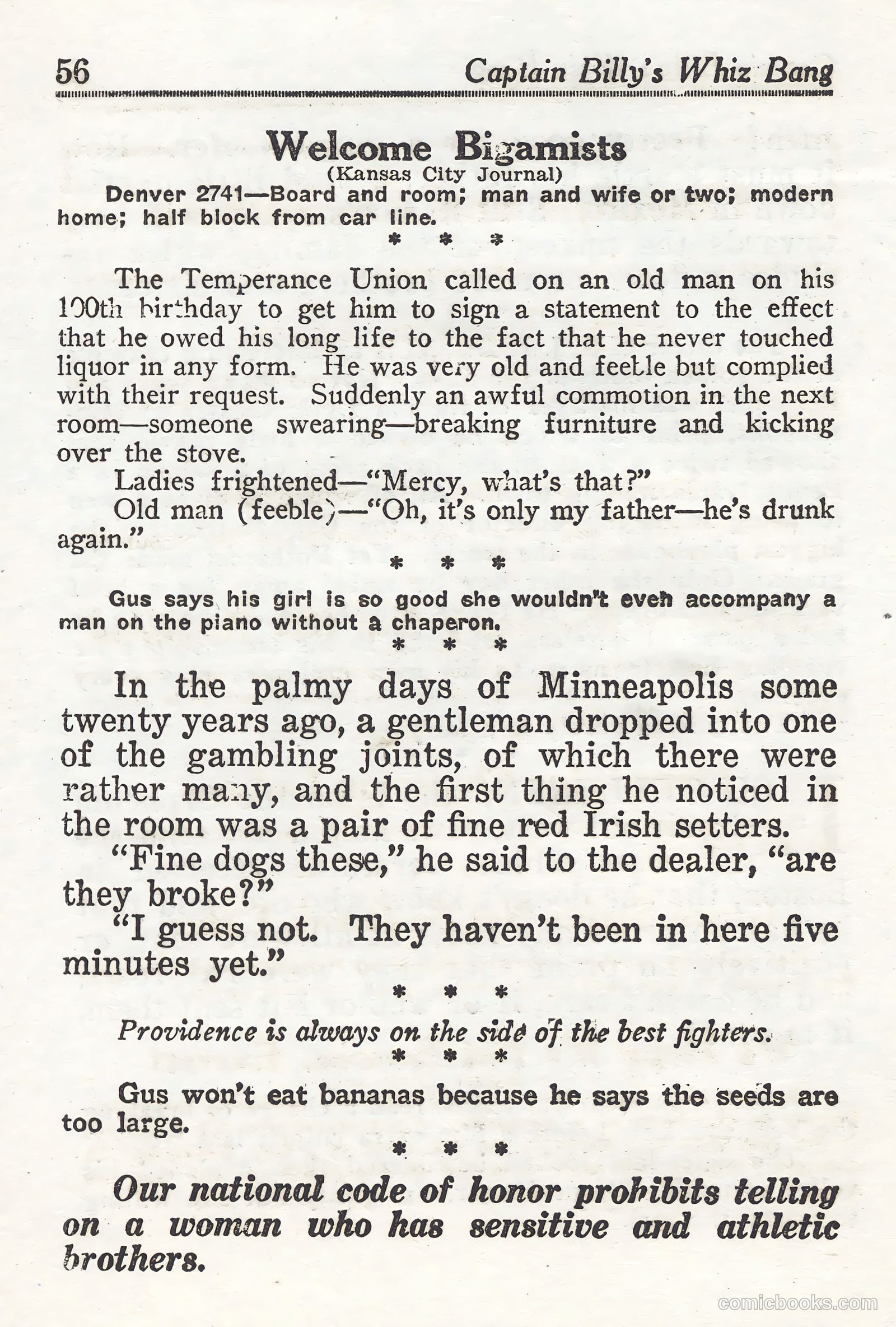
This page contains a series of brief satirical jokes typical of 1920s humor magazines. Key points: **"Welcome Bigamists"**: The classified ad joke mocks permissive morality by advertising lodging for "man and wife or two"—openly advertising accommodations for bigamy. **Temperance Union story**: Satirizes abstinence advocates. They pressure a 100-year-old man to credit longevity to never drinking, but the punchline reveals his *father* (presumably much older) is drunk and destructive—undercutting the temperance message with absurdist humor. **Piano chaperon/banana seeds jokes**: Light observational humor about social propriety and peculiar personal habits. **Minneapolis gambling den**: Jokes that the Irish setters (dogs) are "broken in" by the gambling environment—implying corruption. **Final item**: Satirizes masculine honor codes that protect women from gossip, treating it as a social absurdity. The overall tone is irreverent toward Prohibition, traditional morality, and social conventions—typical of this era's satirical publications.
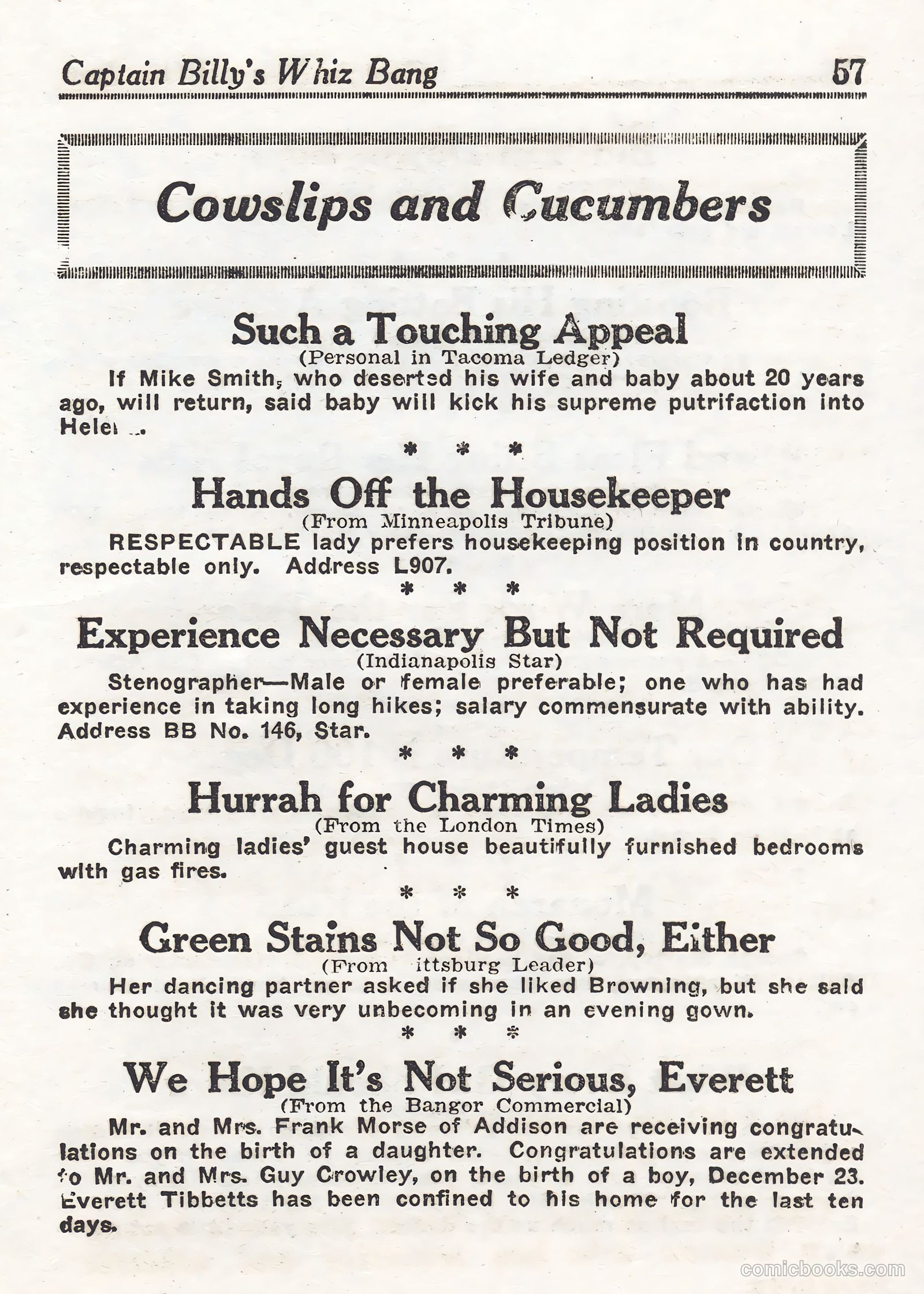
This page reprints humorous classified ads and newspaper notices from various American and British publications, presenting them as unintentional comedy. The "jokes" exploit double meanings and awkward phrasing: - **"Mike Smith"**: A wife's vengeful personal ad threatening a deadbeat dad with physical violence—humor from domestic abandonment and marital rage. - **"Hands Off the Housekeeper"**: A respectable woman's ad that implies sexual vulnerability, read as innuendo about protecting her from employers. - **"Experience...Long Hikes"**: A stenographer job listing absurdly emphasizing hiking over typing skills. - **"Gas Fires"**: A guest house ad that, given the 1920s context of poison gas dangers from WWI, reads ominously. - **"Browning"**: A pun—the dancing partner asks about the poet Robert Browning; she misunderstands as "browning" (skin discoloration). - **"Everett Tibbetts"**: Juxtaposing births with someone confined to bed suggests implied illness or scandal. The satire targets newspaper editors' obliviousness to unintended humor in their own pages.
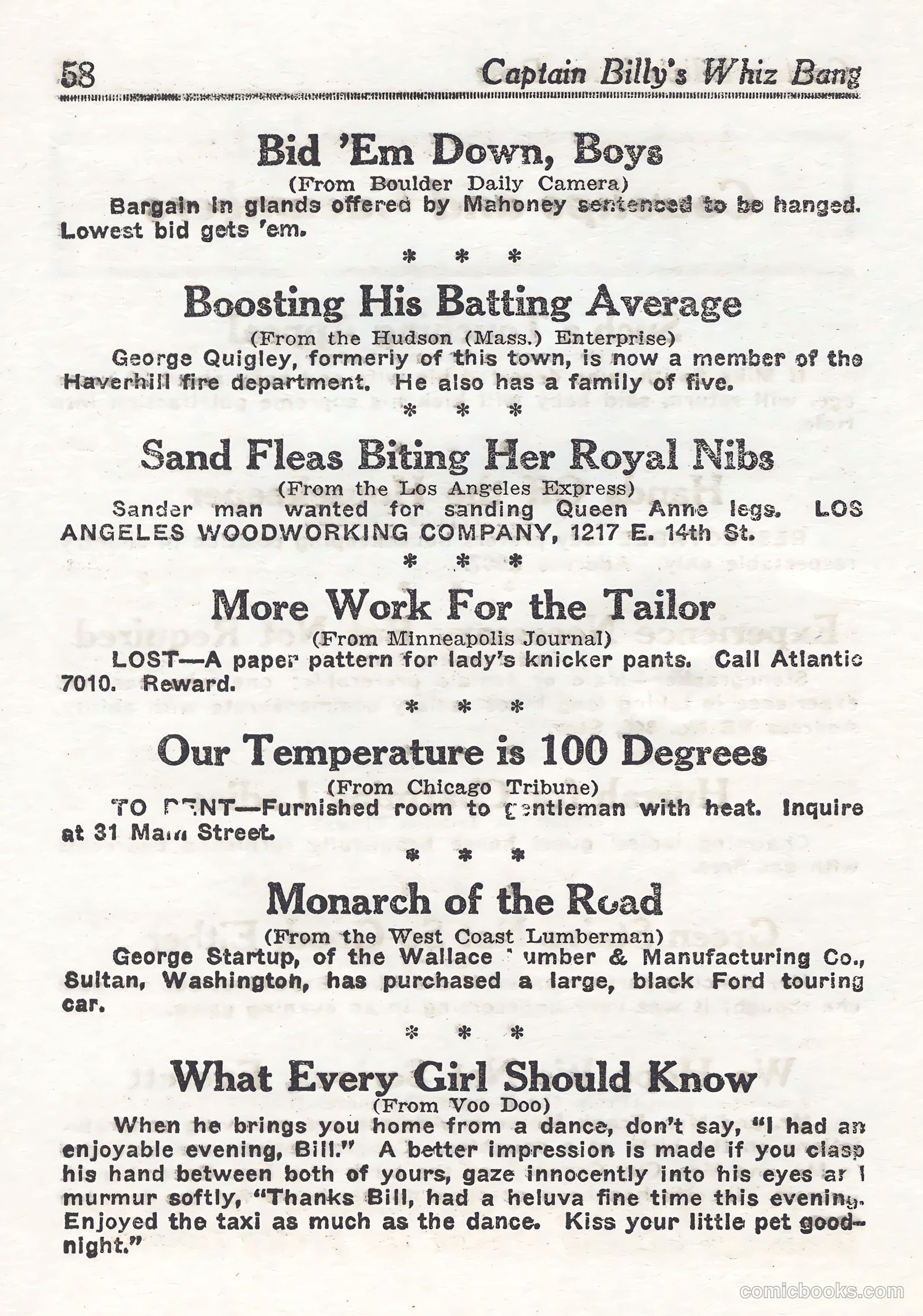
This page is a collection of brief, absurdist humor pieces—mostly reprinted from other newspapers—relying on double entendre and dark comedy typical of 1920s satirical magazines. **Key items:** - **"Bid 'Em Down, Boys"**: Gallows humor about a man (Mahoney) sentenced to death; the "glands" joke is deliberately crude and macabre. - **"Sand Fleas...Royal Nibs"**: Pun on "sanding Queen Anne legs" (furniture restoration vs. literal legs). - **"More Work For the Tailor"**: Lost "knicker pants" pattern—mildly risqué for the era. - **"Temperature is 100 Degrees"**: Ambiguous rental ad playing on whether the room comes with actual heat or implied romantic "heat." - **"What Every Girl Should Know"**: Mock dating advice encouraging women to flirt shamelessly and reference enjoying the taxi ride (implying necking during travel)—poking fun at modern dating etiquette. The humor is juvenile, punning, and edgy—typical of *Whiz Bang*'s irreverent tone toward propriety and authority.
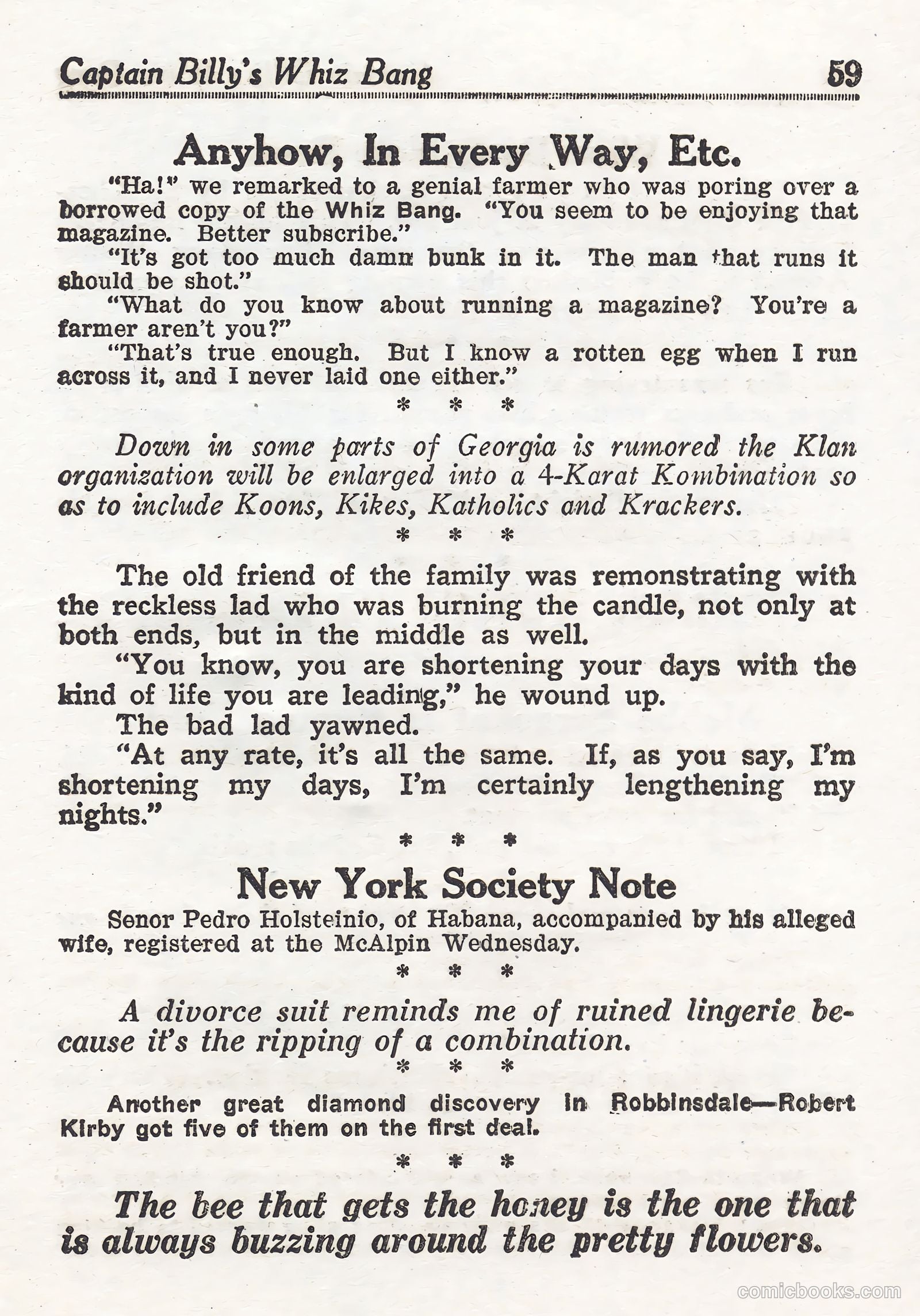
This page contains short satirical jokes and social commentary typical of 1920s humor magazines. The content includes: **Farmer's critique**: A joke mocking magazine criticism—a farmer complains the Whiz Bang contains "bunk" but admits he's unqualified to judge, yet can recognize poor quality ("rotten egg"). **KKK reference**: A dark joke about the Ku Klux Klan expanding into a "4-Karat Kombination" using slurs for Black people, Jewish people, Catholics, and poor whites—satirizing the Klan's bigotry and alliteration obsession. **Youth morality joke**: A reckless young man deflates an elder's warning about burning the candle at both ends by quipping he's lengthening his nights instead—trivializing wasteful living. **Society gossip**: A brief New York social note mocking high society. **One-liner punchlines**: Including crude sexual humor about divorce and a diamond discovery joke. The overall tone is cynical, irreverent, and occasionally offensive by any standard, reflecting 1920s satirical magazine conventions.
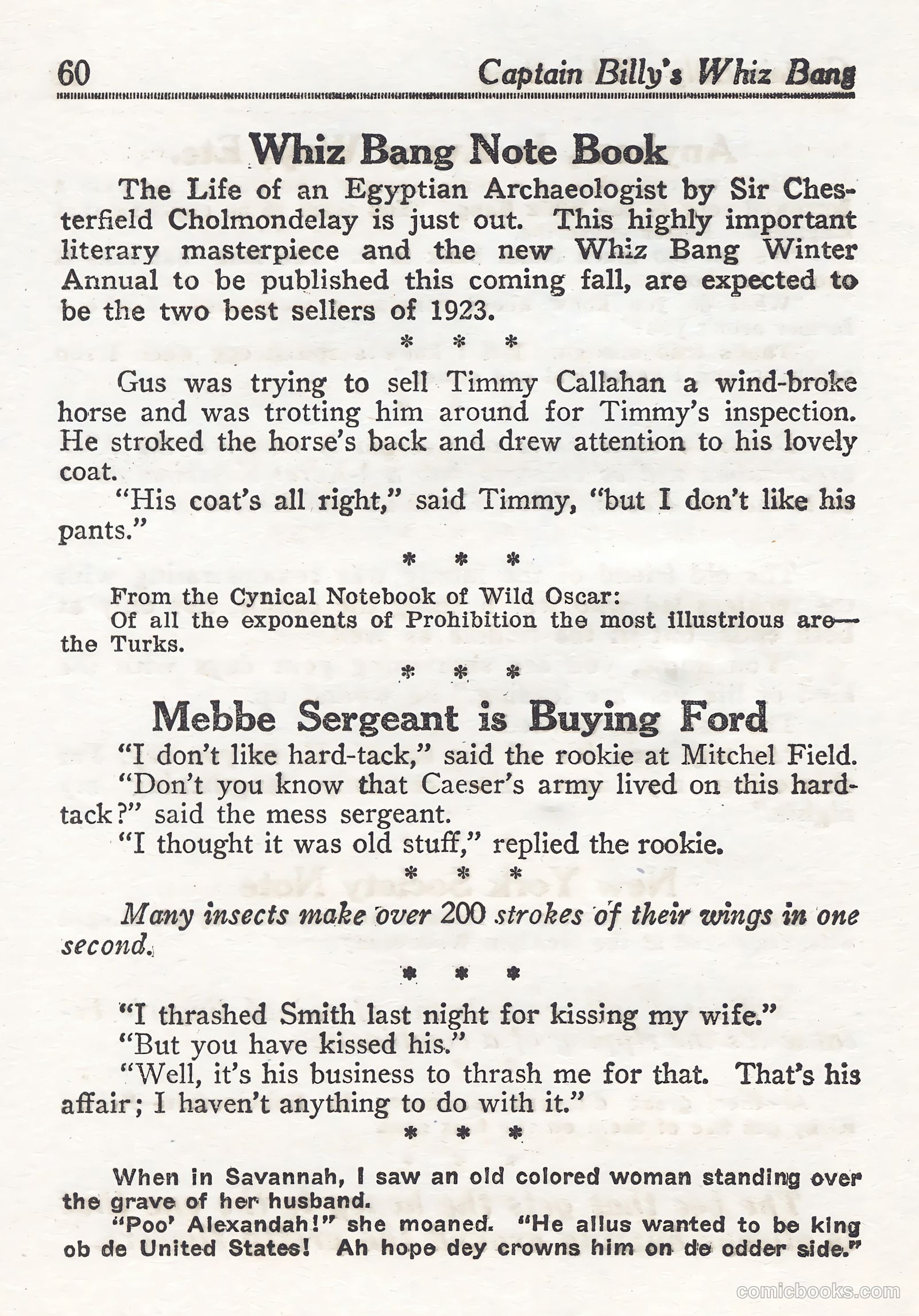
This page contains humor vignettes typical of 1920s satirical magazines. The jokes target: **Horse Trading**: A practical joke about inspecting a horse—the buyer complains about the horse's "pants" (likely meaning its condition or appearance), a humorous deflation of a sales pitch. **Prohibition**: "Wild Oscar" satirizes Prohibition enforcement by noting Turks (from Turkey, a Muslim-majority nation with its own alcohol restrictions) as ironic exemplars—mocking American hypocrisy about the new 1920 law. **Military Life**: A rookie questions hardtack rations; the sergeant cites Caesar's army eating the same. The joke plays on the "old stuff" pun—both ancient and stale. **Gender Double Standards**: A man justifies thrashing another for kissing his wife while having kissed the man's wife himself, treating infidelity as a male "business affair." **Race Humor**: The final anecdote uses dialect humor (common but now offensive) about an enslaved or formerly enslaved woman's aspirations for her deceased husband, mixing pathos with condescension. These reflect period entertainment conventions rather than sophisticated satire.
This is a humor column of mock advice responses to fake reader letters. The jokes rely on puns and double meanings: - **Bootleggers reference**: Alludes to Prohibition-era illegal alcohol sales - **"Collie-wobbles"**: Pun on "collywobbles" (stomach upset) applied to a collie dog - **"Peep sight" vs "open sight"**: Hunting rifle terminology, but "Teddies" jokes about teddy bears (vs. dangerous grizzlies) - **"Snowballs"**: Likely candy that melts in heat - **Passover/stocking**: Plays on Jewish holiday vs. Christmas tradition - **"Coxcomb"**: A flower, but sounds like "cock's comb," fitting a poultry dealers' ball The humor is mild, wholesome wordplay typical of 1920s-era magazine comedy—puns presented as sincere but absurd advice. No identifiable political figures appear; these are generic humorous responses to invented reader concerns.
This page from the satirical magazine contains several short jokes typical of 1920s humor: **"Somebody's Been Peeping"**: A roommate joke playing on the surprise of seeing a familiar neighbor transformed by formal dress—implying she looks more attractive when dressed up than in everyday appearance. **"Tableau"**: A risqué scene (credited to Dartmouth College Paper) depicting a romantic midnight encounter between a man and woman in a nightgown. The humor lies in the man's restraint—he exits to smoke rather than act on the moment, addressing her as "brother" adding an absurdist punchline. **"Gus' Latest Spasm"**: A limerick mocking a Chicago preacher who condemns girls wearing aprons and caps as worse than cats. The joke's counterargument: cats sit on governors' laps, suggesting the preacher's moral judgment is misplaced. **"Dedicated to a Tropical Tart"**: A crude rhyming joke about a woman wearing less clothing as she travels to warmer locations—implying progressive undressing correlates with climate. The content reflects typical 1920s male-oriented humor: flirtation, mild sexual innuendo, and mockery of moral authority.
This page from *Whiz Bang* (a humor magazine popular in the 1920s-30s) contains several brief jokes and anecdotes: **"Billy Bones Buys Big Black Beaver"** mocks fashion's absurdity—specifically the trend of "tucked fur" in women's coats, where vertical pleats create artificial panel effects. The satire targets dressmakers' pretentious designs. **"Our vaccination joke last month didn't take"** references contemporary public debates over vaccination, likely during the post-WWI period when vaccines faced skepticism. **The Tommy joke** plays on childish misinterpretation: a boy mistakes the halo in a biblical illustration (Elijah ascending to heaven) for a "spare tire"—humor based on anachronistic innocence. **"Mama Used to Take Ice"** jokes about a young husband's constant absence, either flirting with the cook or nursing staff—typical domestic humor of the era. The remaining sections include brief literary parodies requiring context unclear from the image alone.
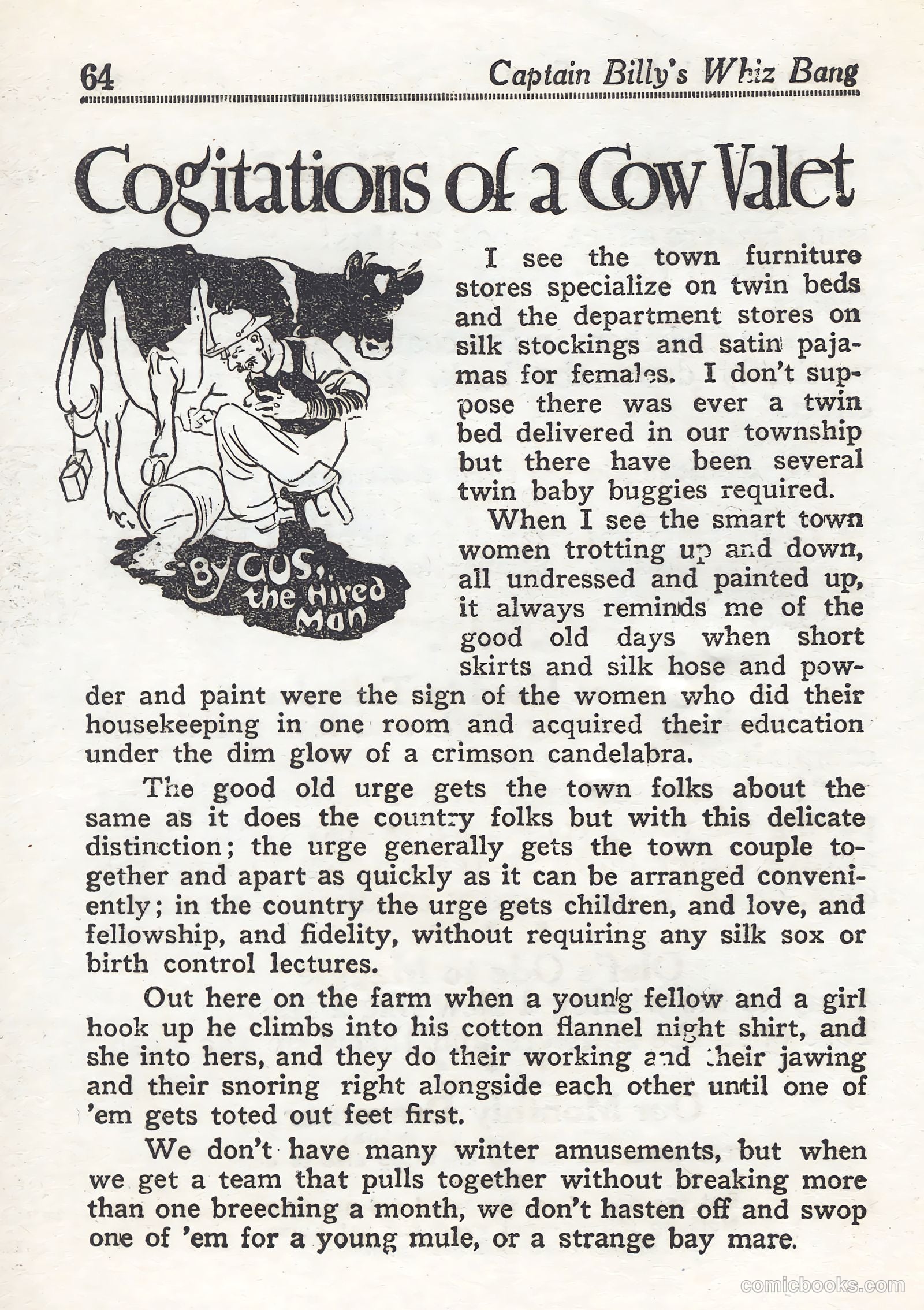
This column by "Gus, the Hired Man" contrasts city and country life, using sharp social satire. The author mocks urban women's fashion (silk stockings, short skirts, makeup) by comparing them to sex workers of an earlier era, implying modern city women are similarly frivolous and morally loose. The piece's central argument is that city dwellers pursue shallow pleasures and lack commitment—couples separate quickly, practice birth control instead of having children. Rural people, by contrast, embody virtue: couples stay together "until one of 'em gets toted out feet first," have children naturally, and maintain fidelity without "silk sox or birth control lectures." The closing metaphor equates wives to work animals ("team," "breeching"), sarcastically suggesting rural men don't abandon their spouses as casually as city men do with romantic partners. The satire mocks both urban modernity and rural attitudes simultaneously—urbanites for materialism and sexual looseness, rural folk for their implicit comparison of marriage to livestock management.
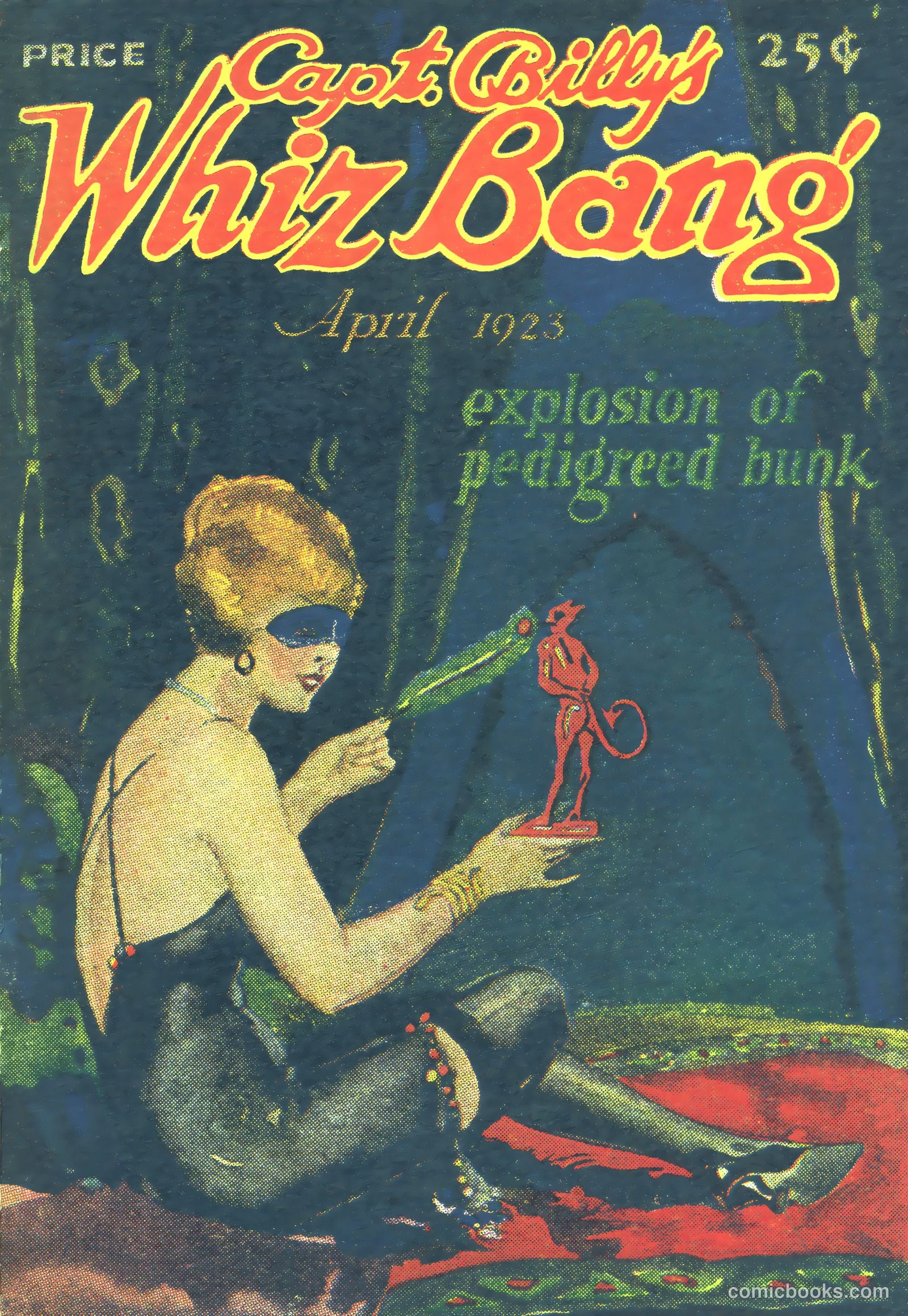
This is the April 1923 cover of *Capt. Billy's Whiz Bang*, a satirical humor magazine. The subtitle "explosion of pedigreed bunk" indicates the issue's theme: mocking pretentious or high-minded nonsense. The illustration depicts a stylized figure (appears to be a woman or androgynous character) in 1920s aesthetic dress—including a headband and jewelry—holding a small red figurine while seated in an underwater or fantastical setting with aquatic plants. The exact satire target remains unclear without additional context, though the "pedigreed bunk" subtitle suggests the image mocks fashionable affectations, artistic pretension, or perhaps spiritualist fads popular in the 1920s. The exaggerated, art-deco style reinforces the mockery of contemporary aesthetic movements or trends the magazine aimed to ridicule.
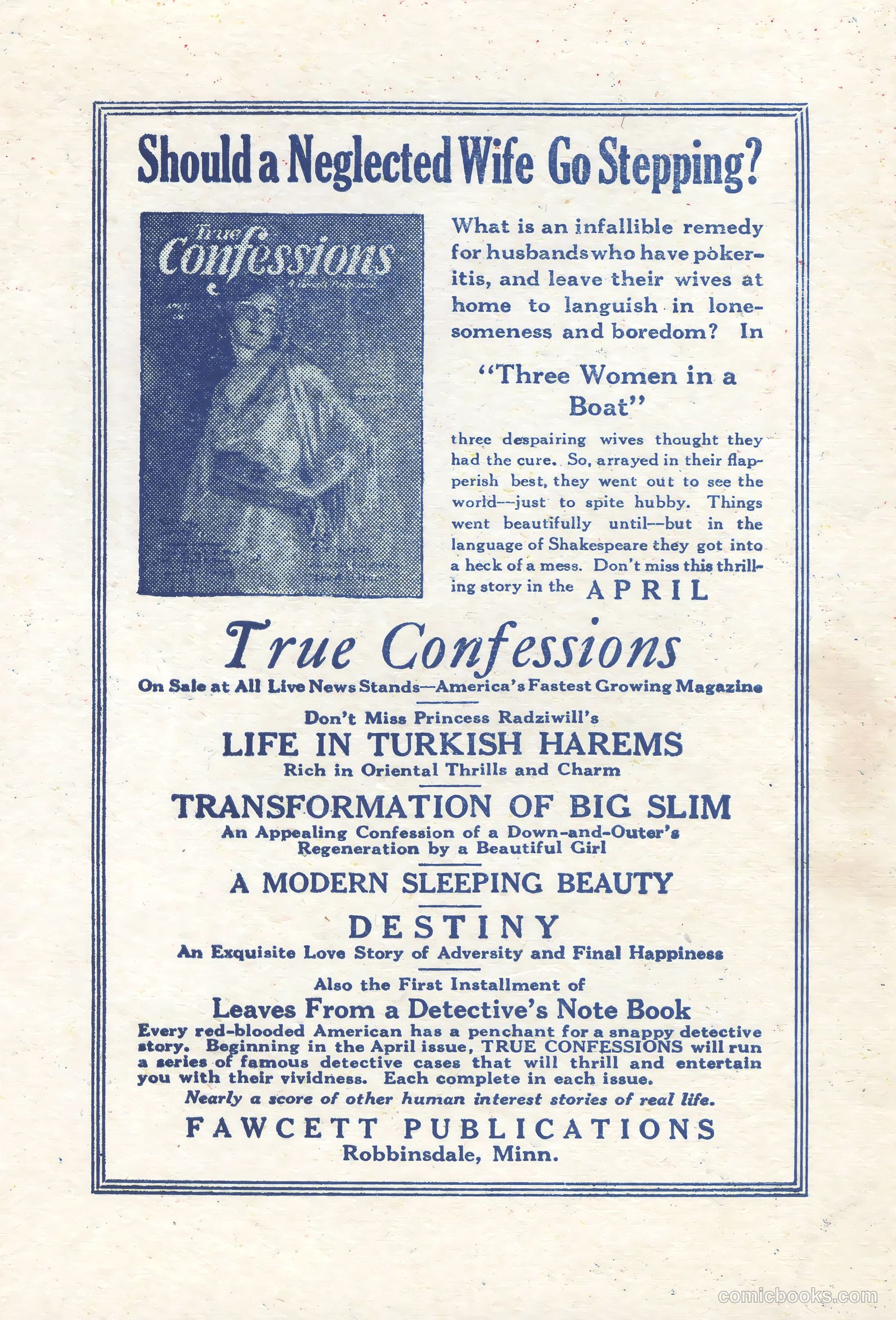
This page is primarily **advertising**, not satire or political commentary. It's a full-page advertisement for *True Confessions* magazine published by Fawcett Publications (Robbinsdale, Minnesota). The headline poses a rhetorical question about marital infidelity—whether neglected wives should "step out" (have affairs)—which was sensational content designed to attract readers. The ad promotes the April issue's featured story, "Three Women in a Boat," about wives who go out "just to spite hubby," with complications "in the language of Shakespeare." The page also advertises other story features like "Life in Turkish Harems" and "A Modern Sleeping Beauty," typical of the pulp magazine content of the era. This appears to be vintage advertising (likely 1920s-1930s) targeting readers seeking melodramatic human-interest stories about relationships and scandal.
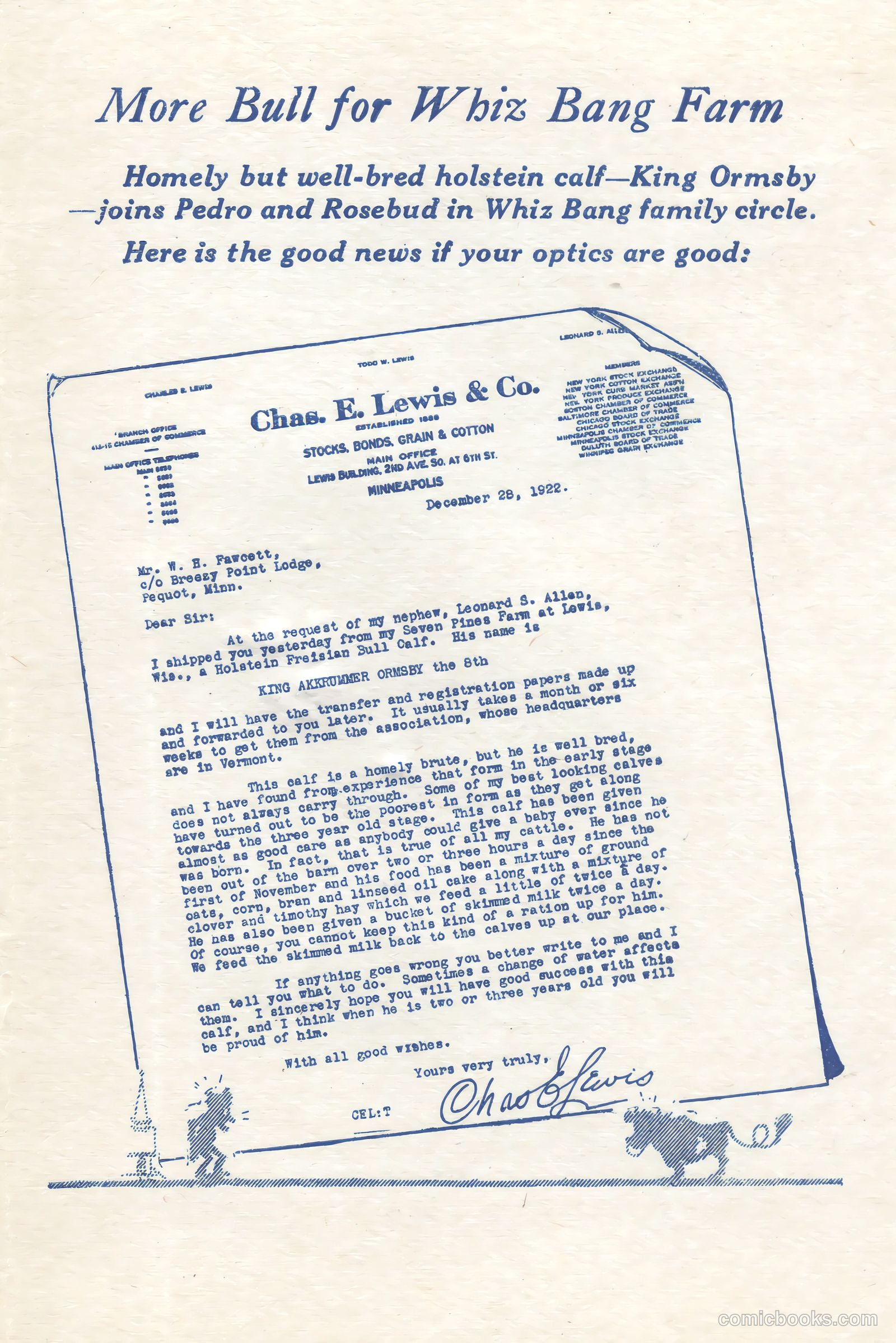
This page presents what appears to be advertising disguised as editorial content for *Whiz Bang*, a satirical magazine. The actual content is a formal business letter from Chas. E. Lewis & Co. (a Minneapolis stocks and commodities firm established 1888) describing shipment of a Holstein bull calf named "King Ormsby the 8th" to a lodge in Minnesota. The satire is subtle: the headline mockingly suggests "more bull" (excrement/nonsense) is coming to the magazine's fictional "farm," while the letter itself is entirely earnest business correspondence about livestock. The joke appears to be inserting legitimate commercial content—even soliciting what readers might assume are paid advertisements—into editorial space, perhaps satirizing both commercial farming practices and the blurred line between editorial and advertising content in 1920s publications.
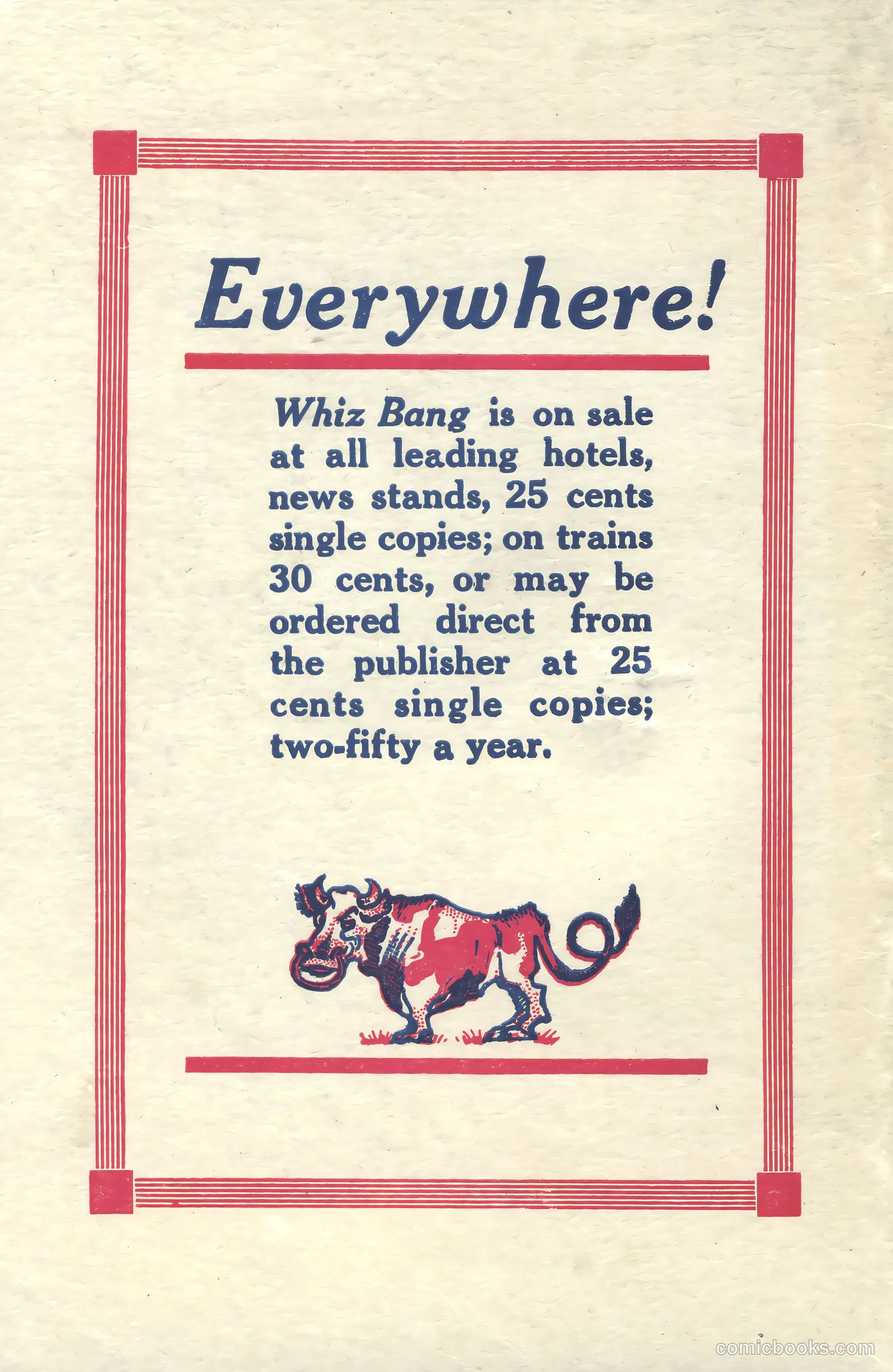
This is primarily an **advertisement/promotional page** for *Whiz Bang* magazine itself, not a political cartoon. The page announces the magazine's availability and pricing across distribution channels (hotels, newsstands, trains, direct mail subscriptions). The visual element is a stylized red and blue **cow or bull mascot** — likely the magazine's logo or branding symbol. The animal appears cartoonish and decorative rather than satirical. The pricing structure ($0.25 single copies at newsstands, $0.30 on trains, $2.50 annually by subscription) reflects early-to-mid 20th century magazine economics. The "Everywhere!" headline emphasizes broad national distribution. There is no apparent political satire or social commentary on this particular page — it functions as a self-promotional insert typical of magazine advertisements from this era.