
Captain Billy's Whiz Bang, April 1923 · page 53 of 68
Captain Billy's Whiz Bang #44 — page 53: what you’re looking at
What you’re looking at
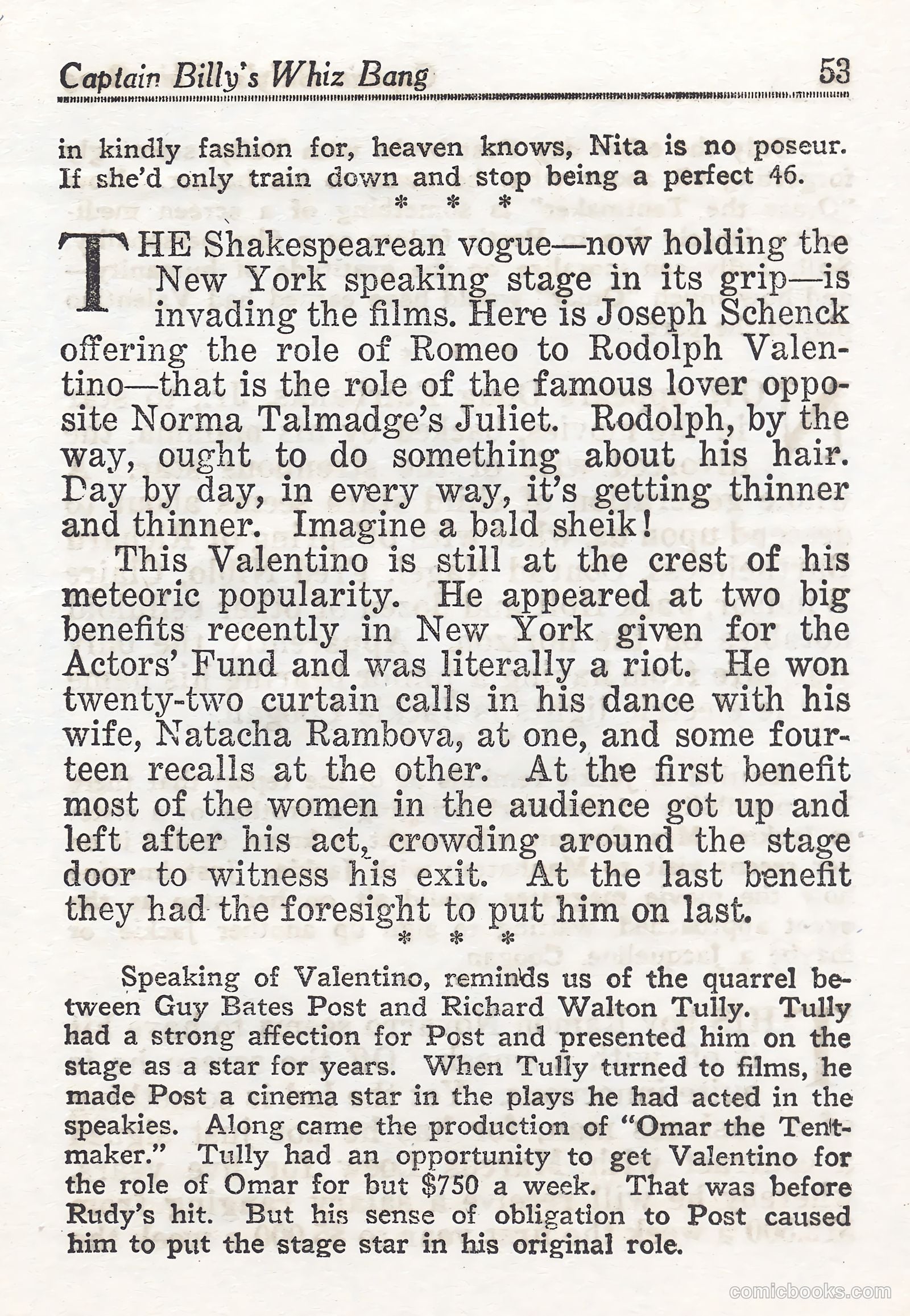
This page contains Hollywood gossip and satire from the early 1920s. The main target is **Rudolph Valentino**, the era's most famous male film star, whose popularity is mocked as excessive and feminizing. The column jokes that women abandoned their seats at benefit performances to crowd the stage door watching him exit—undignified behavior the writer finds ridiculous. The satire includes cutting remarks about Valentino's appearance (thinning hair, calling him a "bald sheik") and his extreme popularity at New York benefits, where he received 22 curtain calls. A secondary anecdote praises director **Richard Walton Tully** for loyalty: he cast his longtime protégé **Guy Bates Post** in "Omar the Tentmaker" rather than hiring the cheaper Valentino (at $750/week), despite Valentino later becoming a major star. The underlying joke: Hollywood's fickle fame and the absurdity of Valentino-mania among female audiences.
📄 Transcribed text from this page (OCR, searchable)
Machine-transcribed from the original scan — historical spelling and the odd misread are preserved.
Captain Billy's Whiz Bang 53 in kindly fashion for, heaven knows, Nita is no poseur. If she'd only train down and stop being a perfect 46. * * * THE Shakespearean vogue—now holding the New York speaking stage in its grip—is invading the films. Here is Joseph Schenck offering the role of Romeo to Rodolph Valen- tino—that is the role of the famous lover oppo- site Norma Talmadge's Juliet. Rodolph, by the way, ought to do something about his hair. Day by day, in every way, it's getting thinner and thinner. Imagine a bald sheik! This Valentino is still at the crest of his meteoric popularity. He appeared at two big benefits recently in New York given for the Actors' Fund and was literally a riot. He won twenty-two curtain calls in his dance with his wife, Natacha Rambova, at one, and some four- teen recalls at the other. At the first benefit most of the women in the audience got up and left after his act, crowding around the stage door to witness his exit. At the last benefit they had the foresight to put him on last. * * * Speaking of Valentino, reminds us of the quarrel be- tween Guy Bates Post and Richard Walton Tully. Tully had a strong affection for Post and presented him on the stage as a star for years. When Tully turned to films, he made Post a cinema star in the plays he had acted in the speakies. Along came the production of "Omar the Tent- maker." Tully had an opportunity to get Valentino for the role of Omar for but $750 a week. That was before Rudy's hit. But his sense of obligation to Post caused him to put the stage star in his original role.