
Captain Billy's Whiz Bang, April 1923 · page 35 of 68
Captain Billy's Whiz Bang #44 — page 35: what you’re looking at
What you’re looking at
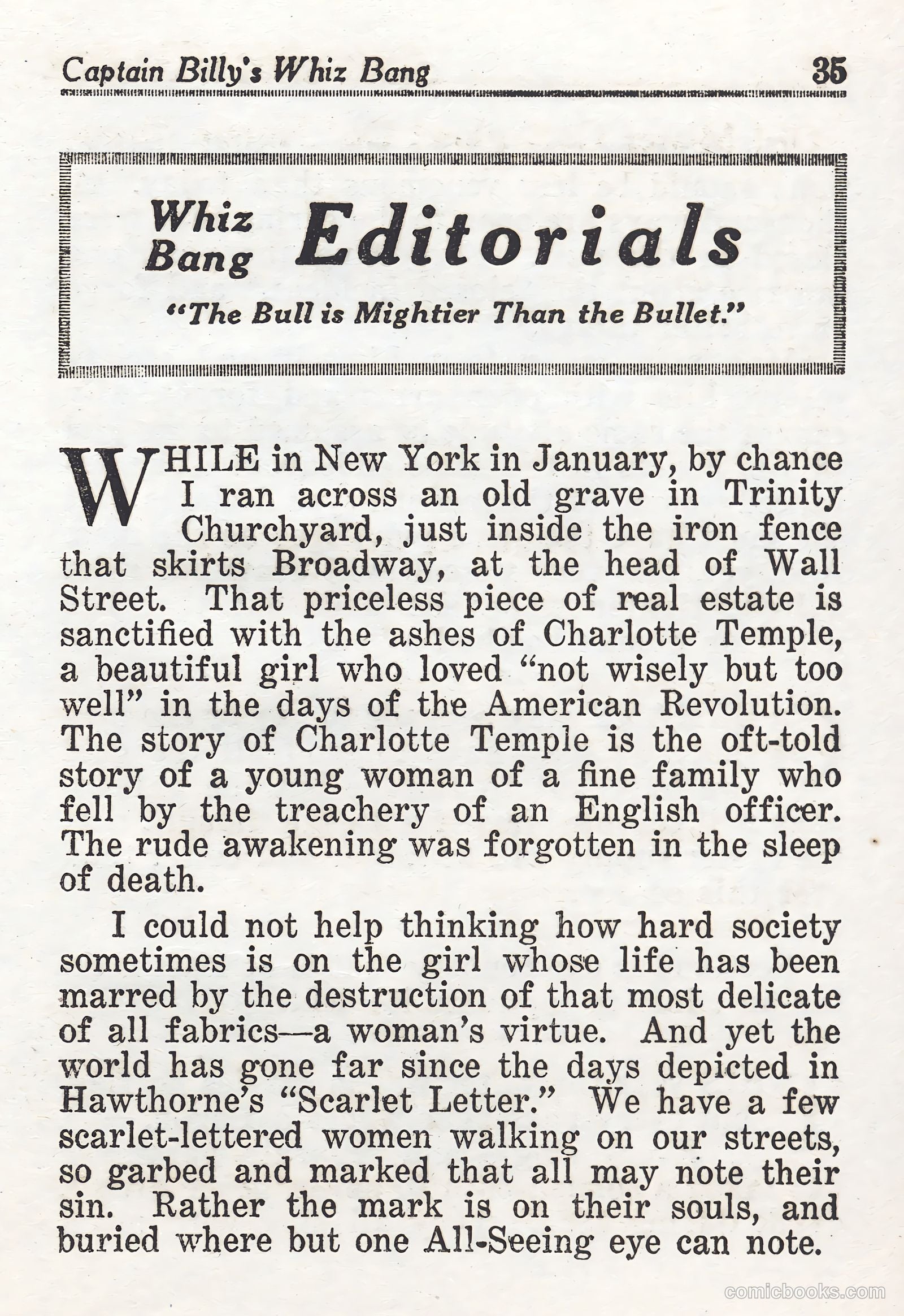
This is an editorial column, not a cartoon. The author reflects on discovering Charlotte Temple's grave in Trinity Churchyard, New York—a historical figure (a young woman seduced by an English officer during the Revolution whose story became a famous 18th-century novel). The piece argues for compassion toward women whose sexual virtue has been compromised. The author notes that while society no longer literally marks "fallen women" with visible scarlet letters (referencing Hawthorne's novel), these women still bear invisible social stigma and judgment. The editorial's thesis—"The Bull is Mightier Than the Bullet"—appears to suggest that moral/social pressure ("the bull") is more destructive than physical violence ("the bullet"). It's a plea for society to be less harsh in condemning women whose lives have been damaged by seduction or sexual transgression, asserting that only divine judgment should apply.
📄 Transcribed text from this page (OCR, searchable)
Machine-transcribed from the original scan — historical spelling and the odd misread are preserved.
Captain Billy's Whiz Bang 35 Whiz Editorials Bang “The Bull is Mightier Than the Bullet.” WHILE in New York in January, by chance I ran across an old grave in Trinity Churchyard, just inside the iron fence that skirts Broadway, at the head of Wall Street. That priceless piece of real estate is sanctified with the ashes of Charlotte Temple, a beautiful girl who loved “not wisely but too well” in the days of the American Revolution. The story of Charlotte Temple is the oft-told story of a young woman of a fine family who fell by the treachery of an English officer. The rude awakening was forgotten in the sleep of death. I could not help thinking how hard society sometimes is on the girl whose life has been marred by the destruction of that most delicate of all fabrics—a woman’s virtue. And yet the world has gone far since the days depicted in Hawthorne’s “Scarlet Letter.” We have a few scarlet-lettered women walking on our streets, so garbed and marked that all may note their sin. Rather the mark is on their souls, and buried where but one All-Seeing eye can note.