
Captain Billy's Whiz Bang, April 1923 · page 33 of 68
Captain Billy's Whiz Bang #44 — page 33: what you’re looking at
What you’re looking at
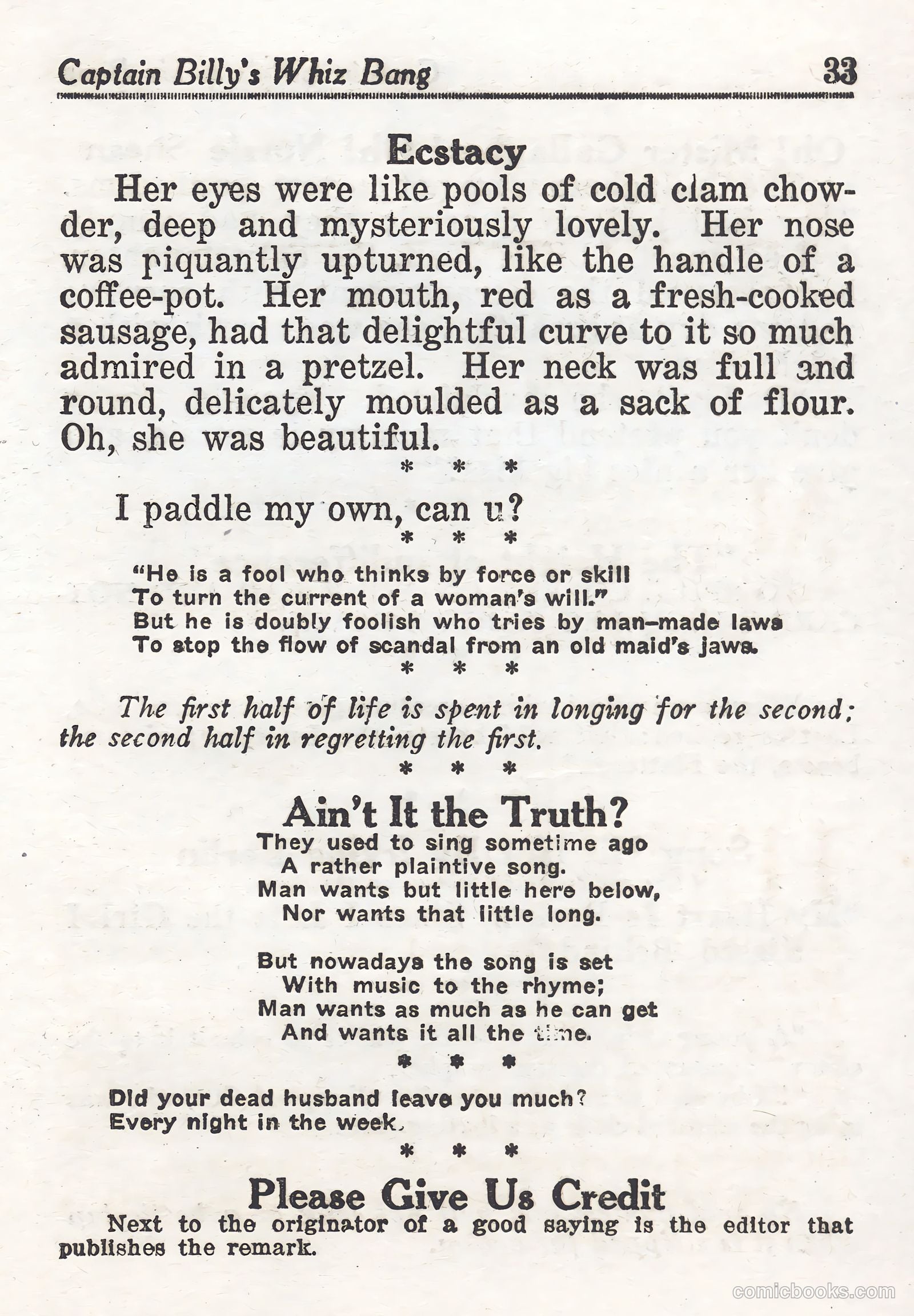
This page contains humorous short quips and observations typical of 1920s satirical magazines. The "Ecstasy" section mocks flowery romantic prose through absurd food metaphors (clam chowder eyes, sausage mouth, flour-sack neck), deflating sentimentality with grotesque imagery. The aphorisms address relationships and gender dynamics. One verse contrasts old notions of male restraint ("man wants but little") with modern male greed ("wants as much as he can get / And wants it all the time"). A joke about a widow being "left" by her dead husband "every night in the week" uses double entendre to mock infidelity or promiscuity. The final section humorously requests editorial credit for reprinting quotations—itself presented as a satirical "remark" worthy of publication. No specific political figures or events are referenced; instead, this reflects general 1920s attitudes about changing male-female relations and consumer excess.
📄 Transcribed text from this page (OCR, searchable)
Machine-transcribed from the original scan — historical spelling and the odd misread are preserved.
Captain Billy's Whiz Bang 33 Ecstasy Her eyes were like pools of cold clam chow-der, deep and mysteriously lovely. Her nose was riquantly upturned, like the handle of a coffee-pot. Her mouth, red as a fresh-cooked sausage, had that delightful curve to it so much admired in a pretzel. Her neck was full and round, delicately moulded as a sack of flour. Oh, she was beautiful. * * * I paddle my own, can u? * * * “He is a fool who thinks by force or skill To turn the current of a woman’s will.” But he is doubly foolish who tries by man-made laws To stop the flow of scandal from an old maid’s jaws. * * * The first half of life is spent in longing for the second; the second half in regretting the first. * * * Ain’t It the Truth? They used to sing sometime ago A rather plaintive song. Man wants but little here below, Nor wants that little long. But nowadays the song is set With music to the rhyme; Man wants as much as he can get And wants it all the time. * * * Did your dead husband leave you much? Every night in the week. * * * Please Give Us Credit Next to the originator of a good saying is the editor that publishes the remark.