
A complete issue · 68 pages · 1921
Captain Billy's Whiz Bang #22
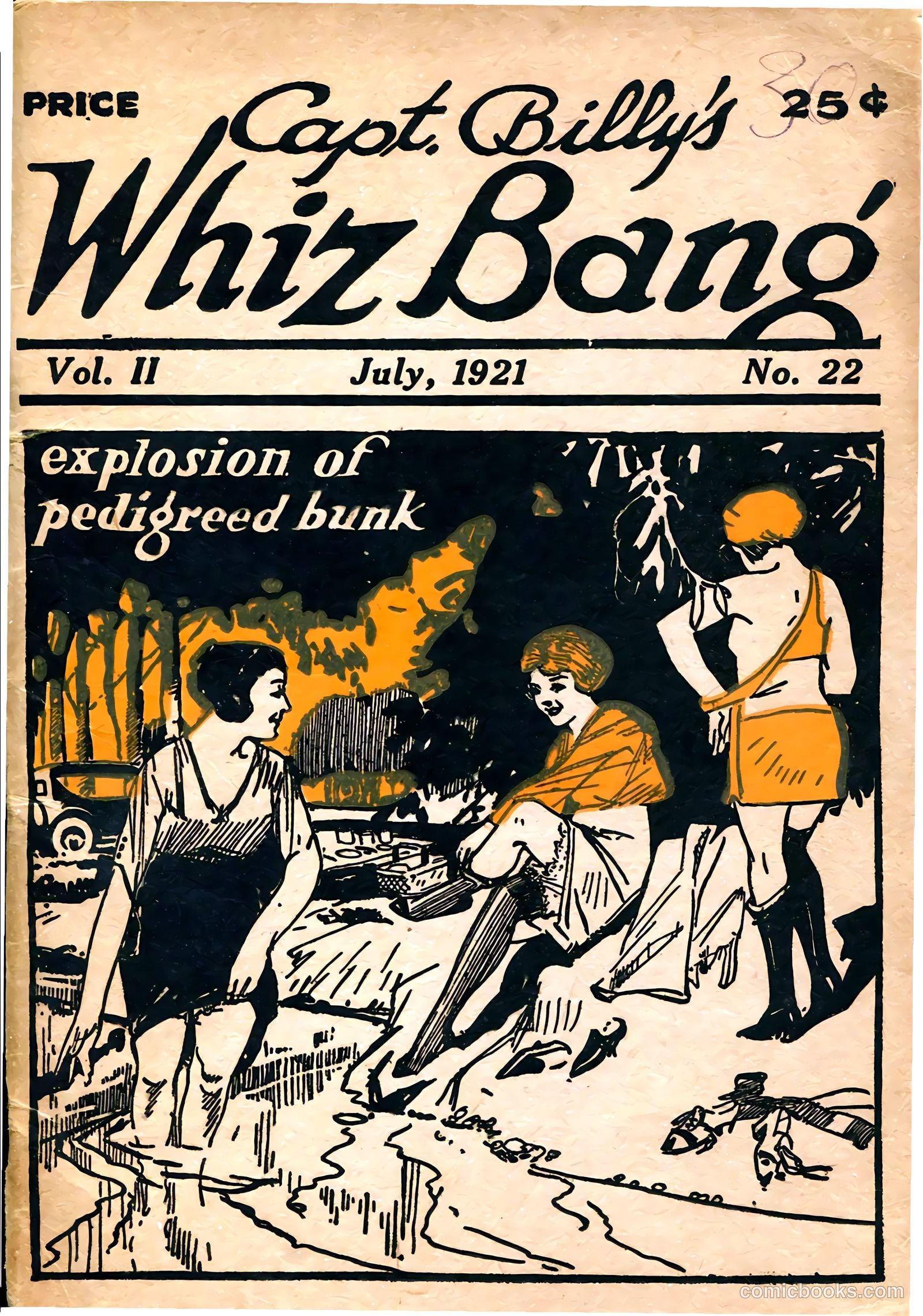
This is the cover of **Capt. Billy's Whiz Bang**, a popular American humor magazine from July 1921. The illustrated scene depicts what appears to be a beach or bathing party with women in 1920s swimwear and a man lying on the ground. The headline reads "explosion of pedigreed bunk." The satire likely targets post-WWI American society's embrace of modern, liberated behavior—particularly women's increasing public presence in swimwear and leisure activities. "Pedigreed bunk" suggests mocking pretentious social attitudes or false respectability surrounding these changes. The comedic "explosion" portrays the shock or disruption this represented to traditional values. This reflects the magazine's typical irreverent humor about contemporary social upheaval during the Jazz Age.
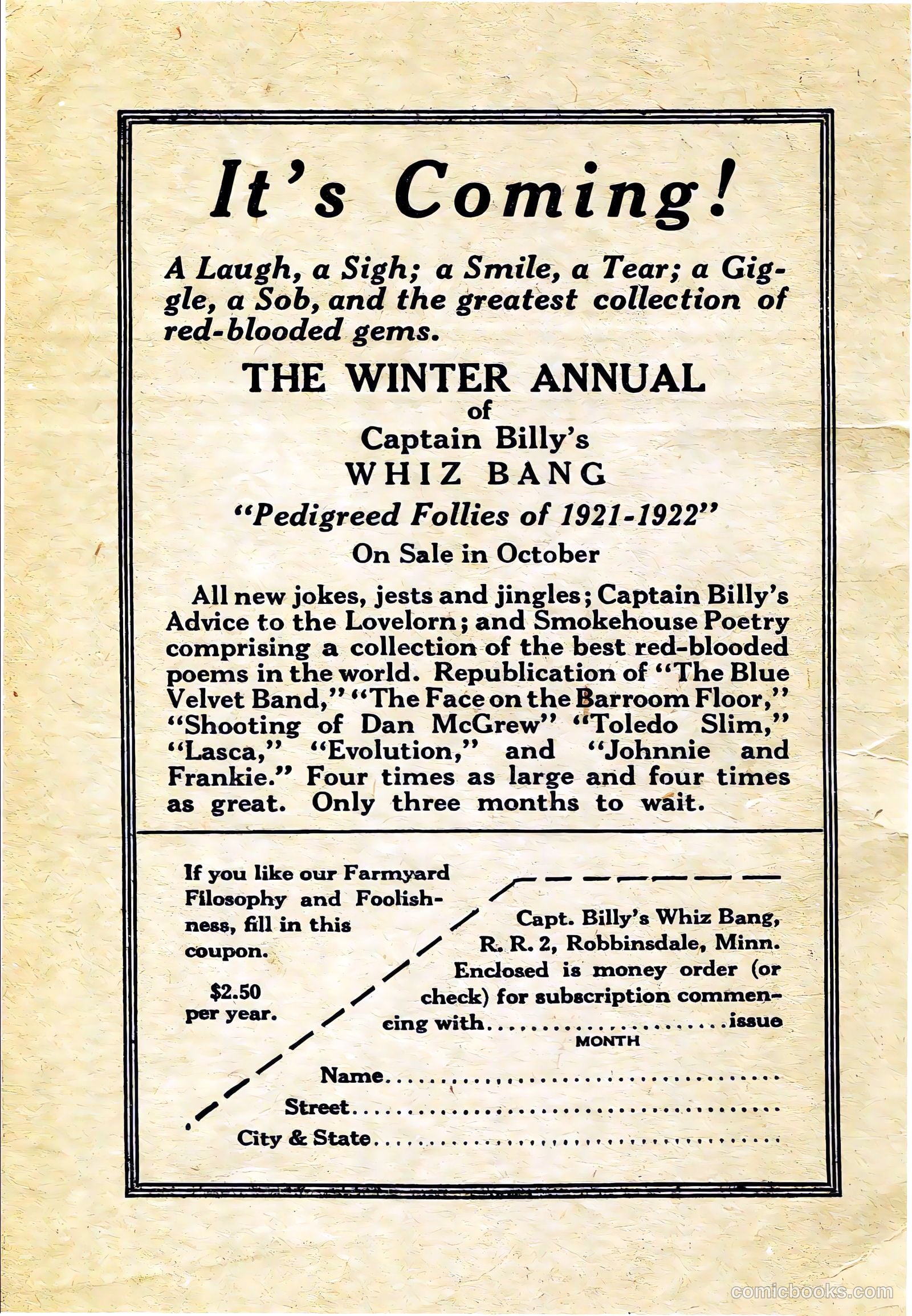
This is a **title page and advertisement** rather than a cartoon or satirical content. It announces an upcoming publication: "The Winter Annual of Captain Billy's Whiz Bang" (1921-1922), to be sold in October. The ad promises "a Laugh, a Sigh; a Smile, a Tear" and lists content including jokes, jingles, "Advice to the Lovelorn," and poetry described as "red-blooded" — typical humor magazine fare. It references republished pieces with titles like "The Blue Velvet Band" and "Shooting of Dan McGrew." The subscription coupon costs $2.50 per year. "Whiz Bang" was a real American humor magazine known for bawdy, irreverent comedy aimed at working-class readers. This page simply promotes the upcoming issue without satirical commentary.
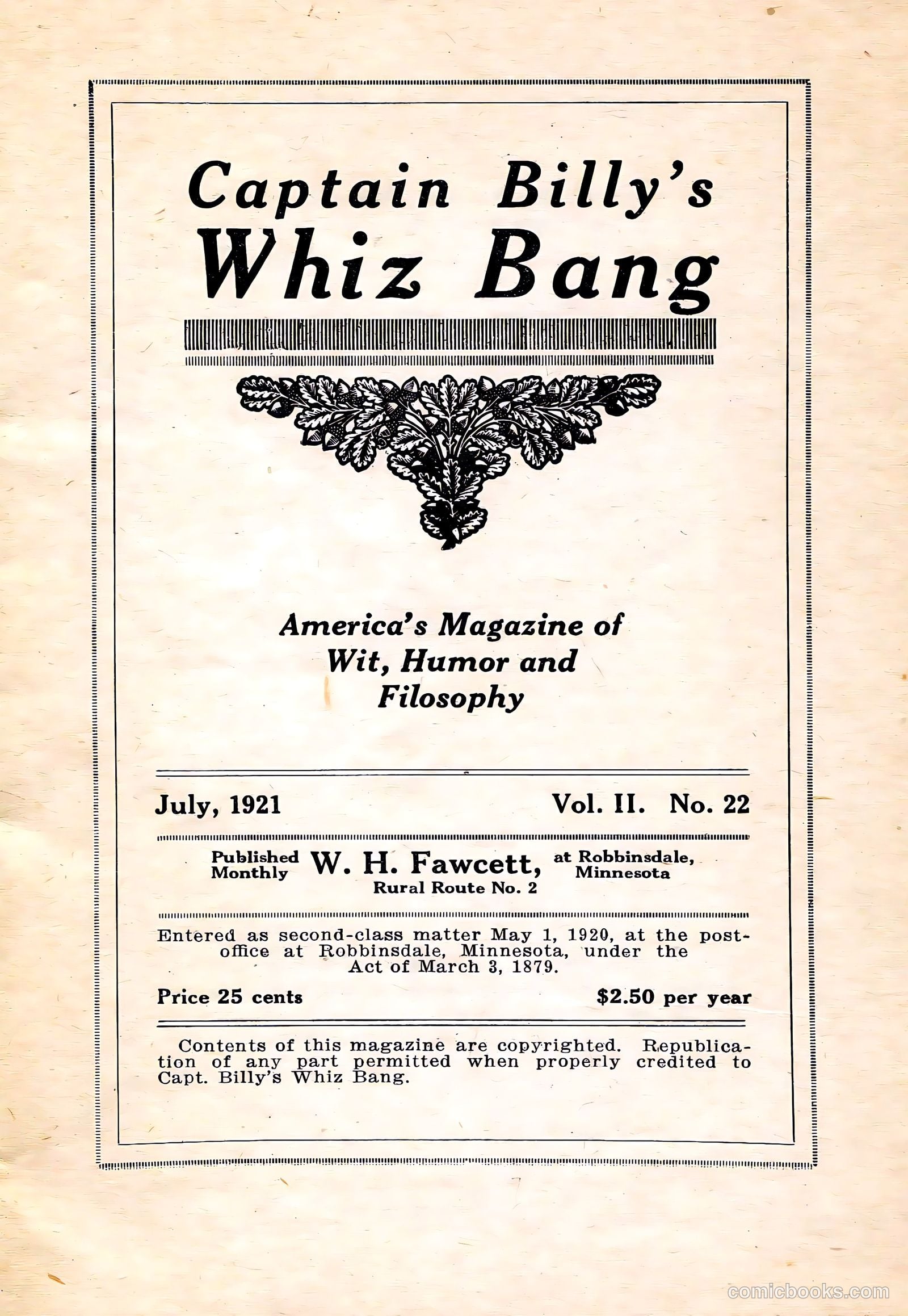
This is the cover/masthead page for **Captain Billy's Whiz Bang**, a satirical humor magazine published monthly in Minnesota during the early 1920s. The page itself contains no cartoon or political content—it's purely a title page listing publication details. It identifies the magazine's editor/publisher as W.H. Fawcett in Robbinsdale, Minnesota, and notes it was entered as second-class mail in May 1920. The magazine's subtitle describes its purpose: "America's Magazine of Wit, Humor and Philosophy." The July 1921 issue cost 25 cents individually or $2.50 yearly. The ornamental header and border reflect typical magazine design aesthetics of the 1920s era. To understand the magazine's actual satirical content, one would need to examine interior pages.
This is a **title page** from *Whiz-Bang*, a 1921 satirical magazine edited by a Spanish-American War and WWI veteran. The page leads with a Theodore Roosevelt quote emphasizing undivided American loyalty—likely referencing post-WWI concerns about immigrant communities and "hyphenated Americans" maintaining ties to foreign homelands, a major political anxiety of that era. The copyright and union label indicate this was a union-printed publication. The dedication to U.S. fighting forces suggests the magazine positioned itself as patriotic. The Roosevelt quote sets the ideological tone: emphasizing singular national allegiance during a period of heightened nativism and suspicion of dual loyalties following World War I.
This is a humorous anecdote rather than a political cartoon. The joke relies on period stereotypes: a drunk man (Norton, intoxicated on "fusel oil and white mule"—bootleg liquor) repeatedly asks a Black maid about women with flower names (Daisy, Pansy, Violet, Rose), implying he's seeking a brothel. The maid's exasperated response—"dis place ain't no hot house"—delivers the punchline through dialect humor, a common comedic device of the era. The second brief anecdote about a "flivver" (Model T Ford) and a colt is simple wordplay about the vehicle's uses. The satire targets Prohibition-era drinking culture and male behavior rather than politics. The stereotyped dialect reflects 1920s entertainment conventions, though modern readers would find it offensive. No specific political figures appear to be referenced.
This page from the satirical magazine contains three unrelated humorous anecdotes rather than cartoons: 1. **Indian courtship ritual**: A folksy story about Native American dating customs involving tom-tom drumming and snow-shoes as rejection signals. This reflects early 20th-century stereotypical depictions of Indigenous peoples common in popular magazines. 2. **Lost brooch advertisement**: A joke about "Maggie," the cookhouse chef, who lost a cameo brooch depicting Venus and Adonis—classical gods of love—suggesting her romantic entanglement. 3. **Deacon Callahan prank**: The main joke here is situational humor: a religious deacon ("Deacon") hides to surprise-kiss his wife, expecting shock. Instead, she warns him not to be "bold" because locals know her reputation—implying she's either well-known or her respectability is at stake. The humor derives from her concern about public appearance rather than marital affection. These are lighthearted, community-focused anecdotes typical of early 20th-century American satirical magazines targeting rural or small-town audiences.
This page contains two humorous anecdotes from "Captain Billy's Whiz Bang," a post-WWI satirical magazine. The first story mocks a jailed man (Johnnie Beaton) who refuses to donate to jail improvements, then immediately organizes an illegal poker game inside—suggesting the jail is fine enough for gambling but not worth improving. The second, longer anecdote concerns Prohibition-era military regulations. During WWI, soldiers were banned from alcohol. The narrator describes a system at Camp Lee where soldiers visiting Pennsylvania (where alcohol remained legal) had to return with "credentials" (bottles) deposited in the captain's desk—a clever bureaucratic workaround to smuggle liquor past military rules. The story sets up a scenario involving a strict teetotaler colonel and a repeatedly troublesome Lieutenant Evans, apparently leading to a humorous confrontation about hidden alcohol. Both stories satirize authority figures and rule-breaking through clever wit.
This page contains two humorous anecdotes from a WWI-era satirical magazine. **The Evans Story**: A drunk military officer (Lieutenant Evans) returns from leave and mistakes his colonel for a mess hall orderly, rudely demanding food. The humor lies in Evans' progressive realization of his error as he hiccups through increasingly apologetic rank corrections ("orderly"→"major"→"colonel"). The satire mocks both military hierarchy and drunken behavior, playing on the contrast between Evans' initial assumption and the colonel's dignified restraint. **The Lost Boy Anecdote**: A child separated from his mother at a baseball game explains he couldn't hold her skirts because he was too short to reach them. This is a gentle joke about abbreviated hemlines—a 1920s fashion controversy where women's skirts became noticeably shorter, shocking more conservative observers. The child's literal inability to grasp the shortened garments represents the cultural gap between traditional dress and modern fashion. Both items satirize social disruption: military discipline and changing women's fashion norms.
This is a **Hollywood gossip column** from *Captain Billy's Whiz Bang*, a 1920s satirical magazine. The column by "Richmond" reports on silent film stars' personal lives and romances. **Key figures mentioned:** - **Edna Purviance** (Chaplin's leading actress) — rumored engaged to a wealthy Los Angeles man - **Charlie Chaplin** — her employer, noted for making only one film ("The Kid") in nearly two years - **Larry Semon** and **Lucille Carlisle** — allegedly involved in a physical altercation - **Katherine McDonald, Natalie Talmadge, Buster Keaton** — other stars referenced **The satire:** The column mocks both the stars and gossip culture itself. It portrays Purviance as content earning just $100/week with abundant leisure time, suggesting she prioritizes "the social game" over career ambition—a veiled critique of either her ambition or her fortunate position. The breathless, scandalous tone parodies celebrity gossip while chronicling real Hollywood drama. The column invites readers to join a "monthly movie gossip club," satirizing the public's hunger for celebrity dirt.
This page is a gossip column satirizing California high society and class mobility. It recounts how Edna, a manicurist from a small town near San Francisco, became romantically involved with Carleton Burke—wealthy, handsome, and from an elite family. The satire targets snobbish social gatekeeping: Edna's humble origins sparked scandal ("much whispering"), but her beauty and composure won acceptance from exclusive circles like the Spreckels family. The piece mocks both the rigid class hierarchy that initially questioned whether she could be "received" and Edna's calculated, dignified navigation of it. The humor lies in the irony that despite Carleton's sustained courtship and social sponsorship, marriage never materializes—suggesting his interest may be less honorable than high society assumed. The column satirizes the pretense and hypocrisy of West Coast elite society.
This page contains three gossip columns about silent-film industry figures, presented without accompanying illustrations. The text is pure celebrity scandal-mongering typical of 1920s tabloid humor magazines. The items target: an unnamed woman involved in "divorce mix-ups"; **Larry Semon** (a Vitagraph comedian-director), accused of violently spanking actress **Lucille Carlisle** on set until she required hospitalization; and **Katherine Macdonald**, a prominent silent-film star earning $40,000 per picture. The satire mocks Hollywood's contradictions: Macdonald is praised by society for remaining "cold and high" and frugal, yet criticized by studio workers as "hard." The tone is salacious and malicious, treating serious allegations (workplace violence) as entertainment. This reflects the era's invasive celebrity gossip culture and early Hollywood's chaotic, unregulated working conditions.
This page contains two satirical items targeting Hollywood figures of the era (likely 1920s). **First item:** Mocks an engaged couple—Katherine (a film actress earning $240,000/year) and Morrell (a San Francisco man with unnamed salary "X"). The satire suggests the wealth disparity is absurd: even Morrell's savings over two years won't buy basic groceries compared to Katherine's income. The joke implies her earning power dwarfs his. **Second item:** References a recent scandal involving a prominent male film actor (described as a "heavy"—a serious dramatic actor nearing fifty). He was arrested with another man after a detective watched them through a keyhole. The passage criticizes "male sissies" infiltrating Hollywood's artistic community, framing his arrest as socially ruinous. The satire criticizes both Hollywood's obscene salaries and moral scandals, while using homophobic language typical of the era's tabloid culture.
This page contains gossip-style commentary about Hollywood scandals, not cartoons. The text discusses two separate celebrity items: 1. **An unnamed man's legal troubles**: A criminal facing jail time whose romantic interest in a wealthy woman allegedly motivated a detective to arrest him, supposedly bribed by the woman with "feminine gold." 2. **Charlie Chaplin and May Collins**: The magazine reports on Chaplin's romantic interest in seventeen-year-old May Collins and rumors of their impending marriage. Collins allegedly gave an interview dismissing marriage concerns while praising only Chaplin, promising not to interfere with his film work if they married. The satire mocks celebrity gossip culture and the public's obsession with stars' private lives. The tone is sardonic about both the scandals themselves and the breathless reporting surrounding them. No specific cartoons appear on this page—it's pure satirical text commentary.
This 1920s gossip column from *Captain Billy's Whiz Bang* satirizes Hollywood celebrities through scandalous anecdotes. The piece opens by mocking **Mildred Harris** and **Charlie Chaplin**'s recent marriage (1918), joking that Harris complained of Chaplin's absence and suggesting if actress **May [Navarre]** also married him, readers could observe two teenage wives' competing theories about spousal duties. The main target is silent comedian **Buster Keaton**, mocked for his enormous extended family that requires restaurants to combine tables. The satire peaks in an anecdote claiming Keaton literally imprisoned his father ("Pa") in his dressing room at Metro studio after a disagreement over Keaton's romantic choices, then continued his evening undisturbed. The joke concludes by suggesting that when Keaton marries actress **Natalie Talmadge** (which actually occurred in 1921), she'll need to lock his chaotic family in closets to maintain peace. The humor relies on readers' familiarity with these celebrities' personal lives and Hollywood's emerging tabloid culture.
This page contains brief humorous jokes and verses typical of 1920s men's magazine humor. The pieces mock romantic and domestic situations: **"The Tale of a Shirt"** debates whether a girlfriend should tell her sweetheart his shirt is untucked—treating it as casual as any other garment, not something intimate or embarrassing. **The fat-girl joke** uses exaggeration for crude humor common to the era. **"All Aboard for Arkansaw"** satirizes rural poverty through a verse cataloging family ailments (eczema, gout, skin conditions). **"No Caveman Stuff Here"** jokes that a woman has destroyed multiple hair nets during rough dates, implying aggressive male behavior. **"In the Garden of Eden"** presents a risqué pun where the apple and tree's dialogue suggests seduction and abandonment. The humor relies on era-specific anxieties about courtship propriety, class differences, and gender dynamics—treated as fodder for comedic one-liners.
This is a two-part satirical story mocking a naive, gossipy newlywed woman. In the first part, she embarrasses her husband by loudly announcing to a lingerie shop owner that "everybody admired" her new intimate garments—implying she showed them around publicly. The husband's mortification is exaggerated for comic effect (considering filing for congress or drinking moonshine as escape). The second anecdote plays on the same character's obliviousness. When a doctor mentions his laryngoscope can "see far," she assumes he means he can see her undergarments and nervously warns she didn't change into fresh ones. The humor targets both her prudish anxiety and her assumption that an innocent medical comment was actually suggestive. The satire targets early 20th-century gender stereotypes: the "silly" gossipy woman, her husband's emasculation, and exaggerated feminine modesty.
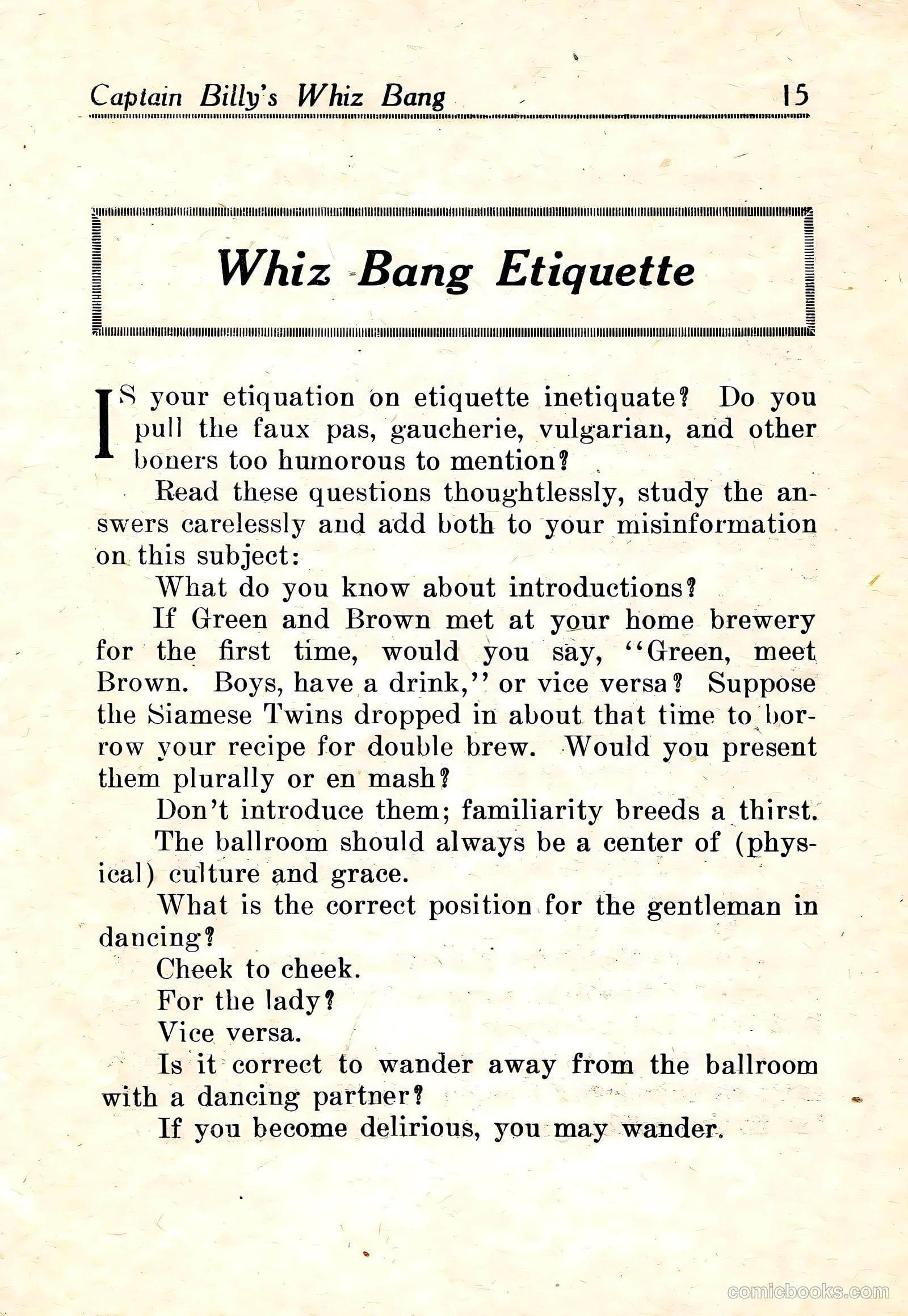
This is a humorous etiquette advice column from *Captain Billy's Whiz Bang*, a satirical magazine. The joke is that the column deliberately gives absurd, contradictory answers to sincere etiquette questions—instructing readers to "read these questions thoughtlessly, study the answers carelessly." The satire mocks both rigid social conventions and people anxious about proper behavior. Examples include: suggesting you introduce people with "Boys, have a drink" (casual rudeness); presenting the "Siamese Twins" "en mash" (a crude pun treating them as a single entity); and advising that wandering from a ballroom with a partner is acceptable "if you become delirious." The column appears aimed at working-class or immigrant readers uncertain about American social rules, gently ridiculing both their concerns and the pretentiousness of etiquette itself. The tone is lighthearted rather than mean-spirited—poking fun at formality while hinting that rigid propriety is unnecessary.
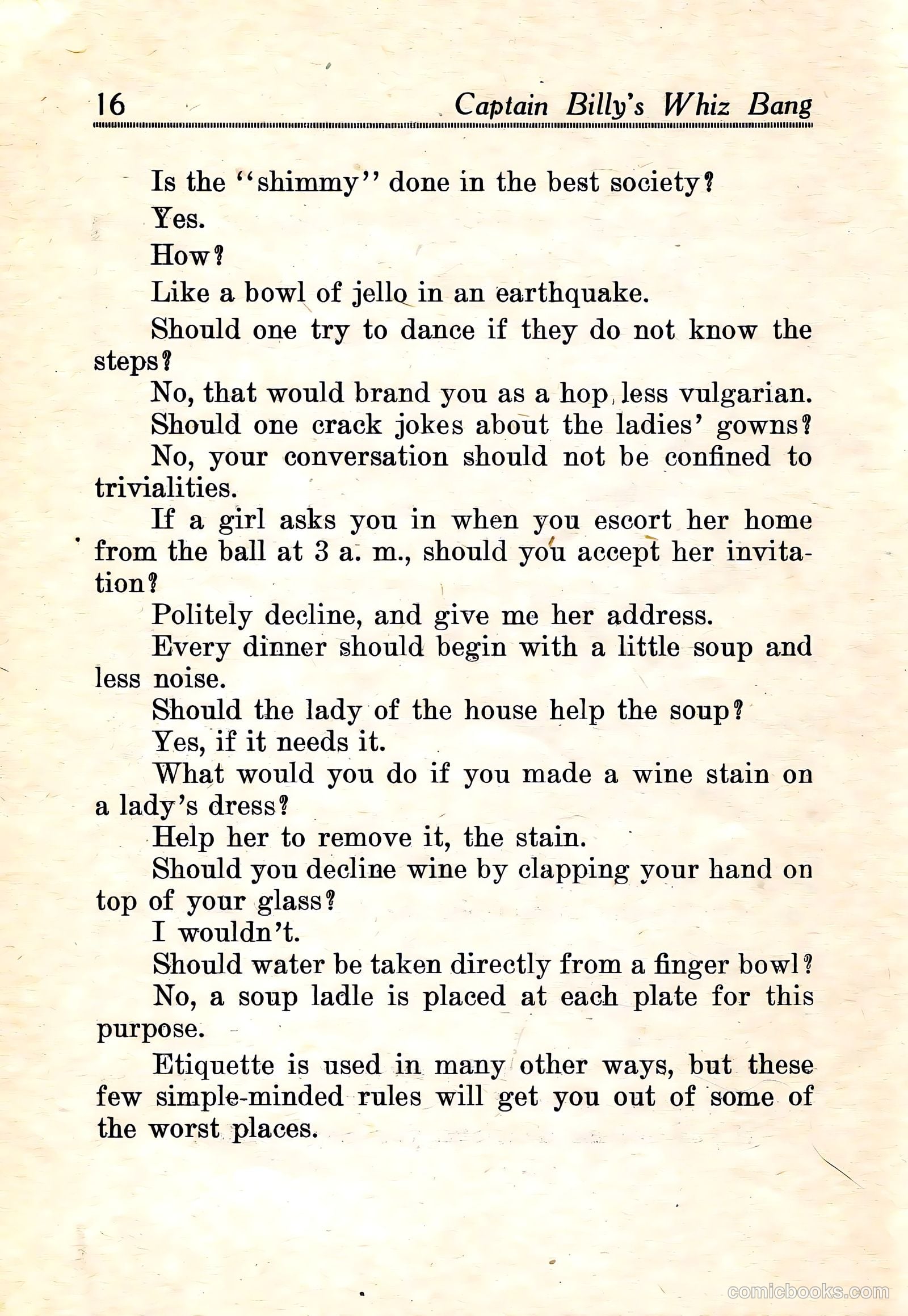
This appears to be a humorous advice column mocking both high-society etiquette and the "Jazz Age" social trends of the 1920s. The "shimmy" was a provocative dance that scandalized traditional society, and the joke compares proper execution to "a bowl of jello in an earthquake"—suggesting refined restraint even while doing something considered vulgar. The satire targets uptight social conventions (don't crack jokes about dresses, keep quiet at dinner) while simultaneously mocking nouveau riche or working-class readers attempting to navigate elite social situations. The final advice—"politely decline" a girl's invitation but "give me her address"—is deliberately crude male humor. The finger bowl and soup ladle questions poke fun at confusing formal dining rules. Overall, the column satirizes both stuffy upper-class propriety and the humorous awkwardness of ordinary people trying to fit in.
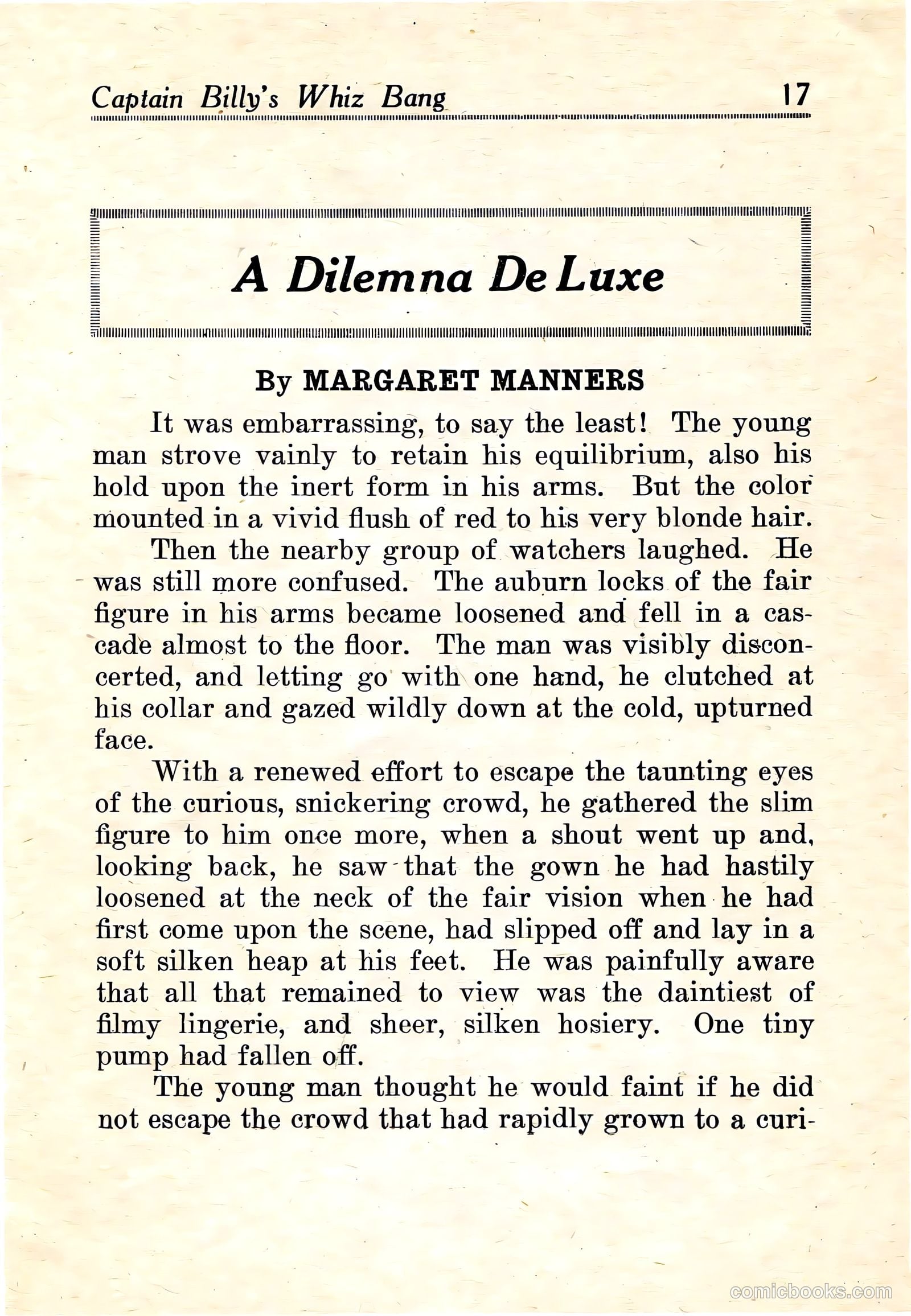
This is a short comedic story (not a cartoon) from *Captain Billy's Whiz Bang*, a humor magazine known for risqué content. The piece depicts a young man in an embarrassing public situation: he's holding an unconscious or limp woman whose clothing progressively falls away, leaving her in lingerie as an amused crowd gathers and watches. The "dilemma" is the protagonist's mortification—he's blushing deeply, flustered, clutching his collar—while being observed by snickering onlookers. The humor relies on the tension between his obvious distress and the sexually suggestive scenario: a partially undressed woman in his arms in public. This reflects 1920s-era "spicy" magazine humor, where sexual situations presented as accidental or comedic (rather than explicit) provided titillation within acceptable publishing bounds. The satire targets male embarrassment and social propriety rather than any specific political or social issue.
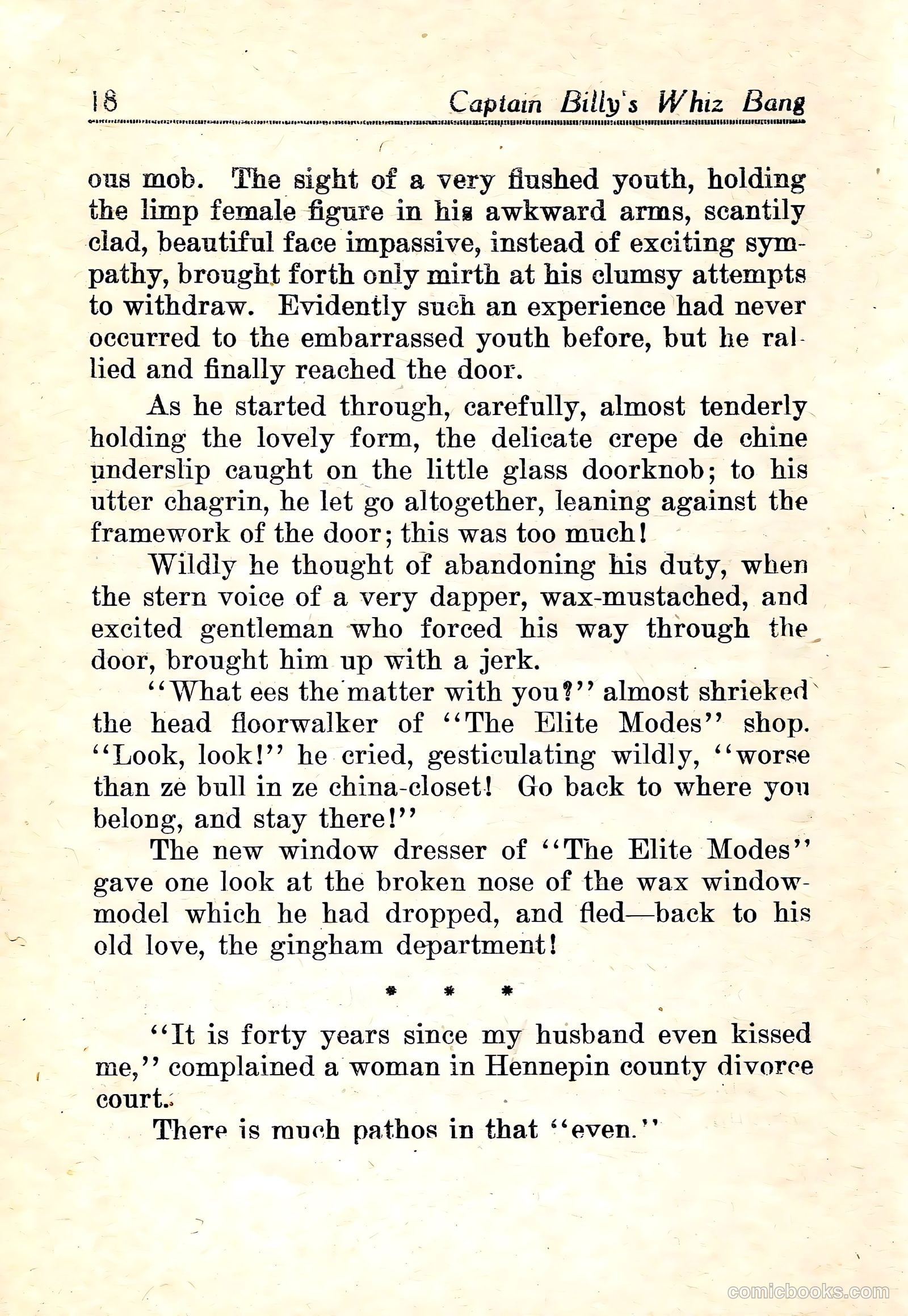
This page contains two brief humorous pieces typical of 1920s American comic magazines. **First Story:** A slapstick comedy about a clumsy young window dresser at "The Elite Modes" shop who accidentally damages a wax mannequin while awkwardly carrying it. A dapper, foreign-accented floorwalker (suggested by "ees," "ze") scolds him with exasperation, comparing the mishap to "a bull in a china-closet"—a common period idiom for destructive clumsiness. The young man flees back to his original department, embarrassed. **Second Item:** A single-sentence joke from a Hennepin County (Minnesota) divorce court where a woman complains her husband hasn't kissed her in forty years. The editorial comment notes the pathos in the word "even"—suggesting such neglect represents emotional abandonment in marriage. Both pieces use everyday situations to mine humor from social awkwardness and marital disappointment, reflecting working-class and middle-class concerns of the era.
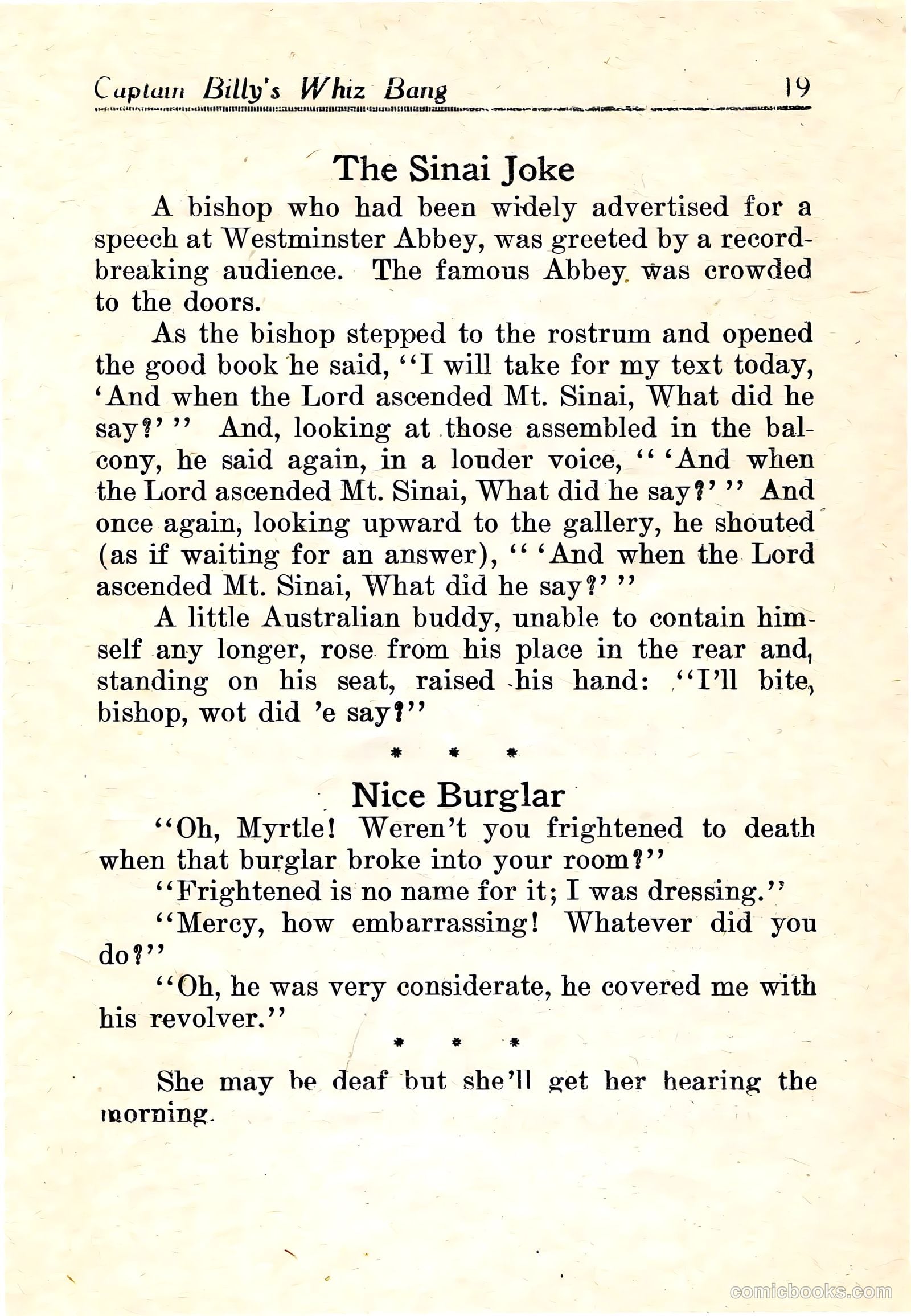
This page contains three separate jokes rather than political cartoons. "The Sinai Joke" mocks a pompous bishop giving a tedious speech at Westminster Abbey. He repeatedly poses a nonsensical theological question—the Lord never ascended Mount Sinai—waiting for audience response. An impatient Australian audience member finally breaks the tension by demanding the bishop answer his own pointless question, deflating the pretension. "Nice Burglar" plays on a double entendre: a woman caught undressing by a burglar is embarrassed about her state of undress rather than the robbery itself. The burglar's "considerateness" in covering her with his revolver creates darkly comedic irony. The final one-liner relies on crude wordplay about deafness and "getting her hearing" (apparently sexual innuendo). These exemplify *Whiz Bang's* lowbrow, irreverent humor targeting religious figures and social conventions.
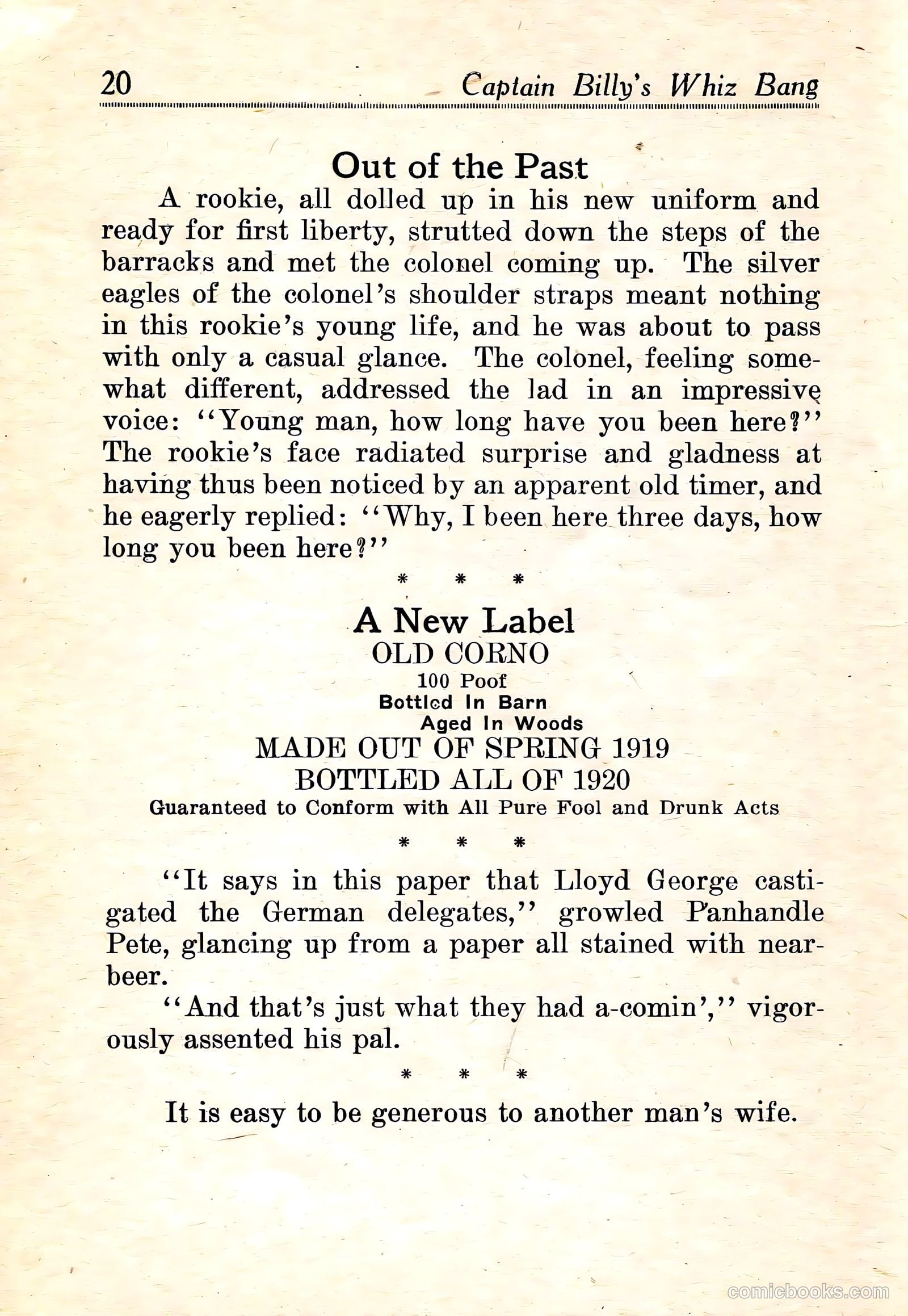
This page contains three short humorous pieces from *Captain Billy's Whiz Bang*, a post-WWI satirical magazine: 1. **"Out of the Past"**: A joke about military hierarchy. A new recruit, unaware of the colonel's rank, casually asks how long *he's* been stationed there—a comedic reversal of expected deference. 2. **"A New Label"**: Satire on Prohibition-era bootlegging. The fake label mocks illegally-made whiskey ("Old Corno," made in a barn in 1919, bottled in 1920), sarcastically claiming it conforms to "Pure Fool and Drunk Acts"—playing on actual alcohol regulation laws. 3. **Lloyd George reference**: Characters comment on the British Prime Minister "castigating" German delegates (likely post-WWI treaty negotiations), claiming Germans deserved it. 4. **Final aphorism**: A cynical observation about hypocrisy regarding other men's wives. The humor targets military absurdity, Prohibition defiance, and post-war politics—typical of this magazine's irreverent 1920s tone.
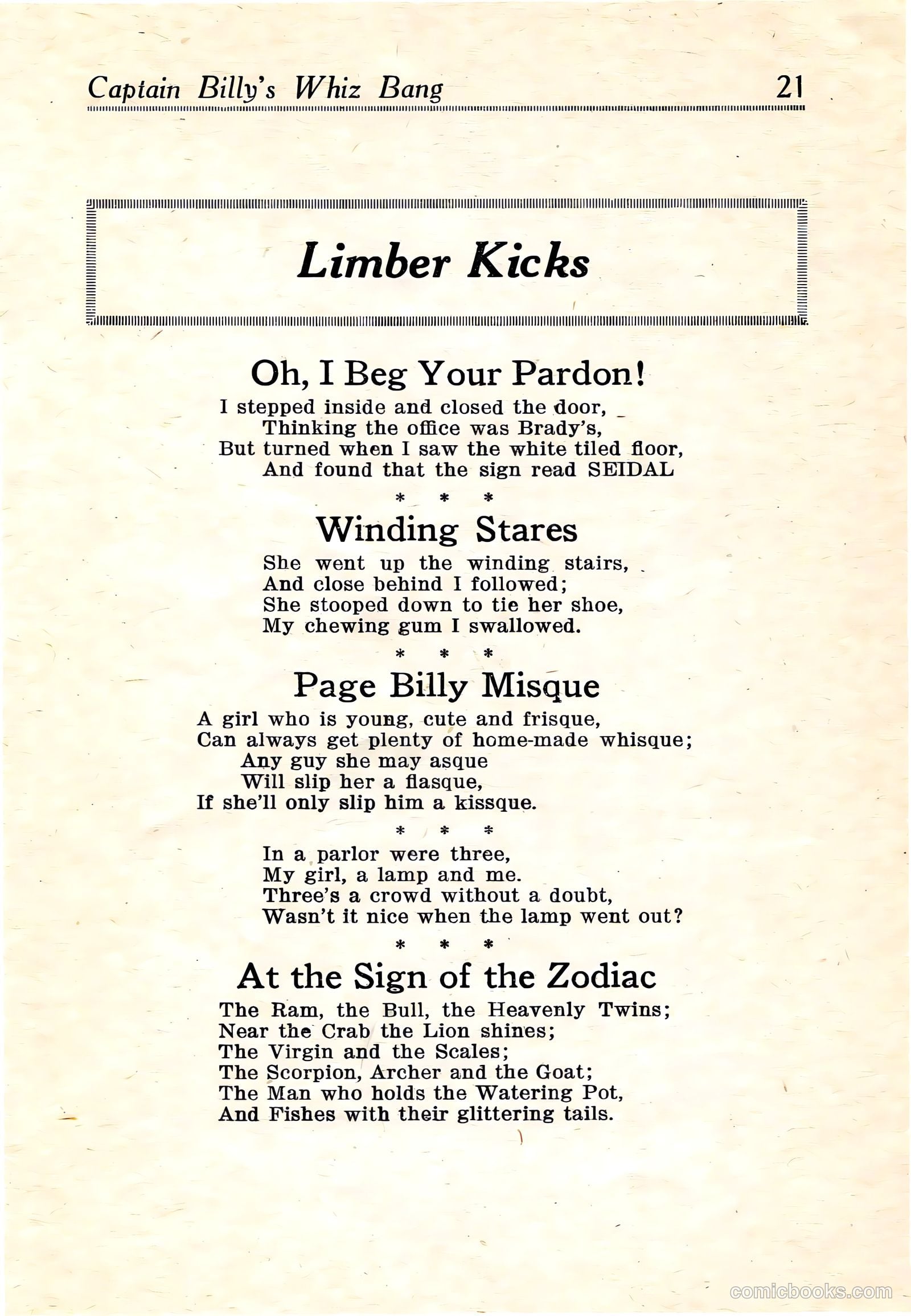
This page from *Captain Billy's Whiz Bang* (a 1920s-era humor magazine) contains brief comedic verses using puns and wordplay—typical of the publication's style. The jokes rely on mishaps and double meanings: mistaking one office for another, swallowing gum during a romantic moment, and suggestive humor about a young woman trading kisses for alcohol (referencing Prohibition-era bootlegging). "Page Billy Misque" plays with forced rhymes ("frisque," "whisque," "asque"). The final piece, "At the Sign of the Zodiac," simply lists zodiac constellations in poetic form—likely filler content rather than satire. These aren't political cartoons but rather light, often risqué humor aimed at adult male readers. The repeated alcohol references and suggestive innuendo about women reflect the magazine's bawdy, irreverent tone during the Jazz Age.
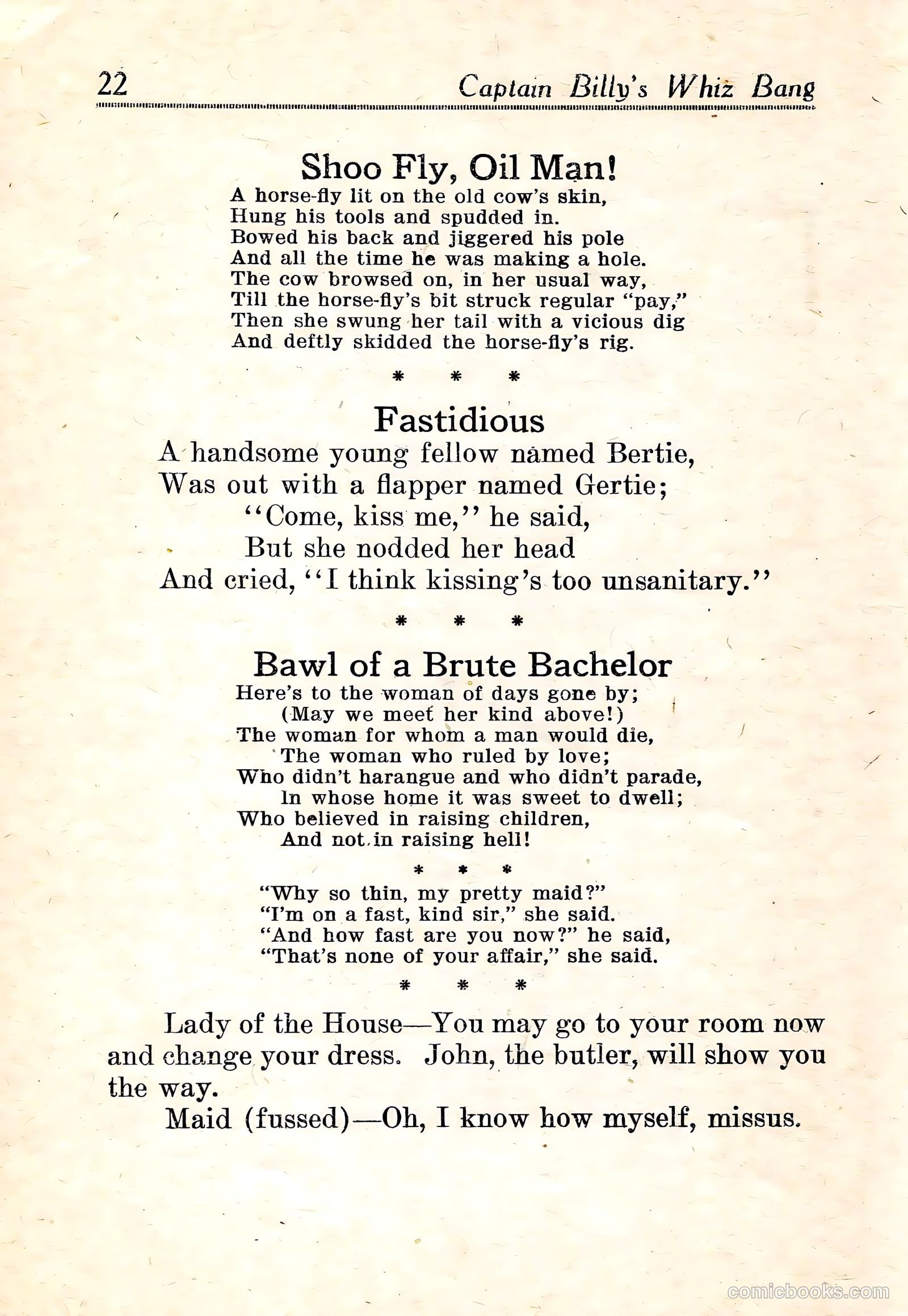
This page contains four humorous verses from an early 20th-century satirical magazine, each mocking contemporary social trends: 1. **"Shoo Fly, Oil Man!"** - An extended metaphor comparing an oil derrick ("horse-fly") drilling into land to an insect boring into a cow's hide. The joke satirizes the oil industry's invasive extraction practices. 2. **"Fastidious"** - Mocks 1920s flappers' affectation of hygiene concerns as an excuse to refuse advances. The woman's claim that kissing is "unsanitary" suggests she's using pseudo-scientific pretense to appear modern while rejecting traditional romance. 3. **"Bawl of a Brute Bachelor"** - Nostalgic criticism of modern women (likely flappers again), contrasting them unfavorably with idealized Victorian wives who were domestic, obedient, and child-focused rather than independent. 4. **Final dialogue** - The maid's sassy response to the lady of the house reveals working-class confidence and familiarity—a subtle jab at changing class dynamics and servant insubordination. The overall tone expresses conservative anxiety about rapid social change, particularly regarding women's independence and behavior.
This is a moralistic satire by a Minneapolis pastor condemning the behavior of beachgoers on California's coast. The author uses the term "beach nuts" to mock young people—particularly young women and men—who cavort scantily dressed at bathing resorts on Sundays. The satire targets the perceived abandonment of religious propriety: instead of observing the Sabbath, beachgoers engage in flirtation and physical intimacy. The author sarcastically invokes religious imagery ("the cross gives way to Cupid's bow," "the Bible is the book of nature") to criticize what he sees as moral decay. The piece reflects 1920s anxieties about changing sexual mores, women's increasing public freedom, and the perceived threat to traditional Christian values. "Beach nuts" refers both to the casual, unrestrainedly behaving young people and implicitly suggests they lack sense or judgment. The closing "devil's undertow" metaphor warns of moral danger lurking beneath California's permissive beach culture.
This is a satirical commentary on 1920s beach culture and modern youth morality. The author mocks young couples engaged in public displays of affection—described through wordplay like "Sea"estas (siestas) and "surge" suits (bathing suits). The satire targets: - **Loose morality**: References to "flesh-pots" and excessive physical contact, suggesting young people behave immorally at beaches - **Shallow femininity**: Girls with "pearly teeth, but no pearls of wisdom" who can paint faces but not create art, play with boys but not piano—criticism of superficiality - **Laziness and idleness**: The final biblical parody compares beach loungers to lilies that "toil not"—they don't work or swim, just pose The reference to "Timon of Athens" (a misanthrope) suggests the author shares that character's disgust with humanity. This reflects conservative anxieties about Jazz Age social changes, particularly women's liberated behavior and rejection of Victorian propriety.
This is a satirical piece from *Captain Billy's Whiz Bang*, a humor magazine popular in the 1920s-30s. The text mocks beach-goers with exaggerated, unflattering descriptions: "pop-eyed, pot-bellied promenaders," "vulgar Venuses," and "heavy-hipped hags." The satire targets the gap between idealized images of beach leisure and reality. The author contrasts how beachgoers look "nice and dry" versus when wet, and compares them unfavorably to glamorous "Sunday supplement" illustrations while comparing them favorably to crude "comic supplement" caricatures—the joke being that actual beachgoers resemble exaggerated cartoon drawings more than idealized media images. The classical reference to Ulysses and sirens adds mock-heroic humor: these "sweating sirens" aren't seductive—they're repulsive. The overall point: beach culture exposes the unglamorous reality beneath modern leisure aspirations.
This page from the satirical magazine contains several short jokes and comedic quips typical of early 20th-century American humor. The content includes: **Beach/Literature commentary**: A dismissive critique of seaside destinations, recommending Romantic and classical writers (Shelley, Burns, Sand, Crabbe, Bacon) as superior alternatives—satirizing both beach culture and intellectual pretension. **Nursery rhyme parody**: A risqué adaptation of "Dickory Dickory Dock" with sexual innuendo about a mouse in a woman's stocking, playing on double meanings. **Marriage satire**: Commentary mocking marriage certificates as worthless papers and divorce as cyclical—reflecting cynicism about matrimonial commitment common in 1920s humor. **Bathroom humor**: "Loo swimmin'" appears to be a pun on British toilet slang. **Office humor**: The final exchange jokes about a stenographer's appearance mattering more than competence—reflecting period sexism and workplace dynamics. No specific political figures or events are caricatured. This represents general social satire and mild ribaldry typical of *Whiz Bang*.
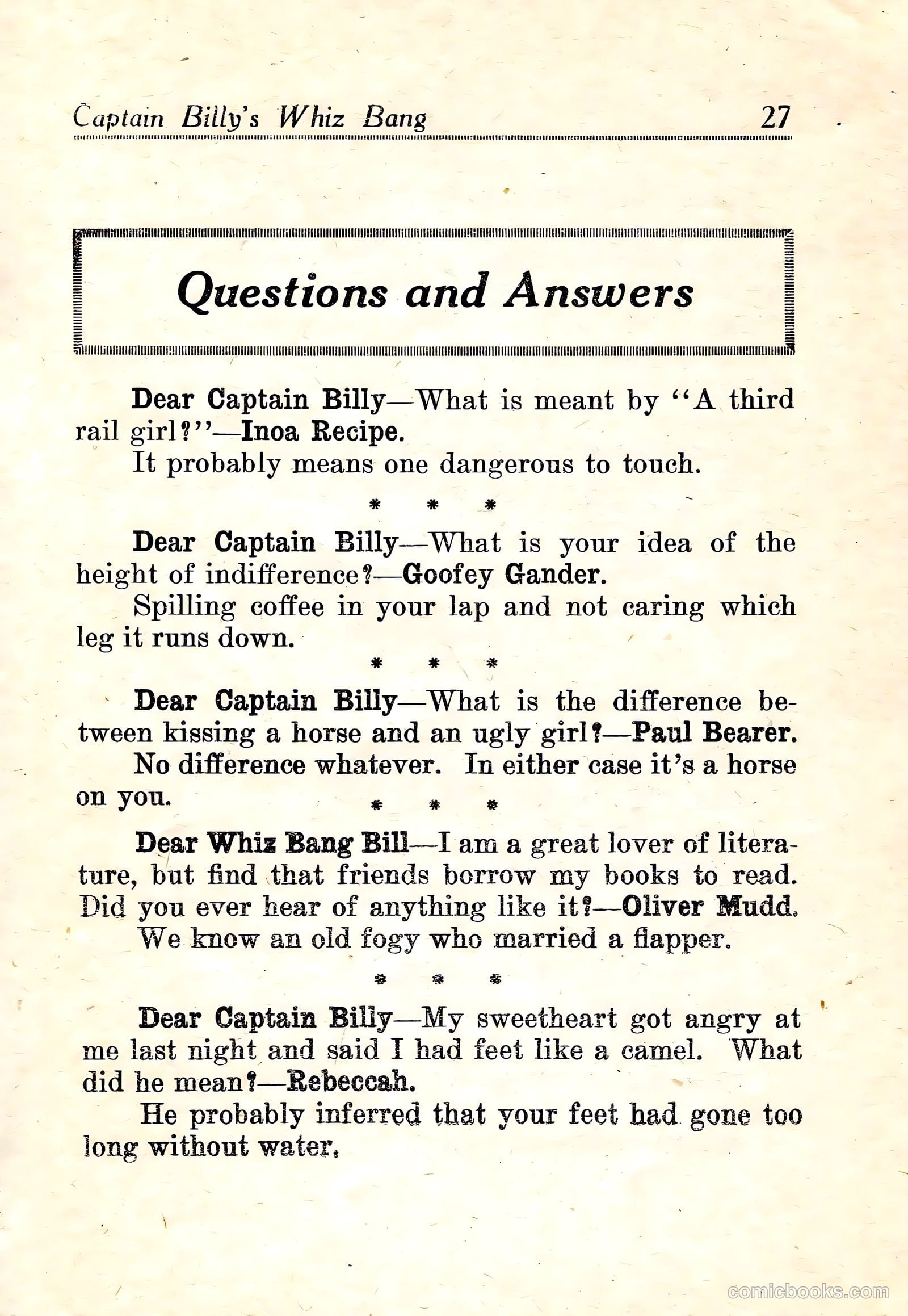
This is a humor advice column from *Whiz Bang*, a 1920s American satirical magazine. The page contains five Q&A jokes playing on wordplay and contemporary slang: 1. **"Third rail girl"** — a sexually dangerous woman (the third rail being electrified/deadly) 2. **"Height of indifference"** — dark humor about being emotionally numb to discomfort 3. **Kissing comparison** — crude joke implying both situations are unpleasant 4. **Book-borrowing problem** — solved by a joke about generational conflict (old man marrying a "flapper," the modern young woman) 5. **Camel feet insult** — plays on camels' desert adaptation, implying the woman's feet are dry/neglected The humor relies on period slang ("flapper"), insulting gender stereotypes, and puns. The advice column format itself parodies advice columns while offering deliberately unhelpful, joke-based responses. This reflects 1920s popular humor's reliance on insults and wordplay rather than situational comedy.
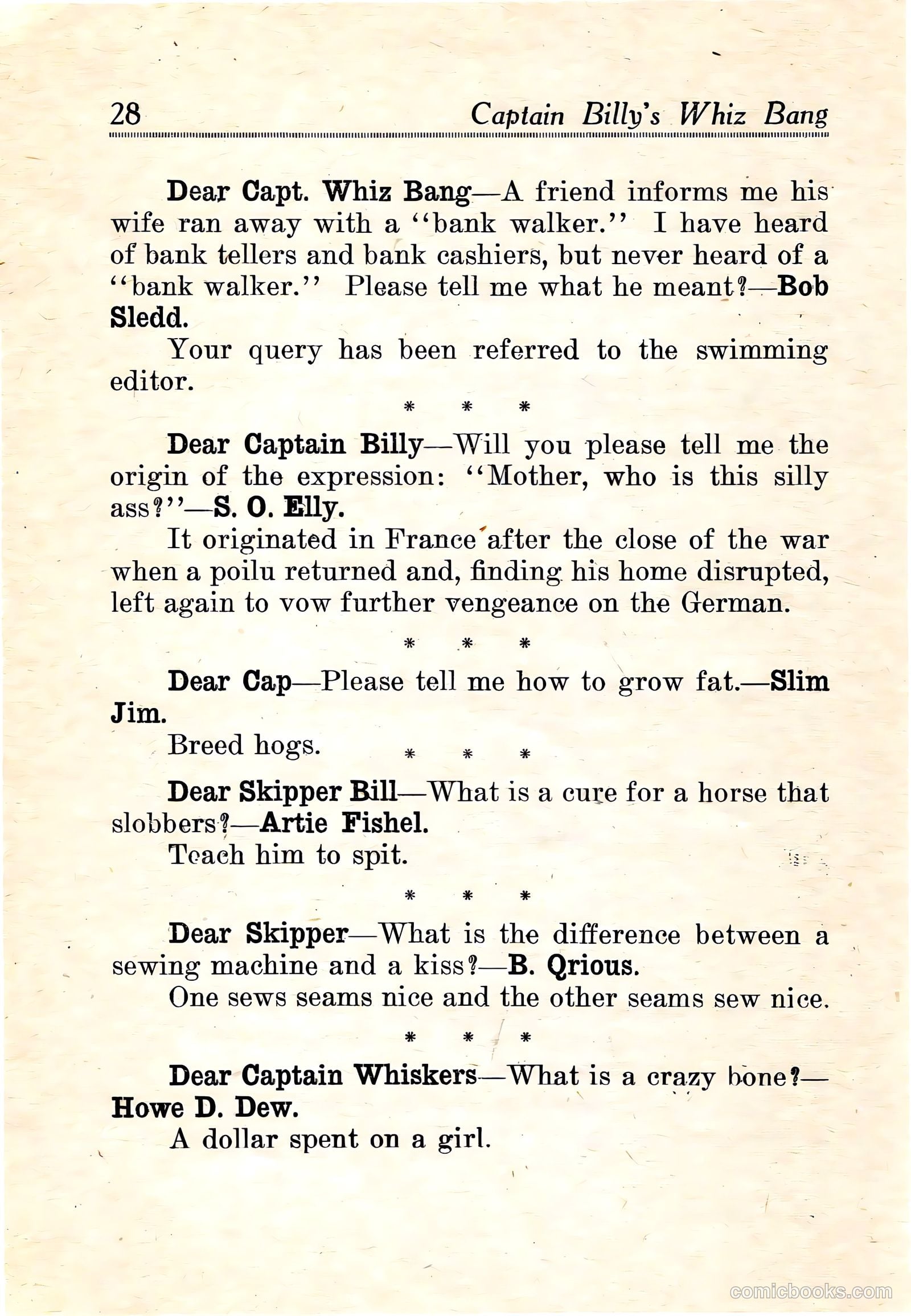
This is a humor advice column styled as "Dear Captain" letters, typical of *Whiz Bang*, a post-WWI satirical magazine known for ribald jokes and wordplay. The jokes rely on puns and double meanings: - **"Bank walker"**: The reply redirects to "swimming editor," implying the wife "swam away"—a euphemism for infidelity. - **"Silly ass"** origins: References a French soldier (poilu) post-WWI, playing on assumed French vulgarity. - **Growing fat**: "Breed hogs"—absurdist non-answer humor. - **Horse slobbering cure**: "Teach him to spit"—similarly illogical. - **Sewing machine vs. kiss**: Pun on "seams/seems"—risqué innuendo. - **"Crazy bone"**: Implies reckless spending on romance. The column targets young male readers with juvenile wordplay and cynical observations about courtship and money. It's characteristic of 1920s American humor magazines that thrived on double entendre and anti-establishment tone.
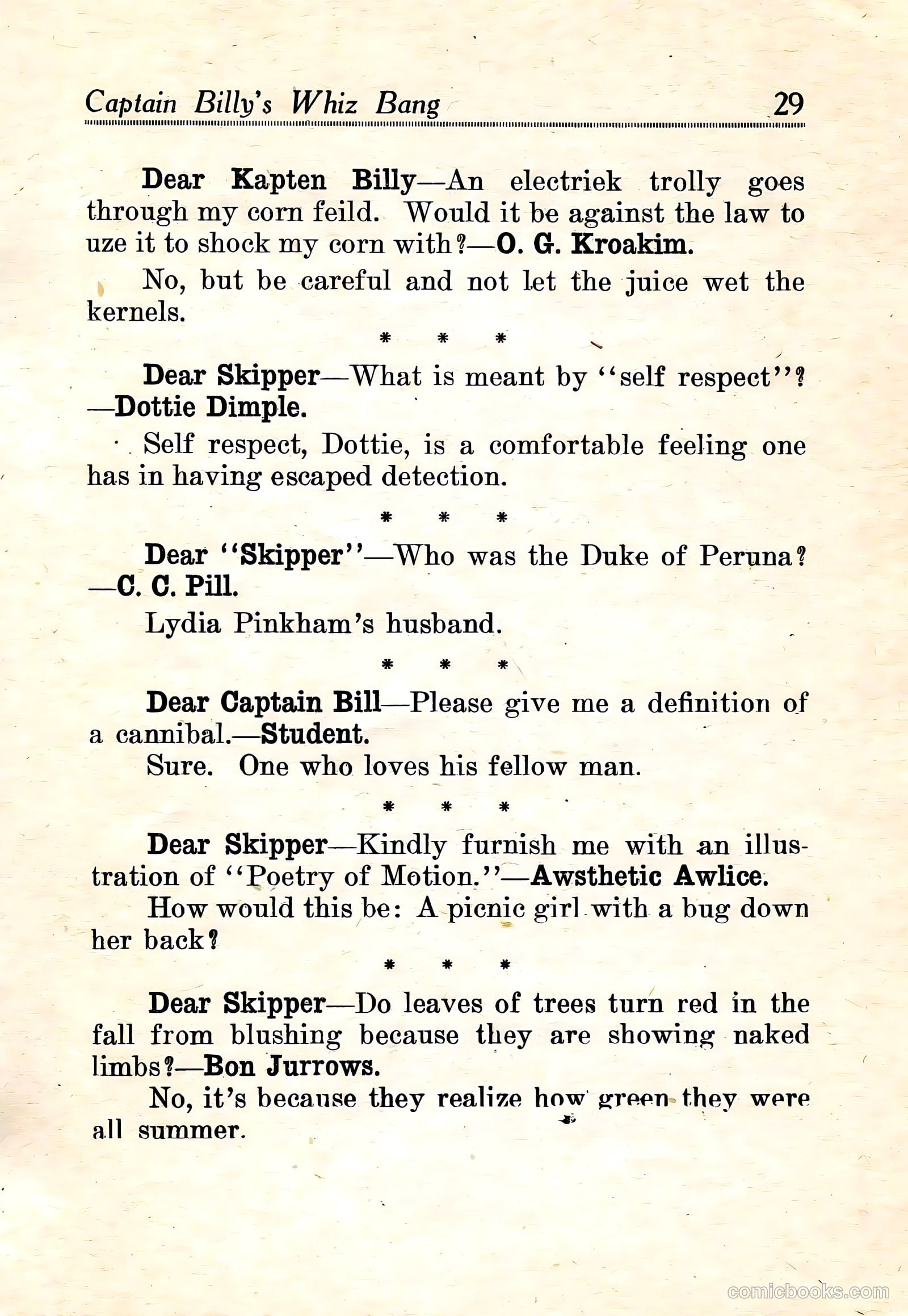
This is a humor advice column featuring absurdist jokes disguised as reader letters. The comedy relies on non-sequiturs and unexpected punchlines rather than political commentary. Key jokes include: a pun about electrocuting corn; a cynical definition of "self respect" as avoiding getting caught doing wrong; a reference to patent medicines (Duke of Peruna and Lydia Pinkham were real 1910s-20s remedies, humorously paired as a "married couple"); a dark joke equating cannibals with ordinary people; and visual humor about a girl's panicked movement from a bug being "poetry of motion." The final joke uses personification—leaves "realize" their greenness and blush with embarrassment. These are typical of *Whiz Bang*'s style: lowbrow, pun-heavy, and occasionally risqué by period standards, targeting working-class readers with accessible, irreverent humor.
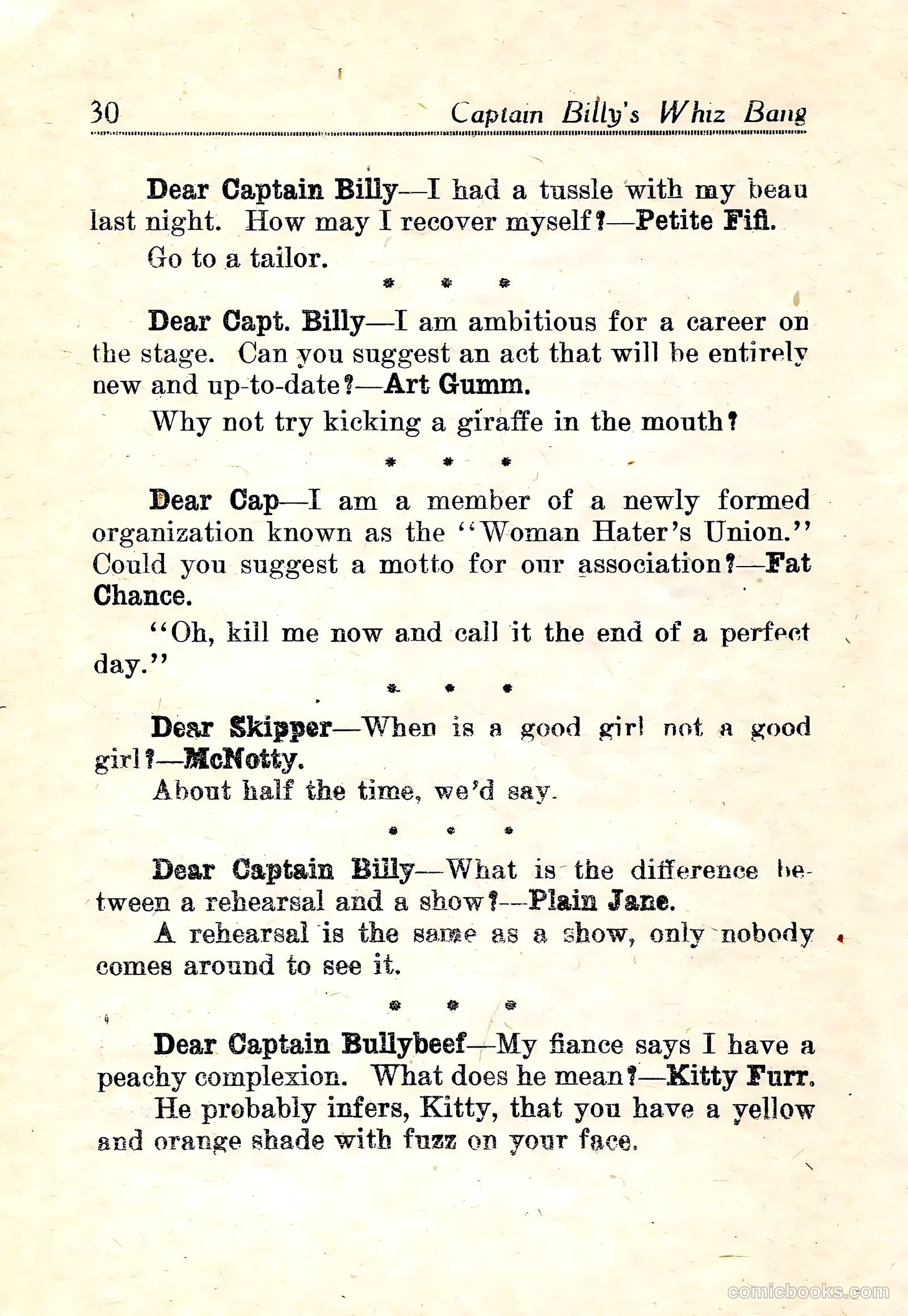
This is a satirical advice column from *Captain Billy's Whiz Bang*, a popular early 20th-century American humor magazine. Rather than genuine advice, "Captain Billy" offers deliberately absurd, insulting, or cynical responses to readers' questions. The jokes target common romantic and social anxieties of the era: relationship conflicts, theatrical ambitions, gender dynamics (the "Woman Hater's Union"), female morality ("good girls"), and appearance standards. The humor relies on unexpected cruelty—suggesting someone recover from a fight by visiting a tailor (implying physical damage), recommending kicking a giraffe as an act, or insulting a woman's "peachy complexion" as actually being yellow and fuzzy. This reflects the satirical tone of 1920s-era humor magazines, which often used cynicism and mockery as comedy, particularly regarding romance, vanity, and social pretension. The column's appeal lay in its irreverent dismissal of earnest concerns.
This page from *Captain Billy's Whiz Bang*—a bawdy American humor magazine—contains three separate jokes typical of the publication's irreverent style. The first two items are brief, risqué quips: one plays on police inspecting a woman (likely a sex worker), the other jokes about a convalescent whose thirst for alcohol outpaces his recovery. The main story, "Another Jellyfish," satirizes Victorian-era schoolmaster prudishness. A boy is severely flogged for answering that a woman is "the most beautiful thing in the world"—apparently deemed immoral or impertinent. The punchline subverts authority: when the boy reports the flogging to his father, they both conclude the *master* is the abnormal one for punishing such a natural answer. The joke mocks excessive, repressive morality disguised as education, suggesting the schoolmaster's reaction reveals suspicious prudery rather than proper virtue.
This is an editorial (not a cartoon) from *Captain Billy's Whiz Bang*, a satirical magazine. It discusses Charlie Chaplin's efforts to bring his mother from England into the United States despite her mental health issues. The piece notes that without Chaplin's influence with politically connected friends, she would have been denied entry. The editorial's point is sympathetic: it argues that Chaplin's famous on-screen melancholy stems from genuine concern for his mother, not mere artistic affectation. The writer uses this to reflect on how tragedy—particularly mental decline of loved ones—affects even those who professionally entertain millions. The comparison to "the circus clown" suggests that comedians' ability to make others laugh contrasts sharply with their private suffering. The tagline "The Bull is Mightier Than the Bullet" remains unclear from this excerpt alone.
This page contains two distinct pieces of commentary: **First section:** A sentimental reflection on Charlie Chaplin's life trajectory—from poverty (living in a London workhouse as a boy) to wealth and success as a comedian. The writer treats this as proof that "life's a funny proposition," emphasizing the ironic contrast between his humble origins and current luxury. **Second section:** A discourse on changing American attitudes toward artistic nudity. The author argues that depictions of the female nude have become culturally acceptable among "cultivated people," while male nudity in art remains controversial even among non-extremists. The piece suggests female nudity titillates without offending, whereas repeated male nudity merely "sates curiosity." The page reflects early 20th-century attitudes about gender, art, and propriety—notably the gendered double standard regarding depictions of the body in fine art.
This page from the satirical magazine contains three separate pieces with no visible cartoons. The opening passage uses innuendo about landscape features (hills, valleys, plains) as a euphemistic defense of depicting female figures in art—a common debate in early 20th-century art criticism about what was considered "provocative." "Be a Booster" is an inspirational poem about self-improvement and ambition, encouraging readers to excel at whatever station they occupy—a motivational piece rather than satire. The final section is a satirical "prayer" that mocks conventional morality by contrasting noble-sounding platitudes (earning honestly, treating others fairly) with cynical asides (needing guns for protection, "unholy skirts"). It's likely social commentary on hypocritical respectability or commentary on contemporary corruption and moral compromise.
This page from the satirical magazine contains several brief humorous pieces rather than a single cartoon. The content includes: **Serious reflections**: A lengthy passage about living a virtuous life, culminating in a simple epitaph "Here Lies a Man"—suggesting that a good life requires no elaborate justification. **Three wisdom proverbs**: A hierarchy distinguishing between teachable ignorance, dangerous false confidence, and true wisdom. This is classic self-help satire. **Sexual humor**: A joke about men's inability to resist looking at women in short skirts—referencing 1920s fashion anxieties about women's hemlines rising. **Alcoholic humor**: A final crude joke about a drunk ("soak") hoping to be returned to a bottle after death, suggesting men prefer drinking to life itself. The overall tone mixes earnest moralizing with lowbrow jokes about masculine weakness—typical of *Whiz Bang*, which targeted working-class male readers with bawdy, irreverent humor.
This page contains three brief humorous pieces typical of 1920s American satirical magazines: **"London Stuff"** is a marital joke: A married man phones his wife suggesting they meet secretly to "smear a little red paint around" (a euphemism for illicit activity). She agrees but innocently asks why he doesn't just come home since "nobody's home"—implying the house is empty and available. The joke's twist: realizing she'd been alone all along, he's now too embarrassed to go out, spending evenings at home instead. **"Oh! Gawsch!"** mocks a local newspaper's innocent reporting of a "stripping bee" (a quilting/sewing social event) at someone's home, with the exclamation treating it as scandalous gossip. **"The High Cost of Company"** presents a hotel sign charging extra for overnight guests, satirizing post-WWI inflation and hospitality costs. The final aphorism is unrelated. These pieces reflect working-class humor and social commentary typical of Whiz Bang's audience.
This page contains three brief satirical anecdotes typical of the magazine's humor. **"Then His Nerve Failed"** depicts a young woman asking a male clerk to tie a necktie around her neck in a shop. The humor hinges on the clerk's nervousness and ultimate failure of courage when the innocent request—her asking if she tucks the tie ends in—takes on suggestive undertones in his mind, given her proximity and the watching male employees. **"She Knew the Truth"** is a courtroom anecdote featuring a Black witness named Mandy Thomas (rendered in dialect) who testifies that two men were "calling each other what they is"—a euphemistic way of saying they were hurling insults or slurs at one another, though she won't specify which ones. The page concludes with three unrelated one-liners offering social commentary: one about women's changing security practices, another punning on "rash marriage" as superficial. The satire targets male anxiety around women, courtroom absurdities, and social change.
This page from *Captain Billy's Whiz Bang* (a 1920s men's humor magazine) presents bawdy poems marketed as "Smokehouse Poetry"—crude, risqué verses for male readership, typically shared in informal settings like barrooms. The poems satirize exotic colonial fantasies. "The Far East" excerpt mocks American soldiers' experiences in the Philippines (likely from the Philippine-American War era), depicting stereotypical interactions with Filipino women. The phrase "goo-goo" was a period slur for Filipinos; "malo soldier" and "jaw-bone" suggest broken English and unpaid debts to local women. The first poem excerpt similarly romanticizes tropical violence in colonial settings (chicle and logwood were trade commodities from Central America). The tone is juvenile, irreverent humor aimed at working-class male audiences—typical of this magazine's appeal. The "Hoboes' Convention" piece below continues this vein of satirizing marginalized social groups for comic effect.
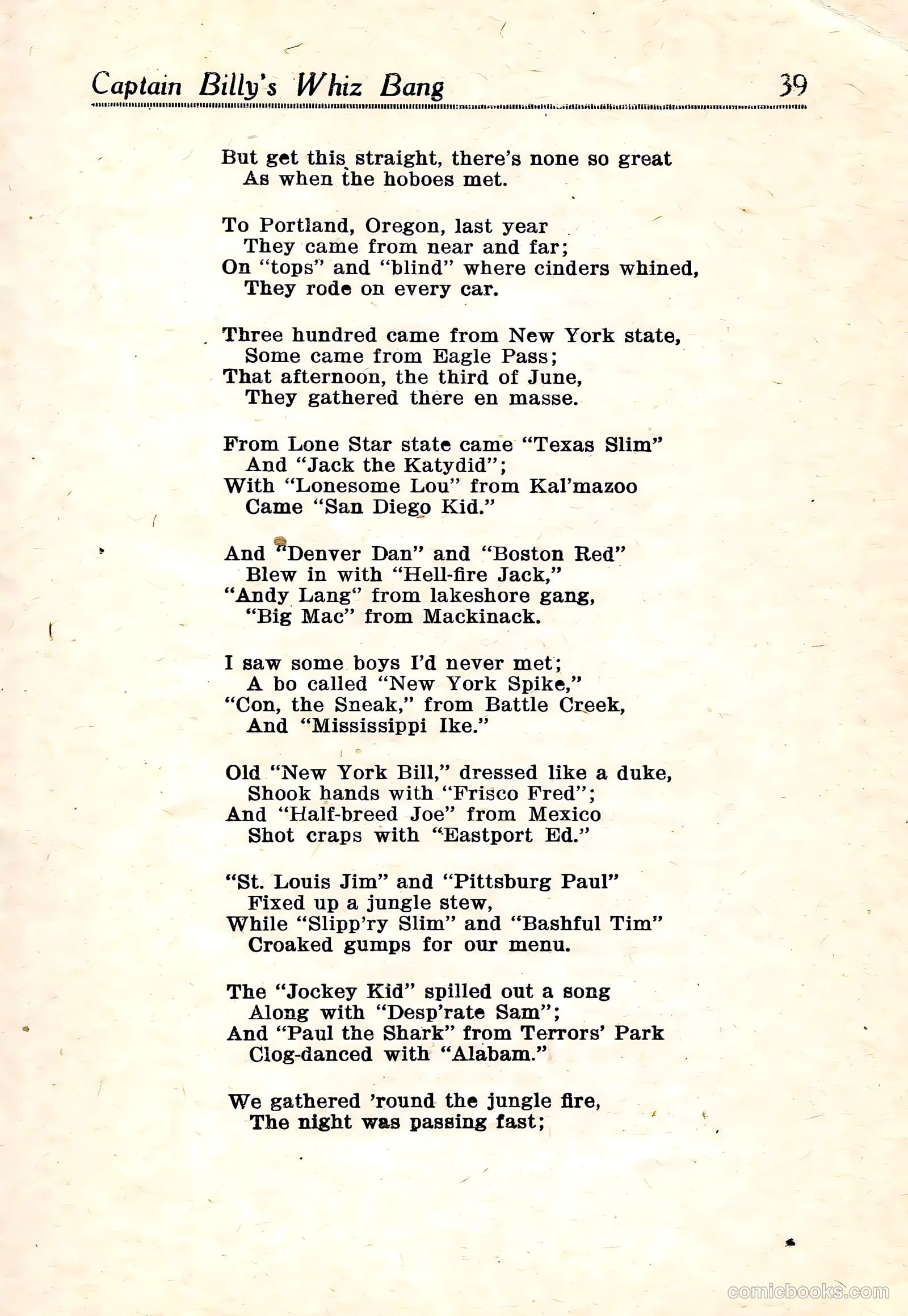
This page is a humorous poem celebrating a hobo gathering in Portland, Oregon. It's not political satire but rather a comedic tribute to transient workers and vagrants—a significant American subculture during the era of freight-train travel. The poem catalogues colorful hobo nicknames (drawn from geographic origins like "Texas Slim," "Boston Red," "Frisco Fred") that reflect the speaker's admiration for hoboes' mobility and independence. Terms like riding "tops" and "blind" (atop and between freight cars) establish authentic hobo vernacular. The humor derives from the contrast between these rough wanderers' dignity ("Old New York Bill, dressed like a duke") and their humble circumstances (sharing jungle stew cooked over a campfire). The poem celebrates camaraderie among society's outcasts rather than mocking them—reflecting Progressive-era sympathy for working-class transience during economically unstable times. This appears to be lighter entertainment content rather than political commentary.
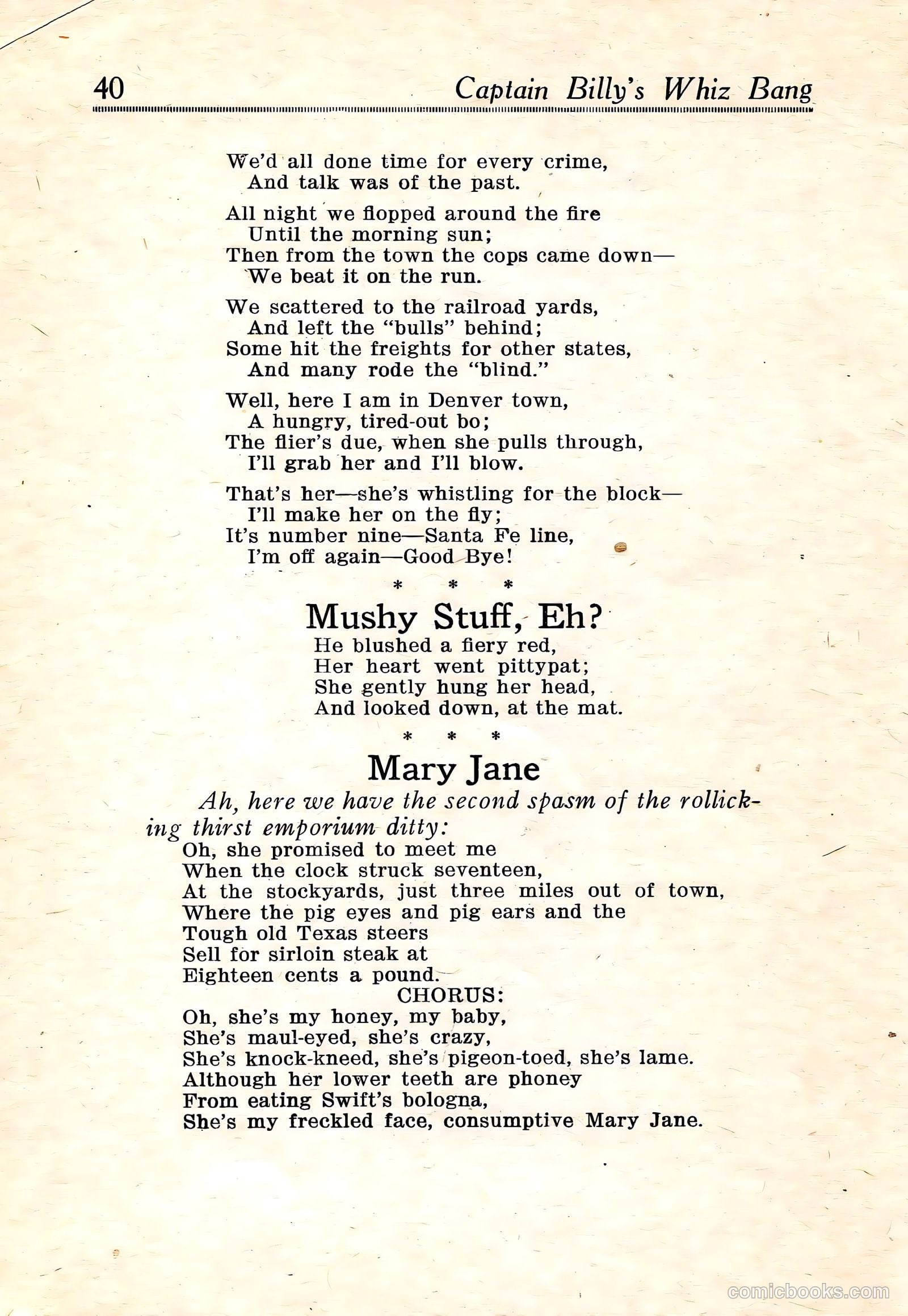
This page contains three humorous poems rather than political cartoons. The first poem depicts a hobo's life—committing crimes, fleeing police, hopping freight trains, and moving between states. The second, "Mushy Stuff, Eh?", appears to be a short romantic vignette showing a blushing couple. The third, "Mary Jane," is a longer comedic song mocking a woman at stockyards, listing her unflattering physical traits ("maul-eyed," "knock-kneed," "pigeon-toed") while claiming to love her. These are bawdy, satirical pieces typical of *Whiz Bang*, a men's humor magazine that mocked romance, working-class life, and social pretense through ribald comedy rather than political commentary. The humor relies on exaggeration and crude characterization.
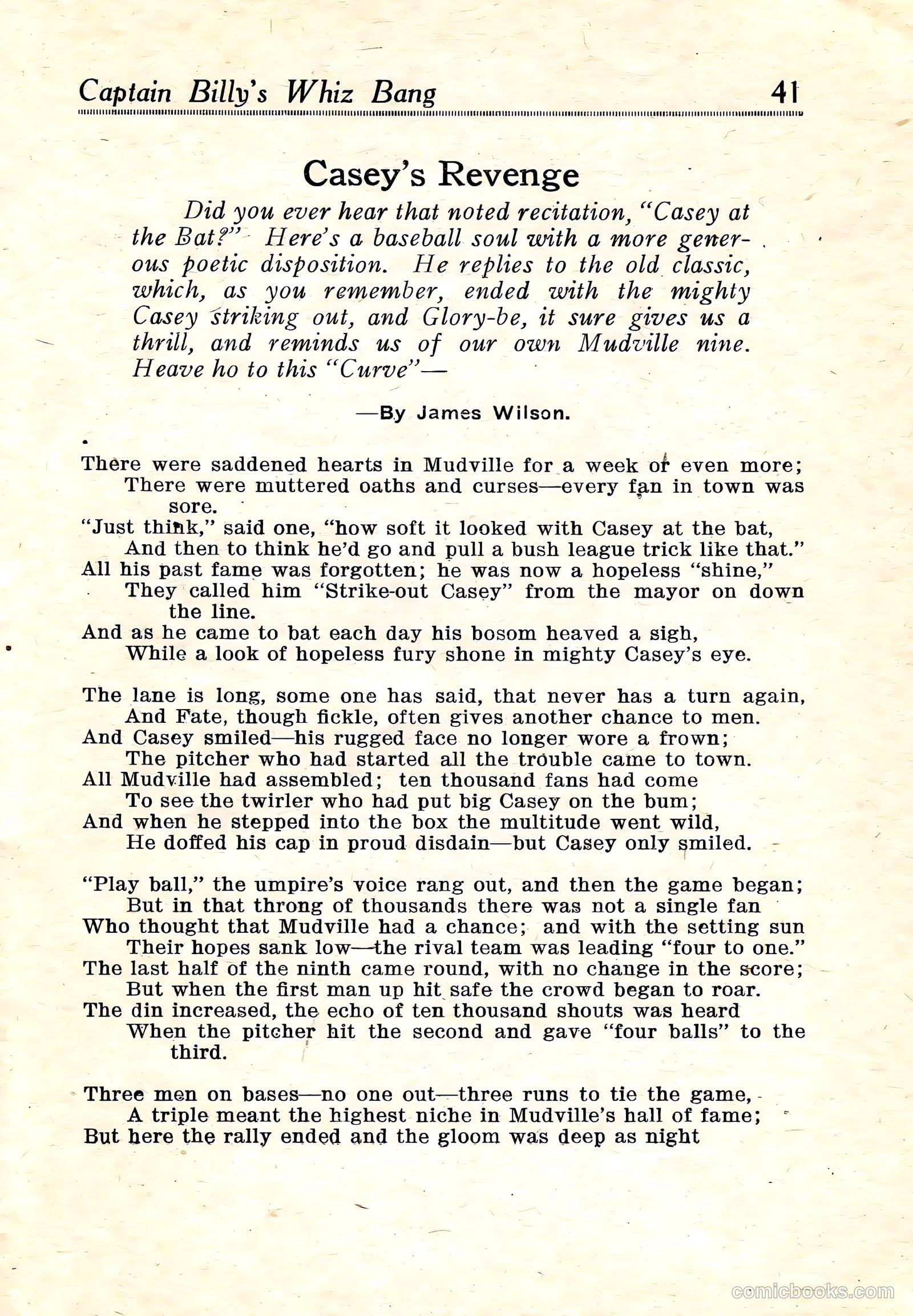
This is a poetic sequel to the famous 1888 poem "Casey at the Bat," which ended with Casey striking out and losing the game. This follow-up story, by James Wilson, imagines Casey's redemption. After his famous failure, Casey becomes a social outcast in his hometown of Mudville—called "Strike-out Casey" and mocked as a "hopeless 'shine'" (period slang for a disgraced person). When the opposing pitcher who defeated him returns to town, Casey gets another chance. In the climactic ninth inning with the bases loaded, the narrative breaks off mid-sentence, apparently leaving Casey's fate uncertain—a deliberate mirror of the original poem's tragic ending. The piece plays on themes of shame, redemption, and second chances, using baseball as an American morality tale. No political satire is evident; this appears to be purely entertainment content.
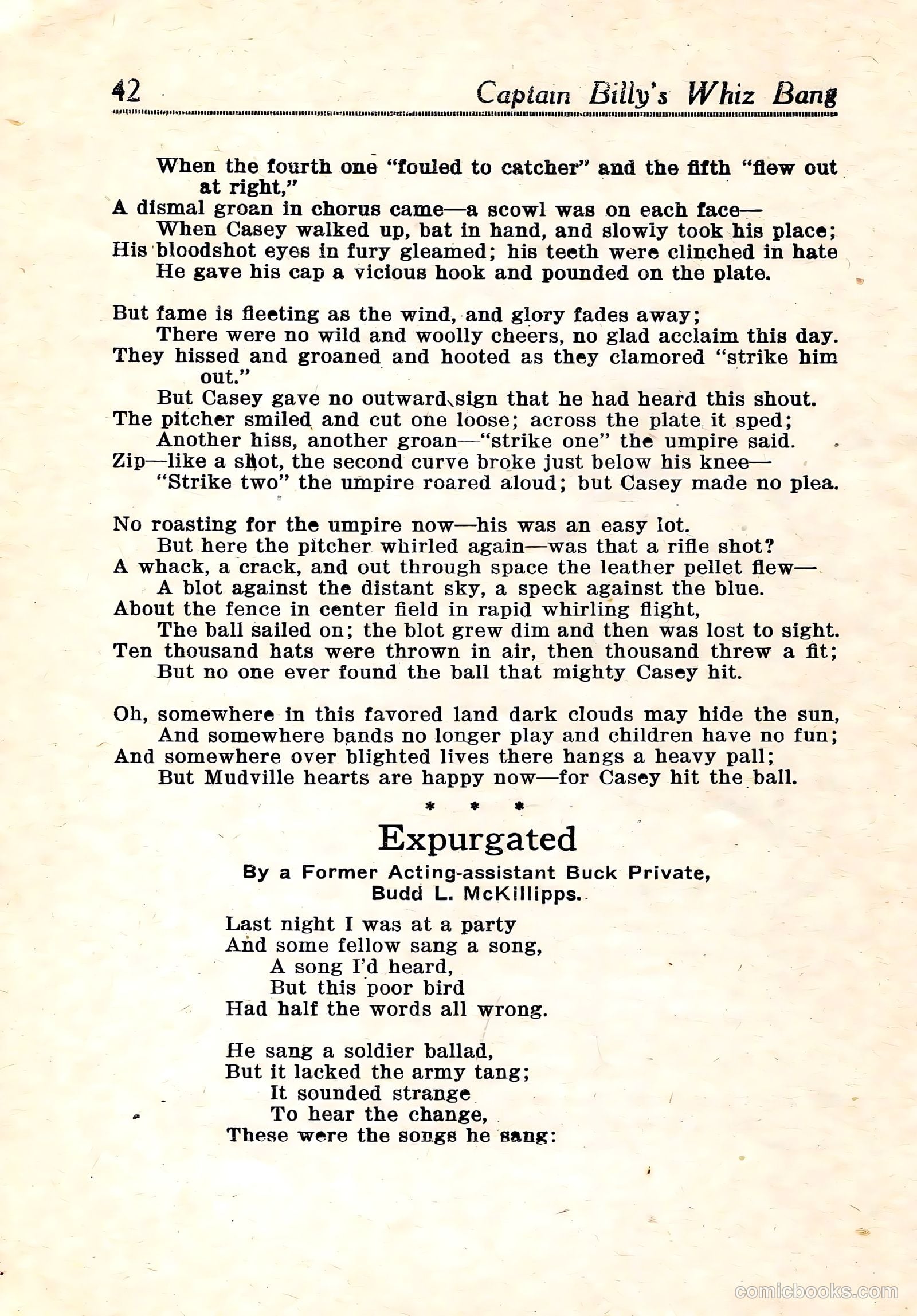
This page contains two poems, not cartoons. "Captain Billy's Whiz Bang" (top) is a baseball poem parodying Ernest Thayer's famous "Casey at the Bat" (1888). Instead of striking out, this Casey hits the ball so hard it flies out of sight entirely—a humorous inversion of the original's tragic ending. The poem celebrates this impossible feat while mocking the crowd's disappointed reaction. Below, "Expurgated" by "Buck Private" Budd L. McKillipps satirizes censorship of soldier songs during wartime. The poem describes a fellow singing a soldier ballad with words "all wrong"—likely referring to how military authorities sanitized or altered popular songs for morale purposes, removing profanity or antiwar sentiment.
This page contains a military song from World War I era, presented as satirical verse. The song mocks military life and non-commissioned officers ("a bunch of dirty sticks"), drill procedures, and the gap between promises of liberty and actual soldier experience. The humor targets the disconnect between recruitment propaganda ("land of liberty") and reality—soldiers stuck doing drills and hoping to "re-enlist when the weather gets cold" (sarcasm suggesting they won't). A final verse references homesickness, with soldiers longing for "mademoiselles in Gay Paree" while injured ("busted knee"), satirizing both romantic wartime fantasies and the costs of military service. The song reflects widespread soldier discontent during or after WWI, presented through Whiz Bang's characteristic irreverent military humor.
This page contains two separate literary pieces rather than cartoons. The first excerpt presents a melancholic song about military life, referencing **Brest** (likely a WWI military encampment). The speaker recalls homesick soldiers singing nostalgic ballads during "long days" and "stockades under arrest," suggesting the author criticizes how wartime authorities suppressed or modified soldiers' traditional songs to remove morale-damaging content. The second piece, "Tribute to the Painted Girl" by Grayce Moody, celebrates a woman who wears makeup—then considered morally questionable, especially for "proper" girls. The poem defends this "painted" woman as loyal, dependable, and kind despite social judgment, positioning her as superior to conventionally "respectable" girls. This reflects 1920s debates about changing female social roles and cosmetic use.
This is a humorous anecdote mocking Prohibition-era "near beer"—a low-alcohol substitute (0.5% ABV) that became legal during the alcohol ban. The joke centers on two naive young men, Algernon and Clarence, who treat this nearly non-alcoholic beverage as if it were genuine beer, describing exaggerated intoxication symptoms: singing urges, uncontrollable laughter, wild behavior. The satire targets both Prohibition's absurdity and the youth's gullibility. By describing modest near beer consumption as causing dramatic drunkenness, the author ridicules how people either actually deceived themselves about near beer's effects or pretended it worked to appear more worldly. The final image of the old dog biting suggests impending chaos—implying even animals respond negatively to such nonsense. The piece satirizes 1920s alcohol restrictions and youthful foolishness simultaneously.
This page contains racial stereotype humor typical of 1920s American magazines. "Liberty's Love Lights" presents a Black couple using exaggerated dialect ("dey has," "de mo' liberty") making a pun: the Statue of Liberty has small lights because "less light" means "more liberty"—a play on words that treats the couple as simplemtons delivering a joke. "Rasping Rastus' Roost" similarly uses caricatured dialect and the stereotypical character name "Rastus" (a common minstrel-era trope). The humor depends on portraying Black people as foolish—here, a man sleeping outside with the gate open, catching cold. The page reflects how mainstream American publications casually embedded racial caricature into humor. Modern readers should understand this reflects period attitudes, not historical accuracy about the people depicted. The satire targets no specific politics—it's simply racial mockery presented as entertainment.
This satirical column by Arthur Neale uses humor to address early 1920s social anxieties about morality and changing customs. The opening joke plays on "one-piece bathing suits"—a contentious fashion issue of the era. Women's swimwear was becoming less modest, causing moral outrage among conservatives. The Puerto Cabello section mocks prudish double-standards: a reverend's innocent reference to "natural beauties" is twisted into suggesting nude swimming, satirizing how moralists read impropriety into innocent statements. The "Art" poem jokes that someone's compliment about admiring "Art" (the author) was actually about a woman's diving grace—a backhanded insult suggesting physical display overshadows artistic merit. The final section references increasingly strict public bathing regulations (enforced modesty codes at places like Coney Island), suggesting even farm workers would be bewildered by complex dress codes. Overall, Neale satirizes America's conservative backlash against modern, more revealing fashions and mixed-gender recreation.
This page from the satirical magazine contains several short jokes and a mock prayer, with no visible political cartoons. The humor relies on wordplay and irreverent takes on conventional topics: a joke about swimwear (implying women wear less clothing in water), a reference to armless Venus de Milo, a vaudeville performer's self-deprecating quip, and a risqué Adam-and-Eve pun where "A dam" sounds like "a damn." The centerpiece is "Our Monthly Prayer"—a parody religious invocation using exaggerated African American dialect ("de," "'possum oil") and absurdist imagery (connecting one's soul to a "gospel telephone," "turpentine his imagination"). It mixes spiritual language with crude, mechanical metaphors, satirizing both evangelical fervor and sermonic grandiosity through irreverent juxtaposition rather than targeting specific figures or events.
This page contains no cartoon or illustration—it's a humorous written feature from an early 20th-century American satirical magazine. The magazine published a "model love letter" in April that apparently generated reader demand for another. The joke is the deliberately overwrought, absurdly flowery love letter addressed to "Miss Gumptious." It mocks overwrought romantic sentiment through exaggerated metaphors: a heart like a "churn dasher," joy like "young goats on a stable roof," and Spanish needles through trousers. The comparisons become increasingly ridiculous and crude as the letter progresses—comparing emotions to a gosling in mud, a bumblebee trapped under glass, and eyes "like cellar doors." The satire targets both purple-prose romance writing and young men attempting pretentious courtship, poking fun at earnest but inept romantic expression.
This page contains a satirical love letter—a parody of overwrought romantic prose common in sentimental literature of the early 20th century. The humor relies on grotesquely mixed metaphors and bathetic (deliberately undignified) comparisons. The narrator claims undying devotion but expresses it through absurd imagery: comparing his beloved's hair to a "sorrel horse powdered with gold," her forehead to "the elbow of an old coat," and her eyes containing "legions of little Cupids bathing, like a cohort of ants in an old Army cracker." The satire mocks both the clichéd conventions of romantic poetry and rural/working-class speech patterns. References to farm life (pigs, milking herds, chanticleer) mixed with classical allusions (Aurora, Parian marble, Cupids) create comic incongruity—elevating rural domesticity to mock-heroic status. *Captain Billy's Whiz Bang* (1919-1936) specialized in irreverent humor targeting sentimental American culture, making this a typical example of the magazine's satirical approach.
This page contains a humorous love letter parody, likely from *Captain Billy's Whiz Bang*, a post-WWI American satirical magazine known for irreverent humor and ribald jokes. The text mockingly exaggerates romantic sentiment through absurdly crude and rustic comparisons. Rather than conventional poetry, the writer compares his beloved's laugh to a "windharp's strain" and "stray lamb's bleat," her dimples to "hollows in cakes of home-made sugar." His love is compared to a "kitten's first catterwaul" and a "mean pup" wanting milk. The satire targets overly sentimental love letters and flowery Victorian courtship language by replacing refined metaphors with farmyard imagery—doughnuts fried in molasses, muscovy ducks, stage horses in pastures. The crude vernacular humor suggests the writer is an unsophisticated rural figure attempting (and failing) at romantic eloquence. This represents the magazine's populist, anti-pretentious comedic style.
This page contains several short humorous pieces from *Captain Billy's Whiz Bang*, a WWI-era satirical magazine: **"Give Her a Ring Under the Eye"** is a joke about gift-giving, where the punchline plays on "ring under the eye" (bruising from a punch) rather than jewelry. **The fashion quip** mocks women's hemlines of the era, suggesting skirts are so short that the only "cap" (hat/coverage) a girl will pursue is literally a man's kneecap. **"A Human Obsession"** describes a disabled WWI veteran—gassed and amputated—who obsessively searches for his lost leg, irrationally suspecting women possess it. He's repeatedly arrested on harassment complaints. The piece calls this troubling behavior a "pleasant mania," using dark humor about a genuine social problem: how communities treated disabled veterans post-war. The opening text appears to be a sentimental letter concluding an earlier piece. **Historical context**: This reflects post-WWI America's complicated relationship with disabled soldiers and early cynicism about their reintegration.
This page from a 1920s satirical magazine contains short humorous pieces targeting domestic life and marriage. **"Pasture Pot Pourri"** opens with a joke mocking wives' complaints about utility bills, playing on Tennyson's famous poem. **"Bedroom Farcical Maxims"** uses puns ("auto/ought to," "stall/stable") for mild marital humor. The central piece, **"Here We Are—In Again,"** darkly jokes about a policeman named Knife whose twins die in quick succession (one from cough, one from flu)—grim humor reflecting post-WWI and pandemic-era mortality. The closing quips mock women's weight and express misogynistic sentiment: marriage is compared to alcoholic withdrawal (DTs), and the final statement reduces women to one of life's pleasures, ranked below wine and song. The overall tone is cynical about marriage and women—typical of this era's "men's magazine" humor, which treated domestic friction and female stereotypes as comedy fodder.
This page from *Whiz Bang*, a satirical humor magazine, contains a series of short jokes and quips typical of 1920s American comedy. The humor relies on: **Crude physical comedy**: The opening verses mock women's appearances—Stella's disabilities presented as punchlines, framed with misogynistic "humor." **Prohibition-era jokes**: References to "hooch" (illegal alcohol) and the "kick in the drink" reflect 1920s Prohibition, when alcohol sales were banned. **Sexual innuendo**: The "Kiss Fighters" section and flirtation jokes use double entendre common to the era's "risqué" humor magazines. **Cynicism about relationships**: Lines like "happily ever after—next day" and the final quip about love being "two damnthings after each other" express jaded attitudes toward romance and marriage. The magazine's tone reflects post-WWI American cynicism and casualness about disability, gender, and morality—attitudes that modern readers would recognize as offensive.
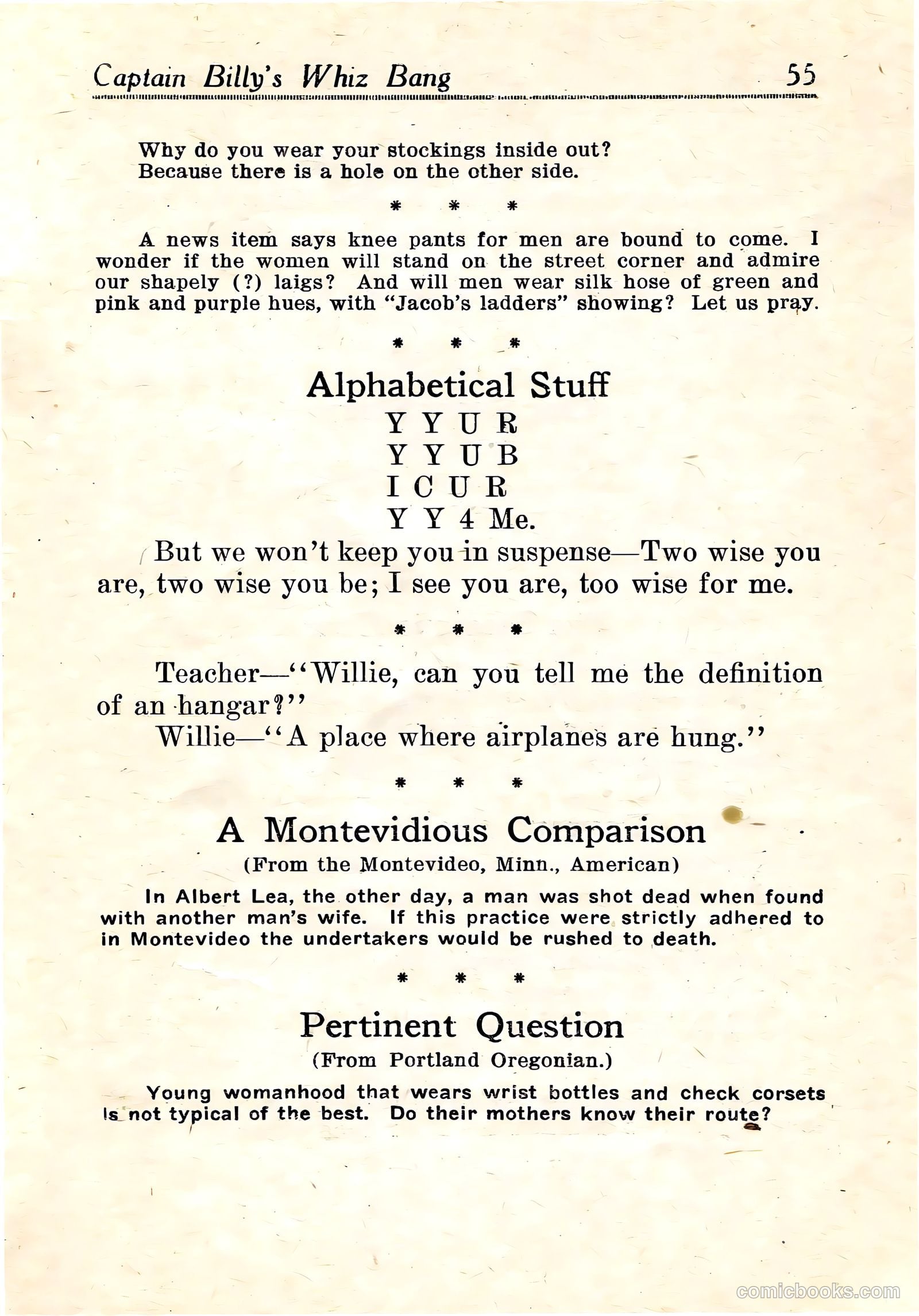
This page contains brief jokes and satirical items typical of 1920s American humor magazines. Key content: **Fashion satire**: The piece mocking "knee pants for men" references a fashion trend, sarcastically suggesting men might wear colorful silk stockings with visible runs ("Jacob's ladders"), mocking both the trend and male vanity. **Wordplay jokes**: "Alphabetical Stuff" consists of phonetic puns (Y Y U R = "Why are you?"), a common period humor format. **Teacher/student joke**: A classic setup where "Willie" deliberately misinterprets "hangar" as a place where airplanes are "hung" rather than housed. **Town comparison**: A dark joke contrasting small-town morality—suggesting Montevideo, Minnesota has more infidelity than neighboring Albert Lea (where such behavior supposedly had fatal consequences). **Social criticism**: The final item attacks young women wearing "wrist bottles" (likely flasks, referencing Prohibition-era drinking) and corsets, questioning parental oversight—reflecting period anxieties about changing female behavior and morality.
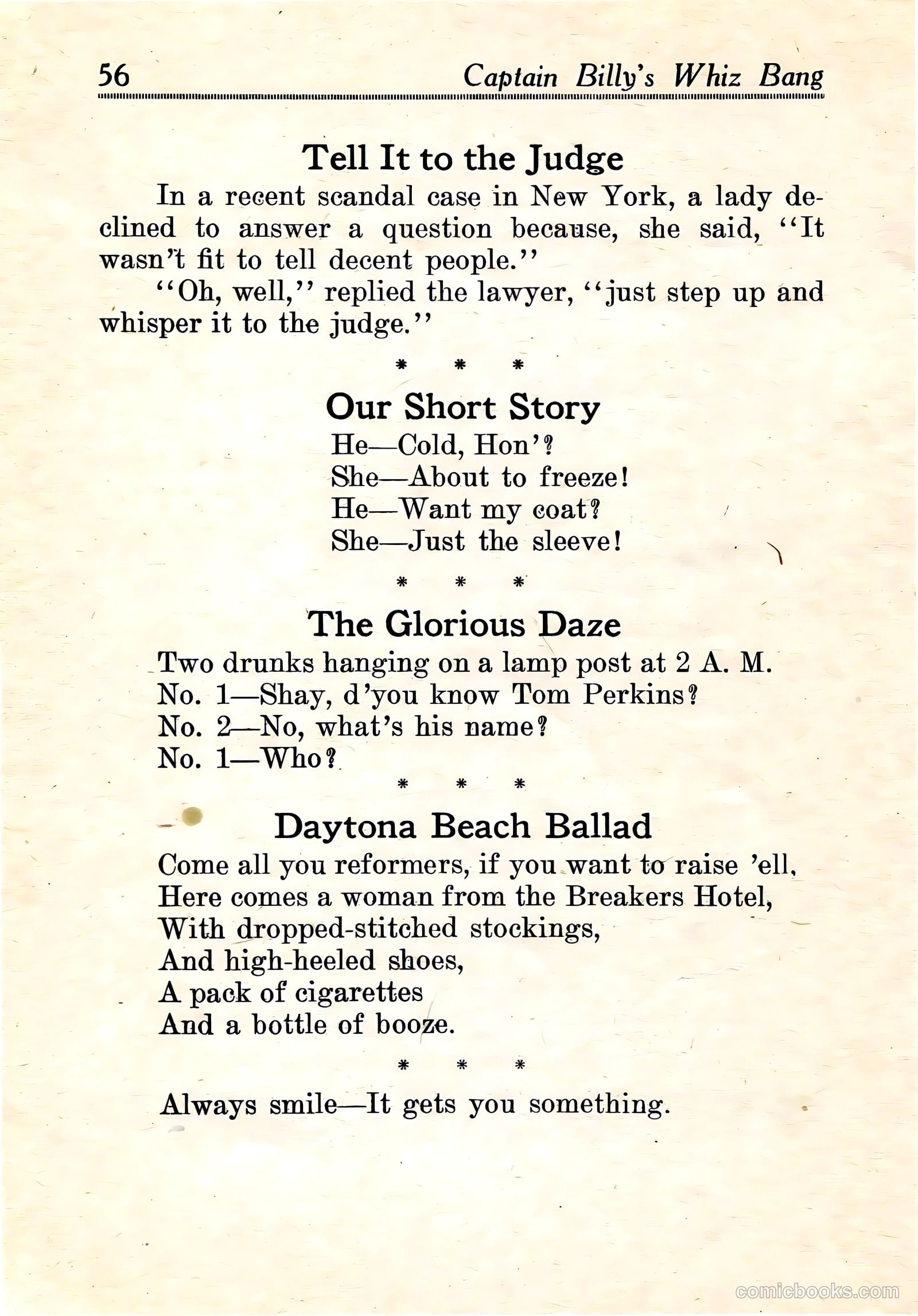
This page contains five brief humorous pieces typical of 1920s-era satirical magazines: **"Tell It to the Judge"** mocks courtroom decorum—a woman claims something is too indecent to tell "decent people," but the lawyer suggests she can whisper it to the judge, implying judges hear all manner of impropriety. **"Our Short Story"** is a flirtatious exchange playing on double meanings ("just the sleeve" suggesting physical intimacy). **"The Glorious Daze"** depicts two drunk men in circular, nonsensical conversation—a joke format about intoxication. **"Daytona Beach Ballad"** satirizes moral reformers by cataloging a woman's "scandalous" behavior (dropped stockings, high heels, cigarettes, alcohol)—likely mocking Prohibition-era pearl-clutching and the gap between Victorian morality and 1920s "modern" behavior. The final aphorism cynically suggests smiling is manipulative. The humor reflects post-WWI irreverence toward authority and traditional propriety.
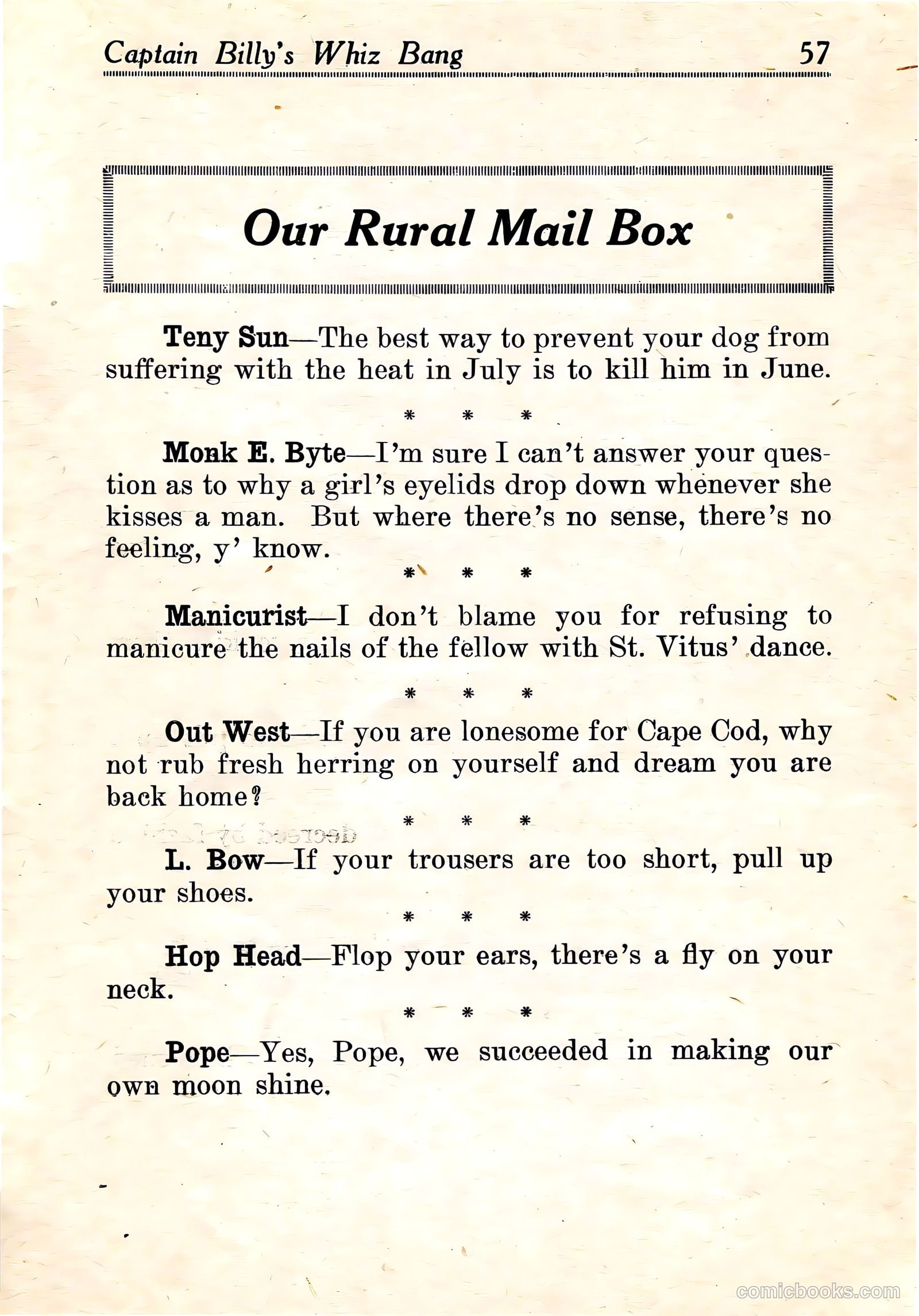
This is a humor column featuring brief comedic tips and responses to fictional reader submissions, identified by punny pseudonyms. The jokes rely on absurdist logic and wordplay typical of 1920s American satirical magazines. Examples include dark humor ("kill your dog in June to prevent July heat"), visual gags ("pull up your shoes" for short trousers), and drug references ("Hop Head" — slang for a narcotics user — given nonsensical advice). The "Pope" entry appears to reference "moonshine" (illegal alcohol from Prohibition era), a double meaning playing on literal moon-making versus bootleg whiskey production. These aren't political cartoons but rather a joke column lampooning rural American life, physical comedy, and contemporary slang. The "Rural Mail Box" framing suggests jokes submitted by country readers, playing into urban magazine readers' perception of rural folk as simple or eccentric.
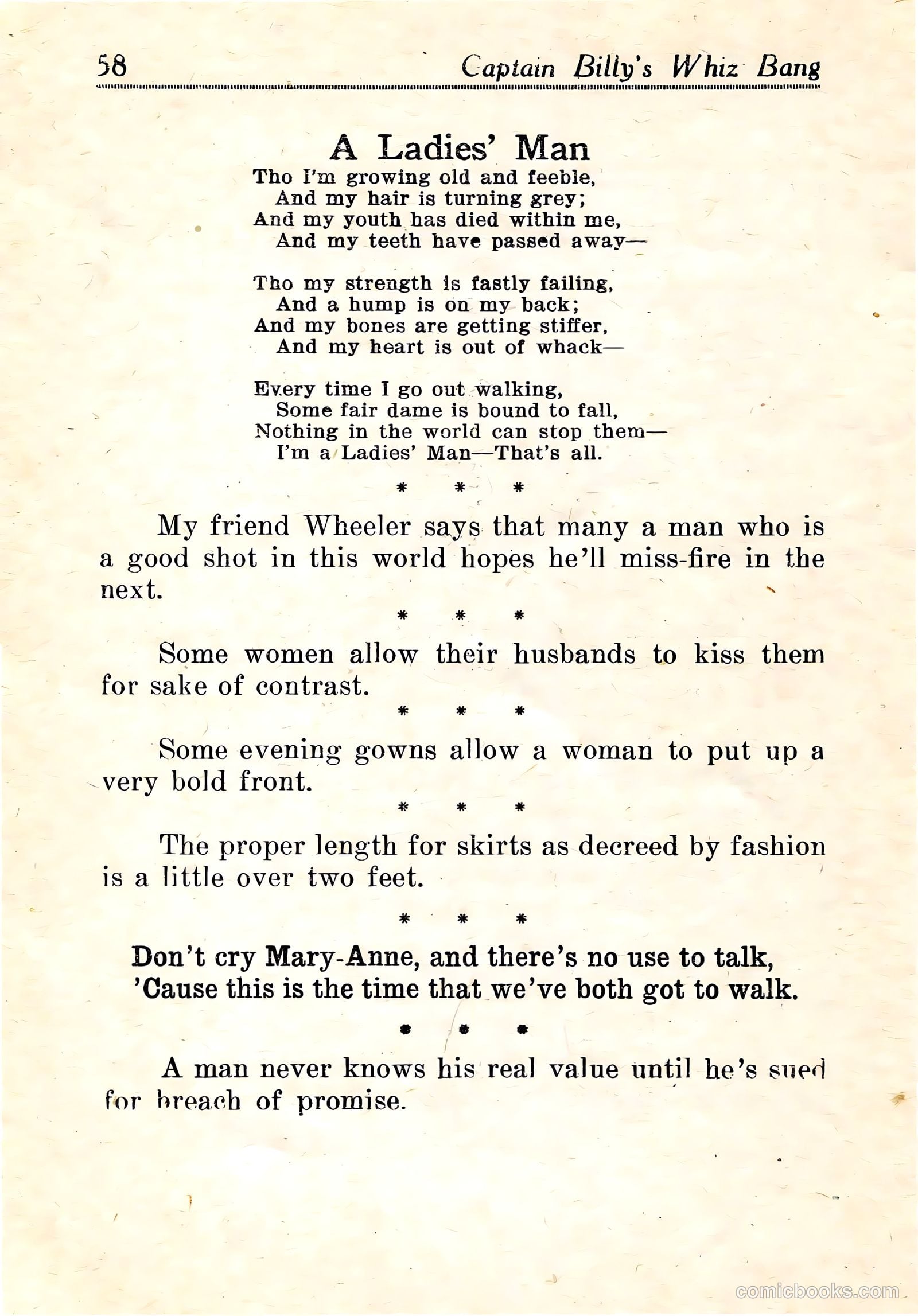
This page contains humorous poems and one-liners from a satirical magazine. The title poem ironically describes an elderly, decrepit man—grey, toothless, hunched, with failing strength—yet claims he's irresistible to women because they "fall" for him when walking. The joke relies on the contrast between his pathetic physical state and his boastful claim. The accompanying jokes target common social situations: men hoping to avoid the afterlife's consequences, women trading marital affection for novelty, revealing evening wear, short skirts (a contemporary fashion controversy), and breach-of-promise lawsuits (when men reneged on marriage proposals). These quips mock gender relations, fashion trends, and male behavior of the era with crude, straightforward humor typical of 1920s American satirical magazines.
This page contains a series of brief humorous quips typical of early 20th-century American satirical magazines. The jokes target conventional romantic and social expectations: The opening exchange mocks marriage by suggesting husbands are burdensome. "Timidity" uses the euphemism "osculates" (kisses formally) to joke about a reserved woman. Another piece satirizes insincere romance—a suitor's elaborate letter professing love "on pages" suggests theatrical affection rather than genuine feeling. "Think It Over" plays darkly on romantic disappointment: both parties have forgotten each other equally, so neither deserves blame. The final "Advice" section uses double entendre: "limb" (leg), "cash," and "horn" contain mildly risqué implications about showing off one's body, wealth, and making noise—essentially mocking vanity and ostentation in social behavior. The humor reflects Jazz Age irreverence toward traditional courtship and propriety.
This page from the satirical magazine contains three unrelated jokes typical of early 20th-century humor: 1. **"Why Did He Shaker?"** - A pun-based joke where a man pursued a woman after seeing various kitchen utensils with female-coded names (Spoon Holder, Potato Masher, etc.), but gave up upon seeing "The Cork Puller"—likely implying she was no longer a virgin, rendering her undesirable. 2. **"A Good Education"** - A Jewish stereotype joke featuring "Abie" (a common Yiddish name). The father deliberately lets his child fall to teach distrust—a dark humor take on parenting philosophy, playing on period antisemitic caricatures of Jewish people. 3. **"Write Your Own Heading"** - A double-entendre: a young woman requests rubber garters, but "rubber" carries sexual innuendo of the era. 4. **Final note** - A wordplay comparing "divorce suit" to "union suit" (long underwear), joking that divorce is the opposite of marriage. The humor relies on period stereotypes, sexual innuendo, and wordplay common to 1920s-era men's magazines.
This page from *Captain Billy's Whiz Bang*—a popular American humor magazine of the 1920s—contains no political cartoons, only satirical humor pieces targeting contemporary social attitudes. The content mocks modern courtship customs and female fashion. "Little Willie's definition" offers innocent, crude humor about kissing. The poem "He Kissed Me" plays on the contradiction between romantic desire and social propriety—the speaker welcomes kisses despite physical retaliation. The "Monthly Motto" section ridicules 1920s women's fashion trends, specifically the increasingly shorter hemlines and "almost undressed" appearance that scandalized conservative society. References to "Miss Failure" versus "Miss Success" and the aspiration for "diamonds" mock materialistic social climbing among women. The final aphorism offers generic inspirational advice unrelated to the preceding content.
This page from *Captain Billy's Whiz Bang* contains several short humorous items typical of 1920s satirical magazines: **"It Feels So Good"** is a joke-within-a-joke: an asylum patient hits himself with a mallet for relief; the punchline deflects to Prohibition-era slang ("blind pig" = illegal speakeasy), suggesting the real pain being self-medicated is social/legal trouble. **"Perfume Leads to Divorce"** sarcastically references a newspaper headline, implying readers will recognize the scandal. **Missouri/Elgin exchange** appears to be a regional rivalry joke (unclear without more context). **"R hounds"** is Prohibition satire: crossing a "rum hound" (drinker) with a "Volstead water spaniel" (named after Prohibition's sponsor) produces dogs that sniff out "prescription-peddling physicians"—mocking how doctors legally distributed alcohol as medicine during Prohibition. **Final joke** plays on financial hardship: someone refuses to gamble, claiming 100 reasons, but admits the real one is poverty—the rest are excuses he'll keep hidden. The page satirizes Prohibition, poverty, and social hypocrisy.
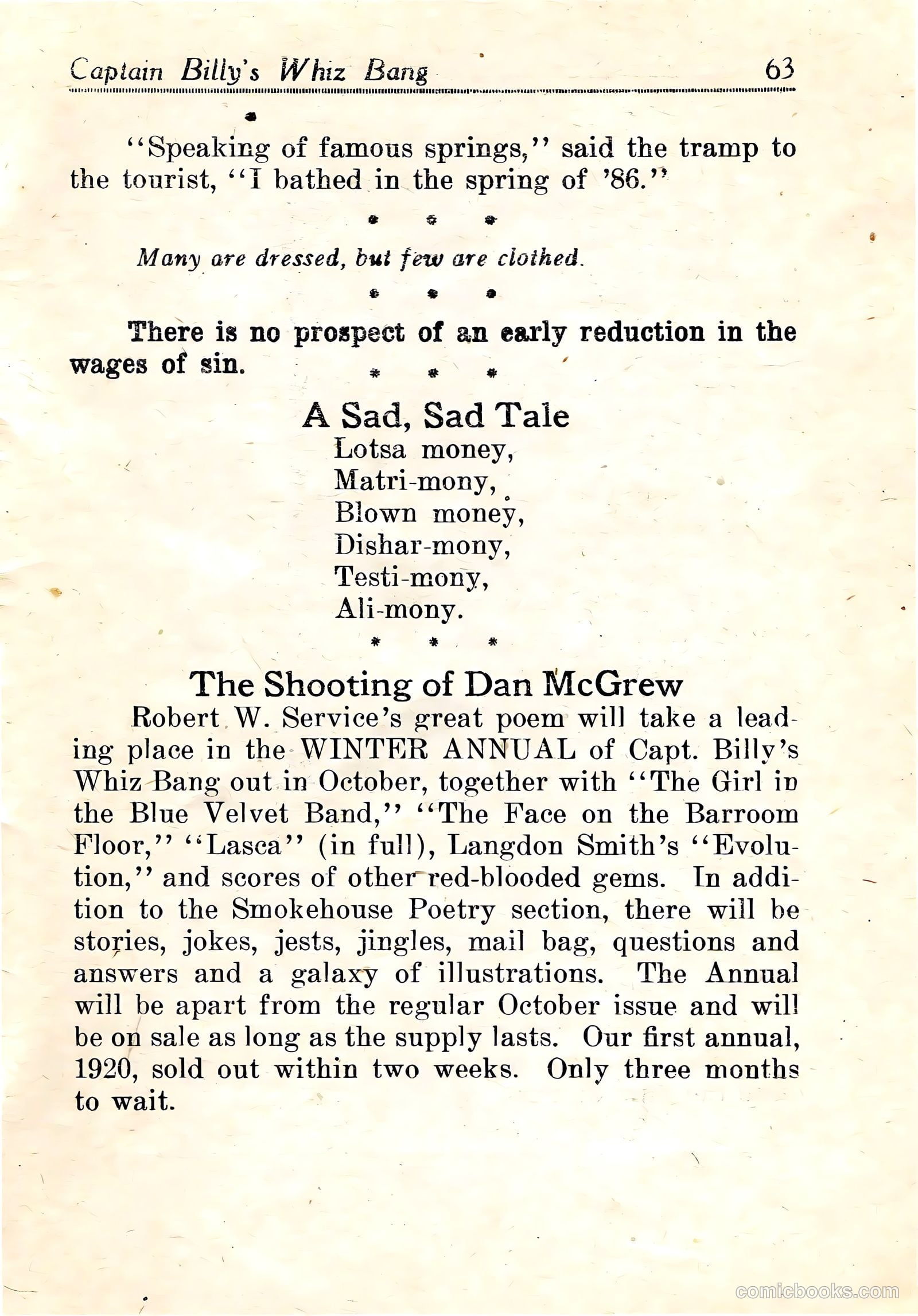
This page from the satirical magazine **Captain Billy's Whiz Bang** contains several brief jokes and an advertisement for the publication's upcoming Winter Annual. The humor targets recognizable social targets: - A tramp's boast about bathing in "the spring of '86" is likely a play on famous mineral springs (popular tourist destinations) versus the vagabond's poverty. - "Many are dressed, but few are clothed" contrasts appearance with substance—a common critique of hypocrisy. - "No prospect of an early reduction in the wages of sin" sardonically suggests vice remains profitable. - "A Sad, Sad Tale" is a pun-list: money leads to marriage ("matri-mony"), then financial ruin ("blown"), discord ("dishar-mony"), and legal testimony ("testi-mony") and alimony payments—a cynical take on matrimony's consequences. The remainder promotes the Winter Annual featuring classic poems like Robert W. Service's "The Shooting of Dan McGrew," positioning the magazine as a source of entertainment and "red-blooded" masculine content.
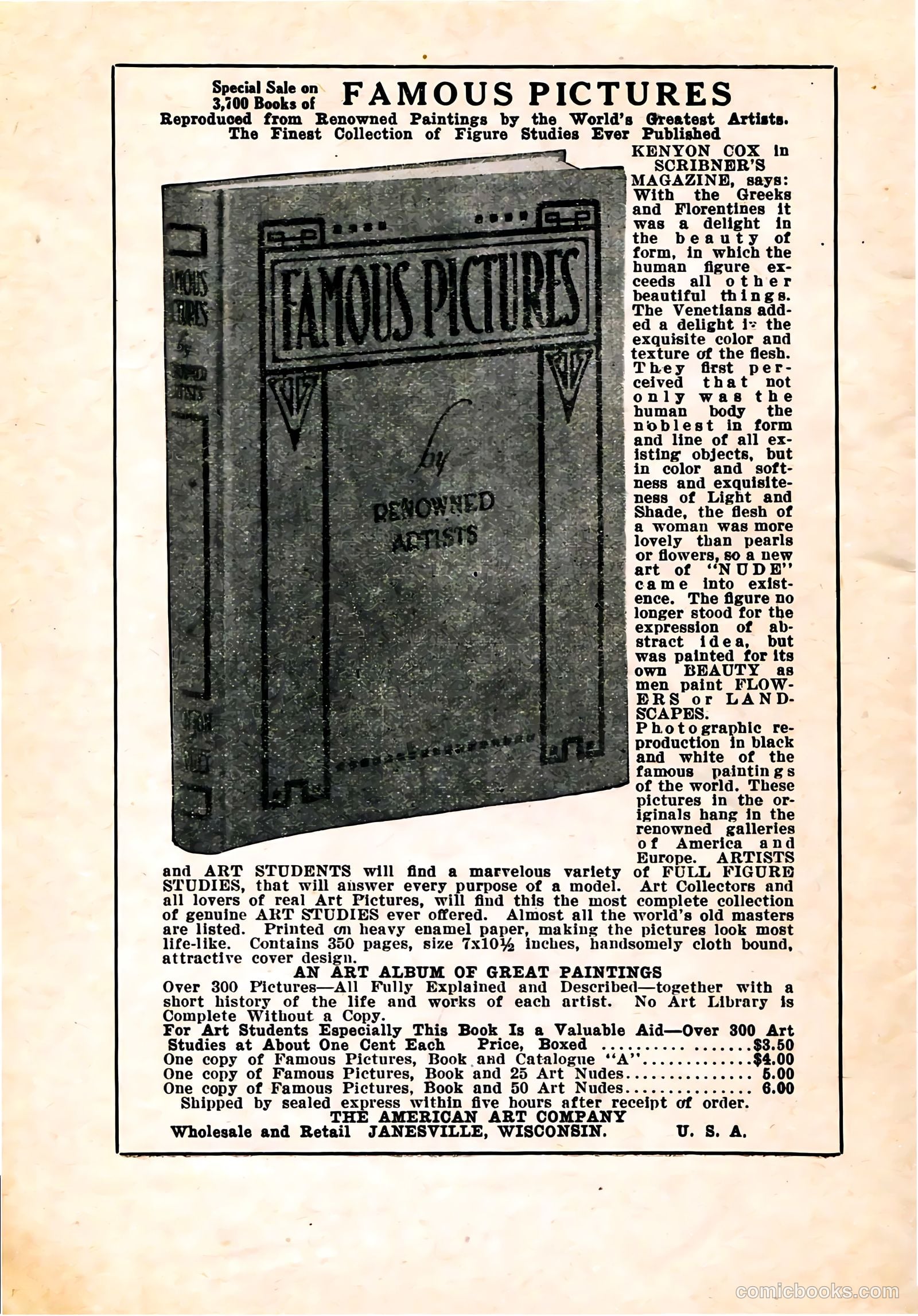
This page is **primarily an advertisement**, not a political cartoon or satirical content. It promotes a mail-order book called "Famous Pictures by Renowned Artists" — a collection of 300+ reproductions of classical paintings, marketed to art students and collectors. The ad includes a quote from Kenyon Cox in "Scribner's Magazine" praising how Renaissance and Venetian art elevated the human figure as a subject. The book promises reproductions of famous paintings printed on enamel paper, sized 7x10½ inches, cloth-bound. Pricing ranges from $3.50 to $6.00 depending on bundle options. The publisher, **The American Art Company** of Janesville, Wisconsin, offers fast shipping. There is **no political satire or cartoon content** visible—this is straightforward period commercial advertising targeting art enthusiasts and students.
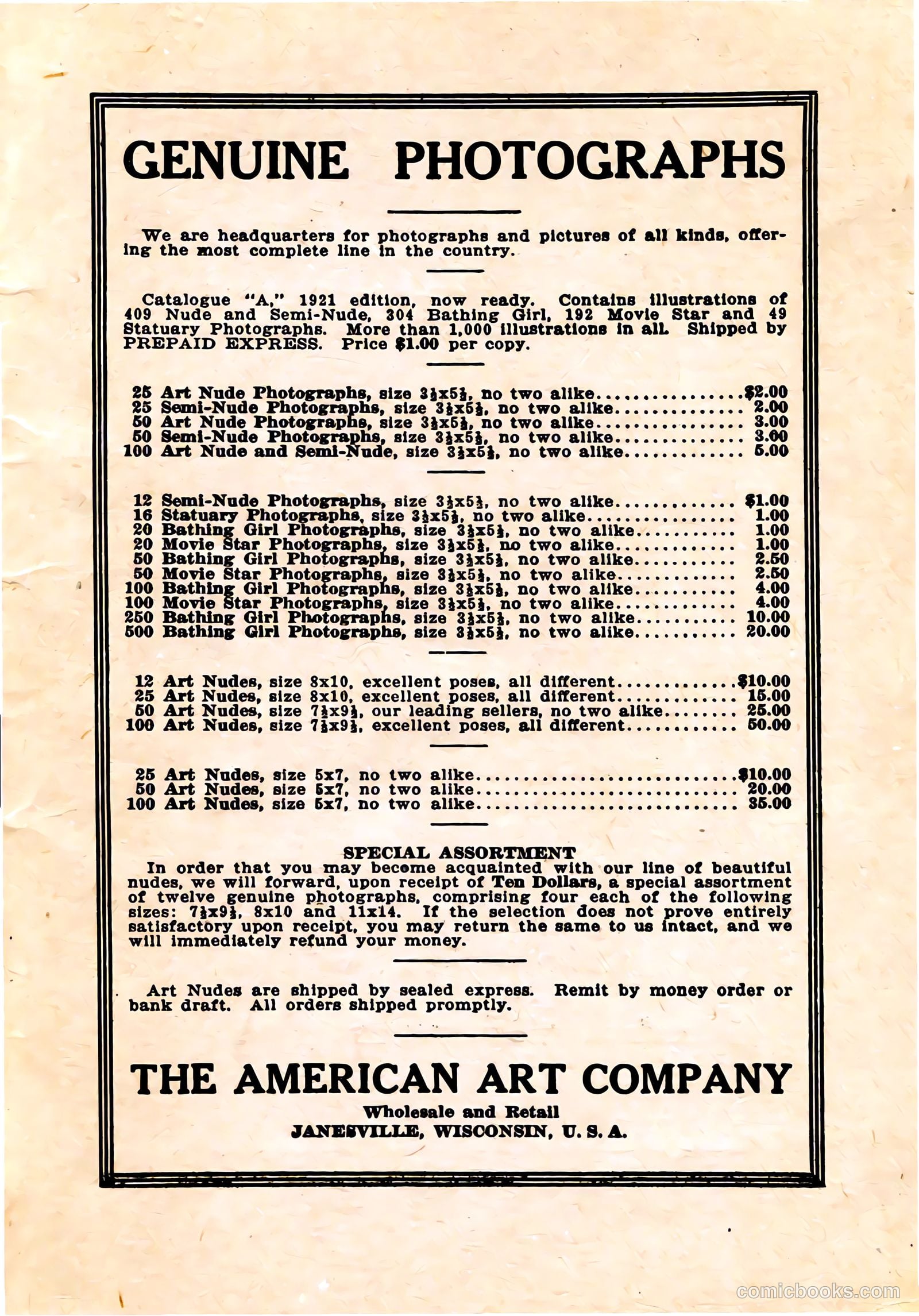
This page is **not a cartoon or satirical content** — it's a straightforward advertisement for "The American Art Company" of Janesville, Wisconsin, circa 1921. The ad promotes mail-order photographs, emphasizing "Art Nudes" and "Semi-Nude" photographs in various sizes and quantities, with prices ranging from $1.00 to $50.00. It also advertises a catalog and offers a "special assortment" trial package for ten dollars. The language ("genuine photographs," "sealed express," "no two alike") suggests this was a common mail-order business of the era. There is **no political satire, caricature, or social commentary** present — just period-appropriate advertising for what appears to be artistic photography.
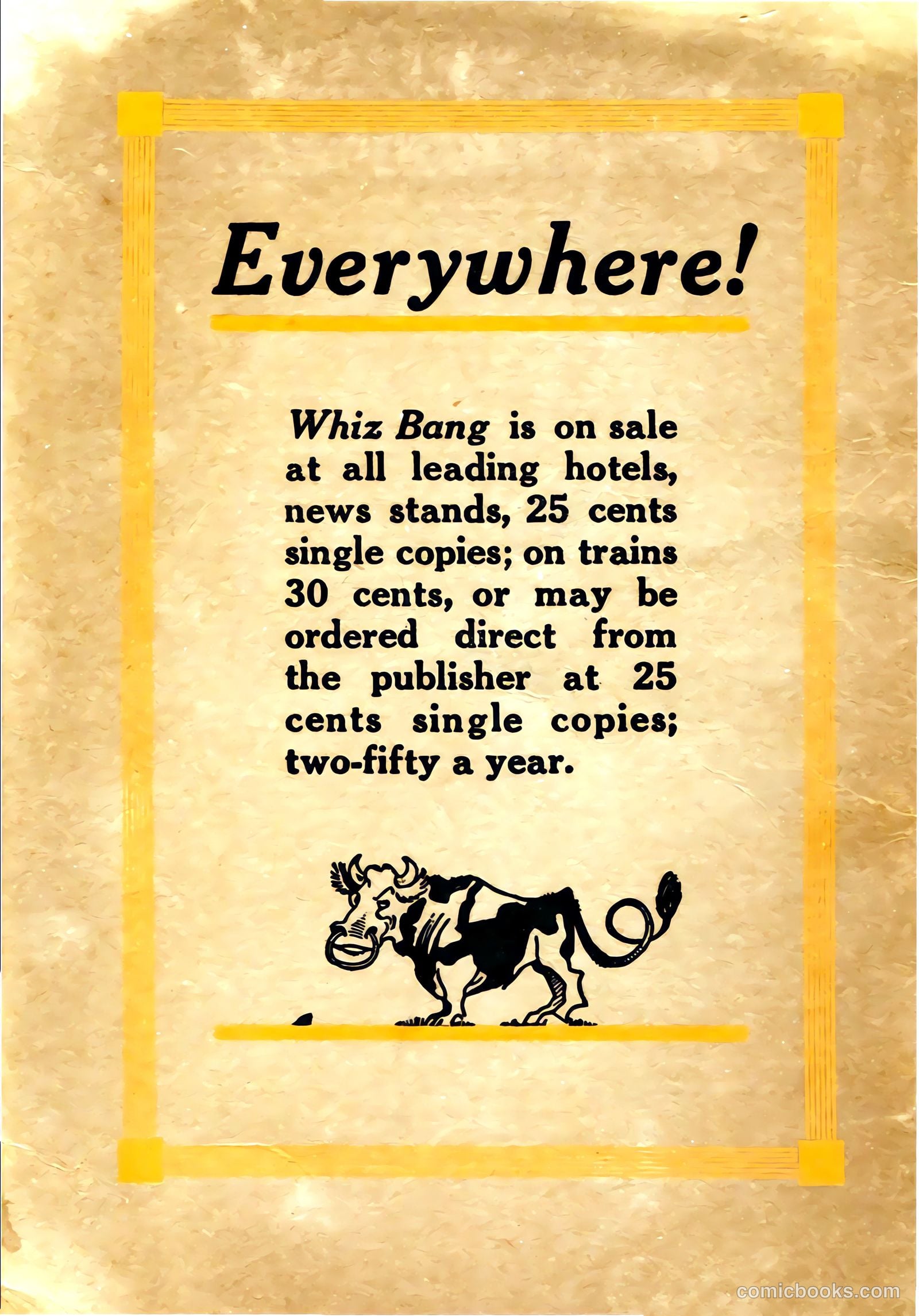
This is a **title/advertisement page** for *Whiz Bang*, a satirical magazine. The page itself contains no cartoon or political content—it's purely promotional material. The only visual element is a **cartoon cow** as the publication's mascot/logo, positioned at the bottom. The text announces distribution information: single copies cost 25 cents at newsstands and hotels, 30 cents on trains, or could be ordered directly from the publisher at 25 cents per copy, with annual subscriptions at $2.50. This appears typical of early-to-mid 20th-century magazine advertisements, emphasizing the publication's widespread availability and affordability. The cow mascot likely served as *Whiz Bang's* recognizable brand symbol throughout the magazine.