
Captain Billy's Whiz Bang, July 1921 · page 7 of 68
Captain Billy's Whiz Bang #22 — page 7: what you’re looking at
What you’re looking at
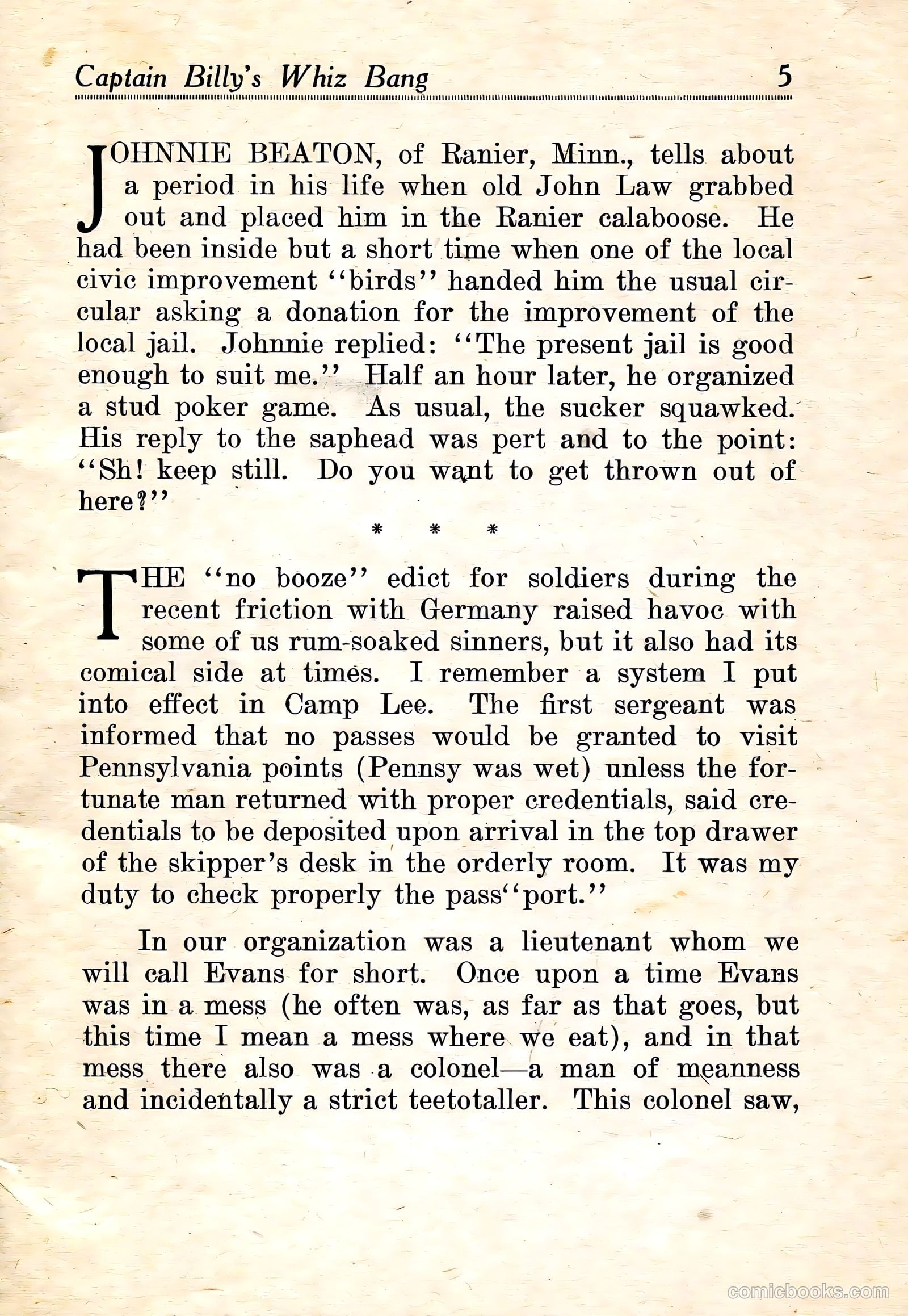
This page contains two humorous anecdotes from "Captain Billy's Whiz Bang," a post-WWI satirical magazine. The first story mocks a jailed man (Johnnie Beaton) who refuses to donate to jail improvements, then immediately organizes an illegal poker game inside—suggesting the jail is fine enough for gambling but not worth improving. The second, longer anecdote concerns Prohibition-era military regulations. During WWI, soldiers were banned from alcohol. The narrator describes a system at Camp Lee where soldiers visiting Pennsylvania (where alcohol remained legal) had to return with "credentials" (bottles) deposited in the captain's desk—a clever bureaucratic workaround to smuggle liquor past military rules. The story sets up a scenario involving a strict teetotaler colonel and a repeatedly troublesome Lieutenant Evans, apparently leading to a humorous confrontation about hidden alcohol. Both stories satirize authority figures and rule-breaking through clever wit.
📄 Transcribed text from this page (OCR, searchable)
Machine-transcribed from the original scan — historical spelling and the odd misread are preserved.
Captain Billy's Whiz Bang 5 JOHNNIE BEATON, of Ranier, Minn., tells about a period in his life when old John Law grabbed out and placed him in the Ranier calaboose. He had been inside but a short time when one of the local civic improvement “birds” handed him the usual cir- cular asking a donation for the improvement of the local jail. Johnnie replied: “The present jail is good enough to suit me.” Half an hour later, he organized a stud poker game. As usual, the sucker squawked. His reply to the saphead was pert and to the point: “Sh! keep still. Do you want to get thrown out of here?” * * * THE “no booze” edict for soldiers during the recent friction with Germany raised havoc with some of us rum-soaked sinners, but it also had its comical side at times. I remember a system I put into effect in Camp Lee. The first sergeant was informed that no passes would be granted to visit Pennsylvania points (Pennsy was wet) unless the for- tunate man returned with proper credentials, said cre- dentials to be deposited upon arrival in the top drawer of the skipper’s desk in the orderly room. It was my duty to check properly the pass“port.” In our organization was a lieutenant whom we will call Evans for short. Once upon a time Evans was in a mess (he often was, as far as that goes, but this time I mean a mess where we eat), and in that mess there also was a colonel—a man of meanness and incidentally a strict teetotaller. This colonel saw,