
Captain Billy's Whiz Bang, July 1921 · page 35 of 68
Captain Billy's Whiz Bang #22 — page 35: what you’re looking at
What you’re looking at
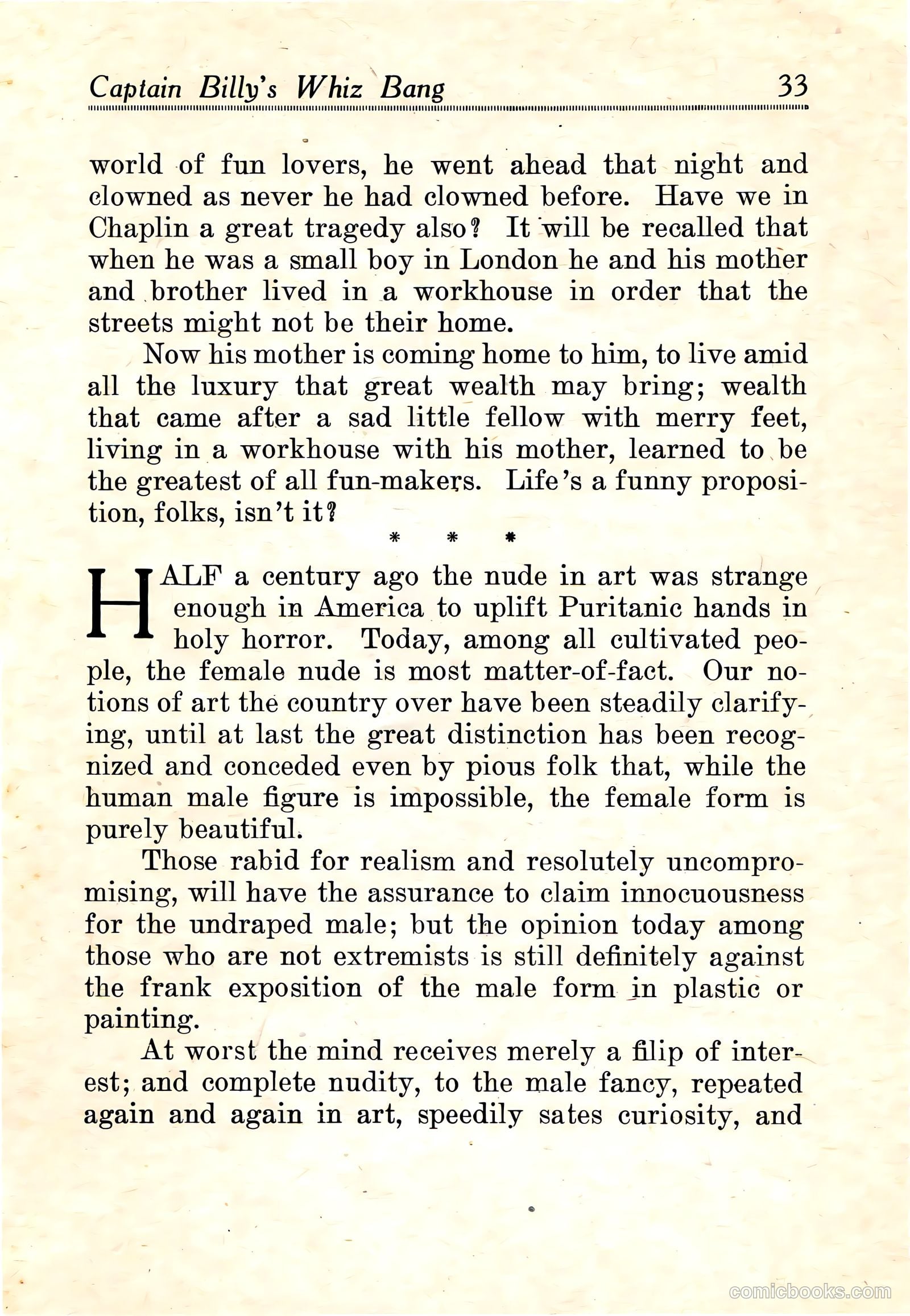
This page contains two distinct pieces of commentary: **First section:** A sentimental reflection on Charlie Chaplin's life trajectory—from poverty (living in a London workhouse as a boy) to wealth and success as a comedian. The writer treats this as proof that "life's a funny proposition," emphasizing the ironic contrast between his humble origins and current luxury. **Second section:** A discourse on changing American attitudes toward artistic nudity. The author argues that depictions of the female nude have become culturally acceptable among "cultivated people," while male nudity in art remains controversial even among non-extremists. The piece suggests female nudity titillates without offending, whereas repeated male nudity merely "sates curiosity." The page reflects early 20th-century attitudes about gender, art, and propriety—notably the gendered double standard regarding depictions of the body in fine art.
📄 Transcribed text from this page (OCR, searchable)
Machine-transcribed from the original scan — historical spelling and the odd misread are preserved.
Captain Billy's Whiz Bang 33 world of fun lovers, he went ahead that night and clowned as never he had clowned before. Have we in Chaplin a great tragedy also? It will be recalled that when he was a small boy in London he and his mother and brother lived in a workhouse in order that the streets might not be their home. Now his mother is coming home to him, to live amid all the luxury that great wealth may bring; wealth that came after a sad little fellow with merry feet, living in a workhouse with his mother, learned to be the greatest of all fun-makers. Life's a funny proposi- tion, folks, isn't it? * * * HALF a century ago the nude in art was strange enough in America to uplift Puritanic hands in holy horror. Today, among all cultivated peo- ple, the female nude is most matter-of-fact. Our no- tions of art the country over have been steadily clarify- ing, until at last the great distinction has been recog- nized and conceded even by pious folk that, while the human male figure is impossible, the female form is purely beautiful. Those rabid for realism and resolutely uncompro- mising, will have the assurance to claim innocuousness for the undraped male; but the opinion today among those who are not extremists is still definitely against the frank exposition of the male form in plastic or painting. At worst the mind receives merely a filip of inter- est; and complete nudity, to the male fancy, repeated again and again in art, speedily sates curiosity, and