
Captain Billy's Whiz Bang, July 1921 · page 43 of 68
Captain Billy's Whiz Bang #22 — page 43: what you’re looking at
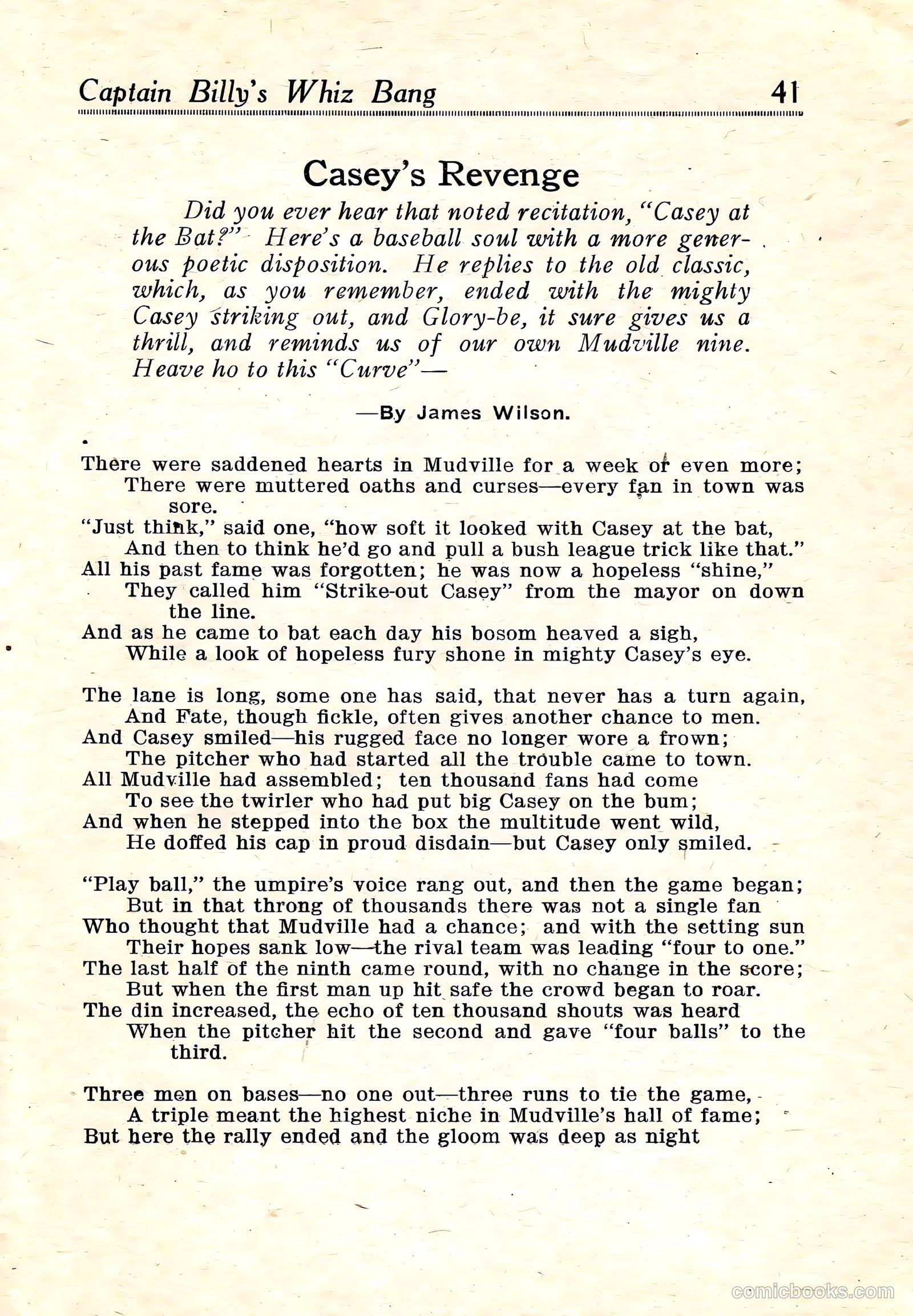
What you’re looking at
This is a poetic sequel to the famous 1888 poem "Casey at the Bat," which ended with Casey striking out and losing the game. This follow-up story, by James Wilson, imagines Casey's redemption. After his famous failure, Casey becomes a social outcast in his hometown of Mudville—called "Strike-out Casey" and mocked as a "hopeless 'shine'" (period slang for a disgraced person). When the opposing pitcher who defeated him returns to town, Casey gets another chance. In the climactic ninth inning with the bases loaded, the narrative breaks off mid-sentence, apparently leaving Casey's fate uncertain—a deliberate mirror of the original poem's tragic ending. The piece plays on themes of shame, redemption, and second chances, using baseball as an American morality tale. No political satire is evident; this appears to be purely entertainment content.
📄 Transcribed text from this page (OCR, searchable)
Machine-transcribed from the original scan — historical spelling and the odd misread are preserved.
Captain Billy's Whiz Bang 41 Casey's Revenge Did you ever hear that noted recitation, “Casey at the Bat?” Here’s a baseball soul with a more gener-ous poetic disposition. He replies to the old classic, which, as you remember, ended with the mighty Casey striking out, and Glory-be, it sure gives us a thrill, and reminds us of our own Mudville nine. Heave ho to this “Curve”— —By James Wilson. There were saddened hearts in Mudville for a week or even more; There were muttered oaths and curses—every fan in town was sore. “Just think,” said one, “how soft it looked with Casey at the bat, And then to think he’d go and pull a bush league trick like that.” All his past fame was forgotten; he was now a hopeless “shine,” They called him “Strike-out Casey” from the mayor on down the line. And as he came to bat each day his bosom heaved a sigh, While a look of hopeless fury shone in mighty Casey’s eye. The lane is long, some one has said, that never has a turn again, And Fate, though fickle, often gives another chance to men. And Casey smiled—his rugged face no longer wore a frown; The pitcher who had started all the trouble came to town. All Mudville had assembled; ten thousand fans had come To see the twirler who had put big Casey on the bum. And when he stepped into the box the multitude went wild, He doffed his cap in proud disdain—but Casey only smiled. “Play ball,” the umpire’s voice rang out, and then the game began; But in that throng of thousands there was not a single fan Who thought that Mudville had a chance; and with the setting sun Their hopes sank low—the rival team was leading “four to one.” The last half of the ninth came round, with no change in the score; But when the first man up hit safe the crowd began to roar. The din increased, the echo of ten thousand shouts was heard When the pitcher hit the second and gave “four balls” to the third. Three men on bases—no one out—three runs to tie the game, A triple meant the highest niche in Mudville’s hall of fame; But here the rally ended and the gloom was deep as night