
Captain Billy's Whiz Bang, July 1921 · page 26 of 68
Captain Billy's Whiz Bang #22 — page 26: what you’re looking at
What you’re looking at
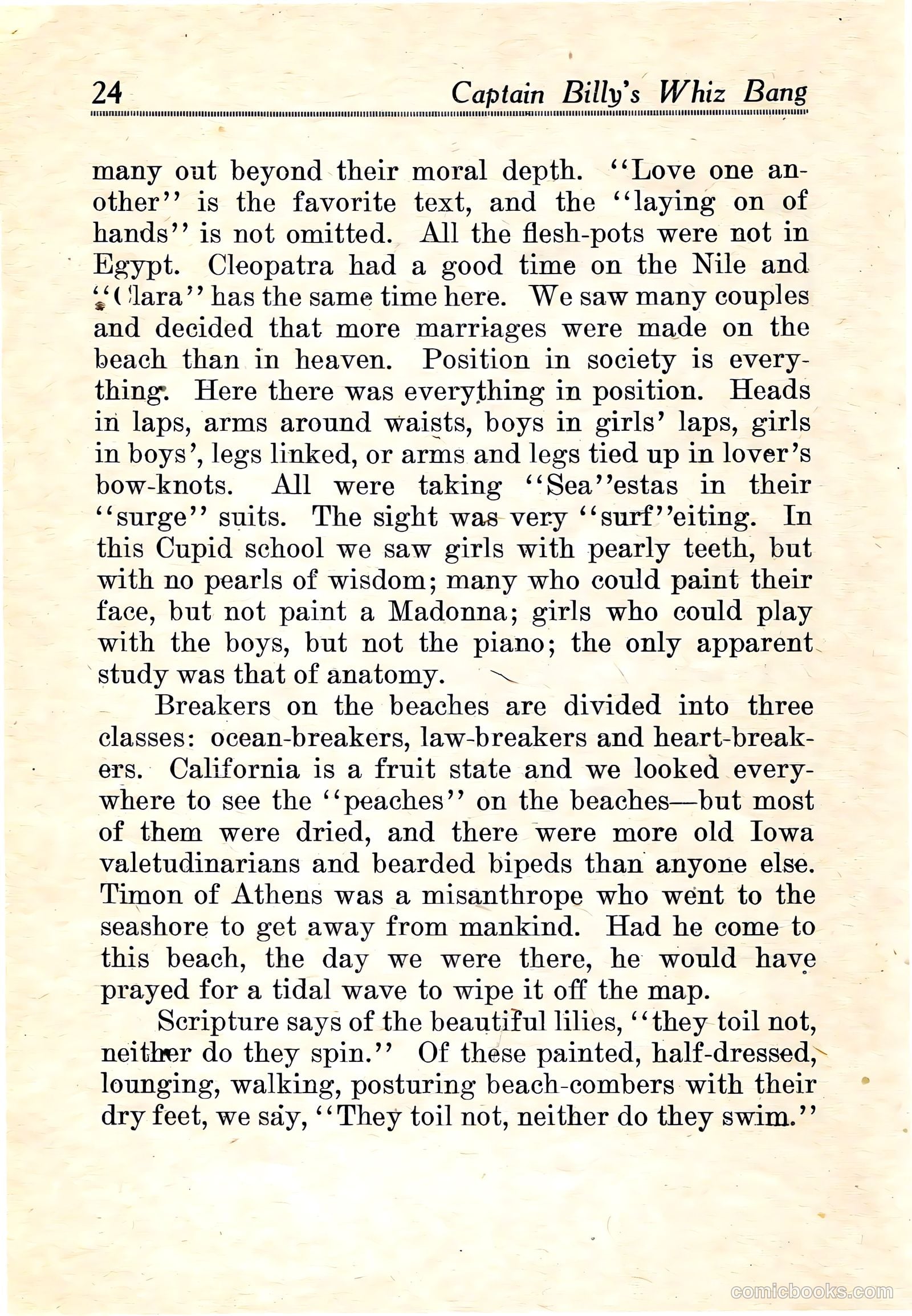
This is a satirical commentary on 1920s beach culture and modern youth morality. The author mocks young couples engaged in public displays of affection—described through wordplay like "Sea"estas (siestas) and "surge" suits (bathing suits). The satire targets: - **Loose morality**: References to "flesh-pots" and excessive physical contact, suggesting young people behave immorally at beaches - **Shallow femininity**: Girls with "pearly teeth, but no pearls of wisdom" who can paint faces but not create art, play with boys but not piano—criticism of superficiality - **Laziness and idleness**: The final biblical parody compares beach loungers to lilies that "toil not"—they don't work or swim, just pose The reference to "Timon of Athens" (a misanthrope) suggests the author shares that character's disgust with humanity. This reflects conservative anxieties about Jazz Age social changes, particularly women's liberated behavior and rejection of Victorian propriety.
📄 Transcribed text from this page (OCR, searchable)
Machine-transcribed from the original scan — historical spelling and the odd misread are preserved.
24 Captain Billy's Whiz Bang many out beyond their moral depth. “Love one an- other” is the favorite text, and the “laying on of hands” is not omitted. All the flesh-pots were not in Egypt. Cleopatra had a good time on the Nile and “Clara” has the same time here. We saw many couples and decided that more marriages were made on the beach than in heaven. Position in society is every- thing. Here there was everything in position. Heads in laps, arms around waists, boys in girls’ laps, girls in boys’, legs linked, or arms and legs tied up in lover’s bow-knots. All were taking “Sea”estas in their “surge” suits. The sight was very “surf”eiting. In this Cupid school we saw girls with pearly teeth, but with no pearls of wisdom; many who could paint their face, but not paint a Madonna; girls who could play with the boys, but not the piano; the only apparent study was that of anatomy. Breakers on the beaches are divided into three classes: ocean-breakers, law-breakers and heart-break- ers. California is a fruit state and we looked every- where to see the “peaches” on the beaches—but most of them were dried, and there were more old Iowa valetudinarians and bearded bipeds than anyone else. Timon of Athens was a misanthrope who went to the seashore to get away from mankind. Had he come to this beach, the day we were there, he would have prayed for a tidal wave to wipe it off the map. Scripture says of the beautiful lilies, “they toil not, neither do they spin.” Of these painted, half-dressed, lounging, posturing beach-combers with their dry feet, we say, “They toil not, neither do they swim.”